A battery cable that drops voltage under load or corrodes at the terminals turns a straightforward electrical upgrade into a recurring headache. Whether you are wiring a solar array, upgrading a car audio system, or replacing worn battery leads on a truck, the conductor material, strand count, and insulation jacket determine how well that current flows for years. A poorly chosen cable introduces resistance, heat buildup, and premature failure that no amount of crimping can fix.
I’m Amir — the founder and writer behind Four Wheel Ask. I have spent years digging into cable construction data, comparing OFC versus CCA conductivity charts, and mapping real-world owner feedback to separate marketing claims from measurable performance.
After researching dozens of cables, analyzing conductivity specs, and evaluating owner feedback, this guide presents the best 6 gauge battery cable for any application.
How To Choose The Best 6 Gauge Battery Cable
Selecting the right battery cable comes down to three foundational elements: conductor purity, insulation durability, and strand configuration. Most budget cables cut corners by using copper-clad aluminum or thin PVC jackets that crack under heat. Understanding these specs separates a connection you set and forget from one that fails mid-trip.
Conductor Material: OFC vs. CCA
Oxygen-free copper (OFC) delivers full conductivity with minimal resistance. Copper-clad aluminum (CCA) uses an aluminum core plated with copper — it weighs less but carries roughly sixty percent of the current capacity of pure copper for the same gauge. For high-amperage draws like inverters, winches, or starter motors, OFC is the only reliable choice.
Strand Count and Flexibility
A higher strand count makes the cable more pliable and easier to route in tight engine bays or through conduit. Cables with 260 strands or more per conductor are considered ultra-flexible. Low strand counts produce a stiff wire that resists bending and can fatigue at connection points over time.
Insulation Jacket and Temperature Range
EPDM rubber insulation resists heat, oil, solvents, and abrasion far better than standard PVC. A cable rated for at least 105 degrees Celsius is mandatory for any under-hood or marine environment. PVC jackets are acceptable in dry, temperature-controlled installations but degrade quickly when exposed to engine heat or battery acid.
Quick Comparison
On smaller screens, swipe sideways to see the full table.
| Model | Category | Best For | Key Spec | Amazon |
|---|---|---|---|---|
| iGreely 6 AWG Wire Kit | Complete Kit | Best Overall | 10 ft + 10 ft, 423 strands, includes lugs & heat shrink | Amazon |
| TEMCo 6 Gauge Cable | Bulk Spool | Premium | 50 ft + 50 ft, 260 strands, EPDM jacket, 115 amps | Amazon |
| Kimbluth 6 Gauge Cable | Pure Copper | Value | 10 ft + 10 ft, 99% OFC, PVC jacket, 600V | Amazon |
| Shirbly 6 Gauge Wire | Flexible Cable | Performance | 5 ft + 5 ft, 423 strands, EPDM jacket, 600V | Amazon |
| TUELETFU Battery Cables | Pre-Terminated | Design | 3 ft pair, tinned copper lugs, UL rated | Amazon |
In‑Depth Reviews
1. iGreely 6 AWG Wire Kit
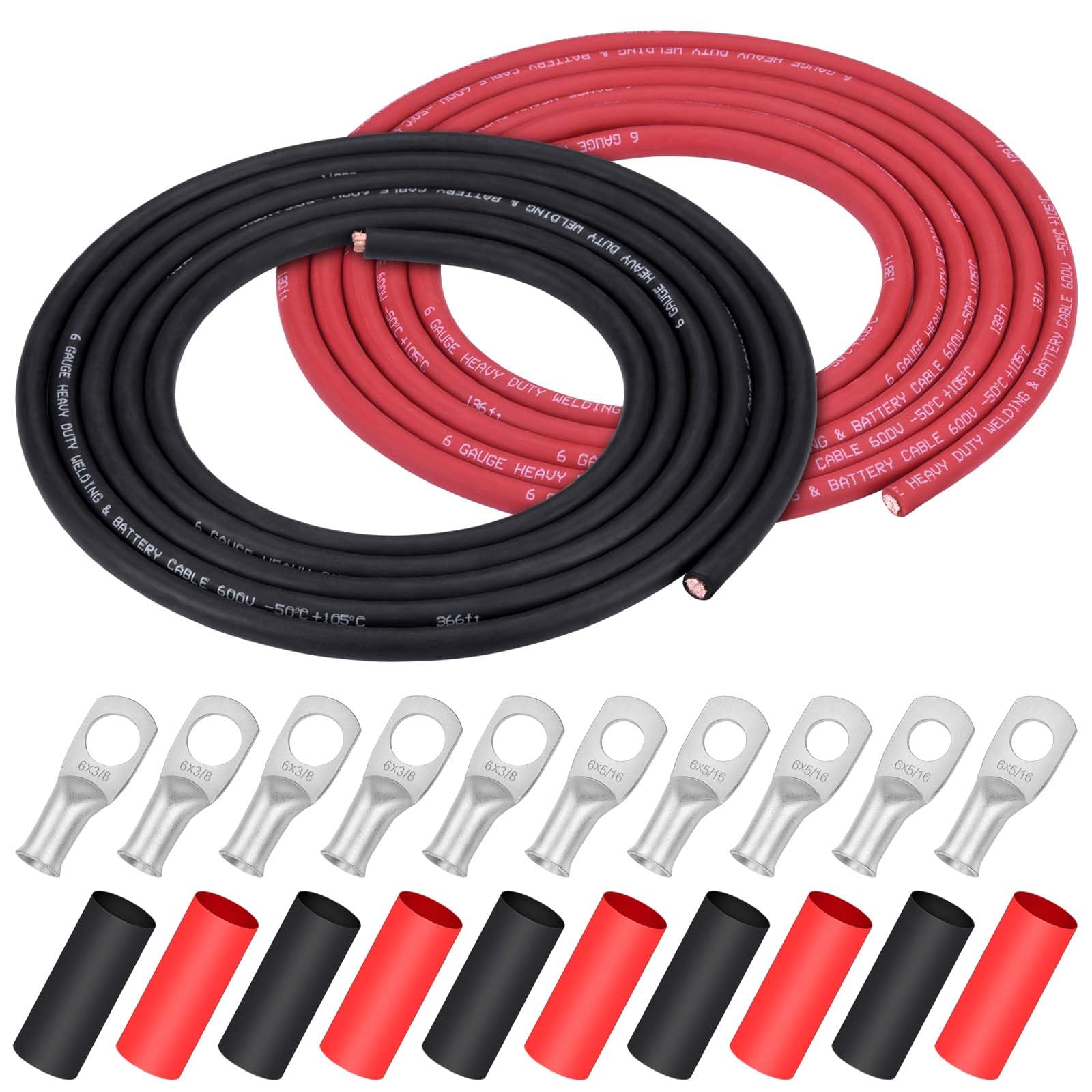
The iGreely kit delivers 10 feet of red and 10 feet of black 6 AWG ultra-flexible welding cable built from 423 strands of annealed OFC copper. The EPDM insulation jacket handles temperatures from negative 58 to 221 degrees Fahrenheit and resists solvents, moisture, and abrasion — essential for both engine bay and marine environments. What sets this kit apart is the inclusion of five 5/16-inch and five 3/8-inch tinned copper lugs plus red and black heat shrink tubing, so you have everything needed to terminate the cable properly on the first try.
The conductor stranding at 423 strands of 0.2mm AS wire makes this cable noticeably more pliable than standard battery cables with lower strand counts. Routing through tight compartments or around sharp bends does not require excessive force, and the cable holds its shape once positioned. The tinned copper lugs feature a closed-end design that blocks moisture and acid intrusion, and the flared barrel allows easy insertion of the conductor before crimping or soldering.
For anyone installing a solar charge controller, upgrading a car audio system, or wiring a power inverter, this kit removes the hassle of sourcing terminals and shrink tubing separately. The two-year warranty provides additional confidence, and the 600-volt rating ensures headroom for DC applications well beyond typical automotive use. It is the most complete package available at this quality level.
What works
- Ultra-flexible 423-strand OFC conductor
- Includes tinned copper lugs in two sizes and heat shrink
- EPDM jacket rated for extreme temperatures and solvents
- Two-year warranty backs the purchase
What doesn’t
- Lugs may require a heavy-duty crimper for best results
- Kit length may be more than needed for small battery swaps
2. TEMCo 6 Gauge Cable

TEMCo Easy-Flex is a 6 AWG pure copper welding cable manufactured in the USA with a rugged EPDM jacket that resists cuts, tears, abrasion, water, oil, grease, and flame. The 260-strand annealed 30-gauge OFC conductor delivers a nominal outer diameter of 0.303 inches and a maximum current rating of 115 amps at lengths up to 50 feet. This cable is rated for 600 volts and operates reliably from negative 58 to 221 degrees Fahrenheit, making it suitable for the harshest under-hood and industrial environments.
The 50-foot red and 50-foot black spools provide enough material for large-scale projects such as RV house battery banks, diesel truck dual-battery setups, or solar array interconnects. Professional installers and RV technicians consistently report that TEMCo cable maintains its flexibility in cold weather and does not develop kinks or memory when coiled. The conductor stranding at 260/30 is slightly coarser than ultra-flexible 423-strand cables, but it still bends easily for most routing scenarios.
Owner feedback from electricians and RV techs emphasizes the consistent quality of the copper — pure OFC with no CCA substitution — and the durable EPDM jacket that withstands years of exposure without hardening. For bulk installations where you need to cut custom lengths and trust every foot of conductor, TEMCo sets the benchmark for American-made welding cable at this gauge.
What works
- Made in USA with pure OFC copper
- High 115-amp rating for demanding loads
- EPDM jacket resists heat, oil, and abrasion
- Bulk 100-foot total length covers large projects
What doesn’t
- Bulk packaging does not include terminals or shrink tubing
- Initial coil may appear like twin-conductor wire at first glance
3. Kimbluth 6 Gauge Cable

The Kimbluth 6 AWG cable is constructed from 99 percent pure oxygen-free copper with a multi-strand core built from 0.256mm wires twisted for improved conductivity and flexibility. A 90-mil PVC jacket provides protection against oxidation, corrosion, high temperature, gasoline, and battery acid. The cable carries a 600-volt rating and operates between negative 40 and 221 degrees Fahrenheit, covering the majority of automotive and solar applications without requiring a premium EPDM jacket.
Users report that the cable cuts and strips cleanly, and the PVC insulation is thick enough to resist marring during installation. The 10-foot red and 10-foot black lengths offer enough material for most battery-to-inverter or battery-to-distribution-block runs in cars, boats, and solar generators. Unlike some budget cables that use CCA, the Kimbluth wire passes the magnet test consistently — a strong indicator of true copper construction.
For the DIY builder who needs reliable OFC cable without paying for a full kit of accessories, this is a solid mid-range option. The PVC jacket is less flexible than EPDM in extreme cold, but for sheltered installations inside a vehicle cabin, battery box, or solar controller enclosure, it provides more than adequate protection at a lower cost than premium rubber-jacketed alternatives.
What works
- True 99% OFC copper, no CCA substitution
- Thick PVC jacket resists acid and abrasion
- Good balance of flexibility and durability
- Fair price for the copper content provided
What doesn’t
- PVC jacket less durable than EPDM in high-heat zones
- No terminals or heat shrink included in the package
4. Shirbly 6 Gauge Wire
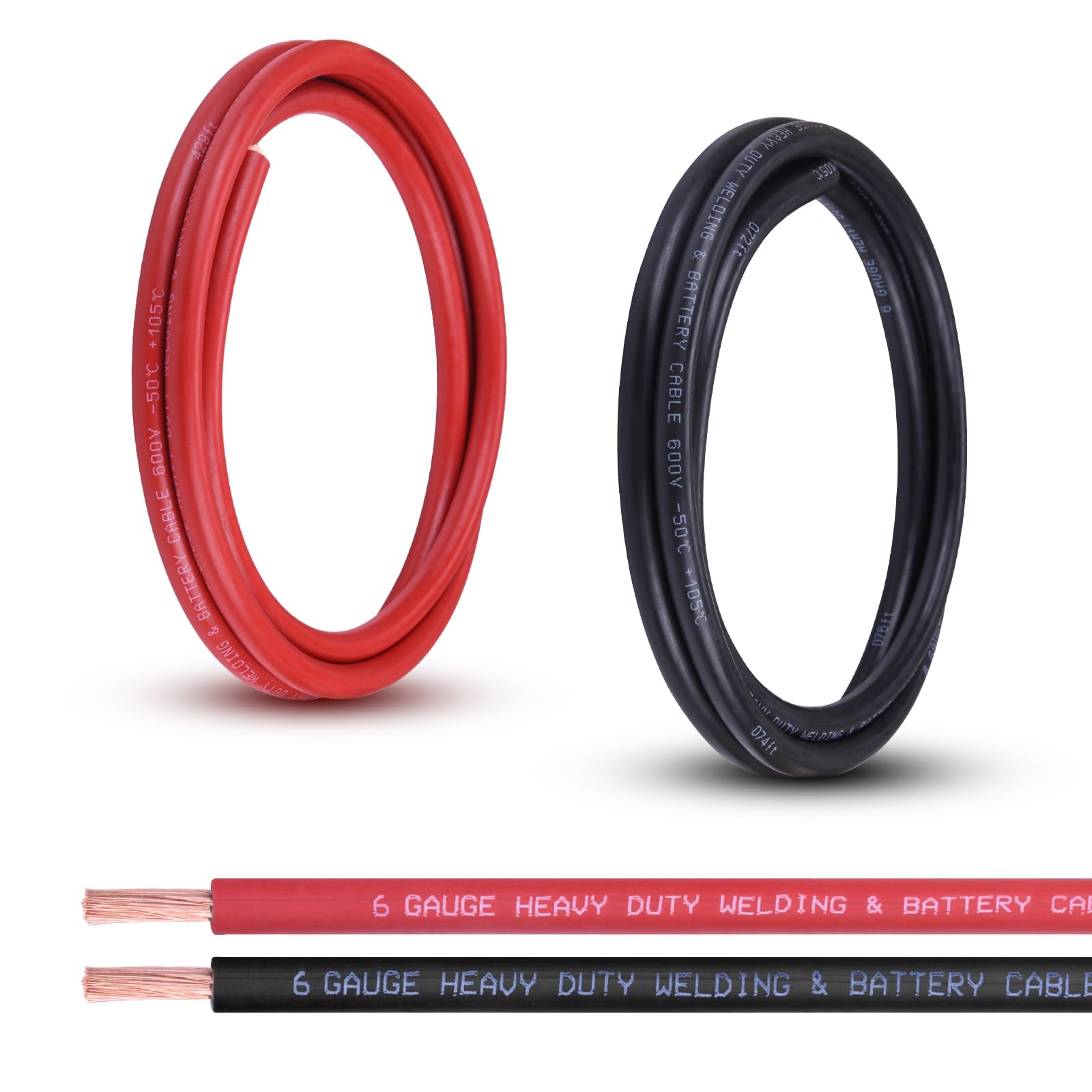
Shirbly’s 6 AWG cable pairs a 423-strand OFC conductor with a solvent-resistant EPDM rubber insulation sheath that handles temperatures from negative 58 to 221 degrees Fahrenheit. The EPDM material provides superior heat resistance, wear resistance, tear resistance, moisture resistance, oil resistance, and corrosion protection compared to standard PVC jackets. This makes the cable an excellent choice for outdoor, marine, and high-heat engine bay installations where jacket integrity is critical.
The 5-foot red and 5-foot black lengths are well-suited for shorter runs such as connecting a battery to a starter solenoid, grounding a chassis, or wiring a secondary battery in a dual-bank setup. The fully annealed pure copper core is rated for 600 volts and uses 423 strands of 0.2mm AS wire, giving it a notably soft feel that bends into any shape without springing back. Users describe the cable as easy to cut, strip, and terminate with standard lugs.
For those who need EPDM-grade insulation but do not require the bulk spool lengths of a 50-foot setup, the Shirbly cable delivers professional-level jacket protection in a package size that fits smaller projects. The absence of included terminals means you will need to source your own lugs and heat shrink, but the cable quality itself matches cables costing significantly more per foot.
What works
- EPDM jacket offers excellent heat and solvent resistance
- 423-strand OFC conductor is very flexible
- 600-volt rating with wide temperature range
- Good option for marine and under-hood use
What doesn’t
- 5-foot lengths may be too short for some installations
- No lugs or terminals included in the package
5. TUELETFU Battery Cables

The TUELETFU 6 AWG battery cables arrive pre-terminated with 5/16-inch tinned copper ring lugs on both ends, eliminating the need for crimping tools or soldering equipment. Each 3-foot cable features a corrosion-resistant tinned copper lug that fits standard battery disconnect switches and terminal posts. The cable is rated for a temperature range of negative 49 to 221 degrees Fahrenheit and meets UL energy specifications, providing a basic level of certification for peace of mind.
These cables are purpose-built for straightforward battery connections on cars, motorcycles, garden tractors, boats, RVs, and solar setups where a simple positive and negative lead is all that is required. Users report that the lugs fit securely over 5/16-inch studs and that the tinned surface resists oxidation better than raw copper. The black jacket is flexible enough for light routing but does not offer the same pliability as high-strand-count welding cable.
For quick replacement of corroded battery leads or for powering a small inverter with minimal installation effort, the TUELETFU cable set is the most straightforward option. The fixed 3-foot length limits its use to short battery-to-device runs, and the lower strand count makes it stiffer than premium welding cable. But for an entry-level price, you get a ready-to-install pair of cables that work immediately out of the package.
What works
- Pre-terminated lugs save installation time and tool cost
- Tinned copper resists corrosion in moist environments
- UL energy specification provides baseline certification
- Ready to use out of the package with no cutting or crimping
What doesn’t
- Fixed 3-foot length limits placement flexibility
- Lower strand count makes the cable noticeably stiffer
Hardware & Specs Guide
OFC vs. CCA Conductors
Oxygen-free copper (OFC) contains at least 99 percent pure copper with minimal oxide content, resulting in lower electrical resistance and better current flow compared to copper-clad aluminum (CCA). CCA wire uses an aluminum core with a thin copper plating — it is lighter and cheaper, but it carries roughly 60 percent of the current capacity of OFC for the same gauge. For high-amperage applications like inverters, winches, and starter motors, OFC is the only reliable choice. A simple magnet test can help identify CCA: copper is non-magnetic, while aluminum with a steel core will attract a magnet.
Strand Count and Flexibility
Strand count directly determines how easily a cable bends and how well it resists metal fatigue at connection points. A 260-strand conductor is considered standard for welding cable, while 423-strand designs fall into the ultra-flexible category. Higher strand counts also improve current distribution across the conductor and reduce skin effect losses at DC frequencies. For installations that require routing through tight engine bays, conduit, or around sharp chassis edges, a 423-strand cable significantly reduces install effort and extends the lifespan of the connection.
Insulation Types: EPDM vs. PVC
EPDM rubber insulation offers superior resistance to heat, oil, solvents, ozone, and abrasion, making it the standard for marine, under-hood, and industrial applications. PVC jackets are more economical and provide adequate protection in dry, temperature-controlled environments, but they degrade faster when exposed to battery acid, fuel vapors, or sustained engine heat. Always check the continuous temperature rating — a cable rated for 105 degrees Celsius is mandatory for engine bay use, while 90-degree PVC may suffice for interior or solar installations.
Voltage Rating and Ampacity
Most 6 AWG battery cables carry a 600-volt rating, which provides substantial headroom for 12-volt, 24-volt, and 48-volt DC systems. Ampacity depends on cable length and insulation type: at 50 feet, 6 AWG copper cable can safely handle up to approximately 115 amps, while shorter runs of 10 feet can support slightly higher current. Always oversize the cable by 10 to 20 percent for continuous loads to minimize voltage drop and heat buildup. Using the correct lug size — 5/16-inch or 3/8-inch — ensures a solid mechanical and electrical connection at the terminal.
FAQ
What is the difference between OFC and CCA battery cable?
Can 6 gauge battery cable handle 100 amps?
How do I choose the correct lug size for my battery cable?
Is PVC insulation good enough for engine bay wiring?
Final Thoughts: The Verdict
For most buyers, the best 6 gauge battery cable winner is the iGreely 6 AWG Wire Kit because it pairs ultra-flexible 423-strand OFC copper with a full set of tinned lugs and heat shrink tubing, removing the guesswork from termination. If you need bulk cable for a large-scale installation, the TEMCo 6 Gauge Cable delivers American-made quality with a proven EPDM jacket. And for a simple replacement of existing battery leads, the TUELETFU Battery Cables provide a ready-to-install solution at an entry-level investment.

Certification: BSc in Mechanical Engineering
Education: Mechanical engineer
Lives In: 539 W Commerce St, Dallas, TX 75208, USA
Md Amir is an auto mechanic student and writer with over half a decade of experience in the automotive field. He has worked with top automotive brands such as Lexus, Quantum, and also owns two automotive blogs autocarneed.com and taxiwiz.com.