A trim piece that suddenly flaps at highway speed, a bumper crack that keeps growing, or an exhaust leak that turns every drive into a drone—these failures always land at the wrong time. The difference between a repair that lasts the life of the car and one that fails within a week comes down to choosing the right adhesive chemistry for the specific part, material, and operating conditions.
I’m Amir — the founder and writer behind Four Wheel Ask. My approach to automotive adhesives focuses on analyzing technical specifications, cross-referencing owner-reported long-term results, and understanding how each formula handles vibration, thermal cycling, and chemical exposure under the hood and along the undercarriage.
Not all glues handle engine bay heat, oil mist, or the constant vibration of a daily driver. Drawing from deep analysis of owner feedback and technical specs, this guide identifies the best glue for car parts for any automotive repair job.
How To Choose The Best Glue For Car Parts
Choosing the wrong adhesive wastes time and leaves a mess. Three factors matter most: the adhesive family that matches your material, the temperature range the bond will face, and the viscosity suited to the repair geometry. Ignore any of these and the bond fails under load.
Adhesive Families: CA, Epoxy, and Fiberglass Wrap
Cyanoacrylate (CA) glues excel on plastic trim, rubber seals, and small interior parts where quick set time and clear finish matter. They reach full strength in hours but become brittle under sustained vibration if used on load-bearing components. Epoxy resins like two-part paste formulas create a tougher, more flexible bond that handles metal-to-metal repairs, fuel tank cracks, and bracket reattachment. Fiberglass repair wrap acts as a structural bandage for exhaust pipes, radiator hoses, and oil lines—it cures into a hard shell that can be sanded and painted but requires a clean cylindrical surface to wrap around.
Temperature and Chemical Resistance
Underhood temperatures routinely exceed 200°F, and catalytic converter areas push past 400°F. Standard household glues soften and lose grip in these zones. Look for formulations explicitly rated for automotive use with published temperature ranges—most quality CA glues hold to 230°F, while epoxy pastes and fiberglass wraps handle 300°F to 400°F. Oil resistance is equally critical around engine components where seepage can undermine a bond over weeks.
Viscosity and Application Method
Thin CA glues use capillary action to wick into hairline cracks and microgaps where gel cannot reach—ideal for headlight housings, dashboard cracks, and trim seam separations. Gel CA glues stay put on vertical surfaces like bumper covers, mirror housings, and side skirts without dripping. Epoxy pastes fill larger voids and gaps up to several millimeters but require clamping during the cure window. The precision of the applicator tip determines whether the glue lands exactly where needed or creates a cleanup headache.
Quick Comparison
On smaller screens, swipe sideways to see the full table.
| Model | Category | Best For | Key Spec | Amazon |
|---|---|---|---|---|
| PEGATANKE Black Epoxy | Epoxy Paste | Structural metal & tank repairs | 550 lb dead weight / 120 PSI | Amazon |
| J-B Weld SuperWeld 2-Pack | CA Gel | Quick general-purpose bonding | 3500 PSI / 30 sec set | Amazon |
| KRAFTPROTZ CA Gel 1.76 oz | CA Gel | Vertical trim & bumper repair | Heat resistant to 230°F | Amazon |
| KRAFTPROTZ CA Liquid 1.76 oz | CA Liquid | Microcracks & headlight housings | Thin capillary action formula | Amazon |
| J-B Weld FiberWeld Cast Kit | Fiberglass Wrap | Exhaust & hose reinforcement | 400°F / 100 PSI / 15 min cure | Amazon |
In‑Depth Reviews
1. PEGATANKE Black 2 Part Epoxy Resin & Cold Weld Adhesive

PEGATANKE is a two-part epoxy paste that blends a metal-filled resin with a hardener to form a cold-weld bond strong enough for structural repairs. Originally formulated for aerospace, naval, and military applications, this adhesive bridges the gap between a simple glue and actual welding. The 1.48-ounce tube provides enough material for multiple repairs on exhaust piping, fuel tanks, coolant tanks, bumpers, and mirror housings.
Each batch supports up to 550 pounds of dead weight per application and withstands 120 PSI of pressure, making it one of the highest load-rated adhesives in this category. The bond cures waterproof and holds up under full submersion—useful for radiator tanks, marine components, and underbody parts exposed to standing water. Full cure takes about 8 hours, but the paste sets firm enough to handle in 30 minutes under direct sun or 90 minutes in shade.
Owner reports confirm that this epoxy succeeds where CA glues and consumer-grade epoxies fail, particularly on rear-view mirror reattachment to windshields and metal bracket repairs that experience constant vibration. The thick paste consistency limits its use on hairline cracks or tight seams, but for gap-filling and load-bearing repairs on metal, plastic, ceramic, and wood, it delivers the most versatile performance in this lineup.
What works
- Exceptional load capacity for structural automotive repairs
- Waterproof and submersible once fully cured
- Bonds multiple materials including metal, plastic, and ceramic
- Withstands high heat and pressure ratings
What doesn’t
- Thick paste cannot penetrate fine cracks or microgaps
- Eight-hour cure time requires patience and clamping
2. J-B Weld Superglue 20g 2 Pack – SuperWeld Professional Grade

J-B Weld SuperWeld delivers a tensile strength rating of 3500 PSI in a gel-form cyanoacrylate that sets in roughly 30 seconds. The two-pack format provides backup for multi-step repairs or for keeping one tube in the garage and one in a road-trip kit. Precision tip applicators allow controlled placement on small clips, trim retainers, and plastic bracketry where excess glue would create a visible mess.
Unlike thin CA glues that run off vertical surfaces, the gel consistency stays exactly where applied, making it suitable for dashboard cracks, mirror housings, and interior trim panels. The bond reaches full cure in 24 hours, but the rapid initial set means parts hold position after less than a minute of finger pressure. Compatibility extends across metal, stone, concrete, fiberglass, rigid plastics, glass, and wood.
Owner feedback highlights consistent performance on small repairs that require immediate hold—securing magnets to 3D-printed parts, fixing dashcam wiring mounts, and reattaching trim clips. Some users note that the 20-gram tubes are relatively small for larger repairs, and the fast set time demands precise alignment before the pieces meet. For quick, high-strength fixes on small automotive components, this is the fastest option in the group.
What works
- Very high tensile strength for a CA glue
- Sets in 30 seconds for rapid repair turnaround
- Gel formula prevents drips on vertical surfaces
- Works across a wide range of materials
What doesn’t
- Small bottle size limits large-area applications
- Fast set leaves no room for repositioning
3. KRAFTPROTZ Automotive Super Glue Gel 1.76 oz – No-Drip Cyanoacrylate
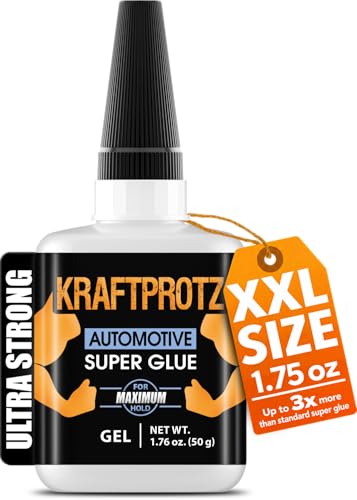
KRAFTPROTZ formulated this gel CA adhesive specifically for the automotive environment, with a no-drip rheology that stays put on vertical bumper faces, side skirts, and fender liners. The 1.76-ounce XXL bottle holds roughly three times the volume of standard automotive glue tubes, reducing the frequency of replacement for mechanics and DIYers who work through multiple repairs. An anti-clog tip design prevents the nozzle from crusting shut between uses.
The gel withstands temperatures up to 230°F and resists oil exposure, engine vibration, and road shocks. This makes it viable for underhood components like air intake ducts, wiring harness clips, and plastic engine covers, as well as exterior trim that cycles through hot sun and cold rain. The controlled flow allows precise application into tight angles and plastic-to-metal interfaces without overspill onto surrounding panels.
Owner reports cite successful long-term repairs on front bumper separation (Golf R known issue), peeling grill chrome held with painter’s tape during cure, and torn rubber seals. Some note that the gel takes longer to harden than thin CA, which actually aids alignment for larger parts. For any repair on a vertical or curved surface where drip control matters, this gel delivers the most targeted application in the category.
What works
- No-drip gel stays on vertical and curved surfaces
- Large 1.76 oz bottle reduces repurchase frequency
- Anti-clog nozzle maintains flow over weeks of use
- Heat and oil resistant for underhood environments
What doesn’t
- Longer cure time than thin CA for instant-grab needs
- Not designed for penetrating hairline cracks
4. KRAFTPROTZ Automotive Super Glue Liquid 1.76 oz – Thin Cyanoacrylate
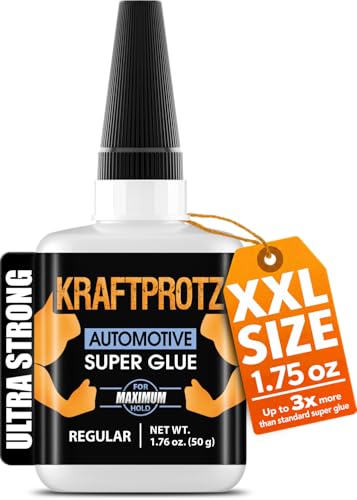
This thin liquid CA glue from KRAFTPROTZ uses capillary action to wick into gaps as narrow as 0.05 mm, making it the only product in this roundup designed for microcrack penetration. The 1.76-ounce XXL bottle mirrors the gel version’s generous volume but delivers a completely different flow profile. Applications include headlight housing cracks, dashboard splits, trim seam separations, and wire harness mounts where the glue must flow into the joint rather than sit on top.
Temperature tolerance matches the gel version at 230°F, with the same resistance to oil, vibration, and engine bay contaminants. The thin formula dries faster than gel due to the larger surface-area-to-volume ratio inside tight gaps. A precision dropper tip controls flow rate, and the anti-clog cap seals the nozzle between sessions. Full cure completes in approximately 4 hours, though bonds reach handling strength within minutes.
Owner feedback highlights successful repairs on BMW leather seats (hole patched and held for five months), torn rubber seals, and front bumper separation where the glue wicked into the seam. Multiple users emphasize that the thin nature requires careful handling—excess can run onto visible surfaces if applied too liberally. For repairs involving cracks, seams, and tight joints that a gel cannot reach, this liquid delivers the best penetration in the lineup.
What works
- Capillary action reaches hairline cracks gels cannot
- Large XXL bottle provides exceptional value per repair
- Fast drying in thin-film applications
- Heat and oil resistant for automotive use
What doesn’t
- Runs off vertical surfaces if over-applied
- Thin consistency requires precision to avoid mess
5. J-B Weld 38237 FiberWeld 2 in. x 36 in. Automotive Repair Cast Kit

J-B Weld FiberWeld takes a completely different approach from the other adhesives here—it is a fiberglass wrap impregnated with resin that activates when soaked in water for 5 to 7 seconds. Once applied, the wrap hardens like steel in about 15 minutes and reaches full strength within 2 hours. The kit includes a pair of gloves and a securing bandage to hold the wrap in place during cure.
Temperature resistance reaches 400°F, and the cured material holds water pressure up to 100 PSI, making this the top choice for exhaust system repairs, radiator and heater hoses, oil and transmission lines, and muffler patches. The wrap can be sanded and painted after curing, which allows it to blend into surrounding components. Applications extend beyond cars to RV and boat emergency repairs where heat and pressure are factors.
Owner reports show strong results on exhaust pipe breaks, cracked mufflers, and structurally sound pipe sections with small holes. Some note that the resin is slimy during application and the gloves may not last through the entire wrap process. For repairs on cylindrical components exposed to extreme heat, this fiberglass wrap provides a solution that no glue or epoxy can match.
What works
- Withstands 400°F exhaust temperatures
- Holds 100 PSI water pressure once cured
- Sands and paints for a finished appearance
- Full cure in 2 hours with 15-minute set time
What doesn’t
- Messy application with sticky resin residue
- Limited to wrap-able cylindrical or flat surfaces
- Not suitable for load-bearing structural joints
Hardware & Specs Guide
Bond Strength (PSI Rating)
PSI ratings measure how much force the cured adhesive can withstand before failing. J-B Weld SuperWeld leads the CA category at 3500 PSI, while the PEGATANKE epoxy supports 550 pounds of dead weight (roughly equivalent to several thousand PSI over a typical bond area). Fiberglass wrap strength depends on the number of layers applied and the surface preparation. For plastic trim and interior parts, anything above 2000 PSI provides more than enough margin. For load-bearing metal repairs, epoxy or wrapped reinforcement is the safer choice over CA glue, which can become brittle under cyclic stress.
Curing Time and Work Life
CA glues set in seconds to minutes but reach full mechanical strength in 4 to 24 hours depending on formula and gap size. Thin CA dries fastest because it spreads into a thin film; gel CA takes longer due to thicker cross-section. PEGATANKE epoxy offers a work life of about 3 minutes after mixing, sets in 30 minutes in direct sun, and fully cures in 8 hours—ample time for positioning and clamping. J-B Weld FiberWeld sets in 15 minutes after water activation and achieves full cure in 2 hours, the fastest full-cure time for high-heat repairs. Matching the cure speed to the repair complexity prevents rushed alignments or waiting unnecessarily.
FAQ
Can CA glue really hold up under hood temperatures?
What is the difference between gel and liquid CA glue for car parts?
Will epoxy glue damage plastic car parts?
How long should I clamp a glued car part before driving again?
Final Thoughts: The Verdict
For most buyers, the best glue for car parts winner is the PEGATANKE Black Epoxy because it covers the widest range of materials and load conditions—from metal brackets to plastic tanks—with a single cold-weld bond that outlasts CA glues in demanding environments. If you need instant grip on small trim repairs, grab the J-B Weld SuperWeld 2-Pack. And for heat-soaked exhaust and hose repairs, nothing beats the J-B Weld FiberWeld Cast Kit.

Certification: BSc in Mechanical Engineering
Education: Mechanical engineer
Lives In: 539 W Commerce St, Dallas, TX 75208, USA
Md Amir is an auto mechanic student and writer with over half a decade of experience in the automotive field. He has worked with top automotive brands such as Lexus, Quantum, and also owns two automotive blogs autocarneed.com and taxiwiz.com.