A failing pump turns every parking lot maneuver into a forearm workout and fills the cabin with that telltale whine. Choosing the wrong replacement means repeating the job in a few months — or worse, losing assist at speed. The right unit restores effortless steering without the noise or premature failure that plagues budget rebuilds.
I’m Amir — the founder and writer behind Four Wheel Ask. I’ve spent years digging into power steering pump specifications, comparing OEM cross-reference data, and analyzing long-term owner reliability reports across dozens of vehicle platforms to identify which units hold up under real driving conditions.
Whether you’re refreshing a daily commuter or upgrading a lifted truck, matching the correct flow rate, seal quality, and build material is critical. This guide breaks down the top contenders for the best power steering pump across budget, mid-range, and premium tiers so you can choose with confidence.
How To Choose The Best Power Steering Pump
Selecting a replacement pump goes beyond matching the mounting pattern. Incorrect flow rates, poor seal materials, and mismatched pulley attachments cause premature noise, leaks, and loss of assist. Focus on these four factors to get a unit that bolts on, bleeds easily, and lasts.
Pump Family & Mounting Pattern
Most modern vehicles use a compact vane-type pump, while older GM platforms and many engine swaps rely on the Saginaw P-Series design. The mounting bracket, inlet/outlet port orientation, and pulley attachment method (press-on vs. bolt-on) must match your engine bay. Cross-reference the OEM part number and visually compare your old pump to avoid ordering a unit that physically won’t fit.
Seal Material & Leak Resistance
The high-pressure seal and internal O-rings are the most common failure points. Standard nitrile rubber degrades quickly under heat and ATF exposure, leading to external weeps and eventual spray failures. Pumps using FKM (Viton®) fluororubber seals withstand temperatures up to 200°C and resist swelling, giving them dramatically longer leak-free service life in hot engine compartments.
Flow Rate & Pressure Output
Stock pumps typically deliver 1.5–3.0 GPM at 1,000–1,500 psi, which is adequate for factory-size tires. Lifted trucks with 35-inch or larger tires and high-caster alignment specs need increased flow (3.0+ GPM) to maintain responsive steering at low RPM. Conversely, vehicles with aftermarket rack-and-pinion conversions (e.g., Mustang II) may require a pressure reducer to avoid seal damage from excessive PSI.
Reservoir & Pulley Inclusions
Some pumps ship as a bare unit without a pulley or reservoir. Verify whether your application uses a separate reservoir (common on many GM trucks) or an integrated housing (typical on many imports). Pulley compatibility matters too — press-on pulleys require a special tool to transfer from the old pump, while bolt-on units simplify the swap. Choosing a kit that includes these components saves an extra trip to the parts store.
Quick Comparison
On smaller screens, swipe sideways to see the full table.
| Model | Category | Best For | Key Spec | Amazon |
|---|---|---|---|---|
| A-Premium APPSP0095 | Honda Accord | OEM-grade replacement with pulley | 7-groove pulley, 2.4L fitment | Amazon |
| PSC Motorsports SP1404 | High Flow | Lifted trucks & heavy steering | Hydroboost compatible, 3+ GPM | Amazon |
| A-Team Performance PS2000BK | Universal GM | Engine swaps & hot rods | Billet aluminum, Saginaw P-Series | Amazon |
| PHILTOP 20-8704 | GM Truck | Chevy/GMC pickup replacement | Aluminum alloy, 2-yr warranty | Amazon |
| DRIVESTAR 21-5366 | Nissan/Infiniti | Titan, Armada, QX56 owners | FKM seal, 5.6L VK56 fitment | Amazon |
| Chefull 21-5495 | Honda | Budget Accord/Odyssey fix | Complete with pulley, 12-mo warranty | Amazon |
| UGFC 20-8740 | GM Full-Size | Silverado, Suburban, Yukon | Integrated reservoir, 10.17 lb | Amazon |
In‑Depth Reviews
1. A-Premium APPSP0095 Power Steering Pump
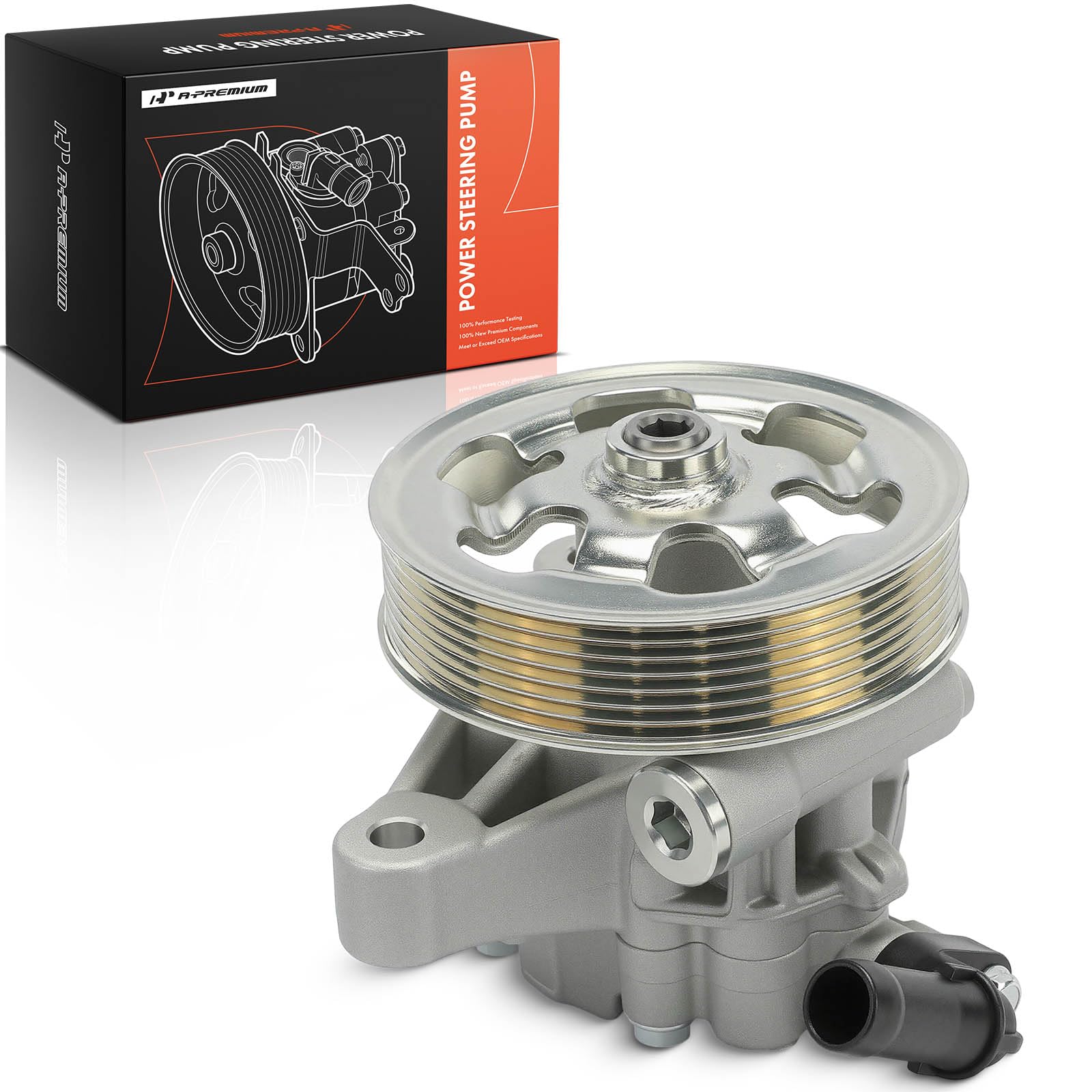
This A-Premium pump targets the 2008–2012 Honda Accord 2.4L market, coming with a 7-groove pulley already installed. That single detail saves the cost and hassle of pressing the old pulley onto a bare pump — a task that requires a specialized puller tool many DIYers lack. The polished aluminum housing mirrors the factory finish and includes multiple OEM cross-references including 56100-R40-A03, 21-5495, and 56100-R40-305, making fitment confirmation straightforward.
Owner reports consistently highlight whisper-quiet operation immediately after proper bleeding. The pump resolved heavy steering and low-speed groan complaints across multiple examples with the K24 engine. A shared theme in positive reviews emphasizes using genuine Honda/Acura power steering fluid — the pump is sensitive to fluid type, and skipping this step introduces noise and reduced service life.
The one-year warranty covers defects, and the manufacturer recommends installing an inline filter and flushing the system beforehand to prevent debris from damaging the new unit. Some long-term feedback notes pump rattle emerging after three months in hot climates, likely tied to fluid choice or air remaining in the system. Overall, this is the cleanest drop-in option for owners who want a complete assembly with no extra parts sourcing.
What works
- Pre-installed pulley eliminates tool rental
- Quiet operation with proper fluid
- Polished finish matches OEM look
What doesn’t
- Sensitive to non-spec power steering fluid
- Occasional reports of early rattle in hot climates
- No reservoir or hoses included
2. PSC Motorsports SP1404 High-Flow P-Series Pump

PSC Motorsports builds this high-flow P-Series pump specifically for vehicles running oversized tires, hydroboost brake systems, or both. The SP1404 moves substantially more fluid per revolution than a standard Saginaw unit, delivering usable steering assist at idle even with 35-inch rubber and high-caster alignment settings. The cast-iron housing handles the increased internal pressures without flexing, and the pump ships ready for a remote reservoir setup.
Owner feedback from lifted Duramax and Power Stroke owners confirms that this pump transforms steering effort. Drivers report the ability to dry-turn the wheel lock-to-lock without the engine needing to rev up — a clear upgrade over stock pumps that struggle with the added leverage of big tires. Proper bleeding technique is critical; air trapped in the hydroboost circuit causes a crunchy pedal feel and requires patience to purge completely.
Some users note that the pump does not include a reservoir, pulley, or mounting brackets, so the total install cost climbs once those components are sourced separately. There is also a recommendation from experienced owners to use Swepco 715 fluid for best longevity. For full-size truck owners who off-road or tow heavy loads, this pump justifies its position as the premium high-output option in the segment.
What works
- Dramatically improves steering with oversized tires
- Robust hydroboost compatibility
- Cast-iron housing handles sustained pressure
What doesn’t
- No pulley, reservoir, or brackets included
- Requires thorough bleeding procedure
- Pricier than most bolt-in options
3. A-Team Performance PS2000BK Saginaw P-Series Pump
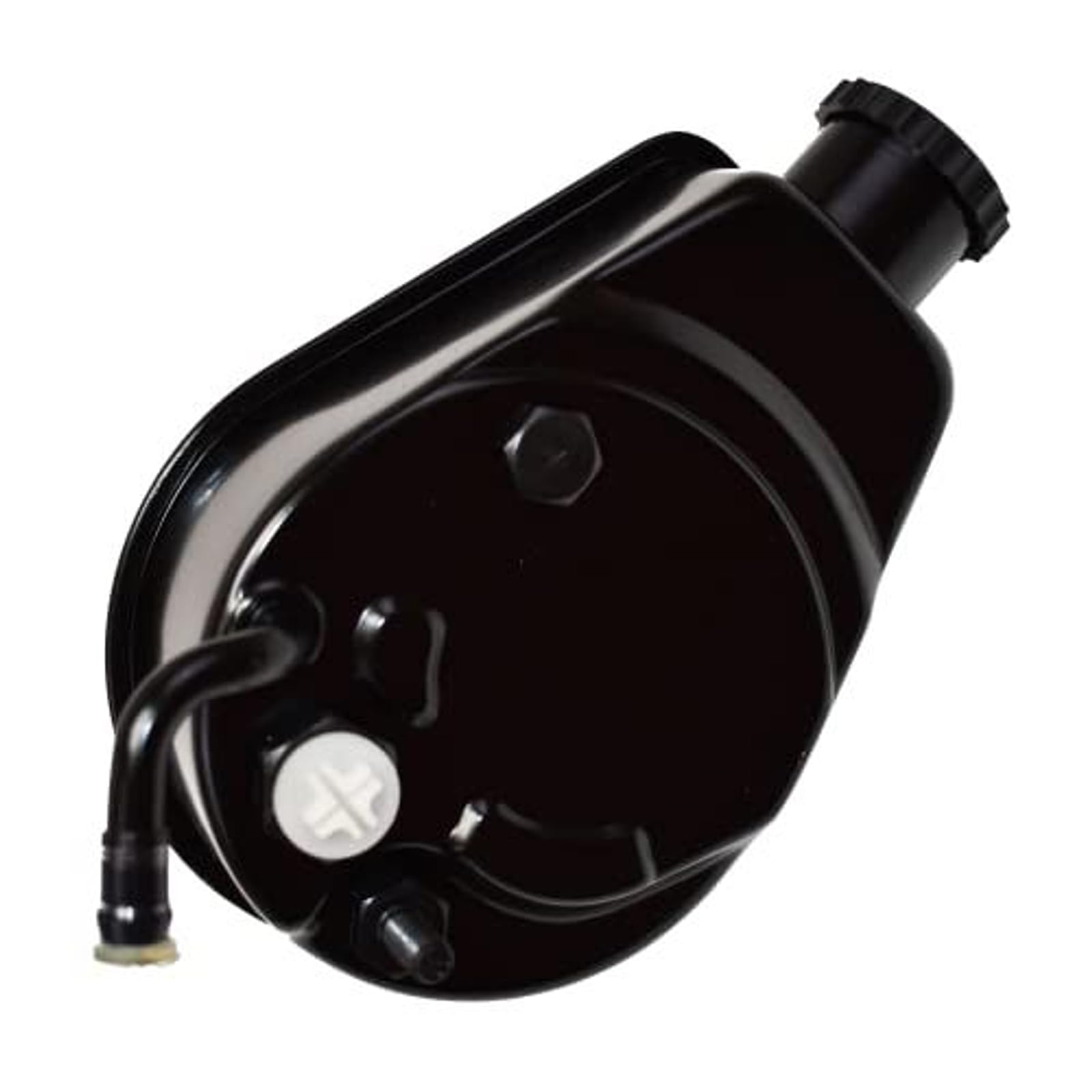
A-Team Performance brings a billet aluminum Saginaw P-Series pump to the table, finished in black with a chrome reservoir cap. This is a universal-fit unit targeting engine swaps, classic car restorations, and hot rod builds rather than direct OEM replacement. The barbed inlet and outlet connectors work with standard power steering hose, and the pump body shares the familiar Saginaw mounting pattern that fits a wide range of GM brackets from the 1960s through the LS-swap era.
Builders report clean installation on small-block Chevy crates, 383 strokers, and LS swaps in vintage chassis like the 1968 Camaro. The included billet cap and chrome reservoir add visual appeal to an open engine bay, and the pump operates quietly when paired with the correct pressure hose and return line. Machining quality is consistent across multiple units, with no burrs or misaligned port threads noted in owner feedback.
One recurring discussion point involves the output pressure. The Saginaw P-Series typically delivers around 1,200 psi, which is compatible with GM integral steering boxes but may overpressure a Mustang II rack-and-pinion conversion that expects roughly 800 psi. Buyers using aftermarket rack setups should factor in the cost of an in-line pressure reducer. Overall, this pump offers excellent visual and mechanical quality for custom chassis work.
What works
- Precision billet aluminum construction
- Chrome cap and reservoir enhance engine bay aesthetics
- Universal Saginaw pattern fits countless GM swaps
What doesn’t
- Pressure too high for some aftermarket racks
- No detailed PSI/GPM specs published
- Pulley and brackets sold separately
4. PHILTOP 20-8704 Power Steering Pump
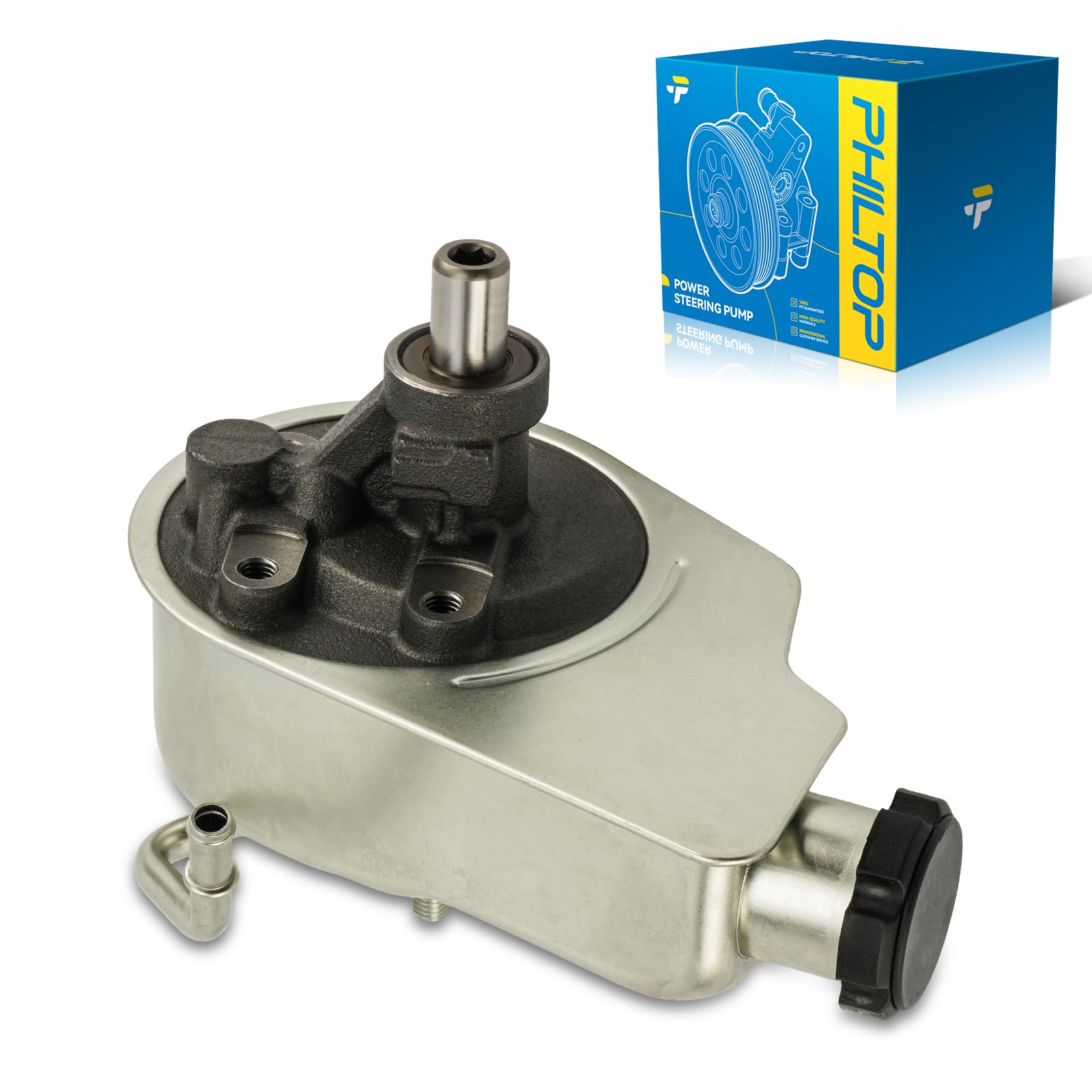
PHILTOP positions this pump as a direct replacement for a massive range of Chevrolet and GMC trucks, including the Silverado 1500, Tahoe, Suburban, and Yukon from model years 1999 through 2006. The unit is built from premium aluminum alloy with precision-machined seals and a reinforced housing designed to prevent fluid bypass under sustained hydraulic load. It ships without a pulley or reservoir, so customers need to transfer those components from the original pump.
Installation feedback from DIY owners indicates straightforward bolting with no bracket modifications. The pump accepts the standard press-on pulley and the threaded high-pressure outlet lines up correctly with factory hoses. Owners appreciate the detailed installation tips included in the package — specifically the reminders to flush the system, replace old O-rings on the pressure line, and bleed air by cycling the steering lock-to-lock with the engine running.
A small percentage of buyers reported noise or reduced assist after a few days, which points to either incomplete bleeding or an underlying issue with the power steering gearbox rather than the pump itself. The two-year warranty provides a solid safety net compared to the typical 12-month coverage found on competing units in this price tier. For GM truck owners looking for a well-supported stock replacement, this pump delivers strong value.
What works
- Extensive GM truck application coverage
- Two-year warranty exceeds industry norm
- Detailed installation and bleeding instructions
What doesn’t
- Pulley and reservoir not included
- A few early noise complaints reported
- Incompatible with luxury package variants
5. DRIVESTAR 21-5366 Power Steering Pump

DRIVESTAR specifically tailors this pump to the Nissan VK56 engine family found in the Titan, Armada, Pathfinder, and Infiniti QX56 across the 2004–2011 model years. The notable design highlight is the use of FKM fluororubber sealing rings rated from -20°C to 200°C, which resist the hardening and shrinkage that cause conventional O-rings to leak after repeated heat cycles. The cast aluminum body also improves heat dissipation compared to stamped steel housings.
Multiple Titan owners report a seamless bolt-on experience with no need to modify brackets or hoses. The pump includes the correct mounting holes and port angles for the factory location, and the pulley (transferred from the old pump) aligns perfectly with the serpentine belt. Feedback consistently notes that steering becomes smooth and quiet immediately after bleeding, with the annoying low-speed groan disappearing entirely.
One caveat is that the pump ships as a bare unit — no gaskets, fittings, or reservoir come in the box. Buyers should inspect their existing O-rings and transfer them carefully during the swap. The 36-month warranty period is significantly longer than most competitors in this price bracket, indicating confidence in the FKM seal longevity. For Nissan V8 owners who want a durable, leak-resistant pump at a reasonable outlay, this is a well-engineered choice.
What works
- FKM seals resist heat degradation and leaks
- Direct fit for Nissan VK56 applications
- 36-month warranty shows manufacturer confidence
What doesn’t
- No gaskets or fittings included
- Requires careful O-ring transfer from old pump
- Not compatible with non-VK56 Nissan models
6. Chefull 21-5495 Power Steering Pump

Chefull delivers a complete power steering pump assembly with pulley for the 2008–2012 Honda Accord 2.4L, as well as the 2011–2012 Odyssey. The pump is entirely new — not remanufactured — and includes a direct-fit design that saves labor time. Multiple OEM part numbers cross-reference with this unit, including 56100-R40-A01 through A04, giving buyers multiple ways to verify fitment before ordering.
Positive owner reports highlight easy installation, proper fitment, and the elimination of steering noise when the correct fluid is used and the system is properly bled. The pump includes a 12-month warranty and is tested before shipping, which filters out most manufacturing defects. A few owners reported using the pump as a quick fix to sell the car, which suggests confidence in its short-term reliability even if long-term testing is limited.
There is one concerning report of catastrophic failure after six months on an Odyssey, where the pump sprayed fluid across the engine and nearly caused a loss of control. While isolated, this highlights the importance of using the correct power steering fluid and verifying that the system is clean before installation. For budget-conscious Honda owners who need a working pump immediately, this unit offers an attractive entry point with manageable risk.
What works
- Complete assembly with pulley included
- 100% tested before shipping
- Low entry price for quick replacement
What doesn’t
- Isolated report of early seal failure
- Requires specific Honda fluid for quiet operation
- 12-month warranty is shorter than some competitors
7. UGFC 20-8740 Power Steering Pump

The UGFC 20-8740 covers the 1999–2013 Chevrolet Silverado 1500, Suburban, Tahoe, GMC Yukon, Sierra, and Cadillac Escalade models, making it one of the widest-coverage pumps in this group. It includes an integrated reservoir, which simplifies installation by eliminating the need to plumb a separate fluid tank and mount it to the inner fender. The machined exterior finish resists corrosion and gives the engine bay a clean, refreshed appearance.
DIY owners report that the pump bolts in easily and restores normal steering effort with no modification. The integrated reservoir saves time during the swap, and the barbed inlet accepts the factory return hose without adapters. Many buyers comment that the pump delivers excellent value for the price, especially when compared to dealership quotes for the same application. The unit is relatively heavy at over 10 pounds, reflecting substantial internal components.
One recurring observation from owners is that the pump does not provide the same effortless low-speed steering feel as the original factory unit, even after thorough bleeding. This suggests slightly different internal valving or a marginally lower displacement compared to the GM OEM spec. The whining noise from the old pump disappears, but steering effort at parking-lot speeds may feel slightly heavier. For drivers who want a cost-effective replacement with broad coverage and a built-in reservoir, this pump remains a practical choice.
What works
- Integrated reservoir simplifies installation
- Very broad GM truck coverage
- Corrosion-resistant machined finish
What doesn’t
- Steering effort slightly heavier than OEM
- Bleeding procedure critical to avoid whine
- Some units may need a return line adapter
Hardware & Specs Guide
Pump Construction Materials
The choice between cast iron and aluminum directly affects weight, heat dissipation, and longevity. Cast-iron housings (common on high-flow and HD pumps like the PSC SP1404) resist flex under high pressure but add several pounds. Aluminum pumps cool faster and save weight but require thicker wall sections to maintain rigidity. Billet aluminum units (such as the A-Team Performance PS2000BK) offer the best strength-to-weight ratio but come at a higher manufacturing cost.
Seal Technology
FKM (Viton) fluororubber seals withstand continuous exposure to power steering fluid at temperatures up to 200°C without hardening or cracking. Standard nitrile rubber O-rings begin to degrade around 120°C, leading to external weeps and eventual spray failures. Pumps using FKM seals, such as the DRIVESTAR 21-5366, typically outlast nitrile-sealed units by two to three times in hot engine compartments. This is the single most important spec for long-term leak prevention.
Flow Rate and Pressure Ratings
Stock pumps output roughly 1.5–2.5 GPM at 1,000–1,500 psi. High-flow units like the PSC SP1404 push 3.0+ GPM, essential for hydroboost brake systems and turning 35-inch or larger tires at idle. Exceeding the pressure rating of a steering gearbox or rack can damage internal seals, which is why some aftermarket rack installations require an in-line pressure reducer. Always match the pump output to the steering component specifications.
Pulley Attachment Types
Press-on pulleys require a dedicated puller/installer tool to transfer the old pulley to the new pump without damaging the shaft or bearings. Bolt-on pulleys use a flange and fasteners, allowing installation with basic hand tools. Pumps that ship with a pre-installed pulley (like the A-Premium APPSP0095 and Chefull 21-5495) save both tool cost and labor time. Verify the groove count and belt alignment before committing to a pump without a pulley.
FAQ
How do I know if my power steering pump is failing?
Can I install a power steering pump myself?
What happens if I use the wrong power steering fluid?
How do I properly bleed air from a new power steering pump?
Are high-flow pumps worth it for stock vehicles?
Final Thoughts: The Verdict
For most buyers, the best power steering pump winner is the A-Premium APPSP0095 because it combines a pre-installed pulley, polished aluminum construction, and direct OEM fitment for the popular Honda Accord 2.4L platform. If you need high-flow capability for a lifted truck, grab the PSC Motorsports SP1404. And for a universal Saginaw pump that looks great in an engine swap, nothing beats the A-Team Performance PS2000BK.

Certification: BSc in Mechanical Engineering
Education: Mechanical engineer
Lives In: 539 W Commerce St, Dallas, TX 75208, USA
Md Amir is an auto mechanic student and writer with over half a decade of experience in the automotive field. He has worked with top automotive brands such as Lexus, Quantum, and also owns two automotive blogs autocarneed.com and taxiwiz.com.