A rear view mirror is the single most-used visual tool in your vehicle, yet most drivers never think about upgrading it until the original cracks, sags, or simply fails to show a clear picture. Whether you are dealing with glare from headlights behind you, a mirror that won’t stay in place on rough roads, or an older vehicle that lacks a backup camera, replacing or upgrading your mirror can transform your driving awareness overnight. The difference between a cheap, dim, distorted mirror and a properly designed unit is the difference between guessing what is behind you and knowing exactly what is back there.
I’m Amir — the founder and writer behind Four Wheel Ask. I have spent years comparing vehicle mirror specifications, studying owner-reported durability data, and analyzing the build quality differences between budget replacement mirrors and premium digital units so that I can separate genuine value from marketing claims.
This guide covers seven distinct rear view mirror solutions spanning simple OEM-style replacements, LCD-integrated units, and full-featured dash cam mirrors. Drawing from comprehensive market analysis and verified owner feedback, our research team determined the top contenders for the best car rear view mirror.
How To Choose The Best Car Rear View Mirror
Not every mirror fits every vehicle, and not every feature set matters to every driver. Understanding the core categories and trade-offs helps you avoid buying a mirror that shakes, distorts, or simply does not do what you need it to do. Below are the three most important decision points.
Mirror Type: OEM Replacement vs. Digital vs. Dash Cam
A basic OEM-style replacement mirror uses a coated glass surface with a manual day/night flip tab. These are the most affordable option and work perfectly for drivers who just want a clear, stable reflection without any electronics. Digital mirrors replace the reflective surface with an LCD panel that shows a live camera feed, eliminating blind spots entirely. Dash cam mirrors combine a digital display with continuous recording, GPS, parking monitoring, and driver-assistance alerts. Choosing between them comes down to whether you need recording capability or simply a wider, unobstructed rear view.
Mounting Compatibility and Vehicle Fit
Most mirrors attach to a windshield button using a slide-and-lock mechanism, but the button shape, arm length, and bracket geometry vary significantly between manufacturers and model years. A vehicle-specific mirror guarantees a direct swap without adapters, while universal mirrors include multiple brackets or a glue-on button to accommodate different windshields. Always confirm the mount type — some digital mirrors require a dedicated bracket kit (sold separately) for vehicles with unusual mirror arms or integrated sensors.
Camera Resolution and Night Performance
For digital and dash cam mirrors, the camera sensor determines image clarity. A 1080P rear camera provides sharp detail for reversing and reading license plates, while 4K front cameras capture wider, more detailed road footage. Night vision capability depends on the sensor — STARVIS 2 sensors, for example, handle low light and headlight glare far better than generic CMOS sensors. Look for wide dynamic range (WDR/HDR) to avoid washed-out images when transitioning between bright sunlight and shadow.
Quick Comparison
On smaller screens, swipe sideways to see the full table.
| Model | Category | Best For | Key Spec | Amazon |
|---|---|---|---|---|
| Pelsee S12 Pro | Mirror Dash Cam | All-in-one safety and recording | 4K Front + 1080P Rear, STARVIS 2, ADAS | Amazon |
| WOLFBOX G850 PRO | Mirror Dash Cam | Blind spot and collision alerts | 4K Front + 1080P Rear, BSD, 12″ Display | Amazon |
| AUTO-VOX T9 | Streaming Media Mirror | OEM-style digital rear view | 1080P AHD, 9.35″ Touch, Loop Recording | Amazon |
| Master Tailgaters 10.5″ | LCD Mirror | Clean backup camera integration | 4.3″ LCD, Auto Brightness, Universal Mount | Amazon |
| Veement VT10 4K | Mirror Dash Cam | Budget-friendly 4K recording | 4K Front + 1080P Rear, Voice Control, 10″ | Amazon |
| JINGEA Ford Mirror | OEM Replacement | Direct factory-style replacement | Manual Day/Night, 10.2″ Width, Convex | Amazon |
| JINGEA Jeep Mirror | OEM Replacement | Rugged off-road replacement | Manual Day/Night, Tempered Glass, 9.5″ | Amazon |
In‑Depth Reviews
1. Pelsee S12 Pro

The Pelsee S12 Pro sits at the intersection of premium build quality and genuine utility. Its STARVIS 2 sensor is the standout spec here — this Sony-derived technology fundamentally changes how the mirror handles low-light conditions, preserving color detail and balancing headlight glare instead of washing out into black-and-white. The 4K front camera captures sharp, readable footage at 25 frames per second, while the 1080P rear camera uses wide dynamic range to keep shadows and highlights in check during daytime transitions. The 12-inch IPS touchscreen provides a crisp, responsive interface without lag.
Beyond raw image quality, the S12 Pro integrates ADAS alerts (forward collision, lane departure, pedestrian detection, and front vehicle start) that are calibrated to avoid excessive false warnings — a common complaint with lesser systems. The 5.8GHz WiFi 6 module transfers files at up to 20 MB/s, making clip retrieval genuinely fast through the Pelsee app. A pre-installed 64GB card means it works out of the box, and the GPS antenna records your route and speed data. Owners of larger vehicles should note the 19.6-foot rear camera cable may require an extension for full-size trucks or SUVs with campers or toppers.
Installation is straightforward: rubber straps secure the mirror over the existing unit, and the rear camera mounts to the top of the rear glass. The mirror measures 11.81 inches wide, so it will not fit mirrors shorter than 6.3 inches — check your current mirror dimensions before ordering. Owner reports consistently highlight the night vision performance as a class leader, and the voice control commands (lock video, take picture) respond accurately without requiring a specific accent or volume level.
What works
- STARVIS 2 sensor delivers best-in-class low-light color detail
- ADAS alerts are accurate and rarely produce false triggers
- Pre-installed 64GB card and GPS antenna included
- Touchscreen interface is responsive and logically laid out
What doesn’t
- Rear camera cable may be too short for full-size trucks and vans
- Rubber straps can be tight on thicker or oddly shaped original mirrors
- Parking monitoring requires a separately sold hardwire kit
2. WOLFBOX G850 PRO

The WOLFBOX G850 PRO distinguishes itself with a blind spot detection (BSD) algorithm that monitors adjacent lanes and issues rear collision alerts — a feature rarely found at this level. The 12-inch full IPS touchscreen delivers a bright, wide viewing area that makes the rear camera feed feel natural rather than cramped. Front recording runs at 2560×1440 at 30 fps (marketed as 4K), while the rear camera captures 1080P at 25 fps, both with WDR/HDR processing to handle mixed lighting conditions. The 170-degree front and rear wide-angle lenses capture more peripheral detail than most competitors.
The 5.8GHz WiFi connection pairs with the WOLFBOX app for quick file downloads without needing to remove the memory card. Voice control supports 12 commands including WiFi toggle, photo capture, and video lock, all of which owners describe as reliable in real driving conditions. The external GPS antenna logs route, speed, and location data that overlays on playback. One notable detail: the G850 PRO includes a 21.3-foot rear camera cable, which eliminates the extension-cable issue that plagues shorter kits on larger vehicles. The included 64GB card handles loop recording immediately, and the G-sensor automatically locks event footage.
Some owners note that the 12-inch display, while excellent for viewing, can partially obstruct the driver-side visor in certain vehicles — a trade-off inherent to large mirror screens. The automatic brightness sensor works well in most conditions, but a few users report that direct sunlight can wash out the display reflection. The BSD and ADAS alerts are adjustable, though the lane departure warning may be overly sensitive on roads with faded markings. Installation is straightforward with rubber straps, though the plastic mounting bracket feels less substantial than the mirror unit itself.
What works
- Blind spot detection and rear collision alerts add genuine safety value
- 21.3-foot rear cable fits full-size trucks without extension
- Large 12-inch IPS display provides excellent visibility
- GPS antenna and 64GB card included in the box
What doesn’t
- Large display may block driver-side visor in some vehicles
- Plastic mounting bracket feels less durable than the mirror body
- Daytime screen reflections can reduce visibility in direct sun
3. AUTO-VOX T9

The AUTO-VOX T9 takes a different approach than the dash cam mirrors above — it is a dedicated streaming media rear view mirror that replaces your original mirror completely using an OEM-style bracket. The 9.35-inch display shows a live 1080P AHD feed from the rear camera with minimal latency, and the glass itself looks like a factory mirror when the display is off. This matters for drivers who want a clean, integrated appearance without a strap-on device. The included bracket kit comes with four adapters that cover roughly 90 percent of vehicles, and the mount eliminates the vibration issues common with universal clip-on solutions.
Image quality from the rear camera is strong in daylight, with natural colors and sharp detail at distances up to about 30 feet. The auto-brightness sensor adjusts the display based on ambient light, and the night performance is competent if not class-leading — the 0.1 lux rating means it handles well-lit streets and parking lots without issue, though very dark rural roads will show more noise. The 140-degree field of view is narrower than some competitors, but the trade-off is reduced fisheye distortion and a more realistic sense of distance when reversing. Parking guidelines are adjustable and can be dragged to match your vehicle width.
The T9 also includes loop recording with manual event locking, functioning as a basic dash cam without the front-facing camera angles of a full dash cam system. This is a secondary feature rather than a primary one — video quality is sufficient for evidence but not for reading license plates at highway speeds. Installation requires hardwiring or tapping into a reverse light circuit for the trigger signal, which adds complexity compared to plug-and-play dash cam mirrors. Owner feedback highlights the rock-solid mount stability even on rough roads, though a few report that the screen can wash out in direct sunlight with the roof down.
What works
- OEM bracket mount replaces the original mirror with zero vibration
- 1080P AHD feed is clear with natural colors and low latency
- Adjustable parking guidelines adapt to different vehicle widths
- Clean factory look when the display is turned off
What doesn’t
- 30 fps refresh rate can feel slightly choppy during fast maneuvers
- No front-facing camera for full dash cam coverage
- Installation is more involved due to hardwiring requirements
4. Master Tailgaters 10.5″ with LCD

The Master Tailgaters 10.5-inch mirror takes a hybrid approach: it functions as a full OEM replacement mirror with a 4.3-inch TFT LCD embedded in the glass. The LCD activates automatically when the vehicle shifts into reverse, displaying the rear camera feed, and the auto-brightness sensor adjusts the screen intensity to match ambient light levels. The mirror glass itself is 4mm thick, which provides a distortion-free, warp-free reflection that many owners describe as better than their factory mirror. This unit is for drivers who want a backup camera display without the complexity of a full dash cam system.
The two RCA video inputs allow connection to a rear camera (sold separately) and a secondary video source, such as a trailer camera or front-facing camera. The universal mount includes both a bracket-style adapter for vehicles with standard mirror arms and a glue-on windshield button for vehicles with unusual mount configurations. The convex glass provides a slightly wider field of view than a flat mirror, which helps reduce blind spots when the LCD is off. The included cable cover and zip ties make for a clean installation that looks factory-installed.
Build quality is a mixed story. The mirror body and glass feel substantial, and the LCD produces a crisp, clear image during the day with good auto-brightness response at night. However, a small number of owners report receiving units with dead pixels or intermittent power issues, suggesting quality control is not perfectly consistent. The lack of built-in recording means this is purely a display — you will still need a separate dash cam if you want recorded footage. Installation is straightforward for anyone comfortable with basic automotive wiring, though routing the RCA cables cleanly takes patience.
What works
- 4mm thick glass delivers a clear, distortion-free reflection
- Auto-brightness LCD works well in both day and night conditions
- Two RCA inputs allow dual camera connection
- Universal mount fits most vehicles with included adapters
What doesn’t
- No built-in recording or dash cam functionality
- Quality control inconsistencies reported by some owners
- RCA wiring requires more installation effort than plug-and-play units
5. Veement VT10 4K
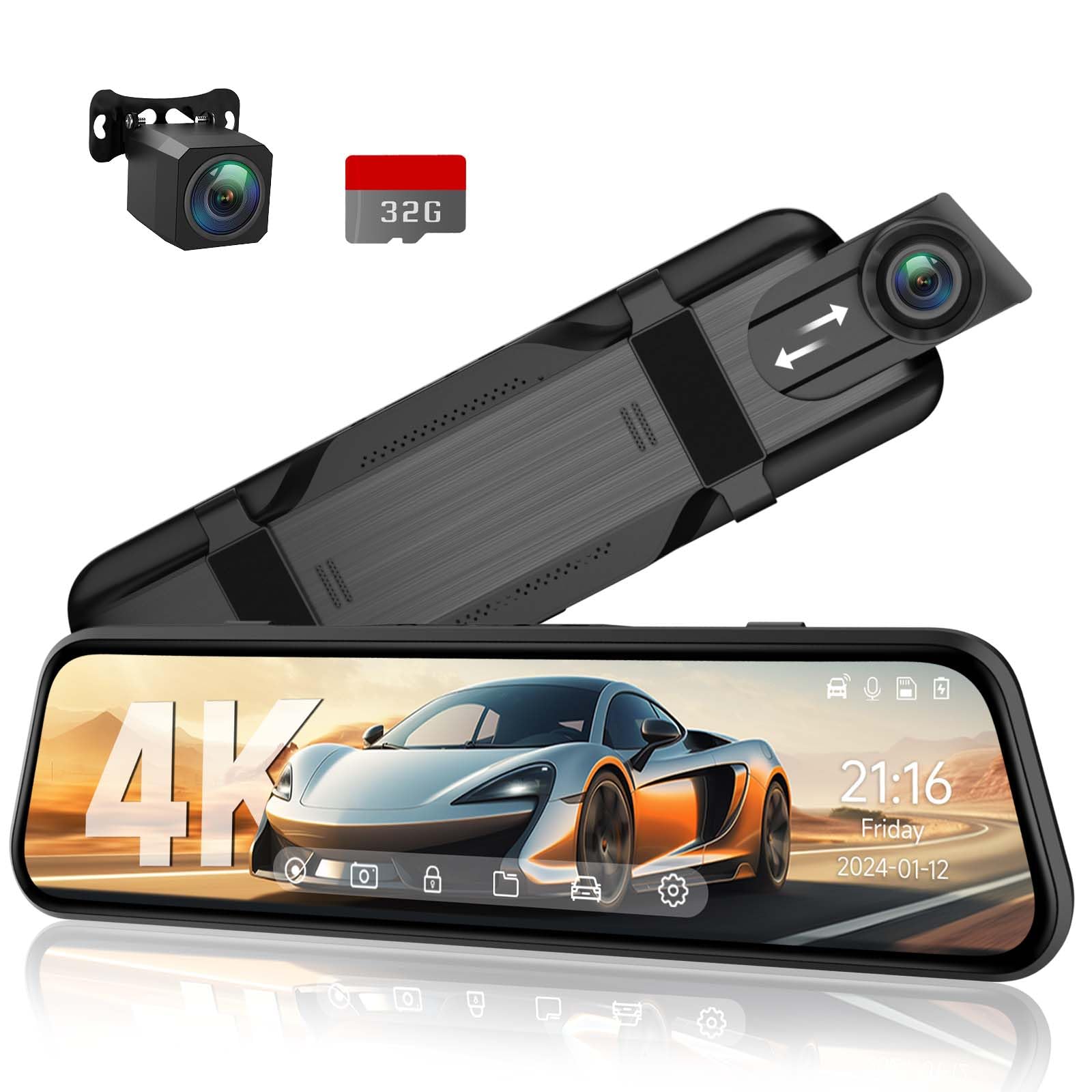
The Veement VT10 proves that 4K front recording and a responsive touchscreen do not require a premium budget. The 10-inch HD IPS display offers intuitive touch controls for adjusting brightness, date, and camera angle, and the full-touch interface is notably smoother than many units at twice the price. The front camera captures 4K video at a wide 170-degree angle, while the rear camera records at 1080P with a 160-degree field of view. The F1.8 aperture on both lenses helps maintain clarity in low light, and the super night vision mode preserves usable detail in parking lots and dimly lit streets.
Voice control covers the essentials: locking video, taking photos, and toggling audio recording. The commands are recognized reliably without requiring a specific cadence, and the voice confirmation lets you know the action was registered. The included 32GB SD card provides immediate storage, and the G-sensor automatically locks footage when a collision is detected. The parking monitor mode requires a three-conductor step-down cable (V3F) for 24/7 surveillance, which is sold separately — standard for this category. The interface separates front, rear, and locked footage into distinct folders, making file management straightforward.
Owners consistently praise the video quality for the price point, noting that license plates are readable during the day and that the rear camera provides a genuine backup view when reversing. The main compromises are in daylight screen brightness — the display can struggle against direct sunlight, and the glossy screen surface picks up reflections that compete with the camera feed. A few owners in taller vehicles (vans, lifted trucks) report that the rear camera makes objects appear farther away than they are, which takes adjustment. The rubber strap mounting system is secure but may not sit perfectly flat on mirrors with unusual contours.
What works
- 4K front recording at a very accessible price point
- Touchscreen interface is responsive and well-organized
- Voice commands work reliably without special calibration
- Included SD card means immediate out-of-box functionality
What doesn’t
- Daytime screen brightness is insufficient in direct sunlight
- Glossy display surface creates distracting reflections
- Rear camera distance perception can feel misleading at first
6. JINGEA Ford Compatible Mirror

The JINGEA Ford-compatible mirror is the simplest product on this list and exactly what many drivers need: a direct OEM-style replacement that slides onto the existing windshield button and stays put. It fits a wide range of Ford models including the F-150 (1997–2009), Ranger (1998–2005), Mustang (1997–2012), Escape (2001–2016), and Explorer (1997–2010), as well as several GM, Dodge, and Saturn models. The glass measures 10.2 inches wide with a convex curvature that provides a slightly wider field of view than the stock flat mirror, and the manual day/night flip tab reduces glare from headlights behind you.
Build quality is surprisingly good at this level. The mirror body uses a combination of glass and plastic that feels solid in hand, and the bracket engages the windshield button with a positive click. The set screw locks the mirror in place securely, and owners report zero vibration or sagging even on trucks with stiff suspensions and rough roads. The anti-glare function works as intended — flipping the tab darkens the reflection enough to eliminate blinding headlight glare without losing the ability to see shapes and movement behind the vehicle. The included windshield button and bracket cover all common Ford mounting patterns.
The main limitation is that this is a pure replacement mirror with no electronics. There is no auto-dimming, no compass, no HomeLink, and no camera input. If your vehicle originally had a manual mirror, this swap is a five-second install. If you are replacing an auto-dimming or feature mirror, you will lose those functions. A few owners note that the convex glass takes a day or two to get used to because objects appear slightly smaller and farther away than with a flat mirror. For the driver who just wants a clear, stable, affordable mirror, this unit delivers exactly that without any unnecessary complexity.
What works
- Direct bolt-on replacement for dozens of Ford and compatible models
- Rock-solid mount with no vibration on rough roads
- Manual day/night flip works well against headlight glare
- Installation takes less than 30 seconds
What doesn’t
- No auto-dimming, compass, or electronic features
- Convex glass requires visual adjustment period
- Only fits specific model year ranges — verify compatibility carefully
7. JINGEA Jeep Compatible Mirror

The JINGEA Jeep-compatible mirror targets a specific but large audience: Wrangler, Cherokee, Compass, and Patriot owners looking for a drop-in replacement that can handle off-road vibrations without drooping or cracking. It fits Jeep Wrangler YJ (1987–1995), TJ (2003–2006), JK (2007–2012), and JL (2013–2017), along with Cherokee (2002–2013), Compass (2007–2016), and Patriot (2011–2017). The tempered glass construction is noticeably more resistant to thermal stress and impact than standard annealed glass mirrors, which matters for vehicles that see trail duty and temperature extremes. The 9.5-inch width is slightly narrower than the Ford version, matching the smaller cabin proportions of most Jeep models.
The manual day/night tab operates with a firm, positive detent and provides meaningful glare reduction without making the reflection too dark to use. The convex lens curvature gives a wider field of view than the factory flat mirror, which helps compensate for the large blind spots inherent to boxy SUV and off-road designs. The included windshield bracket and adhesive button cover the standard Jeep mounting pattern, and the mirror locks onto the button with a secure slide-and-tighten mechanism. Owners report that the mirror stays firmly in place even during aggressive off-road driving on washboard roads and steep inclines — a critical requirement for Wrangler and Cherokee owners.
As with the Ford version, this is a straightforward manual mirror with no electronic features. If your Jeep came with an auto-dimming or temperature-compass mirror from the factory, swapping to this unit means losing those functions. The convex glass also gives a slightly compressed sense of distance, which takes adjustment for drivers accustomed to flat mirrors. A handful of owners mention that the mirror sits at a slightly different angle than the original, requiring a minute of adjustment with the set screw. For anyone with a cracked, sagging, or delaminated factory mirror in a compatible Jeep, this replacement offers genuine durability at a fraction of the dealer part cost.
What works
- Tempered glass construction resists cracking from vibration and temperature changes
- Secure mount holds position during off-road driving
- Wider convex view helps reduce SUV blind spots
- Quick and simple installation with included bracket
What doesn’t
- No auto-dimming or electronic features
- Convex glass compresses distance perception
- Angle may differ slightly from factory — requires set screw adjustment
Hardware & Specs Guide
Mirror Glass Types
Flat glass provides accurate distance perception and is standard on most factory mirrors. Convex glass curves outward slightly, widening the field of view by about 30 percent but making objects appear smaller and farther away. Tempered glass, used in the JINGEA Jeep mirror, resists thermal shock and impact better than standard annealed glass. Electrochromic (auto-dimming) glass uses a gel layer that darkens when it detects bright light from behind, reducing glare automatically.
Digital Display Technologies
IPS LCD panels offer the widest viewing angles and best color reproduction, making them ideal for mirror-mounted displays. TFT LCDs are less expensive but have narrower viewing angles and lower contrast in bright conditions. AHD (Analog High Definition) transmission provides 1080P resolution over standard RCA cables with minimal latency, while digital transmission (used by WiFi-based systems) offers higher bandwidth at the cost of potential signal lag. Touchscreen responsiveness varies significantly between capacitive (smooth, multi-touch) and resistive (pressure-based) panels.
Camera Sensor Specifications
The sensor is the most important determinant of night vision quality. STARVIS 2 sensors (found in the Pelsee S12 Pro) use back-illuminated pixel architecture that doubles low-light sensitivity compared to standard CMOS sensors. Aperture size (F1.8 vs. F2.0) controls how much light reaches the sensor — lower F-numbers mean better low-light performance. Wide dynamic range (WDR/HDR) processing merges multiple exposures into a single frame to preserve detail in scenes with both bright and dark areas, such as tunnel exits or sunset driving.
Mounting Mechanisms
Windshield button mounts use a triangular or circular metal button bonded to the glass. The mirror slides onto the button and is secured by a set screw or spring clip. OEM bracket mounts replace the entire original mirror assembly and bolt directly to the windshield mounting plate using vehicle-specific adapters. Universal rubber strap mounts (used by most dash cam mirrors) stretch over the existing mirror without removal, making installation tool-free but adding bulk. Vehicle-specific fit mirrors guarantee compatibility with the original button geometry, while universal mirrors include multiple adapters to cover different patterns.
FAQ
Can I install a digital rear view mirror in any vehicle?
How does the manual day/night flip tab work?
Do I need a hardwire kit for parking monitoring?
Final Thoughts: The Verdict
For most buyers, the best car rear view mirror winner is the Pelsee S12 Pro because it combines a class-leading STARVIS 2 night vision sensor, useful ADAS alerts, and a responsive touchscreen in a package that works out of the box with a pre-installed 64GB card. If you prioritize blind spot detection and rear collision warnings above all else, grab the WOLFBOX G850 PRO for its integrated BSD system and extra-long rear camera cable. And for a clean OEM-style upgrade without dash cam complexity, nothing beats the AUTO-VOX T9 with its rock-solid bracket mount and factory-integrated look.

Certification: BSc in Mechanical Engineering
Education: Mechanical engineer
Lives In: 539 W Commerce St, Dallas, TX 75208, USA
Md Amir is an auto mechanic student and writer with over half a decade of experience in the automotive field. He has worked with top automotive brands such as Lexus, Quantum, and also owns two automotive blogs autocarneed.com and taxiwiz.com.