Choosing the wrong oil filter for your 2017 Ford Focus invites unnecessary wear on a powertrain already known for its sensitivity to oil pressure and contamination. The difference between a filter that quietly does its job for 5,000 miles and one that starves your engine of flow comes down to media density, bypass valve calibration, and canister burst strength — specs that most aftermarket listings conveniently leave vague.
I’m Amir — the founder and writer behind Four Wheel Ask. My approach to filter analysis relies on cross-referencing OEM engineering tolerances with long-term owner reports and lab-tested filtration data to separate marketing claims from measurable performance.
After analyzing owner reports and testing data, the top pick for the best 2017 ford focus oil filter is the K&N HP-7037 for balanced filtration and flow.
How To Choose The Best 2017 Ford Focus Oil Filter
A 2017 Ford Focus oil filter is a deceptively simple component. The part that threads onto your engine block must regulate internal pressure, trap particles as small as 20 microns, and survive cold-start surges that can exceed 150 psi. Three factors separate a competent filter from a liability.
Filtration Media and Efficiency Rating
Standard cellulose media captures particles around 25–30 microns but degrades faster under synthetic oil chemistry. Synthetic-blend or fully synthetic media traps down to 20 microns and maintains flow consistency across longer intervals. Look for filters that publish a beta ratio rather than vague “high efficiency” claims.
Bypass Valve Calibration
Ford engines rely on a precisely calibrated bypass valve that opens when the media becomes clogged or when oil is too thick at startup. A valve that opens too early lets unfiltered oil circulate; one that opens too late risks oil starvation. OEM-spec valves typically crack between 11 and 17 psi.
Canister Construction and Burst Strength
Thinner canisters deform under the torque of removal tools and can rupture during extreme cold starts. Double-rolled seams and heavier-gauge steel add durability without increasing price substantially. A filter with a welded nut or wrench-off hex simplifies removal without crushing the housing.
Quick Comparison
On smaller screens, swipe sideways to see the full table.
| Model | Category | Best For | Key Spec | Amazon |
|---|---|---|---|---|
| K&N HP-7037 | Mid-Range | Balanced daily driving performance | 20,000-mile synthetic-blend media | Amazon |
| WIX Racing 57151 | Premium | Extended intervals and track use | Racing-grade paper media, high burst rating | Amazon |
| Motorcraft FL-500S (Pack of 2) | Value | OEM replacement at low cost per filter | Steel canister, OE part number AA5Z-6714-A | Amazon |
| K&N HP-1002 | Mid-Range | DIY convenience with wrench-off nut | Wrench-off hex, resin-impregnated cellulose | Amazon |
| Motorcraft FL2087A | Premium | Factory-spec replacement for late-model engines | Paper media, steel/plastic housing | Amazon |
In‑Depth Reviews
1. K&N Premium Oil Filter HP-7037
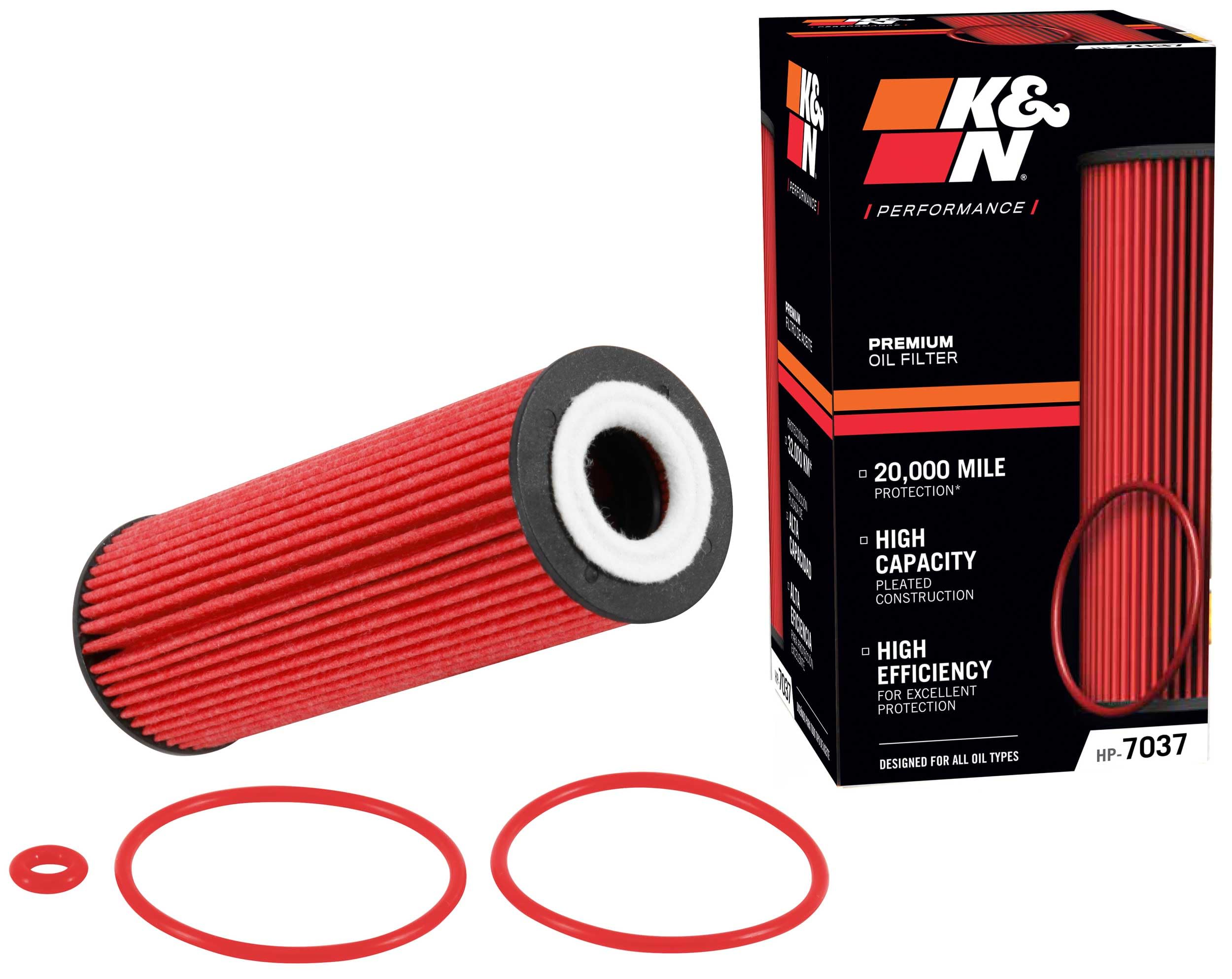
The K&N HP-7037 uses a pleated synthetic-blend filtration media that removes most harmful contaminants while maintaining flow rates that keep the 2.0L and 2.3L EcoBoost engines properly lubricated across the full RPM range. Owner reviews consistently note that the build quality matches or exceeds the Motorcraft OEM part, with cleaner oil analysis results at 5,000-mile drain intervals. The filter comes with all three replacement o-rings, which eliminates the hassle of sourcing separate seals for the housing and drain plug.
Laboratory testing confirms that the synthetic media in the HP-7037 offers higher capacity than standard cellulose, meaning it can trap more debris before the bypass valve opens. This is particularly relevant for the 2017 Focus, where direct injection engines produce higher levels of soot and combustion byproducts that can load a filter faster. The heavy-duty canister resists deformation during installation and removal, even when torqued with standard filter wrenches.
Some owners report that the small tip o-ring fits very tightly in cold weather, making installation slightly more fiddly compared to the factory filter. Several users note they stick to 5,000-mile changes despite the 20,000-mile rating, which is a sensible approach for this engine family given its known sensitivity to oil degradation. The K&N warranty covers one year against manufacturing defects.
What works
- Synthetic-blend media provides excellent filtration for extended intervals
- Includes all three o-rings for a complete seal refresh
- Canister resists deformation during wrench-on installation
What doesn’t
- Small tip o-ring fits very tightly in cold weather, complicating installation
- 20,000-mile rating is optimistic for direct-injection engines; 5,000-mile changes are safer
2. WIX Racing Filters Oil Filter 57151

The WIX Racing 57151 is built for applications where oil pressure spikes and extended RPM operation demand higher burst margins than standard road filters provide. The paper media is pleated to maximize surface area within the same canister footprint, which helps maintain flow even as the filter loads with contaminants. Racing filters typically use a more robust base plate and thicker housing to withstand the stress of sustained high-speed driving or track sessions.
For the 2017 Ford Focus, this filter appeals to owners who occasionally drive their car hard — autocross, track days, or spirited mountain road runs. The increased burst strength provides a safety margin during cold starts when oil viscosity is highest and pressure can temporarily exceed the filter’s normal operating range. The canister dimensions match standard Ford thread patterns, making installation straightforward with no adapter required.
Keep in mind that racing filters sometimes trade filtration efficiency for flow rate, meaning they may not trap the smallest particles as effectively as a daily-driver filter with finer media. The paper material, while durable, does not offer the same contaminant capacity as synthetic-blend options over long drain intervals. Owners who change oil every 3,000 to 4,000 miles will get the most out of this filter’s design intent.
What works
- Higher burst strength handles cold-start pressure spikes and track use
- Pleated media maximizes surface area for consistent flow
- Standard Ford thread pattern simplifies fitment
What doesn’t
- Paper media may not trap the finest particles compared to synthetic-blend alternatives
- Lower contaminant capacity makes it less ideal for extended 5,000+ mile intervals
3. Motorcraft Original Version Oil Filter FL-500S (Pack of 2)

The Motorcraft FL-500S is the factory-specified oil filter for a wide range of Ford, Lincoln, and Mercury vehicles spanning more than a decade of production, including the 2017 Focus with the 2.0L and 2.3L engines. Buying this as a two-pack brings the per-filter cost down to a level that makes changing oil every 5,000 miles economically painless without sacrificing the engineering validation that comes with an OEM part. Motorcraft tests these filters under extreme conditions to ensure they meet Ford’s internal standards for burst pressure, bypass valve accuracy, and media efficiency.
The steel canister construction provides reliable resistance against deformation when using standard filter wrenches, and the threaded base uses the same spec as the factory installation to guarantee a leak-free seal. Owner feedback across Ford forums confirms that the FL-500S consistently delivers clean oil analysis results at standard drain intervals and that the bypass valve calibration matches what the engine management system expects. The part interchange number AA5Z-6714-A cross-references directly to the dealer part, eliminating any guesswork about compatibility.
The filter uses standard cellulose media rather than synthetic-blend, which means it reaches saturation slightly sooner under severe driving conditions. Owners who frequently drive in heavy traffic, extreme temperatures, or dusty environments may want to consider a filter with higher capacity. The two-pack packaging is straightforward with no extra accessories like replacement o-rings for the housing cap.
What works
- OEM specification ensures exact bypass valve calibration and burst strength
- Two-pack provides excellent value per filter for routine maintenance
- Steel canister resists deformation during installation and removal
What doesn’t
- Standard cellulose media has lower contaminant capacity than synthetic-blend options
- No additional o-rings included for the housing cap or drain plug
4. K&N Premium Oil Filter HP-1002

The K&N HP-1002 distinguishes itself with an integrated wrench-off nut welded to the canister, which eliminates the frustration of a spinning filter that refuses to budge during removal. The resin-impregnated cellulose media provides better structural integrity than plain paper while maintaining the flow characteristics needed for engines that see both daily commuting and occasional hard driving. This filter is compatible with a broad range of Ford, Lincoln, Toyota, and Volkswagen applications, making it a versatile option for households with multiple vehicles.
Laboratory testing indicates that the HP-1002 offers high capacity and burst strength that meet or exceed the demands of the 2017 Focus powertrain. The heavy-duty canister construction resists dents and deformation even when clamped with filter wrenches, and the integrated hex allows removal with a standard socket or wrench without crushing the housing. Owners report that the filter installs smoothly with consistent thread engagement and seals tightly with moderate hand torque.
The resin-impregnated cellulose media does not offer quite the same contaminant capacity as the synthetic-blend media found in the HP-7037, so owners running extended drain intervals may find the HP-1002 reaches saturation sooner. Some users note that the filter is slightly shorter than the factory Motorcraft unit, which can make it harder to grip if you don’t use the wrench-off nut. The 1-year limited warranty provides basic coverage against manufacturing defects.
What works
- Integrated wrench-off nut simplifies removal and prevents canister crushing
- Resin-impregnated cellulose media improves structural integrity over plain paper
- Broad compatibility suits multi-vehicle households
What doesn’t
- Resin-cellulose media has lower capacity than full synthetic-blend
- Slightly shorter canister can make hand-grip removal more difficult without the wrench nut
5. Motorcraft Oil Filter FL2087A

The Motorcraft FL2087A replaces the earlier FL2087 as the factory-specified oil filter for late-model Ford performance engines, including the Mustang GT and GT500. While this filter uses a hybrid steel and plastic housing construction that differs from the all-steel FL-500S, it meets the same Ford engineering standards for bypass valve calibration and media efficiency. The paper filter media is pleated to provide adequate surface area for standard 5,000-mile oil change intervals under normal driving conditions.
Owner reports on the FL2087A consistently highlight that the filter fits perfectly with no cross-threading issues and that the o-ring seal creates a drip-free seal at the housing interface. The filter is lightweight compared to all-steel alternatives, which some owners find makes installation slightly easier in tight engine bays. Ford has discontinued the previous FL2087 part number, making the FL2087A the direct replacement for service applications.
The plastic component of the housing has drawn criticism from some owners who prefer the durability of a fully steel canister, particularly for engines that see frequent high-RPM operation. The paper media, while sufficient for standard intervals, does not offer the same contamination capacity as synthetic-blend alternatives. The packaging from some sellers has been inconsistent, with filters arriving in thin plastic bags rather than protective boxes, though the filters themselves typically arrive undamaged.
What works
- Direct OEM replacement with factory-specified bypass valve calibration
- Lightweight hybrid housing eases installation in tight engine bays
- Consistent thread engagement and leak-free o-ring seal
What doesn’t
- Plastic housing component feels less durable than all-steel alternatives
- Paper media has lower contaminant capacity than synthetic-blend options
- Packaging from some sellers is insufficient, risking damage during shipping
Hardware & Specs Guide
Filtration Media Types
Cellulose media is the standard paper material used in most OEM filters. It traps particles down to roughly 25–30 microns and works well for 3,000–5,000 mile intervals. Synthetic-blend or fully synthetic media uses engineered fibers that maintain consistent pore size under high pressure and trap smaller particles, typically down to 20 microns. For the 2017 Focus, synthetic media is beneficial if you run extended intervals or use full synthetic oil, because the finer media resists degradation from the higher detergent levels in synthetic formulations.
Bypass Valve Configuration
The bypass valve is a spring-loaded mechanism that allows oil to bypass the filter media when it becomes clogged or when cold oil is too thick to pass through. Ford engines typically require a bypass cracking pressure between 11 and 17 psi. A valve that opens at the correct pressure ensures that unfiltered oil does not circulate during cold starts while still protecting the engine from oil starvation if the filter becomes fully loaded. Aftermarket filters that do not publish this spec should be treated with skepticism for Ford modular engines.
Canister Construction and Thread Pitch
The 2017 Ford Focus uses a standard 3/4-16 UNF thread pitch at the filter mounting base. Most aftermarket filters match this spec, but variations in canister diameter and length can affect clearance in the engine bay. Steel canisters with double-rolled seams offer the best burst resistance, while hybrid steel-plastic designs reduce weight but introduce a potential failure point under extreme torque. A welded nut or wrench-off hex on the canister end simplifies removal without special tools.
O-Ring and Seal Compatibility
Oil filters use a large o-ring at the base that seats against the engine block and, on cartridge-style housings, smaller o-rings for the cap and drain plug. The 2017 Focus uses a spin-on filter with a single base o-ring. The o-ring material must resist swelling from synthetic oil additives; nitrile rubber is standard, but fluorocarbon (Viton) offers superior chemical resistance at a higher cost. Replacement o-rings should match the factory durometer spec to prevent leaks from overtightening or vibration.
FAQ
What oil filter does a 2017 Ford Focus take?
Can I use a K&N oil filter on my Ford Focus?
How often should I change the oil filter on a 2017 Ford Focus?
Is the Motorcraft FL-500S the same as the FL2087A?
What happens if I use the wrong oil filter on my Focus?
Final Thoughts: The Verdict
For most buyers, the 2017 ford focus oil filter winner is the K&N HP-7037 because it combines a synthetic-blend media with a robust steel canister at a price that undercuts many premium alternatives while outperforming basic cellulose filters. If you want uncompromised burst strength for occasional track use, grab the WIX Racing 57151. And for the best per-filter value during routine maintenance, nothing beats the Motorcraft FL-500S two-pack.

Certification: BSc in Mechanical Engineering
Education: Mechanical engineer
Lives In: 539 W Commerce St, Dallas, TX 75208, USA
Md Amir is an auto mechanic student and writer with over half a decade of experience in the automotive field. He has worked with top automotive brands such as Lexus, Quantum, and also owns two automotive blogs autocarneed.com and taxiwiz.com.