A Level 2 charger is only as reliable as the outlet it plugs into. Many homeowners discover this the hard way when an entry-level receptacle begins to run hot, develops intermittent faults, or—in the worst cases—shows signs of melting after just a few months of daily use. The difference between a safe, long-lasting installation and a fire risk often comes down to the internal construction of a single electrical component.
I’m Amir — the founder and writer behind Four Wheel Ask. My work involves poring over technical specifications, evaluating material grades, and analyzing owner-reported thermal performance across hundreds of residential EV installations to separate genuine upgrades from marketing claims.
For any EV owner, choosing the best ev charging outlet prevents fire hazards by evaluating proper construction, heat resistance, and wire termination.
How To Choose The Best EV Charging Outlet
Selecting the right receptacle for Level 2 EV charging is less about brand preference and more about understanding three core engineering distinctions: terminal design, internal contact construction, and material grade. A standard 50A range or dryer outlet uses components meant for infrequent, short-duration loads. An EV charger can pull 40A to 48A continuously for 6-12 hours, which exposes weak points quickly.
Terminal Connection Type
The most common failure point in budget outlets is the wire termination. Standard outlets often use a phillips-head screw that clamps a small plate against the wire. Under sustained thermal cycling, these connections loosen, increasing resistance and generating heat. Premium industrial-grade receptacles use hex-drive compression clamps or set-screw lugs that allow precise torquing to manufacturer specifications, typically 75 in-lbs, ensuring a stable, low-resistance connection for the long term.
Contact Material and Geometry
The internal contacts that grip the plug prongs are critical. Many entry-level receptacles use half-length brass contact strips that provide less surface area for current transfer. When combined with high amperage draw, these shorter contacts can overheat and lose their spring tension. Industrial-grade units use full-length, heavy-gauge brass or copper alloy contacts that run cooler and maintain grip over thousands of insertion cycles, which is particularly important when the plug remains seated for extended charging sessions.
Quick Comparison
On smaller screens, swipe sideways to see the full table.
| Model | Category | Best For | Key Spec | Amazon |
|---|---|---|---|---|
| Bryant 9450FR | Industrial Grade | Maximum continuous load safety | Full-length brass contacts, hex compression lugs | Amazon |
| Hubbell HBL9450A | Industrial Grade | Proven thermal performance | V-groove hex-clamp contacts, 50A rating | Amazon |
| Hubbell HBL9450A | Industrial Grade | Reliable alternative to melting outlets | Full pin coverage, 5/16″ hex screw V-block | Amazon |
| Midwest U054P | Weatherproof Enclosure | Outdoor/garage installation | Factory-wired 50A, NEMA 3R galvanized steel | Amazon |
| Leviton 1450W | Heavy Duty Receptacle | Weather-resistant EV application | High-impact nylon, 4mm hex drive torquing | Amazon |
| Leviton 1450R | Heavy Duty Receptacle | Value-oriented EV charging | Nylon construction, pressure-wire terminals | Amazon |
| Suplevel 14-50 Outlet Box | Enclosed Outdoor Box | Complete outdoor package | Lockable NEMA 3R metal box, EV-grade socket | Amazon |
In‑Depth Reviews
1. Bryant 9450FR Industrial Grade NEMA 14-50
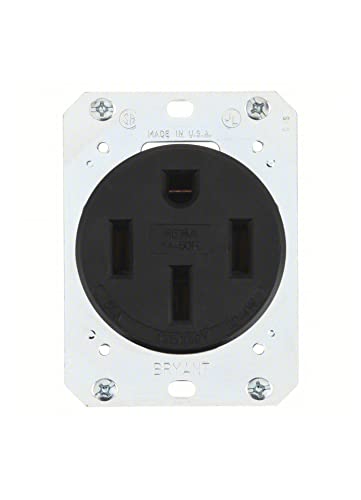
The Bryant 9450FR represents the industrial-grade standard that many EV owners and experienced electricians cite as the benchmark for continuous high-amperage applications. Owner reports consistently note that this unit is manufactured by the same parent company as Hubbell, sharing the same core internal architecture—full-length brass contact strips and hex-drive compression terminals—but often available at a slightly more accessible investment point. The internal design eliminates the half-length stamped contacts found in budget receptacles, directly addressing the overheating and melting issues that plague lower-tier outlets during extended Level 2 charging sessions.
Installation feedback highlights the importance of the compression-style lugs, which accept a standard 3/16-inch Allen wrench and allow for precise torquing to the manufacturer’s 75 in-lb specification. Owners who upgraded from standard residential receptacles report a dramatic reduction in operating temperature at the plug face, with one Tesla owner documenting a consistent 34-35 miles of range added per hour of charge without any thermal events. The unit requires a dedicated faceplate with a larger 2 15/32-inch bore, which is a consideration for anyone retrofitting an existing box, but this is a minor trade-off for the improved safety margin.
Several long-term users have noted that this outlet is the only type recommended by Tesla technicians and certified electricians when asked for a replacement for a failed or melted 14-50 receptacle. The consensus among owner forums is that the initial material cost is recouped quickly through peace of mind and the elimination of recurring EVSE ground-fault errors that often signal impending outlet failure. For anyone installing a new 50A circuit or replacing an existing outlet that shows any sign of heat distress, the Bryant 9450FR is the most technically sound choice available at this price tier.
What works
- Industrial-grade full-length brass contacts for efficient heat dissipation
- Hex-drive compression lugs allow precise torque application
- Proven track record in high-mileage EV charging installations
What doesn’t
- Requires a non-standard faceplate with a larger bore opening
- Slightly deeper body may need a larger junction box
2. Hubbell Wiring Device-Kellems HBL9450A
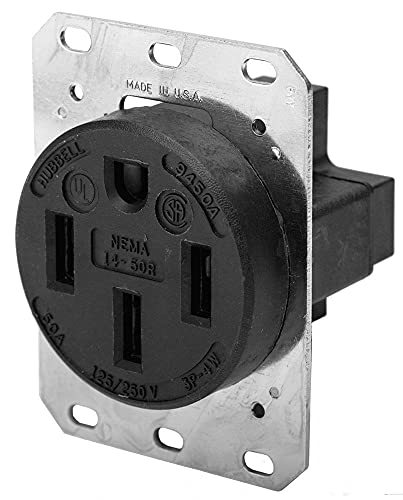
The Hubbell HBL9450A is arguably the most frequently referenced NEMA 14-50 receptacle in EV owner communities focused on long-term reliability. Its defining feature is the V-groove hex-clamp contact system, which uses a 5/16-inch hex screw to compress a solid copper V-block directly onto the wire, creating a gas-tight connection that resists the thermal loosening seen in Phillips-head designs. This engineering detail is repeatedly cited by owners as the reason their installation runs cool even after years of nightly charging cycles at 32 to 40 amps.
Feedback from owners who upgraded from a melted Leviton or generic box-store outlet is strikingly consistent: the Hubbell runs at significantly lower temperatures, typically described as barely warm to the touch at 40A, whereas the previous outlet was hot enough to trigger Tesla’s high-temperature charging alert. The unit is rated for 50A continuous and carries both UL and CSA certifications, providing a clear code-compliant path for inspection. Owners stress that purchasing from a reputable seller is important, as counterfeit units with inferior internals have been reported on some online marketplaces.
The main practical consideration is the faceplate requirement, which needs a 2 15/32-inch diameter opening rather than the standard 2 1/8-inch hole used by typical residential 14-50 receptacles. This necessitates a specific cover plate, such as the Hubbell SS701, and may require a deeper box for proper wire bending space. Despite this installation nuance, the overwhelming owner consensus is that the HBL9450A is the definitive standard for anyone prioritizing fire safety and long-term performance in their EV charging setup.
What works
- Superior V-groove hex-clamp termination for stable high-current connection
- Remains cool during extended 40A charging sessions
- UL and CSA listed for code compliance
What doesn’t
- Requires specialized large-bore faceplate
- Premium price tier compared to standard receptacles
3. Hubbell HBL9450A (Alternate Listing)

This alternate listing for the Hubbell HBL9450A refers to the same underlying industrial-grade receptacle, which is widely regarded as the benchmark for EV charging outlets. The unit’s internal design includes full-length conductive contact pins that engage the entire plug blade surface, distributing current across a larger area and reducing resistive heating. Owner reports comparing this directly to standard Leviton receptacles highlight that the cheaper units use half-length stamped steel or galvanized prongs that can loose spring tension and cause arcing after repeated thermal cycles.
Long-term user accounts document significant real-world performance differences. One owner reported that their Leviton outlet began exhibiting EVSE ground-fault errors after two years of daily charging, and when disassembled, revealed internal plastic melting despite the breaker never tripping. Replacing it with this Hubbell unit resolved the errors entirely, with the new outlet reaching a maximum temperature of 95°F at 40A, while the old unit had been running hot enough to degrade its internal components. The 5/16-inch hex screw and copper V-block clamping system is specifically designed to address this failure mode.
Installation requirements mirror the other Hubbell listing—a 4-11/16-inch junction box is recommended for adequate wire space, and the faceplate must have a 2 31/64-inch hole (Hubbell model SS701). Owners confirm that torquing the wire clamps to 75 in-lbs using a hex bit and a torque wrench is essential for achieving the advertised thermal performance. While this receptacle represents a premium investment compared to standard options, the community consensus remains that it is the most cost-effective fire-prevention measure available for a Level 2 charging installation.
What works
- Full pin coverage for superior current transfer
- Heavy-duty copper V-block eliminates common thermal failure points
- Widely recommended by EV technicians and installers
What doesn’t
- Higher cost may deter budget-conscious buyers
- Requires specific deeper box and larger faceplate
4. Midwest U054P Weatherproof RV Outlet Box
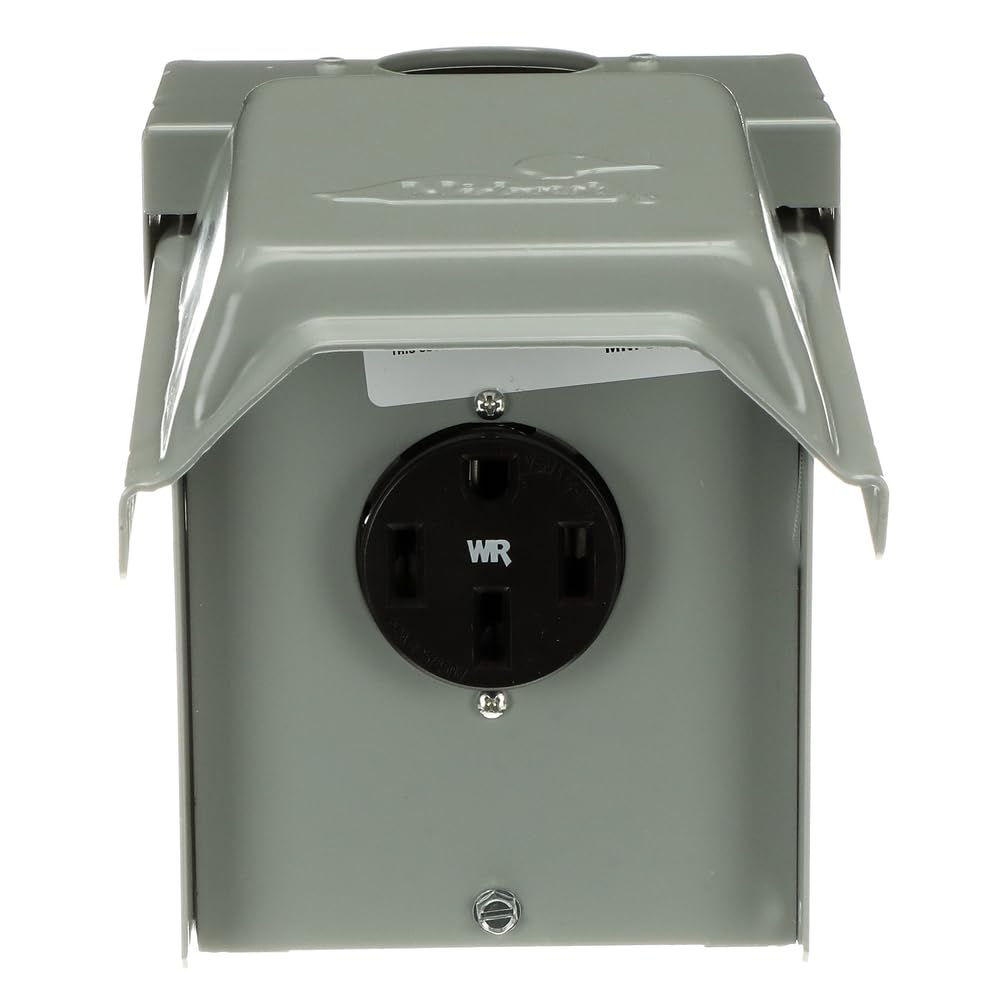
The Midwest U054P takes a different approach by offering a complete, factory-assembled enclosure rather than a standalone receptacle. This unit features a NEMA 3R galvanized steel box with a built-in 50A 14-50R receptacle, designed specifically for outdoor use where weather resistance and security are primary concerns. The factory-wired assembly eliminates the need for field-wiring the socket itself; the installer simply connects the incoming cable to the internal terminals and mounts the box, making it an efficient solution for exterior garage walls, carports, or RV pad installations.
Owner reports from EV users highlight the convenience of the weatherproof locking lid, which provides a degree of protection during active charging and secures the receptacle when not in use. The welded flange and G90 galvanized steel construction are rated for harsh outdoor exposure, and several owners report successful installations that have held up for years against rain, snow, and direct sunlight. The unit also includes padlock provisions and a dead-front design that prevents accidental contact with live components, addressing safety concerns for households with children or renters.
The primary trade-off noted by buyers is that while the enclosure is robust and weather-resistant, the receptacle inside is not the industrial-grade Hubbell or Bryant design. Owners using this unit at the full 40A or 48A continuous charge rate should monitor the outlet temperature periodically, as the enclosed space can trap heat. Some users have mitigated this by pairing the Midwest box with a separate high-grade receptacle replacement if long-term reliability at maximum amperage is the priority. For moderate outdoor use or RV applications, however, this all-in-one solution remains a popular and code-compliant choice.
What works
- Pre-assembled and factory-wired for quick installation
- Rugged NEMA 3R galvanized steel weatherproof enclosure
- Lockable cover with safety dead-front construction
What doesn’t
- Included receptacle is not industrial-grade for extreme continuous loads
- Sealed design can retain heat inside the enclosure
5. Leviton 1450W 50 Amp Weather-Resistant Receptacle
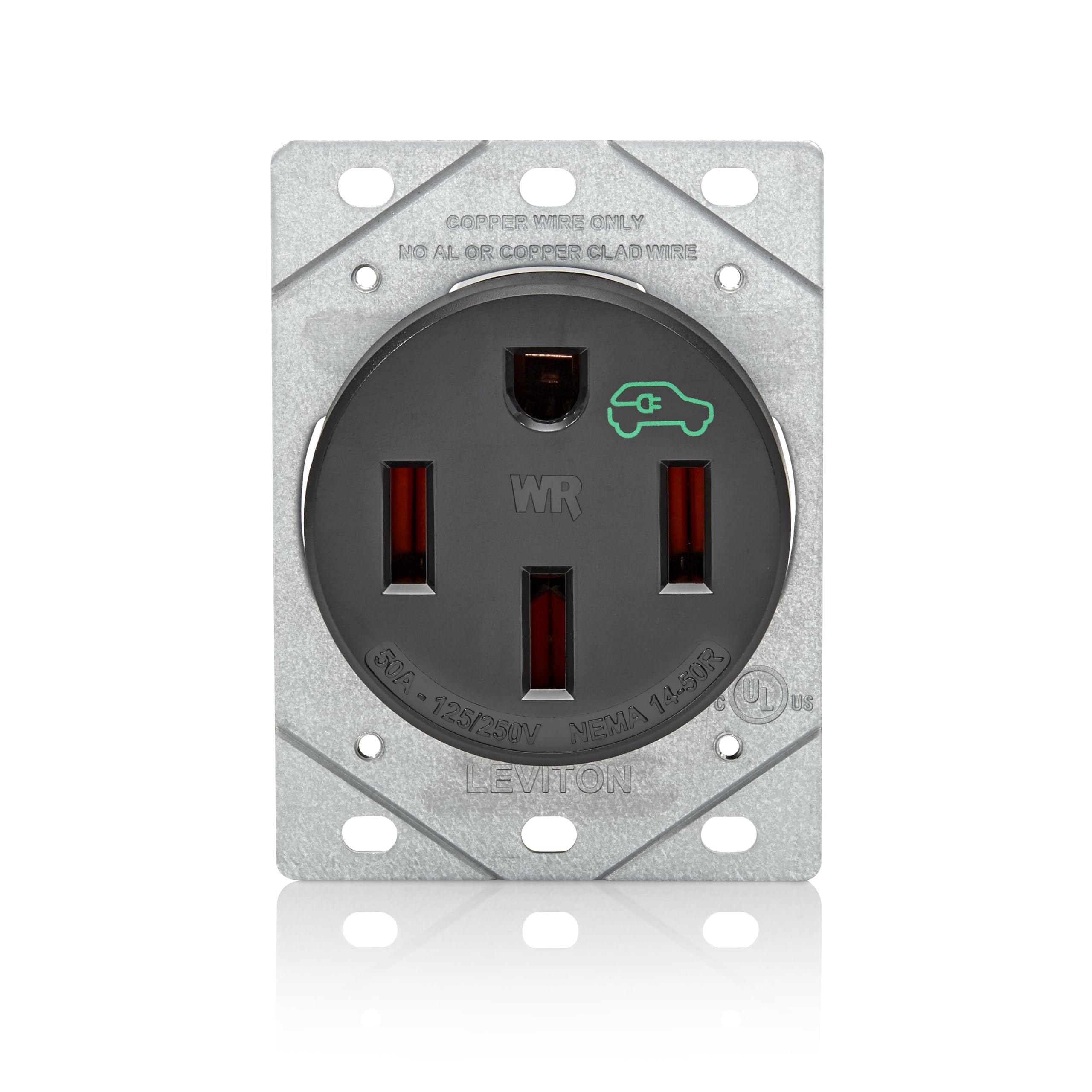
The Leviton 1450W is a dedicated EV-grade receptacle that represents a meaningful improvement over the company’s standard 50A range outlet. It incorporates a 4mm hex-drive terminal system, which is a significant upgrade from the basic Phillips-head screws found on the older residential models. This design change allows for consistent torque application of 75 in-lbs, directly addressing the most common cause of failure in EV charging circuits—loose connections that generate heat under sustained load. The body is constructed from high-impact nylon, offering good mechanical strength and resistance to physical damage during installation.
Owner feedback consistently emphasizes the build quality difference compared to standard Leviton 14-50 outlets. The internal contacts are visibly more robust, with full-width brass blades that provide better contact surface area for the plug. One owner specifically called out the hex-drive feature as the reason for switching, noting that it allows for a much more secure termination. The receptacle is also slightly deeper than the standard model, which may require a deeper box or a raised cover for proper fitment. Several buyers have paired this unit with a larger two-gang metal in-use cover to accommodate the heavier charger plug.
While the 1450W is a competent EV-rated outlet suitable for most home installations, it does not reach the same industrial-grade specification as the Bryant or Hubbell units. Some owner reports suggest that under continuous 48A charging, the 1450W may run warmer than the premium options. For many homeowners charging at 32A or 40A, however, this receptacle represents a solid middle-ground choice that provides a significant safety margin over basic outlets without the full premium investment of an industrial-grade unit.
What works
- Hex-drive terminals for precise torque control
- Durable high-impact nylon construction
- Upgraded internal contacts compared to standard 14-50 models
What doesn’t
- Not industrial-rated for extreme continuous loads
- Slightly larger body may require box modification
6. Leviton 1450R 50 Amp EV Charging Receptacle

The Leviton 1450R is positioned as an entry-level EV-rated receptacle, designed to fill the gap between a standard range outlet and the higher-cost industrial units. It retains the pressure-wire terminal design, which uses a Phillips-head screw to clamp the wire against a brass plate. While less sophisticated than a hex-drive compression lug, this design is familiar to most electricians and can achieve a secure connection when properly torqued. The unit is constructed from durable high-impact nylon and is specifically marketed for EV charging applications, meaning it is built to sustain the longer charge times typical of Level 2 charging.
Owner feedback presents a balanced picture. On the positive side, many users report successful long-term installations when charging at 32A and have noted that the outlet runs warm but not hot. Several owners upgraded from even cheaper generic outlets and experienced immediate improvements in reliability and a reduction in heat. One Tesla owner used a temperature probe to confirm that the 1450R maintained safe temperatures over a month of testing. The consensus among these users is that for moderate charging needs, this is a competent and cost-effective option.
However, owners who charge at higher amperages or have experienced melting issues with previous outlets often caution that the 1450R does not match the thermal performance of the Bryant or Hubbell units. At 48A, the internal half-length contacts may approach their thermal limits, leading to long-term degradation. The screw terminals, while adequate, are more susceptible to loosening over time compared to a compression clamp. For someone on a strict budget who charges at 32A or below, the 1450R is a reasonable choice; for maximum safety margin at higher charge rates, stepping up to an industrial-grade unit is the more prudent path.
What works
- Affordable entry point for EV-rated receptacles
- Robust nylon housing with good impact resistance
- Sufficient for moderate 32A charging applications
What doesn’t
- Phillips-head terminals less secure than hex compression
- Not recommended for continuous 48A charging
7. Suplevel 50 Amp EV/RV Power Outlet Box
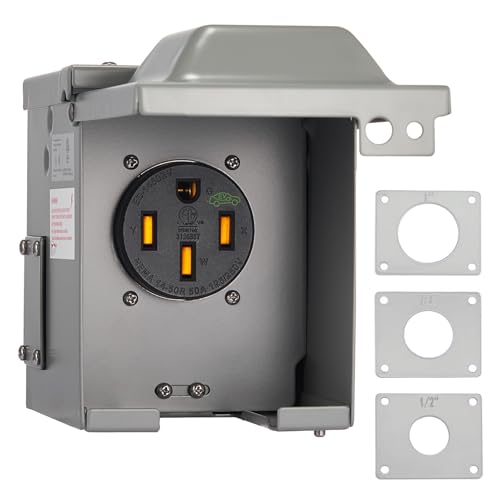
The Suplevel 50 Amp EV/RW Power Outlet Box is a complete solution that pairs an EV-grade NEMA 14-50 socket with a lockable, weatherproof NEMA 3R metal enclosure. This approach targets homeowners who want a single SKU that includes both the receptacle and a suitable outdoor housing, avoiding the complexity of sourcing a separate box and faceplate. The socket inside is specified as EV-grade, designed to handle the extended charge times required by electric vehicles, and the box has ample interior space to accommodate large 50A plug handles and heavy-duty extension cords without forcing the door open.
Owner feedback emphasizes the ease of installation and the robust feel of the metal enclosure. The box includes pre-drilled knockouts on multiple sides with replaceable plates and gaskets, giving the installer flexibility in cable entry direction. Users note that the outlet uses internal hex-bit lugs for wire termination, which is a step up from basic screw terminals and allows for more secure tightening compared to Phillips-head designs. The lockable cover provides security for outdoor installations, which is a practical benefit for shared driveways or rental properties where unauthorized use is a concern.
While the Suplevel box offers excellent convenience and a quality enclosure, the long-term thermal performance of the included socket at maximum continuous load is less documented than the more established standalone industrial receptacles. Some owners have opted to use the box with a higher-grade receptacle swapped in for peace of mind. For an all-in-one package that covers the needs of typical 32-40A home charging in an outdoor setting, the Suplevel delivers solid value and ETL certification, though those planning to consistently draw 48A should consider a separate industrial-grade socket plus a heavy-duty enclosure.
What works
- Complete package includes both box and EV-grade socket
- Lockable weatherproof metal enclosure for outdoor use
- Internal hex-bit lugs for improved wire connection
What doesn’t
- Included socket may not match industrial-grade thermal capacity
- Limited long-term owner feedback at maximum amperage
Hardware & Specs Guide
NEMA 14-50 Configuration
All outlets in this guide use the NEMA 14-50 configuration: a 50-amp, 125/250-volt, 3-pole, 4-wire grounding design with two hot wires, a neutral, and a ground. This is the standard receptacle for Level 2 EV charging in North America, compatible with virtually all major EV mobile connectors. The 14-50 plug is also common in RV parks, making it a versatile choice for dual-use installations. The key differentiator among products is not the configuration itself—all meet the NEMA dimensional standard—but the internal materials: full-length brass vs. half-length stamped contacts, and the terminal type that secures the wire.
Torque Specifications
Proper terminal torque is the single most important factor in EV outlet longevity. Standard residential receptacles often lack a specified torque value, or their screw design makes it difficult to apply consistent force. Industrial-grade units specify 75 in-lbs (8.5 N-m) and use hex-drive compression lugs that can be tightened with a torque wrench attachment. Thermal expansion and contraction during charging cycles can gradually loosen a poorly tightened connection, increasing contact resistance and generating heat. Using a calibrated torque wrench to tighten the wire clamps to the manufacturer’s spec is a code-recommended practice that directly impacts safety and reliability.
Contact Material
The internal contacts that grip the plug blades are the primary thermal management component in a receptacle. Budget outlets typically use half-length, stamped brass or even steel contacts that provide less surface area and higher resistance. This leads to heat buildup, which causes the metal to anneal and lose spring tension over time, creating a vicious cycle of increasing resistance and temperature. Premium receptacles use full-length, heavy-gauge brass or copper alloy contacts that maintain mechanical tension at higher operating temperatures, ensuring consistent electrical contact over thousands of plug cycles.
Housing and Environmental Rating
For outdoor installations, the enclosure rating is as important as the receptacle itself. NEMA 3R enclosures, such as those offered by Midwest and Suplevel, provide rain-tight protection and are suitable for outdoor mounting. These boxes typically include gasketed covers, padlock provisions, and corrosion-resistant finishes like G90 galvanized steel. For a standalone receptacle installed in a garage or protected area, the outlet’s own weather-resistance features—such as a nylon body and rust-proof contacts—may be sufficient. Indoor installations should use a standard NEMA 1 or 2 cover plate, while any outlet within reach of a hose or rain must use a weatherproof while-in-use cover.
FAQ
What makes an EV charging outlet different from a standard 50A outlet?
Why is torque specification important for installation?
Do I need a weatherproof enclosure for an indoor garage installation?
Can I install an EV outlet myself, or do I need an electrician?
Final Thoughts: The Verdict
For most buyers, the best ev charging outlet winner is the Bryant 9450FR because it delivers industrial-grade construction—full-length brass contacts and hex compression lugs—at a more accessible price than the Hubbell alternatives. If you want the proven thermal performance of the V-groove clamp design and don’t mind the premium for a recognized brand, grab the Hubbell HBL9450A. And for an outdoor installation where weather protection and installation convenience matter most, nothing beats the complete factory-assembled package of the Midwest U054P.

Certification: BSc in Mechanical Engineering
Education: Mechanical engineer
Lives In: 539 W Commerce St, Dallas, TX 75208, USA
Md Amir is an auto mechanic student and writer with over half a decade of experience in the automotive field. He has worked with top automotive brands such as Lexus, Quantum, and also owns two automotive blogs autocarneed.com and taxiwiz.com.