A vehicle’s undercarriage, frame rails, and bare metal panels are the first areas to surrender to oxidation, and the wrong coating can trap moisture beneath the surface, accelerating the damage you are trying to prevent. Choosing a formulation that chemically bonds rather than simply sits on top is the difference between a permanent seal and a future rust blister.
I’m Amir — the founder and writer behind Four Wheel Ask. My recommendations are built on cross-referencing technical data sheets, adhesion test results, and long-term owner feedback aggregated from restoration forums, marine yards, and professional shop reports.
After analyzing market data and real-world feedback, I’ve curated the definitive guide to the best epoxy undercoat paint for any restoration project.
How To Choose The Best Epoxy Undercoat Paint
Selecting the right undercoat goes beyond picking a black can off the shelf. The chemical family, application method, and intended substrate all dictate whether the coating bonds permanently or fails prematurely. Below are the critical factors that separate a lasting repair from a do-over.
Epoxy vs. Rubberized vs. Water-Based
Epoxy undercoats cure through a chemical cross-linking reaction between resin and hardener, forming a thermoset plastic that adheres aggressively to metal, fiberglass, and properly prepared plastics. Rubberized coatings remain flexible and provide sound deadening but can trap moisture if applied over existing rust. Water-based primers offer low VOC convenience and fast drying but lack the solvent resistance and mechanical bond strength of a true 2K epoxy system. For bare metal or long-term corrosion protection, epoxy remains the gold standard.
Surface Preparation Is Non-Negotiable
No epoxy formulation can overcome a contaminated or poorly abraded surface. Oil, grease, loose rust, and old paint must be removed via sanding, grinding, or media blasting down to bright metal or a sound factory finish. A clean, roughened surface with a 80–120 grit profile gives the epoxy mechanical teeth to grip. Skipping this step guarantees delamination regardless of the product’s quality.
Mixing Ratio, Pot Life, and Application Method
Two-component systems require precise volumetric or weight-based mixing — a 1:1, 2:1, or 3:1 ratio depending on the brand. Once activated, the clock starts on pot life, which ranges from 30 minutes to several hours. Aerosol 2K cans eliminate mixing but have a shorter usable window after activation. Liquid epoxy can be rolled, brushed, or sprayed; spray application yields the thinnest, most uniform film but requires proper thinning and equipment cleanup with solvents like xylene or acetone.
Cure Time and Recoat Windows
Most epoxy undercoats become dust-dry within 15–30 minutes and can be sanded or topcoated after a few hours, but full chemical cure takes 12–24 hours depending on temperature and humidity. Applying topcoat too early can trap solvents and cause wrinkling; waiting too long past the recoat window may require scuff-sanding to restore mechanical adhesion. Match the product’s cure profile to your shop’s ambient conditions for best results.
Quick Comparison
On smaller screens, swipe sideways to see the full table.
| Model | Category | Best For | Key Spec | Amazon |
|---|---|---|---|---|
| Custom Shop KEP Series | Epoxy Primer | Direct-to-metal automotive restoration | 1:1 mix, 4-hr pot life, DTM adhesion | Amazon |
| SprayMax 2K Epoxy Primer | Aerosol 2K | Small parts and spot repairs | 12.5 oz, dust-dry 15 min, adjustable nozzle | Amazon |
| 3M 3584 Rubberized Undercoating | Rubberized | Undercarriage corrosion and noise reduction | 6-pack, waterproof, textured matte | Amazon |
| TotalBoat TotalProtect | Marine Epoxy | Boat hulls and underwater metal | Quart, waterproof, gelcoat blister prevention | Amazon |
| Eastwood 2K Clear Coat | Clear Coat | High-gloss topcoat protection | 2-pack, 1.2-mil per pass, UV resistant | Amazon |
| Rust-Oleum Black Undercoating | Rubberized | Economical large-area coverage | 12-pack, 15 oz cans, waterproof matte | Amazon |
| Liquid Rubber Multipurpose Primer | Water-Based | Wood and concrete bonding | 1 gallon, clear matte, 1-hr dry time | Amazon |
In‑Depth Reviews
1. Custom Shop KEP Series Epoxy Primer (Black)

The Custom Shop KEP Series is a true 2K epoxy primer formulated for direct-to-metal application on steel, aluminum, fiberglass, gelcoat, and properly prepared plastics. Its 1:1 mixing ratio eliminates guesswork, and the four-hour pot life provides ample working time for larger projects without rushing between coats. The advanced resin system includes anti-corrosive additives that deliver excellent salt spray resistance, making it a strong candidate for chassis work and restoration panels.
Owner reports highlight smooth spray-out through conventional guns at 28 psi with a 1.3 mm tip, and the ability to apply a medium coat that flows out evenly without orange peel. When used as a sealer under single-stage urethane or basecoat clearcoat, the KEP series promotes gloss holdout and intercoat adhesion. Some users noted that the solids at the bottom require thorough drill mixing — a few minutes of mechanical agitation resolves the issue and ensures uniform consistency.
For a professional-grade epoxy that balances performance, mix simplicity, and corrosion defense, this kit delivers reliable results across automotive and industrial applications. The 2.1 VOC formulation meets nationwide regulatory requirements while maintaining the chemical resistance expected from a premium epoxy system.
What works
- Simple 1:1 mix with no induction time
- Excellent adhesion to bare metal and fiberglass
- Four-hour pot life allows deliberate application
What doesn’t
- Solids at bottom require extended drill mixing
- Some cans arrive with dented lids affecting reseal
2. SprayMax 2K Epoxy Primer Black
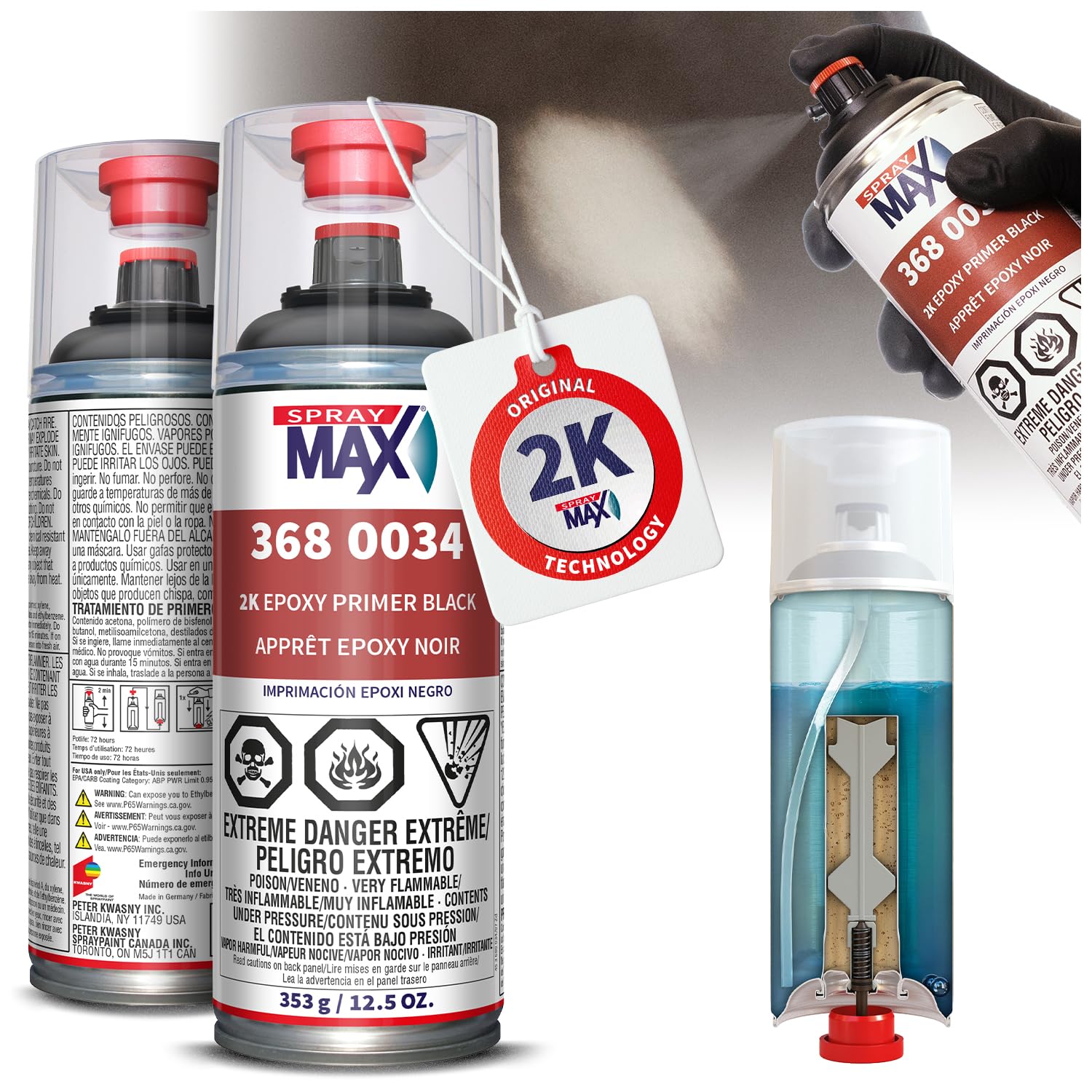
SprayMax packs true 2K epoxy chemistry into an aerosol can, eliminating the need for a spray gun and compressor while maintaining professional bonding strength. The internal hardener is activated by pressing a button on the can bottom, after which the user has a limited pot life to apply the coating. The adjustable nozzle delivers a fan pattern that lays down even coats on motorcycle tanks, fenders, door panels, and rocker panels without runs when proper technique is used.
User feedback confirms that three cans cover a motorcycle tank and fenders with two coats each, drying dust-free in about 15 minutes and sandable within hours. The high-solids formulation sands evenly at 400–600 grit and provides strong mechanical adhesion to sanded steel, body filler, and adhesion-promoted plastics. A few reviewers noted sputtering toward the end of the can, but no clogging or dripping was reported during normal use.
This is the ideal entry point for DIY restorers who want 2K performance without investing in spray equipment. Proper ventilation and a respirator are mandatory — the isocyanate chemistry is effective but requires respiratory protection during application and curing.
What works
- True 2K adhesion in a convenient aerosol format
- Fast drying with even atomization and fan control
- Sands cleanly at 400–600 grit for smooth topcoats
What doesn’t
- Limited pot life after activation requires prompt use
- Strong isocyanate fumes demand full PPE and ventilation
3. 3M 3584 Professional Grade Rubberized Undercoating

3M’s 3584 is a rubberized undercoating designed specifically for vehicle undercarriages, delivering a thick, textured barrier that resists moisture, road salt, and physical abrasion. The six-can pack provides 240–300 square feet of coverage, making it a practical choice for full-frame trucks, SUVs, and fleet vehicles. Its formulation doubles as a sound deadener, reducing road noise by dampening vibrations transmitted through the floor pan and frame rails.
Long-term owner reports from upstate New York — a region known for aggressive winter road salt — show that annual refresh coats on a 2016 RAM kept the frame rust-free over multiple seasons. One reviewer applied it to a new Jeep and sold the vehicle nine years later with zero undercarriage corrosion. The aerosol sprays evenly without running, and the textured matte finish provides a professional OEM-like appearance.
This product is best suited for those who prioritize corrosion protection and noise reduction over a paintable surface. It is not a primer for topcoat paint but rather a standalone protective coating. The 24-hour full cure time should be respected before exposing the coating to road debris or pressure washing.
What works
- Proven long-term rust prevention in severe salt environments
- Reduces road noise through vibration dampening
- Ample coverage per pack for full-frame vehicles
What doesn’t
- Not paintable — designed as a final textured coating
- Requires annual refresh in extreme salt-belt conditions
4. TotalBoat TotalProtect Epoxy Barrier Coat System

TotalBoat’s TotalProtect is a high-build two-part epoxy primer engineered for marine environments, both above and below the waterline. It prevents gelcoat blistering on fiberglass hulls and provides a durable barrier on underwater metals. The quart kit covers approximately 56 square feet at 7 mils wet film thickness, and the thick, mayonnaise-like consistency allows roller application without sagging on vertical surfaces.
Boat restorers report excellent adhesion to sanded gelcoat, epoxy repairs, and JB Weld applications. The epoxy dries to a tough, sandable finish overnight and accepts topcoats after a light scuff. Mixing requires a drill-powered stirrer due to the viscosity, and cleanup is achieved with xylene. A few users noted that foam rollers degrade from the solvents, recommending solvent-resistant roller covers or brush application instead.
This system is purpose-built for wet environments where standard automotive primers would fail. The long pot life (over one hour when thinned) gives plenty of working time for hull sides and bilge areas. It is not designed as a cosmetic topcoat but rather as a structural barrier layer for demanding marine and industrial applications.
What works
- Excellent adhesion on fiberglass, epoxy, and underwater metals
- High-build formula bridges small imperfections
- Long pot life with proper thinning for large-area application
What doesn’t
- Thick consistency requires drill mixer and solvent cleanup
- Foam rollers degrade from chemical content
5. Eastwood 2K Aerosol Clear Coat

Eastwood’s 2K aerosol clear coat delivers a high-gloss protective top layer formulated for automotive refinishing. Each spray pass deposits approximately 1.2 mils of film, and the product flashes in 3–7 minutes between coats depending on ambient temperature. Full cure requires 12 hours at 68°F or 35–40 minutes with infrared drying, making it workflow-friendly for both shop and home use.
Users report that the clear coat levels well with minimal orange peel, and any texture that does appear buffs out easily with 2000-grit wet sanding. One owner applied it over lacquer base coat on a Ford and achieved a factory-quality gloss that remained unchanged after 1.5 years of Texas sun exposure. The 2K chemistry resists yellowing compared to single-component clear coats, and the two-pack format provides enough material for a full panel or small project.
This product is best used as a final clear barrier over color coats rather than as a standalone undercoat. It requires a respirator for safe application due to the isocyanate hardener. The 90-day limited warranty and lifetime tech support add peace of mind for first-time users.
What works
- High-gloss finish that resists yellowing over time
- Levels well with minimal orange peel for a DIY-friendly product
- IR curing capability speeds up shop workflow
What doesn’t
- Clear coat only — not a primer or undercoat
- Isocyanate chemistry requires proper respiratory protection
6. Rust-Oleum Black Undercoating (12 Pack)

Rust-Oleum’s Black Undercoating in the 12-pack format is a rubberized aerosol designed for large-scale corrosion protection and noise reduction on vehicle undercarriages. Each 15-ounce can delivers generous coverage, and the matte black finish provides a uniform appearance that hides surface irregularities. The product is waterproof and formulated to shield against moisture, road debris, and salt exposure.
Owner feedback from truck restorations confirms strong adhesion to clean, dry surfaces. One reviewer applied it to a fully restored truck and reported durable protection that held up well over time. The key caveat echoed across multiple users is that this coating must never be applied over dirt or active rust — trapping moisture beneath the rubberized layer accelerates corrosion rather than preventing it. Overspray control is also critical, as the material can mar unintended surfaces.
For budget-conscious restorers covering a large area, this multipack provides the lowest per-can cost in the category. It functions best as a protective top layer on already sealed or primed surfaces, not as a direct-to-metal epoxy primer. The 24-hour dry time should be respected before exposing the coating to road conditions.
What works
- Excellent value per can for large undercarriage projects
- Strong adhesion to properly cleaned surfaces
- Waterproof matte finish hides imperfections well
What doesn’t
- Not suitable over rust or dirt — traps moisture
- Overspray can mar unintended surfaces if not masked
7. Liquid Rubber Multipurpose Primer

Liquid Rubber Multipurpose Primer is a water-based, low-VOC bonding agent formulated for porous substrates like wood and concrete rather than bare automotive metal. The clear, water-thin liquid penetrates deeply into the surface, acting as a sealer and adhesion promoter for subsequent topcoats. It dries to a matte finish in approximately one hour and can be recoated within two hours, making it one of the fastest-drying primers in this comparison.
Users have successfully applied it on 100-year-old porch decks and 1992 Coleman pop-up camper roofs, reporting that the primer binds well to sanded wood and creates an epoxy-like seal that prevents topcoat peeling. The material goes on milky and dries clear, leaving a slight sheen that indicates proper film formation. Because it contains no solvents, cleanup is done with soap and water, and no respirator is required during application.
This primer is not a replacement for epoxy undercoat on automotive metal — its strength lies in sealing porous surfaces before painting. For restoration work involving wooden subfloors, trailer decks, or camper roofs that require a non-toxic, fast-drying bonding layer, it serves a specialized and effective role.
What works
- Water-based and non-toxic with low VOC
- Penetrates and seals porous substrates effectively
- Fast drying — recoat in as little as two hours
What doesn’t
- Not designed for bare metal corrosion protection
- Thin consistency may surprise users expecting paint-like viscosity
Hardware & Specs Guide
Epoxy Chemistry & 2K Systems
Two-component epoxies consist of a resin base and a hardener (activator) that initiate a cross-linking reaction upon mixing. This thermoset cure produces a film with superior adhesion, chemical resistance, and mechanical strength compared to single-component or air-dry coatings. Aerosol 2K cans contain both components separated internally; activation compresses a bladder that releases the hardener, giving the user a finite pot life measured in hours. Liquid 2K systems require manual mixing with a drill stirrer and offer longer working times, typically 30 minutes to 4 hours depending on the formulation and ambient temperature.
Mixing Ratios & Induction Time
Most epoxy undercoats specify a volumetric mix ratio — common ratios include 1:1, 2:1, or 3:1 (resin to hardener by volume). Accurate measuring is critical; an imbalance leaves unreacted components that weaken the film or prevent proper cure. Some formulations require an induction (sweat-in) period of 5–15 minutes after mixing to allow the chemical reaction to begin, while others can be sprayed immediately. Always consult the technical data sheet for the specific product, as ratios and induction times vary significantly between brands.
Dry Time & Full Cure
Epoxy primers typically reach dust-dry in 15–30 minutes and are sandable within 2–4 hours under standard shop conditions (68–77°F, 50% relative humidity). Full chemical cure takes 12–24 hours, during which the film achieves maximum hardness, solvent resistance, and adhesion. Applying topcoat before full cure can trap solvents and cause delamination; exceeding the manufacturer’s recoat window (often 24–72 hours) requires scuff-sanding to restore mechanical bonding. Temperature below 60°F slows the cure dramatically and can produce a soft film that never reaches full hardness.
Substrate Preparation & Profile
Epoxy undercoats demand a clean, dry, and profiled surface for maximum adhesion. Bare metal should be abraded to an 80–120 grit scratch pattern, while sanded OEM paint requires 180–320 grit. Contaminants like oil, grease, wax, and silicone must be removed with a dedicated wax and grease remover before sanding. Acid-etched or phosphated surfaces improve adhesion on aluminum and galvanized steel. For fiberglass and gelcoat, dewaxing and sanding with 80–180 grit opens the surface for mechanical keying. Skipping preparation is the single most common cause of epoxy coating failure.
FAQ
What is the difference between epoxy primer and epoxy undercoat?
Can I apply epoxy undercoat over existing paint or rust?
How long does epoxy undercoat last before needing recoating?
Do I need a respirator to spray epoxy undercoat?
Final Thoughts: The Verdict
For most buyers, the best epoxy undercoat paint winner is the Custom Shop KEP Series because it combines a simple 1:1 mix ratio, four-hour pot life, and proven direct-to-metal adhesion at a price point that undercuts many competitors. If convenience is your priority for small spot repairs, grab the SprayMax 2K Epoxy Primer — it delivers genuine 2K performance from an aerosol can without spray equipment. And for marine or submerged applications where waterproof barrier protection is critical, nothing beats the TotalBoat TotalProtect for its high-build epoxy formulation and blister prevention on fiberglass hulls.

Certification: BSc in Mechanical Engineering
Education: Mechanical engineer
Lives In: 539 W Commerce St, Dallas, TX 75208, USA
Md Amir is an auto mechanic student and writer with over half a decade of experience in the automotive field. He has worked with top automotive brands such as Lexus, Quantum, and also owns two automotive blogs autocarneed.com and taxiwiz.com.