A portable compressor fridge is not a luxury for car camping — it is the single piece of gear that eliminates the need for ice runs, soggy food, and temperature guesswork. Choosing the wrong unit means either draining your vehicle battery or watching your provisions spoil under the midday sun.
I’m Amir — the founder and writer behind Four Wheel Ask. My approach relies on deep market research, cross-referencing compressor specifications, insulation density data, and long-term owner feedback from overlanding forums to separate real performance from marketing claims.
Below, I break down nine models that span entry-level portables to award-winning dual-zone systems, all selected after analyzing cooling curves, power draw reports, and real-world durability logs. This guide consolidates everything you need to confidently select the best fridge for car camping for your setup.
How To Choose The Best Fridge For Car Camping
Selecting a portable fridge involves more than looking at quart capacity. The compressor type, energy efficiency, battery protection threshold, and build integrity all determine whether the unit will serve you reliably for years or fail halfway through a remote trip. Below are the critical factors to evaluate before you make a purchase decision.
Compressor Quality and Cooling Performance
The compressor is the heart of any portable fridge. Entry-level units use generic rotary compressors, while premium models like the ICECO GO20 employ a SECOP unit — a Danish brand known for low vibration and long lifespan. Look for the ability to reach freezing temperatures (32°F) within 15 to 20 minutes from a warm start. A unit that struggles to hold a set temperature in a hot vehicle will drain more power and risk spoiling food.
Battery Protection Settings
Three-level battery protection (Low, Medium, High) is a non-negotiable feature for car camping. The setting determines the voltage at which the fridge shuts off to save enough battery power for starting the engine. A fridge connected to a vehicle battery without this feature can leave you stranded. Most portable fridges allow you to select a cutoff voltage between 9.6V and 12.4V, so you can adapt to the health of your starter battery or auxiliary setup.
Dual-Zone vs. Single-Zone
Dual-zone fridges like the ICECO GO20 use a removable divider and independent temperature controls to let you freeze meat on one side while keeping drinks cold on the other. Single-zone units are simpler and more energy-efficient because they lack the extra controller circuitry. If you want to carry frozen items alongside fresh produce without cross-contamination, dual-zone is worth the premium. For basic drinks-and-snacks trips, a well-insulated single-zone unit is sufficient.
Dimensions and Vehicle Fitment
Measure your trunk, rear cargo area, or available floor space before selecting a fridge. A 53-quart model like the EKOJUCE provides generous capacity for a family of four but occupies significant floor space. Compact units around 18 to 21 quarts fit comfortably on a back seat or behind the front seats of a sedan. Check the external dimensions against your vehicle’s cargo opening to avoid unpleasant surprises during installation.
Quick Comparison
On smaller screens, swipe sideways to see the full table.
| Model | Category | Best For | Key Spec | Amazon |
|---|---|---|---|---|
| Kohree 19QT | Mid-Range | Compact single-person camping | 19 Qt capacity, 45W draw | Amazon |
| Megiu 23QT | Mid-Range | Quiet overnight use | 23 Qt, below 40 dB noise | Amazon |
| Setpower RF25 | Premium | Power outage resilience | 27 Qt, 50 hour ice pack | Amazon |
| EUHOMY 32QT | Premium | Built-in battery for off-grid | 32 Qt, usable battery inside | Amazon |
| BougeRV CRPRO 30QT | Mid-Range | Overlanding with tie-downs | 30 Qt, 45W max mode | Amazon |
| ICECO GO20 21QT | High-End | Dual-zone + SECOP compressor | 21 Qt, Red Dot Design Award | Amazon |
| EKOJUCE 53QT | Mid-Range | Family-size trips | 53 Qt, APP control | Amazon |
| Alpicool Y19E 21QT | Budget | Value-driven weekend trips | 21 Qt, 19 lbs weight | Amazon |
| BODEGA 18QT | Budget | Entry-level compact use | 18 Qt, reversible lid | Amazon |
In‑Depth Reviews
1. Kohree 19QT Car Refrigerator

The Kohree 19QT strikes an excellent balance between capacity, cooling speed, and battery safety for solo campers or couples. This unit reaches 32°F from a 68°F ambient temperature in roughly 15 minutes, which puts it ahead of many similarly priced models. The three-level battery protection (Low, Medium, High) ensures the fridge shuts off before draining the starter battery, a feature that is often absent in entry-level units.
At 45 decibels, the compressor runs quietly enough for overnight use inside a tent or vehicle cabin. The ergonomic top handle and non-slip base make it easy to slide the unit into a trunk without sliding around when cornering. The 19-quart capacity holds up to 24 cans plus three kilograms of food, which is adequate for a weekend trip.
One area where the Kohree could improve is the lack of app connectivity — you adjust temperature only via the physical panel. For campers who want remote monitoring, a model with Bluetooth or Wi-Fi would be preferable. Still, for pure day-to-day reliability and price-to-performance ratio, this is the strongest contender on the current market.
What works
- Fast chill from 68°F to 32°F in under 15 minutes
- Three-level battery protection with clear H/M/L settings
- Runs at 45 dB — quiet enough for cabin use
What doesn’t
- No app or remote control for temperature adjustments
- Capacity may be tight for more than two people
2. Megiu 23 Quart Car Refrigerator

The Megiu 23QT stands out for its combination of an inverter compressor and a touch-control LED interface — features typically found on models costing significantly more. The unit reaches 32°F in approximately 17 minutes from a warm start and pushes down to -0.4°F within 50 minutes, making it suitable for both chilling drinks and freezing meat. The noise rating of below 40 decibels is among the quietest in this category, which matters for light sleepers at roadside camps.
Energy efficiency is a strong suit here; the average 45-watt power draw translates to less than one kilowatt-hour per day. The round-cornered HIPS inner tank with removable baskets simplifies cleaning while keeping smaller items organized. The 23-quart size fits onto a rear seat with a seatbelt loop or sits securely in a trunk without dominating the cargo area.
One trade-off is the manual defrost system, which requires periodic attention if you operate the unit in freezer mode for extended periods. Automatic defrost would reduce maintenance, but for most weekend campers, the occasional manual cycle is a minor inconvenience relative to the overall build quality.
What works
- Sub-40 dB noise level is excellent for quiet campsites
- Inverter compressor uses less than 1 kWh per day
- Touch panel with clear temperature readout
What doesn’t
- Manual defrost requires periodic attention in deep freeze
- Blue color scheme is not to everyone’s taste
3. Setpower RF25 27 Quart Refrigerator

The Setpower RF25 is engineered for campers who demand cooling resilience during power interruptions or extended off-grid stays. Its proprietary Smartele compressor cools from 68°F to 32°F in 15 minutes and hits -4°F in about 45 minutes. What sets this unit apart is the integrated ice pack that doubles as a removable divider — it keeps contents cold for up to 50 hours after power loss, giving you a real safety margin if your auxiliary battery runs out overnight.
Power consumption is notably low: 28 watts in ECO mode and 40 watts in MAX mode, both well under the 1 kWh-per-day threshold. The reversible door orientation and Bluetooth app control add convenience without making the interface overly complex. The 27-quart capacity is ideal for 2-to-3-day trips for a couple.
The main downside is weight — at 23.5 pounds, it is heavier than comparable 25-liter models due to the thicker insulation. Campers who frequently lift the fridge in and out of a vehicle may find the extra heft a nuisance over time. However, for performance-focused users, the thermal retention justifies the weight penalty.
What works
- Ice pack provides 50-hour temperature hold after power loss
- ECO mode draws only 28 watts
- Bluetooth app control with dual operation mode
What doesn’t
- Heavier than many rivals at 23.5 lbs
- LED interior light is not standard
4. EUHOMY 32 Quart Portable Refrigerator

The EUHOMY 32QT is one of the few portable fridges on the market that includes a usable internal battery. When fully charged, it runs for approximately 6 hours without any external power source. This makes it an attractive option for campers who do not have a dedicated auxiliary battery system and want to run the fridge on a picnic table without draining their vehicle. The high-efficiency compressor reaches 32°F from 77°F in about 15 minutes, matching the speed of premium units.
Beyond the battery, the fridge includes a dedicated compartment that acts as both a power/charging station and a small storage pouch for essentials. A built-in LED light and a USB port for phone charging add practicality. The three-level battery protection system is adjustable from 9.6V to 12.4V, giving you fine control over how much reserve you leave in the starting battery.
The internal battery does add weight and complexity, and the 6-hour runtime is modest when compared to a dedicated power station. If you plan multi-day stays without any external charging, you will need additional batteries. Still, for weekend trips or day-use at a campground with access to shore power, this integrated battery is a genuine convenience.
What works
- Built-in battery provides 6 hours of off-grid runtime
- Fast cooling from 77°F to 32°F in 15 minutes
- USB port and LED light are thoughtful inclusions
What doesn’t
- Battery runtime is limited for long trips without charging
- Heavier than non-battery models of similar size
5. BougeRV CRPRO 30 Quart Refrigerator

The BougeRV CRPRO 30QT delivers overlander-focused design features at a mid-range price point. Four integrated tie-down points on the sides allow you to secure the fridge with straps or bungee cords, preventing movement during aggressive off-road driving. The unit handles inclines up to 30 degrees without compressor issues, which is critical for dirt-road and trail use. The inverter compressor draws 45 watts on MAX mode and drops to 36 watts on ECO, keeping daily consumption well under 1 kWh.
Noise production is rated at 45 dB — quiet enough for cabin use but not as silent as the Megiu unit. An interior LED light makes nighttime retrieval easy, and the included storage box fits a small 277Wh power station to extend runtime. The 30-quart capacity suits solo or couple campers who need extra room for fresh ingredients alongside drinks.
The manual defrost system requires more upkeep than automatic models if you frequently use the freezer function. Also, the door orientation is fixed to the right, which may limit placement in tight vehicle layouts. For budget-conscious overlanders who prioritize secure mounting, this unit offers strong value.
What works
- Four tie-down points for secure overlanding installation
- Runs on 36W in ECO mode for low current draw
- Handles 30-degree inclines without compressor failure
What doesn’t
- Manual defrost in freezing mode
- Door hinge is fixed to the right side only
6. ICECO GO20 21 Quart Dual Zone Refrigerator
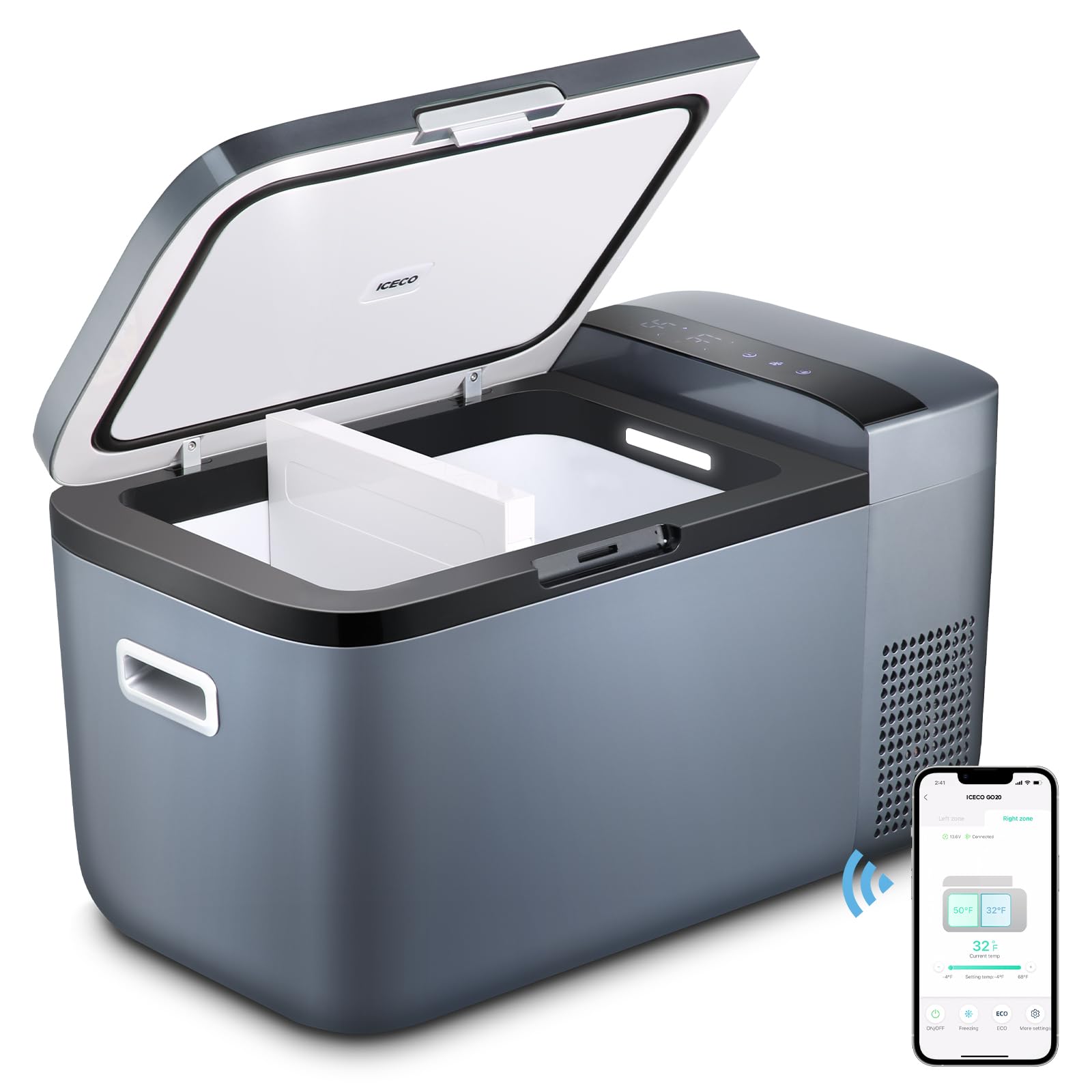
The ICECO GO20 is the most technologically advanced unit on this list, carrying both a Red Dot Design Award and an IDEA International Design Excellence Award. The core differentiator is the SECOP compressor — a Danish-made unit renowned for low vibration, high reliability, and fast cooling up to 40-degree inclines. The dual-zone system uses a removable partition and two independent digital controllers, allowing you to run one side as a freezer (down to 0°F) and the other as a refrigerator (up to 50°F).
App control via Bluetooth provides remote temperature monitoring and mode switching without opening the lid. The 21-quart capacity is modest, but the dual-zone functionality means you are effectively carrying two coolers in one shell. At 21 quarts, it fits easily on a rear seat or in a compact SUV cargo area. The ETL certification and 5-year compressor warranty indicate a high confidence in long-term durability.
The major drawback is the annual energy consumption rating of 275 kWh, which is higher than simpler single-zone models. The dual controllers and SECOP compressor draw more current under constant operation. For users who need a compact, premium dual-zone solution and are willing to manage the power budget, the ICECO GO20 is the gold standard.
What works
- SECOP compressor with proven durability and low vibration
- True dual-zone with independent temperature controls
- Red Dot and IDEA design awards for engineering
What doesn’t
- Higher energy consumption than single-zone models
- Premium price places it above most entry-level budgets
7. EKOJUCE 53 Quart Refrigerator
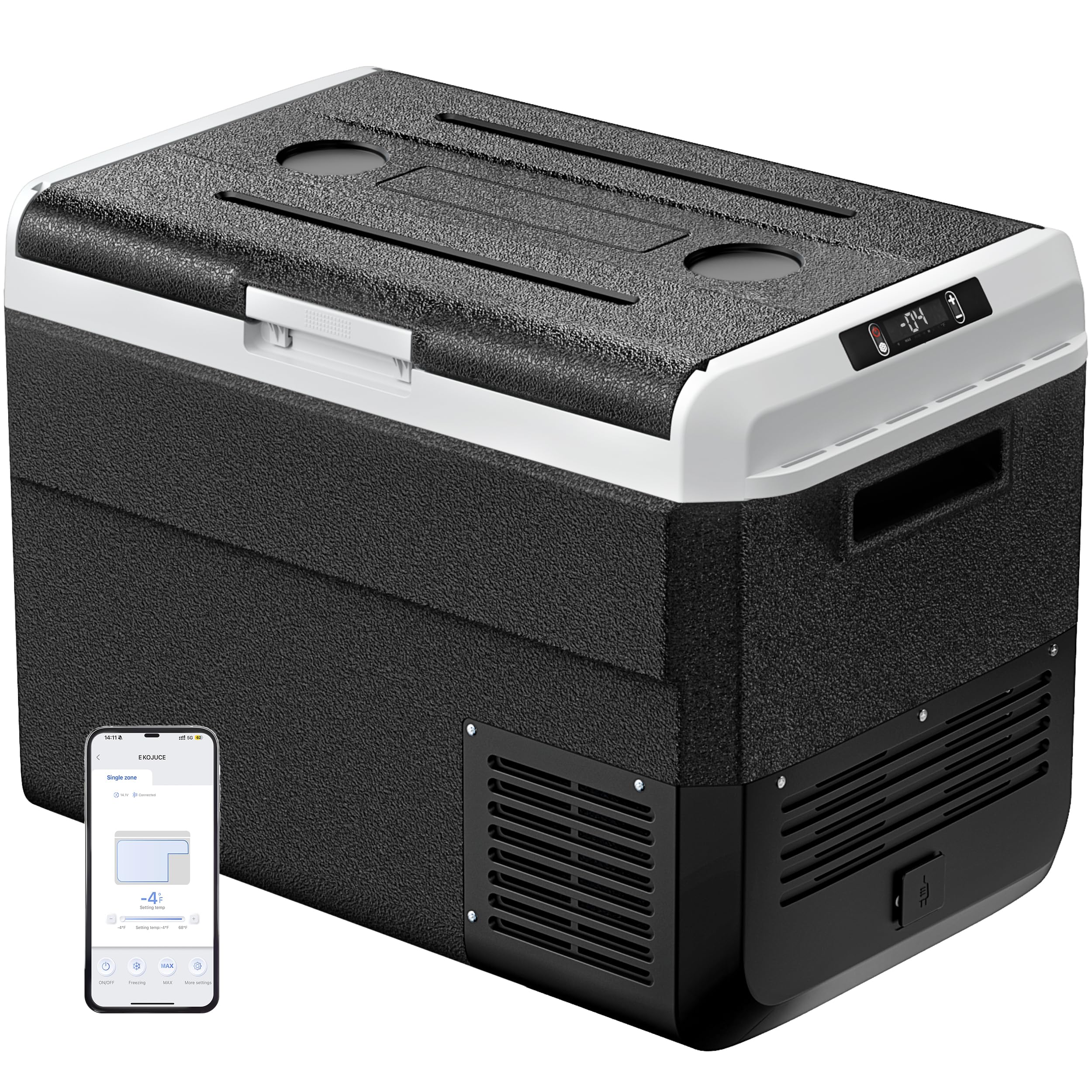
The EKOJUCE 53QT is the family-size option for car campers who need to store a full week’s worth of provisions. At 50 liters, it can hold groceries for a family of four on a multi-day trip. The unit includes a high-performance compressor that can drop to your set temperature on MAX mode in approximately 15 minutes. The ECO mode keeps power consumption manageable for extended stays. Bluetooth app control allows you to monitor and adjust settings without opening the lid, reducing cold air loss.
Noise output is rated at just 32 decibels — quieter than a typical conversation and one of the best ratings in this roundup. The three-level battery protection prevents deep discharge of your vehicle battery, and the unit is shock-resistant for rough roads. Two electronic device slots and cup holders integrated into the lid design add convenience for truck and van use.
The large footprint is the main trade-off: at 53 quarts, this fridge requires dedicated cargo space and is too big for a compact car back seat. Additionally, the annual energy consumption rating of 148 kWh translates to a steady draw that demands a capable auxiliary battery or solar setup for true off-grid use.
What works
- Massive 53-quart capacity for family trips
- Very quiet operation at 32 dB
- Bluetooth app control for remote monitoring
What doesn’t
- Large size limits vehicle compatibility
- Power consumption requires robust auxiliary battery
8. Alpicool Y19E 21 Quart Refrigerator
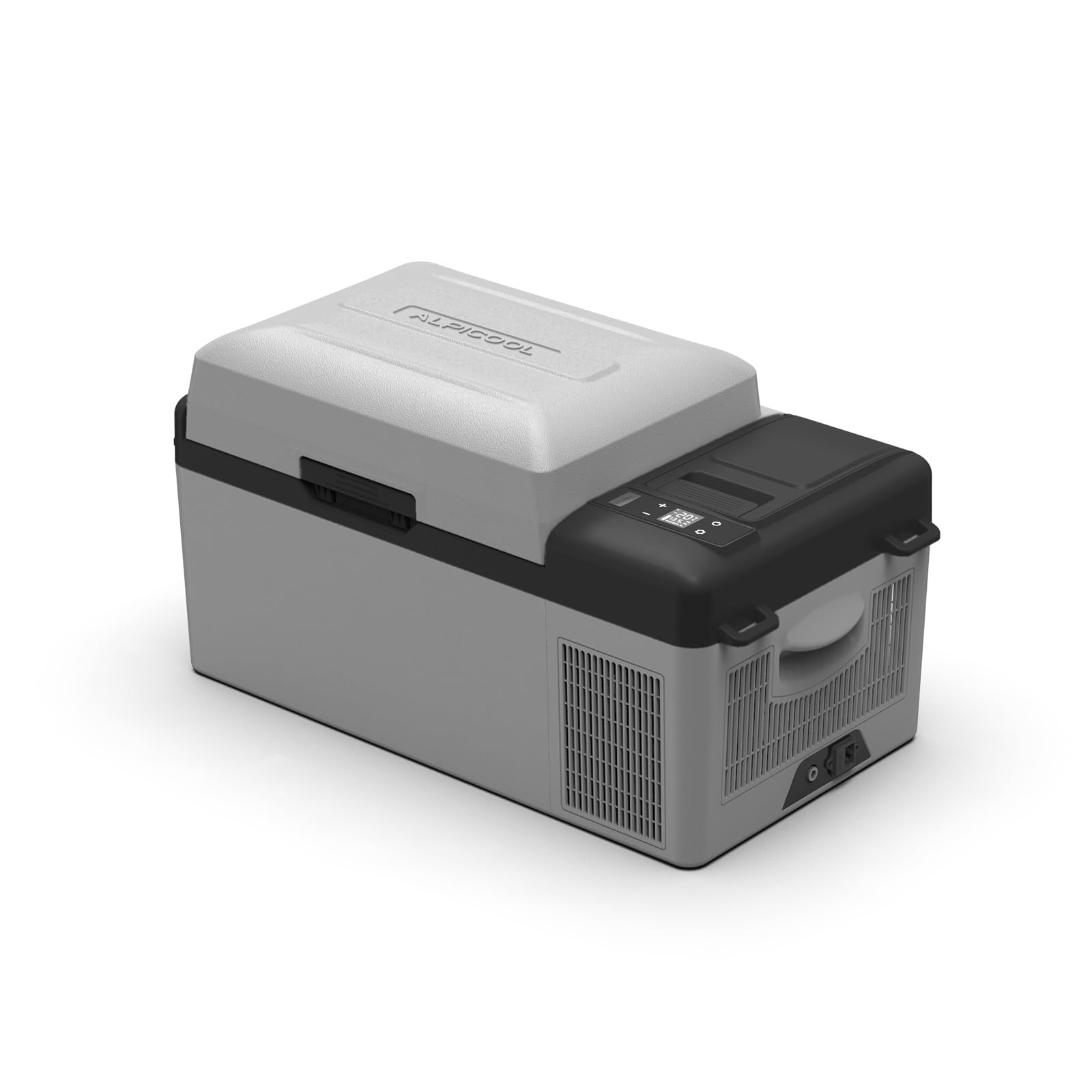
The Alpicool Y19E represents the lowest-cost entry point into compressor fridge ownership without resorting to a thermoelectric cooler. The 21-quart capacity fits 18 bottles or 25 cans, which is adequate for weekend trips for one or two people. Cooling performance reaches -4°F, ensuring you can freeze items as well as chill drinks. The three-level battery protection with temperature memory function preserves your vehicle battery from over-discharge.
Weighing only 19 pounds, this is one of the lightest compressor fridges available, making it easy to move between vehicles or carry to a campsite. The ECO and MAX modes let you balance cooling speed with power consumption based on your current needs. The inclusion of both 12/24V DC and 110-240V AC cables ensures compatibility with car outlets, solar panels, and home wall sockets.
The build quality is basic — the plastic housing lacks the reinforced corners of mid-range units, and the handle feels less robust than on premium models. Some user reports mention the AC adapter running warm during extended use. For the price point, the Alpicool delivers core functionality, but campers who plan heavy off-road use may want to invest in a tougher case.
What works
- Lightest unit at 19 lbs — ideal for portability
- True compressor cooling to -4°F at a low cost
- Three-level battery protection with memory function
What doesn’t
- Build quality feels less durable than mid-range models
- AC adapter may run warm under continuous use
9. BODEGA BODEGACOOLER 18 Quart Refrigerator
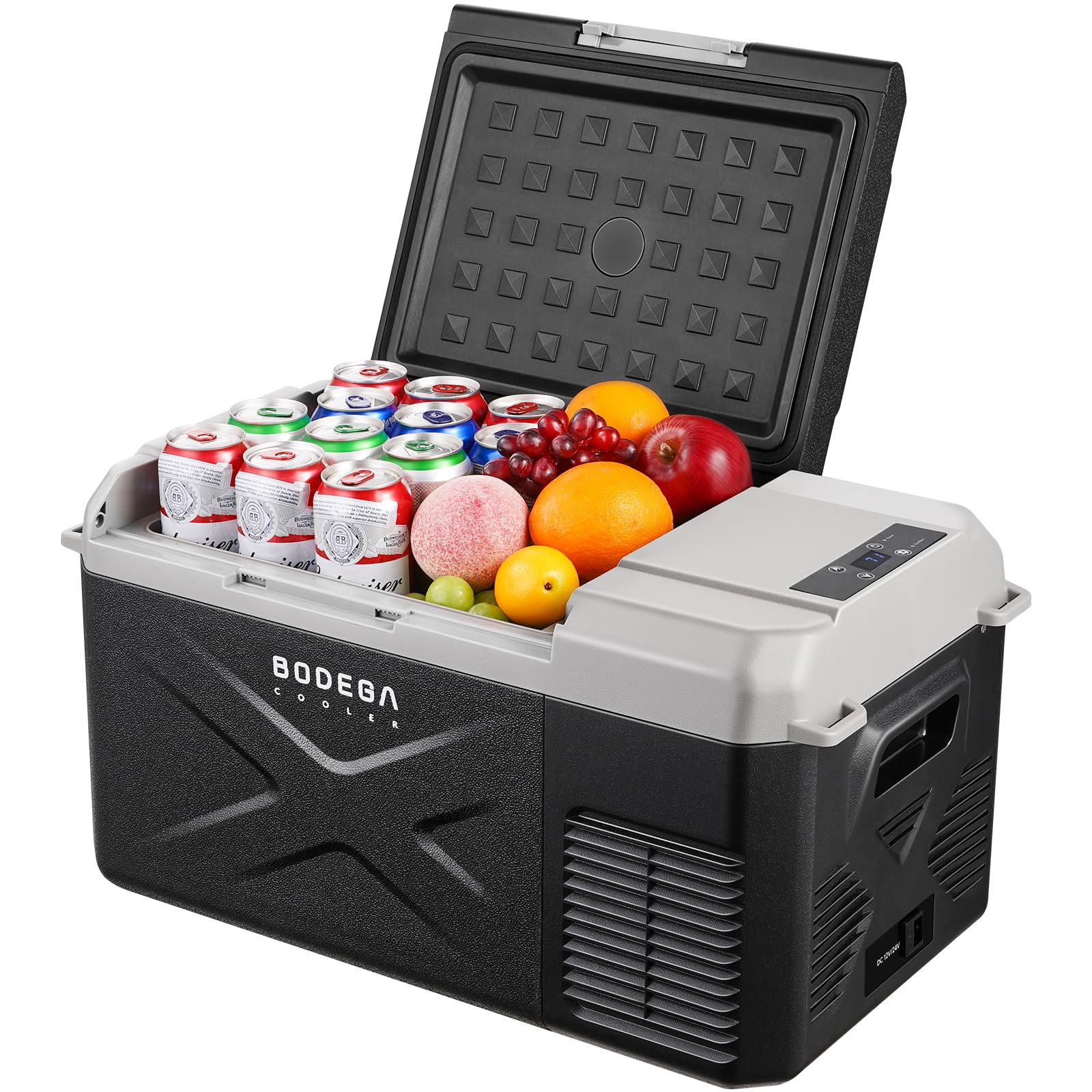
The BODEGA BODEGACOOLER 18QT is a no-frills compressor fridge designed to keep the entry cost as low as possible while still offering genuine freezing capability. The 18-quart capacity is the smallest in this roundup, but it fits neatly behind the front seat of a sedan or on a motorcycle trailer. Cooling speed is respectable: 68°F to 32°F in about 15 minutes, and down to -4°F in about 50 minutes. The average 45-watt power draw is similar to mid-range units, keeping daily electricity usage under 1 kWh.
User-friendly touches include a detachable two-way lid that can be reversed for left or right opening, built-in LED light, and cup slots on the lid to prevent spills. The anti-slip base and secure fastening holes allow stable mounting on bumpy roads. The 5-year compressor warranty provides peace of mind for a budget-tier product.
The primary compromise is the manual temperature control interface, which is less precise than digital touch panels found on more expensive models. Additionally, the ABS plastic shell is thinner than on units like the Megiu or ICECO, so careful handling is advised. For car campers on a strict budget who still want true compressor performance, this unit serves as a functional entry point.
What works
- Lowest price point for a genuine compressor fridge
- Fast 15-minute drop from ambient to 32°F
- Reversible lid adds placement flexibility
What doesn’t
- Manual control interface lacks precision
- Thinner plastic shell requires careful handling
Hardware & Specs Guide
Compressor Types
Two main compressor families appear in portable car fridges: standard rotary compressors and digital inverter compressors. Rotary units are simpler and less expensive but can produce more vibration and consume slightly more current. Digital inverter compressors, like those used by Megiu and BougeRV, adjust their rotational speed to match the cooling load, which reduces power consumption by up to 20 percent compared to fixed-speed units. High-end models like the ICECO GO20 use a SECOP brand compressor, which is a Danish-manufactured rotary unit known for extremely quiet operation and long service intervals. For car camping, a digital inverter compressor offers the best balance of efficiency and durability.
Battery Protection Circuitry
Three-level battery protection systems monitor the voltage of the connected power source. The “Low” setting typically cuts power at around 10.5V, which is suitable only for vehicles with healthy starter batteries. “Medium” cuts at approximately 11.5V, offering a safety margin for standard daily drivers. “High” sets the cutoff at around 12.2V, leaving enough reserve to start most engines from a single battery pack. If you are using a dedicated auxiliary battery with a low-voltage disconnect built in, set the fridge’s protection to Low to maximize runtime. Always coordinate your fridge setting with your vehicle’s electrical architecture to avoid premature shutdown or a dead battery.
FAQ
Can I run a compressor fridge off my car’s starter battery overnight?
What size fridge do I need for a weekend car camping trip?
How much power does a 12V compressor fridge use per day?
Final Thoughts: The Verdict
For most buyers, the best fridge for car camping winner is the Kohree 19QT because it delivers fast compressor cooling, reliable three-level battery protection, and a compact footprint at a reasonable entry price. If you want a built-in battery to avoid power station wiring, grab the EUHOMY 32QT. And for dual-zone performance with a top-tier Swedish compressor, nothing beats the ICECO GO20.

Certification: BSc in Mechanical Engineering
Education: Mechanical engineer
Lives In: 539 W Commerce St, Dallas, TX 75208, USA
Md Amir is an auto mechanic student and writer with over half a decade of experience in the automotive field. He has worked with top automotive brands such as Lexus, Quantum, and also owns two automotive blogs autocarneed.com and taxiwiz.com.