Painting plastic automotive parts often ends in peeling, chipping, or a finish that never looks right. The difference between a factory-like result and a disappointing mess comes down to one thing: choosing a formula engineered specifically for low-energy plastic substrates rather than repurposing a general-purpose can.
I’m Amir — the founder and writer behind Four Wheel Ask. I spend my time dissecting technical data sheets, comparing polymer adhesion technologies, and combing through thousands of owner-reported durability assessments to separate real performance from marketing claims.
This guide focuses on formulations that chemically bond to plastic rather than just sitting on top. After analyzing hundreds of owner reviews and technical specs, I identified the best black paint for plastic based on adhesion, durability, and finish.
How To Choose The Best Black Paint For Plastic
Not all spray paints grip plastic the same way. Standard enamels rely on mechanical etching, which often fails on smooth polypropylene or ABS. The right plastic-specific paint uses solvent blends that slightly soften the top layer of the substrate, creating a chemical weld that resists peeling and chipping. Understanding a few key variables helps you pick the right can for your specific part.
Adhesion Chemistry vs Surface Prep
Some products include built-in adhesion promoters that bond directly to plastic without sanding. Others require a separate primer or at least a scuff with fine grit. The trade-off is convenience versus versatility — dedicated plastic paints often work on a narrower range of substrates but deliver stronger long-term grip. Owner reports consistently show that skipping the recommended prep step is the number one cause of premature failure.
Finish Type and UV Stability
Matte black hides minor surface imperfections and resists showing fingerprints, but it tends to chalk faster under direct sun unless the formula includes UV stabilizers. Gloss black reveals every flaw in your prep work but typically uses harder resins that withstand abrasion better. The best choice depends on whether the part lives under the hood, inside the cabin, or on exterior trim exposed to full sunlight.
Heat and Chemical Resistance
Engine bay components, brake caliper covers, and radiator shrouds require paint rated for sustained heat well above ambient. Standard rattle-can enamels soften or discolor at temperatures as low as 160°F. Specialty high-temp plastic paints maintain integrity up to 200°F and resist oil, coolant, and brake fluid exposure. Always verify the temperature rating before painting any part near the engine or exhaust.
Quick Comparison
On smaller screens, swipe sideways to see the full table.
| Model | Category | Best For | Key Spec | Amazon |
|---|---|---|---|---|
| VHT Duplicolor ESP820007 | Spray Paint | High-heat engine bay parts | 200°F rated, no sanding needed | Amazon |
| Rust-Oleum 248649 Gloss Black | Spray Paint | Interior and exterior trim | Adheres to polypropylene, 20-min dry | Amazon |
| Polar Gloss Black Direct to Rust | Spray Paint | Multi-surface restoration | Rust resistant, 2-pack, 24-hr cure | Amazon |
| Rust-Oleum 331182-6PK Ultra Matte | Spray Paint | Large projects and multi-part jobs | 6-pack, 12 sq ft per can, ultra matte | Amazon |
| Tamiya 85006 TS-6 Matt Black | Spray Paint | Precision finishes on small parts | Lacquer, 30-min dry, true matte | Amazon |
In‑Depth Reviews
1. VHT Duplicolor ESP820007 Black High Temperature Plastic Paint

VHT built this formula specifically for automotive-grade plastics that live near heat sources. The 200°F temperature rating makes it one of the few rattle-can options suitable for engine covers, radiator shrouds, and battery boxes without worrying about softening or discoloration. Owner reports consistently highlight the thick viscosity that builds coverage quickly without running, even on vertical surfaces.
The oil and fluid resistance is a standout feature for under-hood use. Multiple reviewers noted that the paint held up after repeated exposure to coolant spills and brake cleaner without lifting or blistering. Application requires minimal surface prep beyond cleaning — the solvent blend etches into the plastic without sanding, which saves significant labor on complex-shaped parts with tight corners.
Some users found the finish more satin than true matte, and the one-hour handle time means you need patience before reassembly. But for a plastic-specific paint that combines heat tolerance with direct adhesion, this is the most versatile option in the lineup.
What works
- Proven adhesion to smooth plastic without sanding
- Withstands engine-bay heat and fluid exposure
- Thick formula resists runs on vertical panels
What doesn’t
- Finish leans satin rather than flat matte
- One-hour dry time feels slow for small jobs
2. Rust-Oleum 248649 Automotive Paint for Plastic Spray, Gloss Black

Rust-Oleum’s plastic-specific formula targets the difficult-to-coat surfaces that frustrate DIYers — polypropylene, polystyrene, PVC, and fiberglass all bond well here without a separate adhesion promoter. The any-angle spray nozzle is a practical advantage for reaching awkward under-dash or wheel-well areas where keeping the can upright is impossible.
The 20-minute dry-to-touch speed allows multiple coats in a single afternoon, which is valuable when building up gloss on large panels. Reviewers emphasize that technique matters more than with other sprays: laying down enough paint per pass to wet the surface uniformly prevents the frosted or orange-peel appearance that happens when coats are too thin. The gloss finish responds well to wet-sanding and buffing for those who want a mirror shine.
Durability holds up well on exterior trim and interior parts that see moderate UV exposure. Some owners reported that the paint remains slightly softer than two-part urethanes, so deep scratches from rubbing against rough objects are possible. For a single-stage aerosol that requires no mixing and cleans up with mineral spirits, it delivers consistent results.
What works
- Excellent adhesion to tough plastics like polypropylene
- Fast 20-minute recoat window speeds projects
- Any-angle nozzle reaches tight spots easily
What doesn’t
- Requires uniform wet coats to avoid orange peel
- Softer than two-part urethane under abrasion
3. Polar Gloss Black Direct to Rust Spray Paint (2-Pack)
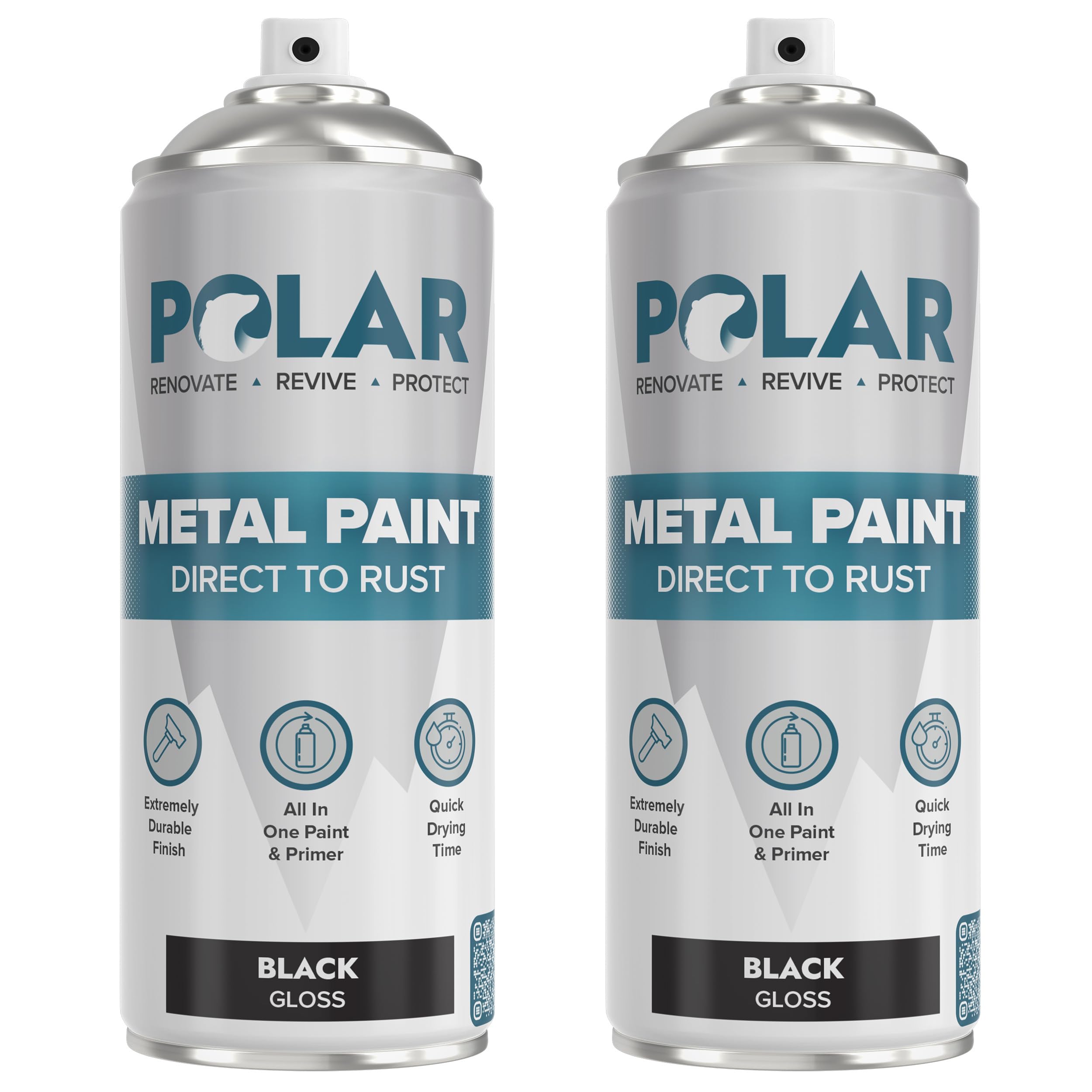
Polar’s Direct to Rust formula takes a different approach — instead of focusing solely on plastic adhesion, it builds a dual-purpose coating that works on metal, wood, plastic, and ceramic. The gloss black finish is formulated with UV stabilizers and salt-spray resistance, making it a strong contender for outdoor plastic parts like fender flares, trim pieces, and motorcycle components that face weather exposure.
The 2-pack configuration provides 27 total fluid ounces, which covers roughly 42 square feet across two cans. That volume makes it practical for larger projects where a single 11-ounce can runs out before the job is done. The quick-dry formula reaches tack-free in 20 minutes with a full cure at 24 hours, and reviewers praised the smooth self-leveling behavior that minimizes brush marks on smooth plastic surfaces.
Some owners reported inconsistent nozzle performance and occasional can defects that caused sputtering. A few noted that the paint peeled on heavily flexed plastic parts, suggesting it works best on rigid or semi-rigid substrates rather than soft, bendable trim. For rigid plastic components that also have metal fasteners or brackets in the same assembly, the rust-resistant properties add genuine value.
What works
- Excellent UV and salt-spray resistance for outdoor use
- 2-pack value covers large projects economically
- Self-leveling formula reduces visible brush strokes
What doesn’t
- Some cans have nozzle or sputtering issues
- Not ideal for soft, flexible plastic parts
4. Rust-Oleum 331182-6PK Painter’s Touch 2X Ultra Cover Ultra Matte Black (6-Pack)
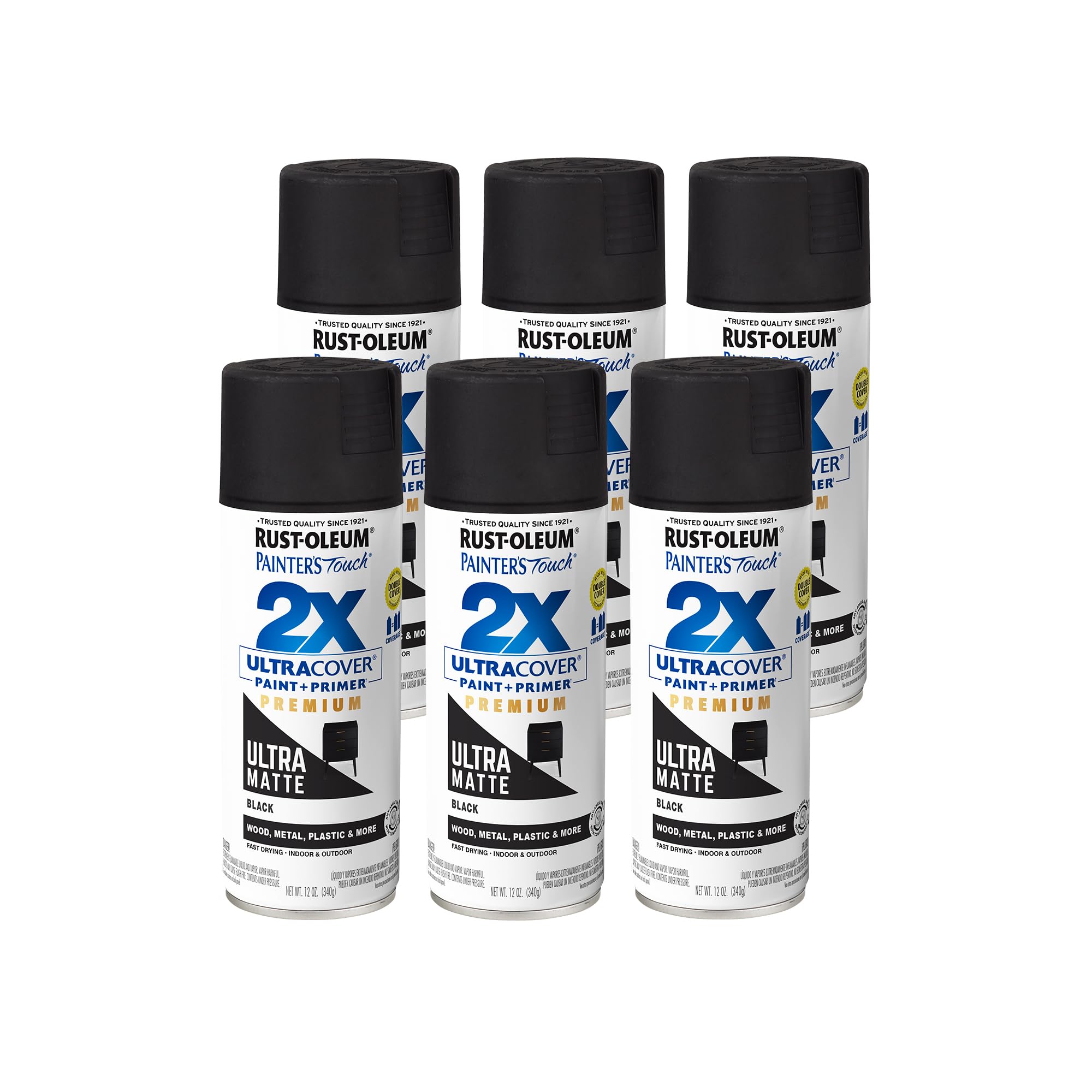
Rust-Oleum’s Painter’s Touch 2X Ultra Cover line is not marketed exclusively as a plastic paint, but the oil-based formula bonds surprisingly well to clean plastic surfaces when applied in light coats. The ultra matte finish delivers a flat, vintage appearance that interior trim restorers and custom builders seek for dashboard components and door panels where glare reduction matters.
The 6-pack provides 72 total ounces of paint, enough to cover roughly 72 square feet. That volume makes this the most economical option in the lineup for anyone painting multiple parts or an entire set of plastic trim pieces. The 2X coverage technology means one coat often hides the previous color or surface imperfections, cutting total application time significantly.
Reviewers consistently praised the even spray pattern and clog-free nozzle performance, which reduces frustration during long painting sessions. The chip-resistant oil-based formula holds up well on interior parts that see occasional contact. However, the ultra matte finish shows fingerprints and smudges more readily than gloss or satin, and the paint requires thorough surface cleaning to avoid fisheye defects on uncleaned plastic.
What works
- Exceptional value per ounce with 6-can bulk pack
- Ultra matte finish ideal for low-glare interiors
- Smooth, clog-free nozzle performance
What doesn’t
- Ultra matte smudges and fingerprints easily
- Requires meticulous cleaning to prevent fisheyes
5. Tamiya 85006 TS-6 Matt Black Lacquer Spray Paint

Tamiya’s TS-6 lacquer is a model-building staple that has earned a cult following among automotive restorers who need a precision matte black for small plastic components. The lacquer formulation dries rock-hard in under 30 minutes and produces a consistent, grain-free matte surface that looks factory-molded rather than painted. The color code #333333 corresponds to a true neutral black without blue or brown undertones.
Reviewers specifically praised its performance on ABS plastic hulls, model car bodies, and rifle components where dimensional accuracy matters. The paint fills fine scratches effectively without obscuring detail lines, and the low odor compared to other lacquers makes indoor use more tolerable. Single-coat coverage is achievable on smooth surfaces, which is rare for a matte aerosol.
The main trade-off is the small 100ml can size — about 3.4 fluid ounces — which limits each can to small parts or touch-up work. The price per ounce is significantly higher than automotive-grade sprays, making it uneconomical for large trim panels. For small precision parts where finish quality is the priority, this remains the benchmark that other matte blacks are measured against.
What works
- Grain-free true matte finish with no sheen
- Dries hard in 30 minutes for fast assembly
- Single-coat coverage on smooth ABS surfaces
What doesn’t
- Small can size limits use to small parts
- Higher cost per ounce than bulk alternatives
Hardware & Specs Guide
Adhesion Chemistry
Plastic paints use solvent systems that partially dissolve the top polymer layer, creating a physical bond as the solvent evaporates and the paint cures. This is fundamentally different from mechanical adhesion, which relies on rough surfaces for grip. Products with built-in adhesion promoters (like VHT and Rust-Oleum’s plastic-specific formulas) work on smooth polypropylene and ABS without sanding. Lacquer-based paints like Tamiya TS-6 bond through solvent welding but require careful surface prep to avoid crazing on sensitive plastics like polystyrene.
Cure Time and Handling
Dry-to-touch times across these products range from 20 to 30 minutes, but full cure varies significantly. Rust-Oleum’s 248649 can be recoated in 20 minutes and reaches service hardness in about 24 hours. VHT’s plastic paint recommends 1-hour handling time with no forced heat cycle required. Polar’s Direct to Rust needs a full 24-hour cure before the coating reaches its rated chemical resistance. Tamiya’s lacquer achieves full hardness in about 30 minutes due to the fast solvent flash-off. Always allow full cure before exposing painted parts to heat, moisture, or mechanical stress.
Finish Types and Light Reflectance
Matte finishes (Tamiya TS-6, Rust-Oleum Ultra Matte) diffuse light evenly and hide surface imperfections but tend to show handling marks over time. Gloss finishes (Rust-Oleum 248649, Polar Gloss Black) reflect more light and require flawless surface prep to avoid highlighting scratches or orange peel. Satin finishes (VHT Duplicolor) offer a middle ground that resists fingerprints better than gloss while providing more sheen than matte. The published color codes vary: Tamiya uses #333333, while VHT lists #2F4F4F for its black formula.
Heat and Chemical Resistance
Standard plastic paints are typically rated for ambient use up to 150°F before softening begins. VHT’s high-temperature formula extends that ceiling to 200°F, making it the only option in this group suitable for engine bay components. Rust-Oleum’s 248649 and Painter’s Touch lines are not heat-rated and may soften on radiator shrouds or near exhaust heat. Polar’s formulation includes rust inhibitors but does not list a specific heat rating above typical automotive use. For oil and fuel resistance, VHT and the Rust-Oleum plastic-specific paint both show good resistance in owner field reports.
FAQ
Do I need to sand plastic before using plastic-specific spray paint?
Why does my spray paint peel off plastic after a few weeks?
Can I use regular spray paint on plastic if I prime it first?
What is the best clear coat to use over black plastic paint?
How do I fix orange peel texture on painted plastic?
Final Thoughts: The Verdict
For most buyers, the best black paint for plastic winner is the VHT Duplicolor ESP820007 because it combines heat resistance, direct adhesion without sanding, and proven durability in engine-bay conditions. If you want a fast-drying gloss finish for interior or exterior trim, grab the Rust-Oleum 248649 Gloss Black. And for precision matte work on small plastic components, nothing beats the Tamiya 85006 TS-6 Matt Black.

Certification: BSc in Mechanical Engineering
Education: Mechanical engineer
Lives In: 539 W Commerce St, Dallas, TX 75208, USA
Md Amir is an auto mechanic student and writer with over half a decade of experience in the automotive field. He has worked with top automotive brands such as Lexus, Quantum, and also owns two automotive blogs autocarneed.com and taxiwiz.com.