A radiator that fails mid-commute or during a tow job isn’t just an inconvenience — it’s a gamble on engine health that can turn a simple swap into a head-gasket nightmare. The aftermarket radiator space is crowded with options that range from thin-wall economy units to dense-core performance pieces, and choosing wrong means living with temperature creep, fitment fights, or premature failure.
I’m Amir — the founder and writer behind Four Wheel Ask. I’ve spent years comparing cooling system specifications, tracking aluminum vs. plastic tank failure rates, and cross-referencing owner feedback across thousands of aftermarket radiator installations to separate genuine upgrades from parts-bin filler.
Whether you drive a pickup, SUV, or sedan, finding the right best aftermarket auto radiators means matching core dimensions, materials, and port locations to your specific engine platform and driving demands.
How To Choose The Best Aftermarket Auto Radiators
Selecting the right radiator goes beyond picking something that bolts in. Coolant flow rate, fin density, tank material, and transmission cooler integration all determine whether your engine stays at operating temperature under load or creeps toward the red zone. Here are the critical factors to evaluate before buying.
Core Construction: All-Aluminum vs. Plastic-Aluminum Hybrids
All-aluminum radiators use welded tanks and cores that resist cracking from thermal cycling and vibration, making them the preferred choice for high-mileage drivers and those in hot climates. Plastic-tank designs with aluminum cores are lighter and cheaper to produce, but the crimped joint between metal and plastic is a known failure point after several years of pressure cycling. For long-term ownership, all-aluminum construction typically delivers a higher return on investment.
Row Count and Core Thickness
Standard replacement radiators use a single row of coolant tubes, which is sufficient for most daily-driven vehicles. Two-row and four-row designs increase the surface area for heat exchange, but they also reduce airflow velocity through the core if the fan and shroud setup isn’t matched. Thicker cores require careful clearance checks — especially on vehicles with mechanical fans or aftermarket intercoolers. Match the row count to your engine’s heat output and the vehicle’s intended use.
Port Size, Location, and Transmission Cooler Integration
Inlet and outlet diameters must match your existing hoses, and the port location (top vs. side, driver vs. passenger) determines whether the radiator is a true direct-fit or requires custom hose routing. Integrated transmission oil coolers and engine oil coolers add complexity but simplify installation. Verify that the cooler fittings match your line thread pitch to avoid stripped connections at startup.
Quick Comparison
On smaller screens, swipe sideways to see the full table.
| Model | Category | Best For | Key Spec | Amazon |
|---|---|---|---|---|
| Mishimoto MMRAD-WRX-01 | Performance | Subaru WRX/STI owners seeking maximum cooling capacity | 2-row, 1.65″ core, all-aluminum TIG-welded | Amazon |
| SPELAB CU162 | Performance | Classic Chevy & G-Body builds needing heavy cooling | 4-row, 8.46″ core depth, aluminum | Amazon |
| TRQ RDA82616 (Ram) | Premium | Dodge Ram 1500/2500/3500 V8 direct replacement | Cross-flow, aluminum core, TOC included | Amazon |
| Spectra Premium CU2370 | Mid-Range | Chevy Silverado/GMC Sierra daily drivers | 34-1/16″ core, multi-louvered fins, TOC & EOC | Amazon |
| TRQ RDA82857 (Rogue) | Mid-Range | Nissan Rogue & Rogue Select 2.5L owners | Aluminum core, plastic tank, direct-fit | Amazon |
| Alpaspare 1693 | Mid-Range | GM full-size trucks & SUVs 1988-2004 | 34.09″ core, 1.25″ thick, TOC & EOC | Amazon |
| SCITOO 618 | Budget | Chevy C/K & GMC pickup owners on a budget | 22.25″ core, painted aluminum, multi-layer | Amazon |
| Auto Dynasty 2334 | Budget | Silverado/Sierra 1999-2007 4.8L/5.3L trucks | 28″ wide, 1-row, T-6061 aluminum core | Amazon |
| Zynrako CH3010345 | Budget | Dodge Grand Caravan & Chrysler Town & Country | 24.19″ core, 1″ thick, folded fin edges | Amazon |
In‑Depth Reviews
1. Mishimoto MMRAD-WRX-01 Performance Aluminum Radiator

Mishimoto’s MMRAD-WRX-01 is a performance-grade, all-aluminum radiator engineered specifically for the Subaru WRX and STI platform from 2001 through 2007. The core measures 27.24 inches wide by 13.54 inches tall with a 1.65-inch thickness across two rows, delivering considerably more coolant volume and surface area than the factory plastic-tank unit. Each tank is TIG-welded with 0.08-inch wall thickness, and the overall assembly is rated to handle the higher thermal loads generated by modified turbocharged engines without the tank-seam fatigue that plagues OEM-style radiators on this chassis.
Owner feedback across multiple WRX and STI forums confirms excellent fitment on 2002 through 2007 models, though the thicker core requires attention to fan-mounting hardware. The factory fan screws do not reach through the thicker core, so M6x1.0 bolts of appropriate length are needed. The crossover tube also demands a longer 5/16-inch coolant hose since the OEM hose will not stretch to the new port location. Power steering hose routing may need slight adjustment on some years, but no permanent modifications are necessary. The included Mishimoto radiator cap should be swapped to the upper reservoir per the manufacturer’s instructions for proper pressure regulation.
Cooling performance under hard driving is notably improved over stock. Owners report sustained coolant temperatures below 200 degrees Fahrenheit in 100-degree traffic and significantly faster temperature recovery after pulls or track sessions. The drain plug must be tightened securely, and the overflow nipple block-off bolt on certain revisions can snap if over-torqued — epoxy is a common field fix. Mishimoto backs this radiator with a lifetime warranty, which adds confidence given the higher upfront investment compared to economy options.
What works
- Superior TIG-weld quality and tank thickness vs. economy aluminum radiators
- Direct bolt-in for 2001-2007 WRX/STI with no core support modifications
- Lifetime warranty from a brand with established aftermarket support
What doesn’t
- Requires replacement fan bolts and longer crossover hose — not truly drop-in
- Overflow nipple block-off bolt prone to snapping if over-tightened
- Power steering hose may need slight rerouting on some model years
2. SPELAB CU162 4 Row Aluminum Radiator
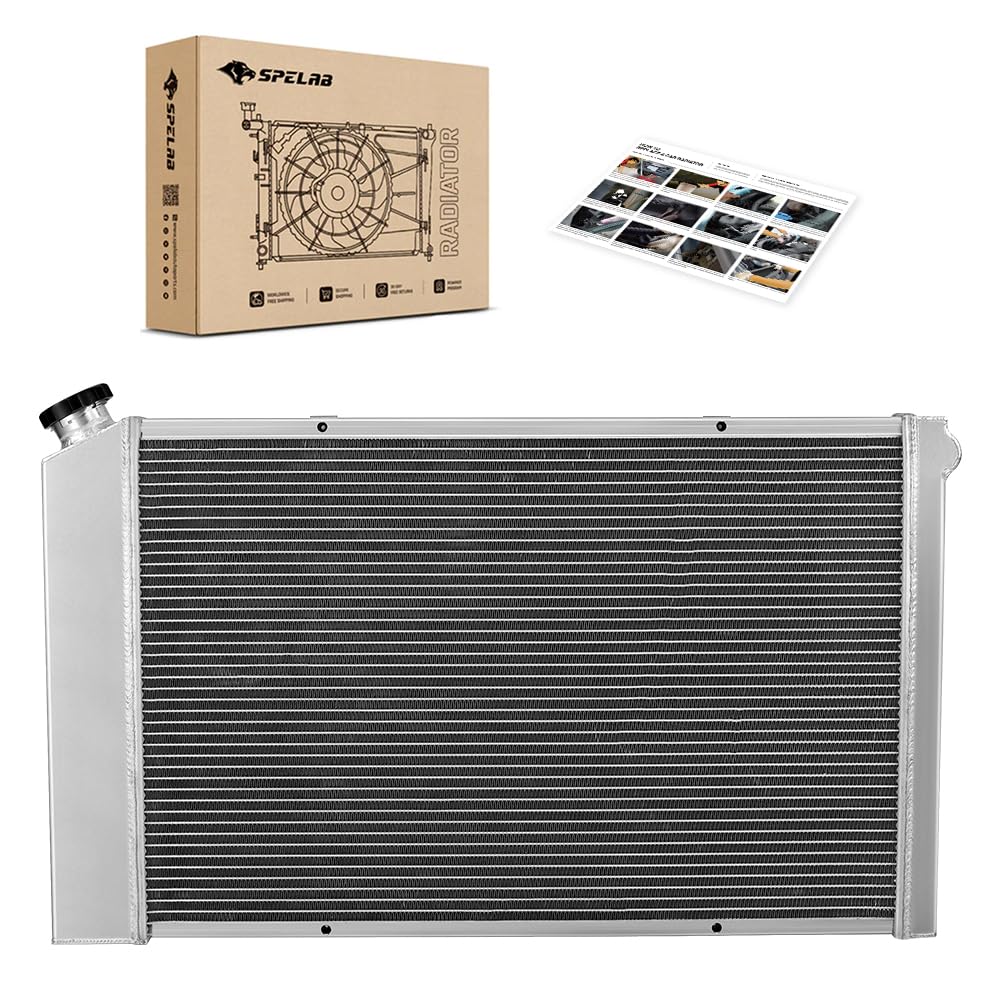
The SPELAB CU162 is a massive 4-row aluminum radiator designed for the classic GM platform family — 1970-1987 C/K and G-series pickups, Malibu and Monte Carlo G-body cars, and 1971-1987 Buick models. Core dimensions of 31.73 inches wide, 19.13 inches tall, and an imposing 8.46 inches deep provide extreme surface area for heat rejection, making this unit suited for high-compression small-blocks, big-blocks, or towing applications where standard single-row radiators struggle to keep pace. The kit includes a fan shroud and relay harness, which simplifies installation for vehicles that may have missing or mismatched factory cooling components.
Construction uses increased tube wall thickness compared to economy multi-row radiators, with machined aluminum tanks and welded seams rather than crimped plastic ends. The included relay kit supports electric fan setups, which is useful for older trucks that may have been converted from mechanical fans. Owner reports indicate the radiator fits well within the core support of these classic chassis, though the sheer core depth requires verifying clearance with the engine fan, water pump pulley, and any aftermarket accessories mounted to the front of the engine. Some owners on Jeep JK applications noted the passenger-side tank-to-core seal developed a leak after roughly 35 days of use, which highlights the importance of checking tank welds on arrival.
For those building a high-heat classic pickup or G-body, the SPELAB CU162 offers the cooling capacity of a custom race radiator at a fraction of the fabrication cost. The core depth does reduce airflow velocity, so a matched high-CFM electric fan or a properly shrouded mechanical fan is essential to realize the full cooling potential. The absence of threaded mounting holes on certain brackets means self-tapping bolts are required, and the driver-side AC bracket boss may sit slightly short of flush, leaving a small gap that does not affect function but requires attention during installation.
What works
- Extreme 4-row core depth for high-heat engines and towing use
- Full kit includes shroud and relay harness for simpler installation
- Welded aluminum tanks eliminate plastic-to-metal crimp failures
What doesn’t
- Core depth may interfere with mechanical fans or AC brackets
- Some units reported tank-to-core seal leaks within the first month
- No threaded holes — requires self-tapping bolts for mounting
3. TRQ Radiator Assembly for Dodge Ram 1500/2500/3500
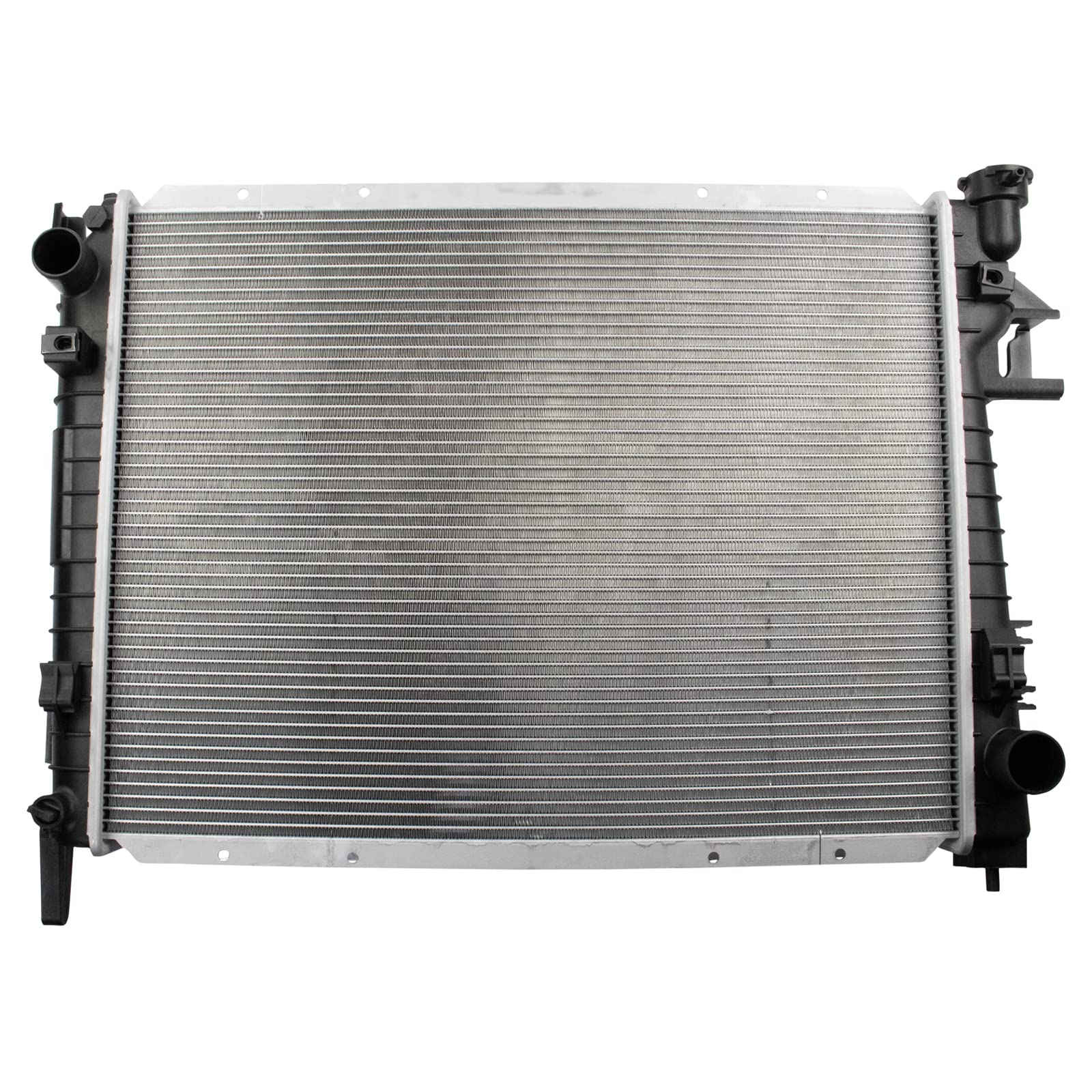
TRQ’s RDA82616 radiator is a direct-fit cross-flow unit engineered for the 2004-2009 Dodge Ram 1500, 2500, and 3500 equipped with the V8 5.7-liter engine. Cross-flow radiators route coolant horizontally across the core, which allows for a lower hood profile and often improves coolant distribution compared to vertical-flow designs. The aluminum core is paired with a transmission oil cooler, and the assembly replaces OEM part numbers 55056481AB, 55056481AC, and 55056682AE. TRQ has been manufacturing replacement parts for over 25 years, and this model benefits from their extensive fitment validation and DIY video support library.
Installation feedback from Ram owners confirms a clean fit with no need for bracket modifications or core support trimming. The petcock orientation differs slightly from some factory configurations, but this does not interfere with draining access. Owners applying this to 2011 Jeep Wrangler applications noted that moving the rubber bumpers and cutting a hole for an additional mounting point was necessary on newer chassis — this is platform-specific and not required for the intended Ram application. The transmission cooler line fittings use standard thread pitch, and the included radiator cap matches factory pressure specifications. A few users reported that the unit does not include caps or seals for the engine coolant pipes, requiring reuse of original hardware.
TRQ offers a 24-month warranty on this radiator, which is shorter than the lifetime coverage some competitors provide but still offers reasonable protection. The cross-flow architecture and direct-fit engineering make this a strong replacement option for Ram owners who want a bolt-in solution without the trial-and-error of universal radiators. The slightly higher cost compared to no-name alternatives reflects the validation testing and fitment consistency that TRQ has developed over two decades of production.
What works
- True direct-fit with no bracket or hose modifications on Ram 5.7L
- Cross-flow design improves coolant distribution vs. vertical-flow alternatives
- TRQ provides detailed DIY video support for installation guidance
What doesn’t
- 24-month warranty is shorter than lifetime coverage from some competitors
- Petcock position differs from factory drain location
- Does not include engine coolant pipe caps or seals
4. Spectra Premium CU2370 Radiator

Spectra Premium’s CU2370 is a well-established replacement radiator that fits Chevrolet Silverado, GMC Sierra, and Cadillac Escalade models from the early 2000s. The core measures 34-1/16 inches wide and incorporates both a transmission oil cooler and an engine oil cooler, making it a direct replacement for vehicles equipped with factory cooling for both systems. Spectra Premium has been a staple in the aftermarket cooling space for years, and this model is designed to match the original equipment fit, form, and function without requiring hose splices or bracket adaptation.
The core uses high-density multi-louvered fins to enhance heat transfer, and the drop-in design includes an accessory pack that contains the necessary hardware for most installations. Owner reports on 2003 Silverado 5.3-liter trucks indicate straightforward installation completed in roughly ten minutes, with no coolant leaks or overheating issues under heavy daily use. The unit has also been installed on 2002 Yukon Denali XL with the 6.0-liter engine, where owners noted cooler operating temperatures than the factory radiator. However, there are isolated reports of units arriving with crimp defects that cause immediate coolant loss — one owner reported a leak from the metal end strip area that resulted in significant coolant waste and vehicle downtime.
Quality control consistency appears to be the main variable with this radiator. The majority of installations go smoothly and deliver reliable long-term service, but the occasional defective unit suggests that a thorough leak test before full installation is wise. Spectra Premium’s extensive OEM cross-reference coverage — listing dozens of compatible part numbers — makes this one of the most broadly compatible options for GM truck and SUV owners in this price tier. For a daily-driven Silverado or Sierra that needs a dependable replacement without the cost of a premium all-aluminum unit, the CU2370 delivers solid value.
What works
- Integrated transmission and engine oil coolers for complete OEM replacement
- Drop-in fit with included accessory pack simplifies installation
- Broad vehicle coverage across GM truck and SUV platforms
What doesn’t
- Inconsistent quality control — some units leak from crimp seams immediately
- Plastic tank construction limits long-term durability vs. all-aluminum
- Higher failure rate reported on units manufactured in certain production batches
5. TRQ Radiator Assembly for Nissan Rogue 2008-2015
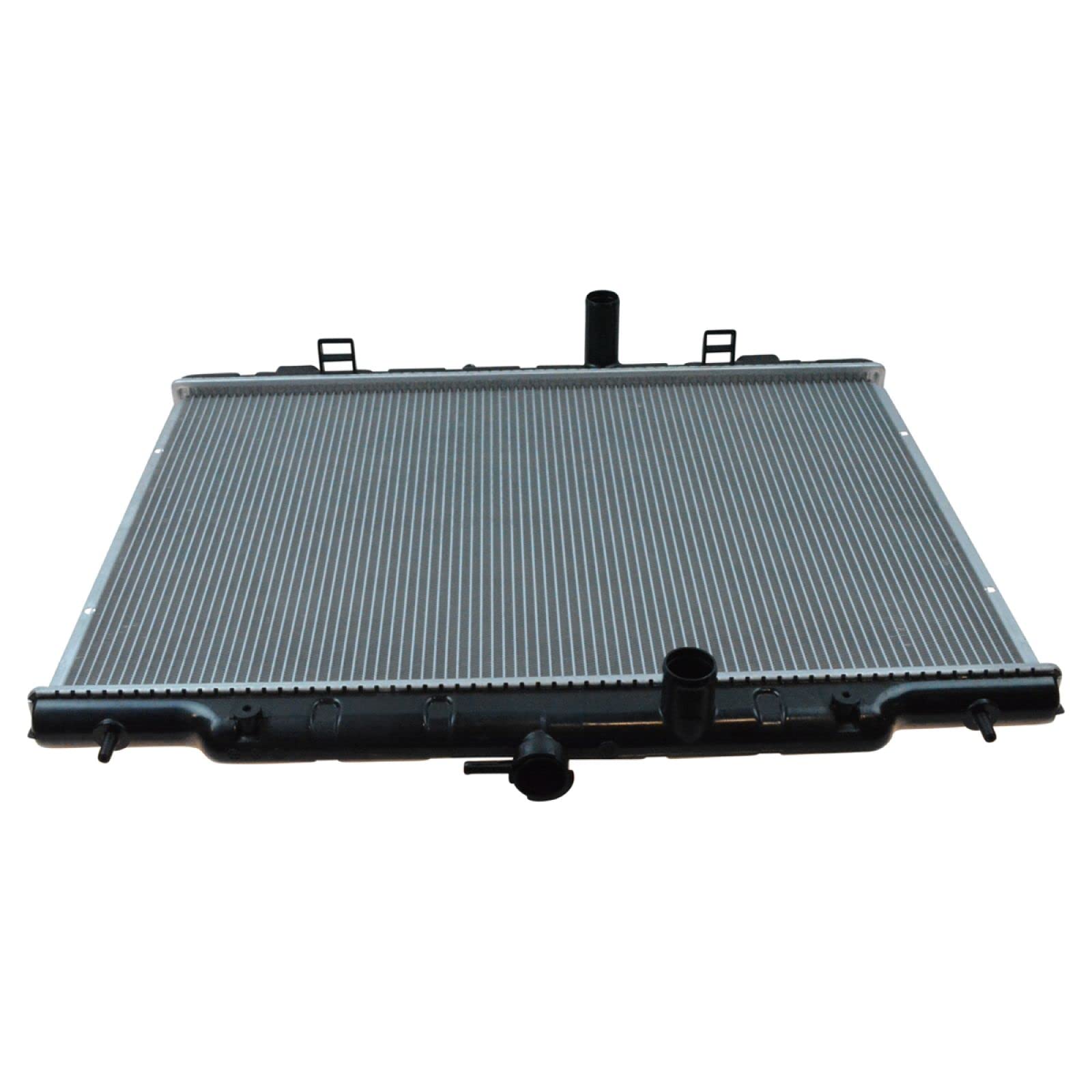
The TRQ RDA82857 radiator is a direct-fit replacement for the 2008-2013 Nissan Rogue and 2014-2015 Rogue Select with the L4 2.5-liter engine. The aluminum core with plastic tank construction matches the OEM design, and the unit replaces factory part numbers 21400-JM00A and CU13047. TRQ’s positioning in the market emphasizes fitment accuracy and installation support — their extensive library of DIY installation videos is one of the more useful resources for first-time radiator swappers, covering everything from drain procedures to hose clamp torque.
Installation reports from Rogue owners indicate that the radiator fits precisely with the correct fittings for transmission cooler lines, requiring no modifications to the core support or fan shroud. The packaged protection during shipping is consistently rated as above average, with multiple owners noting that the radiator arrived undamaged even on units that had been in transit for extended periods. The four fan shroud clips are the only additional attachment points needed beyond the main mounting bolts, and the pre-assembled design eliminates the need to transfer components from the old radiator. A small number of owners have raised the question of long-term durability given the plastic tank design, but no widespread failure pattern has emerged across the review data available.
For Nissan Rogue owners looking for a straightforward replacement that maintains factory cooling performance and fitment, the TRQ delivers a balanced package of quality and affordability. The DIY video library adds genuine value for those attempting the job at home, and the fitment validation through Amazon Garage reduces the risk of ordering the wrong part. The aluminum core provides adequate heat rejection for the 2.5-liter engine under normal driving conditions, though those in extreme climates or with high-mileage vehicles may want to inspect the plastic tank seams periodically for signs of stress cracking.
What works
- Precise fitment with correct transmission cooler line fittings included
- Excellent packaging reduces shipping damage risk
- TRQ’s DIY video library provides step-by-step installation guidance
What doesn’t
- Plastic tank construction less durable than all-aluminum alternatives
- Long-term reliability data still limited for this specific model
- Fan shroud clips must be transferred or sourced separately if missing
6. Alpaspare 1693 Radiator for GM Trucks & SUVs
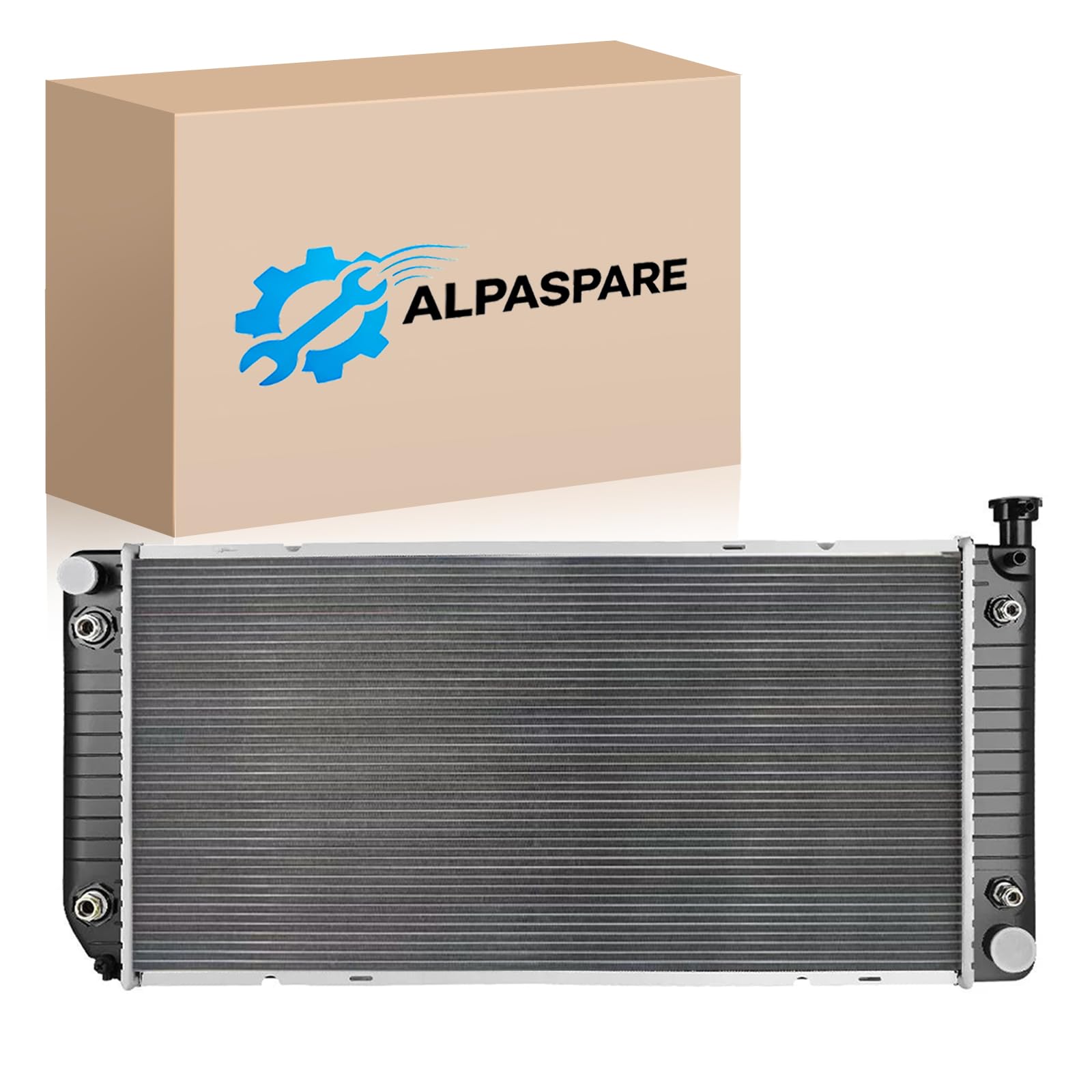
The Alpaspare 1693 radiator is an aluminum direct-fit replacement covering a broad range of GM full-size trucks and SUVs from 1988 through 2004, including Cadillac Escalade, Chevrolet C/K and Silverado, GMC Sierra and Yukon, and Suburban models. The core measures 34.09 inches in length, 16.81 inches in height, and 1.25 inches in thickness, with inlet and outlet diameters of 1.29 inches and 1.57 inches respectively. Both transmission and engine oil coolers are integrated, matching the factory configuration on equipped models. OEM cross-reference numbers include 52477782, 52481440, 1522, and 1693, among others.
Installation feedback indicates a true 1:1 drop-in fit with no requirement for cutting, drilling, or sourcing extra hardware. Owners who installed this on 2009 Ford Explorer and 2010 Nissan Altima applications — surprisingly broad cross-platform compatibility — reported that the radiator seated correctly on all mounting points and sealed without leaks. The aluminum construction eliminates the plastic tank failure mode that affects aging OEM radiators, and each unit undergoes pressure and leak testing before shipment. Some units arrived with bent cooling fins from shipping, but owners consistently reported no performance degradation from minor fin deformation. The packaging quality received mixed feedback, with one unit arriving in a box that had been repaired with tape, though the radiator itself was undamaged internally.
Given the wide vehicle coverage and aluminum construction at a competitive price point, the Alpaspare 1693 represents a solid mid-range option for owners of classic GM trucks and SUVs who want to move away from plastic-tank radiators. The integrated coolers simplify installation on vehicles equipped with automatic transmissions and oil coolers, and the 1.25-inch core thickness provides a noticeable cooling improvement over the thinner factory units on these platforms. The main consideration is verifying fitment for your specific year and engine combination, as the listing covers a broad range but individual configurations may vary.
What works
- True 1:1 drop-in fit with no modifications needed for most GM applications
- Aluminum construction eliminates plastic tank failure common on OEM units
- Integrated TOC and EOC simplify installation on equipped vehicles
What doesn’t
- Shipping packaging inconsistent — some units arrive with box damage
- Cooling fins prone to bending during transit, though function unaffected
- Broad compatibility range requires careful year/engine verification
7. SCITOO 618 Radiator for Chevy C1500/C2500
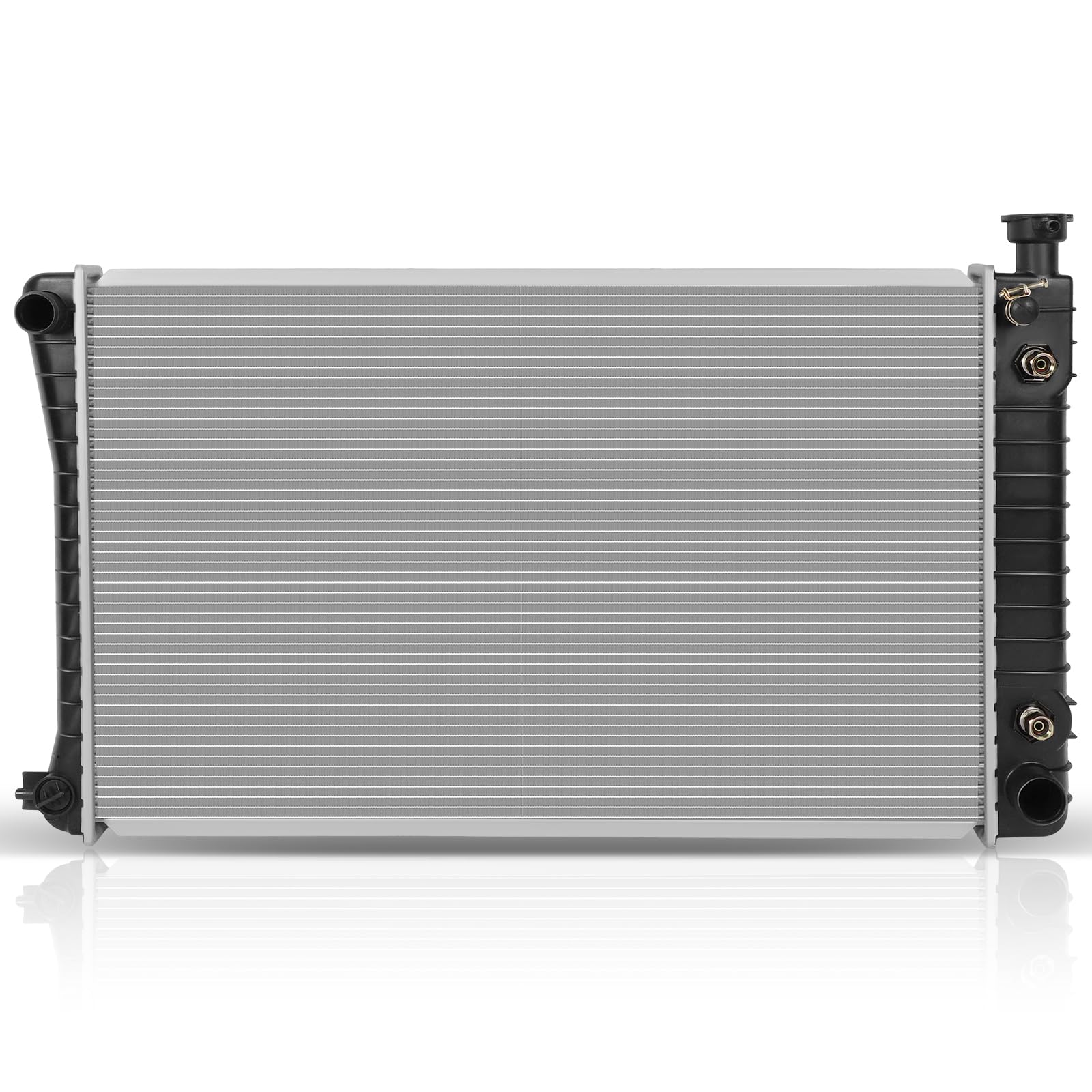
The SCITOO 618 radiator is a budget-oriented aluminum replacement designed for 1988-1995 Chevrolet C1500 and C2500 pickups equipped with 5.0-liter or 5.7-liter V8 engines, as well as compatible GMC C/K-series trucks from the same era. The core dimensions of 22.25 inches wide, 5.2 inches thick, and 5.12 inches tall use a painted aluminum construction with a high-density multi-layer cooling design aimed at maximizing heat rejection within a compact footprint. Reference numbers include 618, 1690, CU618, and multiple GM OEM part numbers, providing a wide cross-reference for fitment verification.
Owner feedback highlights the straightforward installation process, with multiple reports confirming that the radiator bolts directly into the factory core support without bracket modifications or hose alignment issues. The painted exterior finish provides basic corrosion resistance, though the paint coating is thinner than powder-coated alternatives and may chip during handling. One owner noted that the cooling fins are soft and bend easily when touched, which is a common characteristic of economy radiators using thinner aluminum stock. The multi-layer cooling design does provide adequate heat rejection for daily driving and light towing, with several owners reporting consistent operating temperatures after installation on trucks with over 150,000 miles.
As an entry-level replacement for older GM pickup owners who need a functional radiator without exceeding a strict budget, the SCITOO 618 delivers the essential cooling performance required to keep a stock or lightly modified small-block V8 at proper operating temperature. The aluminum construction is an upgrade over the original plastic-tank design, though the thin wall thickness means it will not withstand the same abuse as a heavy-duty aftermarket radiator. For a farm truck, weekend hauler, or budget restoration where every dollar counts, this radiator provides a viable path back to reliable cooling.
What works
- Direct bolt-on fitment for GM C/K-series pickups with no modifications
- Aluminum construction upgrades over factory plastic-tank radiators
- Multi-layer core provides adequate cooling for stock V8 engines
What doesn’t
- Thin aluminum fins bend easily during handling or cleaning
- Paint coating chips more readily than powder-coated alternatives
- Long-term durability unproven for heavy towing or high-load use
8. Auto Dynasty 28″ Radiator for Silverado/Sierra

The Auto Dynasty 28-inch radiator is a factory-style single-row aluminum replacement engineered for 1999-2007 Chevrolet Silverado and GMC Sierra 1500 trucks, as well as compatible Tahoe, Suburban, Yukon, and Escalade models with 4.3-liter, 4.8-liter, or 5.3-liter engines and automatic transmissions. The core uses T-6061 aluminum construction with a reinforced PVC material frame designed to resist heat and wear. The core dimensions measure 28-1/4 inches wide, 18-11/16 inches tall, and 1 inch deep, with a 1-5/16-inch inlet and 1-9/16-inch outlet. The integrated transmission oil cooler eliminates the need for external coolers on automatic-equipped vehicles.
Installation reports from Silverado owners confirm a straightforward bolt-on process with no drilling or modifications required. One owner’s 2004 Silverado, fitted after a deer strike, returned to reliable daily service with no cooling issues. A 2002 Yukon Denali XL equipped with the 6.0-liter engine showed improved cooling performance compared to the factory radiator, though the owner noted concerns about long-term durability after reading reports of leaks developing within the first year. A critical failure was reported on one unit where the upper transmission line bung connector stripped threads after only two days, causing complete fluid loss and vehicle stranding — this appears to be a manufacturing defect rather than a widespread issue, but it highlights the importance of inspecting all threaded fittings before installation.
The Auto Dynasty 2334 occupies a specific niche: owners of GMT800 trucks who want an aluminum-core upgrade at a price that undercuts most all-aluminum competitors. The factory-style design preserves the original mounting and hose routing, while the T-6061 aluminum core offers better corrosion resistance than the OEM plastic-aluminum hybrid. The single-row configuration is adequate for stock engines but may struggle under sustained heavy towing in hot weather. The transmission cooler fitting quality is the primary risk point, and pre-installation inspection of the bung threads is strongly recommended.
What works
- Factory-style bolt-on fitment for GMT800 trucks with no modifications
- T-6061 aluminum core offers improved corrosion resistance over OEM
- Integrated transmission oil cooler simplifies installation on automatic trucks
What doesn’t
- Transmission line bung threads reported stripped on some units
- Single-row core may struggle with sustained heavy towing in hot climates
- Long-term leak reports within first year raise durability questions
9. Zynrako Radiator for Dodge Grand Caravan / Chrysler Town & Country
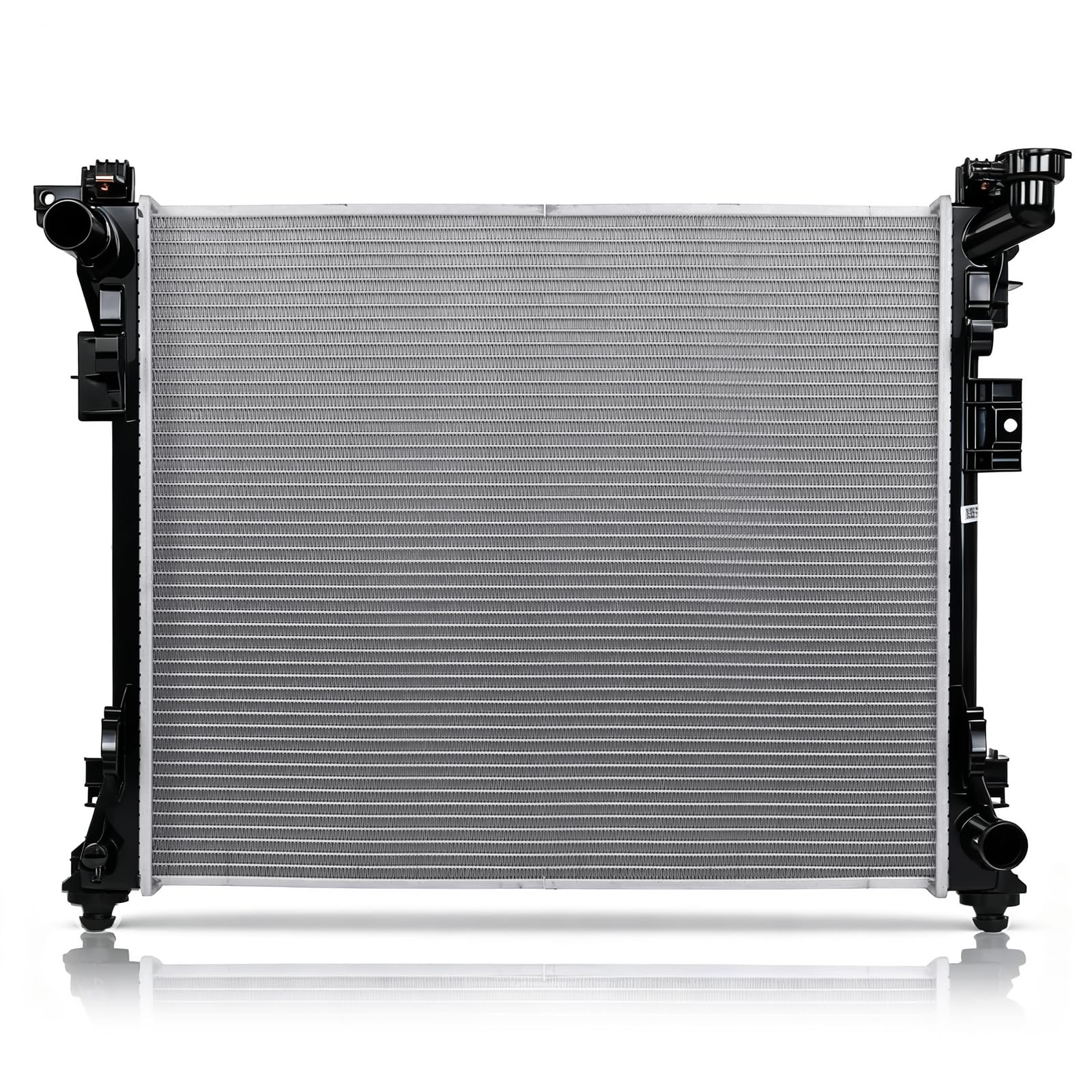
The Zynrako aluminum radiator is designed as an OE-fit replacement for Chrysler Town & Country (2008-2016), Dodge Grand Caravan (2008-2020), Ram C/V (2012-2015), and Volkswagen Routan (2009-2014). The core measures 24.19 inches tall, 20.38 inches wide, and 1 inch thick, with inlet and outlet diameters of 1.54 inches. Replacement OE numbers include CH3010345, 4677751AA, and 4677755AE. The design uses folded fin edges and an optimized 24-inch core aimed at reducing engine temperatures by up to 15 percent compared to stock — a notable claim for a front-drive minivan platform that tends to run hot under load, especially with air conditioning engaged.
Owner feedback confirms that the radiator fits the 2011 Town & Country Touring L and 2013 Dodge Grand Caravan perfectly, with clean welds, OEM-matched mounting points, and no leaks after installation. The aluminum build is noticeably thinner than the original plastic-tank unit it replaces, which caused initial concern for one owner who had to research whether the reduced thickness would affect cooling performance — it did not. A 2004 Ford F-150 owner also reported successful fitment, indicating that the core dimensions may work cross-platform for certain applications, though the intended minivan fitment is the primary use case. Several owners noted that long-term durability remains an open question given the aggressive pricing and thinner core construction.
For owners of Chrysler and Dodge minivans facing a failed radiator — a common issue on these platforms as the plastic tanks age and crack — the Zynrako offers a functional replacement at a cost that often leaves room in the budget for the labor of installation. The claimed 15 percent cooling improvement over stock is difficult to verify independently, but owner reports of stable operating temperatures after installation suggest the radiator meets or exceeds the cooling demands of the 3.6-liter Pentastar and 3.8-liter V6 engines. The folded fin edges are a thoughtful detail that improves airflow at low vehicle speeds, which is relevant for stop-and-go driving. Time will tell how the thin aluminum core holds up against years of thermal cycling, but initial impressions are positive.
What works
- Perfect OE-fitment for Grand Caravan, Town & Country, and Routan
- Folded fin edges improve low-speed airflow for stop-and-go driving
- Significant cost savings compared to dealer replacement parts
What doesn’t
- Thinner core construction raises long-term durability concerns
- Cooling improvement claims of 15% lack independent verification
- Limited installation instructions included — DIY owners may need video resources
Hardware & Specs Guide
Row Count and Core Thickness
The number of tube rows and the total core depth directly determine a radiator’s heat rejection capacity. Single-row cores are standard on most OEM replacements and provide adequate cooling for daily-driven vehicles. Two-row cores double the coolant tube surface area and are appropriate for tuned engines or light towing. Four-row cores offer the highest thermal capacity but require careful airflow management — the thicker core slows air velocity, so a high-performance fan and proper shroud sealing are essential to realize the benefit. Measure the available space between the engine and the core support before selecting a multi-row radiator, as clearance issues with mechanical fans or water pump pulleys are common on older platforms.
Port Size and Location Specifications
Inlet and outlet diameters must match your engine’s water pump outlet and thermostat housing to prevent flow restriction or hose fitment issues. Common sizes range from 1.25 inches to 1.75 inches, with most GM and Chrysler applications using 1.5-inch ports. Port location — whether top inlet with bottom outlet or side inlet with cross-flow outlet — determines hose routing and must match the vehicle’s original configuration. Installing a radiator with mismatched port orientation forces custom hoses and may interfere with fan shroud or accessory belt clearance. Always verify the port location in the product images and cross-reference with your existing radiator before ordering.
Transmission and Engine Oil Cooler Integration
Many aftermarket radiators include integrated coolers for automatic transmission fluid and engine oil. These coolers consist of tubes running through the radiator tank that transfer heat from the fluid to the coolant. The presence and size of these coolers must match your vehicle’s original equipment — an engine with an external transmission cooler requires bypassing an integrated cooler or installing a loop. Verify that the thread pitch of the cooler fittings matches your existing lines; SAE and metric threads are both common, and cross-threading a fitting during installation can cause immediate fluid loss and transmission damage.
Core Material and Tank Construction
Radiator cores are typically made from aluminum, while tanks are either aluminum or nylon-reinforced plastic. All-aluminum construction with welded tanks eliminates the crimped seam failure point common on plastic-tank radiators, but it comes at a higher cost and often requires more precise mounting. Plastic tanks are lighter and cheaper, but they become brittle with age and heat exposure, typically failing at the crimp joint after 5-8 years. For vehicles that are kept long-term, all-aluminum radiators provide a permanent solution that outlasts the rest of the cooling system. For short-term ownership or strict budget constraints, high-quality plastic-tank radiators from established brands still offer reliable service.
FAQ
Can I install an aftermarket radiator myself without professional help?
How do I know if an aftermarket radiator will fit my vehicle?
Is an all-aluminum radiator always better than a plastic-tank radiator?
What causes a new aftermarket radiator to leak immediately after installation?
How often should I replace my aftermarket radiator?
Final Thoughts: The Verdict
For most buyers, the best aftermarket auto radiators winner is the Mishimoto MMRAD-WRX-01 because it combines TIG-welded all-aluminum construction with a true direct-fit design for the Subaru WRX/STI platform, backed by a lifetime warranty that protects your investment through years of hard driving. If you want maximum cooling capacity for a classic GM build, grab the SPELAB CU162 with its 4-row core and included shroud kit. And for a dependable daily-driver replacement on GM trucks, nothing beats the value of the Spectra Premium CU2370 — a proven design that keeps your engine cool without breaking the bank.

Certification: BSc in Mechanical Engineering
Education: Mechanical engineer
Lives In: 539 W Commerce St, Dallas, TX 75208, USA
Md Amir is an auto mechanic student and writer with over half a decade of experience in the automotive field. He has worked with top automotive brands such as Lexus, Quantum, and also owns two automotive blogs autocarneed.com and taxiwiz.com.