A dash cam should capture the road without capturing your wallet month after month. Too many models lock basic features—like parking monitoring or cloud uploads—behind a recurring paywall. The right unit gives you crisp footage, reliable storage, and peace of mind with zero ongoing costs.
I’m Amir — the founder and writer behind Four Wheel Ask. I’ve spent years analyzing product specifications, build quality, and owner feedback to separate the truly functional from the overhyped.
Choosing the best dash cam without subscription demands comparing video clarity, storage capacity, and long-term dependability across several models.
How To Choose The Best Dash Cam Without Subscription
A subscription‑free dash cam should never compromise on core recording quality or reliability. Focus on three areas: sensor technology, parking‑mode intelligence, and storage flexibility.
Sensor and Night‑Vision Capability
STARVIS 2 sensors from Sony are the gold standard for low‑light performance. They dramatically reduce noise and motion blur, letting you read license plates even in near‑darkness. Look for models that combine STARVIS 2 with wide apertures (F1.5–F1.8) and HDR/WDR processing.
Parking Mode Without Subscription
Real 24‑hour parking monitoring uses G‑sensor triggers or time‑lapse recording, not cloud servers. A hardwire kit (sold separately) powers the camera while the car is off. Avoid “cloud parking mode” that requires a monthly plan — local event‑based recording is free, immediate, and private.
Storage and Data Management
Local microSD card support (ideally up to 256 GB or 512 GB) lets you keep full control of your footage. Wi‑Fi connectivity is handy for quick transfers, but don’t let an app’s limitations force you into a subscription. The best units include a quality card in the box and support loop recording with G‑sensor locking.
Quick Comparison
On smaller screens, swipe sideways to see the full table.
| Model | Category | Best For | Key Spec | Amazon |
|---|---|---|---|---|
| VIOFO A329S | Premium | Ultimate clarity, 4TB SSD support | 4K@60fps + 2K rear, dual STARVIS 2 | Amazon |
| ROVE R2‑4K Dual PRO | Premium | Free 128GB card + CPL filter | 4K+2K, STARVIS 2 front & rear, WiFi 6 | Amazon |
| REDTIGER F4 Pro | Performance | Touch screen, fast WiFi 6 | 4K+1080p, STARVIS 2, voice control | Amazon |
| FAIMEE 3‑Channel | Triple Coverage | Interior + front & rear | 4K+2K+2K, 128GB card, dual‑band WiFi | Amazon |
| REDTIGER F7N Pro | Value | Best all‑rounder for the price | 4K front + 1080p rear, STARVIS 2 | Amazon |
| Garmin Dash Cam Mini 3 | Compact | Ultra‑discreet, voice controlled | 1080p, 140° FOV, polarizer lens | Amazon |
| Pelsee P1 Pro | Budget | Entry‑level with included 64GB card | 4K front + 1080p rear, STARVIS 2 | Amazon |
In‑Depth Reviews
1. VIOFO A329S 4K 60FPS Dash Cam Front and Rear
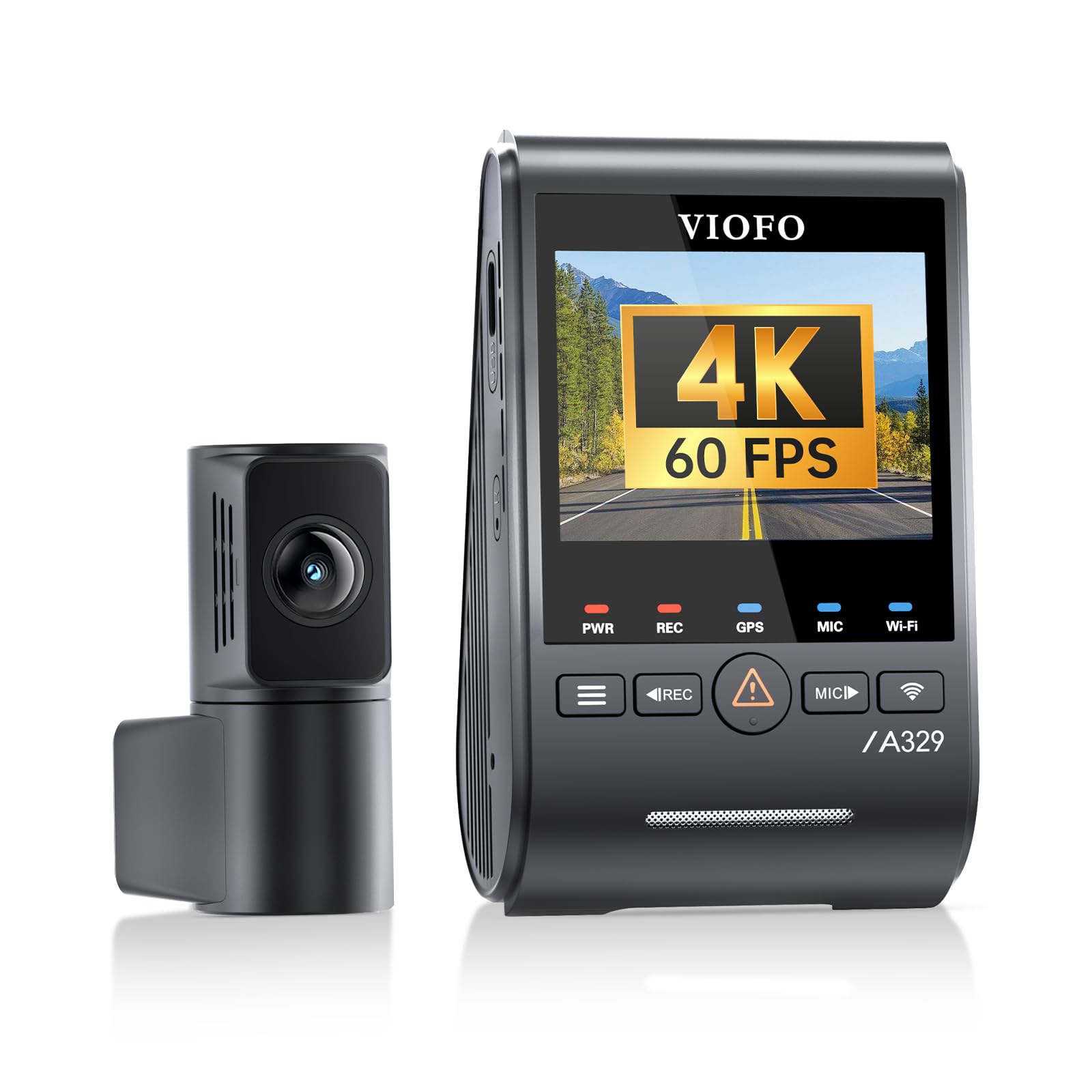
The VIOFO A329S sits at the top of the no‑subscription market because it delivers pro‑level recording without any cloud tie‑ins. Its front camera records 4K at 60 fps (or 4K with HDR at 30 fps), while the rear captures 2K — both using Sony STARVIS 2 sensors for exceptional low‑light clarity. Owners consistently praise the sharp details, especially when reading plates at dusk or in tunnel transitions.
What sets this model apart is its futuristic storage: it supports external SSDs up to 4 TB, plus microSD cards up to 512 GB. That translates to weeks of continuous looping without worrying about overwriting critical clips. The power‑saving parking mode uses G‑sensor triggers rather than a cloud subscription, and the included anti‑glare CPL filter cuts windshield reflections effectively.
Installation is straightforward with the slim coaxial cable, and the VIOFO app provides quick WiFi 6 transfers. A few users noted that the front 4K 60fps disables HDR, but the daytime quality remains outstanding. For buyers who want the absolute best image fidelity and zero recurring fees, the A329S is the benchmark.
What works
- Industry‑leading 4K 60fps front footage
- Massive 4 TB SSD support
- True subscription‑free parking mode
- Excellent low‑light performance
What doesn’t
- No microSD or SSD included
- HDR unavailable at 60 fps
2. ROVE R2‑4K Dual PRO Dash Cam Front and Rear
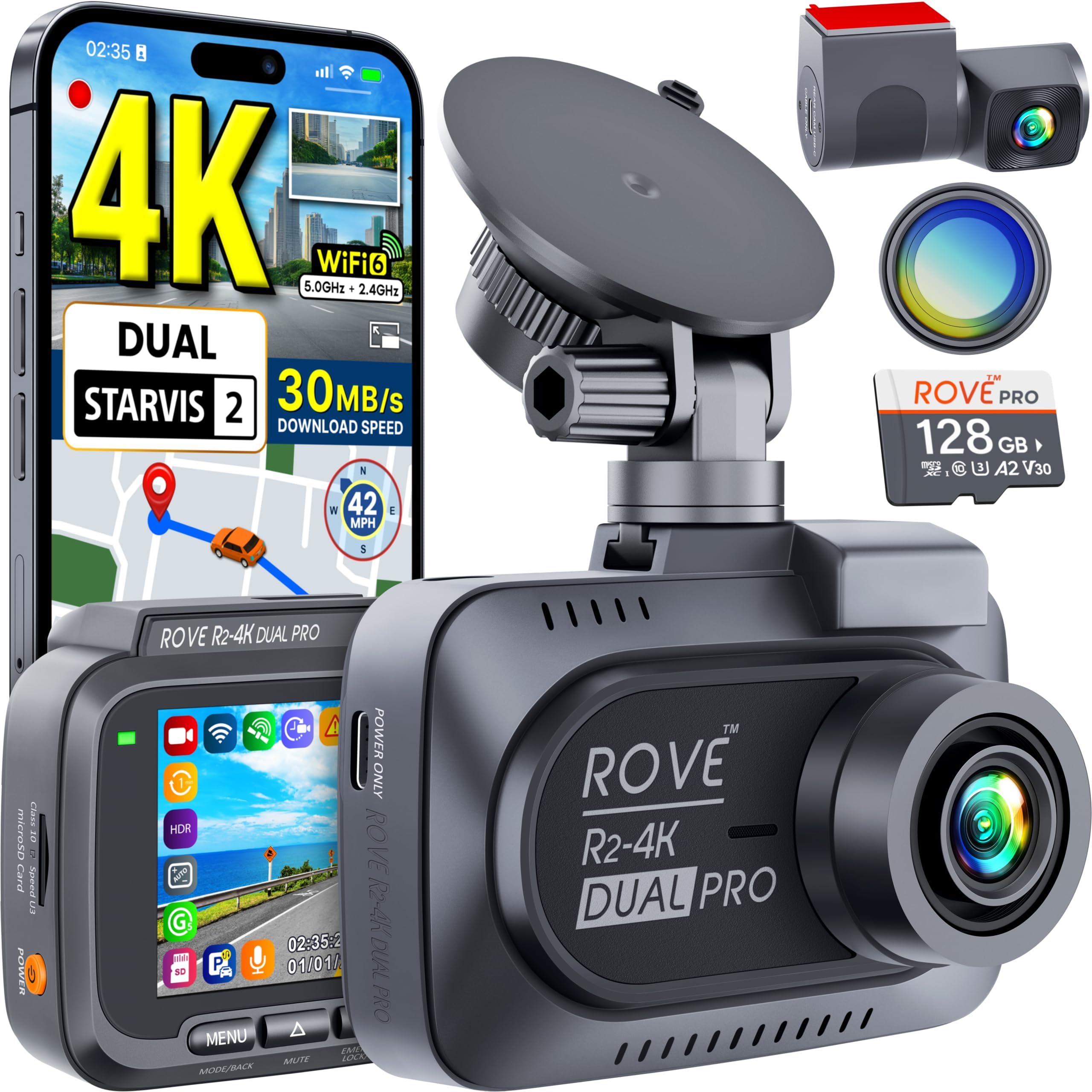
The ROVE R2‑4K Dual PRO brings premium dual‑channel recording with Sony’s latest IMX678 (front) and IMX675 (rear) STARVIS 2 sensors. The result is crisp 4K front and 2K rear footage with minimal motion blur even under fast‑changing lighting. Included in the box are a 128 GB microSD card and a CPL filter — two items that are often sold separately.
WiFi 6 connectivity enables download speeds up to 30 MB/s, and the free ROVE Dash Cam GPS Player lets you replay trips with full GPS overlay. The 24‑hour parking monitor offers three intelligent modes (time‑lapse, motion, collision detection) all driven by local G‑sensor logic — no subscription required. Owner reports highlight the robust build and responsive US‑based customer support.
Minor drawbacks: there is no voice control, and the CPL filter can introduce slight artifacts in very low light. The rear camera’s tight fit also makes cable routing a bit fussy in hatchbacks. Still, for a feature‑packed dual‑camera system that includes everything you need out of the box, the ROVE is a standout subscription‑free choice.
What works
- Dual STARVIS 2 sensors for excellent night video
- Fast WiFi 6 transfers
- Includes 128GB card and CPL filter
- Quad‑mode GPS with free playback software
What doesn’t
- No voice control
- Rear camera connector is tight
3. REDTIGER F4 Pro 4K Mini Dash Cam Front and Rear
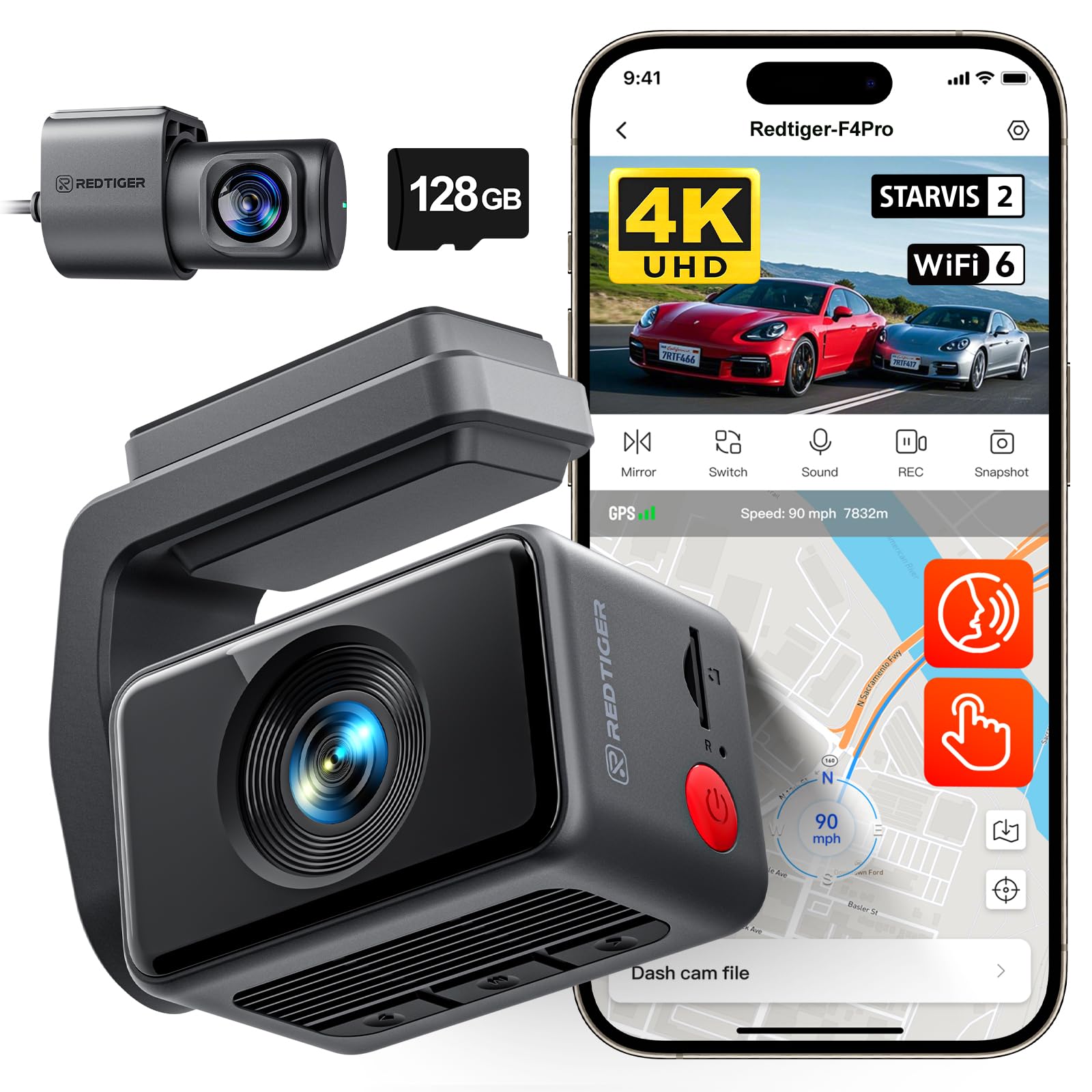
The REDTIGER F4 Pro stands out for its 2.2‑inch touchscreen and voice control — features more common in premium units. It records 4K front and 1080p rear using a STARVIS 2 sensor, delivering sharp daytime details and respectable night performance. The included 128 GB card means you can start recording immediately without additional purchases.
WiFi 6 (5.8 GHz) enables very fast video exports, and the built‑in GPS logs speed and route data. The dual‑mode parking monitor (collision lock and time‑lapse) works via a hardwire kit and requires no cloud plan. Owners note the compact footprint and removable slide cover keep the camera unobtrusive on the windshield.
Some users wish the field of view were wider — the 140° coverage is adequate but not class‑leading. The touchscreen interface, while convenient, lacks all the settings available in the app. For drivers who want a sleek, modern interface and fast wireless transfers without a subscription, the F4 Pro is a compelling mid‑premium option.
What works
- Responsive touchscreen and voice control
- Fast WiFi 6 download speeds
- 128GB card included
- Compact, low‑profile design
What doesn’t
- Field of view could be wider
- App‑only settings not mirrored on touchscreen
4. FAIMEE 4K+2K+2K 3‑Channel Dash Cam
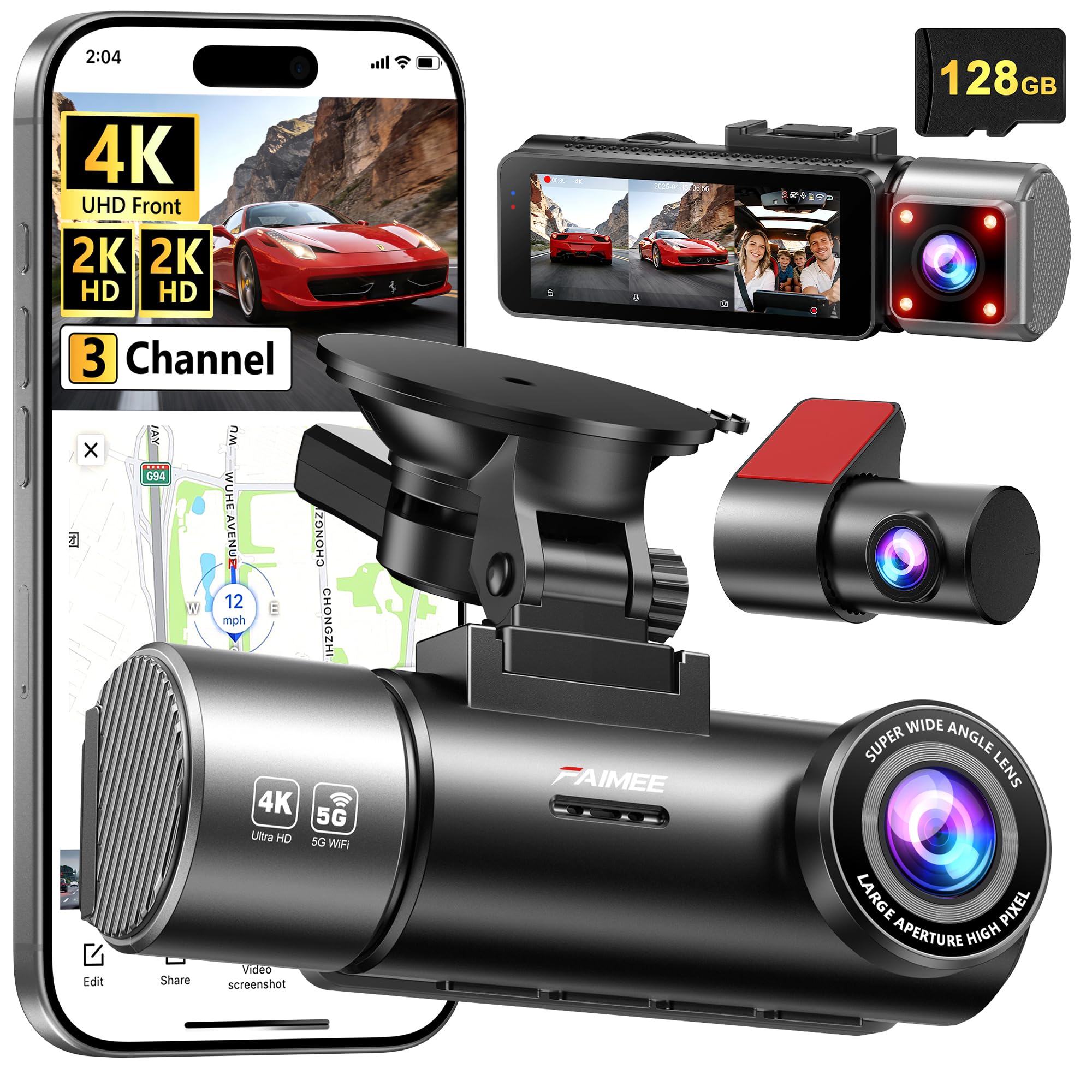
Rideshare drivers and those who want full cabin coverage will appreciate the FAIMEE’s three‑channel design: 4K front, 2K interior, and 2K rear. All three streams record simultaneously with a wide 170° front lens and 150° rear lens, minimizing blind spots. The F1.8 aperture and WDR support deliver usable footage even in challenging lighting.
Dual‑band WiFi (5.8 GHz / 2.4 GHz) connects to the FAIMEE app for live view and file downloads, while the built‑in GPS logs route and speed. A free 128 GB card is included, and the G‑sensor‑based parking mode (hardwire kit required) keeps monitoring costs at zero. Owners report reliable performance over weeks of use, with crisp details and smooth app operation.
The trade‑off for three channels is a more involved installation — managing three cables takes patience. The interior camera’s placement may also interfere with rear‑view mirror adjustment in some vehicles. For anyone needing interior monitoring (e.g., for rideshare or teen driver supervision) without a subscription, the FAIMEE offers exceptional value.
What works
- True 3‑channel recording (front/interior/rear)
- Good night vision with WDR
- Dual‑band WiFi and GPS included
- 128GB card in the box
What doesn’t
- Cable routing is time‑consuming
- Interior camera can block mirror adjustment
5. REDTIGER F7N Pro 4K Dash Cam Front and Rear
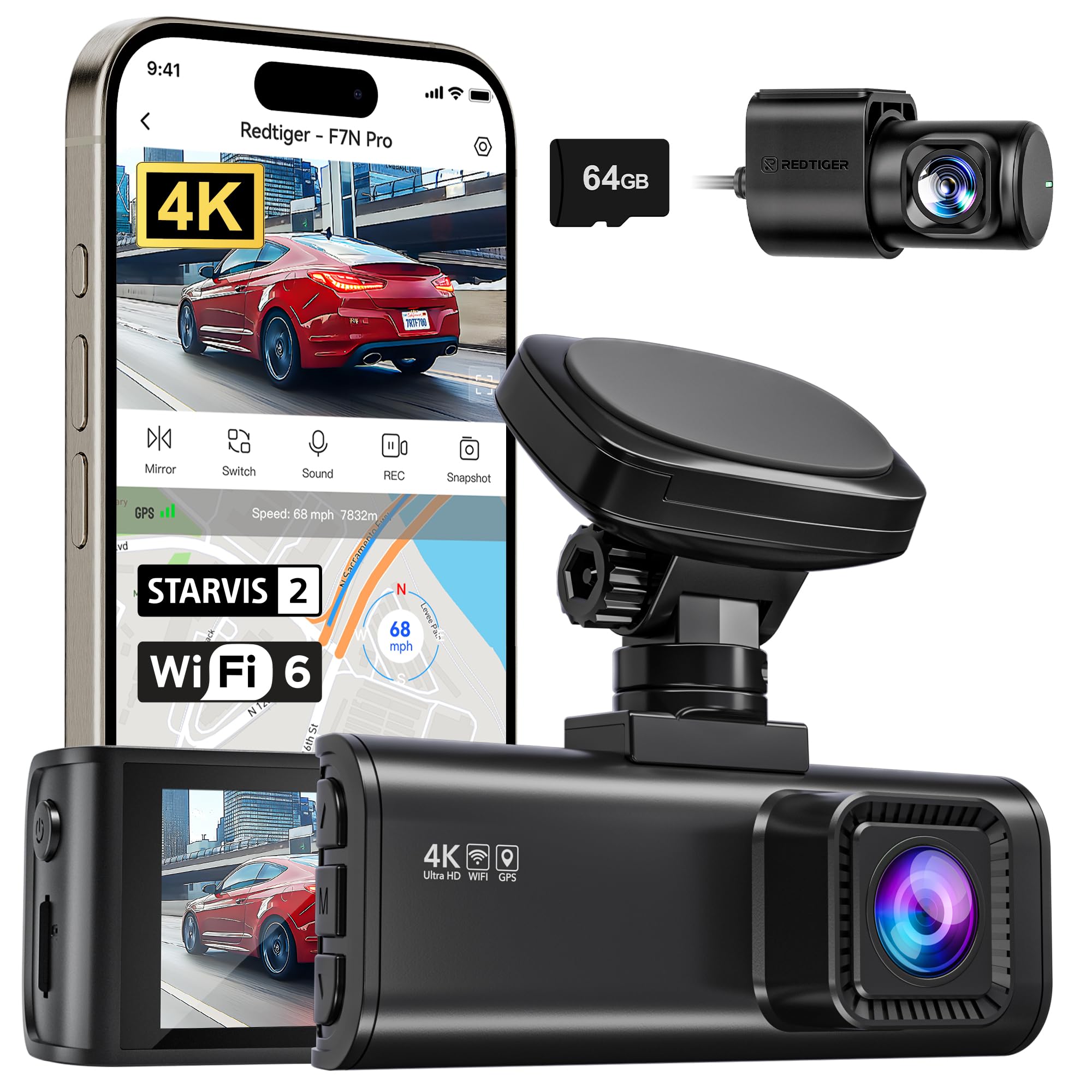
The REDTIGER F7N Pro is the sweet spot for budget‑conscious buyers who still want STARVIS 2 performance. It records 4K UHD front and 1080p Full HD rear with a 170°+140° field of view. The F1.5 front aperture is among the widest at this price tier, allowing more light for low‑light clarity. A 64 GB memory card is included, and it supports cards up to 256 GB.
Built‑in GPS logs your route and speed, and the REDTIGER app provides WiFi connectivity for playback and sharing. The parking monitor uses G‑sensor detection and time‑lapse recording — both free features. Owners consistently praise the video quality and ease of installation, with many noting that the footage rivals more expensive units.
Some feedback points to the small 3.18‑inch screen and slightly dated menu interface. The WiFi connection can be finicky, and downloading a full 4K clip takes about 15 minutes. For drivers who want dependable STARVIS 2 recording without spending a premium, the F7N Pro delivers strong value.
What works
- Excellent STARVIS 2 night performance
- Wide aperture front lens (F1.5)
- Easy installation with strong adhesive mount
- Budget‑friendly pricepoint
What doesn’t
- Small screen and dated menu
- WiFi downloads can be slow
6. Garmin Dash Cam Mini 3

The Garmin Mini 3 is the smallest dash cam on this list — roughly the size of a key fob — and mounts behind the rear‑view mirror for a near‑invisible profile. It records crisp 1080p HD video with a 140° field of view, and the built‑in Clarity polarizer reduces windshield glare effectively. Voice control lets you save clips or start/stop audio recording hands‑free.
Unlike most Garmin units, the Mini 3 does not require a Vault subscription for basic operation. It records automatically on power, and the Garmin Drive app (free) handles local playback and file downloads. Parking guard mode is available for free via a hardwire kit. Owners appreciate the discreet form factor and reliable construction that withstands cabin heat.
The main trade‑off is resolution — 1080p is adequate but not for capturing distant plates in low light. Some users report intermittent WiFi connection and slow file transfers. The lack of a display means you rely entirely on the app for configuration. For drivers who prioritize stealth and simplicity over 4K detail, the Mini 3 is a solid, subscription‑free companion.
What works
- Extremely compact, almost invisible
- Built‑in polarizer reduces glare
- Voice control for hands‑free operation
- Reliable auto‑recording
What doesn’t
- Only 1080p resolution
- Slow WiFi file transfers
- Setup can be finicky for some users
7. Pelsee P1 Pro 4K Dash Cam Front and Rear
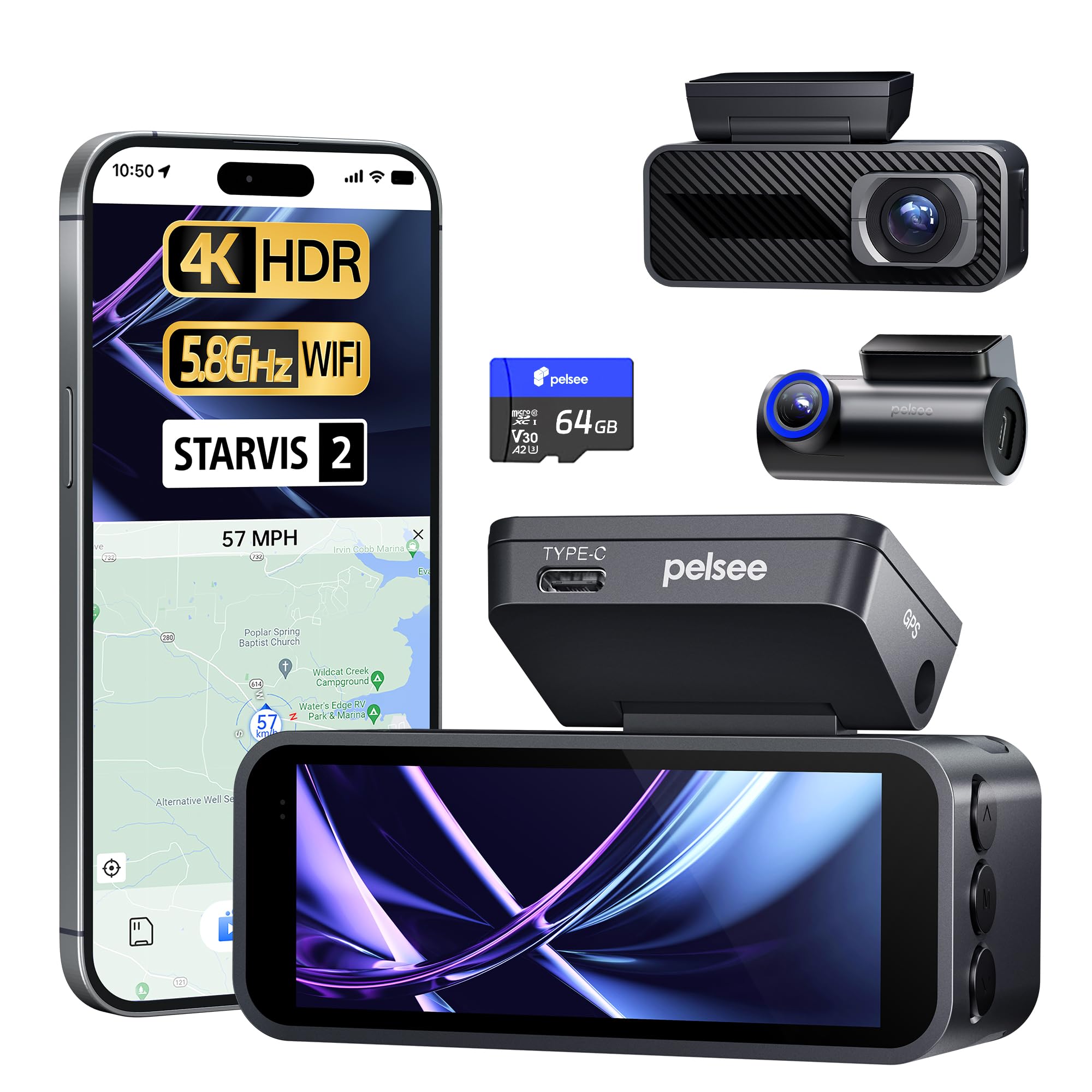
The Pelsee P1 Pro is the most affordable entry into STARVIS 2 territory, offering 4K front and 1080p rear recording with full‑color night vision. The 3.39‑inch IPS screen is generous for a budget model, and the included 64 GB card gets you started immediately. ADAS alerts (forward collision, lane departure) and voice commands add safety‑oriented features typically found in pricier units.
5.8 GHz WiFi provides smooth app connectivity for reviewing and sharing clips, while built‑in GPS stamps speed and coordinates onto footage. The 24‑hour parking mode uses G‑sensor triggers or time‑lapse (hardwire kit required) — no subscription needed. Customer feedback highlights the easy installation and responsive support from Pelsee.
The trade‑offs: the front camera runs at 25 fps (not 30), and the rear cable length may be tight for larger vehicles. Some users also note that the parking mode sensitivity requires tuning to avoid false triggers. For budget shoppers who want a capable, subscription‑free dash cam with modern sensor technology, the Pelsee P1 Pro is a strong contender.
What works
- Affordable STARVIS 2 performance
- Large 3.39‑inch display
- Includes 64GB card and hardwire kit
- ADAS and voice control
What doesn’t
- Front records at 25 fps
- Rear cable could be longer
- Parking mode sensitivity requires adjustment
Hardware & Specs Guide
STARVIS 2 Sensors
Sony’s STARVIS 2 technology is the benchmark for dash cam night vision. It boosts light sensitivity up to four times compared to standard sensors, reducing noise and motion blur. Models from VIOFO, ROVE, REDTIGER, and Pelsee all leverage this tech to capture usable plates in near‑darkness.
Resolution & Frame Rate
Higher resolution (4K vs. 1080p) is critical for reading distant plates. The VIOFO A329S leads with 4K 60fps (HDR off), while most dual‑channel units offer 4K front at 24–30 fps. Frame rate matters for smoothness, but a steady 30 fps is usually sufficient for accident evidence.
Parking Mode
Subscription‑free parking modes use a combination of G‑sensor impact detection and time‑lapse recording. A hardwire kit (sold separately) powers the camera while the car is off. Avoid models that require cloud plans — local event‑based parking mode keeps your data private and costs zero.
Storage Options
Most dash cams support microSD cards from 64 GB to 512 GB. The VIOFO A329S is unique in also supporting external SSDs up to 4 TB. Loop recording with G‑sensor locking ensures critical clips aren’t overwritten. Always use high‑endurance cards designed for continuous video writing.
FAQ
Do I need a subscription for any of these dash cams?
Can I use the dash cam without connecting it to my phone?
What does a hardwire kit do and do I need one?
How much storage do I really need?
Final Thoughts: The Verdict
For most buyers, the dash cam without subscription winner is the VIOFO A329S because it offers unmatched 4K 60fps quality, massive storage support, and a true subscription‑free parking mode. If you want dual STARVIS 2 sensors with everything included, grab the ROVE R2‑4K Dual PRO. And for a budget‑friendly entry point that still delivers STARVIS 2 performance, nothing beats the REDTIGER F7N Pro.

Certification: BSc in Mechanical Engineering
Education: Mechanical engineer
Lives In: 539 W Commerce St, Dallas, TX 75208, USA
Md Amir is an auto mechanic student and writer with over half a decade of experience in the automotive field. He has worked with top automotive brands such as Lexus, Quantum, and also owns two automotive blogs autocarneed.com and taxiwiz.com.