Direct injection engines deliver impressive fuel economy and power, but the tradeoff is a stubborn carbon buildup on intake valves that port-injected engines simply don’t face. Without fuel washing over the valves, deposits accumulate mile after mile, eventually robbing performance and fuel efficiency. The right additive makes a real difference, but most formulas on the shelf aren’t equipped to handle the unique demands of GDI hardware.
I’m Amir — the founder and writer behind Four Wheel Ask. My work involves studying chemical detergent packages, cross-referencing thousands of verified owner reports, and evaluating how different formulations perform across diverse engine platforms and driving conditions.
This guide cuts through the marketing noise to separate true carbon fighters from basic maintenance additives. After analyzing dozens of formulas and thousands of owner reports, I found top performers to help pick the best fuel injector cleaner for direct injection.
How To Choose The Best Fuel Injector Cleaner For Direct Injection
Not all fuel system cleaners are built alike, and the difference matters most for direct injection engines. Standard additives designed for port injection simply cannot clear the intake valve deposits that GDI engines accumulate. Understanding a few technical factors will help you pick a formula that delivers measurable results rather than just a freshened smell at the pump.
PEA Concentration and Quality
Polyether Amine (PEA) is the benchmark detergent chemistry for carbon removal in modern engines. It withstands high combustion temperatures and breaks down the hard, baked-on deposits that form on GDI intake valves. Products with higher PEA concentrations clean more aggressively in fewer treatments, while lower concentrations work better as a maintenance dose. The difference between a true decarbonizer and a light cleaner almost always comes down to the PEA load.
Direct Injection Compatibility
Many fuel system cleaners are formulated for older port-injection designs where fuel naturally cleans the intake tract. Direct injection engines need a formula that targets deposits in the combustion chamber and on the injector tips themselves. Look for products explicitly labeled for GDI use or those with a proven track record in turbocharged and high-compression direct injection platforms. Owner reports on GDI-specific forums are often more reliable than the fine print on the bottle.
Treatment Frequency and Method
Some cleaners are designed as a one-time shock treatment to clear heavy buildup, while others are meant for continuous maintenance every few thousand miles. Using a heavy-duty cleaner too often can be wasteful, and using a light maintenance additive on a severely carbon-clogged engine will disappoint. The best approach is to start with a high-concentration cleaner to establish a baseline, then switch to a milder product for regular upkeep.
Fuel Type and Additive Synergy
Ethanol content and regional fuel quality influence how deposits form and how well a cleaner works. Higher ethanol blends tend to produce more moisture and can accelerate deposit formation in some engines. Products that include corrosion inhibitors or fuel stabilizers offer added protection for vehicles that sit idle or see seasonal use. For daily drivers on standard pump gas, a straight PEA-based cleaner without extra additives is usually the most efficient choice.
Quick Comparison
On smaller screens, swipe sideways to see the full table.
| Model | Category | Best For | Key Spec | Amazon |
|---|---|---|---|---|
| BG 44K Platinum | Premium Cleaner | Maximum carbon removal | PEA formula, dealership-grade | Amazon |
| Liqui Moly Jectron | Fuel Additive | Smooth idle and response | German formulation, 2-pack | Amazon |
| Lucas Oil Fuel Injector Cleaner | Maintenance Cleaner | Regular upkeep and diesel | 12-pack, gas and diesel | Amazon |
| Mercury Quickleen | Marine Cleaner | Marine and small engines | Concentrated, OEM spec | Amazon |
| Berryman 7516 | High Mileage Cleaner | Heavy deposit removal | HEST solvent, 15 oz | Amazon |
In‑Depth Reviews
1. BG 44K Platinum

BG 44K has long been the benchmark that dealership service departments reach for when a direct injection engine rolls in with drivability complaints. The Platinum formulation builds on that reputation with a concentrated PEA package designed to tackle the hardest carbon deposits without relying on harsh solvents that can damage oxygen sensors or catalytic converters. It is the product that experienced technicians recommend when a simple top-shelf additive will not cut it.
Owner feedback consistently highlights rapid, measurable improvements. Multiple reports show fuel economy jumping by several miles per gallon within the first tank after treatment, with idle smoothness and throttle response following shortly after. One detailed account documented a jump from 18 to over 30 miles per gallon after a single treatment, along with complete elimination of throttle hang-over at stops. Several owners noted that the improvement was clearly noticeable within the first mile of driving.
This product is formulated for serious carbon remediation, not light maintenance. The concentration level means it should be used strategically, typically every 5,000 miles or before an oil change, rather than at every fill-up. For GDI owners dealing with rough idle, reduced power, or declining fuel economy, BG 44K offers the closest thing to a professional induction cleaning in a bottle. It carries a higher entry point than retail shelf products, but the results justify the investment for those who need real cleaning power.
What works
- Noticeable improvement in power and fuel economy within one tank
- Professional-grade PEA concentration trusted by dealerships
- Eliminates rough idle and throttle hesitation effectively
What doesn’t
- Premium price point compared to retail additives
- Overkill for routine maintenance between major services
2. Liqui Moly Jectron

Liqui Moly has earned a strong following among European car owners and performance enthusiasts who demand precise fuel system operation. Jectron is their dedicated fuel injection cleaner that targets injector fouling and carbon deposits with a carefully balanced detergent package. It is designed to restore the spray pattern of clogged injectors, which directly improves combustion efficiency and reduces the amount of unburned fuel that contributes to long-term carbon buildup.
Owner reports across a range of engine types, from older Honda Civics to turbocharged four-cylinders, describe smoother idling and noticeably better throttle response after treatment. One review on a high-mileage 2000 Civic noted that the engine ran like new after pouring in a bottle. Another owner of a turbocharged four-cylinder reported that the product quieted noisy lifters, though not as completely as they had hoped for that specific engine. The two-pack configuration offers good value for owners who want to treat multiple vehicles or perform back-to-back cleanings.
Jectron strikes a practical balance between cleaning power and cost. It is not as aggressive as BG 44K, making it better suited for regular maintenance rather than emergency decarbonization. The formula works well on both port-injected and direct injection engines, which makes it a versatile choice for households with mixed vehicle types. For GDI owners looking for a dependable product they can use every 3,000 to 5,000 miles without breaking the budget, Jectron delivers consistent results.
What works
- Noticeable improvement in idle smoothness and throttle response
- Versatile formulation works on port and direct injection engines
- Two-pack provides good value for multi-vehicle households
What doesn’t
- Less effective on severe carbon buildup compared to heavy-duty options
- Results on noisy lifters vary by engine platform
3. Lucas Oil Fuel Injector Cleaner

Lucas Oil is a household name in the additive world, and their fuel injector cleaner has been a staple for twenty years among owners who prioritize consistent maintenance over one-time shock treatments. This product ships as a twelve-pack of 5.25-ounce bottles, making it a practical choice for fleet operators, households with multiple vehicles, or anyone who wants to keep a bottle in the garage for continuous use. The formula is designed to clean and lubricate the entire fuel system, including pumps and injectors.
Long-term owner accounts reveal a pattern of steady, reliable performance rather than dramatic single-tank transformations. One reviewer noted using the product for twenty years without a single fuel-system related issue, while another reported measurable improvements in diesel mileage on a 2015 Ram Eco-Diesel. Several comments mention that the product works well when added every other fill-up as a preventative measure. The ability to use it in both gasoline and diesel engines adds flexibility for mixed-fuel households.
This product occupies a specific niche in the GDI cleaning conversation. It is not formulated to aggressively strip heavy carbon deposits like the BG or Berryman options, but its lubricating properties offer genuine value for high-pressure fuel pumps that are common in direct injection systems. The twelve-pack format brings the per-bottle cost down significantly, making it an affordable option for owners who prefer to add a cleaner at every oil change. For routine maintenance between heavy-duty decarbonization sessions, Lucas is a solid choice.
What works
- Excellent value per bottle in the twelve-pack configuration
- Works in both gasoline and diesel engines without issue
- Fuel system lubricants benefit high-pressure GDI pumps
What doesn’t
- Not strong enough for heavy carbon deposit removal on GDI valves
- Primarily a maintenance product, not a cure for existing drivability issues
4. Mercury Quickleen
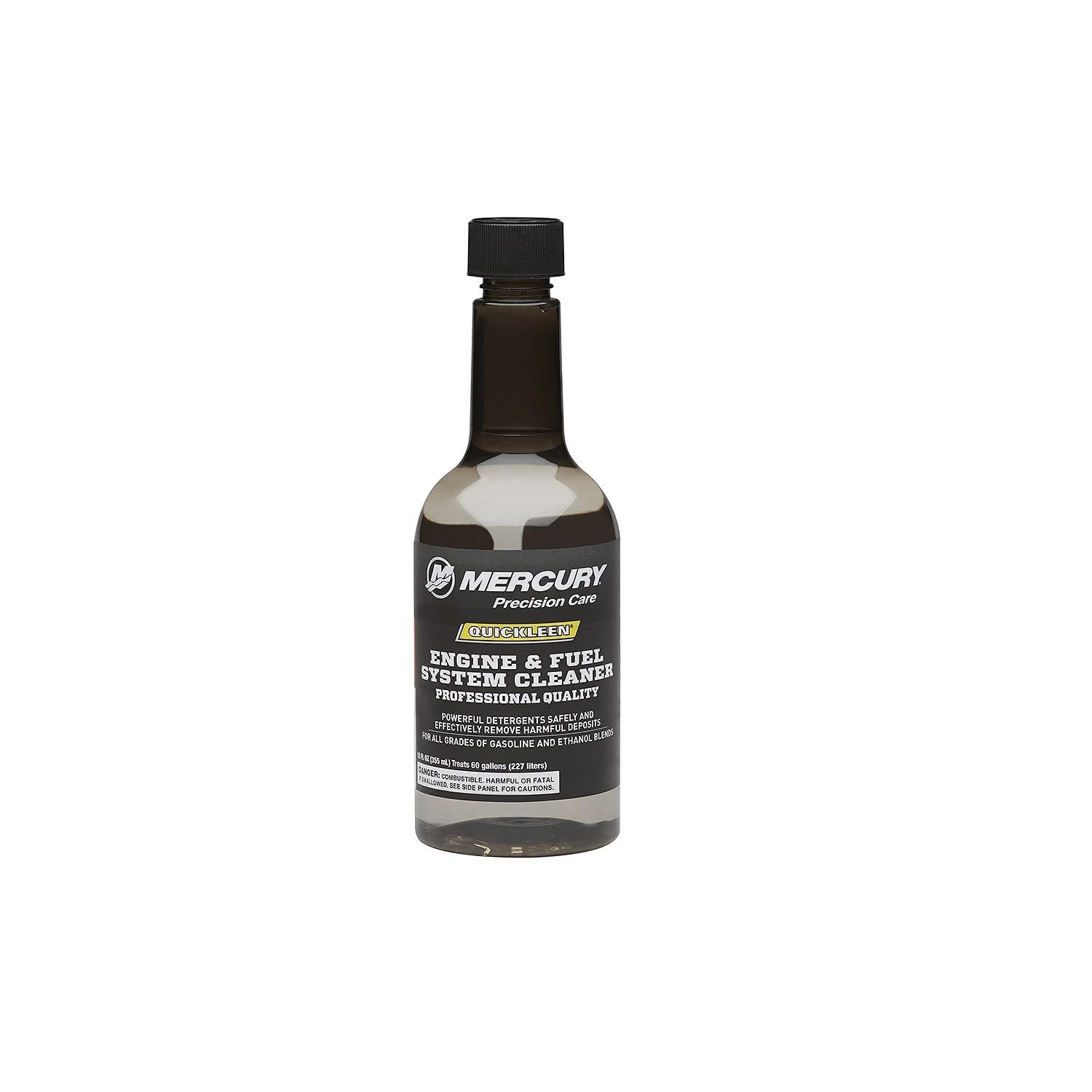
Mercury Quickleen comes from the marine engineering world, where fuel system deposits can disable a vessel far from shore. This OEM-specified cleaner is produced by Mercury Marine to their own stringent standards, and it is formulated to remove carbon from carburetors, injectors, intake valves, spark plugs, piston crowns, and cylinder heads. The concentrated nature of the formula means that just one ounce treats five gallons of fuel, making each bottle stretch much further than typical automotive additives.
Owner feedback extends well beyond marine applications. Several verified buyers report that Quickleen cleared persistent sputtering and hard-starting issues on power generators and lawn mowers after a single treatment. Marine engineers who use the product seasonally note that it resolves full-throttle power loss and hesitation caused by degraded fuel deposits. The consensus among those who have tried multiple cleaners is that Quickleen punches above its weight class in terms of raw cleaning ability, particularly on carbon that has had time to bake onto surfaces.
For direct injection owners, Quickleen offers an interesting alternative to mainstream automotive products. The concentrated PEA-equivalent chemistry is designed to handle the extreme conditions inside a marine engine, which often run hotter and under heavier loads than automotive power plants. The main consideration is that it does not contain fuel stabilizers, so users with seasonal vehicles will need to add a separate stabilizer product for long-term storage. For aggressive cleaning on a budget, this marine-grade option deserves serious consideration.
What works
- Highly concentrated formula treats up to 60 gallons per bottle
- OEM-grade cleaning power tested in demanding marine environments
- Resolves sputtering and hard-start issues across multiple engine types
What doesn’t
- No fuel stabilizer included for seasonal storage applications
- Marine focus may feel unfamiliar to automotive-only users
5. Berryman 7516 High Mileage Fuel System Rejuvenator

Berryman has been manufacturing fuel system chemicals for decades, and the 7516 High Mileage Fuel System Rejuvenator represents their most aggressive consumer-level formula. What sets this product apart is Berryman’s proprietary HEST — High Energy Solvent Technology — which uses strong active solvents rather than weak carriers like mineral spirits or kerosene. The result is a pour-can product that can dissolve fuel residue and carbon deposits that milder additives simply cannot touch.
Real-world owner reports paint a compelling picture for high-mileage direct injection engines. One verified account describes how Berryman B12 cured hesitation and power loss on a Victory Hammer motorcycle that had sat for three years, with the owner noting it was superior to Sea Foam, Lucas, and Chevron alternatives. Another detailed a situation where the product reduced oil consumption on a 2007 RAV4 from one quart per 300 miles to one quart per 1,000 miles after a single tank. The same owner noted that the initial treatment caused a temporary misfire as dislodged carbon burned off, which is a sign that the product was working aggressively.
This is not a gentle maintenance additive. Berryman 7516 is formulated for engines that already have measurable carbon problems, and it works best as an initial decarbonization tool. Users should be prepared for the possibility of a temporary misfire as heavy deposits break loose and pass through the combustion chamber. The metal pour can and 15-ounce size offer good value for the cleaning power delivered. For GDI owners with high-mileage engines who need to reclaim lost performance without a costly professional cleaning, this is the most cost-effective entry point.
What works
- Aggressive solvent chemistry dissolves heavy carbon deposits effectively
- Proven results on high-mileage engines with oil consumption issues
- Excellent value for the cleaning power delivered per pour
What doesn’t
- Can cause temporary misfire as heavy deposits break loose
- Harsh solvents not ideal for continuous maintenance use
Hardware & Specs Guide
PEA vs. Other Detergent Chemistries
Polyether Amine (PEA) is the most effective detergent chemistry for removing carbon deposits from direct injection engines because it withstands the high temperatures inside GDI combustion chambers without breaking down. Other common chemistries include polyisobutylene amine (PIBA), which works better at lower temperatures and is more suited to port injection systems. When reading a product label for GDI use, PEA should be the primary active ingredient. Products that list only PIBA or that do not specify their detergent chemistry are unlikely to deliver meaningful carbon removal on direct injection engines.
Concentration and Dosage Guidelines
The concentration of PEA in a given product determines how aggressively it cleans and how frequently it should be used. High-concentration formulas like BG 44K are designed for periodic shock treatments every 5,000 to 10,000 miles, while lower-concentration products like Lucas Oil can be used every 1,000 to 3,000 miles as a maintenance dose. Using a high-concentration product too frequently can waste money without additional benefit, and using a low-concentration product on a severely carbon-clogged engine will produce disappointing results. Matching the product strength to the actual condition of the engine is the key to effective fuel system maintenance.
FAQ
Does fuel injector cleaner actually work on direct injection engines?
How often should I use fuel injector cleaner on a GDI engine?
What is the difference between PEA and PIBA in fuel system cleaners?
Final Thoughts: The Verdict
For most buyers, the best fuel injector cleaner for direct injection winner is the BG 44K Platinum because it delivers dealership-grade PEA cleaning power that produces noticeable improvements in fuel economy, idle smoothness, and throttle response within a single tank. If you want a balanced product for regular maintenance between major cleanings, grab the Liqui Moly Jectron. And for high-mileage engines that need aggressive carbon removal on a budget, nothing beats the Berryman 7516.

Certification: BSc in Mechanical Engineering
Education: Mechanical engineer
Lives In: 539 W Commerce St, Dallas, TX 75208, USA
Md Amir is an auto mechanic student and writer with over half a decade of experience in the automotive field. He has worked with top automotive brands such as Lexus, Quantum, and also owns two automotive blogs autocarneed.com and taxiwiz.com.