Bore gauge sets separate serious engine builders from hobbyists. A few tenths of a thousandth can mean the difference between a sealed ring land and a smoky headache, so the tool you choose needs to deliver repeatable, trustworthy data every time you plunge it into a cylinder. The market offers everything from budget-friendly kits with digital readouts to shop-grade mechanical sets that hold their calibration for decades, and navigating those options requires understanding what actually drives measurement integrity.
I’m Amir — the founder and writer behind Four Wheel Ask. I’ve spent years analyzing product specifications, studying owner-reported accuracy drift, and comparing build quality across hundreds of precision measurement tools to give you a clear view of what matters most in a bore gauge set.
Whether rebuilding an engine or checking cylinder tolerances, the right best bore gauge set ensures accurate and reliable measurements every time.
How To Choose The Best Bore Gauge Set
A bore gauge set is only as good as its weakest component — the indicator, the contact points, and the centering mechanism all have to work together to deliver repeatable readings. Understanding a few key specs will save you from buying a set that drifts after a few months of use.
Graduation and Indicator Type
Graduation — typically 0.0005 inch or 0.0001 inch — determines the smallest increment the gauge can resolve. For most engine cylinder work, 0.0005 inch is sufficient because factory service limits rarely demand tighter resolution. Digital indicators offer quick decimal readouts and can be zeroed easily, while dial indicators provide an analog sweep that some machinists prefer for detecting taper and out-of-round patterns at a glance. The trade-off is that digital units rely on batteries and electronics that can fail in harsh shop environments, whereas mechanical dial indicators are virtually immune to humidity and vibration.
Range, Depth, and Contact Points
The measuring range tells you the smallest and largest bore diameter the set can handle. A 2-to-6-inch range covers most automotive cylinders, though small-engine work may require a narrower set. Depth capability — how far into the bore the gauge can reach — matters for accessing ring wear zones below the ridge. Carbide-tipped anvils resist wear far better than steel contacts, maintaining their original geometry through hundreds of measurements. Self-centering mechanisms reduce operator error by automatically aligning the gauge to the bore’s true centerline, which is critical for consistent data across multiple cylinders.
Build Quality and Included Accessories
An all-metal clamping system and a rigid measuring rod prevent flex that introduces error. Insulated grips reduce heat transfer from your hand, minimizing thermal expansion drift during extended use. A fitted storage case protects the delicate indicator and contact points from shop debris. Some sets include extension rods for deeper bores and multiple anvil sizes to cover the full range — verify that the set you choose includes enough accessories to handle the specific engine families you work on without forcing you to buy add-ons later.
Quick Comparison
On smaller screens, swipe sideways to see the full table.
| Model | Category | Best For | Key Spec | Amazon |
|---|---|---|---|---|
| Accusize EE20-1406 | Dial | Best Overall Value | 1.4–6 in, 0.0005 in grad | Amazon |
| Fowler 52-646-300-0 | Dial | Shop-Proven Durability | 2–6 in, 9.5 in depth | Amazon |
| Accusize EE20-2416 | Dial | High Precision Work | 1.4–6 in, 0.0001 in grad | Amazon |
| Mitutoyo 511-753 | Dial | Professional Metrology | 2–6 in, 0.0001 in res | Amazon |
| Starrett 3089Z-131-26J | Dial | Industrial Longevity | 2–6 in, ±0.0001 in accuracy | Amazon |
| HFS 16242 | Dial | Budget-Friendly Engine Work | 2–6 in, 10 in depth | Amazon |
| Neoteck Digital Bore Gauge | Digital | Entry-Level Digital Readout | 2–6 in, 0.0005 in res | Amazon |
In‑Depth Reviews
1. Accusize Industrial Tools Dial Bore Gauge Set EE20-1406
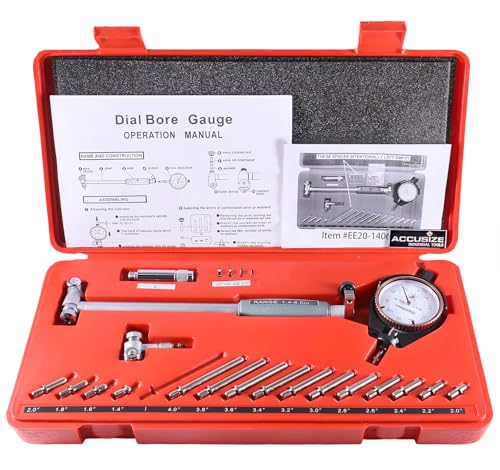
The Accusize EE20-1406 hits the sweet spot between cost and capability. Its 1.4-to-6-inch range covers passenger car and light truck cylinders, and the 0.0005-inch graduation provides enough resolution for standard rebuild tolerances without pushing the budget into professional-metrology territory. The carbide-tipped contact points are a meaningful upgrade over plain steel because they resist edge wear that would introduce reading drift after repeated use on cast-iron bores.
Self-centering measuring heads reduce the operator learning curve considerably — you can drop the gauge into a cylinder and get a repeatable reading without fiddling with alignment. The bezel lock holds the zero setting reliably, and the chrome-plated handle resists corrosion from coolant and solvent exposure. The fitted case keeps everything organized, and the included extension holder adds versatility for deeper bores.
Where the Accusize really earns its place is in consistency across the full range. The indicator responds smoothly through the entire travel, and the tolerance markers on the dial face give you an immediate visual reference for whether a bore falls within spec. For a shop that needs one solid set for general engine building, this is the most balanced option available.
What works
- Carbide anvils offer excellent wear resistance for long-term accuracy
- Self-centering heads simplify setup and reduce operator error
- Includes extension holder and quality fitted storage case
What doesn’t
- Indicator bezel lock can feel stiff out of the box
- No digital option for users who prefer decimal readouts
2. Fowler 52-646-300-0 Cylinder Dial Bore Gage

Fowler has built a solid reputation in the precision tool space, and the 52-646-300-0 backs that up with a thoughtfully designed two-point contact system that excels at detecting ovality and taper. The 9.5-inch measuring depth gives you ample reach to assess ring wear zones below the ridge in most passenger-vehicle and light-truck blocks without needing an extension.
The carbide-tipped anvil contacts provide long-term abrasion resistance, which matters when you’re repeatedly gauging dirty or slightly abrasive cylinder walls. The self-centering mechanism engages quickly, and the insulated grip keeps thermal drift from your hand at a minimum during extended measuring sessions. The 0.0005-inch graduation is standard for this class, but the indicator feels precise and responds without noticeable hysteresis.
A 2-inch extension is included in the fitted case, which adds flexibility for deeper blocks or V-engine configurations where the main bore sits further from the deck surface. The overall build quality feels robust — the clamping hardware is all metal, and the rod assembly does not exhibit any play even at full extension.
What works
- Two-point contact system provides clear taper and ovality readings
- 9.5-inch depth handles most blocks without add-ons
- Carbide anvils hold up to abrasive cylinder conditions
What doesn’t
- Fitted case could use more interior padding for indicator protection
- Limited to 0.0005-inch graduation, not suitable for ultra-tight tolerances
3. Accusize Industrial Tools Dial Bore Gauge Set EE20-2416
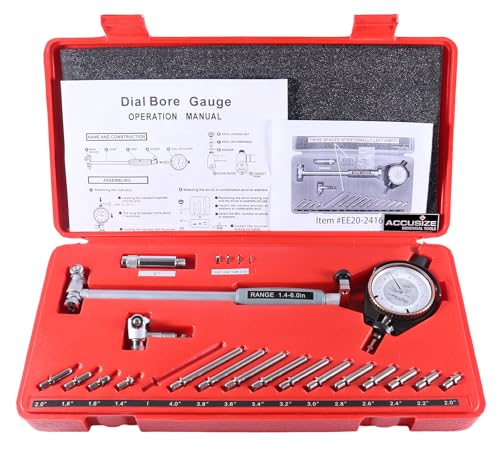
The Accusize EE20-2416 is the high-resolution sibling of the EE20-1406, trading the standard 0.0005-inch graduation for a finer 0.0001-inch scale that suits tighter machining tolerances. This set is built around an AGD Group 2 dial indicator with a 0-to-0.05-inch measuring range, which gives you enough travel to capture out-of-round conditions while maintaining the finer resolution needed for performance-engine work.
Carbide-tipped contact points are standard here too, and the self-centering heads feel smooth and consistent across the full 1.4-to-6-inch range. The bezel lock holds zero securely, and the tolerance markers on the dial face provide a quick pass-fail reference that speeds up inspection work when you are checking multiple cylinders in sequence. The chrome-plated handle and metal clamping assembly feel identical in quality to the standard-resolution model.
Where this set differentiates itself is in applications that demand tighter control — aligning main bearing bores, checking cylinder wall straightness for high-compression builds, or verifying lifter bore geometry. The extra resolution reveals variations that a 0.0005-inch gauge would smooth over, making it a worthwhile upgrade for shops that regularly work to tighter than factory specs.
What works
- 0.0001-inch graduation exposes subtle bore variations
- AGD Group 2 indicator provides smooth response over full travel
- Same rugged build and carbide anvils as the standard model
What doesn’t
- Premium price step over the 0.0005-inch version
- Indicator bezel can be slightly stiff when adjusting zero
4. Mitutoyo 511-753 Dial Bore Gage

Mitutoyo’s 511-753 is the benchmark that other bore gauge sets are measured against. Made in Japan with the company’s hallmark attention to manufacturing consistency, this 2-to-6-inch set delivers 0.0001-inch resolution that holds its calibration through years of daily shop use. The dial indicator action is exceptionally smooth, with no perceptible sticking or backlash even at the extremes of the measuring range.
The build quality reflects Mitutoyo’s industrial-grade engineering — the guide and anvil assembly feels precise, and the clamping mechanism secures the indicator without any play. The 2-inch measuring depth is adequate for most cylinder work, and the indicator’s clear face with fine markings makes reading tenths straightforward even in dim shop lighting. The fitted case keeps everything protected, though it is relatively compact compared to some bulkier sets.
What you pay for here is repeatability. When you measure the same bore ten times, the Mitutoyo returns the same number with minimal variation. That level of consistency is critical in professional engine shops where decisions about bore sizing and piston fit depend on trusting the tool’s output, and it is the reason this set remains a top choice among machinists who cannot afford measurement ambiguity.
What works
- Industry-leading calibration stability and repeatability
- Silky-smooth indicator action with no hysteresis
- Compact fitted case with secure storage
What doesn’t
- Premium price positions it beyond casual hobbyist budgets
- Includes only the basic accessories, extensions may be needed separately
5. Starrett 3089Z-131-26J Dial Bore Gage
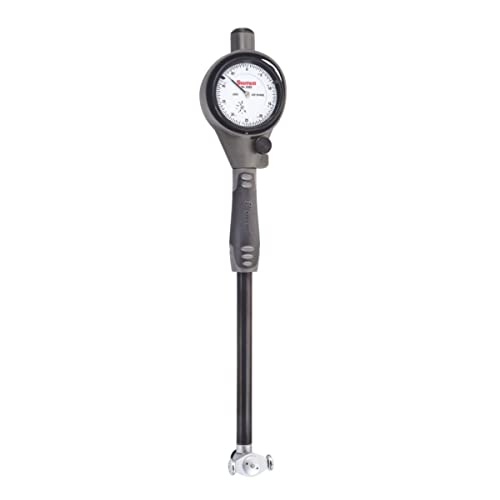
Starrett has been a cornerstone of precision measurement for over a century, and the 3089Z-131-26J reflects that heritage. This 2-to-6-inch dial bore gage delivers ±0.0001-inch accuracy, making it one of the tightest-spec sets available without moving to a digital comparator. The aluminum construction keeps the tool lighter than equivalent steel-bodied gauges, reducing fatigue during long inspection sessions.
The ergonomic design focuses on real-world usability — the non-slip grip is genuinely comfortable, and the lightweight frame makes one-handed positioning much easier than heavier sets. The carbide contact points provide the abrasion resistance expected at this level, and the indicator response is crisp and predictable across the full measuring range. The protective case is well-padded and holds the components securely during transport.
Starrett’s strength here is longevity. The indicator mechanism is sealed against shop dust, and the build quality suggests this tool will still be delivering accurate readings decades from now if properly cared for. For a shop that wants one premium set that will outlast multiple careers, this is the most sensible long-term investment.
What works
- ±0.0001-inch accuracy rivals professional metrology standards
- Lightweight aluminum construction reduces fatigue
- Sealed indicator resists dust and shop contaminants
What doesn’t
- Premium price requires serious commitment
- No digital readout for decimal-preference users
6. HFS Dial Indicator Bore Gage Set 16242

HFS delivers a compelling value proposition with the 16242 bore gage set, offering a 2-to-6-inch range and a generous 10-inch measuring depth that surpasses many pricier competitors. The 12 interchangeable anvils give you the flexibility to cover the full range incrementally, which is helpful when you need to check multiple bore sizes in a single session without constantly swapping out the entire head assembly.
The jeweled-bearing movement inside the indicator provides smooth operation that feels more refined than the price point suggests. The self-centering mechanism engages reliably, and the chrome-plated handle with insulated grip offers decent thermal protection during extended use. The ABS storage case is functional, keeping the anvils organized and the indicator protected between jobs.
The biggest advantage of the HFS set is the depth — 10 inches lets you reach ring travel zones in deep cylinder blocks that shallower gauges cannot access without separate extensions. For a budget-conscious shop that needs full-depth capability and a wide anvil selection, this set punches above its class.
What works
- 10-inch depth reaches deep ring wear zones without extensions
- 12 anvils provide thorough range coverage
- Jeweled bearing movement feels smooth for the price level
What doesn’t
- Case build quality is basic compared to premium sets
- No carbide anvils — steel contacts wear faster on abrasive bores
7. Neoteck Digital Bore Gauge Set

The Neoteck bore gauge set takes a digital approach, pairing a 0-to-0.5-inch digital indicator with a mechanical bore gauge head that covers 2 to 6 inches. The digital readout displays measurements in 0.0005-inch increments, which matches the graduation of most mechanical dial indicators in this class but adds the convenience of a clear decimal display that eliminates interpretation errors from reading a dial face.
The self-centering heads engage smoothly, and the insulated grip helps minimize thermal drift during handling. The all-metal clamping device secures the indicator head without wobble, and the sealed gauge head offers reasonable dust protection for shop environments. The set includes 12 measuring probes ranging from 50 mm to 105 mm, giving you comprehensive coverage of the full bore range straight out of the box.
Battery dependency is the primary trade-off — the LR44 cell powers the digital indicator, and if it dies mid-job, you are effectively blind until you find a replacement. The digital display also has a smaller viewing angle than a dial face, which can be annoying in awkward under-hood positions. For a beginner or occasional user who prefers digital clarity over analog tradition, the Neoteck provides a functional entry point.
What works
- Digital readout eliminates dial interpretation errors
- 12 probes cover full 2-to-6-inch range with fine increments
- Self-centering heads reduce measurement inconsistency
What doesn’t
- Battery dependency creates risk of mid-job failure
- Display viewing angle is limited in tight engine bays
Hardware & Specs Guide
Graduation and Resolution
Graduation refers to the smallest increment the gauge can display or indicate. A 0.0005-inch graduation is standard for general engine rebuilding because factory service limits for cylinder bore wear typically range from 0.003 to 0.005 inches, making half-thousandth resolution sufficient. A 0.0001-inch graduation is necessary for performance builds where piston-to-wall clearances are measured in tenths. Digital indicators offer switchable resolution and zeroing convenience, but they introduce battery dependency and electronic drift risk. Mechanical dial indicators are passive devices that remain accurate indefinitely and respond to subtle bore variations through an analog sweep that many machinists find reveals taper patterns more intuitively than a digital number.
Contact Point Materials
Carbide-tipped anvils are the gold standard because tungsten carbide is significantly harder than the cast iron or steel cylinder walls being measured. This hardness means the anvil geometry stays consistent through thousands of measurements, maintaining the calibration relationship between the anvil faces and the indicator reading. Steel anvils wear measurably over time, especially if the cylinder surface contains abrasive particles from combustion deposits or honing residue. The wear gradually rounds the anvil tips, introducing error that increases with use. For a set that will see regular shop rotation, carbide is worth the premium because it eliminates a variable that silently degrades measurement accuracy.
Self-Centering Mechanism
A self-centering bore gauge uses a spring-loaded mechanism that automatically positions the measuring head along the true diameter line of the bore. Without self-centering, the operator must rock the gauge to find the minimum reading that indicates the centerline, which introduces variability between users and between measurements. Good self-centering mechanisms engage with consistent force and return to the same position reliably. Poor mechanisms can hang up on dirt or have weak spring tension that fails to overcome the gauge’s own weight when measuring horizontally. The mechanism’s quality directly affects how quickly you can take repeatable readings across multiple cylinders.
Indicator Type and Travel
Most bore gauge sets use a dial indicator with a travel range of 0.025 to 0.050 inches. The indicator measures the displacement of the bore gauge head’s moving anvil as it contacts the cylinder wall relative to the zero setting established on a master ring or micrometer. AGD Group 2 indicators are the most common form factor, offering a 2-inch dial face with clear markings and a balanced bezel for zero adjustment. The indicator’s internal mechanism — typically a rack-and-pinion or lever-type movement — determines how smoothly the needle responds. Jeweled bearings reduce friction and wear, maintaining smooth action over years of use. The quality of the indicator often defines the overall accuracy of the set more than the bore gauge head itself.
FAQ
What is the difference between a dial bore gauge and a digital bore gauge?
How do I zero a bore gauge set before measuring?
Can a bore gauge set measure taper and out-of-round?
Final Thoughts: The Verdict
For most buyers, the best bore gauge set winner is the Accusize EE20-1406 because it delivers carbide anvils, self-centering heads, and a solid 1.4-to-6-inch range at a price that makes sense for serious engine builders without overshooting into professional-metrology budgets. If you need the finest resolution for performance engine work, grab the Accusize EE20-2416 with its 0.0001-inch graduation. And for a shop that wants a single set that will last a lifetime, nothing beats the Mitutoyo 511-753 or the Starrett 3089Z-131-26J — both are built to deliver consistent, trustworthy readings for decades.

Certification: BSc in Mechanical Engineering
Education: Mechanical engineer
Lives In: 539 W Commerce St, Dallas, TX 75208, USA
Md Amir is an auto mechanic student and writer with over half a decade of experience in the automotive field. He has worked with top automotive brands such as Lexus, Quantum, and also owns two automotive blogs autocarneed.com and taxiwiz.com.