Choosing the wrong rubber turns a perfect singletrack into a constant fight for grip. A tire that hooks up on hardpack can wash out on loose loam, and a soft-terrain monster can wear flat in a single season on rocky trails. The right set makes the bike feel planted, predictable, and responsive mile after mile.
I’m Amir — the founder and writer behind Four Wheel Ask. My work focuses on breaking down market data, comparing compound formulations, and analyzing owner feedback across hundreds of off-road tire reviews to identify what actually performs on the trail.
After sorting through thousands of rider reports and testing data, I’ve compiled the definitive list of best dirt bike tires for trail riding that balance grip, durability, and real-world value for every terrain type.
How To Choose The Best Dirt Bike Tires For Trail Riding
Trail riding places unique demands on a tire that track racing or street cruising do not. You need a tread that clears mud, a compound that resists cuts from sharp rocks, and enough casing strength to handle square-edged hits at lower pressures. Understanding three core factors will prevent a costly mismatch.
Tread Pattern and Knob Height
Terrain determines tread. Soft-to-intermediate trails with loam, sand, or loose dirt require tall, widely spaced knobs that self-clean and bite deep. Hardpack and rocky trails benefit from a tighter pattern with shorter knobs that prevent squirm and offer a larger contact patch. A true dual-sport pattern splits the difference, offering a smoother ride on pavement while still hooking up on fire roads.
Compound and Ply Rating
Softer compounds generate maximum grip on cool, wet surfaces but wear quickly on hot tarmac or abrasive rock. Harder compounds last longer but can feel slippery on slick roots or clay. Ply rating (4-ply, 6-ply, 12-ply) indicates casing strength: higher ply counts resist pinch flats and sidewall cuts better on harsh terrain but add rotational weight. A 6-ply is typically ideal for aggressive trail riding.
Construction Type and Sizing
Most dirt bike tires use bias-ply construction, which allows the sidewall to flex for better traction at lower pressures. Radial tires exist for specific ATV applications but are rare on trail bikes. Always match the exact size code on your sidewall (e.g., 80/100-21 for front, 110/100-18 for rear). Installing a mismatched diameter or width can alter handling geometry and even cause clearance issues with the swingarm or fender.
Quick Comparison
On smaller screens, swipe sideways to see the full table.
| Model | Category | Best For | Key Spec | Amazon |
|---|---|---|---|---|
| Tusk EMEX T-35 Set (90/100×21 & 110/100×18) | Mid-Range | Soft-Intermediate Terrain | Bias, Tube-Type, 110/100-18 Rear | Amazon |
| Kenda K760 Dual/Enduro Rear | Value | Budget Trail & Dual-Sport | Bias, Tube-Type, 100/100-18 | Amazon |
| WIG Racing Motocross Combo | Premium | Aggressive Trail & All-Surface | Bias, Includes Tubes, 110/90-19 Rear | Amazon |
| Tusk EMEX T-35 Set (70/100×19 & 90/100×16) | Mid-Range | Small-Bore Bikes & Intermediate Trail | Bias, 6-Ply Casing, 90/100-16 Rear | Amazon |
| Carlisle AT489 Trail | Premium | ATV Utility Trail Use | Radial, 4-Ply, 25×10-12 | Amazon |
| Tusk EMEX T-35 Set (70/100×17 & 90/100×14) | Mid-Range | Mini Bikes & Youth Trail | Bias, 4-Ply Casing, 90/100-14 Rear | Amazon |
| Kenda K270 Dual/Enduro Front | Value | Dual-Sport Front Replacement | Bias, 6-Ply, Tube-Type, 3.00-21 | Amazon |
In‑Depth Reviews
1. Tusk EMEX T-35 Set (Front 90/100×21 & Rear 110/100×18)

The Tusk EMEX T-35 set is engineered for the most common trail conditions: loose dirt, loam, sand, and hard-packed corners. The deep, non-directional tread pattern clears debris efficiently while maintaining a generous contact patch for stable braking. This 90/100×21 front and 110/100×18 rear pairing is a popular upgrade on full-size enduro and motocross bikes like the YZ250F.
Rider feedback consistently highlights the tire’s grip in corners and how well it wears after multiple rides. The stiff carcass, while offering excellent support for aggressive riding, does require a firm hand during mounting. The durable rubber compound resists chunking better than some soft-terrain competition, extending the usable life without sacrificing traction in the wet.
For the trail rider who wants a single set that does it all without stepping up to boutique pricing, the T-35 is the strongest all-around performer. The balance of grip, durability, and value is hard to beat.
What works
- Excellent self-cleaning tread pattern
- Compound holds up well on varied terrain
- Strong value for a complete set
What doesn’t
- Stiff sidewalls make installation difficult
- Front tread pattern could be more aggressive
2. Kenda K760 Dual/Enduro Rear (100/100-18)

The Kenda K760 is a classic enduro tire that leans heavily toward dirt (90/10 dirt/road rating) while retaining DOT approval for street-legal dual-sport bikes. The tall, aggressive knobs are spaced to self-clean in mud and loam, and the 12-ply rated casing is overbuilt for punishing rocky trails where pinch flats are a real risk.
Owners report surprisingly good traction for an entry-level price point, especially on sandy trails and loose over hardpack. The tire is easy to mount and runs quietly on pavement for a knobby. The most common trade-off noted is accelerated tread wear on high-speed gravel roads; the compound is designed for grip, not longevity on abrasive surfaces.
For the weekend trail rider who needs a reliable rear tire that can handle a bit of pavement to reach the trailhead, the K760 delivers respectable performance without breaking the budget. It is also a popular choice for 250cc and 450cc bikes alike.
What works
- Impressive traction for the cost
- Very tough, high-ply casing
- DOT legal for road sections
What doesn’t
- Wears faster on gravel roads
- Limited sizes compared to premium brands
3. WIG Racing Motocross Combo (110/90-19 & 80/100-21)

This WIG Racing combo is designed for the demanding trail rider who refuses to compromise on grip. The directional tread pattern is optimized for mud and sand, with aggressive spacing that churns through loose material while maintaining forward bite. The set includes both 110/90-19 rear and 80/100-21 front tires with matching inner tubes, saving the hassle of sourcing separately.
Owner reports are remarkably consistent: these tires outperform expectations on deep, soft terrain and have been raced for over 130 miles on a rear tire without significant chunking—a durability figure that rivals tires costing significantly more. The compound strikes an effective balance between traction on wet surfaces and resistance to abrasion.
Trail riders who ride aggressively in varied conditions will appreciate the confidence this set provides. The included tubes simplify installation, and the overall package represents a strong return on investment for those who log serious miles.
What works
- Excellent mud and sand performance
- Durable compound with long tread life
- Comes with inner tubes included
What doesn’t
- Not DOT approved for road use
- Decals not included on the tire
4. Tusk EMEX T-35 Set (Front 70/100×19 & Rear 90/100×16)
This Tusk EMEX T-35 variant is built for small-bore and intermediate-sized dirt bikes, such as 125cc and 250cc trail machines, that use a 19-inch front and 16-inch rear wheel combination. The aggressive deep tread pattern mirrors the larger T-35 set, providing the same self-cleaning ability in loam and sand.
The 6-ply casing is a notable upgrade for a tire in this size range, offering enhanced puncture resistance against rocks and roots. This makes it a strong candidate for riders who often tackle technical, rocky singletrack. Owner reviews mirror those of the larger set, praising the traction and wear characteristics on soft-to-intermediate terrain.
While the rubber compound delivers solid grip, the stiffer sidewall construction can make mounting a challenge. For the trail-focused intermediate bike rider looking to maximize capability without downsizing tire quality, this T-35 set is a direct upgrade over stock tires.
What works
- Reinforced 6-ply casing for durability
- Excellent terrain versatility
- Great cornering stability
What doesn’t
- Stiff sidewalls complicate mounting
- Limited to smaller wheel sizes
5. Carlisle AT489 Trail (25×10.00-12)
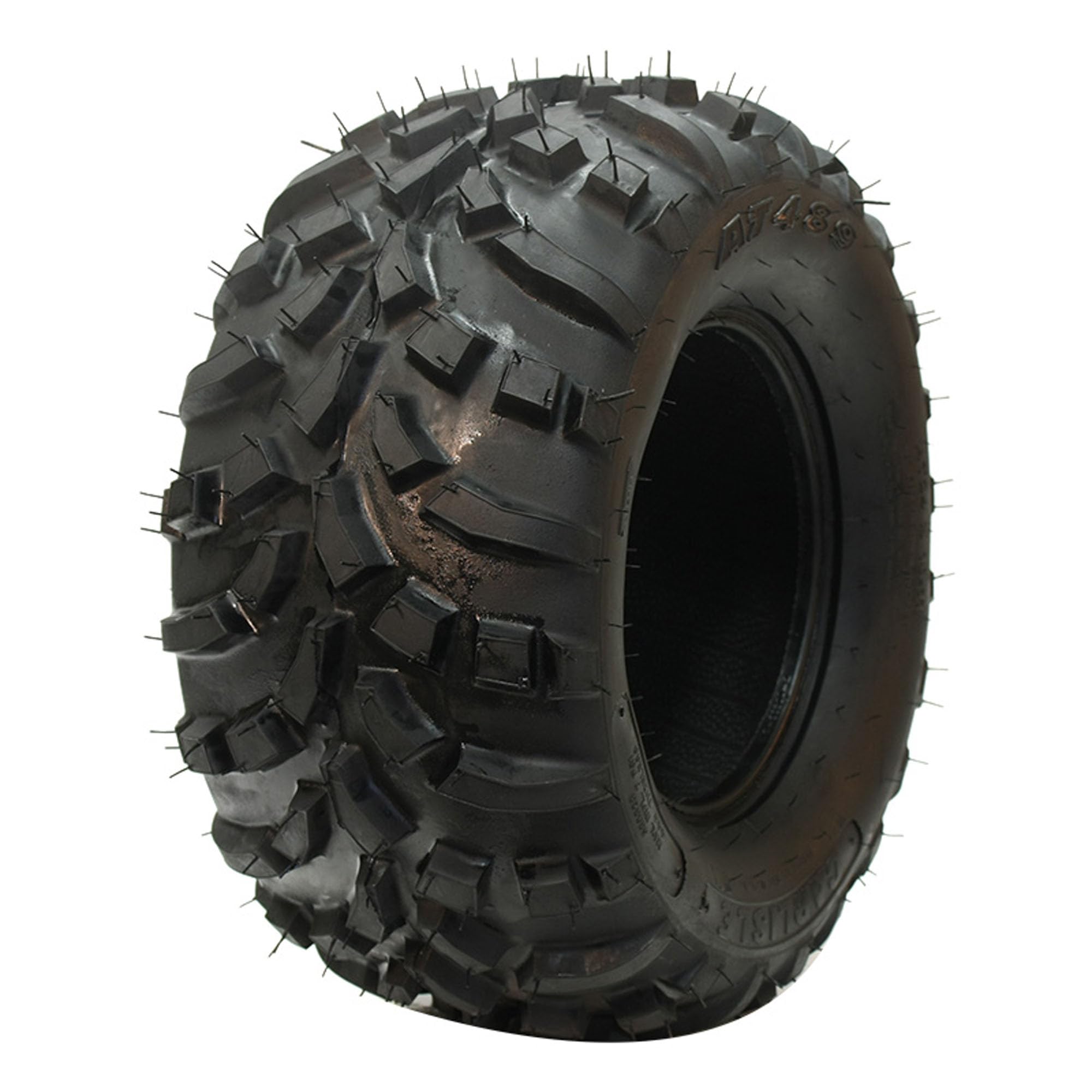
The Carlisle AT489 is a radial trail tire designed primarily for utility ATVs, but it earns a place in this guide for riders using ATVs for trail exploration and work access. Its radial construction provides a supple ride feel and excellent tread wear on hard-packed surfaces, a common complaint with bias-ply utility tires.
Long-term owner reports are striking: one set lasted nearly a decade on a Honda Recon, mostly on blacktop and gravel, with slow, even wear. The tread pattern is non-aggressive and does not throw rocks, making it comfortable for group rides and less disruptive on shared trails. It is not designed for deep mud or aggressive trail carving.
The AT489 is a specialized choice for the UTV or ATV owner who prioritizes longevity, ride comfort, and low noise. It is not a performance mud tire, but for its intended use as a reliable, hard-wearing trail and utility option, it is a proven performer.
What works
- Exceptional tread life
- Smooth, quiet ride on hardpack
- Doesn’t throw rocks onto trail
What doesn’t
- Limited soft-terrain traction
- Not for aggressive, high-speed riding
6. Tusk EMEX T-35 Set (Front 70/100×17 & Rear 90/100×14)
Built for smaller wheel diameters (17-inch front, 14-inch rear), this Tusk EMEX T-35 set caters specifically to youth dirt bikes, pit bikes, and some mini motocross machines. It brings the same deep-tread, soft-to-intermediate terrain DNA of the larger T-35 sets down to a compact, lightweight package.
The 4-ply casing keeps rotational weight low, which is essential for small-displacement bikes that rely on momentum. Owner feedback on the full-size sets applies here: good grip in loam, stable cornering, and decent wear. The tire is notably stiff for its size, a common trait for the T-35 line, which may require more effort to mount.
For the youth trail rider transitioning from street riding to off-road, this set provides a legitimate performance upgrade. It offers predictable traction that builds confidence without overwhelming the smaller bike’s chassis.
What works
- Scaled-down aggressive tread pattern
- Lightweight 4-ply construction
- Great entry-level trail upgrade
What doesn’t
- Stiff tire can be hard to mount
- Untested long-term durability unknown
7. Kenda K270 Dual/Enduro Front (3.00-21)

The Kenda K270 is the front tire counterpart to a popular dual-sport system, designed as a direct OEM replacement for bikes that see a 60/40 mix of dirt to road. Its 6-ply rated casing provides robust puncture resistance, which is valued by trail riders who navigate rocky and root-strewn paths at lower air pressures.
The tread pattern is biased toward street use for a dual-sport tire, meaning it will track well on pavement between trail sections but lacks the aggressive edge bite of a full knobby. Owners report it is a reliable, predictable front tire that wears slowly and holds up well to Arizona-style desert trails and forest roads.
For the budget-conscious dual-sport rider who needs a front tire that can handle both the daily commute and the weekend trail, the K270 is a sensible, economical choice. It is not an enduro race tire, but it delivers exactly what it promises: dependable dual-sport performance.
What works
- Excellent value for the price
- Durable 6-ply casing
- DOT approved for street use
What doesn’t
- Limited off-road traction in mud
- Not a true aggressive knobby pattern
Hardware & Specs Guide
Tread Pattern: Directional vs. Non-Directional
Directional tires (like the WIG Racing set) feature a V-shaped or arrowhead pattern designed to spin in one direction for maximum forward bite in mud and sand. Non-directional tires (like the Tusk EMEX T-35) can be mounted on either side and are often more versatile across a range of trail conditions. For pure trail riding, an aggressive directional pattern on the rear and a non-directional pattern on the front is a common setup for balanced cornering.
Ply Rating and Casing Strength
Ply rating indicates the tire’s resistance to punctures and impacts. A 4-ply tire is lightweight and suitable for sandy or loamy terrain where sharp rocks are rare. A 6-ply tire adds significant protection for rocky trails without being overly heavy. The Kenda K760 uses a 12-ply casing, which is overkill for most trail riders but excellent for extreme rock crawling and desert riding where flats are common.
FAQ
How often should I replace my trail riding tires?
Can I use a motocross tire for trail riding?
What tire pressure should I run for trail riding?
Final Thoughts: The Verdict
For most buyers, the best dirt bike tires for trail riding winner is the Tusk EMEX T-35 Set because it delivers the best balance of grip, durability, and value for the widest range of trail conditions. If you want maximum longevity and a complete package, grab the WIG Racing Motocross Combo. And for a reliable budget dual-sport front that can handle the street commute, nothing beats the Kenda K270.

Certification: BSc in Mechanical Engineering
Education: Mechanical engineer
Lives In: 539 W Commerce St, Dallas, TX 75208, USA
Md Amir is an auto mechanic student and writer with over half a decade of experience in the automotive field. He has worked with top automotive brands such as Lexus, Quantum, and also owns two automotive blogs autocarneed.com and taxiwiz.com.