An electric motor without usable speed control is like a throttle that only goes wide open — fine for a few jobs, frustrating for most. Whether you are powering a custom go-kart, a benchtop tool, a trolling rig, or an automation project, the ability to dial in the exact RPM separates a usable setup from a constant headache. The right motor delivers torque where you need it, runs cool under load, and gives you precise, repeatable speed adjustment.
I’m Amir — the founder and writer behind Four Wheel Ask. My approach centers on analyzing owner-reported performance data, comparing build materials and thermal handling, and studying how each unit holds up across real-world applications rather than marketing claims.
After analyzing specs, owner feedback, and real-world performance data, we identified the top options for the best electric motor with speed control.
How To Choose The Best Electric Motor With Speed Control
Selecting the right motor with integrated speed control comes down to understanding your load, duty cycle, and power source. A mismatch in torque or voltage leads to heat buildup, poor speed regulation, or premature failure. Focus on four key areas before you buy.
Torque and Speed Requirements
Know the mechanical load you need to move. Low-speed, high-torque applications — like conveyor drives, rotisseries, or winches — demand a motor with a gear reduction or high starting torque rating. High-speed applications like scooter drives or spindle motors prioritize RPM range. Look at rated torque at the shaft, not just horsepower, since speed control reduces available torque at lower RPM without proper controller design.
Voltage and Power Compatibility
Your power source dictates the motor voltage. Battery-powered builds commonly use 12V, 24V, or 48V DC systems, while shop equipment ties into 110V or 230V AC lines. A motor rated for the wrong voltage either lacks power or suffers insulation damage. Check the full-load amperage draw and confirm your power supply or battery can sustain it without voltage sag, which causes erratic speed control behavior.
Build Quality and Materials
Copper windings, aluminum or steel housings, and sealed bearings separate a motor that lasts from one that fails mid-project. Brushed DC motors are inexpensive and simple to control but wear out brushes over time. Brushless motors offer higher efficiency and longer life but require more sophisticated controllers. For AC motors, look for thermal overload protection and CSA or UL listing as indicators of tested reliability.
Speed Control Features and Integration
Not all speed controllers are created equal. Some units include a built-in potentiometer for simple dial adjustment, while others use external control boxes with digital displays and remote start-stop capability. Verify that the controller matches the motor type — a universal controller will not work with a single-phase AC gear motor unless specifically designed for it. Also confirm whether the controller offers closed-loop speed regulation for consistent RPM under varying loads.
Quick Comparison
On smaller screens, swipe sideways to see the full table.
| Model | Category | Best For | Key Spec | Amazon |
|---|---|---|---|---|
| VQP High Torque Motor | Complete Package | Heavy machinery & automation | 250W, 16nm torque, 0-135 RPM, reversible | Amazon |
| Century VGreen EVO | Pool Pump Motor | Pool pump replacement | 1.65 THP, 600-3450 RPM, dual voltage | Amazon |
| VEVOR 1HP Motor | General Purpose | Agricultural & shop equipment | 1HP, 3450 RPM, 56C frame, reversible | Amazon |
| Eapmic 110V Gear Motor | Geared AC Motor | Low-speed automation projects | 90W, 135 RPM, 1:10 reduction, 110V | Amazon |
| Minn Kota Endura C2 | Trolling Motor | Kayak & jon boat trolling | 30lb thrust, 30″ shaft, 5 forward speeds | Amazon |
| Vevitts Brushed Motor | DC Scooter Motor | E-scooter & DIY builds | 24V, 350W, 3000 RPM, reversible | Amazon |
| HY Huanyang 10HP VFD | Frequency Drive | 3-phase motor speed control | 10HP, 220V input, RS-485 support | Amazon |
In‑Depth Reviews
1. VQP High Torque AC Motor + Speed Controller + Gear Box

The VQP High Torque AC Motor arrives as a complete system with the motor, gearbox, and a dedicated speed controller — eliminating the guesswork of matching components. Rated at 250W with 16nm of torque and a speed range of 0-135 RPM on 110V AC input, this unit targets applications that demand low-speed grunt rather than high RPM. Owner reports confirm it handles heavy static loads up to 120 pounds on a rotisserie setup without overheating over multiple hours of continuous operation.
The integrated control box provides smooth variable speed adjustment along with reversible rotation, making it suitable for conveyor belts, winches, and industrial machinery where directional control matters. Some users noted that under very low speed settings the motor exhibits a brief start-up jump before stabilizing, and the included instruction documentation lacks English translation. The torque curve holds well under load, though one report indicated that heavy static loads can cause back-driving after power-off if no additional brake is incorporated.
Build quality centers on a copper-wound induction motor with a robust gearbox housing. The controller includes overload and overheat protection, which adds a layer of safety for continuous-duty applications. For buyers who need a ready-to-run high-torque solution with factory-matched speed control, this package saves the hassle of sourcing separate components and tuning them together.
What works
- Complete motor-gearbox-controller package simplifies installation
- Genuine 16nm torque handles heavy industrial and DIY loads
- Overload and overheat protection on the control box
- Smooth variable speed with reversible rotation
What doesn’t
- Motor can jump briefly at minimum speed start-up
- Instruction manual is not printed in English
- Static loads may back-drive without an external brake
2. Century Motor VGreen EVO 1.65 THP Variable Speed Motor

The Century VGreen EVO is a variable-speed replacement motor designed primarily for pool pump applications, though its wide RPM range from 600 to 3450 opens up other uses where programmable speed control is beneficial. It operates on both 115V and 230V AC with automatic voltage detection, simplifying installation across different wiring setups. The single-button user interface controls an internal schedule that adjusts motor speed at set times, which improves energy efficiency compared to fixed-speed pool pumps.
Owner feedback highlights significant reductions in electrical consumption and noticeably quieter operation compared to standard single-speed pump motors. The motor primes quickly and maintains water clarity through customizable speed profiles. However, the programming logic is not immediately intuitive — the external timer dictates the schedule rather than the motor running at a single speed, so users expecting simple dial control may find the learning curve frustrating. A few units reportedly failed within weeks, though the manufacturer provided refunds.
Build quality includes copper windings and a 23-pound assembly that feels substantially built. The included freeze protection feature is a practical addition for colder climates. Energy savings over a season can offset the initial investment, especially for pool owners running the pump daily. For applications requiring programmable variable speed with automatic voltage sensing, the VGreen EVO delivers a refined solution backed by a reputable brand.
What works
- Wide 600-3450 RPM variable speed range
- Automatic voltage detection for 115V or 230V
- Measurable energy savings and quieter operation
- Freeze protection for cold-weather installations
What doesn’t
- Programming interface is not intuitively designed
- Some units experienced early failure within weeks
- Runs louder than some owners expected at max speed
3. VEVOR 1HP Electric Motor 3450 RPM

The VEVOR 1HP Electric Motor delivers a straightforward high-speed solution for general-purpose equipment replacement. With a 3450 RPM rating at 1 horsepower, it operates on dual-voltage 115V or 230V AC and uses a standard 56C frame with a 5/8-inch keyed shaft. The motor includes overload protection with manual reset, which adds safety for applications like air compressors, water pumps, table saws, and grain bin fans where continuous duty is common.
Real-world reports confirm that this motor replaces more expensive name-brand units effectively — one owner swapped a failed unit on a grain bin fan and considered the performance identical to a replacement costing several times more. Boat lift users noted the 3450 RPM speed required removing the cable box to fit the plastic cover, but the motor handled the lift duty without issue. Table saw users reported ample power after correcting the rotation direction during installation.
The heavy-duty rolled steel shell and copper windings provide durability for stationary shop equipment. A small number of owners experienced early failure with smoke and motor stoppage, though the majority of feedback indicates reliable operation over extended periods. The reversible CW/CCW rotation simplifies wiring for different setups. For budget-conscious buyers needing a robust 1HP motor for farm or workshop machinery, this unit offers strong value without cutting critical safety features.
What works
- Strong 1HP output at 3450 RPM for demanding tools
- Dual-voltage operation with automatic overload protection
- Reversible rotation simplifies installation
- Price significantly undercuts comparable name-brand motors
What doesn’t
- Some units reported early failure with smoke emission
- 3450 RPM may require modification for some applications
- Heavier than some competing models at 27.6 pounds
4. Eapmic 110V 90W AC Gear Motor with Speed Controller
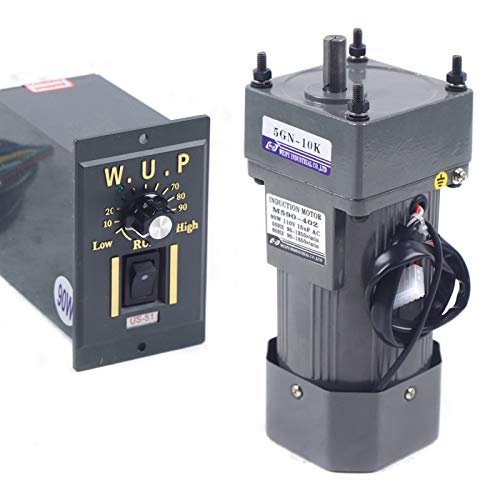
The Eapmic 110V AC Gear Motor combines a 90W geared motor with a dedicated speed controller and reducer in one package, targeting low-speed automation and hobbyist projects. With a rated speed of 0-135 RPM and a 1:10 reduction ratio, this unit produces 5.7nm of torque — sufficient for light conveyor systems, model machinery, soda churners, and welding positioners. The 12mm shaft diameter and compact footprint make it relatively easy to mount in tight spaces.
User reports describe the motor as physically large and heavy for its power class — comparable to an automotive starter motor — which surprised some buyers expecting a smaller unit. The screw terminal wiring connections are clearly marked, making hookup straightforward even for less experienced users. Some owners noted that the motor cannot be stalled by hand at its lowest RPM setting, confirming that the torque output is genuine. The speed controller provides smooth adjustment across the full range.
A few buyers experienced controller defects that caused overheating and jittery operation after about ten seconds, but the seller responded by replacing the controller or the entire unit promptly. The copper construction and geared housing contribute to a durable feel. For school projects, light industrial tasks, or DIY automation where controlled low-speed rotation is the priority, this motor offers a balanced combination of torque and adjustability at a reasonable investment.
What works
- Complete motor-controller-reducer package ready to run
- Genuine low-speed torque with smooth speed adjustment
- Clearly marked screw terminals for simple wiring
- Responsive seller support for defective units
What doesn’t
- Physically large and heavier than expected for 90W
- Some controllers arrived defective and needed replacement
- Too heavy for mounting on lightweight weld positioners
5. Minn Kota Endura C2 Transom-Mount Trolling Motor

The Minn Kota Endura C2 is a freshwater trolling motor that integrates speed control into a purpose-built marine package. With 30 pounds of thrust and a 30-inch composite shaft, it offers five forward speeds and three reverse speeds through a telescoping tiller handle. The push-to-test battery meter built into the motor head gives immediate feedback on remaining charge, which is valuable for all-day fishing trips on kayaks, jon boats, or pedal boats.
Owner feedback consistently praises the motor’s durability and quiet operation. One user reported cruising Lake Mead on a pedal boat for an hour at high gear with the battery indicator still showing full charge. Kayak anglers noted that the motor provides steady forward movement even when towing a second kayak, and the 12V adapter plug works seamlessly with portable power stations. The reinforced composite construction resists UV damage and warping, holding up well in direct sun exposure over multiple seasons.
The Power Prop design handles light vegetation without bogging down, and the easy-release lever lock bracket allows quick angle adjustments. Some users noted that routing wires internally on certain kayaks required creative solutions, but the motor performs reliably once installed. For anyone who needs a dependable electric trolling motor with intuitive speed selection and proven marine-grade construction, the Endura C2 is a reference standard in its class.
What works
- Five forward and three reverse speeds for precise control
- Battery meter integrated into the motor head
- Quiet, durable composite shaft resists UV and warping
- Efficient power draw extends on-water run time
What doesn’t
- Wire routing can be challenging on some kayak hulls
- Limited to freshwater use only
- 30-inch shaft may be short for deeper transoms
6. Vevitts 24V 350W Brushed Permanent Magnet Motor

The Vevitts 350W Brushed DC Motor offers an affordable and widely compatible upgrade path for Razor-style electric scooters, dirt bikes, and lightweight DIY electric vehicle projects. Operating on 24V DC and spinning at 3000 RPM with a 20A current draw, this permanent magnet motor uses an aluminum body with full copper windings for heat dissipation. Owners report that it fits directly into Razor MX350 and MX400 frames, delivering noticeable power improvements over stock motors — including higher top speeds and cooler running temperatures under sustained load.
Feedback from multiple verified buyers confirms that the motor handles riders weighing up to 177 pounds without overheating, and one owner achieved 22 mph on flat ground by overvolting to 36V. The motor runs cooler than the factory unit, which reduces the risk of thermal shutdown during longer rides. Some units arrived with thin-gauge lead wires and a slightly bent mounting bracket, though the bracket was still functional. One owner received a defective unit, but the seller replaced it promptly, and the replacement ran flawlessly for months.
The motor is reversible by swapping power wires, adding flexibility for various drive configurations. It lacks integrated speed control, so buyers need an external PWM controller for variable speed operation. For budget-minded builders looking for a reliable 24V motor that punches above its weight class in power and thermal performance, especially for Razor scooter restorations or go-kart projects, this unit delivers consistent results.
What works
- Direct-fit replacement for many Razor scooter models
- Runs cooler and faster than stock motors
- Handles riders up to 177 pounds without overheating
- Seller support responsive for defective unit replacement
What doesn’t
- Lead wires are thinner than ideal for the current draw
- Some units arrive with slightly bent mounting brackets
- Requires external speed controller for variable operation
7. HY Huanyang 10HP VFD Single-Phase to 3-Phase Converter

The HY Huanyang 10HP VFD is a variable frequency drive that converts single-phase 220V AC input to three-phase output for powering and controlling 3-phase motors up to 7.5HP (5.5kW). It supports remote potentiometer speed control, RS-485 communication, and DPS vector control, making it suitable for shop tools like table saws, planers, and spindle motors that benefit from adjustable speed ramping. The unit includes a graphical LCD display for parameter programming and fault diagnosis.
Owner reports from hobbyists and small shop owners confirm that the VFD runs 3-phase equipment smoothly once correctly programmed. One user operated a 7.5HP 1950s wood planer for over a year with excellent results, and another ran a 16-inch Delta radial arm saw for two years without issues. The parameter set is more flexible than many name-brand drives, though this also means users must invest time in programming to match their motor characteristics — especially for high-RPM spindles up to 30,000 RPM. Some buyers noted that the unit delivers approximately 5.5kW when running on single-phase input, which is less than the rated 10HP that requires true 3-phase input.
A few units arrived dead on arrival or experienced braking resistor failures when following the included instructions, but customer support was responsive with replacements. The CE listing and non-flammable design add safety confidence. For workshop owners who need affordable variable-frequency speed control for existing 3-phase machinery, the HY Huanyang VFD provides substantial capability at a fraction of the cost of premium industrial drives.
What works
- Converts single-phase input to 3-phase output for shop tools
- RS-485 communication and remote potentiometer support
- Flexible parameter programming for various motor types
- Cost significantly below comparable industrial VFDs
What doesn’t
- Full 10HP rating requires 3-phase input, not single-phase
- Braking resistor connection instructions can cause failures
- Programming requires time and technical understanding
- Some units arrived DOA with no power indication
Hardware & Specs Guide
RPM Range and Speed Control Method
The operating speed range of an electric motor determines what applications it can serve. Low-speed gear motors (0-135 RPM) deliver high torque for conveyor belts, rotisseries, and positioners, while high-speed motors (3000-3450 RPM) suit pumps, saws, and scooters. Speed control methods vary: brushed DC motors use simple PWM controllers, AC gear motors rely on variable-frequency drives or dedicated control boxes, and trolling motors use multi-position rotary switches. Always verify that the controller and motor are electrically compatible — a mismatched combination causes speed surging or component damage.
Torque Ratings and Power Output
Torque, measured in newton-meters (nm) or pound-feet, is the rotational force available at the shaft. High-torque motors (10+ nm) are essential for lifting, turning heavy loads, or overcoming initial friction. Power output in watts or horsepower indicates the total work capacity — 1HP equals roughly 746W. A motor with a gear reduction trades RPM for torque multiplication; for example, a 90W motor with a 1:10 gearbox generates more usable torque than a 90W direct-drive motor. Check both the continuous and peak torque ratings, as some motors can briefly exceed their rated torque during startup.
Voltage and Frame Specifications
Voltage compatibility must match the power source exactly. DC motors for mobile applications commonly use 12V, 24V, or 48V batteries, while stationary AC motors run on 110V or 230V household or industrial power. The frame type — such as 56C for NEMA-standard motors — determines mounting dimensions and shaft configuration. Keyed shafts with specified diameters (5/8-inch or 12mm) transmit torque to pulleys, sprockets, or couplings without slipping. Dual-voltage motors offer flexibility for different wiring setups but require correct configuration of the terminal connections.
Build Quality and Thermal Management
Materials directly affect motor longevity. Copper windings conduct electricity more efficiently than aluminum, reducing heat buildup. Aluminum or rolled steel housings dissipate heat through natural air cooling or integrated fans. Sealed or shielded bearings prevent dust and moisture ingress. Thermal overload protection — either automatic or manual reset — shuts down the motor before insulation damage occurs. For continuous-duty applications, verify the duty cycle rating (S1 for continuous, S3 for intermittent) to avoid overheating during extended operation.
FAQ
What size electric motor do I need for my application?
Can I use a speed controller with any electric motor?
What is the difference between brushed and brushless motors for speed control?
How do I wire a reversible motor with speed control?
Final Thoughts: The Verdict
For most buyers, the best electric motor with speed control winner is the VQP High Torque AC Motor because it delivers a complete, ready-to-run system with genuine 16nm torque, smooth variable speed control, and reversible rotation — all backed by robust overload protection. If you need programmable variable speed for energy-conscious pool pump operation, grab the Century VGreen EVO. And for a budget-friendly 1HP workhorse that handles farm and shop equipment without breaking the budget, nothing beats the VEVOR 1HP Electric Motor.

Certification: BSc in Mechanical Engineering
Education: Mechanical engineer
Lives In: 539 W Commerce St, Dallas, TX 75208, USA
Md Amir is an auto mechanic student and writer with over half a decade of experience in the automotive field. He has worked with top automotive brands such as Lexus, Quantum, and also owns two automotive blogs autocarneed.com and taxiwiz.com.