Chasing an electrical short without the right tool turns a ten-minute fix into an afternoon of frustration. Whether you are tracking a parasitic drain, a blown fuse, or an intermittent open circuit, the gap between guessing and knowing comes down to the diagnostic tool in your hand. A capable short finder does not just locate the fault — it tells you polarity, continuity, and component health in one pass.
I’m Amir — the founder and writer behind Four Wheel Ask. My approach focuses on cross-referencing manufacturer specifications, analyzing owner-reported failure patterns, and comparing build quality across budget, mid-range, and professional-grade tools to find the real performers.
After carefully analyzing specifications and owner feedback, I confidently recommend the best electrical short finder for accurate diagnostic work.
How To Choose The Best Electrical Short Finder
Selecting the right short finder means matching the tool’s capabilities to the type of electrical work you do most. A dedicated circuit breaker finder works well for residential and light automotive outlet tracing, while a power circuit probe handles live-circuit diagnostics, component activation, and polarity checks on vehicle systems. Know your primary use case before you buy.
Tool Type: Breaker Finder vs. Power Circuit Probe
Breaker finders use a transmitter-receiver pair to identify which breaker controls a specific outlet or fixture. They excel at panel mapping and GFCI testing. Power circuit probes, by contrast, inject voltage or ground into a circuit to test component function, locate shorts, and verify continuity without constantly swapping multimeter leads. Many modern probes combine both modes.
Voltage Range and Cable Length
Automotive electrical systems run 6 to 30 volts DC, while residential circuits operate at 90 to 240 volts AC. A versatile short finder covers both domains. Cable length directly affects usability — a 20-foot cord lets you reach the rear of a truck or trailer without repositioning the battery connection. Extension cables add flexibility for larger vehicles.
Safety and Protection Features
Overload protection, built-in circuit breakers, and reverse-polarity safeguards prevent damage to the tool and the vehicle’s electronics. Non-contact voltage detection adds an extra layer of safety when working near live wires. Look for tools that meet UL, CE, or RoHS standards if you work in professional settings where certification matters.
Quick Comparison
On smaller screens, swipe sideways to see the full table.
| Model | Category | Best For | Key Spec | Amazon |
|---|---|---|---|---|
| VDIAGTOOL V200 Pro | 2-in-1 Probe | Comprehensive short & breaker finding | 6-42V DC, 20+20 ft cable | Amazon |
| Autel PS100 2026 | Power Probe | Professional component activation | 6-30V DC, 40 ft total cable | Amazon |
| Fluke BK120 | Breaker Finder | Residential & commercial panel tracing | 110V AC min, NCV & socket test | Amazon |
| Autel PowerScan (B00UZ940ES) | Power Probe | Value-packed circuit diagnosis | 6-30V DC, 20+20 ft cable | Amazon |
| KAIWEETS KT301P | Breaker Finder | LCD-guided breaker & GFCI testing | 30-150V AC, NCV & flashlight | Amazon |
| Topdiag P100 | Power Probe | Affordable all-in-one circuit testing | 9-30V DC, 20 ft cable | Amazon |
| Klein Tools ET310 | Breaker Finder | Basic residential breaker identification | 90-120V AC, GFCI tester built-in | Amazon |
In‑Depth Reviews
1. VDIAGTOOL V200 Pro Automotive Circuit Tester
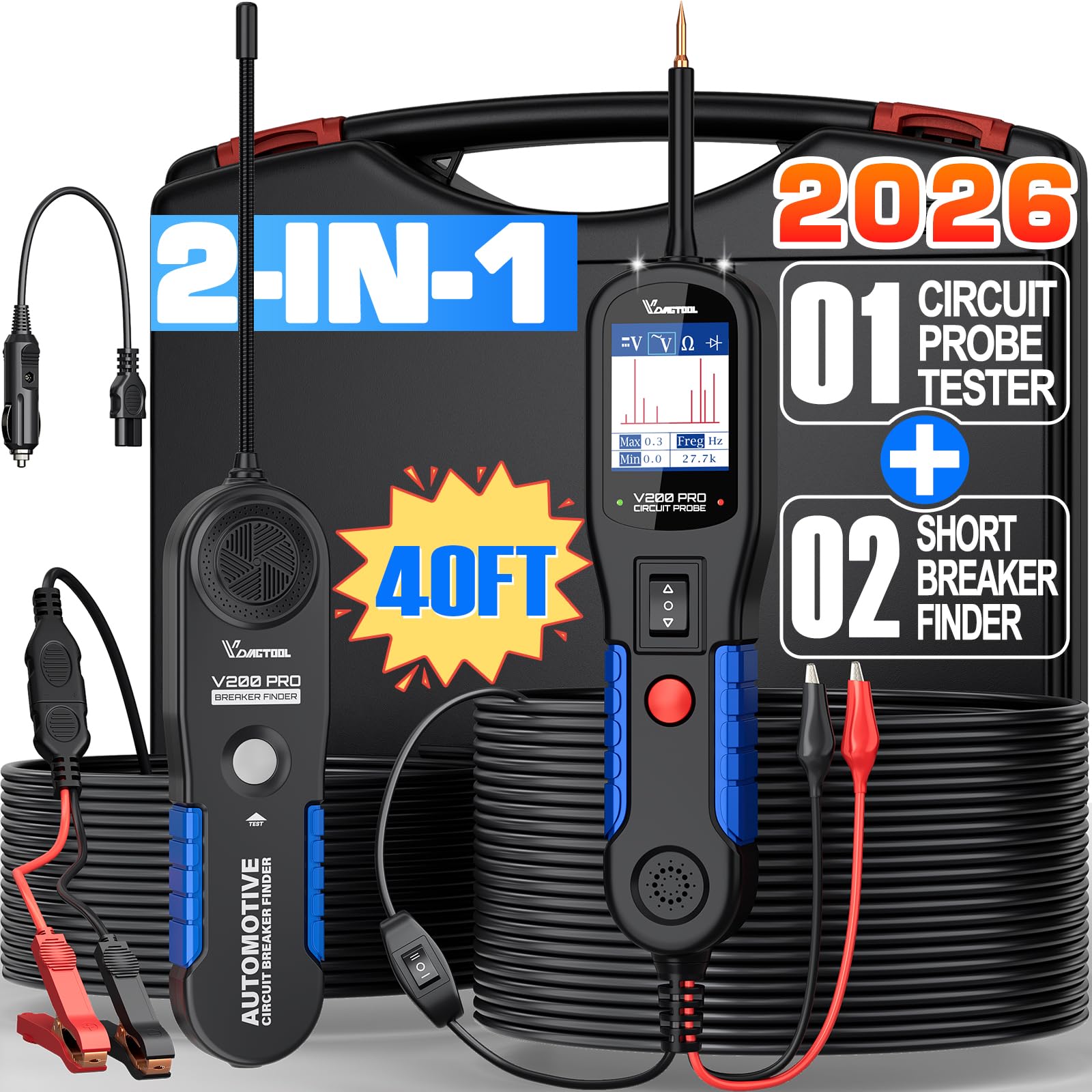
The VDIAGTOOL V200 Pro stands apart by integrating a power circuit probe and a dedicated breaker finder into a single handheld unit. Mode I delivers full AC/DC voltage, resistance, and diode testing with component activation, while Mode II switches to tone-based wire tracing that locates open circuits, broken wires, and current leaks without piercing insulation. This dual-mode architecture eliminates the need to carry separate tools for live-circuit diagnosis and passive cable tracking.
Under the hood, the V200 Pro handles 6 to 42 volts DC, covering nearly every passenger vehicle, light truck, and RV electrical system. The included 20-foot main cable plus an additional 20-foot extension cord gives you full bumper-to-bumper reach without constantly moving the battery clamp. The built-in overload protection shuts down and restarts automatically, safeguarding both the tool and the vehicle’s sensitive modules during inadvertent short-circuit tests.
Owner feedback consistently highlights the straightforward mode switch and the clear tone changes during wire tracing. The 3-year warranty and lifetime technical assistance add long-term confidence that cheaper alternatives simply do not offer. For anyone who wants one tool that genuinely does the work of two, the V200 Pro is the clear first choice.
What works
- True 2-in-1 functionality covering probe and breaker finding
- Exceptional 40-foot total cable length
- Automatic overload protection with reset
- 3-year warranty with lifetime support
What doesn’t
- Mode II requires a 9V battery for the breaker finder circuit
- Learning curve for first-time users switching between modes
2. Autel PS100 Power Circuit Probe Tester (2026)
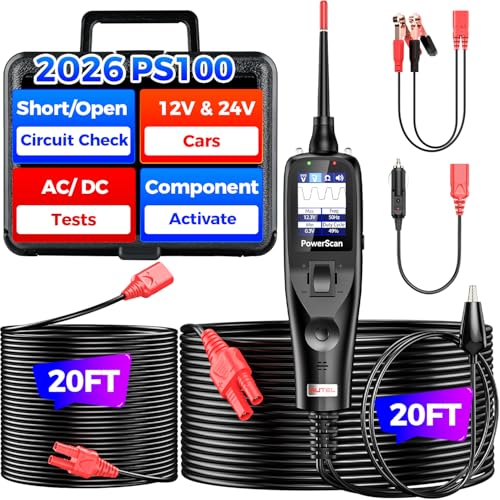
The 2026 Autel PS100 represents a refined generation of power circuit probe technology, packing four dedicated working modes — DC voltage, AC voltage, resistance, and tone-based feedback — into a compact, ergonomic body. Its 0.1-volt DC resolution allows precise measurement of signal circuits and sensor outputs, while the AC mode captures minimum and maximum voltage, frequency, and duty cycle for diagnosing variable-frequency components like fuel injectors and cooling fans.
Component activation is where the PS100 truly flexes. It can energize blower motors, window regulators, windshield wipers, radiator fans, and lighting circuits directly from the probe tip, letting you verify component integrity without backprobing connectors or jumping relays. The 20-foot main cable plus an additional 20-foot extension provides the same bumper-to-bumper freedom as the V200 Pro, and the built-in LED flashlight keeps the work area visible in dark footwells and trunk compartments.
User reports across automotive forums praise the PS100’s intuitive interface and the clear red/green LED polarity indicators that eliminate guesswork when tracing unmarked wires. The 12-month warranty and 30-day return policy offer reasonable protection, though the warranty period trails the V200 Pro by a wide margin. For professional technicians who prioritize mode versatility and component testing, the PS100 delivers top-tier performance.
What works
- Excellent 0.1V DC resolution for sensor-level diagnosis
- Four distinct working modes cover nearly every circuit scenario
- Strong component activation capability for on-vehicle testing
- Dual power supply via cigarette lighter or battery clamps
What doesn’t
- Warranty period is shorter than some competitors
- No dedicated breaker-finder mode for passive wire tracing
3. Fluke BK120 SmartTrace Breaker Finder and Socket Tester

Fluke’s BK120 SmartTrace brings the brand’s legendary build quality to the breaker-finder category with a 4-in-1 design that includes breaker identification, non-contact voltage detection, socket wiring testing, and an LED flashlight. The transmitter plugs directly into a standard outlet and injects a tracing signal, while the receiver scans the panel with audible and visual alerts that intensify as you near the correct breaker. The dual-sensitivity NCV mode detects voltage on both terminal strips and supply cords, adding a layer of safety verification before you touch any conductor.
The socket tester function on the transmitter automatically checks seven common wiring faults and tests GFCI trip functionality, making it a legitimate all-in-one tool for residential and light-commercial electrical work. The bright LED flashlight on the receiver is not an afterthought — it illuminates dim breaker panels effectively, reducing the need for a separate work light. Fluke’s compliance with UL 61010-1 and IEC 61010-2-030 standards gives professional electricians the certification confidence they need for job-site use.
Owner reviews consistently note the BK120’s build quality and the clarity of its audible feedback during panel scanning. The main limitation is its 110-volt AC minimum operating voltage, which means it cannot be used directly on automotive 12-volt systems. For residential and commercial electricians who need a reliable, certifiable breaker finder with socket-testing capabilities, the BK120 is the premium pick.
What works
- Fluke brand reliability with UL/IEC certification
- Dual-sensitivity NCV for safe live-wire detection
- Integrated GFCI and socket wiring tester
- Bright flashlight reduces need for extra tools
What doesn’t
- 110V AC minimum — not usable for automotive diagnostics
- Higher price tier compared to similar breaker finders
4. Autel PowerScan Automotive Circuit Tester (B00UZ940ES)
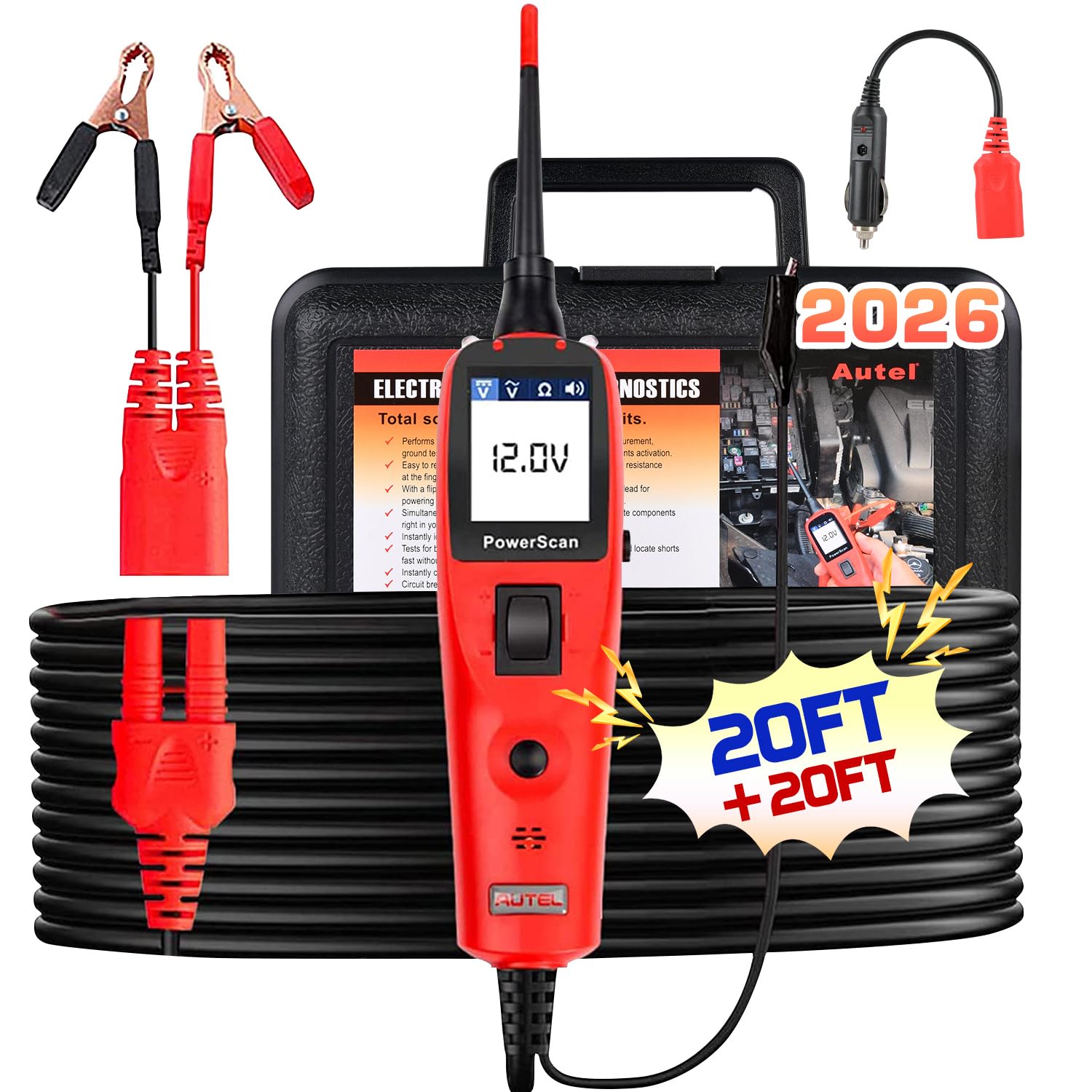
The earlier Autel PowerScan shares the same core DNA as the 2026 PS100 — four working modes, component activation, and a 20-foot main cable with an additional 20-foot extension — at a lower entry point. It supports 6 to 30 volts DC, making it suitable for nearly all passenger vehicles, light trucks, and motorcycles. The probe tip delivers voltage or ground on demand, and the integrated multimeter-style readout handles voltage, resistance, and continuity checks without needing a separate meter.
Component activation works reliably for blower motors, power windows, lighting circuits, and fuel injectors, giving DIYers and weekend mechanics the ability to test components without backprobing or jumper wires. The overload-protected circuit breaker trips automatically during short-circuit tests, then resets, protecting both the tool and the vehicle’s control modules. The built-in flashlight provides adequate illumination for dark engine bays and under-dash areas.
Seasoned owners note that while this generation lacks some of the interface refinements of the 2026 version — the display is simpler and the mode switching feels slightly less polished — the actual measurement accuracy and component-driving capability are identical. For buyers who want Autel-grade circuit testing without paying for the latest model, this generation represents the best value per dollar in the power probe category.
What works
- Same core Autel accuracy as the newer PS100 model
- Full component activation for on-vehicle testing
- 40 feet of total cable reach
- Overload protection with auto-reset circuit breaker
What doesn’t
- Interface feels less refined than the 2026 version
- Shorter warranty compared to some competitors
5. KAIWEETS KT301P Circuit Breaker Finder with LCD Display
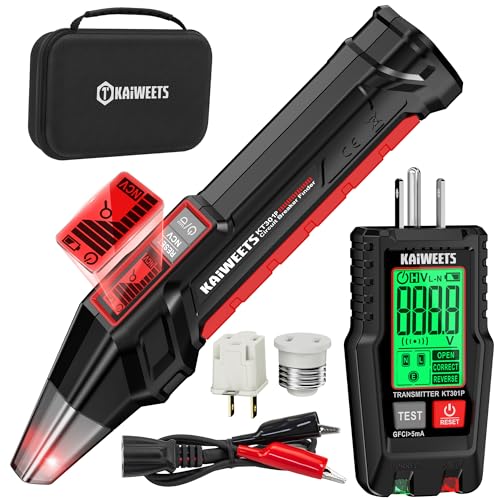
The KAIWEETS KT301P sets itself apart with a large backlit LCD screen that displays real-time voltage readings, wiring status, and signal strength in one glance. This visual clarity eliminates the guesswork of interpreting tone patterns alone, making it especially useful for DIYers who are still building their diagnostic intuition. The transmitter doubles as a GFCI outlet tester with automatic trip testing, and the receiver includes a non-contact voltage detection function for safe preliminary checks.
The kit ships with a 3-prong to 2-prong adapter, a light socket adapter, and an alligator clip adapter, broadening compatibility beyond standard grounded outlets. The durable carrying case keeps everything organized and protected during transport. The receiver’s backlit LCD and the built LED flashlight on the transmitter make this kit genuinely usable in low-light panel rooms and basements.
Feedback from home users highlights the KT301P’s ease of use and the clarity of the on-screen wiring fault descriptions, which cover seven common outlet wiring errors. The main trade-off is that this tool is a dedicated breaker finder — it does not function as a power circuit probe for automotive live-circuit testing. For homeowners and electricians focused on residential breaker identification and outlet wiring verification, the LCD-equipped KT301P offers the most user-friendly experience at this price tier.
What works
- Large LCD screen with backlight for easy reading
- Comprehensive accessory kit including adapters and case
- Integrated GFCI tester with automatic trip testing
- NCV function for safe live-wire detection
What doesn’t
- Limited to breaker finding — no power probe capability
- Not suitable for automotive 12-volt system diagnostics
6. Topdiag P100 Automotive Power Circuit Probe Tester
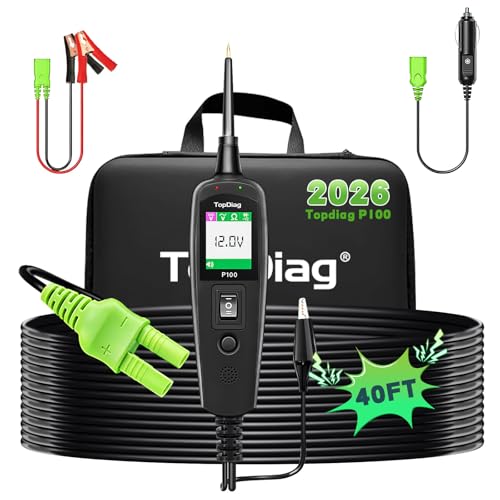
The Topdiag P100 enters the power probe segment with a straightforward value proposition: it handles AC/DC voltage, resistance, continuity, polarity detection, and component activation at a budget-friendly price point. The tool supports 9 to 30 volts DC, covering 12-volt cars and 24-volt trucks and buses. Its built-in circuit breaker trips during overload conditions, then resets, protecting both the tool and the vehicle’s electronics from accidental short-circuit damage.
Component activation works for lighting circuits, motors, relays, and solenoids, and the 20-foot cable allows reasonable freedom of movement around most vehicles. The probe tip delivers positive or negative voltage at the press of a switch, and the LED indicators provide clear polarity feedback. The self-test function lets you verify the tool is functioning correctly before you start probing unknown circuits — a smart workflow step that some competing tools omit.
Owner reports indicate that the P100 performs reliably for basic circuit testing and short location, though the build quality does not match the Autel or VDIAGTOOL units at higher price points. The 1-year warranty and 60-day return policy provide a safety net, and the 24/7 tech support is a welcome touch for less experienced users. For budget-conscious DIYers who need a functional power probe without the professional price tag, the P100 delivers the essentials.
What works
- Affordable entry point for power probe functionality
- Wide voltage range covers 12V and 24V systems
- Built-in circuit breaker for overload protection
- Self-test function for pre-diagnostic verification
What doesn’t
- Build quality feels less robust than premium alternatives
- No extension cable included for larger vehicles
7. Klein Tools ET310 AC Circuit Breaker Finder

The Klein Tools ET310 is the industry standard for basic residential circuit breaker identification. Its two-part system consists of a transmitter that plugs into the outlet and a receiver that scans the breaker panel. When the receiver lands on the correct breaker, it delivers both visual and audible confirmation. The transmitter doubles as a GFCI outlet tester, allowing you to verify wiring condition and test GFCI trip functionality in one step.
The ET310 operates on 90 to 120 volts AC, making it a dedicated tool for North American residential and commercial outlet circuits. The transmitter docks directly into the receiver for compact storage, a thoughtful design detail that keeps the two components together between jobs. The 9-volt battery for the receiver is included, so the tool is ready to use out of the box. Klein’s reputation for rugged hand tools carries over to this tester — owners report years of reliable service under regular job-site use.
Feedback from electricians and homeowners consistently praises the ET310’s reliability and simplicity. The biggest limitation is its narrow focus — it cannot test automotive circuits, trace wires behind walls, or perform any live-circuit diagnostics. It does one thing (breaker finding with GFCI testing) and does it well. For anyone who needs a no-fuss, trusted breaker finder for home electrical work, the ET310 remains the benchmark.
What works
- Trusted Klein Tools build quality and long-term durability
- Integrated GFCI outlet tester with wiring verification
- Compact docking storage keeps components together
- Clear audible and visual breaker confirmation
What doesn’t
- Limited to 90-120V AC residential circuits only
- No power probe or wire tracing capability
Hardware & Specs Guide
Voltage Range and Compatibility
Automotive electrical short finders must handle 6 to 30 volts DC for passenger vehicles, light trucks, and motorcycles. Tools rated for 24 volts DC also cover heavy-duty trucks, buses, and some RV systems. Residential breaker finders operate on 90 to 240 volts AC and are not interchangeable with automotive probes. Always verify the voltage range before applying the tool to an unfamiliar system — connecting a 120V-only breaker finder to a 12V circuit will yield no useful reading, and applying a power probe to a 240V line without proper rating can damage the tool.
Cable Length and Reach
Short finders with integrated cables between 6 and 20 feet offer basic reach for engine-bay work. Tools that include an additional 20-foot extension cable allow full bumper-to-bumper coverage on full-size trucks and SUVs without repositioning the battery connection. For trailer wiring diagnostics, a 40-foot combined reach lets you walk the entire trailer length while monitoring the probe display. Cigarette-lighter power adapters add convenience by eliminating the need to clamp directly to the battery for every test.
Overload Protection and Safety
Built-in circuit breakers that trip and automatically reset are critical for preventing damage during inadvertent short-circuit tests. Look for tools with reverse-polarity indicators — red and green LEDs that confirm positive or negative connection before you apply power to a component. Non-contact voltage detection on breaker finders adds a safety layer by confirming live wires without direct probe contact. Certifications such as UL 61010-1, CE, and RoHS indicate the tool has passed third-party safety and materials compliance testing.
Component Activation and Signal Testing
Power circuit probes with component activation can supply voltage or ground directly to a device — such as a blower motor, fuel injector, or lighting circuit — to verify function without jumping relays or using external power sources. This capability saves significant diagnostic time on intermittent failures that do not appear during static resistance checks. Signal circuit testing captures frequency and duty cycle on variable-frequency components, helping identify failing sensors and actuators that still produce a reading but outside the expected range.
FAQ
What is the difference between a circuit breaker finder and a power circuit probe?
Can I use an electrical short finder on my car’s 12-volt system?
Do I need special training to use a power circuit probe tester?
What safety precautions should I take when using a short finder?
Final Thoughts: The Verdict
For most buyers, the best electrical short finder winner is the VDIAGTOOL V200 Pro because it combines a full-featured power circuit probe with a dedicated breaker finder in one unit, backed by a 3-year warranty and 40 feet of cable reach. If you want professional-grade component activation and four-mode versatility, grab the Autel PS100 2026. And for residential breaker identification with the trusted Fluke name behind it, nothing beats the Fluke BK120 SmartTrace.

Certification: BSc in Mechanical Engineering
Education: Mechanical engineer
Lives In: 539 W Commerce St, Dallas, TX 75208, USA
Md Amir is an auto mechanic student and writer with over half a decade of experience in the automotive field. He has worked with top automotive brands such as Lexus, Quantum, and also owns two automotive blogs autocarneed.com and taxiwiz.com.