Power ratings in the car audio world are notoriously optimistic. A badge that reads 2000 watts rarely delivers that number cleanly, and the amplifier that looks like a bargain on paper often becomes a headache after a few months of daily use. The difference between a satisfying subwoofer setup and a frustrating one usually comes down to choosing an amplifier that honestly delivers its rated power, runs cool under load, and includes the right protection circuitry for long-term reliability.
I’m Amir — the founder and writer behind Four Wheel Ask. My approach to evaluating amplifiers centers on cross-referencing manufacturer specifications against real-world owner data, thermal efficiency benchmarks, and build quality indicators that predict long-term performance rather than just peak output numbers.
After evaluating power delivery, thermal performance, and real owner feedback across dozens of models, our pick for the best amplifier for car subwoofer combines honest specs with proven durability.
How To Choose The Best Amplifier For Car Subwoofer
Selecting the right amplifier comes down to matching power delivery with your subwoofer demands, understanding impedance loads, and evaluating thermal performance. The cheapest option often lacks protection circuitry, while the most expensive may exceed your electrical system capacity. Focus on RMS ratings, impedance stability, and real-world reliability data rather than peak wattage claims.
RMS Power Versus Peak Power
Continuous RMS power is the only rating that matters for sustained bass output. Peak power numbers are marketing figures that represent a brief burst before distortion or thermal shutdown occurs. Look for amplifiers that honestly state RMS at your target impedance — a quality unit delivers its rated RMS cleanly for extended listening sessions without entering protection mode.
Impedance Stability and Wiring
An amplifier rated for 1-ohm operation must handle the thermal and current demands of low-impedance loads. Subwoofers wired to present a 1-ohm or 2-ohm load extract maximum power from monoblock amps, but not all amplifiers handle this reliably. Verify that the amplifier includes adequate heatsinking and MOSFET power supply components for stable low-impedance operation.
Crossover Controls and Filtering
A usable amplifier includes a low-pass filter adjustable between 50 Hz and 250 Hz, along with a subsonic filter to block frequencies below the subwoofer tuning range. These controls prevent distortion and mechanical damage. Bass boost circuits can add punch but often introduce clipping at higher settings — use them sparingly.
Quick Comparison
On smaller screens, swipe sideways to see the full table.
| Model | Category | Best For | Key Spec | Amazon |
|---|---|---|---|---|
| CT Sounds CT-1500.1D | Monoblock | Balanced power and compact footprint | 1500W RMS at 1 ohm | Amazon |
| Alpine S-A60M | Class D | Clean power from a trusted brand | 600W RMS at 1 ohm | Amazon |
| Orion XTR3500.1DZ | High Power | Maximum SPL and high RMS demands | 3500W RMS at 1 ohm | Amazon |
| Taramps HD 2000 | Full Range | High RMS in a compact chassis | 2000W RMS at 1 ohm | Amazon |
| Rockville dB12 | Compact | Budget-friendly with tuning flexibility | 500W RMS at 2 ohms | Amazon |
| KICKER CX Series + Kit | Bundle | Plug-and-play with wiring included | 400W RMS at 2 ohms | Amazon |
| AUDIOZERONE ZE1000.1 | Entry Level | Low-cost entry with solid RMS delivery | 1000W RMS at 1 ohm | Amazon |
In-Depth Reviews
1. CT Sounds CT-1500.1D

CT Sounds built the CT-1500.1D around a MOSFET pulse-width modulated power supply that prioritizes thermal efficiency without sacrificing output. The compact footprint — roughly 14.6 by 5.6 inches — makes it installable under seats or in tight trunk spaces, yet it delivers 1500 watts RMS at 1 ohm with consistent voltage regulation. Owner reports confirm that the amplifier runs cool even during extended high-volume sessions, a strong indicator that the heatsink design and Class D topology work as intended.
The four-way protection circuitry covers high voltage, low voltage, over-current, and high-temperature scenarios, which adds peace of mind for drivers pushing the amplifier near its limits. User feedback from installations powering single 15-inch subwoofers and dual 12-inch setups alike indicates clean output with no thermal shutdown issues. The included bass knob allows remote adjustment, though some owners note that the knob range could be more linear at the upper end.
Considering the RMS delivery at the 1-ohm load and the build quality apparent in the lug terminals and internal layout, this amplifier occupies a strong middle ground between entry-level options and high-end competition units. It suits drivers who want verified power, reliable cooling, and a form factor that doesn’t dictate where the amplifier must be mounted.
What works
- Delivers rated 1500W RMS at 1 ohm without overheating
- Compact size fits under seats and in small compartments
- Four-layer protection circuitry covers multiple fault conditions
What doesn’t
- Bass knob response flattens above 50% for some users
- Terminal layout could be slightly tighter for cleaner wiring
2. Alpine S-A60M

Alpine’s S-A60M represents what happens when a major manufacturer applies CEA-2006 compliant testing to a monoblock amplifier. The rated 600 watts RMS at 1 ohm is conservative compared to some competitors, but owner-verified bench tests show the amplifier actually delivers around 667 watts RMS — a rare case of under-rating rather than over-promising. The compact chassis houses preamp and speaker-level inputs, making it compatible with factory radios without requiring a separate line-output converter.
Real-world installations include powering single 12-inch Kicker subs in Jeep Wranglers and dual JBL 10-inch setups, with owners consistently reporting clean output and no thermal issues even during extended listening periods. The variable bass boost and detented gain adjustment help set levels accurately without test equipment. One common observation among long-term owners is that the amplifier remains reliable after years of daily use, replacing multiple cheaper units that failed prematurely.
The S-A60M fits best for buyers who prioritize brand reliability, clean power delivery, and hassle-free integration with factory audio systems. It does not chase peak wattage records, but the power it provides is usable, stable, and backed by a company with a strong service network. For moderate subwoofer setups requiring honest, sustained output, this Alpine delivers exactly what the spec sheet promises.
What works
- CEA-2006 compliant rating with verified output exceeding spec
- Preamp and speaker-level inputs fit factory radio installations
- Long-term reliability with no thermal or protection mode issues
What doesn’t
- Bass boost center frequency fixed at 50 Hz limits tuning flexibility
- RMS output limited compared to similarly sized competitors
3. Orion XTR3500.1DZ

Orion’s XTR3500.1DZ sits at the top of the power hierarchy with a true 3500-watt RMS rating at 1 ohm, built on a Korean manufacturing platform known for high-current, low-impedance stability. The amplifier includes a subsonic filter, variable low-pass crossover with 12 dB per octave slope, and phase shift control — features typically found on competition-grade units. Owner reports confirm that the amplifier powers three 12-inch Kicker L7 subwoofers wired to around 1.4 ohms without entering protection mode, producing extreme SPL levels.
The 4-way protection circuitry covers voltage, current, and thermal faults, but the amplifier demands a robust electrical system. Multiple owners recommend upgrading to 0-gauge wiring and a high-output alternator or secondary battery to avoid voltage drop issues. Some users noted that the included bass knob uses a 1/8-inch phono connector rather than the RJ11 shown in marketing images, and the remote knob itself feels less durable than the amplifier chassis. A few early units exhibited LED indicator failure and cold-temperature startup noise that resolved after warm-up.
This Orion is for enthusiasts building high-power systems where maximum RMS delivery is the primary goal. The build quality and Korean engineering justify the investment for those willing to address the electrical system upgrades required. Drivers seeking moderate bass for daily commuting will find more practical options lower on the power scale.
What works
- True 3500W RMS at 1 ohm with clean, sustained output
- Korean manufacturing with high-quality internal components
- Full crossover suite with subsonic filter and phase control
What doesn’t
- Requires heavy electrical upgrades for stable operation
- Bass knob connector type inconsistent with product images
- Some units exhibit cold-start noise before reaching operating temperature
4. Taramps HD 2000

Taramps has built a reputation for producing high-RMS amplifiers in unusually small packages, and the HD 2000 continues that trend. Measuring just under 9 by 7.3 by 2.5 inches and weighing about 4.2 pounds, this monoblock delivers a full 2000 watts RMS across 1, 2, or 4 ohms thanks to its full-range Class D topology. Bench testing from owners confirms the amplifier actually exceeds its rating, with one measurement showing 2834 watts RMS at 1 ohm — a significant margin above the advertised spec.
The HD 2000 includes variable high-pass and low-pass filters, an LED monitor indicator for clipping detection, and a high-level input for factory radio integration. Owners running dual 12-inch Skar Audio subwoofers report clean output without overheating, and the amplifier’s small size makes it easy to mount in tight spaces. The included cooling fan is effective but generates noticeable noise when music is not playing, which matters for drivers who value cabin quietness during low-volume cruising.
This Taramps model delivers exceptional power density for its physical footprint, making it ideal for installations where space is limited but output requirements are high. The clipping indicator is a practical tool for setting gain without distortion. Buyers should account for the fan noise if they frequently drive with the audio system off or at very low volume.
What works
- Exceeds rated 2000W RMS in real-world bench testing
- Extremely compact for the power output delivered
- Built-in clipping indicator simplifies gain setup
What doesn’t
- Cooling fan audibly runs when no music is playing
- First unit failure rate reported by some buyers required replacement
5. Rockville dB12

Rockville’s dB12 channels peak power marketing through a 2000-watt claim while the real-world RMS rating settles at 500 watts at 2 ohms — an honest figure that aligns with owner bench tests showing 563 watts RMS. The amplifier includes fully adjustable 12 dB per octave crossover controls, a subsonic filter adjustable from 15 to 55 Hz, and a 12 dB bass equalizer for precision tuning. The remote dashboard subwoofer control and LED-illuminated logo add visual appeal for installs where the amplifier is visible.
Owner feedback from installations powering 15-inch Rockford Fosgate subwoofers and dual 12-inch setups indicates the dB12 runs cool under normal listening conditions and never enters thermal protection during extended high-volume use. The MOSFET power supply contributes to stable voltage regulation, and the IC-controlled protection circuitry covers overheating, under-voltage, over-voltage, and short circuits. A small but notable detail: the Allen keys required for the wiring terminals are included in the box, which reduces frustration during installation.
This amplifier suits budget-conscious buyers who need reliable power in the 500-watt RMS range without sacrificing crossover flexibility. The included remote bass knob and protective circuitry make it a complete package for moderate subwoofer builds. Some units have arrived with cosmetic defects, but functional reliability appears consistent based on aggregate owner data.
What works
- Real-world RMS testing matches or exceeds the 500W rating
- Adjustable subsonic filter and bass EQ provide tuning flexibility
- Runs cool under extended load without thermal shutdown
What doesn’t
- Occasional cosmetic defects reported on arrival
- Peak power marketing can mislead less experienced buyers
6. KICKER CX Series 400W + Wiring Kit
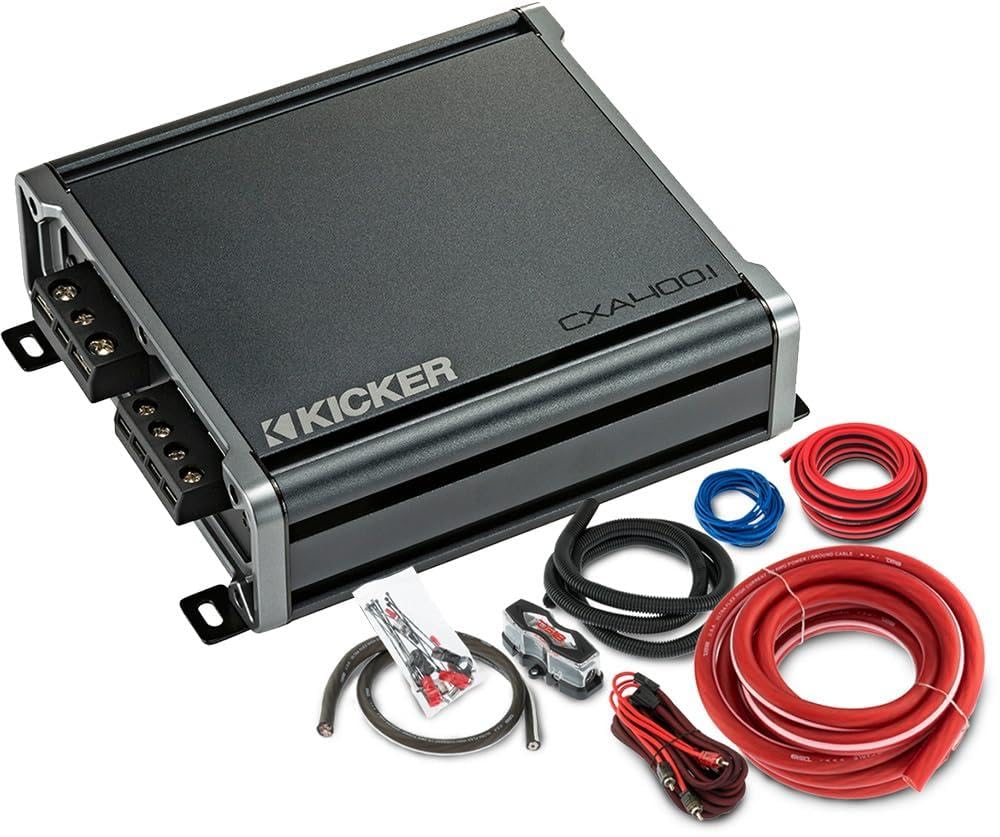
KICKER packages the 46CXA400.1T CX Series monoblock amplifier with a DS18 AMPKIT8 8-AWG complete wiring kit, creating a turnkey solution for first-time subwoofer buyers. The amplifier delivers 400 watts RMS at 2 ohms with KICKER’s typical conservative rating approach, meaning it reliably meets its spec without pushing thermal limits. The wiring kit includes power cable, ground cable, RCA interconnects, fuse holder, and connectors — everything needed for a basic installation beyond the subwoofer and head unit.
Owner reports highlight the ease of installation and the peace of mind that comes with a major brand warranty. The amplifier works well with single subwoofer setups in the 300-to-500 watt RMS range, and the Class D design keeps heat dissipation manageable even in confined mounting locations. Some buyers chose not to use the included bass knob, noting that the amplifier sounds balanced without remote adjustment, while others found the knob useful for quick level changes between music genres.
This bundle is purpose-built for drivers who want a straightforward installation without sourcing separate components. The power output suits entry-level and mid-range subwoofers, and KICKER’s service network provides support if issues arise. Experienced enthusiasts seeking higher RMS output or advanced crossover controls will need to look at the more powerful options on this list.
What works
- Complete wiring kit included for a single-purchase installation
- KICKER brand reliability with accessible customer support
- Class D efficiency keeps heat low in tight mounting spots
What doesn’t
- 400W RMS is limited for larger subwoofer builds
- Bass knob is optional for many users and adds wiring clutter
7. AUDIOZERONE ZE1000.1

AUDIOZERONE’s ZE1000.1 enters the market as a budget-oriented monoblock that delivers 1000 watts RMS at 1 ohm — a figure confirmed by multiple owners who bench-tested the unit. The Class D MOSFET design keeps power loss low and the heatsink size manageable, measuring 11 by 6.9 by 2 inches. Thermal, overload, and short-circuit protection are included, which is notable for an amplifier at this price point. Owners running 10-inch and 12-inch subwoofers report clean output with no protection mode issues over two years of daily use.
The amplifier powers dual Skar Audio SDR12 subwoofers at 1 ohm without overheating, and some users measured output exceeding the rated 1000 watts RMS. The high-level input option works well with factory radios, and the build quality feels solid for the category. A recurring observation is that the speaker wire terminals can loosen if not tightened firmly, leading to intermittent connection loss — a simple fix with regular inspection during maintenance.
This AUDIOZERONE model is the strongest entry-level option for buyers on a tight budget who still want verified 1000-watt RMS capability. It lacks some refinements of premium brands, but the core power delivery and protection features are present. Drivers planning to run the amplifier at maximum output continuously should monitor terminal tightness and ensure adequate airflow around the heatsink.
What works
- Verified 1000W RMS delivery at an accessible price
- Thermal and short-circuit protection included
- High-level input works with factory radio systems
What doesn’t
- Speaker wire terminals can loosen over time if undertightened
- No subsonic filter for fine-tuning low-frequency extension
Hardware and Specs Guide
Class D Topology
All seven amplifiers on this list use Class D architecture, which converts DC power to AC audio signals through high-frequency switching rather than linear amplification. This approach reduces heat generation by roughly 40 to 50 percent compared to Class A/B designs, allowing smaller heatsinks and more compact chassis dimensions. The efficiency advantage becomes critical when the amplifier is mounted in enclosed spaces with limited airflow, such as under seats or in sealed trunk compartments.
MOSFET Power Supply
Metal-oxide-semiconductor field-effect transistors handle the DC-to-DC conversion inside each amplifier, stepping up the vehicle’s 12-volt electrical system to the higher voltages required for audio output. Higher-quality MOSFET arrays support lower impedance loads and maintain voltage regulation under heavy current draw. Amplifiers with inadequate MOSFET specifications often exhibit voltage sag during bass transients, leading to audible distortion and premature protection mode activation.
Protection Circuitry
Modern monoblock amplifiers include multiple protection systems: thermal sensors that shut down the unit before component damage occurs, over-current detection that prevents speaker wire short circuits from destroying the output stage, and DC offset protection that blocks harmful direct current from reaching the subwoofer. These circuits add complexity but significantly extend the service life of both the amplifier and the connected subwoofer. Budget amplifiers sometimes omit one or more of these protections to reduce cost.
Crossover and Filter Controls
A low-pass filter allows only frequencies below a selected threshold — typically between 50 Hz and 250 Hz — to reach the subwoofer, preventing midrange and high-frequency content from distorting bass output. The subsonic filter removes ultra-low frequencies below the subwoofer’s tuning range, reducing mechanical stress on the cone and voice coil. Adjustable crossover slopes, measured in dB per octave, determine how sharply the filter cuts: 12 dB per octave provides a good balance between selectivity and natural roll-off for most subwoofer applications.
FAQ
What size amplifier do I need for my subwoofer?
What does 1 ohm stable mean on an amplifier?
Should I use peak power or RMS when matching an amplifier?
Can I install a monoblock amplifier with a factory radio?
What gauge power wire do I need for my amplifier?
Final Thoughts: The Verdict
For most buyers, the amplifier for car subwoofer winner is the CT Sounds CT-1500.1D because it delivers verified 1500-watt RMS power in a compact, cool-running chassis with comprehensive protection circuitry. If you want brand reliability and factory-radio compatibility, grab the Alpine S-A60M. And for maximum SPL builds demanding true high-RMS output, nothing beats the Orion XTR3500.1DZ.

Certification: BSc in Mechanical Engineering
Education: Mechanical engineer
Lives In: 539 W Commerce St, Dallas, TX 75208, USA
Md Amir is an auto mechanic student and writer with over half a decade of experience in the automotive field. He has worked with top automotive brands such as Lexus, Quantum, and also owns two automotive blogs autocarneed.com and taxiwiz.com.