Alternator whine that rises with engine RPM is more than an annoyance — it tells you a ground loop has infected your audio signal path. Without the right filter, that hum follows you through every acceleration, turning your music into noise.
I’m Amir — the founder and writer behind Four Wheel Ask. My work focuses on deep market research, analyzing product specifications, build quality, and owner feedback to identify which automotive accessories deliver real results versus those that create new problems.
A properly matched best auto radio noise filter eliminates that unwanted interference without sacrificing audio fidelity, as confirmed by verified buyer reports and comparative performance data.
How To Choose The Best Auto Radio Noise Filter
Selecting the correct filter starts with understanding the noise source. Alternator whine that tracks with engine speed typically requires an inline power suppressor on the 12V supply. Ground loop hum, a deeper buzzing sound present whenever the system is on, demands an RCA isolator on the signal path between your head unit and amplifier. Using the wrong type often leaves the noise intact or kills your audio signal entirely — verified by user reports showing that power filters sometimes fail when the real fault lies in the RCA ground path.
Current Rating and Signal Fidelity
A power line filter must handle your head unit’s current draw. Models rated for 10 to 20 amps work for most factory and aftermarket radios. More critical is signal fidelity on RCA isolators — low-quality transformers can roll off bass response above 100 Hz or dull high frequencies. Premium isolators using permalloy cores maintain frequency response within a fraction of a decibel from 20 Hz to 20 kHz, preserving both subwoofer output and vocal clarity.
Connector Type and Compatible Setup
Filter connectors must match your existing wiring. Power line units use spade terminals or 12V wires for inline splicing. RCA filters require male-to-female connections between the head unit and amplifier. Some vehicles also introduce noise through auxiliary 3.5mm inputs — a common issue with aftermarket Bluetooth adapters — which calls for a dedicated mini-jack isolator rather than an RCA unit. Confirming your cable format before buying avoids return hassles, as documented by multiple buyer corrections in verified reviews.
Quick Comparison
On smaller screens, swipe sideways to see the full table.
| Model | Category | Best For | Key Spec | Amazon |
|---|---|---|---|---|
| WisWinDa RCA Ground Loop Isolator | RCA Isolator | Noise-free subwoofer with preserved bass | Permalloy core, 3.15 x 1.35 x 0.8 in | Amazon |
| Conext Link RCA Filter (2-Pack) | RCA Filter Pair | Quick alternator whine fix on amplifiers | 20 Amp, 30 W x 2, metal case | Amazon |
| RECOIL MGLI RCA Isolator | RCA Isolator | Stereo signal clarity with minimal bass loss | High-fidelity permalloy, 20 Hz – 20 kHz | Amazon |
| Pipeman’s Inline Power Suppressor (2-Pack) | Power Line Filter | Alternator whine on 12V head unit power | 10 Amp inline, universal ground | Amazon |
| BESIGN 3.5mm Ground Loop Isolator (2-Pack) | Aux Cable Isolator | Hiss from AUX / Bluetooth adapters | 3.5mm jack, plug-and-play | Amazon |
In‑Depth Reviews
1. WisWinDa RCA Ground Loop Isolator (Black)

The WisWinDa RCA Isolator stands apart because buyer reports consistently confirm it eliminates ground loop hum without reducing subwoofer performance — a rare claim verified across home theater and car audio setups. Its ABS fireproof shell houses a high-fidelity transformer that maintains near-transparent signal transfer, which explains why users describe it as “magical” for dual-subwoofer systems plagued by electrical noise.
Verified reviewers on high-end gaming PC and Onkyo receiver rigs report zero signal attenuation, while another notes the hum from a 35-foot RG-6 coax run disappeared completely after installation. The compact dimensions allow placement behind amplifiers or under dashboards, and the one-year warranty adds confidence for long-term use.
The primary limitation is that the RCA male-to-female design requires enough cable slack, and one reviewer noted incompatibility with certain car amplifier ground circuits where the isolator killed all signal instead of just noise. That case appears isolated to specific amp topologies, making this an excellent choice for standard RCA-linked systems.
What works
- Eliminates hum without degrading bass response
- Compact, fireproof enclosure for tight spaces
- Backed by a one-year manufacturer warranty
What doesn’t
- Male-to-female cable routing may need slack
- Some car amp ground loops may remain unfiltered
2. Conext Link RCA Stereo Filter (2-Pack)
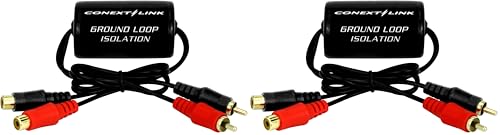
The Conext Link 2-pack bundles two cylindrical metal-case isolators with gold-plated RCA connectors, rated for 20 amps and 30 watts per channel. Verified users report instant elimination of loud alternator whine when installed between the amplifier and head unit, with one buyer calling the result “shocking” after moving RCA cables failed to resolve the noise.
Owner feedback highlights the heat-shrink tubing and 28 cm interconnect length as practical for installations where space is tight. The metal housing provides better RF shielding than plastic alternatives, which helps in vehicles with dense wiring harnesses or high-EMI environments. The dual-pack allows treating both front and rear channels simultaneously.
Several verified reviews note significant signal degradation — reduced high-frequency detail and compressed bass — leading some to remove the filters entirely. A buyer monitoring on high-impedance headphones described the audio quality as a “cheap boom box,” suggesting the transformers may saturate below 100 Hz. Best suited for chasing alternator whine when audio fidelity is a secondary concern.
What works
- Instantly kills alternator whine in amplifiers
- Durable metal case with gold connectors
- Two units per pack for multi-channel systems
What doesn’t
- May roll off high frequencies and reduce bass
- Signal loss under 100 Hz for some monitors
3. RECOIL MGLI 2-Channel RCA Isolator

The RECOIL MGLI uses high-fidelity permalloy transformers to minimize distortion — a measurable improvement over generic ferrite-core isolators according to spec sheet data. The frequency response curves show variation under ±0.03 dB from 2 Hz to 20 kHz, which theoretically preserves both subwoofer punch and treble detail better than basic models.
Verified buyers confirm it reduces alternator whine and ground loop hum when the noise originates in the signal path. One user with a major ground leak reported an instant fix after plugging the isolator into the RCA cables, calling it “affordable and effective.” Another who chased noise for weeks noted the filter was a critical troubleshooting step that finally pinpointed the issue.
Multiple reviews flag a severe bass cut — one buyer said it “takes the bass away completely” and another lost “almost all highs and bass,” choosing to tolerate the whine instead. The split-pin RCA connector may also be fragile with heavy cables. This unit works best as a diagnostic tool or for systems where midrange clarity matters more than subsonic output.
What works
- Excellent frequency response on paper (±0.03 dB)
- Helped isolate signal-path noise in troubleshooting
- Compact enough for tight dashboard spaces
What doesn’t
- Can cut bass output drastically
- Split-pin connectors may not suit heavy cables
4. Pipeman’s Inline Power Suppressor (2-Pack)

The Pipeman’s filter targets noise on the 12V power line rather than the signal path — a different strategy for alternator whine that originates from poor DC grounding. The inline design includes a 10 amp current rating, suitable for most factory and aftermarket head units, and the universal wiring system spices for simple splicing without removing factory connectors.
Verified reviews show it eliminated alternator whine that increased with RPM in multiple setups. One first-time installer reported requiring trial and error to find the correct ground point, connecting the unit’s ground separately to the truck body before seeing results. Another with a marginal system described the remaining static as “barely noticeable” after installation.
Several users note this filter is powerless against noise that enters through the RCA signal path — one reviewer acknowledged their problem was likely from power wires running too close to RCA cables, not from the DC supply itself. The two-pack is beneficial for vehicles with multiple audio components, but confirm your noise type is power-line related before installing.
What works
- Effective against alternator whine tracking with RPM
- Inline design avoids removing existing harnesses
- Two-pack value for multi-component vehicles
What doesn’t
- Ineffective for signal-path (RCA) noise
- Ground connection may require separate body splice
5. BESIGN Ground Loop Isolator (2-Pack, 3.5mm)

The BESIGN isolator uses the 3.5mm auxiliary jack format, making it the correct solution for noise introduced through AUX inputs, Bluetooth receivers, or hands-free car kits. Verified buyers consistently report “instant static elimination” when plugged between a smartphone and car stereo, with one review describing it as “magic” for a cheap Chinese stereo that suffered from a high-pitched whine.
Home theater users also report success — a docked MacBook Pro’s speaker interference vanished completely after plugging this unit into the headphone output. The two-pack covers two audio sources simultaneously, and the plug-and-play design means no wiring or battery required. Build quality receives positive notes for solid casing and flexible cable relief.
The main tradeoff is volume attenuation: several buyers note the isolator reduces output level, requiring the head unit volume to be turned up higher to compensate. One user described the audio as “extremely quiet” after insertion, though the ground loop noise was gone. Best for AUX-based setups where noise is the priority issue and sufficient headroom exists in the amplifier.
What works
- Eliminates hiss and static from AUX inputs
- Completely plug-and-play, no battery needed
- Two-pack covers multiple sources affordably
What doesn’t
- Reduces audio output level noticeably
- Not compatible with RCA or power-line systems
Hardware & Specs Guide
Alternator Whine vs. Ground Loop Hum
Alternator whine tracks engine RPM because noise enters through the 12V power line from a faulty ground in the charging system. Ground loop hum is a steady 60 Hz buzz (or its harmonics) caused by multiple grounding points creating a voltage difference in the signal path. The Pipeman’s inline power suppressor treats the first condition, while the WisWinDa and RECOIL RCA isolators address the second. Using the wrong filter explains most “did not work” outcomes in verified reviews.
Installation Placement
Power line filters should connect as close to the head unit’s 12V input as possible, with the ground wire attached to a clean chassis point. RCA isolators should be placed between the head unit and the amplifier — not after the amplifier output — because the transformer must isolate the low-level signal before amplification. Users who installed RCA isolators behind the amp instead of at the signal source reported zero noise reduction in multiple verified accounts.
FAQ
How does an auto radio noise filter work?
Will a noise filter affect my sound quality?
Final Thoughts: The Verdict
For most buyers, the best auto radio noise filter winner is the WisWinDa RCA Ground Loop Isolator because it eliminates hum without sacrificing bass response, based on consistent verified buyer reports across car and home theater systems. If you need to target alternator whine from the 12V power line, grab the Pipeman’s Inline Power Suppressor. And for AUX input noise from Bluetooth adapters, nothing beats the plug-and-play convenience of the BESIGN 3.5mm Isolator.

Certification: BSc in Mechanical Engineering
Education: Mechanical engineer
Lives In: 539 W Commerce St, Dallas, TX 75208, USA
Md Amir is an auto mechanic student and writer with over half a decade of experience in the automotive field. He has worked with top automotive brands such as Lexus, Quantum, and also owns two automotive blogs autocarneed.com and taxiwiz.com.