The market for in-vehicle scanning technology spans far beyond a single device type. Whether your goal is to monitor public safety radio traffic, detect radar enforcement, or pull diagnostic trouble codes from your car’s computer, each category demands a fundamentally different set of engineering priorities. Choosing the wrong tool means wasting money on features you cannot use or missing the capability you actually need.
I’m Amir — the founder and writer behind Four Wheel Ask. My approach focuses on dissecting manufacturer specifications, comparing real-world owner reports, and evaluating build quality across price tiers to identify which products deliver genuine value for their intended use case.
For anyone serious about situational awareness, the right best car radio scanner delivers clear signal reception across the most critical frequency bands.
How To Choose The Best Car Radio Scanner
The term “car radio scanner” covers three distinct product families: radio communication scanners that monitor public safety and aviation bands, radar/laser detectors that alert to speed enforcement, and OBD2 diagnostic tools that read your vehicle’s electronic control unit. Understanding which category matches your primary need is the first and most important decision. Each type uses different hardware, different frequency ranges, and different legal considerations.
Frequency Coverage and Modulation Support
For radio communication scanners, the frequency range determines what you can hear. A basic unit covering 25–1300 MHz handles VHF and UHF bands used by police, fire, EMS, aviation, and marine traffic. However, many public safety agencies now use digital trunked systems requiring support for APCO P25 Phase I and II, DMR, or NXDN protocols. Without the correct digital decoding, a scanner will hear only silence or garbled noise on those channels. Radar detectors operate on K, Ka, and X bands plus laser, so look for wide-band coverage and advanced filtering against false alerts from modern vehicle safety systems.
Build Quality, Portability, and Power Source
Mobile scanners designed for dashboard or center-console mounting typically feature a larger chassis with better heat dissipation, external antenna ports, and direct 12-volt DC power. Handheld units offer portability but smaller speakers and shorter battery life. OBD2 scanners plug directly into the vehicle’s diagnostic port and draw power from the car, so cable length, connector durability, and wireless connectivity (Bluetooth or Wi-Fi) matter more than battery capacity. For radar detectors, discreet mounting and clear line of sight through the windshield are critical — bulky designs can obstruct vision or draw unwanted attention.
Software, Database Updates, and Ease of Use
Radio scanners require programming — either via front-panel controls, PC software, or preloaded databases. Models with location-based scanning and automatic database updates reduce setup time dramatically. Radar detectors benefit from red-light and speed-camera databases that require periodic firmware updates. OBD2 scanners range from simple code readers to advanced tools with live data graphing, repair guidance, and manufacturer-specific enhancements. A clear, readable display and intuitive menu navigation separate devices you will actually use from those that end up in the glovebox.
Quick Comparison
On smaller screens, swipe sideways to see the full table.
| Model | Category | Best For | Key Spec | Amazon |
|---|---|---|---|---|
| Uniden SDS200 | Base/Mobile Scanner | Simulcast digital performance | True I/Q SDR, 3.5″ color display | Amazon |
| Whistler TRX-1 | Handheld Scanner | Portable multi-system monitoring | P25/DMR/NXDN, 50-hour recording | Amazon |
| Uniden R4W | Radar Detector | Long-range speed enforcement alerts | Blackfin DSP, Wi-Fi + Bluetooth | Amazon |
| Uniden BEARTRACKER 885 | CB + Scanner Hybrid | CB radio with integrated scanning | 40-channel CB + trunk tracking | Amazon |
| Uniden Bearcat BCD260DN | Base/Mobile Scanner | Preloaded DMR/NXDN scanning | Band scope, rapid channel tagging | Amazon |
| Uniden R3 | Radar Detector | GPS-enabled false alert filtering | OLED display, red-light camera data | Amazon |
| MUCAR CDE900 | OBD2 Scanner | Touchscreen diagnostics on a budget | 4″ touchscreen, 106 brand coverage | Amazon |
| Innova 5210 | OBD2 Scanner | Code reading plus battery testing | Live data, oil reset, verified fixes | Amazon |
| BlueDriver LSB2 | OBD2 Scanner | Smartphone-based code diagnostics | Bluetooth, no subscription, 7000+ codes | Amazon |
In‑Depth Reviews
1. Uniden SDS200

The Uniden SDS200 represents the current engineering ceiling for base and mobile radio scanners. Its Software Defined Radio architecture combined with True I/Q technology directly addresses the single biggest complaint among scanner enthusiasts: poor reception on digital simulcast systems where multiple towers broadcast on the same frequency. The SDS200 decodes those signals with a clarity that earlier hardware-based scanners cannot match, making it the definitive choice for urban and suburban environments where simulcast distortion is prevalent.
The 3.5-inch fully customizable color display is a functional leap over monochrome or small OLED screens. You can assign colors to individual fields, choose which information appears where, and monitor multiple data streams simultaneously without menu diving. The built-in HomePatrol database covers all known radio systems in the US and Canada with weekly updates available through the free Sentinel software. Location-based scanning via zip code, GPS coordinates, or the auto-locate feature means you can travel across the country and the scanner automatically selects the correct local systems without manual reprogramming.
Construction quality is substantial — the metal chassis and desktop stand feel built for years of continuous use. The unit ships with an AC adapter, three DC power cords (including a cigar plug and a three-wire lead for vehicle lighting control), a telescoping antenna, and a USB cable for programming and firmware updates. GPS compatibility adds automatic re-selection as you drive, and the Favorites Scan system lets you combine custom lists with the full database. For any enthusiast or professional who demands the best possible decode performance in a base/mobile form factor, the SDS200 sets the benchmark.
What works
- Superior simulcast digital decode with True I/Q technology
- Large, fully customizable color display with field-level control
- Comprehensive preloaded US/Canada database with weekly updates
- Location-based scanning with GPS auto-selection reduces setup friction
What doesn’t
- Premium pricing places it beyond casual or budget buyers
- Desktop form factor requires dedicated mounting space in a vehicle
- Steeper learning curve for users new to scanner programming
2. Whistler TRX-1
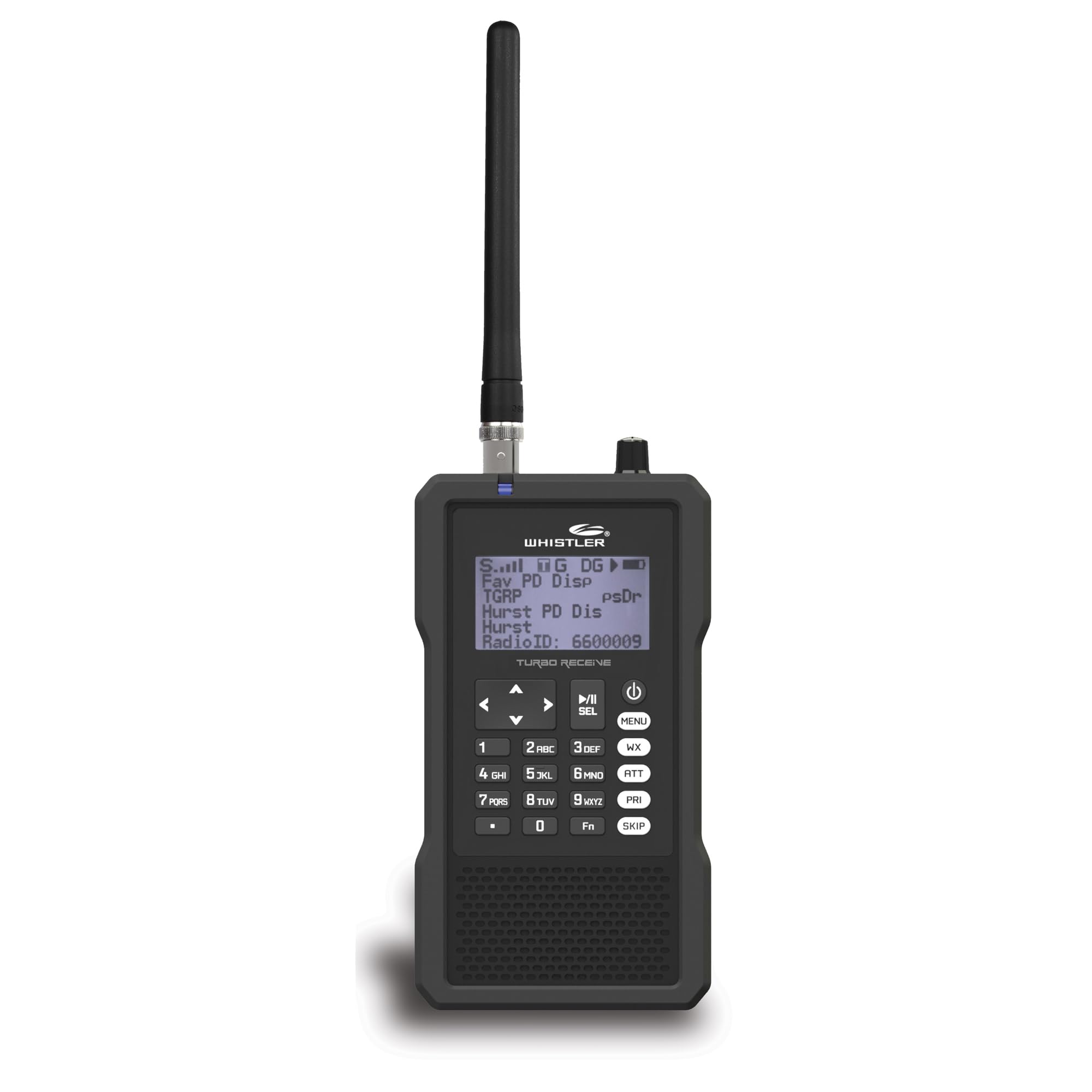
The Whistler TRX-1 is a purpose-built handheld digital scanner that packs serious trunk-tracking and decoding capability into a portable package. It supports APCO P25 Phase I and II, DMR, and NXDN protocols out of the box, meaning it can receive the vast majority of public safety and commercial radio systems currently operating across North America. The object-oriented database management system allows storage of millions of objects limited only by MicroSD card capacity, and the 200 customizable scan lists plus a dedicated Skywarn list give advanced users granular control over what they monitor and when.
Audio recording is a standout feature — the TRX-1 records up to 50 hours of radio traffic to the included 2GB MicroSD card. Playback can happen directly on the device or transferred to a PC for long-term storage and analysis. The tri-color LED alert system is programmable to flash specific colors and patterns, including emergency vehicle strobe emulation, which adds a visual layer to monitoring that most scanners lack. The raw discriminator output allows connection to third-party decoding software without any internal hardware modification, a significant advantage for users who want to experiment with digital decoding beyond the built-in capabilities.
Physical design emphasizes one-handed operation with an intuitive keypad layout and responsive navigation controls. The compact, rugged housing weighs only 7.4 ounces, making it genuinely pocketable for fieldwork. The V-Scanner II system supports up to 200 saved configurations via the PC interface, so you can instantly switch between monitoring setups for different regions or scanning preferences. The USB connection handles file access, firmware upgrades, and data streaming. For users who need a handheld that delivers desktop-grade decoding performance and extensive customization, the TRX-1 is a serious contender.
What works
- Built-in P25 Phase I/II, DMR, and NXDN decoding covers major digital protocols
- 50-hour audio recording with onboard playback and PC transfer
- Programmable tri-color LED alerts enhance situational awareness
- Raw discriminator output enables third-party decoding without hardware mods
What doesn’t
- Battery life is limited during continuous scanning with recording active
- Object-oriented programming can be complex for first-time scanner users
- Speaker audio can be hard to hear in noisy vehicle cabins without an external speaker
3. Uniden R4W
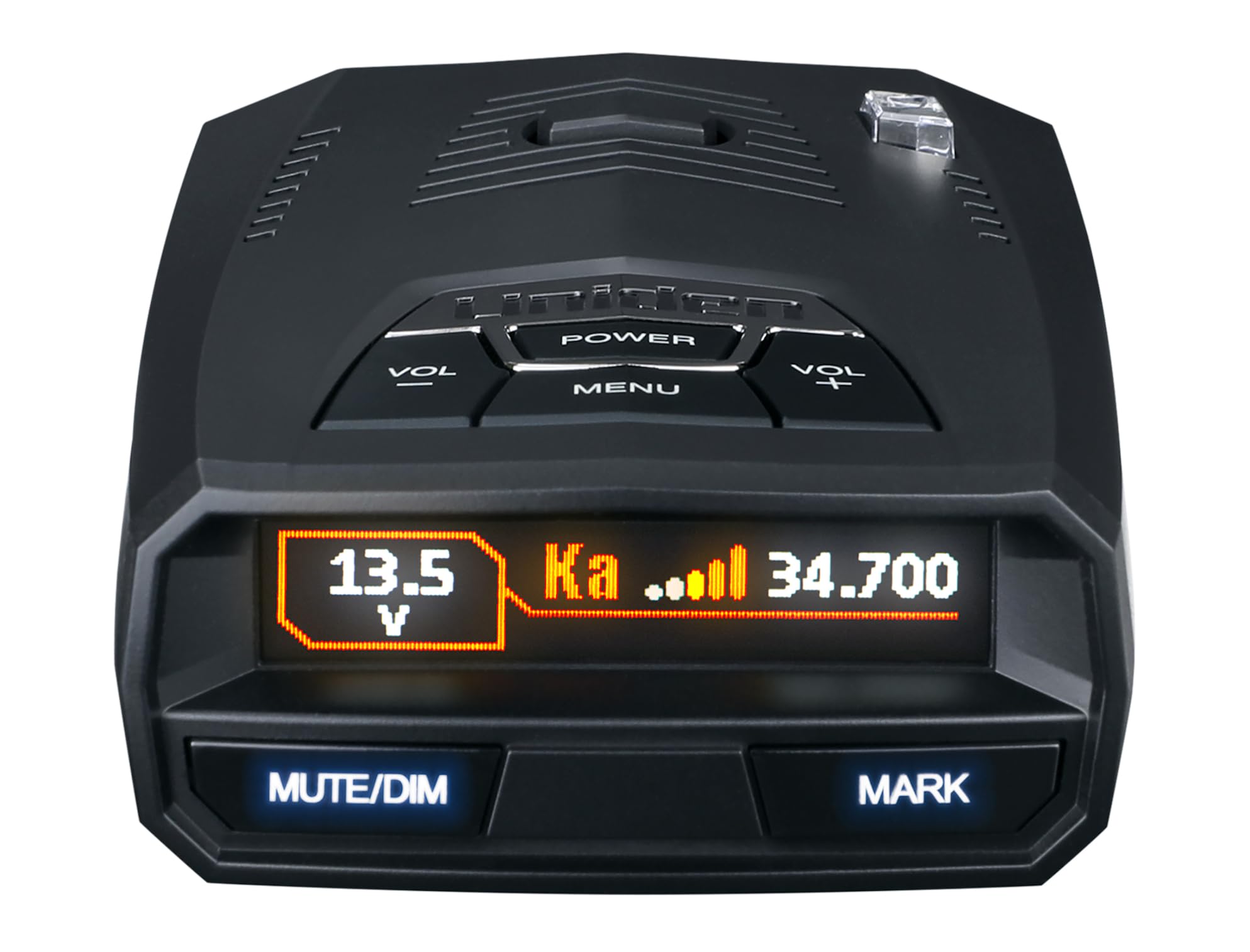
The Uniden R4W builds on the company’s long-running radar detector legacy with a focus on extreme detection range and intelligent false-alert management. The Blackfin Digital Signal Processor provides the computational headroom needed to discriminate between genuine radar threats and the growing number of false sources emitted by modern vehicle safety systems such as blind-spot monitors and collision avoidance radars. K and Ka band filtering has been refined to reduce annoyances without sacrificing sensitivity to legitimate enforcement signals, a balance that many detectors struggle to achieve.
Connectivity is a major step forward. Built-in Wi-Fi and Bluetooth enable seamless integration with the R/TACH companion app, which adds real-time crowd-sourced alert data and simplifies firmware updates. The GPS module with auto mute memory learns your regular routes and automatically suppresses false alerts from fixed sources like retail store door openers — you never hear the same false alert twice on a familiar road. The preloaded speed and red-light camera database adds another layer of protection, and the multi-color OLED display presents frequency, signal strength, and band information clearly at a glance.
Voice alerts are programmable and allow hands-free operation, which is essential for keeping attention on the road. The compact form factor (4.5 x 2.8 x 1.1 inches) mounts discreetly on the windshield or dashboard without obstructing vision. Power is supplied via the included 12-volt DC cord. While the R4W is positioned as a premium radar detector, its combination of extreme range, advanced filtering, and app connectivity makes it a strong value for drivers who cover long distances or travel through areas with varied enforcement tactics.
What works
- Extreme detection range with Blackfin DSP provides exceptional sensitivity
- Advanced K/Ka band filtering reduces false alerts from vehicle safety systems
- Wi-Fi and Bluetooth enable app integration and easy firmware updates
- GPS auto mute memory permanently eliminates known false alert locations
What doesn’t
- Premium pricing positions it above budget and mid-range alternatives
- App-dependent features require a smartphone and consistent connectivity
- Windshield mount may be subject to visibility restrictions in some jurisdictions
4. Uniden BEARTRACKER 885

The Uniden BearTracker 885 is one of the most innovative products in this category because it merges a full 40-channel CB radio with a digital trunk-tracking scanner in a single chassis. This hybrid approach eliminates the need for two separate devices taking up dashboard or center-console space. The scanner side monitors police, fire, ambulance, and DOT radio traffic across US and Canadian frequencies, while the CB side handles the usual 4-watt AM communications on the 27 MHz band. Both operate simultaneously — there is no switching back and forth between modes.
The BearTracker Warning System is the defining feature. Using the built-in GPS receiver and a preloaded nationwide database, the unit automatically alerts you when you are approaching an area with active public safety transmissions. This proximity-based alerting is far more useful than simply scanning all channels all the time — it focuses your attention on relevant traffic based on your actual location. The GPS also enables automatic channel selection as you travel, so the scanner adapts to new regions without manual reprogramming.
The CB side includes a 7-color display, SWR meter for antenna tuning, RF gain and mic gain controls, PA mode, talkback, and NOAA weather alerts with severe weather warnings. The noise-cancelling microphone is designed for high-cab environments like tractor-trailers. The unit measures 8.6 x 15.1 x 3.6 inches and weighs about 5 pounds, so it commands a significant footprint. For professional drivers and serious CB users who also want live public safety monitoring without a second device, the BearTracker 885 solves a problem no other single product addresses.
What works
- Combines full CB radio with digital trunk-tracking scanner in one unit
- BearTracker Warning System uses GPS for location-based public safety alerts
- Simultaneous CB and scanner operation with no mode switching required
- GPS-enabled automatic channel selection adapts to travel routes
What doesn’t
- Large chassis requires significant installation space in the vehicle
- Scanner functionality may feel limited compared to dedicated scanner models
- CB feature set is not as deep as standalone high-end CB radios
5. Uniden Bearcat BCD260DN

The Uniden Bearcat BCD260DN is a base/mobile digital scanner that arrives with DMR and NXDN decoding already enabled — no additional licenses or paid upgrades required. This matters because many agencies and commercial users have migrated to these digital formats, and having them preloaded means the scanner works immediately out of the box on a wider range of channels than units that require separate activation. The BCD260DN covers the bands used for emergency response including SAME weather alerts, aviation, marine, railroad, NASCAR, and non-digital public safety communications, with direct access to over 10,000 pre-programmed frequencies.
The Band Scope feature provides a real-time spectral display that helps you identify active frequencies visually, which is especially useful when searching for unknown traffic or verifying signal occupancy. Rapid System and Channel Number Tagging lets you quickly label and organize discovered channels for future reference. The narrowband reception capability ensures compatibility with the tighter channel spacing used by many modern radio systems, preventing the audio distortion that occurs when a wideband receiver tries to process a narrowband signal.
The DCS/CTCSS rapid decode system instantly detects and displays sub-audible tone settings, which is critical for programming trunked systems or filtering out unwanted traffic on shared frequencies. The USB connection handles firmware updates and programming, and the unit includes a power adapter and owner’s manual. The BCD260DN strikes a practical balance between advanced features and straightforward operation, making it suitable for both experienced scanner users and motivated newcomers who want preloaded digital capability without additional fees or complex setup procedures.
What works
- DMR and NXDN decoding preloaded with no extra purchase or subscription
- Band Scope provides visual spectrum analysis for frequency hunting
- Narrowband reception ensures clean audio on modern channel spacing
- DCS/CTCSS rapid decode instantly identifies sub-audible tones
What doesn’t
- No touchscreen interface — navigation relies on button controls
- Display is functional but not as visually rich as higher-tier models
- Limited to conventional and trunked scanning without APCO P25 Phase II
6. Uniden R3

The Uniden R3 established a reputation for delivering near-flagship radar detection performance at a more accessible price point, and it remains a strong contender in the mid-range segment. The core engineering priority here is range — the R3 uses the same fundamental antenna and receiver architecture that propelled Uniden to the top of independent detector tests, with sensitivity capable of spotting low-power radar emissions well before a visual encounter. The advanced false alert filtering engine works to suppress the constant chirping that plagues lesser detectors in urban environments.
The built-in GPS module with mute memory is the standout convenience feature. As you drive familiar routes, the R3 learns the location of fixed false sources such as automatic door openers and permanently mutes them. Over time, your daily commute becomes virtually silent until a genuine threat appears. The preloaded red-light and speed-camera database adds enforcement awareness, and free database and firmware updates keep the unit current. The multi-color OLED display presents frequency, band, and signal strength information in a clear, easy-to-read format that improves situational awareness without being distracting.
Voice alerts are programmable and support hands-free operation, which is particularly valuable for drivers who want to keep their eyes on the road. The compact housing measures 4.5 x 2.81 x 1.25 inches and mounts cleanly on the windshield. The R3 does not include Wi-Fi or Bluetooth connectivity for app integration, so it lacks the crowd-sourced alert layer found on more expensive models. However, for drivers who want proven long-range detection, reliable GPS false-alert management, and a straightforward user interface without a monthly subscription or app dependency, the R3 delivers exceptional value.
What works
- Extreme long-range sensitivity rivals detectors at twice the price
- GPS mute memory permanently eliminates repeated false alerts
- Preloaded red-light and speed-camera database with free updates
- Multi-color OLED display provides clear at-a-glance information
What doesn’t
- No Wi-Fi or Bluetooth for app-based crowd-sourced alerts
- Windshield mount design may be restricted in some areas
- Firmware update process is functional but slower than wireless methods
7. MUCAR CDE900

The MUCAR CDE900 brings a 4-inch touchscreen and Android-based operating system to the OBD2 diagnostic market at a price point that undercuts most comparable touchscreen scanners. The hardware includes a quad-core processor, 16GB of internal storage expandable via MicroSD up to 256GB, and a 1500mAh battery for cordless operation around the vehicle. The unit runs on Android 6.0 and supports software for 106 vehicle makes, making it one of the most broadly compatible handheld diagnostic tools in its tier.
Full OBD2/EOBD diagnostics cover all standard powertrain codes, and the live data graphing function displays up to 120 data streams simultaneously with four-in-one graph views. The auto-VIN feature identifies the vehicle automatically, and the one-click diagnostic report can be printed or shared. The CDE900 can be upgraded to a four-system diagnostic tool covering ABS, SRS, TCM, and ECM through a paid software extension — that is a one-time fee, not a subscription, and it costs less than buying a dedicated four-system tool from the start. The wireless OTA update capability keeps the software current without needing a PC connection.
The user interface is straightforward for anyone familiar with Android devices, and the touchscreen is responsive for menu navigation and data scrolling. Historical records, report management, and a demo mode for practice are all included. The device supports FCA AutoAuth for Chrysler, Dodge, Jeep, and RAM vehicles, though you need to register your own FCA account. The CDE900 represents a compelling option for DIY mechanics who want modern touch-based diagnostics and broad vehicle coverage without paying for professional-grade equipment they may never fully utilize.
What works
- Large 4-inch touchscreen with Android OS provides intuitive navigation
- Software support for 106 vehicle makes covers a wide range of cars
- Live data graphing with up to 120 parameters enhances diagnostic depth
- Wireless OTA updates and one-time paid upgrade path for multi-system access
What doesn’t
- Android 6.0 is an older operating system with limited app support
- Multi-system diagnostics require a separate paid software extension
- Some units may be customer returns resold without inspection
8. Innova 5210
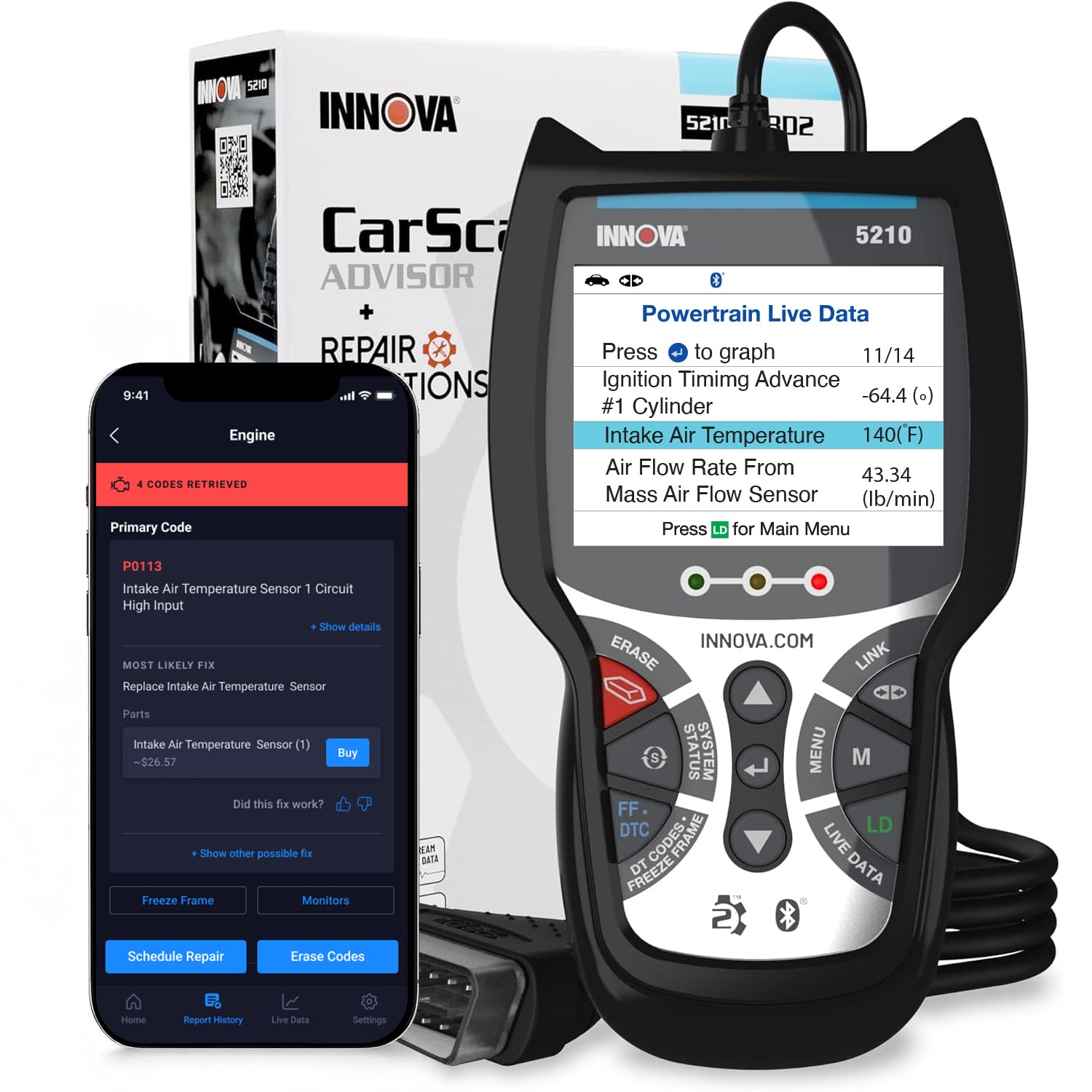
The Innova 5210 stands out in the OBD2 category because it pairs standard code-reading capability with a built-in car battery tester. This dual functionality means a single tool can diagnose a check engine light and simultaneously check alternator output and battery health, which is genuinely useful because many drivability symptoms trace back to charging system problems rather than engine management faults. The battery test helps prevent unexpected breakdowns by identifying weak batteries before they fail, adding a layer of preventative maintenance that most code readers do not address.
On the diagnostic side, the 5210 reads and clears check engine light codes and ABS codes — though ABS coverage varies by vehicle, so Innova provides a coverage checker to verify compatibility before purchase. Live data streaming displays RPM, engine temperature, fuel trims, and oxygen sensor readings in real time. The drive cycle readiness feature helps determine whether a vehicle is likely to pass an emissions test, which is valuable for owners navigating smog check requirements. The oil light reset function lets DIYers clear maintenance reminders after an oil change without a trip to the dealership.
The free RepairSolutions2 app on iOS and Android provides verified fixes based on real-world repairs from ASE-certified mechanics. The app cross-references the trouble code with known repair patterns and suggests parts and labor cost estimates. This connected approach transforms the 5210 from a simple code reader into a guided diagnostic system, and there are no subscription fees or hidden charges. The 2.8-inch screen is adequate for code display and live data, and the attached OBD2 cable with a quick-start guide gets you up and running quickly. For value-conscious owners who want code reading, battery testing, and repair guidance in one device, the 5210 delivers practical versatility.
What works
- Combines OBD2 code reading with battery and alternator testing
- Free RepairSolutions2 app provides verified fixes and cost estimates
- Oil reset and smog check readiness features add maintenance utility
- No subscription fees for the app or diagnostic guidance
What doesn’t
- ABS code coverage varies by make and model, so verification is essential
- Small 2.8-inch screen limits data visibility during live streaming
- Bluetooth connectivity requires the app for full repair guidance features
9. BlueDriver LSB2
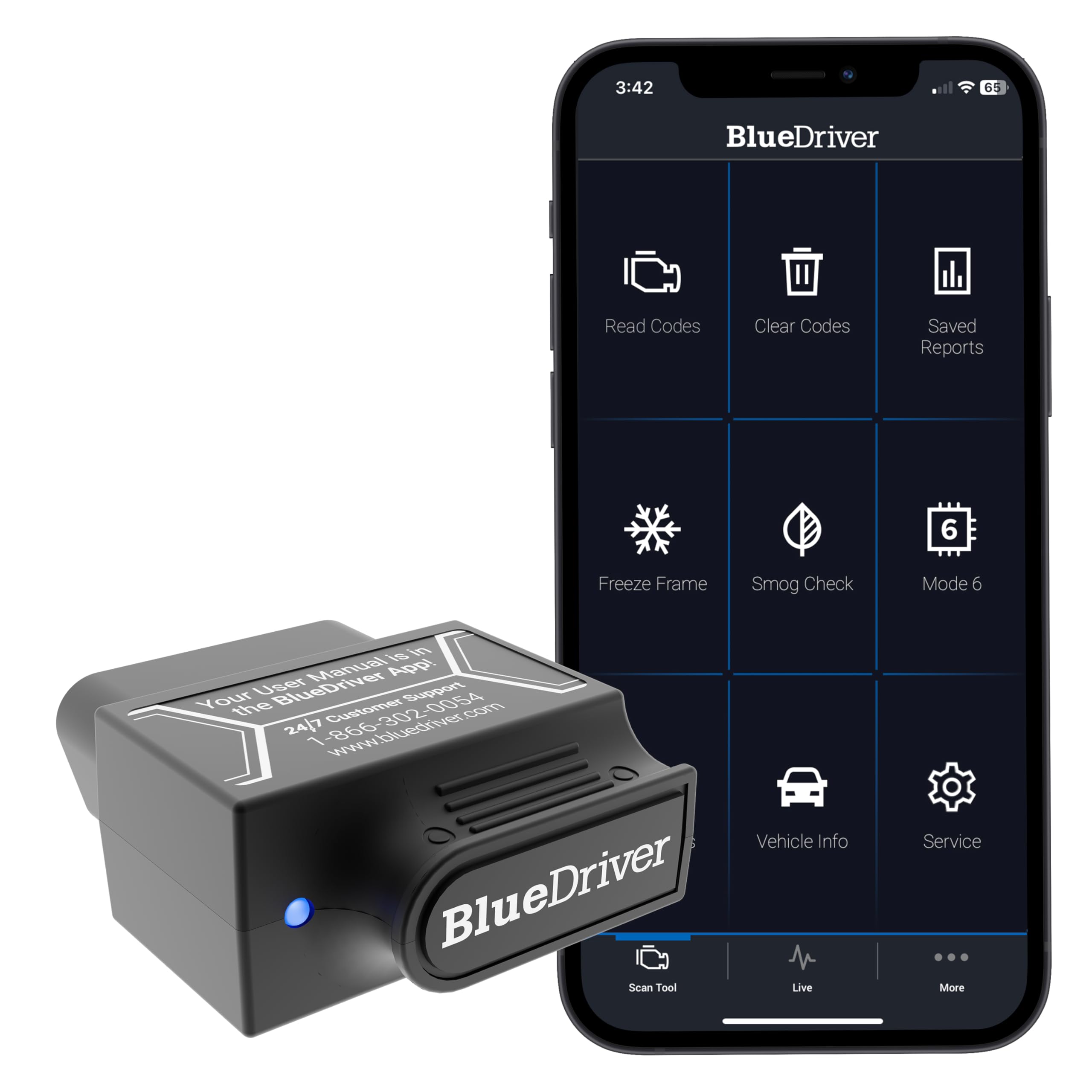
The BlueDriver LSB2 is a Bluetooth-enabled OBD2 scan tool that shifts all display and interaction to your smartphone or tablet via a dedicated app available on both iOS and Android. This approach keeps the physical hardware compact — the dongle measures just 2.2 x 1.9 x 1 inches and weighs 0.13 pounds — while leveraging the processing power and screen quality of your existing mobile device. The app interface is polished and regularly updated, covering over 7,000 trouble codes across vehicles from 1996 and newer.
Unlike many OBD2 adapters that require a paid subscription to access enhanced features, the BlueDriver app includes all core functionality with no recurring fees. You can read and clear codes, view enhanced diagnostics that go beyond basic powertrain codes, and access repair reports that include possible causes, common fixes, and technical service bulletins. The live data feature displays sensor readings in real time, and the emissions readiness monitor helps track smog check status. The app also generates a VIN-specific report that summarizes the vehicle’s overall health.
Build quality is solid for a compact dongle, and the 180-day money-back guarantee plus one-year defect warranty from Lemur Vehicle Monitors provides confidence in the purchase. The main limitation is that the tool is entirely dependent on the app — if your phone battery dies or you do not have your phone with you, the tool is unusable. Additionally, the Bluetooth connection can occasionally drop in environments with heavy wireless interference. For drivers who always carry a smartphone and want a simple, subscription-free diagnostic solution for occasional code reading and monitoring, the BlueDriver is a clean and effective choice.
What works
- Compact Bluetooth dongle leverages smartphone for display and analysis
- No subscription fee for full diagnostic and repair guidance features
- Covers 7,000+ codes with enhanced diagnostics beyond basic powertrain
- 180-day money-back guarantee and one-year warranty provide peace of mind
What doesn’t
- Fully dependent on smartphone — no built-in screen or standalone operation
- Bluetooth connectivity can be unreliable in high-interference environments
- Limited to OBD2 diagnostics without support for manufacturer-specific systems
Hardware & Specs Guide
Digital Decoding Standards (P25, DMR, NXDN)
Modern public safety and commercial radio systems have largely migrated from analog FM to digital modulation. APCO P25 Phase I and II is the standard for North American public safety agencies, while DMR and NXDN are common in commercial, industrial, and some municipal applications. A scanner that lacks the correct digital decoder will produce silence or garbled audio on those channels. The premium units in this guide — the Uniden SDS200 and Whistler TRX-1 — support all three protocols natively. Mid-range options like the BCD260DN include DMR and NXDN but may have limited P25 Phase II support. Always verify which digital formats your local agencies use before purchasing.
Frequency Range and Band Coverage
Radio scanners typically cover 25 MHz to 1.3 GHz, encompassing VHF Lo (30–50 MHz), VHF Hi (150–174 MHz), UHF (450–512 MHz), and 700/800 MHz bands used by trunked public safety systems. Aviation (118–137 MHz), marine (156–174 MHz), and NOAA weather (162.4–162.55 MHz) fall within this spectrum. Radar detectors operate on K band (24.125 GHz), Ka band (34.7 GHz), and X band (10.525 GHz), plus laser (904 nm). OBD2 scanners do not use radio frequencies — they communicate digitally over the CAN bus via the vehicle’s diagnostic port. Understanding which frequency ranges your target signals occupy is the foundation of choosing the right device.
Trunk Tracking and Simulcast Handling
Trunked radio systems use a pool of frequencies shared among many users, with a control channel directing which frequency to use for each transmission. A scanner must follow the control channel data to track conversations — this is called trunk tracking. Simulcast occurs when multiple transmitters broadcast the same signal on the same frequency, creating interference patterns that confuse conventional scanners. The Uniden SDS200 with True I/Q technology is specifically engineered to decode simulcast signals reliably, while the Whistler TRX-1 handles conventional trunk tracking well but may struggle with severe simulcast distortion. For areas with known simulcast systems, the SDS200 is the reference standard.
Display, Battery, and Power Considerations
Base/mobile scanners run on 12-volt DC vehicle power and are designed for continuous use during drives. Handheld units like the Whistler TRX-1 offer portability but have finite battery life — typically 4–8 hours depending on scanning mode and recording usage. OBD2 scanners draw power from the vehicle’s diagnostic port, so battery life is not a factor, but cable length and connector durability matter. Radar detectors plug into the 12-volt accessory socket and draw minimal current. Display technology ranges from basic LCD to full-color touchscreen: the Uniden SDS200’s 3.5-inch color display is the largest in this guide, while the MUCAR CDE900’s 4-inch touchscreen is designed for OBD2 data visualization.
FAQ
What is the difference between a radio scanner and a radar detector?
Do I need a digital scanner or will analog work?
Can an OBD2 scanner fix car problems or just read codes?
Are radar detectors legal everywhere in the United States?
Final Thoughts: The Verdict
For most buyers, the best car radio scanner winner is the Uniden SDS200 because it delivers unmatched digital simulcast decoding performance and the most comprehensive database-driven scanning experience in a base/mobile form factor. If you want true portability and extensive digital protocol support in a handheld package, grab the Whistler TRX-1. And for drivers focused primarily on speed enforcement detection with GPS-based false alert management and strong value, nothing beats the Uniden R3 at its price point. Each of these instruments serves a distinct monitoring philosophy — matching the device to your specific environment and listening priorities is what separates a smart purchase from a regrettable one.

Certification: BSc in Mechanical Engineering
Education: Mechanical engineer
Lives In: 539 W Commerce St, Dallas, TX 75208, USA
Md Amir is an auto mechanic student and writer with over half a decade of experience in the automotive field. He has worked with top automotive brands such as Lexus, Quantum, and also owns two automotive blogs autocarneed.com and taxiwiz.com.