Choosing a generator for your RV means balancing power output, noise levels, fuel efficiency, and portability in a single, often expensive, purchase. The wrong pick can mean a sleepless night in a quiet campground or a dead battery when you need it most, making a deep dive into the specifications and real-world owner feedback essential before swiping a card.
I’m Amir — the founder and writer behind Four Wheel Ask. My work focuses on dissecting product specifications, analyzing build quality data, and aggregating long-term owner feedback to separate marketing claims from genuine performance for the discerning RV community.
After analyzing the data on eleven of the most compelling models currently on the market, the single actionable takeaway is this: the best way to secure your off-grid comfort is to match your rig’s specific amperage draw to a reliable inverter with clean power delivery, which is exactly what this analysis of the best generators for rv aims to clarify.
How To Choose The Best Generators For RV
Selecting the right mobile power source is a balance of physics and logistics. You are matching an engine’s output to the electrical load of an air conditioner, a refrigerator, and various charging devices. The wrong calculation here leads to tripped breakers or a unit that is too loud for the campsite.
Wattage: Surge vs. Running Power
Every motorized appliance, especially an RV air conditioner, requires a high burst of power to start (surge watts) before settling into a lower constant draw (rated watts). Your generator must be rated to handle the surge of your largest appliance, typically a 13,500 BTU AC unit which can require up to 2800 starting watts, while also covering your base load for lights and the refrigerator. Always overshoot the total running wattage by at least 20% for a safe margin.
Inverter vs. Conventional
Conventional generators spin at a fixed speed to produce raw power, which is acceptable for basic tools but can damage sensitive electronics due to voltage fluctuations. Inverter generators, on the other hand, produce clean, stable sine-wave power (less than 3% total harmonic distortion) and can adjust their engine speed based on the load, making them drastically quieter and more fuel-efficient. For modern RVs with laptops and smart TVs, an inverter model is the standard.
Fuel Type and Runtime
Gasoline offers the highest energy density and is widely available, but it degrades over time, requiring careful storage management. Propane burns cleaner, stores indefinitely, and is better for the engine’s longevity, but it provides about 10% less peak power. Dual-fuel models offer the most flexibility, allowing you to switch based on availability and price. Runtime is also critical: a unit that runs for only 4 hours at half load will require a middle-of-the-night refueling trip, whereas a larger tank can cover a full night’s sleep.
Quick Comparison
On smaller screens, swipe sideways to see the full table.
| Model | Category | Best For | Key Spec | Amazon |
|---|---|---|---|---|
| PowerSmart 3600W | Mid-Range Inverter | Best Overall Value | 3200W/3600W, 50.7 lbs | Amazon |
| PowerSmart 3800W | Mid-Range Inverter | Quiet Operation | 3200W/3800W, 59dB | Amazon |
| Aceup Energy 4000W | Dual Fuel Inverter | Fuel Flexibility | 3200W/4000W, Propane Capability | Amazon |
| WEN 56360i | Lightweight Inverter | Camping Portability | 2900W/3600W, 46 lbs | Amazon |
| Champion 4000W | Safety Focused | CO Shield Safety | 3000W/4000W, 48.1 lbs | Amazon |
| WEN DF360iX | Dual Fuel Inverter | Flexible Fuel Choice | 2900W/3600W, CO Watchdog | Amazon |
| Champion Tri-Fuel 5000W | Premium Tri-Fuel | Multi-Fuel Versatility | 4000W/5000W, Electric Start | Amazon |
| Westinghouse 4000W | Premium Inverter | Convenience & Features | 3300W/4000W, Remote Start | Amazon |
| Westinghouse 12500W | Heavy Duty | Whole-RV Backup | 9500W/12500W, Dual Fuel | Amazon |
| Honda EU2200iC | Premium Compact | Reliability & Resale | 1800W/2200W, 47 lbs | Amazon |
| Honda EU3000iS | Premium Power | Extended Overnight Runs | 2800W/3000W, 19.6H Run | Amazon |
In‑Depth Reviews
1. PowerSmart 3600-Watt Portable Inverter Generator

The PowerSmart 3600W lands in the center of the market with a compelling balance of peak output and manageable weight. Its 149cc engine produces 3200 rated watts and 3600 surge watts, a level capable of handling a 15,000 BTU RV air conditioner alongside a refrigerator. The critical detail here is the sub-3% THD clean sine wave power, which ensures safety for modern electronics without the premium price tag of the top-tier brands.
Owner feedback consistently highlights the exceptional ease of use, with multiple buyers noting a first-pull start and quiet operation that defies the unit’s power class. The parallel capability adds significant long-term value, allowing a second unit to be linked later for double the power output. The 1.3-gallon fuel tank provides roughly 4.5 hours of runtime at half load, which is adequate for overnight camping but requires monitoring for longer stretches.
For the RV owner who wants genuine 30A RV readiness without stepping into the luxury tier, this unit represents the most sensible power-per-dollar ratio on the market. It is not the lightest, but the 50.7-pound weight with an integrated handle makes it a one-person task to load and unload from a pickup truck or RV storage bay.
What works
- Strong 3600W surge handles large RV air conditioners.
- Clean inverter power safe for laptops and smartphones.
- Parallel ready for future expansion.
- Excellent first-pull start reliability per owner data.
What doesn’t
- Runtime at half load is limited to under 5 hours.
- Parallel kit is sold separately.
2. PowerSmart 3800W Portable Inverter Generator
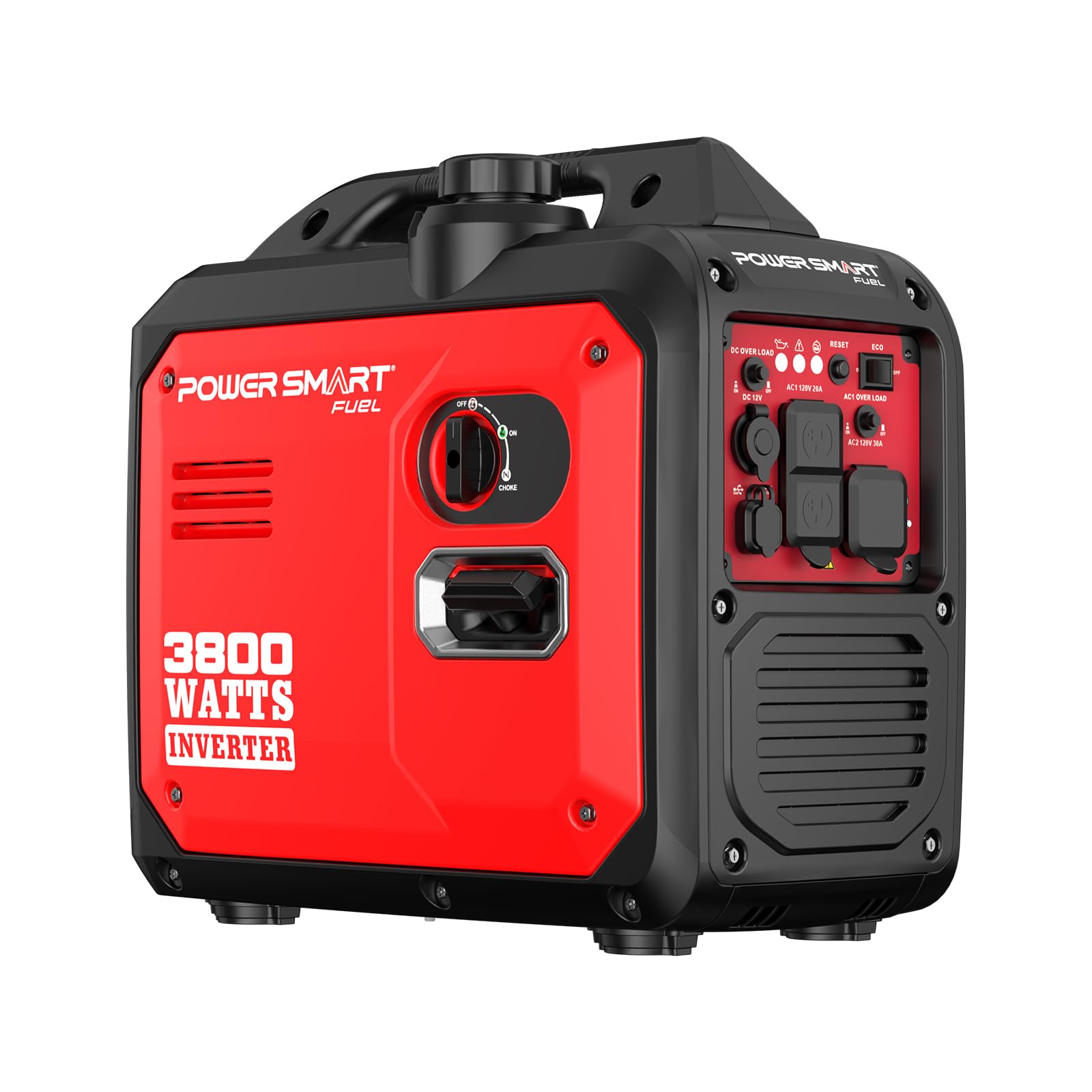
Building on the same platform as its 3600W sibling, this model pushes the surge capacity to 3800 watts while maintaining a 52-pound frame. The primary differentiator is the engineering towards a whisper-quiet 59dB noise profile from 23 feet, making this a strong candidate for campgrounds with strict noise ordinances or for boondockers who value silence over all else.
The 143cc engine and 1.19-gallon fuel tank yield a 4.5-hour runtime at 50% load. The inclusion of an economy mode is a key feature, as it allows the engine to automatically throttle down when power demand is low, significantly extending fuel efficiency on a typical RV trip where the load varies between a fridge and intermittent AC use. The clean sine wave output and parallel capability mirror the value proposition of the 3600W model.
This unit is best suited for the RV owner who prioritizes a peaceful camping experience and has a slightly higher power ceiling for startup surges. The extra 200 surge watts over the 3600W model provides a larger cushion for older AC units that may pull more on startup, reducing the risk of an overload shutdown.
What works
- Industry-leading 59dB quiet operation.
- 3800W surge provides excellent startup headroom.
- Economy mode saves fuel at low loads.
- Lightweight at 52 lbs for the wattage class.
What doesn’t
- Comparatively small fuel tank limits runtime.
- Parallel kit is an additional purchase.
3. Aceup Energy 4000-Watt Dual Fuel Inverter Generator
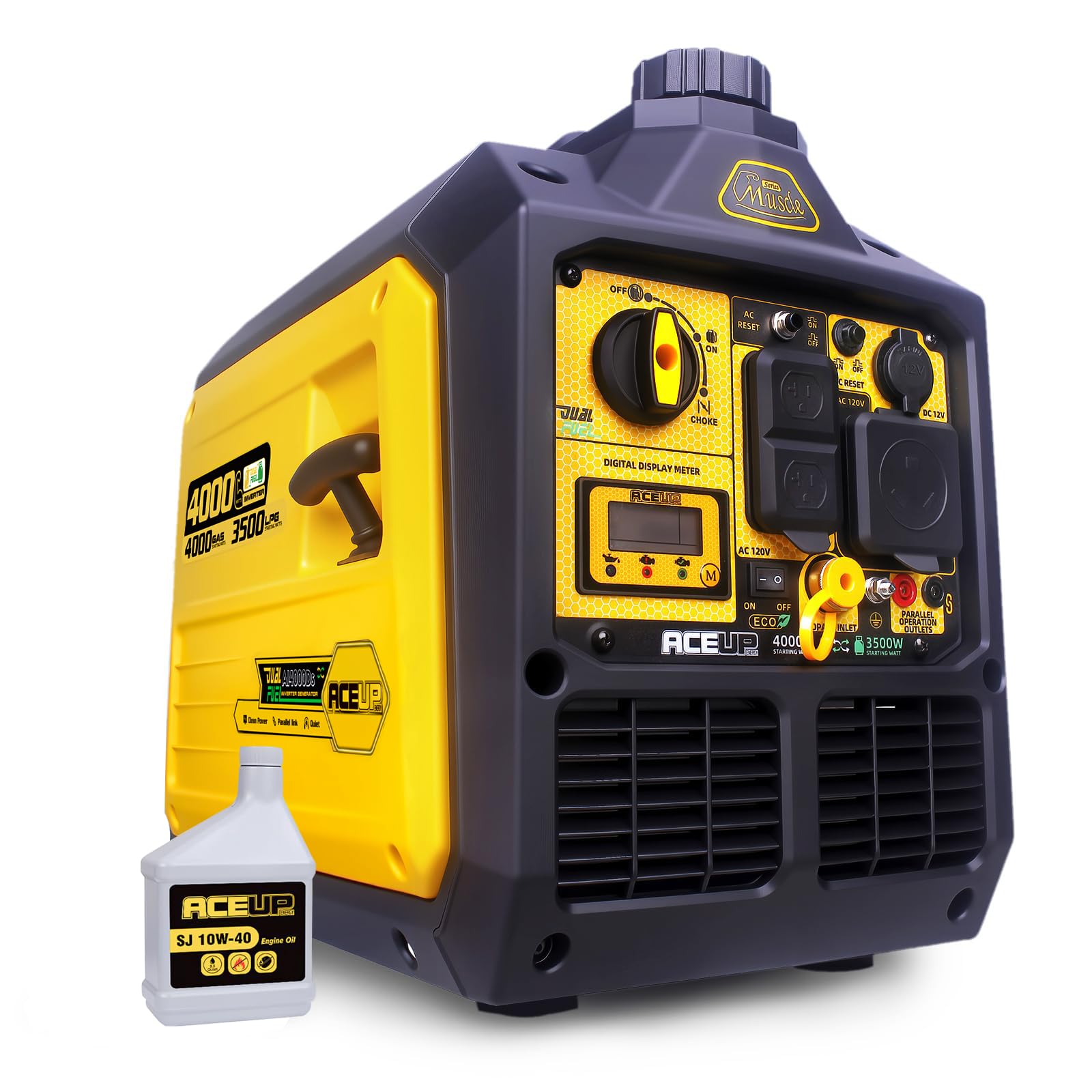
The Aceup Energy 4000W enters the conversation as a strong dual-fuel contender, operating on both gasoline (4000 peak/3200 rated watts) and propane (3500 peak/3000 rated watts). This flexibility is a major advantage for RV owners who want the option of long-term propane storage without fuel degradation, especially for emergency backup at home or during extended boondocking trips.
A standout spec is the built-in intelligent gauge that tracks voltage, runtime, fuel level, and hertz. This eliminates guesswork and allows the user to manage load distribution effectively from a single glance. The unit also features a THD below 1.5%, which is even cleaner than the typical 3% threshold, providing superior protection for high-end electronics. Owner data confirms the propane mode runs smoothly and quietly, with the unit starting reliably after a few pulls.
This generator is an excellent choice for the budget-conscious buyer who does not want to compromise on fuel flexibility or modern convenience features. While the brand is less established than Honda or Westinghouse, the inclusion of a 2-year warranty and positive early owner feedback for propane operation suggest a solid build quality at a very accessible entry point.
What works
- Dual-fuel flexibility with included propane hose.
- Ultra-clean power with sub-1.5% THD.
- Intelligent digital gauge for live monitoring.
- Compact and lightweight for its power output.
What doesn’t
- Lack of long-term consumer reliability data.
- Propane output is lower than gasoline.
4. WEN 3600-Watt Portable Inverter Generator (56360i)

The WEN 56360i stands out for its remarkable portability, weighing in at just 46 pounds — the lightest in the 3600-watt class. This makes it the go-to option for RVers who frequently move their generator or have limited lifting capability. Despite the light weight, it still delivers 2900 rated watts and 3600 surge watts, enough to start a 13,500 BTU AC unit according to multiple owner reports.
The fuel shut-off feature is a practical long-term investment. By allowing the carburetor to run dry before storage, it prevents gumming and stale fuel issues that plague many seasonal generator users. Owners consistently praise its quiet operation, describing it as a “gentle purr,” and its reliable cold-start behavior even in sub-freezing temperatures. The inclusion of a TT-30R RV receptacle is a premium touch for a unit in this weight class.
This model is the definitive choice for the lightweight camper who wants the full feature set of a larger inverter generator without the back strain. The trade-off is a slightly lower rated wattage compared to the 3200W-rated models, so users with a particularly large AC unit should verify compatibility, but for the vast majority of travel trailers, this unit offers an unbeatable weight-to-power ratio.
What works
- Extremely portable at only 46 pounds.
- Fuel shut-off extends engine lifespan.
- Reliable start-up even in cold weather.
- Includes direct TT-30R RV outlet.
What doesn’t
- Rated wattage is lower than some competitors.
- Not enough power for heavy-duty workshop tools.
5. Champion Power Equipment 4000-Watt Inverter Generator

Champion’s entry into the mid-tier inverter market is anchored by its integrated CO Shield carbon monoxide auto-shutoff system. This safety technology is not a gimmick; it is a UL-recognized feature that automatically turns off the generator if dangerous CO levels are detected, providing essential peace of mind for those who camp in enclosed or semi-enclosed areas like RV porches.
At 48.1 pounds, it is one of the lightest 4000-watt inverters available, competing directly with the WEN 56360i for portability. It delivers 3000 running watts and 4000 starting watts, with a notable runtime of up to 10 hours at a 25% load. The parallel capability allows pairing with another Champion unit for up to 8000 starting watts, providing a scalable solution for larger rigs.
The 3-year warranty and free lifetime technical support from Champion provide a safety net that is rare in this price bracket. While the noise rating of 64 dBA is slightly higher than the whisper-quiet PowerSmart units, it remains conversational-level quiet and well within campground regulations. This is the smart buy for the safety-conscious owner who wants a reliable brand without the Honda premium.
What works
- CO Shield auto shut-off for safety.
- Lightweight at 48.1 lbs for 4000W.
- Long 10-hour runtime at low load.
- Excellent 3-year warranty and support.
What doesn’t
- Noise level is average for the class.
- Parallel kit purchased separately.
6. WEN Quiet and Lightweight 3600-Watt Dual Fuel (DF360iX)

The WEN DF360iX takes the popular 3600W platform and adds dual-fuel capability, allowing seamless switching between gasoline (3600 surge/2900 rated) and propane (3500 surge/2600 rated). The inclusion of a tool-free LPG quick-connector makes switching fuels effortless in the field, a major convenience for RVers who carry both fuel types.
A critical safety upgrade over the standard model is the WEN Watchdog CO Shutdown Sensor. This automatic shut-off system adds a crucial layer of protection, particularly for those who run the generator near the RV. The unit maintains the same 49-pound weight as its gasoline-only counterpart, meaning no penalty for the added flexibility. The inclusion of a fuel shut-off also helps preserve engine health during storage.
This is the optimal pick for the RVer who wants the proven reliability of the WEN platform but needs the flexibility of propane for long boondocking trips or emergency home backup. The slight reduction in wattage on propane is a standard trade-off, but the 2600 running watts are still sufficient for powering a 13,500 BTU AC unit and charging electronics simultaneously.
What works
- Dual-fuel with easy tool-free propane connection.
- CO Watchdog sensor for safety.
- Lightweight at 49 pounds with dual fuel.
- Fuel shut-off for long-term storage.
What doesn’t
- Wattage drops on propane fuel.
- Three-year warranty is standard.
7. Champion Power Equipment 5000-Watt Tri Fuel Generator

The Champion 5000W Tri-Fuel generator is a heavy-duty solution for the RV owner who needs to run a 50A rig or wants a single unit for both home backup and mobile power. The ability to run on natural gas, propane, or gasoline right out of the box, with all hoses included, makes it the most versatile fuel system in this analysis. The 224cc engine provides 4000 running watts on gasoline, 3600 on propane, and 3240 on natural gas.
The electric start with a rocker switch and an included battery eliminates the physical strain of pull-starting a large engine. The digital display tracks voltage, frequency, and run time, giving the user precise control over the load. The CO Shield sensor adds the same safety layer found on the smaller Champion unit, ensuring automatic shutdown if CO levels become dangerous.
This unit is ideal for the serious RVer or full-timer who requires substantial power and values fuel flexibility above portability. At 135 pounds, it is not a portable generator in the traditional sense; it is a stationary power plant that should be loaded once and parked. For those with the storage space and need for high power, the tri-fuel capability is a significant long-term advantage.
What works
- Runs on gasoline, propane, and natural gas.
- Electric start with included battery.
- CO Shield safety sensor.
- Digital display for monitoring.
What doesn’t
- Very heavy at 135 pounds.
- Not as quiet as inverter models.
8. Westinghouse 4000 Peak Watt Inverter Generator

The Westinghouse 4000W Inverter Generator (model 4021) is a feature-rich premium unit that competes directly with the Honda and Yamaha class. Its headline feature is the remote electric start with a key fob, allowing the user to start the generator from the comfort of the RV. This is complemented by an auto-choke system that eliminates the manual choke lever, making operation truly push-button simple.
A major differentiator is the telescoping handle, a rare feature on generators that makes rolling it across a campsite or into storage significantly easier than carrying a 61.7-pound unit. The rotating digital display shows fuel level, power output, remaining run time, and voltage. The noise rating of just 52 dBA is exceptionally quiet, rivaled only by Honda in this class, ensuring it will not disrupt a quiet campground.
Priced as a premium entry, it delivers 3300 rated watts and 4000 peak watts with a 1.69-gallon tank providing up to 7 hours of runtime. The 3-year warranty and nationwide service network add confidence. This is the definitive choice for the RVer who wants the most convenient, quiet, and feature-packed inverter generator on the market without moving to the ultra-premium tier.
What works
- Remote key fob and electric start.
- Extremely quiet 52 dBA operation.
- Telescoping handle for easy transport.
- Informative digital display with fuel gauge.
What doesn’t
- Premium price point.
- Heavier than some competitors at 61.7 lbs.
9. Westinghouse 12500 Peak Watt Dual Fuel Generator

The Westinghouse 12500W is a full-size home backup generator that doubles as an extreme RV power source. Its 457cc cast-iron sleeve engine produces 9500 running watts and 12500 peak watts on gasoline, with a reduction to 8500/11200 on propane. This output is sufficient to run a 50A RV with multiple AC units, a washer/dryer, and a well pump simultaneously, making it a true whole-rig solution.
The unit includes a remote start key fob, a transfer switch-ready L14-30R 30A outlet, and a 50A RV-ready 14-50R outlet with rubber covers. The 6.6-gallon fuel tank offers a generous 12-hour runtime at 50% load, allowing for full overnight coverage. The dual-fuel capability with included propane hose provides a clean-burning alternative for extended use.
This generator is not for the casual weekend camper. At 212 pounds, it requires a dedicated spot in a truck bed or a trailer. But for the full-time RVer or those living in disaster-prone areas who need a single generator to power their entire property and RV, the Westinghouse 12500W delivers unmatched capacity and fuel flexibility.
What works
- Massive 12500W surge handles a 50A rig.
- Dual-fuel with included propane hose.
- Remote start for convenience.
- 12-hour runtime on a single tank.
What doesn’t
- Extremely heavy and not portable.
- Higher noise output than inverters.
10. Honda EU2200iC 2200-Watt Companion Inverter Generator

The Honda EU2200iC is widely considered the gold standard in portable inverter generators, and for good reason. Its legendary reliability is the primary asset: owner reports consistently describe units that start on the second pull even after sitting unused for six months. The 208cc Honda engine, known for its fuel efficiency, provides 1800 rated watts and 2200 surge watts with an impressively quiet operation.
A key upgrade for RV use is the built-in 30A outlet, which allows two EU2200i Companion units to be connected with a simple parallel cord (not a full parallel kit) to deliver 4400 surge watts and 3600 rated watts. This modular approach allows the owner to carry a single 47-pound unit for basic needs and only bring the second for AC usage, optimizing weight and flexibility. The fuel shut-off valve prevents carburetor issues during storage.
The EU2200iC is the premium choice for the RVer who prioritizes absolute reliability, long-term resale value, and whisper-quiet operation above all else. The power output is limited compared to the 3600W units, making it best for smaller trailers or as part of a dual-unit setup. The investment here is in a machine that will likely last a decade or more with minimal maintenance.
What works
- Unmatched Honda reliability and fuel efficiency.
- Extremely quiet operation.
- Lightweight at 47 lbs.
- Parallel capability with simple cord.
What doesn’t
- Premium price point is a significant investment.
- Limited to 2200W on its own.
- Lacks electric start or remote.
11. Honda EU3000iS 3000 Watt Inverter Generator
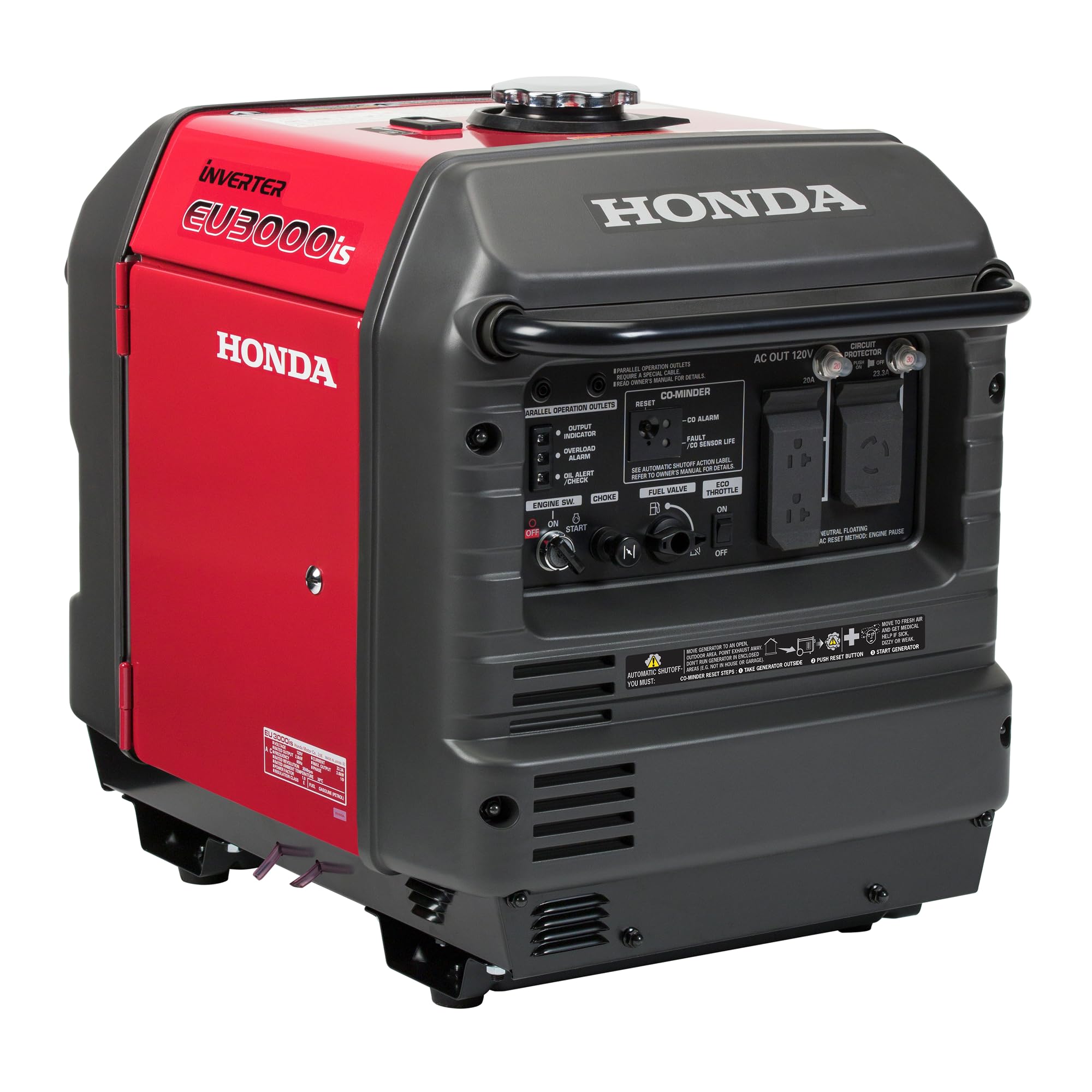
The Honda EU3000iS fills the gap between the popular 2200W and larger home backup units. Its 3000 surge watts and 2800 rated watts are sufficient to start a 13,500 BTU RV air conditioner on a single unit without needing a parallel setup. The 418cc engine is renowned for its smooth, quiet operation, with a 50 to 57 dBA noise profile and an Eco Throttle system that delivers exceptional fuel economy.
The standout feature is the runtime: the 3.4-gallon fuel tank provides up to 19.6 hours of continuous operation at 25% load. This is a critical advantage for overnight use, as it eliminates the need for a 3 AM refueling trip. The electric start and CO-MINDER carbon monoxide detection system add convenience and safety. The simple, proven design means fewer things to break over the long term.
This generator is the ultimate solution for the RVer who wants a single, powerful, and reliable unit that can handle a full night of AC operation without interruption. The lack of wheels is a common complaint given the 144-pound weight, but the performance and efficiency are unmatched in this power class. It is the long-term partner for serious off-grid adventurers.
What works
- Up to 19.6 hours of runtime.
- Quiet 50-57 dBA operation.
- CO-MINDER safety system.
- Proven Honda reliability and efficiency.
What doesn’t
- Very heavy at 144 lbs without wheels.
- Premium price is a major investment.
Hardware & Specs Guide
Inverter Technology
Inverter generators produce clean power by converting AC to DC and back to a stable AC sine wave. This process allows the engine to throttle up and down based on the load, resulting in quieter operation, better fuel economy, and power safe for sensitive devices like laptops and medical equipment. Non-inverter (conventional) generators spin at a constant 3600 RPM for 60Hz power, which is louder and less efficient but often cheaper per watt.
Total Harmonic Distortion
THD measures the purity of the electrical waveform. Clean power is generally considered to be less than 5% THD, with inverter generators typically delivering below 3%. Higher THD can cause overheating in motors, erratic behavior in digital clocks, and damage to sensitive electronics. For modern RVs with inverter refrigerators and smart appliances, a sub-3% THD rating is strongly recommended.
Surge vs. Rated Watts
The single most misunderstood spec. Surge (starting) watts are the momentary burst of power required to start an electric motor, usually lasting less than a second. Rated (running) watts are the continuous power the generator can supply. An air conditioner can have a surge requirement double its running load. Always compare the generator’s surge wattage to the ‘locked rotor amps’ (LRA) of your AC unit, not just the running amperage.
Parallel Capability
A feature that allows two compatible inverter generators to be connected via a parallel kit or cord, doubling the available power output. This is a strategic advantage for RVers who might start with a single smaller unit and later add a second for increased capacity. It provides modularity, allowing you to carry only one unit for light trips and both for full AC usage.
FAQ
Can a generator power my RV air conditioner?
How do I maintain my generator for long life?
Final Thoughts: The Verdict
For most buyers, the best generators for rv winner is the PowerSmart 3600W because it delivers the best overall balance of power, weight, and clean inverter output for a very reasonable entry point. If you want the quietest and most convenient operation without stepping into the ultra-premium tier, grab the Westinghouse 4000W for its remote start and telescoping handle. And for the ultimate in reliability and fuel efficiency for smaller rigs, nothing beats the Honda EU2200iC, especially when paired with a second unit for extra power.

Certification: BSc in Mechanical Engineering
Education: Mechanical engineer
Lives In: 539 W Commerce St, Dallas, TX 75208, USA
Md Amir is an auto mechanic student and writer with over half a decade of experience in the automotive field. He has worked with top automotive brands such as Lexus, Quantum, and also owns two automotive blogs autocarneed.com and taxiwiz.com.