A factory service manual is the single most authoritative document for any repair—it contains the exact torque values, diagnostic procedures, and assembly sequences that rolled off the engineering floor. Without it, every bolt you turn becomes a guess, and every electrical fault becomes a scavenger hunt through vague aftermarket diagrams.
I’m Amir — the founder and writer behind Four Wheel Ask. I’ve spent years analyzing repair manual specifications and studying owner feedback across dozens of automotive platforms, separating factory-original documentation from generic aftermarket alternatives.
Whether you are restoring a vintage classic or maintaining a daily driver, picking the best auto factory service manuals ensures factory-spec accuracy for every critical repair.
How To Choose The Best Auto Factory Service Manuals
Factory service manuals vary widely in scope, binding quality, and diagram fidelity. Understanding the key differentiators helps you avoid buying a reprint that blurs critical torque tables or omits wiring schematics.
OEM Factory vs Aftermarket Coverage
An OEM factory manual is the same document dealership technicians use—it is written by the manufacturer and covers every system in surgical detail. Aftermarket manuals such as Haynes and Chilton condense multiple model years into a single volume, which saves shelf space but often truncates diagnostic flow charts and omits specialty tool callouts. For deep engine or transmission work, the factory original is irreplaceable.
Model-Specific Fitment and Year Range
One manual does not fit all. A 2007 Nissan Versa manual will not include the 2019 CVT updates even if the body shell looks identical. Always verify that the ISBN or part number matches your exact model year, engine code, and trim level. Multi-model manuals like the Chilton Ford Ranger / Mazda B-series are convenient but require cross-referencing VIN-specific notes.
Print Binding, Page Count, and Legibility
A manual with fewer than 300 pages almost certainly omits deep diagnostic procedures. Factory manuals routinely exceed 700 pages and include fold-out wiring diagrams. Spiral or perfect binding matters less than paper weight—thin, glossy pages resist grease and tearing far better than newsprint stock. Always inspect sample images for diagram clarity before committing.
Quick Comparison
On smaller screens, swipe sideways to see the full table.
| Model | Category | Best For | Key Spec | Amazon |
|---|---|---|---|---|
| VW Beetle / Karmann Ghia Official Service Manual | OEM Factory | Vintage VW Enthusiasts | 466 pages, 1970–1977 coverage | Amazon |
| VW Vanagon Repair Manual 1980–1991 | OEM Factory | Vanagon Restorers | 1388 pages, 12-year coverage | Amazon |
| Porsche 911 Carrera Service Manual 1984–1989 | OEM Factory | 911 Carrera Owners | 768 pages, G-body chassis | Amazon |
| SAAB 900 16 Valve Official Service Manual | OEM Factory | SAAB 900 Owners | 634 pages, 1985–1993 | Amazon |
| 1957 Chevrolet Passenger Car Factory Service Manual | OEM Factory | Classic Chevy Restorers | 731 pages, Bel Air / Nomad / 150 / 210 | Amazon |
| Nissan Versa Haynes Repair Manual 2007–2019 | Aftermarket | Versa DIY Maintenance | 272 pages, all models | Amazon |
| Chilton Ford Ranger / Mazda B-series 2000–2011 | Aftermarket | Ranger & B-series Owners | 400 pages, 1st edition | Amazon |
In‑Depth Reviews
1. Volkswagen Super Beetle, Beetle & Karmann Ghia Official Service Manual
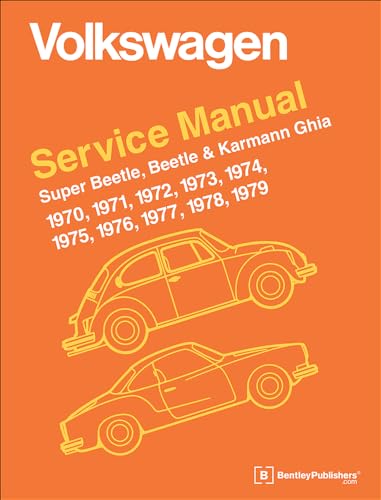
This Bentley-published factory manual covers the air-cooled VW range from 1970 through 1977, including the Super Beetle, standard Beetle, and Karmann Ghia. At 466 pages, it delivers the same diagnostic and repair procedures that dealership technicians used when these cars were new—complete with torque specifications, valve adjustment sequences, and wiring diagrams that aftermarket guides routinely skip.
The binding lies reasonably flat on a bench, and the paper stock holds up to repeated thumbing better than the thinner pages found in Haynes or Chilton volumes. Owners report that the fuel system and brake overhaul sections are particularly thorough, with exploded-view illustrations that make parts identification straightforward. The manual also includes the later Super Beetle front suspension details, which differ from the standard Beetle setup.
One limitation is that it does not cover convertible or automatic models in the same depth as the hardtop manual-transmission variants. But for the vast majority of air-cooled VW owners, this single volume replaces half a shelf of aftermarket paperbacks with a single authoritative source that needs no cross-referencing.
What works
- True OEM factory content with complete torque and wiring data
- Detailed exploded-view diagrams for engine and brake systems
- Includes Super Beetle front suspension specifics
What doesn’t
- Convertible and automatic variants get less coverage
- Page count is moderate compared to multi-volume factory sets
2. Volkswagen Vanagon Repair Manual 1980–1991
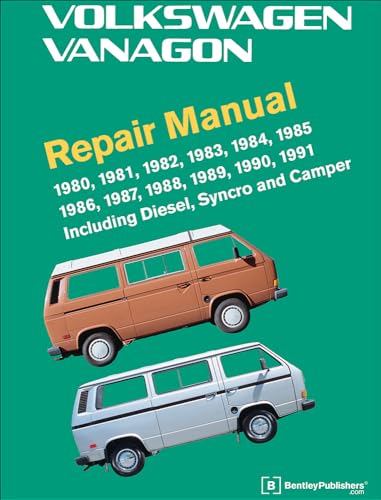
At seven pounds and nearly 1400 pages, this Bentley manual is the definitive reference for the Vanagon line from air-cooled through Wasserboxer. It reproduces the factory workshop manual in its entirety, covering every system from the complex fuel injection variations to the rear suspension and HVAC setups that changed across the model run. No aftermarket guide comes within a thousand pages of this depth.
The manual is organized by system rather than model year, which means you can trace a wiring fault from the fuse box to the tail lights without flipping between chapters. Owners of Westfalia camper conversions particularly value the interior trim and electrical accessory sections that are omitted from shorter manuals. The paper is heavy-gauge and the spiral-like binding stays open at a selected page—critical when you have both hands in the engine bay.
Because it covers twelve model years in one binding, some late-model-specific notes require careful reading of the inline update paragraphs. The sheer size also makes it impractical to carry in the vehicle for roadside reference. For a full Vanagon restoration or major engine-out service, however, this is the only manual that will answer every question before you turn the first bolt.
What works
- Encyclopedic coverage of all Vanagon variants and systems
- Factory-correct wiring diagrams and diagnostic sequences
- Stays open on the workbench without constant re-weighting
What doesn’t
- Late-model updates require careful inline cross-referencing
- Too large and heavy to carry in the glove box
3. Porsche 911 Carrera Service Manual 1984–1989

Bentley’s Porsche 911 Carrera manual targets the G-body chassis era from 1984 through 1989, covering coupe, targa, and cabriolet body styles. At 768 pages, it delivers the factory-level detail required for the 3.2-liter engine, the 915 and G50 transmissions, and the Bosch Motronic fuel injection system that defined this generation. Wiring schematics are reproduced at full size, which makes diagnosing intermittent electrical faults far more practical than with compressed aftermarket diagrams.
The suspension and brake sections include factory alignment specs and ABS service procedures that are often missing from third-party manuals. Owners report that the engine rebuild chapter is the reference standard for the Carrera 3.2, with clear piston ring end-gap placement and cam timing instructions. The manual is printed on thick, matte paper that resists oil smudges and page tears during heavy shop use.
Coverage is limited to the 3.2 Carrera models only—Turbo, 944, and 928 owners will need separate volumes. The binding is sturdy but the weight makes one-handed use awkward. For any serious 911 Carrera restoration or performance build, this manual saves far more in avoided mistakes than it costs on the shelf.
What works
- Comprehensive Motronic injection and G50 gearbox coverage
- Full-size wiring diagrams for electrical system diagnosis
- Oil-resistant paper stock suitable for workshop environment
What doesn’t
- Does not cover Turbo or non-3.2 variants
- Heavy binding makes one-handed reading difficult
4. SAAB 900 16 Valve Official Service Manual 1985–1993
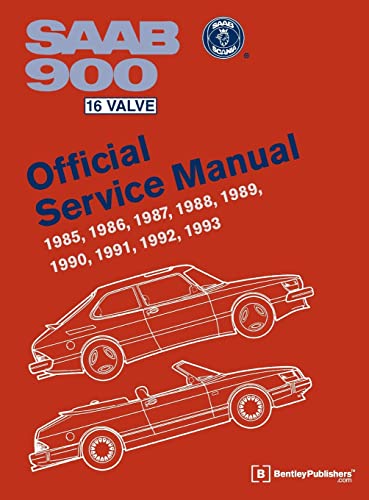
SAAB 900 ownership has always required a certain tolerance for Swedish engineering quirks, and this Bentley manual decodes every one of them for the 16-valve models produced between 1985 and 1993. The 634-page volume covers the B201 and B202 engines, the unique SAAB direct-ignition system, and the front-strut suspension geometry that differs substantially from conventional MacPherson designs. Wiring diagrams are model-specific, not generic approximations.
The diagnostic flow charts for the APC turbo and the LH-Jetronic fuel injection systems are replicated directly from the factory source, which means you can trace a boost leak or a cold-start fault without guessing which sensor feeds which signal. Owners rebuilding the 16-valve head appreciate the detailed valve clearance tables and the camshaft timing marks that are often omitted from aftermarket guides. The clutch and transmission removal sections include the specialty tool cross-references needed for the job.
Coverage is limited to the 16-valve 900—the earlier 8-valve models and the 9000 series require their own manuals. The binding is durable but the page count means it does not lie completely flat without a weight on the spine. For any serious SAAB 900 restoration or turbo system overhaul, this is the single most valuable reference you can own.
What works
- Complete APC turbo and LH-Jetronic diagnostic procedures
- Factory-derived valve clearance and cam timing data
- Includes specialty tool callouts for major repairs
What doesn’t
- Does not cover 8-valve or 9000 series models
- Binding does not stay fully flat without weight
5. 1957 Chevrolet Passenger Car Factory Repair Shop & Service Manual
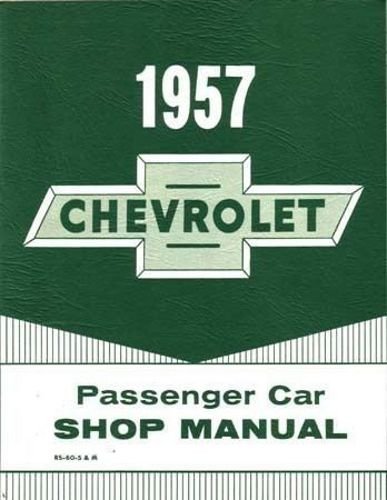
This is a direct reproduction of the original 1957 Chevrolet factory shop manual, covering the 150, 210, Bel Air, Nomad, and station wagon models in a single 731-page volume. It contains every procedure the dealership technicians used for the Blue Flame six-cylinder and the small-block V8 engines, the Powerglide and three-speed manual transmissions, and the torque-tube rear axle that defined this iconic generation. No aftermarket guide condenses this era with the same fidelity.
The manual is organized by engine, chassis, and body systems with the period-correct exploded-view illustrations that restorers rely on for correct assembly order. Specifications for bearing clearances, valve adjustments, and carburetor tuning are presented in the original format, which matters when you are aiming for a factory-correct rebuild. The four-pound weight and 11-inch height mean it commands bench space, but the information density is unmatched for Tri-Five Chevrolet work.
Because this is a reproduction of a 1957 document, the image quality depends on the scan source—some illustrations show minor age-related contrast loss. Reproduction manuals also lack the scent and feel of original dealer-issue paper. For the content alone, however, this volume delivers a full factory service library at a fraction of the cost of collecting original dealer bulletins.
What works
- Complete factory procedures for all 1957 Chevy passenger models
- Original exploded-view diagrams for correct assembly
- All torque and clearance specs in factory format
What doesn’t
- Some scanned illustrations show contrast age
- Does not include later-model updates or TSB revisions
6. Nissan Versa 2007 thru 2019 Haynes Repair Manual
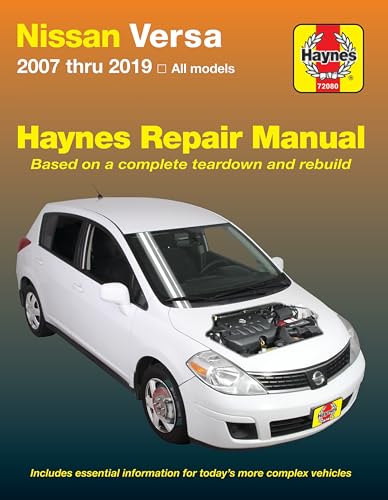
Haynes manuals are the most accessible entry point for DIY maintenance, and this Versa edition covers every model from 2007 through 2019 in a single 272-page binding. It condenses the essential procedures—oil changes, brake jobs, belt replacements, and basic electrical troubleshooting—into a format that a first-time owner can follow without dealership experience. The step-by-step photographs are far more approachable than the dense technical text of a factory manual.
The manual covers both the 1.6L and 1.8L gasoline engines used across the Versa lineup, with separate sections for the manual and CVT transmissions. Owners report that the interior trim removal guides and the headlight replacement procedures are particularly accurate and save time compared to trial-and-error prying. The wiring diagrams are simplified but cover the major circuits that a home mechanic is likely to encounter.
The 272-page count means that deeper diagnostics—such as CVT hydraulic pressure tests or body control module fault tracing—are not included. Owners performing engine swaps or full suspension overhauls will outgrow this manual quickly. For routine maintenance and common repairs on a daily-driver Versa, however, it provides the most cost-effective guidance available.
What works
- Clear step-by-step photos for common repair procedures
- Covers twelve model years in a single affordable volume
- Includes simplified wiring diagrams for basic electrical work
What doesn’t
- Too brief for deep diagnostic or transmission overhaul work
- CVT-specific procedures are minimal
7. Chilton Total Car Care Ford Ranger Pick-ups 2000–2011 & Mazda B-series 2000–2009
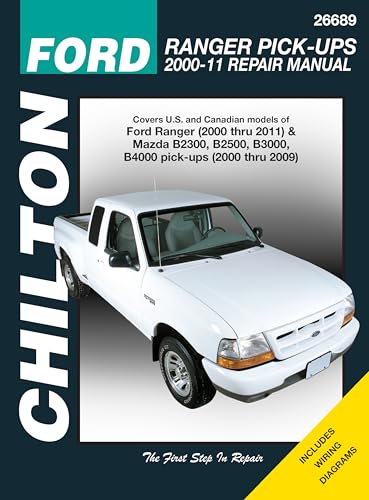
Chilton’s Total Car Care series occupies the middle ground between the brevity of Haynes and the depth of a factory manual. This Ranger and B-series edition packs 400 pages of procedures into a single volume that covers both the Ford Ranger and the mechanically identical Mazda B-series from the early 2000s through 2011. The manual includes the 2.3L, 3.0L, and 4.0L engine families, plus the five-speed automatic and manual transmissions used in these trucks.
The brake and suspension sections include torque tables and alignment specs that allow a home mechanic to perform a complete front-end rebuild without guessing fastener tightness. The wiring diagrams are more detailed than the typical Haynes offering and include pin-out references for the engine control module. Owners report that the 4.0L timing chain and the 3.0L head gasket procedures are covered with enough clarity to complete those jobs without supplemental research.
The Chilton format uses a system-based organization rather than a tear-down sequence, which can require page-flipping between sections during complex repairs. The page count, while higher than Haynes, still omits the full transmission overhaul and body electronics diagnostics found in factory manuals. For the Ranger owner who wants more than an oil-change guide but does not need dealer-level depth, this volume hits the practical sweet spot.
What works
- Covers both Ford Ranger and Mazda B-series in one manual
- Includes engine management pin-out and wiring data
- Torque and alignment specs for complete front-end work
What doesn’t
- System-based layout requires page-flipping between sections
- Does not include full transmission overhaul procedures
Hardware & Specs Guide
Page Count & Depth
Factory OEM manuals average 600–1400 pages and contain every diagnostic tree, torque spec, and wiring schematic the manufacturer produced. Aftermarket manuals typically range from 250–450 pages and summarize common procedures. Always cross-reference the page count against the complexity of the repair you plan to undertake—a transmission overhaul requires the depth of a factory manual, while a simple belt replacement does not.
Binding & Paper Quality
OEM and premium aftermarket manuals use heavier paper stock (measured in gsm) that resists tearing and oil absorption. Spiral- or lay-flat bindings allow the book to stay open at a selected page, which is critical when both hands are occupied. Perfect-bound manuals require a heavy weight to keep flat and are more prone to spine cracking over time.
Year & Model Coverage
A manual that spans more than five model years inevitably generalizes some specifications. Factory manuals often include inline update bulletins for late-model changes, while aftermarket volumes may list a single specification for the entire production run. Verify that the manual’s coverage includes your exact engine code and transmission type before purchasing.
Diagram Clarity
The resolution and labeling of wiring diagrams and exploded-view illustrations vary significantly between reproduction and original printings. Factory-original and licensed Bentley reprints maintain crisp, legible diagrams. Some budget reprints of older factory manuals suffer from scan artifacts that obscure critical callouts and connector pin numbers.
FAQ
What is the difference between a factory service manual and an aftermarket manual?
Can I use a manual from a different model year for my car?
Are reprinted factory manuals as good as the original dealer versions?
How many pages should a factory service manual have to be considered complete?
Final Thoughts: The Verdict
For most buyers, the best auto factory service manuals winner is the Volkswagen Super Beetle, Beetle & Karmann Ghia Official Service Manual because it delivers genuine OEM depth at a realistic investment for the vintage VW owner. If you need encyclopedic coverage of a multi-year platform, grab the VW Vanagon Repair Manual for its unmatched 1388-page detail. And for routine maintenance on a modern daily driver without breaking the bank, nothing beats the value of the Nissan Versa Haynes Repair Manual.

Certification: BSc in Mechanical Engineering
Education: Mechanical engineer
Lives In: 539 W Commerce St, Dallas, TX 75208, USA
Md Amir is an auto mechanic student and writer with over half a decade of experience in the automotive field. He has worked with top automotive brands such as Lexus, Quantum, and also owns two automotive blogs autocarneed.com and taxiwiz.com.