MX gloves are the single most overlooked piece of safety gear in motocross. Riders spend heavily on helmets and boots, then grab whatever cheap glove is nearest the register. That gap in judgment shows up in every crash report — shredded palms, jammed fingers, and knuckles ground down to bone. A well-engineered glove does more than cushion your grip; it dictates how much control you retain when the bike bucks, the roost flies, and your hands take the first hit.
I’m Amir — the founder and writer behind Four Wheel Ask. My work focuses on combing through technical specifications, evaluating material claims against real owner feedback, and identifying which products actually hold up under the conditions riders face.
After analyzing dozens of options across material quality, protection features, and real-world durability data, these are the best mx gloves for every type of rider from weekend warriors to pros.
How To Choose The Best MX Gloves
Selecting the right MX glove comes down to understanding where protection, feel, and durability intersect. A glove that prioritizes one at the expense of the other two will leave you frustrated on the trail or vulnerable in a crash. Below are the key decision points every rider should evaluate before buying.
Knuckle Protection — Hard Shell vs. Soft Padding
Hard-shell knuckle guards, typically made from TPR, PVC, or carbon fiber, deflect direct impacts from branches, rocks, and handlebar slap. Soft padding, usually EVA foam or gel, absorbs vibration and minor bumps but offers little protection against sharp or forceful strikes. For aggressive trail riding and motocross, hard shell is the standard. For casual cruising or pit riding, soft padding may be sufficient.
Palm Material — Leather vs. Synthetic
Leather palms, especially goatskin or cowhide, provide superior abrasion resistance and mold to your hand over time for a custom fit. Synthetic palms, often Clarino or microfiber, are lighter, dry faster, and usually include touchscreen compatibility out of the box. The trade-off is durability — synthetics wear through faster on rough grips and during crash slides. Riders who train frequently or race should lean toward leather or reinforced synthetic blends.
Closure and Cuff Design
A secure closure keeps the glove from shifting during aggressive riding. Hook-and-loop straps are the most common and reliable, but the width and placement of the strap matter. A compression-molded neoprene cuff with a wide closure panel distributes pressure evenly and keeps dirt out. Pull-on styles with no closure save weight but sacrifice fit security, especially after the elastic degrades.
Quick Comparison
On smaller screens, swipe sideways to see the full table.
| Model | Category | Best For | Key Spec | Amazon |
|---|---|---|---|---|
| Fox Racing Dirtpaw | Motocross | Trail & Track Riding | TPR Knuckle Guards & Touchscreen | Amazon |
| Alpinestars SMX-2 Air Carbon V2 | Premium Sport | High-Speed Performance | Carbon Knuckle & Full-Grain Leather | Amazon |
| ILM Goatskin Leather DN01 | All-Season | All-Weather Riding | Goatskin Leather & Hard Shell Knuckle | Amazon |
| Saints of Speed Knuckle1 | Street / Dirt | Warm Weather Riding | Leather Palms & Touchscreen | Amazon |
| RaceQuip RQP 350 | Racing | Track Day Use | Nomex Knit Construction | Amazon |
| Milwaukee Leather MG7570 | Cruiser | Cold Weather Riding | Gel Palm & Reflective Design | Amazon |
| INBIKE MTB Gloves | Multi-Sport | Budget Trail Riding | EVA Padded & TPR Protection | Amazon |
In‑Depth Reviews
1. Fox Racing Dirtpaw Motocross Dirt Bike Glove

The Fox Racing Dirtpaw has been a mainstay in motocross for years because Fox actually iterates on the design instead of coasting on brand name. The current version uses a direct-inject TPR knuckle guard that shields against branches and debris without creating a stiff shell that restricts hand movement. That balance between protection and mobility is harder to engineer than most riders realize — cheap gloves either use a flimsy foam pad that does nothing or a rigid plastic cap that catches on everything.
The palm is a padded single-layer conductive Clarino, which means you get touchscreen response without a bulky capacitive patch that wears off after three washes. Fox also added stretch mesh finger gussets that improve airflow and dexterity, plus silicone fingertip prints that give you reliable lever grip in wet or muddy conditions. The compression-molded neoprene cuff with hook-and-loop closure locks the glove in place without cutting off circulation.
Owner feedback consistently highlights the durability of the nylon main body and the fact that the touchscreen function actually works for GPS and phone use. The only common complaint is that the sizing runs slightly small for riders with broad palms, so checking the size chart carefully before ordering is recommended. For the combination of protection, breathability, and real-world usability at this price point, the Dirtpaw sets the standard.
What works
- Direct-inject TPR knuckles protect without restricting grip or finger movement
- Conductive Clarino palm offers reliable touchscreen response that lasts
- Stretch mesh gussets and silicone prints improve airflow and lever traction
What doesn’t
- Sizing runs small for wider hands — check measurements before ordering
- Synthetic palm wears faster than leather under heavy training schedules
2. Alpinestars SMX-2 Air Carbon V2 Gloves

The Alpinestars SMX-2 Air Carbon V2 sits at the top of the performance pyramid for riders who treat glove protection as non-negotiable. The main shell uses a multi-panel construction of full-grain leather reinforced with poly mesh and TPR inserts, giving it a structural integrity that most gloves in this category cannot match. The carbon fiber knuckle guard is impact-absorbing and positioned to cover the full metacarpal area without creating pressure points when you grip the bars.
EVA foam panels on the thumb and interior side of the guard add another layer of crash protection where secondary impacts often occur. The 3D mesh surfaces on the fingers and back of the hand are engineered for cooling performance during long motos, and the pre-curved finger construction reduces material bunching so you maintain consistent bar feel. The hook-and-loop closure is the same design Alpinestars uses on its race-spec models, which tells you something about where this glove fits in their lineup.
Riders who have logged significant hours in these gloves report that the full-grain leather breaks in beautifully over time and that the carbon knuckle never shifts out of position during aggressive riding. The trade-off is that the break-in period is longer than with all-synthetic gloves, and the price point reflects the materials and engineering investment. For riders who prioritize impact protection and long-term durability over low weight, this is the benchmark.
What works
- Carbon fiber knuckle provides premium impact protection without bulk
- Full-grain leather with poly mesh reinforcement delivers exceptional durability
- Pre-curved fingers and 3D mesh reduce fatigue and improve airflow
What doesn’t
- Break-in period is longer than synthetic alternatives
- Premium pricing puts it out of range for casual or occasional riders
3. ILM Goatskin Leather Motorcycle Gloves DN01

The ILM DN01 delivers genuine goatskin leather construction with a hard-shell PVC knuckle at a price point where most competitors are using synthetic materials and foam padding. Goatskin is naturally more abrasion-resistant than cowhide while remaining softer and more supple, which means these gloves offer a protection-to-comfort ratio that is difficult to find in the mid-range. The hard-shell knuckle covers the full finger joint area and is reinforced with stitching that holds up under repeated impact.
Stretch lips at the fingers and back of the hand allow the glove to expand or contract with temperature changes and hand swelling during long rides, a detail that shows ILM thought about real-world riding conditions. The elastic wrist strap combined with a Velcro closure system gives the rider fine control over fit pressure. Touchscreen functionality on the thumb and forefinger is integrated into the leather itself rather than relying on a glued-on conductive patch that eventually peels off.
Owner reports consistently note that the sizing runs smaller than standard, and ILM explicitly advises ordering one size up. Riders who follow that guidance report a snug, secure fit that breaks in beautifully. The perforated version offers significantly better airflow than the solid leather option, making it more suitable for warm-weather riding. For riders who want genuine leather protection without stepping up to premium pricing, the DN01 represents the smartest value play in this lineup.
What works
- Genuine goatskin leather offers superior abrasion resistance at a fair price
- Hard-shell PVC knuckle provides real impact protection, not just padding
- Stretch lip design accommodates hand swelling during extended riding
What doesn’t
- Sizing runs small — ordering one size up is essential for proper fit
- Perforated version needed for warm weather; solid leather runs hot
4. Saints of Speed Motorcycle Gloves Knuckle1
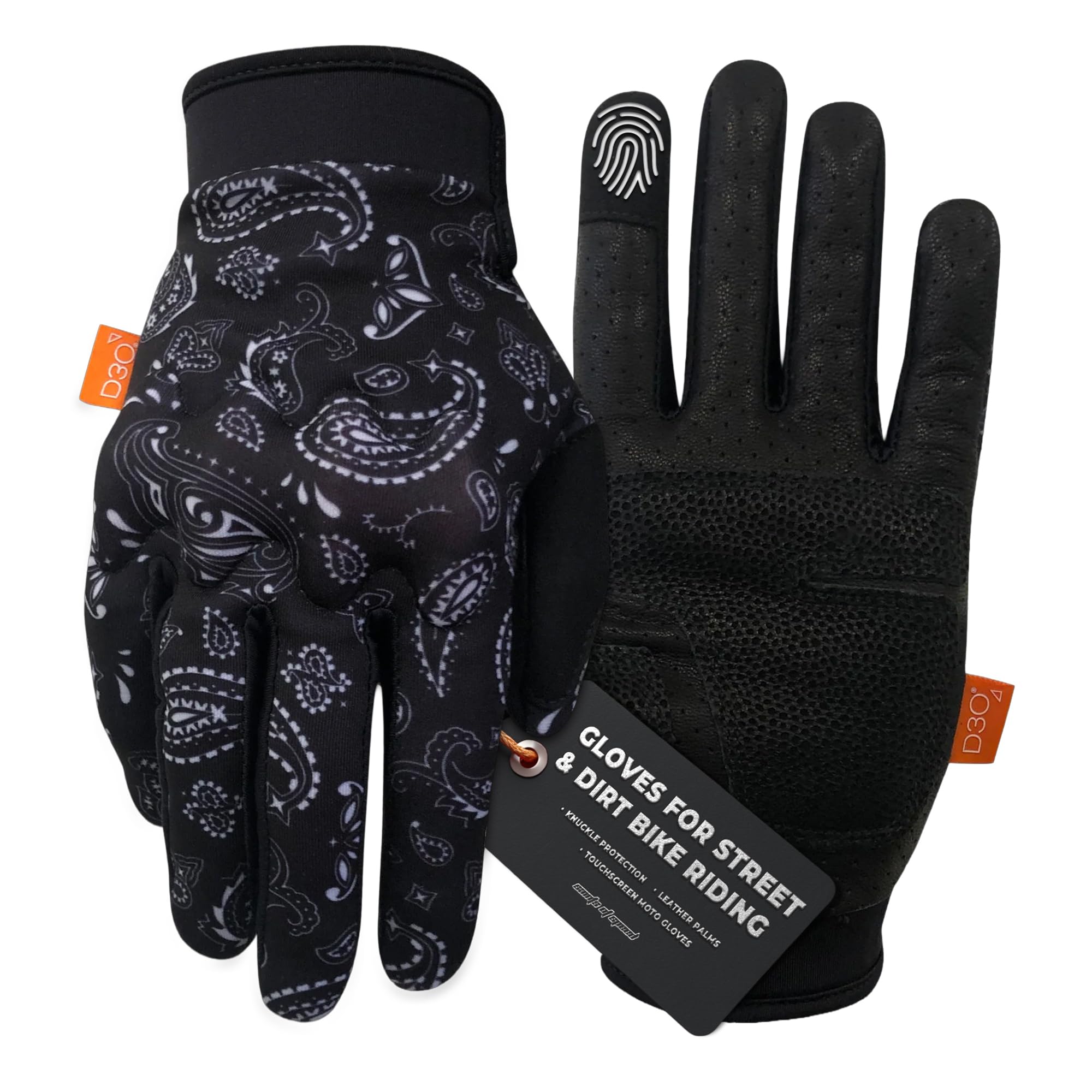
The Saints of Speed Knuckle1 gloves are designed around a simple premise: give riders leather palm durability and real knuckle protection without making the glove feel like a welding mitt. The leather palms are perforated for ventilation and provide excellent grip and abrasion resistance for both street and dirt applications. The soft-hard knuckle protectors use a dual-density approach — a rigid outer shell to deflect impact and a softer inner layer to absorb energy and maintain flexibility.
Touchscreen material on the index finger and thumb is responsive enough for GPS navigation and music control without requiring you to stop and remove the gloves. The lightweight construction and perforated palm make these gloves particularly well-suited for warm-weather riding where breathability is a priority. The hook closure system is simple but effective, and the universal fit pattern accommodates a wide range of hand shapes without excessive bunching.
Rider feedback emphasizes that the leather palm holds up well against regular use and that the knuckle protection stays in place during crashes. The main critique centers on the limited color and pattern options, though the Black Paisley design offers a distinctive look that stands out from the sea of all-black gloves. For riders who split time between street commuting and dirt trail riding, the Knuckle1 offers a versatile balance that few competitors at this level match.
What works
- Perforated leather palm combines abrasion resistance with ventilation
- Dual-density knuckle protectors balance impact absorption with flexibility
- Touchscreen response on thumb and index finger works reliably
What doesn’t
- Limited color and pattern options compared to competitors
- Hook closure system is functional but less secure than wider hook-and-loop straps
5. RaceQuip RQP 350 Series Driving Gloves

The RaceQuip RQP 350 Series takes a different approach than traditional MX gloves by borrowing directly from motorsport — the Nomex knit construction is designed to provide heat and flame resistance that off-road gloves simply do not offer. While this may seem excessive for trail riding, riders who participate in track days, endurance events, or any situation where fire risk is a consideration will appreciate the added safety margin. The single-layer design keeps weight low and tactile feedback high.
The white leather reinforced palm is a purposeful design choice — leather provides the abrasion resistance needed for grip durability, and the light color makes wear patterns immediately visible so you know exactly when the glove needs replacement. The pull-on closure with no hook-and-loop strap reduces weight and eliminates the pressure point that some riders experience with strapped cuffs. This design works best for riders who prioritize minimalism and have a hand shape that fits the universal sizing.
Being non-SFI rated, these gloves are not certified for professional racing series that require fire-rated equipment, but for amateur track days and spirited riding, the Nomex construction still offers a genuine safety advantage over standard nylon or polyester gloves. Owner feedback indicates that the sizing runs true and the single-layer design provides excellent bar feel. The trade-off is minimal impact protection — there are no knuckle guards or hard armor, so these are best suited for riders who prioritize fire resistance and feel over crash impact defense.
What works
- Nomex knit construction provides heat and flame resistance unmatched by standard MX gloves
- Leather reinforced palm offers good abrasion resistance with excellent bar feel
- Pull-on design eliminates pressure points and reduces overall weight
What doesn’t
- No knuckle or impact protection limits crash safety for aggressive off-road riding
- Non-SFI rated means it won’t meet certain professional racing requirements
6. Milwaukee Leather MG7570 Men’s Reflective Skull Premium Leather Gloves

The Milwaukee Leather MG7570 takes a cruiser-oriented approach to hand protection, focusing on comfort and visibility rather than hard-core MX impact defense. The gel palm padding is the standout feature — it absorbs road vibration and reduces hand fatigue during long rides in a way that firmer foam paddings cannot match. The premium leather construction provides solid abrasion resistance, and the short wrist design keeps the gloves unobtrusive under jackets.
The reflective skull detailing is more than cosmetic — the reflective elements improve nighttime visibility for riders who spend time on the road after dark. The gel padding extends across the base of the palm and into the thumb area, which is exactly where pressure builds up during extended grip holding. The fit is tailored toward riders with average to larger hand proportions, and the leather breaks in gradually to conform to your specific hand shape over time.
Rider feedback highlights the comfort factor as the primary reason to choose these gloves over more aggressively styled MX options. However, the lack of knuckle protection and the short wrist design mean these are not suitable for motocross or aggressive off-road riding where impact protection is critical. For street-focused riders, dual-sport commuters, or anyone who prioritizes all-day comfort and visibility over hardcore protection, the MG7570 delivers exceptional value.
What works
- Gel palm padding effectively reduces vibration and hand fatigue on long rides
- Reflective elements improve nighttime visibility for street and dual-sport use
- Premium leather construction breaks in for a comfortable custom fit
What doesn’t
- No knuckle protection limits suitability for off-road or aggressive MX riding
- Short wrist design leaves gap between glove and jacket sleeve
7. INBIKE MTB Mountain Bike Gloves with Knuckle Protection

The INBIKE MTB gloves are the most affordable option in this guide, but they pack more protection features than the price suggests. The thickened EVA palm pad provides wear resistance and shock absorption where your hands contact the grips, while TPR finger pads on the joints add impact protection that is usually reserved for gloves costing significantly more. The polyester construction with breathable holes on the palm keeps airflow moving during active riding.
The touchscreen microfiber material on the index finger is functional for basic phone use, and the non-slip silicone rubber on the fingers improves lever control in wet conditions. The hook-and-loop fastener on the stretchy cuff allows for easy size adjustment, and the ambidextrous design simplifies ordering. The gloves are marketed for MTB, BMX, MX, and ATV use, making them a versatile budget option for riders who participate in multiple disciplines.
Owner feedback indicates that the gloves fit well for the price and that the TPR protection is appreciated by riders who have taken spills on rocky terrain. The main durability concern is that the synthetic palm material wears faster than leather alternatives, particularly for riders who train frequently or ride on abrasive grip surfaces. For entry-level riders, occasional trail users, or anyone needing a backup pair for less demanding rides, the INBIKE gloves offer genuine protection without a significant investment.
What works
- TPR finger pads provide real impact protection at an entry-level price
- EVA palm padding absorbs vibration and adds abrasion resistance
- Touchscreen microfiber and silicone grip details function well for the cost
What doesn’t
- Synthetic palm wears faster than leather under frequent or aggressive use
- Breathable hole design compromises durability in high-wear areas
Hardware & Specs Guide
Knuckle Protection Materials
TPR (thermoplastic rubber) is the most common impact material in mid-range MX gloves — it offers good deflection for branch strikes and handlebar impacts while remaining flexible enough for natural hand movement. PVC hard shells, found on the ILM DN01, provide higher rigidity at a lower cost but can feel bulkier. Carbon fiber, used on the Alpinestars SMX-2, is the lightest and strongest option, but it significantly increases the price. EVA foam, used in budget gloves like the INBIKE, absorbs vibration but offers minimal protection against sharp or hard impacts.
Palm Construction & Durability
Leather palms, whether goatskin or cowhide, offer the highest abrasion resistance and develop a custom fit over time. Clarino and microfiber synthetic palms are lighter, dry faster, and integrate touchscreen compatibility more seamlessly, but they wear through faster on rough grips and during crash slides. Perforated leather, as seen on the Saints of Speed Knuckle1, attempts to bridge the gap by adding ventilation while retaining leather durability. Riders who train multiple times per week should prioritize leather or heavily reinforced synthetic blends to avoid replacing gloves every season.
Touchscreen Integration
Capacitive touchscreen compatibility in MX gloves is achieved either through conductive thread woven into the fabric, conductive material bonded to the leather or synthetic surface, or a separate conductive patch sewn onto the fingertip. Sewn-on patches are the least reliable — they peel, crack, and lose conductivity after a few washes. Conductive leather or Clarino, used on the Fox Dirtpaw and ILM DN01, lasts significantly longer because the conductivity is inherent to the material rather than added as an afterthought.
Cuff Design & Closure Systems
Compression-molded neoprene cuffs with wide hook-and-loop closures, as found on the Fox Racing Dirtpaw, provide the most secure fit and best dirt seal for motocross conditions. Standard elastic cuffs with narrow straps, seen on the Saints of Speed and INBIKE, are lighter and more comfortable for casual use but allow more debris entry and can loosen during aggressive riding. Pull-on closure systems, like the RaceQuip RQP 350, save weight and eliminate pressure points but offer no adjustability and rely entirely on elastic tension to maintain fit.
FAQ
Are MX gloves supposed to fit tight or loose?
How often should MX gloves be replaced?
Can MX gloves be washed in a machine?
Do MX gloves need to be leather for adequate protection?
Final Thoughts: The Verdict
For most buyers, the best mx gloves winner is the Fox Racing Dirtpaw because it delivers TPR knuckle protection, a reliable touchscreen palm, and excellent breathability at a price that balances durability with accessibility. If you want premium impact protection and long-term leather durability, grab the Alpinestars SMX-2 Air Carbon V2. And for the best value in genuine leather with hard-shell knuckle coverage, nothing beats the ILM Goatskin Leather DN01.

Certification: BSc in Mechanical Engineering
Education: Mechanical engineer
Lives In: 539 W Commerce St, Dallas, TX 75208, USA
Md Amir is an auto mechanic student and writer with over half a decade of experience in the automotive field. He has worked with top automotive brands such as Lexus, Quantum, and also owns two automotive blogs autocarneed.com and taxiwiz.com.