An e-bike without a reliable battery gauge is like a car without a fuel gauge — you are always guessing when the next charge stop will be. Relying on voltage readouts alone leaves room for error, especially as batteries age and their discharge curves change, making a dedicated monitor one of the smartest upgrades for any electric bike owner.
I’m Amir — the founder and writer behind Four Wheel Ask. My research focuses on analyzing product specifications, build quality reports, and verified owner feedback to identify the most accurate and durable battery monitoring solutions on the market.
This guide compares five battery gauges across voltage compatibility, display clarity, waterproofing, and installation requirements to help you choose the right one. After carefully analyzing specs, owner feedback, and build quality metrics across dozens of the top options, I recommend the best battery gauge for e-bike.
How To Choose The Best Battery Gauge For E-Bike
Selecting the right battery gauge for your e-bike comes down to understanding how the monitor reads your pack, where you ride, and how much data you want on screen. The five models in this guide span three distinct monitoring approaches and a range of environmental protections, so matching the gauge to your specific build is straightforward once you know what to look for.
Monitoring Method: Voltage Sense vs. Shunt-Based
The biggest performance split in this category is between simple voltage monitors and shunt-based coulomb counters. Voltage-only gauges — like the ELMCONFIG and DROK models — measure the battery’s present voltage and map it to a percentage based on a preset discharge curve. These are easy to install but lose accuracy under load because voltage sags when you accelerate or climb hills. Shunt-based monitors like the AILI and QWORK measure actual current flow in and out of the battery, giving you a true State of Charge percentage that stays accurate regardless of riding conditions. If you want real-time precision, a shunt-based gauge is worth the extra installation effort.
Voltage Range and Chemistry Compatibility
E-bike battery packs come in several voltages — 36V is the most common on commuter and entry-level models, while 48V and 52V packs are typical on performance and long-range builds. Every gauge in this guide covers at least 36V to 48V, but the specific range matters if you run a 24V cargo trike or a 72V high-power setup. Battery chemistry also affects accuracy: lithium-ion and LiFePO4 packs hold nearly flat voltage throughout their discharge cycle, making them harder to read with voltage-only meters. Shunt-based monitors handle all chemistries equally well because they measure energy flow rather than voltage levels.
Weather Resistance and Build Environment
An e-bike lives outdoors, so the gauge you choose needs to handle whatever weather you ride in. The IP65 rating on the ELMCONFIG provides protection against rain spray and dust, while the IPX7 rating on the SUPNOVA allows full immersion for up to 72 hours — a significant jump in durability. If your bike stays parked in a garage and rarely sees rain, a standard gauge will hold up fine. For commuters who ride year-round in wet climates, the waterproofing premium pays for itself the first time you get caught in a downpour.
Quick Comparison
On smaller screens, swipe sideways to see the full table.
| Model | Category | Best For | Key Spec | Amazon |
|---|---|---|---|---|
| AILI Battery Monitor with Shunt | Shunt Monitor | Accurate SoC Tracking | 8-120V / 100A Shunt | Amazon |
| QWORK Battery Monitor | Shunt Monitor | High-Current Systems | 8-80V / 350A Shunt | Amazon |
| SUPNOVA IPX7 Battery Monitor | Waterproof | Outdoor Wet Conditions | 7-100V / IPX7 Rated | Amazon |
| DROK 48v Battery Meter | Voltage Monitor | Simple Plug-and-Play | 10-100V / LCD Display | Amazon |
| ELMCONFIG BM210 | LED Monitor | Budget-Friendly Builds | 12-72V / 10-Segment LED | Amazon |
In‑Depth Reviews
1. AILI Battery Monitor with Shunt
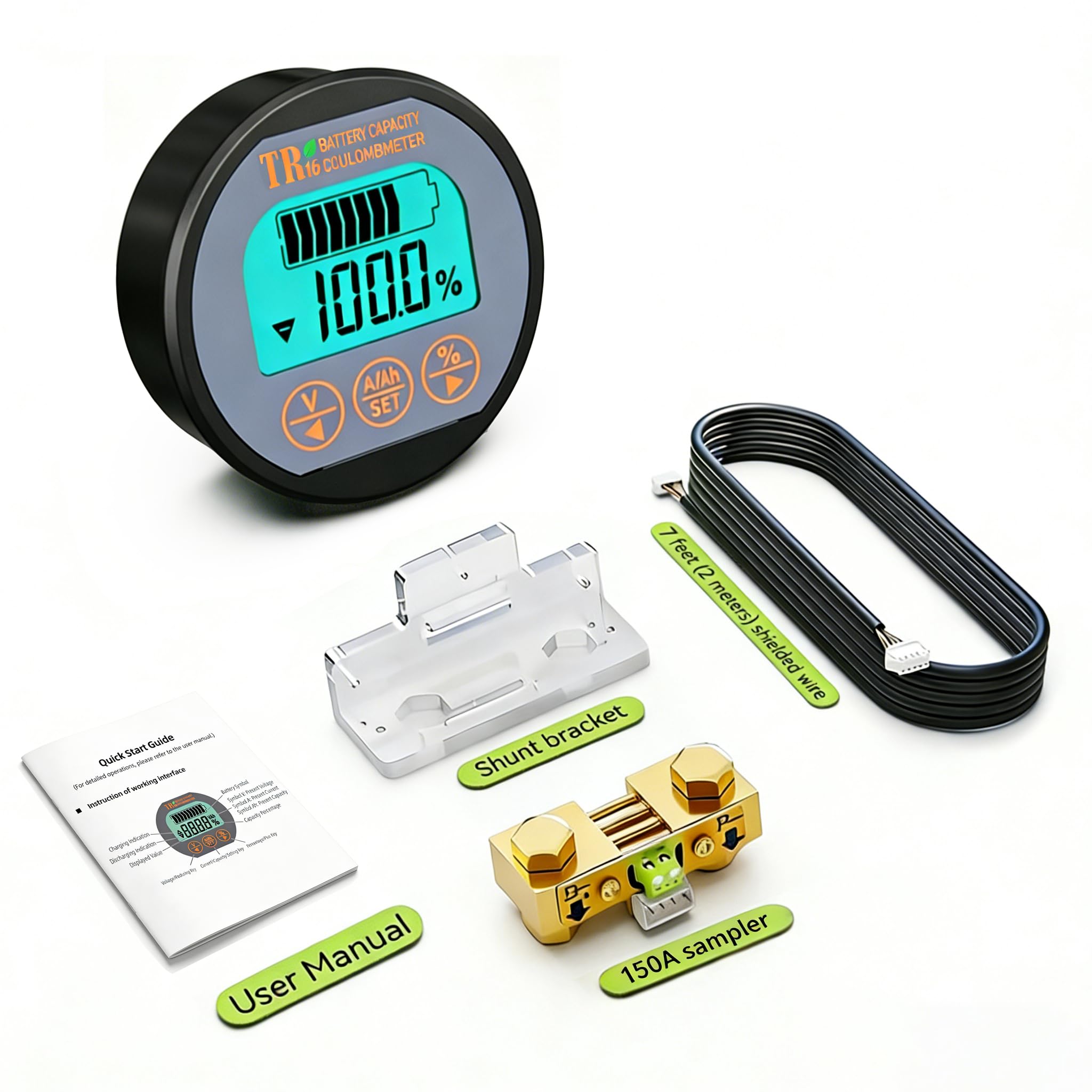
The AILI Battery Monitor stands out as the most comprehensive option in this lineup thanks to its integrated 100A shunt and coulomb-counting technology. Unlike simple voltage-based indicators, this monitor tracks actual energy flow in and out of the battery, displaying State of Charge as a true percentage rather than a voltage estimate. The backlit LCD screen provides real-time data on voltage, current, and remaining capacity up to 999Ah, making it the only model here that gives you the full picture at a glance.
Compatibility spans 8V to 120V, covering everything from 12V to 48V e-bike systems and beyond. The monitor supports LiFePO4, lithium-ion, AGM, gel, and sealed lead-acid batteries, making it a versatile choice for riders who may upgrade their battery chemistry in the future. Installation requires wiring the included shunt into the negative battery line, which most users report completing in under 20 minutes. The package includes the display meter, a 2-meter extension cable, the 100A shunt, and a bracket — everything needed for a clean install.
The ultra-low standby power draw of 50-60 microamps means the monitor won’t drain your battery when parked. A sleep mode activates automatically to preserve charge, and the memory function retains all settings and readings after power disconnection — no recalibration needed after a charge session. With over 800 verified ratings and a 4.3-star average, this is the most trusted model in the group for accurate capacity tracking, and the self-powered design (8-80V) eliminates the need for an external power supply.
What works
- True coulomb-counting accuracy with integrated 100A shunt
- Ultra-low standby draw protects battery when idle
- Wide voltage range covers all common e-bike systems
What doesn’t
- Shunt installation requires more wiring than voltage-only gauges
- Display screen is compact, not ideal for distance viewing
2. QWORK Battery Monitor Voltmeter Ammeter

The QWORK Battery Monitor targets riders with higher current demands, featuring a reinforced 350A shunt that handles demanding electrical systems without thermal drift. The unit monitors voltage from 8V to 100V and displays charge and discharge current in real time, giving you a clear picture of how much power your e-bike is drawing during climbs or full-throttle operation. This is the monitor to choose if you run a high-power hub motor or plan to scale up your battery capacity in the future.
A built-in memory chip retains test parameters even after a complete power loss, eliminating the need for frequent manual recalibration. The backlit LCD screen shows voltage, amperage, and amp-hour values in a compact panel-mount design that integrates cleanly into custom dashboards or handlebar mounts. The included 13-foot custom cable provides unusual flexibility in placement, allowing you to mount the display on your handlebars while keeping the shunt near the battery compartment.
Capacity tracking reaches up to 999Ah, which is overkill for most e-bike batteries but useful for riders managing large battery banks or solar charging setups. The NIST-traceable and CE-marked certification adds confidence in measurement accuracy. Some owner feedback notes that the documentation could be clearer for first-time shunt users, but the installation is straightforward for those familiar with basic DC wiring. The 350A shunt capacity means this monitor runs cool even under sustained high current, a real advantage for performance e-bikes.
What works
- 350A shunt handles high-current e-bike systems with minimal heat buildup
- 13-foot cable offers flexible mounting options
- Data memory retains settings after power loss
What doesn’t
- Documentation lacks detail for installation newcomers
- Upper voltage limit of 80V excludes 96V experimental builds
3. SUPNOVA IPX7 Waterproof Battery Monitor

The SUPNOVA IPX7 Battery Monitor brings genuine waterproofing to the table, with a fully sealed shell rated for immersion up to 72 hours. This makes it the top choice for e-bike riders who face rain, mud, or frequent washing. The monitor handles 7V to 100V systems and works with ternary lithium, lead-acid, AGM, and LiFePO4 batteries right out of the box — though the default is set to 12V lead-acid, requiring a simple setting adjustment to match your e-bike pack.
A buzzer alarm function allows you to set low and high voltage thresholds, providing an audible warning when your battery is running low or overcharging. The display switches between voltage and temperature readings with a short press of the “M” button, giving you ambient thermal data alongside battery status. The included mounting bracket, double-sided adhesive, and screw kit make installation flexible, and the 23.6-inch wire leads provide enough reach for most handlebar or stem mounting positions.
Owner reports consistently highlight the IPX7 rating as the primary reason for purchase, with many noting that previous non-waterproof gauges failed within months of outdoor use. The power-off memory function retains settings after disconnection, preventing the frustration of resetting parameters after each charge. The main caveat is that the percentage display requires proper initial calibration — several users initially saw 100% until they followed the setup instructions carefully. Once configured correctly, the reading stays consistent across charge cycles.
What works
- IPX7 waterproof rating survives heavy rain and washing
- Adjustable buzzer alarm warns of low or over-voltage conditions
- Dual voltage and temperature display in one unit
What doesn’t
- Requires initial calibration to display accurate percentage
- Default 12V setting must be changed for most e-bike voltages
4. DROK 48v Golf Cart Battery Meter

The DROK 48v Golf Cart Battery Meter offers a no-frills LCD approach to battery monitoring with support for 10V to 100V systems. The display shows both voltage and remaining capacity percentage, and includes a temperature gauge that reads the internal meter temperature in Fahrenheit. While the temperature reading is not ambient air temperature, it serves as a useful diagnostic for monitor health in hot or cold operating environments, particularly if the gauge is mounted near a motor controller that generates heat.
Programmable percentage mapping allows you to calibrate the display to match your specific battery’s discharge curve, which is particularly useful for lithium packs that maintain steady voltage until near depletion. The default configuration is set for a 48V lead-acid battery, so riders with 36V or 52V e-bike systems will need to adjust the settings during installation. The compact black housing fits into standard panel cutouts, and the two-wire hookup — positive and negative only — makes this one of the simplest models to install.
This monitor is best suited for riders who want a simple, readable display without the complexity of shunt installation. It connects with just two wires, making it a true plug-and-play option that can be installed in minutes with basic hand tools. The trade-off is that voltage-based percentage estimation is inherently less accurate than shunt-based coulomb counting, particularly under variable load conditions typical of e-bike riding with hills and stop-and-go traffic. For casual riders who primarily want to avoid being stranded, the DROK delivers adequate visibility at an accessible price point.
What works
- Simple two-wire installation with no shunt required
- Programmable percentage mapping for custom discharge curves
- Clear LCD readable in direct sunlight
What doesn’t
- Voltage-based percentage loses accuracy under load
- Default 48V lead-acid setting must be changed for lithium packs
5. ELMCONFIG BM210 LED Battery Monitor

The ELMCONFIG BM210 brings a straightforward 10-segment LED display to the budget-friendly end of the battery gauge spectrum. With 1 red, 2 yellow, and 7 green LED segments, each representing 10% battery capacity, the display provides an at-a-glance readout that is easy to see in bright daylight without a backlight. Voltage selection is handled via DIP switches, supporting 12V, 24V, 36V, 48V, 60V, and 72V systems — giving you broad compatibility in a compact package.
The IP65 waterproof rating means the gauge can handle rain and mist without issue, though it should not be submerged. Reverse polarity protection and over-voltage protection are built in, preventing damage if the wires are connected incorrectly during installation — a valuable safety net for first-time installers. The compact dimensions allow it to fit in tight spaces on handlebars or dashboards, and the lightweight design adds negligible weight to your build.
This is the most accessible option for riders on a tight budget who need a basic capacity indicator without the complexity of shunt wiring or programmable settings. The three-color LED system gives clear visual warnings as the battery depletes, with the red segments activating below 30% capacity to signal that charging is needed soon. The main limitation is the lack of precise voltage or current data — you get a simple bar graph of remaining charge, nothing more. For riders who just need to know roughly how much range is left at a glance, the BM210 delivers that function reliably without frills.
What works
- Simple DIP switch voltage selection covers 12V to 72V systems
- IP65 waterproofing handles rain and mist exposure
- Reverse polarity protection prevents wiring mistakes
What doesn’t
- LED bar graph offers no precise voltage or current data
- Not suitable for submersion despite IP65 rating
Hardware & Specs Guide
Shunt-Based vs. Voltage-Based Monitoring
The fundamental difference between these two approaches is how they determine remaining battery capacity. Voltage-based monitors simply measure the battery’s present voltage and map it to a percentage using a preset discharge curve. This method works reasonably well for lead-acid batteries with their steep voltage slope, but it struggles with lithium chemistries that hold near-constant voltage for most of their discharge cycle. Shunt-based monitors place a precision resistor — the shunt — in the negative battery line and measure the current flowing through it. By tracking every amp-hour that goes into and out of the battery, the monitor calculates the true State of Charge with far greater accuracy. The trade-off is installation complexity: a shunt monitor requires wiring the shunt inline, while a voltage monitor connects to just the positive and negative terminals.
Display Technology: LED vs. LCD
LED bar graph displays like the one on the ELMCONFIG BM210 use individual colored segments to show approximate charge level. These are extremely visible in bright sunlight because the LEDs emit their own light, but they offer no numerical precision — you get a rough percentage, not a voltage or current reading. LCD displays like those on the DROK, SUPNOVA, AILI, and QWORK use liquid crystal technology with a backlight to show alphanumeric data. LCDs give you exact voltage, amperage, and capacity numbers, making them far more useful for diagnosing battery health and tracking power consumption. The downside is that LCD screens can be harder to read in direct sunlight unless they have a high-contrast or transflective backlight. For riders who want detailed data, an LCD is essential; for those who just want a quick visual reference, an LED bar graph is simpler and often more durable.
FAQ
Can I use a golf cart battery gauge on my e-bike?
What voltage does my e-bike battery have?
Do I need a shunt-based monitor for accurate readings?
Final Thoughts: The Verdict
For most buyers, the best battery gauge for e-bike winner is the AILI Battery Monitor with Shunt because it delivers true coulomb-counting accuracy across a wide voltage range with minimal standby power draw, making it suitable for any lithium or lead-acid e-bike pack. If you want maximum weather protection, grab the SUPNOVA IPX7 — its immersion-rated housing and audible alarm make it the safest choice for all-weather commuters. And for a simple, no-wiring-fuss option, nothing beats the DROK 48v Meter, which gives you a clear LCD readout with just two wires and no shunt required.

Certification: BSc in Mechanical Engineering
Education: Mechanical engineer
Lives In: 539 W Commerce St, Dallas, TX 75208, USA
Md Amir is an auto mechanic student and writer with over half a decade of experience in the automotive field. He has worked with top automotive brands such as Lexus, Quantum, and also owns two automotive blogs autocarneed.com and taxiwiz.com.