Boondocking off the grid demands a reliable energy source, and the difference between a relaxing sunset and a dead battery often comes down to the solar panel you choose. The market is flooded with wattage claims and efficiency numbers that don’t always translate to real-world charging, making it critical to separate marketing hype from actual performance data.
I’m Amir — the founder and writer behind Four Wheel Ask. My process involves deeply analyzing product specifications, build quality, and aggregated owner feedback to identify which portable solar panels deliver consistent, reliable power for the demanding RV lifestyle.
Whether you’re topping off a power station after a cloudy day or running a fridge for a weekend trip, choosing the right kit is an investment in your freedom. This guide evaluates the top models to help you find the best portable solar panels for rv for your specific setup and travel style.
How To Choose The Best Portable Solar Panels For RV
Selecting a portable solar panel for your RV goes beyond just looking at the wattage number. You need to balance efficiency, build quality, and compatibility with your existing power station to ensure you’re not leaving usable energy on the table.
Wattage vs. Real-World Output
A panel’s rated wattage is measured in a lab under ideal conditions. Real-world output is usually 70-85% of that number due to temperature, cloud cover, and angle. Plan for this derating so you don’t overspend on wattage you can’t actually capture.
Cell Technology and Conversion Efficiency
Higher efficiency cells, such as N-Type or monocrystalline with etched backsheets, convert more sunlight per square foot. This matters most when you have limited roof space or want to pack lighter panels for portable use.
Connector Types and Cable Length
Not all power stations use the same input connector. A good portable solar kit includes multiple adapters (XT60, Anderson, DC7909, DC8020) so you can plug directly into your Jackery, EcoFlow, or Bluetti. A longer cable—around 10 feet—gives you more flexibility to position the panel in direct sun while keeping your generator shaded and cool.
Quick Comparison
On smaller screens, swipe sideways to see the full table.
| Model | Category | Best For | Key Spec | Amazon |
|---|---|---|---|---|
| Renogy 200W E.Flex | Premium | Best Overall Performance | 200W, 25% Efficiency, 13.89 lbs | Amazon |
| BigBlue 150W | Premium | Lightweight High Efficiency | 150W, 25% N-Type, 8.82 lbs | Amazon |
| DOKIO 200W | Mid-Range | Complete Kit Value | 200W, PWM Controller, 9 lbs | Amazon |
| SOKIOVOLA 200W | Mid-Range | High Output Per Dollar | 200W, 25% N-Type, 16.3 lbs | Amazon |
| MHPOWOS 220W | Mid-Range | High-Voltage for MPPT | 220W, 40V Output, 17.8 lbs | Amazon |
| EBL 200W | Budget-Friendly | Large Wattage for Less | 200W, Monocrystalline, 17.95 lbs | Amazon |
| TWELSEAVAN 110W | Budget-Friendly | Rugged Entry-Level | 110W, IP68, 10.6 lbs | Amazon |
| ZOUPW 100W | Budget-Friendly | Ultra-Compact Starter | 100W, 5-in-1 Cable, 9.5 lbs | Amazon |
| Renogy 100W Flexible | Specialty | Curved Surface Mounting | 100W, Semi-Flexible, 4 lbs | Amazon |
In‑Depth Reviews
1. Renogy 200W E.Flex Portable Solar Panel
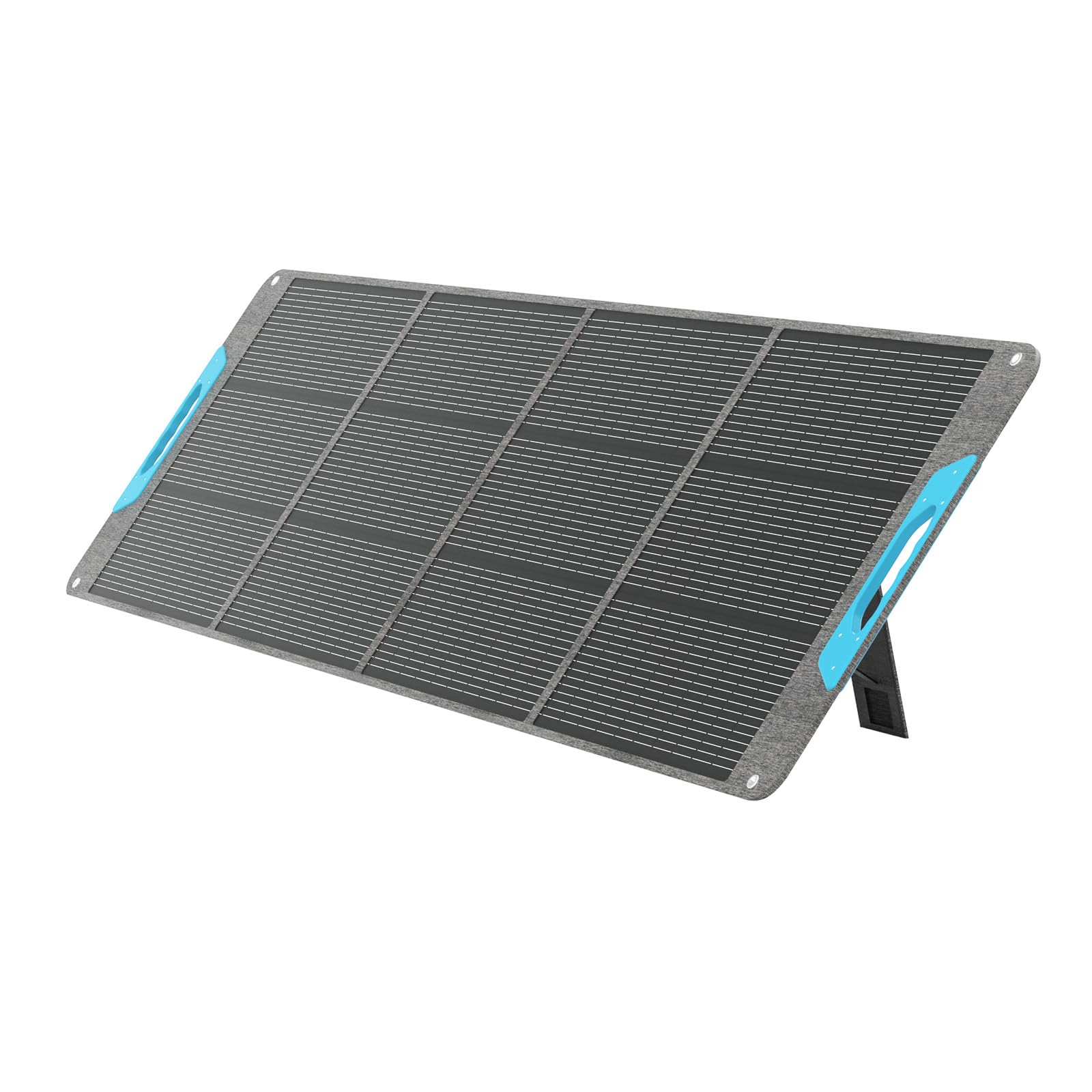
The Renogy 200W E.Flex sits at the top of the premium tier with its 16BB N-Type cell technology that achieves a class-leading 25% conversion efficiency. Owner feedback consistently shows real-world output settling between 150 and 191 watts in direct sun, which is an excellent retrieval rate that justifies the higher investment. The magnetic closure system and quad-fold design make deployment and breakdown noticeably faster than traditional Velcro-based panels, a detail that matters when you’re setting up camp in fading light.
Build quality reflects Renogy’s long-standing reputation in the solar market. The IP65 rating provides solid protection against dust and splashes, while the four adjustable kickstands and reinforced grommets offer stable positioning even in windy conditions. At just under 14 pounds, it is remarkably lightweight for a 200-watt panel, and the built-in USB-C PD port (45W) and dual USB-A ports allow for direct device charging without a power station.
For RV owners who want a no-compromise portable panel that balances top-tier efficiency with genuine portability, this is the benchmark. Pair it with a compatible MPPT controller to maximize the N-Type cell advantage, and you have a setup that consistently outperforms lower-cost alternatives in partial shade and morning hours.
What works
- Exceptionally high real-world wattage output
- Lightweight design with magnetic closure for quick setup
- Integrated USB-C PD and dual USB-A ports
What doesn’t
- Kickstand Velcro can interfere during angle adjustment
- Premium price point requires careful budget consideration
2. BigBlue 150W SolarPowa150
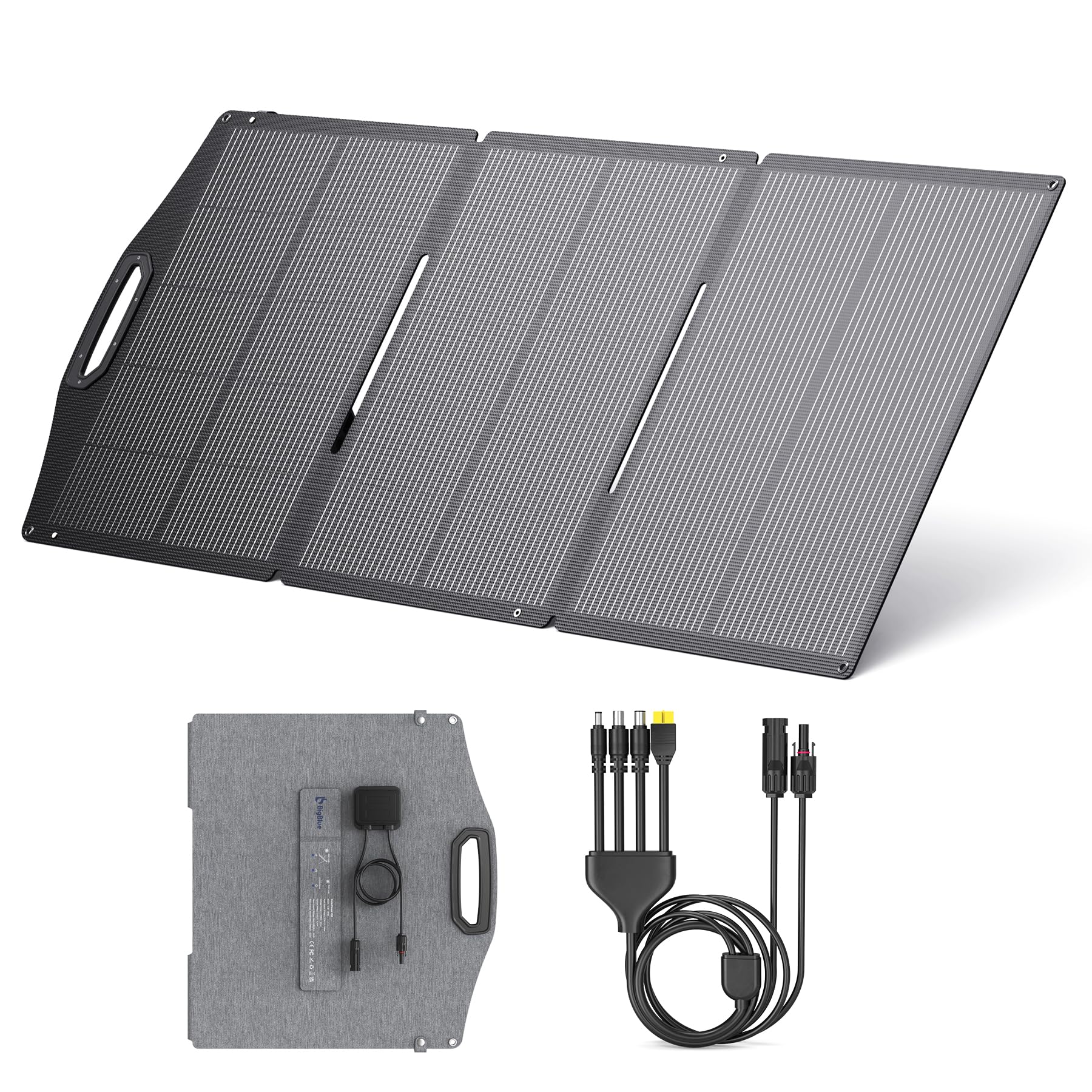
The BigBlue 150W SolarPowa150 leverages N-Type solar technology to deliver a 25% conversion rate, making it one of the most efficient panels in its wattage class. Owner testing in clear June conditions recorded a 20Ah power bank charging from 35% to 100% in just two hours, closely matching MPPT performance predictions. This level of efficiency is particularly valuable for RVers who need to maximize charging in limited sunlight or with smaller power stations.
Weighing just 8.8 pounds, it is exceptionally light for its output, and the IP68 waterproof rating ensures it can handle sudden rainstorms without concern. The built-in kickstands are stable enough for most surfaces, though some users note that the 2-leg design for a 3-panel layout can feel slightly unbalanced in strong winds. The MC-4 connector comes with versatile adapters including DC5521, 8020, 7909, and XT60, covering the vast majority of portable power stations on the market.
This panel is an excellent choice for the weight-conscious RVer who still demands high efficiency. The two-year warranty and responsive customer service add peace of mind, and the USB-C fast charging port is a welcome addition for topping off devices directly from the panel.
What works
- Best-in-class efficiency for the 150W category
- Very lightweight and truly portable
- Strong customer support reputation
What doesn’t
- Kickstand stability could be improved
- Junction box ports are not fully waterproof
3. DOKIO 200W Portable Foldable Solar Panel Kit

The DOKIO 200W kit stands out as a complete system that includes a standalone PWM charge controller, multiple connector adapters, and a generous 9.8-foot cable. Real-world reports from owners north of the 45th parallel show output around 170 watts on a sunny May day, which is a respectable 85% of the rated spec. The separate controller design is a smart feature because it allows for easy future upgrades to an MPPT controller without replacing the entire panel setup.
Weighing just 9 pounds and folding down to a compact 19.3 x 26.4 x 1.1 inches, it is one of the most space-efficient 200W panels available. The included SAE, XT60, and alligator clip adapters make it compatible with a wide range of battery systems and power stations. The USB ports are a practical touch for direct device charging when connected to a 12V battery, and the controller’s protection against reverse polarity and overcharge adds a layer of safety that is reassuring for first-time solar users.
For the RV owner looking for an all-in-one kit that provides everything needed to start harvesting solar power immediately, the DOKIO 200W delivers strong value. The soft-case design requires care to avoid damaging cells by bending, but the overall package is hard to beat for the price.
What works
- Complete kit with PWM controller and multiple adapters
- Lightweight and compact when folded
- Good real-world output for the price
What doesn’t
- Lacks built-in kickstands for tilting
- Soft case can damage cells if bent incorrectly
4. SOKIOVOLA N-Type 16BB 200W
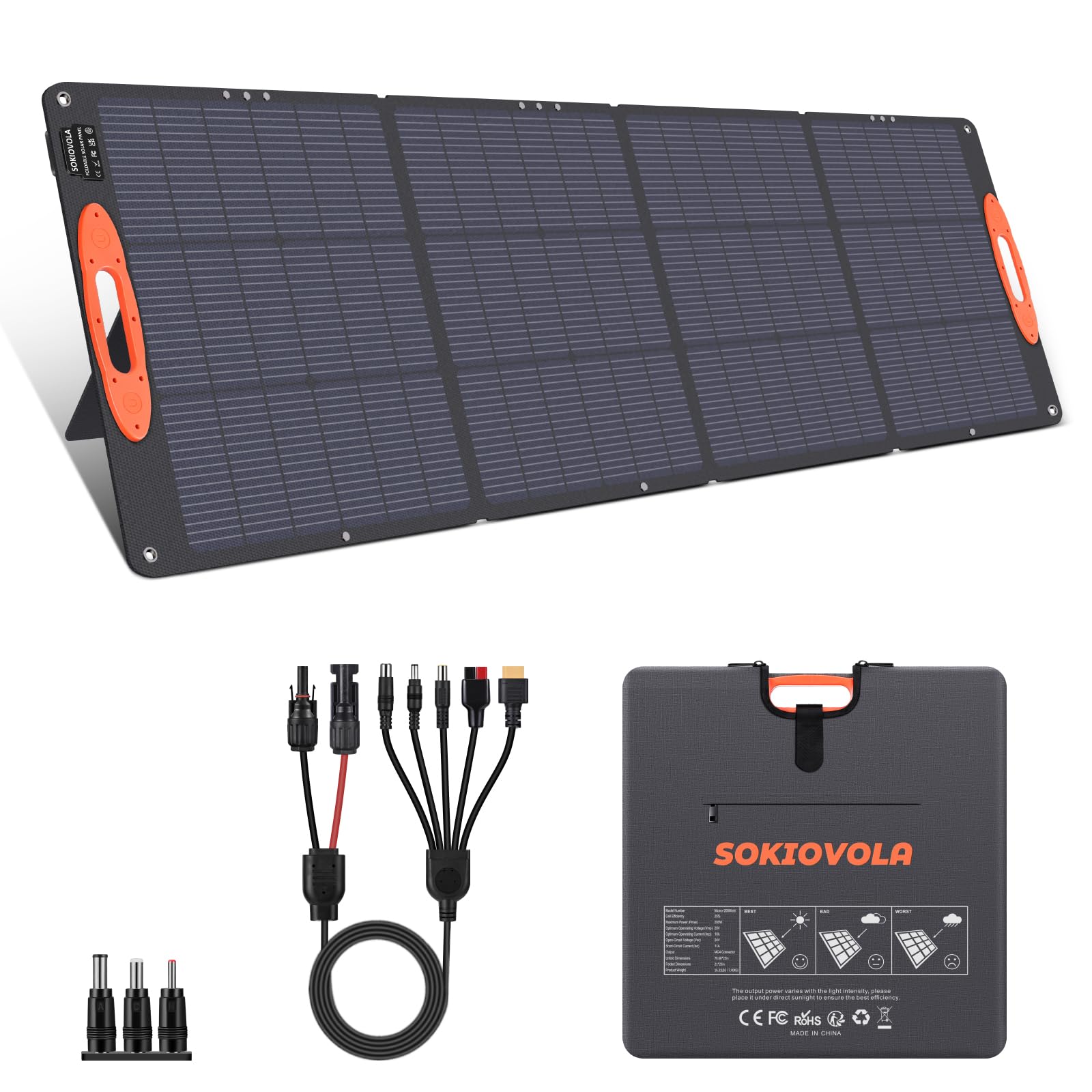
The SOKIOVOLA 200W panel utilizes N-Type 16BB cell technology to achieve 25% efficiency, and owner data from Southern California shows it reaching 177 watts in full sun—an 88-89% retrieval rate that competes well with more expensive models. The winter performance is also notable, with a user pulling 80 watts with minimal panel adjustment, demonstrating good low-light responsiveness. The included carrying bag is a quality touch that many owners appreciate for storage and transport.
Constructed with ETFE coating and an IP68 waterproof rating, this panel is built to endure harsh weather conditions. The magnetic handle and four attachment holes provide flexible mounting options, and the 5-in-1 connector cable (XT60, DC5521, Anderson, DC7909, DC8020) ensures broad compatibility across power station brands. The foldable dimensions of 21 x 23 inches make it manageable for most RV storage compartments.
While the build quality is generally good, some owners have noted that the kickstand legs have a very strong retraction force that can make alignment tricky, and the included XT60 connector has been reported as flimsy on some units. Overall, it represents a strong mid-range option that delivers high performance per dollar, especially if purchased during a promotional period.
What works
- Excellent real-world wattage output near 90% of rating
- Sturdy included carrying bag
- Broad connector compatibility
What doesn’t
- Kickstand alignment can be difficult
- Some connector quality concerns reported
5. MHPOWOS 220W Portable Solar Panel

The MHPOWOS 220W panel differentiates itself with a 40V output voltage that pairs exceptionally well with MPPT charge controllers. Owner testing in late November at mid-20°F temperatures recorded over 200 watts at 44V, highlighting the cold-weather advantage of higher-voltage panels. The four-panel foldable design with individual kickstands allows for versatile positioning, though it is more susceptible to wind than a solid rigid panel.
Weighing approximately 17.8 pounds, it is on the heavier side for portable use, but the robust fabric construction and IP67 rating provide confidence in adverse conditions. The panel comes with a 7-in-1 solar connector that covers most power station inputs, and the 23.5% monocrystalline conversion efficiency is competitive for this price tier. Owners using it with Jackery 1000 v2 units report achieving 150W with minimal aiming and up to 220W with proper tilt.
The 40V design is a double-edged sword: it unlocks higher MPPT efficiency, but you must carefully verify that your power station can accept a 40V input. Some units have a lower maximum voltage limit, which could result in no charging at all. For the savvy RVer with a compatible high-input-voltage power station, this panel offers a serious performance advantage.
What works
- High 40V output works great with MPPT controllers
- Excellent cold-weather performance
- Durable fabric construction
What doesn’t
- Not compatible with all power station input voltages
- Kickstand Velcro re-attachment can be cumbersome
6. EBL 200W Portable Solar Panel
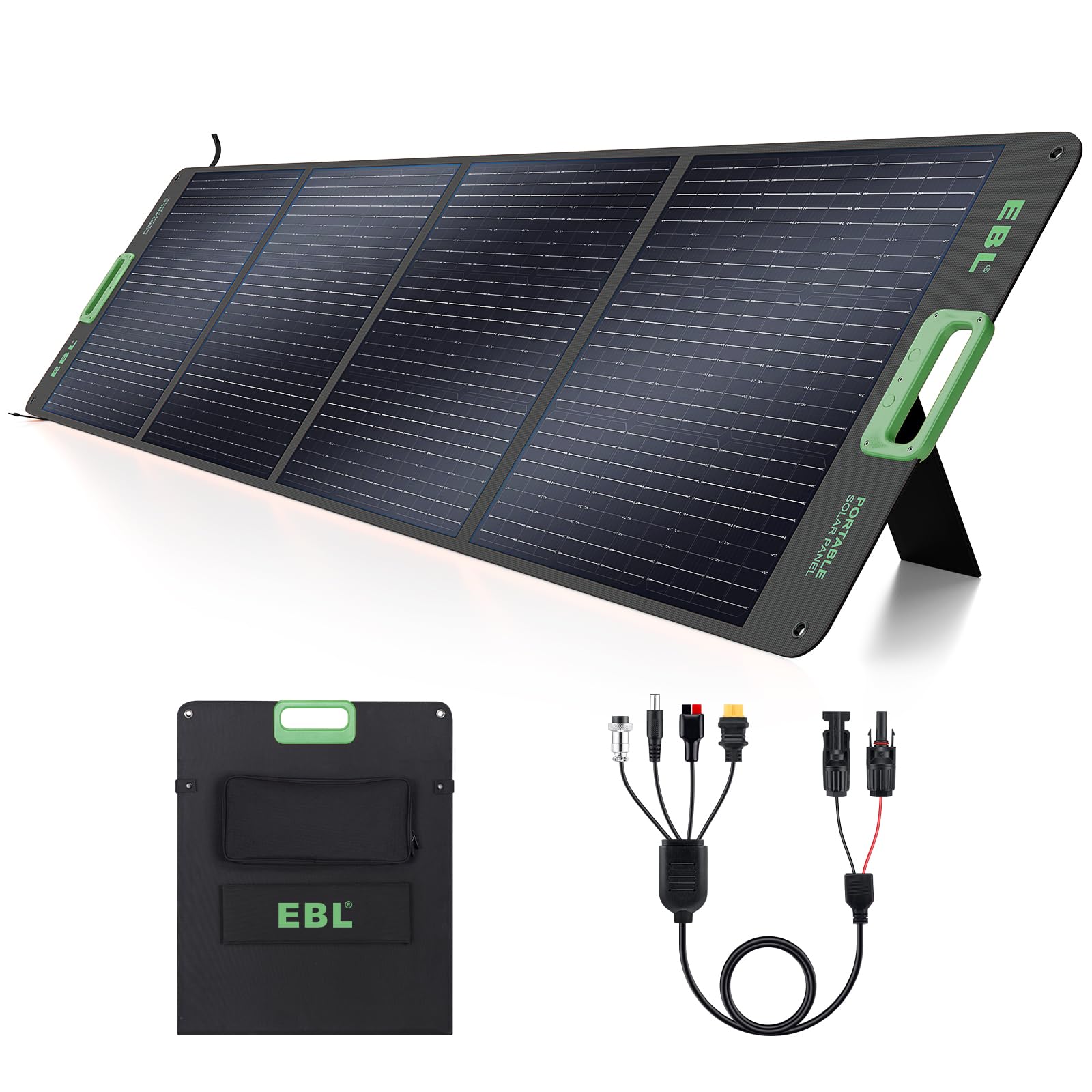
The EBL 200W panel aims to deliver high wattage at a budget-friendly price point, and owner reports suggest it largely succeeds. A user on a Baja trip recorded up to 170 watts in full sun, while another averaged 131-145W on sunny April days and charged a 448Wh battery from 7% to 100% in just three hours. The 23.5% monocrystalline conversion efficiency is solid, and the upgraded PET lamination with 840D Oxford cloth provides a durable, weather-resistant exterior.
The foldable design collapses to a compact 25.31 x 20.87 x 2.17 inches, making it easy to store in an RV compartment. The MC-4 to 4-in-1 cable includes XT60, Anderson, DC7909, and aviation connectors, which covers the most common power station brands. The panel is FCC, RoHS, and EMC certified, and includes short circuit and surge protection for safe operation.
At nearly 18 pounds, it is one of the heavier panels in this review, and some owners have reported build quality inconsistencies with the first unit they received. The MC-4 connectors are durable, and the weatherproofing holds up well in rain. For the RVer on a strict budget who needs 200W of capacity and is willing to accept a bit more weight, this is a compelling option.
What works
- High wattage for a budget-friendly investment
- Good real-world output in sunny conditions
- Durable outer fabric and weatherproofing
What doesn’t
- Heavy compared to competing 200W panels
- Build quality can be inconsistent
7. TWELSEAVAN 110W Portable Solar Panel
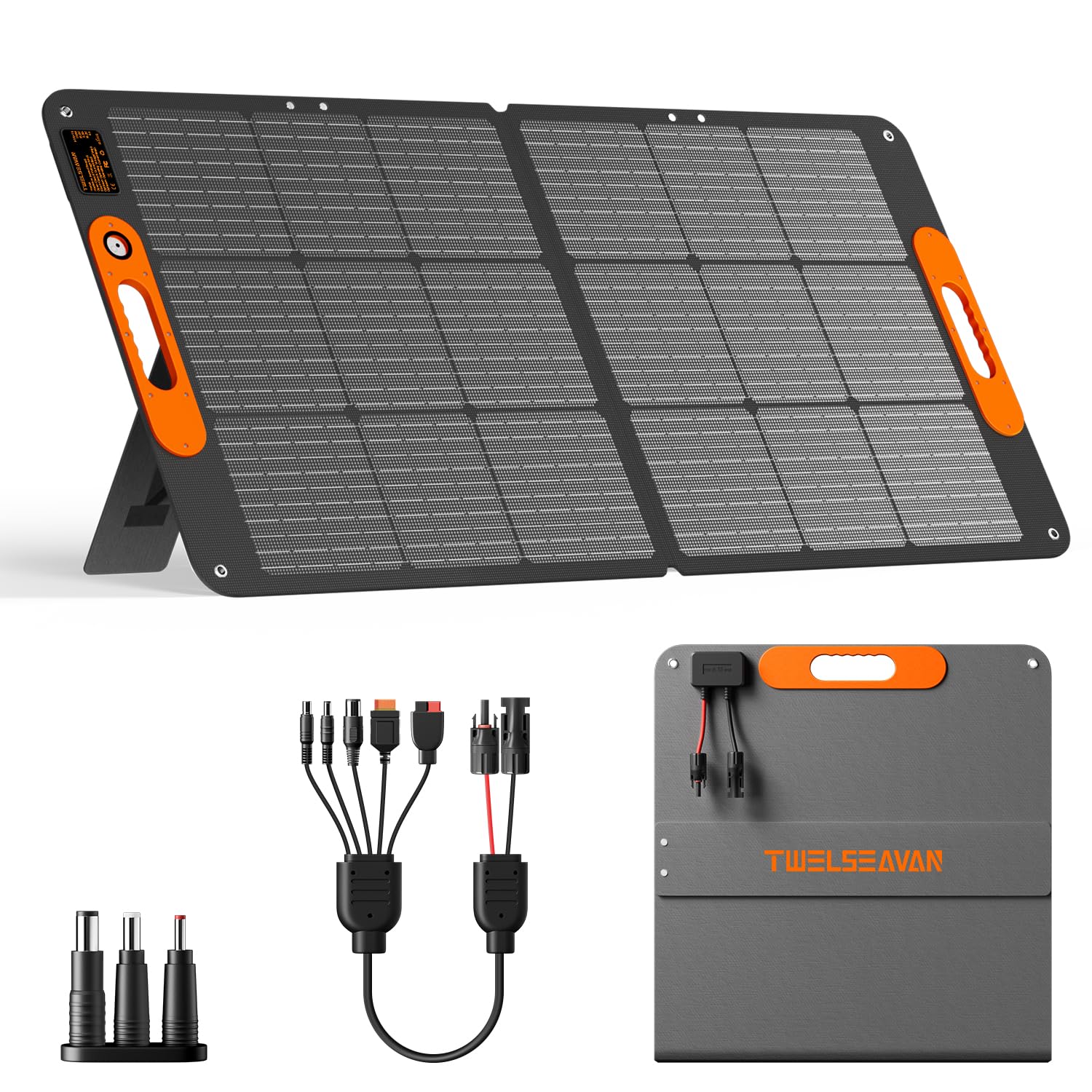
The TWELSEAVAN 110W panel carves out a niche for those who want a rugged, waterproof solar charger without spending for high wattage. With an IP68 rating and ETFE one-piece lamination, it is built to withstand the elements better than many panels in its class. Owner testing shows it delivering 104W to a Jackery 1000, dropping only slightly to 98W with light haze, indicating strong real-world performance that aligns closely with its rating.
The 24% conversion efficiency from A+ grade monocrystalline cells is excellent for a panel at this price tier. It includes a solar angle guide and two quick-adjust stands to help optimize the angle to the sun. The 118-inch 5-in-1 MC4 cable provides plenty of reach for flexible positioning, and the three included DC adapters (5521 to 5.5×2.5, 6.4×4.4, 3.5×1.35) ensure compatibility with a wide range of power stations including Jackery, EcoFlow, and Bluetti.
Weighing 10.6 pounds, it is not the lightest 110W panel available, but the build quality and waterproofing justify the slightly higher weight. Some owners noted a strong initial chemical odor and an MC4 connector that was very tight, but these issues did not affect performance. It is a reliable mid-range option for RVers who prioritize durability above all else.
What works
- Excellent IP68 waterproof rating for all-weather use
- High real-world efficiency close to rated spec
- Long cable and good connector selection
What doesn’t
- Initial strong chemical odor reported
- MC4 connector can be difficult to connect
8. ZOUPW 100W Portable Solar Panel

The ZOUPW 100W panel is a strong entry-level option that punches above its price tier in build quality and included accessories. It uses Grade A+ monocrystalline cells to achieve 23.5% efficiency, and owner testing has confirmed it charges a Jackery Explorer 300 from 84% to 100% in about 20 minutes on a cloudy day. The magnetic easy-carry handle and compact folded size (24.13 x 21.06 x 1.77 inches) make it simple to grab and go from an RV storage bay.
The standout feature is the true 5-in-1 cable that includes connectors for DC8020, XT60, Anderson, DC7909, and DC5521, covering 99% of power stations without needing extra adapters. The IP67 waterproof ETFE coating provides good protection against rain and splashes, and the zippered pocket keeps the built-in controller and cables dry. For direct device charging, it includes a USB-C PD port (15V/3A) and two USB-A ports with QC3.0 support.
Weighing 9.5 pounds, it is a manageable weight for one-handed carrying. The adjustable kickstands allow a 45-degree angle for better sun capture. Some users noted the USB-C PD max output is 45W rather than the 60W sometimes advertised, but this is still ample for phones and tablets. It is an excellent choice for the RVer who wants a reliable, portable panel for topping off electronics and small power stations.
What works
- Excellent connector compatibility with 5-in-1 cable
- Compact and lightweight with magnetic handle
- IP67 waterproof and durable construction
What doesn’t
- USB-C PD limited to 45W, not advertised 60W
- Leg adjustability is somewhat limited
9. Renogy 100W Flexible Solar Panel

The Renogy 100W Flexible panel is a completely different category of product—a semi-flexible panel designed for permanent or semi-permanent mounting on curved surfaces. Weighing only 4 pounds and measuring just 0.08 inches thick, it is 70% lighter and 95% thinner than a conventional rigid panel. Owner reports from van conversions and Class B RVs confirm it withstands wind loads up to 2400 Pa and snow loads up to 5400 Pa, making it surprisingly robust for its flexible form factor.
The 22% high-efficiency monocrystalline cells are a good match for the panel’s ultra-thin polymer construction. Multiple owners have used VHB tape to mount these panels directly to the curved roofs of campervans and airstreams, connecting them to Renogy charge controllers and LiFePO4 battery banks. The 5-year warranty from Renogy is a significant vote of confidence for a product that will be exposed to the elements full-time.
This is not a portable panel in the foldable sense—it is a mounting solution for those who want to add solar capacity to curved surfaces without the weight and profile of rigid glass panels. For RVs with fiberglass or aluminum roofs that have a pronounced curve, this is the most elegant solution available. Pair two of them with a quality MPPT controller, and you have a stealthy, low-profile charging system that stays on the roof indefinitely.
What works
- Ultra-light and extremely thin for stealth mounting
- Durable laminate that withstands weather and vibration
- 5-year manufacturer warranty
What doesn’t
- Not suitable for portable/ground use
- Requires careful installation to avoid damage
Hardware & Specs Guide
Wattage vs. Real-World Output
Manufacturers rate panels under standard test conditions (STC) at 77°F with 1000W/m² irradiance. In practice, expect 70-90% of that number depending on cloud cover, temperature (panels lose efficiency as they heat up), and angle. A 200W panel that delivers 170W in real-world use is performing well. Use this derating factor when sizing your system to avoid a shortfall during extended cloudy periods.
Cell Technology: N-Type vs. Monocrystalline
Standard monocrystalline cells are the workhorse of the solar industry, offering 18-23% efficiency. N-Type cells, used in many premium panels, achieve 24-26% efficiency by reducing electron recombination losses. This translates to better performance in low-light conditions like dawn, dusk, or overcast days. N-Type panels also have a lower temperature coefficient, meaning they degrade less in hot weather—a critical factor for summer RVing in the Southwest.
FAQ
Can I use a portable solar panel while driving?
How do I connect a portable solar panel to my RV battery directly?
What size solar panel do I need for my RV?
Are higher voltage panels better for portable use?
Final Thoughts: The Verdict
For most buyers, the best portable solar panels for rv winner is the Renogy 200W E.Flex because it balances industry-leading N-Type efficiency with genuine portability and a strong warranty. If you want a lighter, more affordable kit with excellent real-world output, grab the BigBlue 150W. And for the budget-conscious RVer who needs a complete plug-and-play system, nothing beats the value of the DOKIO 200W kit.

Certification: BSc in Mechanical Engineering
Education: Mechanical engineer
Lives In: 539 W Commerce St, Dallas, TX 75208, USA
Md Amir is an auto mechanic student and writer with over half a decade of experience in the automotive field. He has worked with top automotive brands such as Lexus, Quantum, and also owns two automotive blogs autocarneed.com and taxiwiz.com.