Old brake fluid absorbs moisture over time, lowering its boiling point and turning your brake pedal spongy when you need firm response most. Choosing the right replacement for a 2001 Honda Accord means understanding DOT ratings, boiling-point specs, and compatibility with the vehicle’s ABS system — not just grabbing any bottle off the shelf.
I’m Amir — the founder and writer behind Four Wheel Ask. I’ve spent years analyzing automotive fluid specifications, cross-referencing OEM requirements against aftermarket data sheets, and studying owner feedback to identify which products deliver consistent, safe braking performance.
After reviewing boiling points, moisture specs, and OEM fitment data, we found the safest stopping power for your best 2001 honda accord brake fluid.
How To Choose The Best 2001 Honda Accord Brake Fluid
The 2001 Honda Accord came from the factory filled with DOT 3 or DOT 4 brake fluid, and the braking system — including its ABS module — was designed around glycol-based fluid chemistry. Selecting the wrong type can lead to seal swelling, reduced braking performance, or costly ABS pump damage. Here is what matters most when choosing a replacement.
Understanding DOT Ratings
DOT 3, DOT 4, and DOT 5.1 are all glycol-based and compatible with the seals and ABS hardware found in your Accord. DOT 5 is silicone-based and must never be used in vehicles with ABS — it aerates inside the pump and causes complete brake failure. Stick with DOT 3 or DOT 4 for a direct OEM match, or DOT 5.1 if you want a higher wet boiling point without changing the fluid type.
Dry vs. Wet Boiling Point
Dry boiling point measures fresh fluid straight from the bottle. Wet boiling point measures fluid after it has absorbed roughly 3.7 percent water by volume — the real-world condition after a year or two of service. A higher wet boiling point means the fluid maintains its compressibility resistance longer, keeping your pedal firm during repeated stops in traffic or on downhill grades.
Moisture Absorption and Flush Intervals
All glycol-based brake fluid is hygroscopic by design — it pulls moisture into the system to prevent localized water pooling that causes corrosion. The trade-off is that boiling point drops steadily over time. Honda recommends flushing the brake fluid every two to three years regardless of mileage. Choosing a fluid with a higher starting wet boiling point extends the safe window between changes.
Viscosity and ABS Performance
Low-viscosity fluid moves through the tiny orifices inside ABS modulator valves more quickly during rapid cycling events. DOT 4 and DOT 5.1 are generally thinner at cold temperatures than standard DOT 3, which improves ABS response during winter driving. If you live in a colder climate, a low-viscosity DOT 4 or DOT 5.1 fluid provides an extra margin of safety.
Quick Comparison
On smaller screens, swipe sideways to see the full table.
| Model | Category | Best For | Key Spec | Amazon |
|---|---|---|---|---|
| Brembo L04210 | DOT 4 LV | Premium daily-driver safety | Low viscosity for ABS, 1 L | Amazon |
| LIQUI Moly DOT 5.1 | DOT 5.1 | High heat / performance driving | Wet boiling point 365°F, 250 ml | Amazon |
| Genuine Toyota Fluid 00475-1BF03 | DOT 3 | OEM-spec replacement | 12 oz, meets DOT 3 standards | Amazon |
| MAG 1 120 Premium DOT 3 | DOT 3 | Budget-friendly full flush | Dry 492°F / Wet 304°F, 32 oz | Amazon |
| Johnsen’s 7012-6 Silicone DOT-5 | DOT 5 | Classic / non-ABS vehicles only | Silicone, 500°F protection, 12 oz | Amazon |
In-Depth Reviews
1. Brembo L04210 Brake Fluid
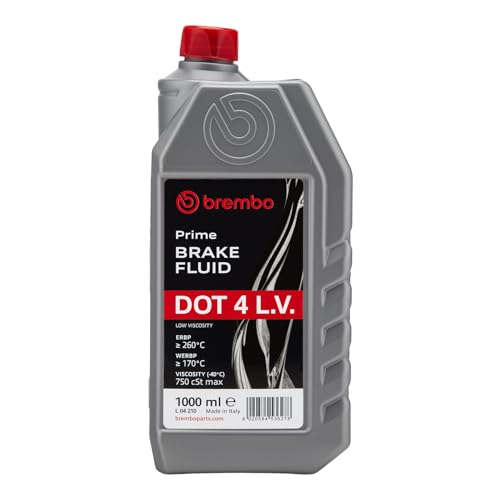
Brembo’s L04210 is a low-viscosity DOT 4 fluid engineered specifically for vehicles with advanced electronic braking and stability systems — including ABS, ESP, ASR, TCS, and EBD. The 2001 Honda Accord’s Bosch-based ABS unit benefits directly from the reduced viscosity, which allows the fluid to flow through the modulator’s tiny passages more quickly during rapid pressure-bleed cycles. This translates to more consistent pedal modulation when the system activates on slick pavement.
Owner reports consistently highlight the fluid’s staying power: multiple reviewers note that after a full year of service the pedal remains firm and the fluid shows minimal color darkening, indicating strong resistance to thermal breakdown. The 260°C flash point provides a generous safety margin over standard DOT 3 fluids, especially during hard braking events on long descents or in stop-and-go traffic. Brake fluid is the single most neglected safety item on older vehicles, and choosing a premium low-viscosity DOT 4 fluid addresses the Accord’s most common braking complaint — a soft pedal that worsens as the fluid ages.
One liter is sufficient for a complete system flush on the Accord, with enough left over for a top-off after bleeding all four corners. The bottle design includes a resealable cap that minimizes exposure to ambient moisture during storage. For owners who plan to keep their Accord on the road for several more years, the Brembo L04210 delivers the best balance of thermal performance, ABS compatibility, and long-term corrosion protection.
What works
- Low viscosity improves cold-weather ABS response
- High wet boiling point extends safe service intervals
- Full liter provides enough fluid for a complete flush
What doesn’t
- Premium pricing compared to basic DOT 3 fluids
- Overkill for owners who flush strictly per the maintenance schedule
2. LIQUI Moly Brake Fluid DOT 5.1

LIQUI Moly’s DOT 5.1 fluid sits at the top of the glycol-based performance hierarchy, offering a wet boiling point that significantly exceeds both DOT 3 and standard DOT 4 specifications. For a 2001 Accord that sees mountain driving, towing, or frequent stop-and-go commuting, the higher thermal capacity means the fluid resists vapor lock longer when the brakes are worked hard. The 250-milliliter bottle is compact, but the fluid’s potency means a single bottle is enough for a complete bleed — experienced owners note that the wide base of the bottle prevents tipping during one-handed pouring.
Despite the “DOT 5.1” label, this fluid is fully compatible with the Accord’s rubber seals and ABS system because it remains glycol-based — not silicone-based like DOT 5. Owners who have used it in European and Japanese vehicles alike report that the pedal feel sharpens noticeably after a flush, with a firmer bite at the top of the pedal travel. The German manufacturing standards also mean consistent quality from batch to batch, which is important for a safety-critical component like brake fluid.
The primary consideration is volume: at 250 milliliters, you will need to measure carefully to avoid running short during a full system flush on the Accord, which typically requires about 500 to 600 milliliters for a complete exchange. Buying two bottles ensures you have enough to purge all old fluid from the calipers and clutch system if your Accord has a hydraulic clutch. For owners who prioritize the highest possible wet boiling point without switching to a silicone formulation, this is the logical choice.
What works
- Excellent wet boiling point for sustained braking performance
- Fully compatible with ABS and standard rubber seals
- Stable German formulation with consistent batch quality
What doesn’t
- Small bottle size requires two units for a full system flush
- Premium cost per ounce compared to DOT 3 alternatives
3. Genuine Toyota Fluid 00475-1BF03 Brake Fluid

Genuine Toyota Fluid 00475-1BF03 is an OEM-specification DOT 3 fluid originally developed for Toyota and Lexus vehicles, but its performance parameters align closely with the Honda Accord’s factory requirement. The fluid meets or exceeds DOT 3 standards with a formulation designed to reduce vapor lock by providing a higher boiling point than the minimum specification. For Accord owners who prefer an OEM-equivalent product from a major Asian manufacturer, this is a direct substitute that will not introduce compatibility concerns.
The 355-milliliter (12-ounce) bottle is small, reflecting Toyota’s standard packaging for brake fluid. Owners of Toyota vehicles report that the fluid provides superior metal component protection and helps prevent corrosion inside the brake system — the same anti-corrosion additives that benefit Toyota braking systems translate directly to the Accord’s iron calipers and steel brake lines. Multiple reviews highlight that the fluid maintains a clean appearance even after months of service, which suggests effective moisture management and minimal copper leaching from the brake lines.
The small bottle size means you will need at least two units to complete a full flush on the Accord. The fluid is a straightforward DOT 3 formulation, so it does not offer the elevated wet boiling point of a DOT 4 or DOT 5.1 fluid. For Accord owners who follow the recommended two-year flush interval and drive under normal conditions, this OEM-grade fluid provides proven protection at a reasonable per-bottle cost. It is also a good option for topping off between flushes if you prefer to keep a single fluid type in the system.
What works
- OEM-grade anti-corrosion additives protect iron calipers and steel lines
- Meets DOT 3 specifications with a higher-than-minimum boiling point
- Trusted formulation from a major Asian automotive manufacturer
What doesn’t
- Small 12-ounce bottle requires multiple units for a full flush
- DOT 3 wet boiling point is lower than premium DOT 4 alternatives
4. MAG 1 120 Premium DOT 3 Brake Fluid

MAG 1’s 120 Premium DOT 3 Brake Fluid is a straightforward, no-frills option that exceeds the minimum DOT 3 performance specifications by a healthy margin. The advertised dry boiling point of 492°F and wet boiling point of 304°F provide a meaningful buffer above the required 401°F dry and 284°F wet thresholds. For a 2001 Accord that is used for daily commuting and around-town driving, this fluid delivers the thermal headroom needed to prevent vapor lock without paying a premium for higher DOT 4 or DOT 5.1 performance.
The 32-ounce bottle is the largest single container in this comparison, providing enough fluid to complete a full brake system flush on the Accord with some left over for the clutch circuit if equipped. Owners of a wide range of vehicles — from a 1970 Pontiac Firebird to a 1996 Honda — report that the fluid performs exactly as expected with no compatibility issues. The fluid is manufactured in the USA by Warren Distribution, which produces a broad range of automotive lubricants and fluids under the MAG 1 brand.
The biggest practical consideration with any DOT 3 fluid is its service life. Once the bottle is opened, the fluid begins absorbing moisture from the air, and an opened container should be used within 90 days to maintain its performance specifications. The large 32-ounce size is ideal if you plan to flush the Accord’s system immediately, but less practical if you only need a small amount for a top-off. For budget-conscious owners who do their own maintenance, this is the most economical way to restore firm pedal feel.
What works
- Large 32-ounce bottle covers a full flush plus clutch circuit
- Exceeds minimum DOT 3 dry and wet boiling point specs
- Lowest cost per ounce among the products reviewed
What doesn’t
- DOT 3 wet boiling point is lower than premium formulations
- Opened bottle must be used within roughly 90 days
5. Johnsen’s 7012-6 Silicone DOT-5 Brake Fluid

Johnsen’s Silicone DOT-5 Brake Fluid is fundamentally different from the other products in this guide — it uses a silicone base instead of the glycol chemistry found in DOT 3, DOT 4, and DOT 5.1 fluids. This distinction matters enormously for the 2001 Honda Accord because silicone DOT 5 fluid is incompatible with ABS systems. The Accord’s ABS modulator relies on the slight electrical conductivity and lubricity of glycol-based fluid to operate its internal valves correctly; silicone fluid causes erratic valve operation and can lead to complete ABS failure.
Owners who have used Johnsen’s DOT-5 report excellent results in classic cars and motorcycles that lack ABS — vehicles with simple hydraulic brake systems where the silicone fluid’s resistance to moisture absorption prevents internal corrosion for years. The 500°F protection rating provides a very high thermal margin, and the fluid’s non-hygroscopic nature means it does not absorb water like glycol fluids do. For a vintage car that sits for months at a time, this eliminates the need for frequent fluid flushes.
The critical restriction for Accord owners is that converting to DOT 5 requires complete removal of all glycol residue from the system, including replacement of seals, hoses, and the master cylinder — a labor-intensive and expensive process. Even a trace of residual glycol will turn the silicone fluid into a gel-like sludge. Johnsen’s DOT-5 earns its place in this guide as a reference point: it is an excellent product for the right application, but the 2001 Honda Accord is not that application unless you are building a dedicated track car with the ABS system completely removed.
What works
- Excellent moisture resistance for long-term storage vehicles
- High 500°F protection rating resists thermal fade
- Ideal for classic cars and motorcycles without ABS
What doesn’t
- Not compatible with the Accord’s ABS system
- Requires complete system conversion if switching from glycol fluid
Hardware & Specs Guide
Dry Boiling Point
This is the temperature at which fresh, uncontaminated brake fluid begins to form vapor bubbles when measured in a laboratory setting. Vapor bubbles are compressible — they turn your firm brake pedal into a spongy, unreliable lever. DOT 3 requires a minimum dry boiling point of 401°F, while DOT 4 requires 446°F and DOT 5.1 requires 500°F. The fluids in this guide range from 492°F on the MAG 1 DOT 3 to over 500°F on the Johnsen’s DOT-5 and the LIQUI Moly DOT 5.1.
Wet Boiling Point
This is the boiling point after the fluid has absorbed approximately 3.7 percent water by weight — the typical condition after one to two years of service. It is the more important specification for real-world safety because it tells you how the fluid will perform after it has aged. DOT 3 requires a minimum wet boiling point of 284°F, DOT 4 requires 311°F, and DOT 5.1 requires 356°F. The Brembo L04210 and LIQUI Moly DOT 5.1 lead this category with the highest wet boiling points in the group.
Viscosity and ABS Flow
Brake fluid must flow quickly through the small orifices inside the ABS modulator, especially in cold weather when viscosity increases. DOT 4 and DOT 5.1 fluids are formulated with lower viscosity than standard DOT 3, which allows them to move through the system faster during rapid pressure-bleed cycles. The Brembo L04210 is explicitly labeled as low-viscosity DOT 4 and is recommended for vehicles with electronic stability and braking systems.
Moisture Resistance and Fluid Life
Glycol-based DOT 3, DOT 4, and DOT 5.1 fluids are hygroscopic by design — they absorb moisture evenly throughout the system to prevent localized corrosion. This means their boiling point drops predictably over time. Silicone DOT 5 fluid is non-hygroscopic and resists moisture absorption, but any water that enters the system pools at low points and causes localized rust. For a daily-driven Accord, glycol-based fluid with a two-year flush interval is the safer, more practical choice.
FAQ
Can I use DOT 4 instead of DOT 3 in my 2001 Honda Accord?
How often should I flush the brake fluid on my 2001 Accord?
Will using a premium DOT 5.1 fluid damage my Accord’s seals?
Can I top off my Accord brake fluid with a different brand?
Final Thoughts: The Verdict
For most buyers, the 2001 honda accord brake fluid winner is the Brembo L04210 because it combines low-viscosity ABS performance with a high wet boiling point at a reasonable per-liter cost. If you want the highest possible thermal margin for mountain driving or heavy loads, grab the LIQUI Moly DOT 5.1. And for a simple, budget-conscious flush that covers the entire system with a single bottle, nothing beats the MAG 1 Premium DOT 3.

Certification: BSc in Mechanical Engineering
Education: Mechanical engineer
Lives In: 539 W Commerce St, Dallas, TX 75208, USA
Md Amir is an auto mechanic student and writer with over half a decade of experience in the automotive field. He has worked with top automotive brands such as Lexus, Quantum, and also owns two automotive blogs autocarneed.com and taxiwiz.com.