A dead battery miles from the dock is more than an inconvenience — it is a safety hazard that turns a relaxing day on the water into a stressful rescue situation. Whether you are wrestling with a cold marine engine, running electronics on a deep-cycle bank, or need a portable jump pack that fits in a waterproof bag, the right starting solution depends on understanding cranking amps, reserve capacity, and battery chemistry in a saltwater environment.
I’m Amir — the founder and writer behind Four Wheel Ask. My approach centers on cross-referencing manufacturer specifications with long-term owner feedback to separate marketing claims from real-world dependability in marine starting applications.
After analyzing dozens of top models and thousands of verified owner reports, we identified the best boat battery starter options that deliver reliable performance on the water.
How To Choose The Best Boat Battery Starter
Selecting a marine starting solution requires balancing cranking power, battery chemistry, physical dimensions, and your specific boating habits. A starter for a weekend bass boat has very different requirements than one for a twin-engine offshore cruiser.
Cranking Amps and Engine Compatibility
Cold cranking amps measure a battery’s ability to start an engine at freezing temperatures. Marine engines typically need higher CCA than automotive equivalents due to higher compression ratios and the added resistance of water-cooled exhaust systems. As a rule of thumb, aim for at least one CCA per cubic inch of engine displacement, and always verify that your chosen battery meets the minimum CCA recommended by your outboard or inboard manufacturer.
Battery Chemistry: AGM, Flooded, or LiFePO4
Absorbent glass mat (AGM) batteries dominate the marine starting market because they are spill-proof, vibration-resistant, and require no maintenance. Flooded lead-acid batteries remain the budget option but demand regular water checks and ventilation. Lithium iron phosphate (LiFePO4) batteries now offer significant weight savings, faster charging, and dramatically longer cycle life, though they require compatible alternators and chargers to avoid damaging the battery management system.
Dual-Purpose versus Dedicated Starting Batteries
A dedicated starting battery delivers maximum cranking power but has minimal reserve capacity for running electronics. Dual-purpose batteries provide a middle ground — enough cranking amps to start your engine plus moderate deep-cycle capability for fish finders, radios, and bilge pumps. If you run multiple accessories while anchored, a separate house battery bank combined with a dedicated starter battery is the more reliable setup. Jump starters add portable flexibility for emergencies but are not substitutes for a properly sized house bank.
Quick Comparison
On smaller screens, swipe sideways to see the full table.
| Model | Category | Best For | Key Spec | Amazon |
|---|---|---|---|---|
| NOCO Boost GB40 | Jump Starter | Emergency Starting | 1000A Peak, 6.0L Gas | Amazon |
| AVAPOW TJ58 8000A | Jump Starter | Heavy-Duty Starting | 8000A Peak, 4-inch Display | Amazon |
| LiTime 165Ah Dual Purpose | Lithium Battery | Marine Dual Purpose | 1200 CCA, 165Ah LiFePO4 | Amazon |
| ANCEL BS200 Super Starter | Jump Starter | Permanent Installation | 700A Peak, Super Capacitor | Amazon |
| WEIZE Group 31M AGM | AGM Battery | Deep Cycle Cranking | 825 CCA, 105Ah AGM | Amazon |
| GOLDENMATE 100Ah LiFePO4 | Lithium Battery | Deep Cycle Storage | 100Ah, 15000 Cycles | Amazon |
| MARSENERGY 100Ah Group 24 | Lithium Battery | Deep Cycle Storage | 100Ah, 4500 Cycles | Amazon |
| BuTure VAC 10-in-1 8000A | Jump Starter | All-in-One Emergency | 8000A, 160PSI Compressor | Amazon |
| OPTIMA RedTop 34 | AGM Battery | Premium Starting | 800 CCA, SpiralCell | Amazon |
| Schumacher SJ1329 600A | Jump Starter | Budget Starting | 600A, Lead-Acid Internal | Amazon |
| DKLU1 Group U1 Lithium | Lithium Battery | Lawn and Garden | 450 CCA, 3Ah LiFePO4 | Amazon |
In-Depth Reviews
1. NOCO Boost GB40

NOCO set the standard for portable lithium jump starters, and the GB40 remains the most trusted model for boaters who want a compact emergency pack. Its 1000-amp peak output handles gasoline engines up to 6.0 liters and diesel engines up to 3.0 liters, covering the vast majority of trailer boats, center consoles, and small cruisers. The patented spark-proof technology and reverse polarity protection make it safe for users who may be connecting clamps in tight, dark engine compartments after a long day on the water.
Owner feedback consistently highlights the GB40’s ability to hold a charge for months during storage, which is critical for seasonal boaters who only visit the marina every few weeks. The 100-lumen LED flashlight with SOS and strobe modes provides reliable emergency lighting for night repairs or signaling. At just 2.5 pounds, this unit fits easily into a tackle box or glove compartment without adding noticeable weight.
Some owners report needing to activate the manual override button for completely dead batteries, a step that is not clearly documented in the printed manual. The included USB-C charging cable is welcome, but a wall charger is not included in the box. Despite these minor gaps, the GB40 delivers consistent starting performance across a wide range of conditions, including sub-zero temperatures, making it the most well-rounded choice for boaters who prioritize portability and proven reliability.
What works
- Compact form factor fits in small storage spaces
- Holds charge for months between uses
- Spark-proof clamps eliminate connection anxiety
- Integrated flashlight with multiple modes
What doesn’t
- Wall charger not included in the package
- Override feature for dead batteries not clearly documented
- Limited to 6.0L gas and 3.0L diesel engines
2. AVAPOW TJ58 8000A Jump Starter
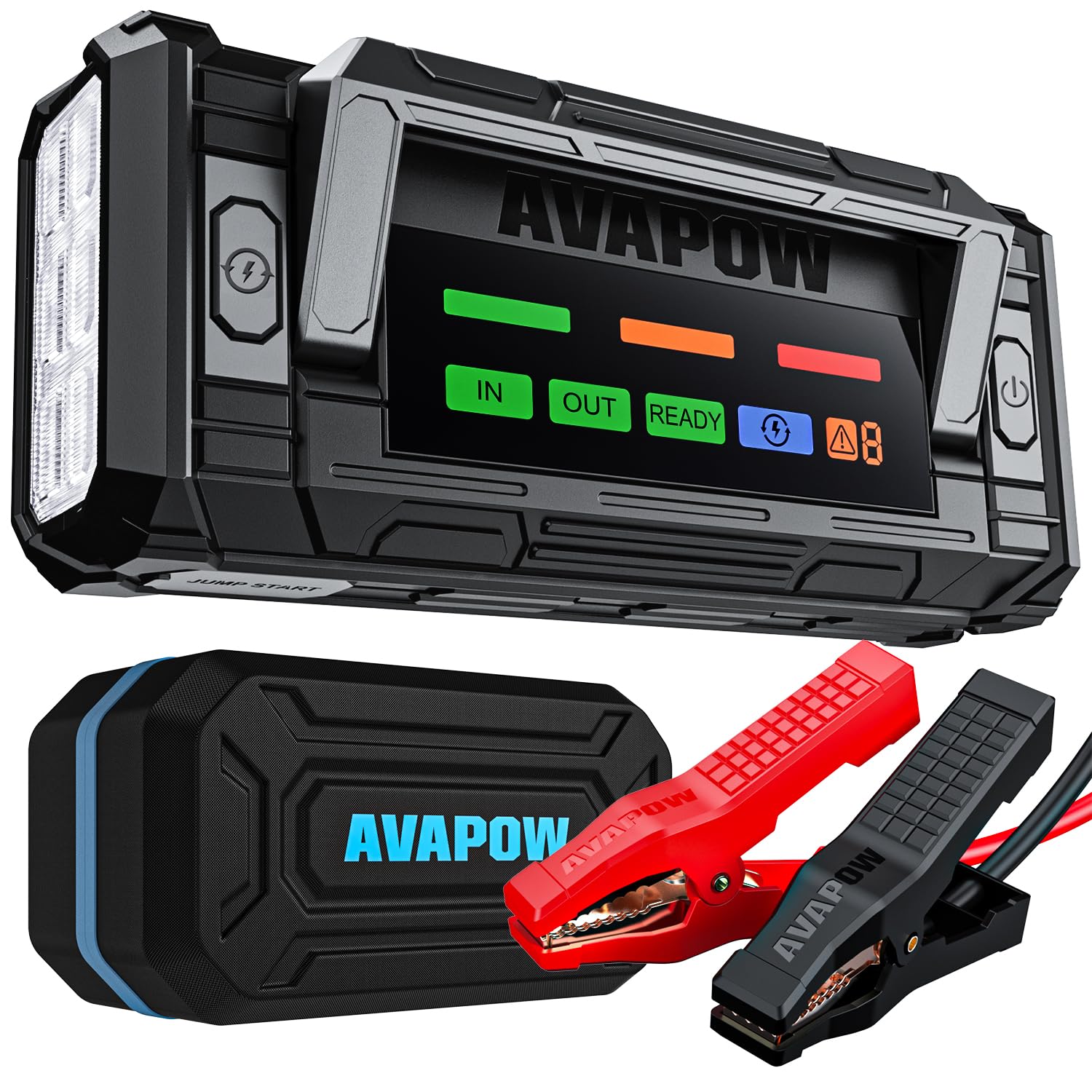
The AVAPOW TJ58 brings an 8000-amp peak current rating that covers every gasoline engine and nearly all diesel engines commonly found in recreational marine applications. The standout feature is the 4-inch smart display that shows battery level, charging status, clamp connection integrity, and error alerts, removing guesswork during an already stressful situation. This is especially valuable for less experienced boaters who may not be familiar with jump-starting procedures in cramped engine bays.
Users praise the rigid ABS and PC casing combined with flame-retardant materials, which provide real protection in a marine environment where fuel fumes and battery gases may be present. The dual-layer copper clamps deliver strong cranking power even on completely depleted batteries, and the Force Start button provides an extra layer of capability for stubborn engines. The 30W PD fast charging brings the unit to full capacity in roughly 1.5 hours, and the USB-A and 12-volt DC outputs can power phones, fish finders, and small accessories.
Several owners report successful starts in subzero Midwestern winters and for older outboard motors that smaller packs could not handle. The unit weighs 4.3 pounds with a rugged handle, which is heavier than compact models but still easy to carry aboard. A few users note that the unit requires a top-up charge every two to three months during storage to maintain optimal health, a common requirement for high-capacity lithium packs. The lifetime warranty adds long-term peace of mind for a product that may only be used a few times per year.
What works
- Massive 8000A peak handles large marine diesels
- Clear 4-inch display with error alerts simplifies use
- Flame-retardant casing adds safety in engine compartments
- Fast 1.5-hour recharge time
What doesn’t
- Heavier than compact alternatives at 4.3 pounds
- Requires periodic top-up charging in storage
- Overkill for small outboards and personal watercraft
3. LiTime 12V 165Ah Dual Purpose Lithium Marine Battery
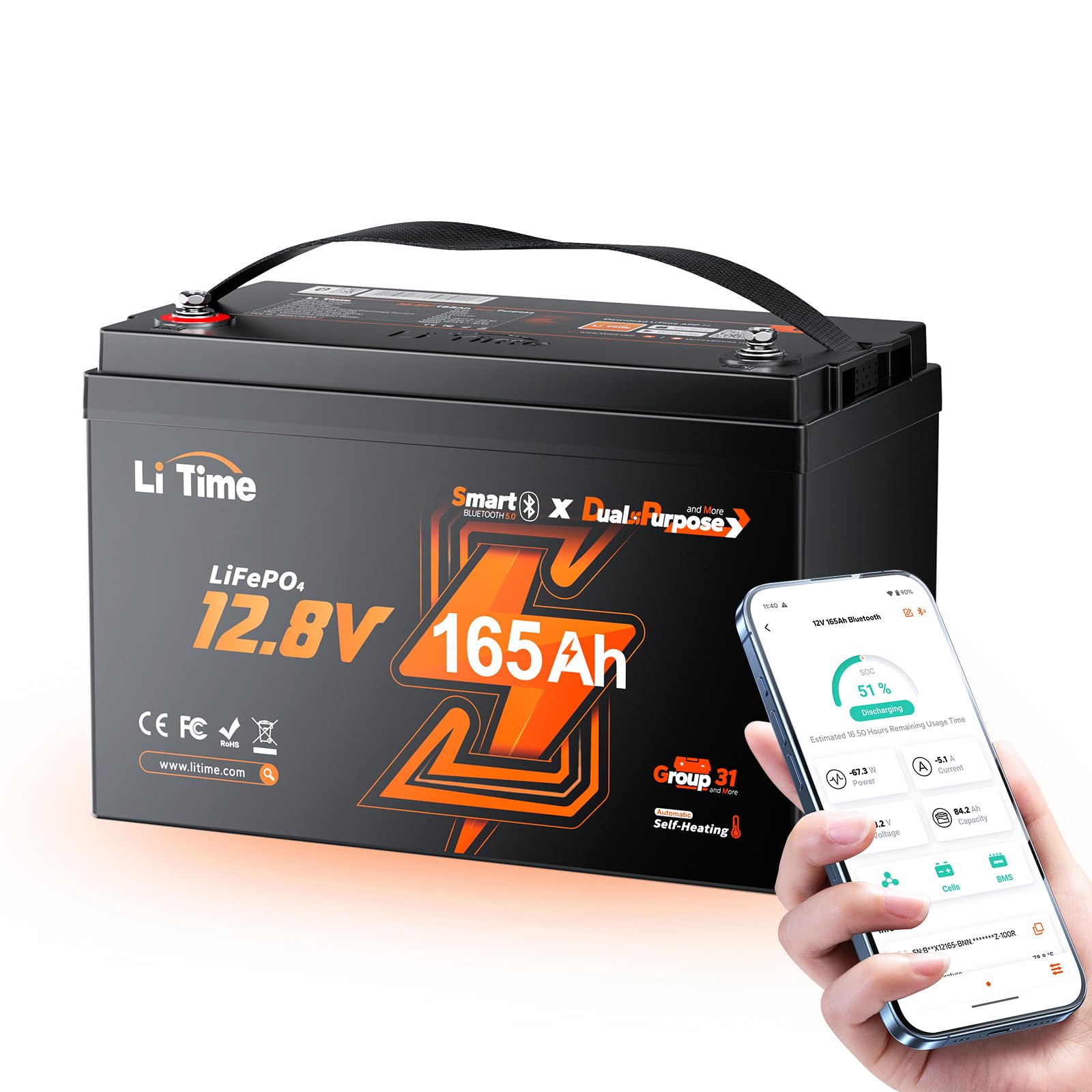
The LiTime 165Ah dual-purpose battery represents the next generation of marine electrical systems, combining a dedicated starting battery with a deep-cycle house bank in a single Group 31 package. With 1200 cold cranking amps and a 165-amp-hour capacity, this LiFePO4 battery can start large outboards while simultaneously powering fish finders, radios, and livewell pumps for extended periods. The built-in automatic heating technology activates when temperatures drop below freezing, ensuring the battery can charge in cold weather conditions that would disable standard lithium batteries.
Owners report that this battery eliminates the need for separate starting and house banks on smaller to mid-sized boats, saving significant weight and space. The LiTime battery weighs just 33.5 pounds — roughly half the weight of an equivalent AGM battery with similar capacity. The Bluetooth monitoring app provides real-time voltage, state of charge, and temperature data, and it sends alerts before the battery reaches a critical discharge level. The 15 percent emergency reserve feature automatically cuts discharge to preserve enough power for engine starting, a thoughtful safety net for boaters who run electronics hard while anchored.
A small number of owners experienced customer service delays when troubleshooting charging issues, and the battery requires a compatible LiFePO4 charger to achieve its rated lifespan. The terminal bolts received feedback for being slightly short for some marine cable lugs. Overall, this battery delivers exceptional performance for boaters ready to transition from legacy lead-acid chemistry to a modern lithium setup with genuine dual-purpose capability.
What works
- Eliminates need for separate starting and house batteries
- Automatic heating enables charging below freezing
- Bluetooth monitoring with low-charge alerts
- Half the weight of equivalent AGM batteries
What doesn’t
- Requires compatible LiFePO4 charger and alternator
- Terminal bolts may be short for some cable lugs
- Customer service response times reported as inconsistent
4. ANCEL BS200 Super Starter
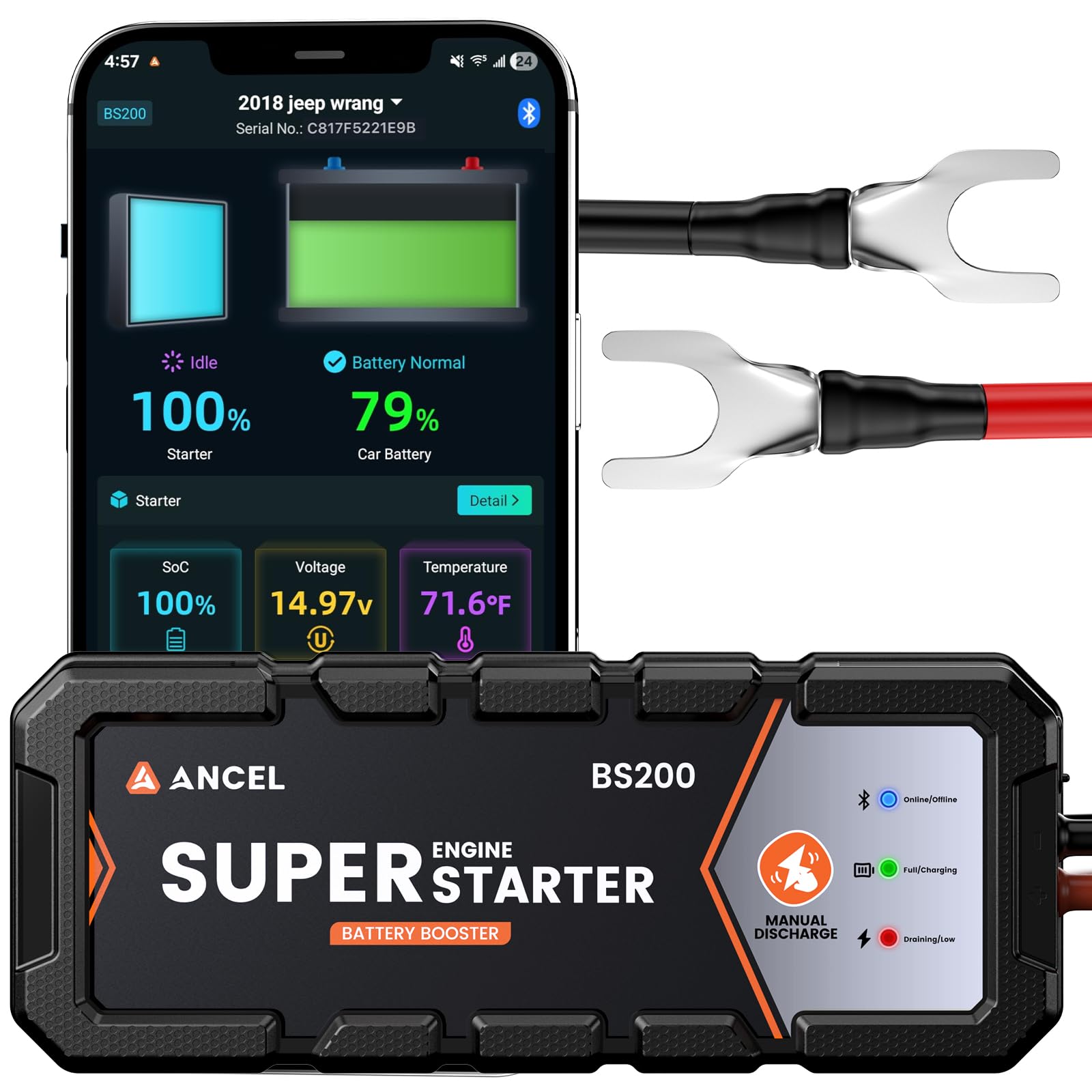
The ANCEL BS200 takes a fundamentally different approach to jump-starting by using supercapacitor technology rather than a traditional lithium battery. Once permanently connected to your boat’s battery, it charges itself from the battery’s residual energy and delivers a 700-amp boost when needed. This set-it-and-forget-it design eliminates the most common failure point of portable jump starters — a dead internal battery found only when you need it most. For boaters who leave their vessel at a marina or mooring, this provides continuous protection without requiring regular maintenance charging.
Owner reviews emphasize the peace of mind that comes from a device that is always ready and never needs to be remembered or retrieved from storage. The supercapacitor technology is rated for 100,000 start assists with no chemical degradation, meaning the unit can outlast the boat itself. The companion smartphone app displays real-time battery voltage, temperature, and jump-start history, allowing owners to monitor battery health between trips. The operating range spans from minus 40 to 176 degrees Fahrenheit, making it suitable for boats stored in extreme climates.
The most notable constraint is that the BS200 ships with a 700-amp peak output, which may be insufficient for large twin-engine setups or high-compression marine diesels exceeding that threshold. A few owners found the permanent wiring installation requires basic electrical skills and may not be straightforward for everyone. The unit works best as a supplement to a healthy battery rather than a solution for a completely failed battery with zero residual charge.
What works
- Permanent installation removes risk of dead backup unit
- Supercapacitor rated for 100,000 start assists
- Smartphone monitoring with voltage and temperature data
- Operates reliably in extreme hot and cold conditions
What doesn’t
- 700A peak may not handle large twin-engine setups
- Requires basic wiring knowledge for installation
- Needs some residual battery charge to function
5. WEIZE BCI Group 31M Dual Purpose AGM Battery

WEIZE offers a robust dual-purpose AGM battery that delivers genuine cranking capability alongside deep-cycle resilience. The Group 31M form factor provides 825 cold cranking amps and 105 amp-hours of capacity, making it suitable for boats that need reliable starting power plus the ability to run electronics during a day on the water. The AGM construction is leak-proof and maintenance-free, eliminating the need to check water levels or clean corrosion from terminals in a saltwater environment.
Owner feedback highlights the battery’s ability to start large engines effortlessly, with several users installing three units in parallel for diesel RV applications and reporting excellent results. The quick-charge capability allows recovery up to five times faster than flooded batteries, which is valuable for boaters who return to the dock with partially depleted banks and need to recharge before the next outing. The vibration resistance is 20 times greater than flooded batteries, addressing a common failure mode in boats that encounter rough water.
At 67 pounds, this battery is significantly heavier than lithium alternatives, which is an important consideration for weight-sensitive boats. A few owners noted that the terminal configuration requires careful measurement to ensure compatibility with existing battery trays and cable lengths. While AGM technology is well-proven, the cycle life is still substantially shorter than LiFePO4 options, making this a better choice for boaters who prioritize upfront affordability and proven technology over maximum cycle longevity.
What works
- Strong 825 CCA starts large marine engines reliably
- Leak-proof AGM construction ideal for boats
- Quick-charge capability reduces downtime
- Exceptional vibration resistance for rough water
What doesn’t
- Heavy at 67 pounds affects weight distribution
- Shorter cycle life compared to lithium alternatives
- Terminal configuration may require adapter modifications
6. GOLDENMATE 12V 100Ah LiFePO4 Deep Cycle Battery

GOLDENMATE delivers a strong value proposition with its 100-amp-hour LiFePO4 battery, which provides up to 15,000 deep cycles compared to the 300 to 500 cycles typical of lead-acid alternatives. The built-in 100-amp BMS protects against overcharging, over-discharging, overcurrent, overheating, and short circuits, making this a safe drop-in replacement for Group 31 flooded batteries in trolling motor and house bank applications. The battery weighs 28.7 pounds, which is roughly 60 percent less than a comparable lead-acid battery, freeing up capacity for gear or fuel.
Owners report excellent runtime on trolling motors, with one user describing six hours of continuous use at 40 to 60 percent throttle on a 46-pound thrust motor. The ability to connect up to four batteries in series or parallel allows boaters to scale their electrical system from 12 volts to 48 volts and from 100 amp-hours to 400 amp-hours without changing batteries. The Bluetooth app provides charge level, runtime estimates, and remaining charge time, giving owners clear visibility into their electrical status without lifting the hatch.
A critical limitation is that this battery is not designed for engine starting applications and the product page explicitly states it cannot be used as a starting battery. Some owners reported that the built-in handle broke during normal installation, though the company offered partial refunds in those cases. The battery also requires additional waterproofing measures if installed in an area exposed to bilge water or rain, as the casing is not rated for direct water contact.
What works
- Exceptional 4000 to 15000 cycle lifespan
- Lightweight at 28.7 pounds for Group 31 size
- Bluetooth monitoring with charge estimates
- Scalable series or parallel configuration
What doesn’t
- Not suitable for engine starting applications
- Not waterproof without additional protection
- Handle durability reported as a weak point
7. MARSENERGY 12V 100Ah LiFePO4 Deep Cycle Battery
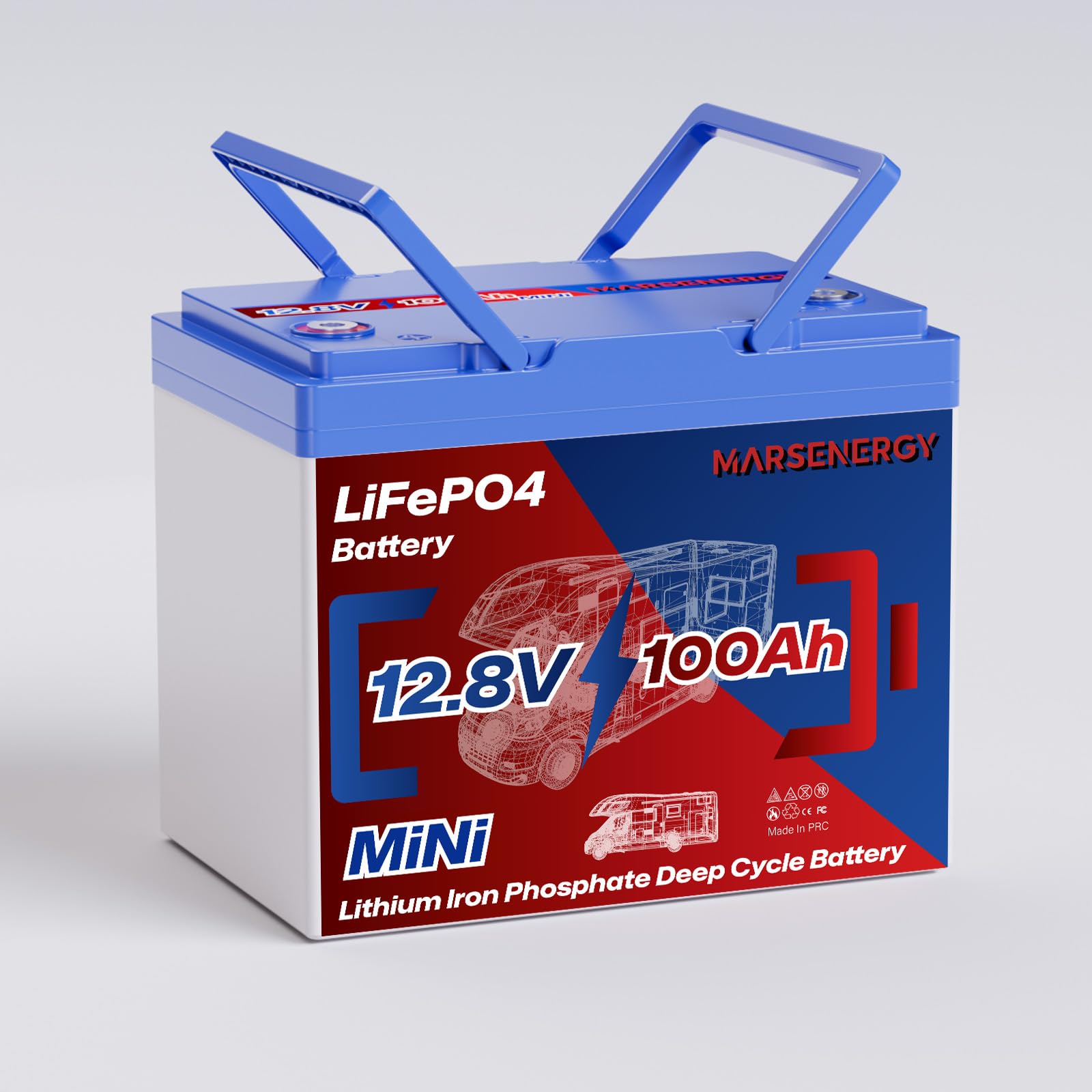
MARSENERGY offers a compelling Group 24 LiFePO4 battery that weighs only 21 pounds, making it one of the lightest 100-amp-hour options on the market. The BCI Group 24 footprint matches standard lead-acid battery trays, so upgrading to lithium requires no modification to existing battery boxes or hold-downs. The battery uses A-grade lithium cells with an advanced BMS that provides multiple safety protections and puts the battery into sleep mode during abnormal conditions, automatically resuming normal operation once the issue is resolved.
Owner reviews highlight the battery’s strong charge retention and rapid recovery when using solar panels, with one dry-camper reporting minimal generator use over an entire weekend thanks to the battery’s ability to accept charge efficiently. The self-heating version warms the cells before charging in cold temperatures, taking roughly 50 minutes to bring the battery from 21 degrees to 41 degrees Fahrenheit before beginning the charge cycle. The five-year after-sales service provides longer coverage than many competing lithium batteries at this price point.
Some owners report that the Bluetooth app requires a Chinese account sign-up process, which may be inconvenient for privacy-conscious users. A few users noted that the state-of-charge reading in the app never reaches 100 percent, maxing out around 98 percent, which may indicate a calibration limitation in the BMS firmware. The slow charge acceptance at around 21 amps means full recharges take longer than some competing models, though this is adequate for overnight charging with solar or a standard marine charger.
What works
- Extremely lightweight at 21 pounds for 100Ah capacity
- Group 24 footprint fits standard battery trays
- Self-heating option enables cold-weather charging
- Five-year after-sales service provides long coverage
What doesn’t
- Bluetooth app requires Chinese account registration
- State-of-charge display may not show 100 percent
- Slow charge acceptance at approximately 21 amps
8. BuTure VAC 10-in-1 8000A Jump Starter with Air Compressor
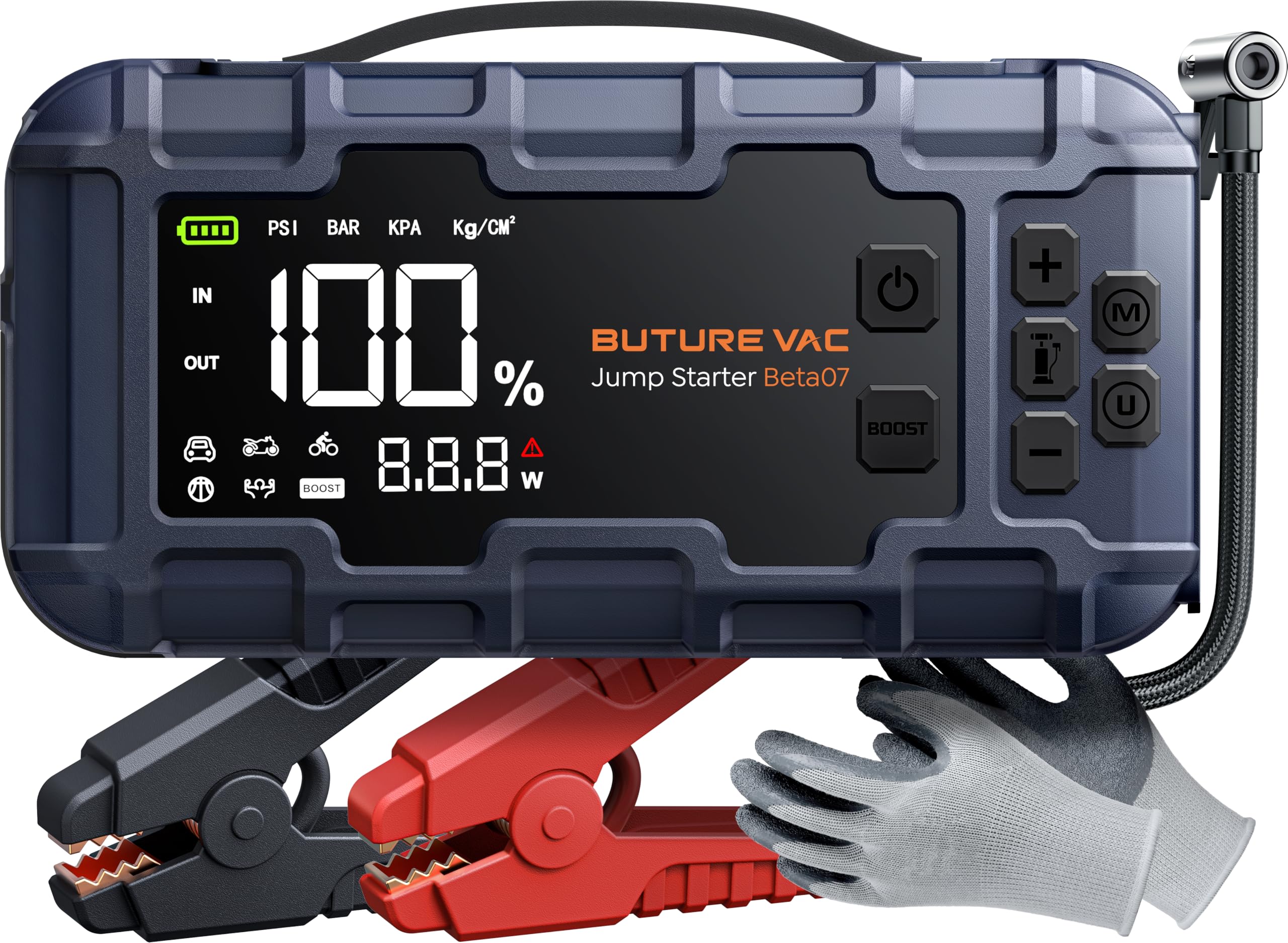
The BuTure VAC packs an impressive feature set into a single portable unit, combining an 8000-amp jump starter with a 160 PSI cordless air compressor, 45W PD fast charging, a 26800 milliamp-hour power bank, and an 800-lumen LED work light. The built-in air compressor is particularly useful for boaters who need to top off trailer tires, inflate towable tubes, or adjust air pressure on inflatable boats between launches. The 3.3-inch smart display shows real-time tire pressure with plus or minus 1 PSI accuracy and includes five inflation modes for different applications.
Owner reports confirm that the unit charges quickly through the 45W USB-C input, reaching 80 percent in about one hour, and that the jump-starting function reliably fires engines that have been sitting idle for months. The included 400-volt insulated gloves add a layer of safety for marine environments where battery terminals may be corroded or difficult to access. The retractable handle and rugged carrying case make it easy to transport between the truck, boat, and trailer without damage.
Some users found that the air compressor drains the battery pack relatively quickly, with only two tires possible on a single charge in some cases, and the pump struggles with large truck tires requiring significant air volume. The interface received mixed feedback for being slightly cumbersome to navigate without the manual on hand. A few owners noted that the unit could not jump-start a completely dead battery with zero residual voltage, though it worked well when the battery had at least some charge remaining.
What works
- Integrated air compressor adds real utility for boaters
- Fast 45W charging reaches 80 percent in one hour
- Insulated gloves provide extra safety in tight engine bays
- Bright 800-lumen LED with SOS mode
What doesn’t
- Air pump drains battery quickly under heavy use
- Interface requires manual reference for full navigation
- May not start batteries with completely zero voltage
9. OPTIMA RedTop 34 Starting Battery

OPTIMA’s RedTop 34 has earned its reputation as a premium starting battery through decades of proven performance in demanding applications. The patented SpiralCell AGM technology uses 99.99 percent pure lead wound into spiral plates, which delivers higher power density and greater vibration resistance than conventional flat-plate AGM designs. With 800 cold cranking amps and 100 minutes of reserve capacity, this battery provides reliable starting power for marine engines while offering enough reserve to run essential electronics during short stops.
Long-term owner reports consistently describe eight to ten years of service life in both automotive and marine applications, with several users reporting that their RedTop outlasted multiple vehicles. The completely sealed, maintenance-free design eliminates terminal corrosion and acid leaks, which is critical in a marine environment where battery acid can damage fiberglass, aluminum, and electrical components. The battery is also fully recoverable after deep discharges, unlike many standard AGM batteries that lose capacity permanently after being drained below 50 percent.
The RedTop 34 weighs 37.9 pounds, which is moderate for its power output but still significantly heavier than lithium alternatives with similar cranking capability. A small number of owners experienced premature failure within the first year, though this appears to be an outlier in a product known for exceptional reliability. The SAE terminal design is standard for most marine applications, but some boaters may need terminal adapters for their specific cable ends. The warranty fulfillment process requires working directly with OPTIMA rather than through Amazon, which a few owners found inconvenient.
What works
- SpiralCell technology delivers exceptional vibration resistance
- Consistent eight to ten year service life reported by owners
- Spill-proof design protects fiberglass and electronics
- Recoverable after deep discharge events
What doesn’t
- Heavier than lithium batteries with similar CCA
- Warranty requires direct manufacturer contact
- Occasional early failures reported despite general reliability
10. Schumacher SJ1329 600A Jump Starter and Power Station

Schumacher Electric brings decades of battery charging expertise to the SJ1329, a 600-amp jump starter and portable power station designed for 12-volt automotive, marine, and powersport applications. The internal lead-acid battery provides reliable starting power for four to six cylinder gasoline and diesel engines, covering the majority of small to mid-sized outboard and sterndrive configurations. The built-in 12-volt DC outlet expands the unit’s usefulness for powering marine accessories such as bilge pumps, spotlights, and small inverters while working on the boat.
Owner feedback emphasizes the straightforward operation: connect the clamps, press the switch to verify the connection, and start the engine. Several users reported replacing their Schumacher unit after seven or more years of service with a new one from the same brand, indicating strong long-term reliability. The LED work light is bright enough for engine compartment repairs at night, though users note that there is no on-off switch for the light, which can be a minor annoyance. The unit weighs 7.8 pounds, which is heavier than modern lithium jump starters but provides a solid, durable feel.
The most significant limitation is the internal lead-acid battery technology, which offers only 7000 milliamp-hours of capacity compared to the 20,000 to 26,800 milliamp-hours found in similarly priced lithium packs. This translates to fewer jump starts per charge and longer recharge times. The lead-acid chemistry also means the unit loses charge faster during storage and requires more frequent maintenance charging. For boaters who only need occasional emergency starting and want a proven, budget-friendly option, the SJ1329 remains a solid choice despite its older technology.
What works
- Proven Schumacher reliability with years of service reported
- Simple operation with minimal learning curve
- Built-in 12V outlet expands accessory power options
- Affordable entry point for emergency starting
What doesn’t
- Lead-acid internal battery has lower capacity than lithium packs
- Heavier and bulkier than modern lithium alternatives
- LED light lacks an on-off switch
- Requires more frequent maintenance charging in storage
11. DKLU1 Group U1 Lithium LiFePO4 Lawn Mower Battery
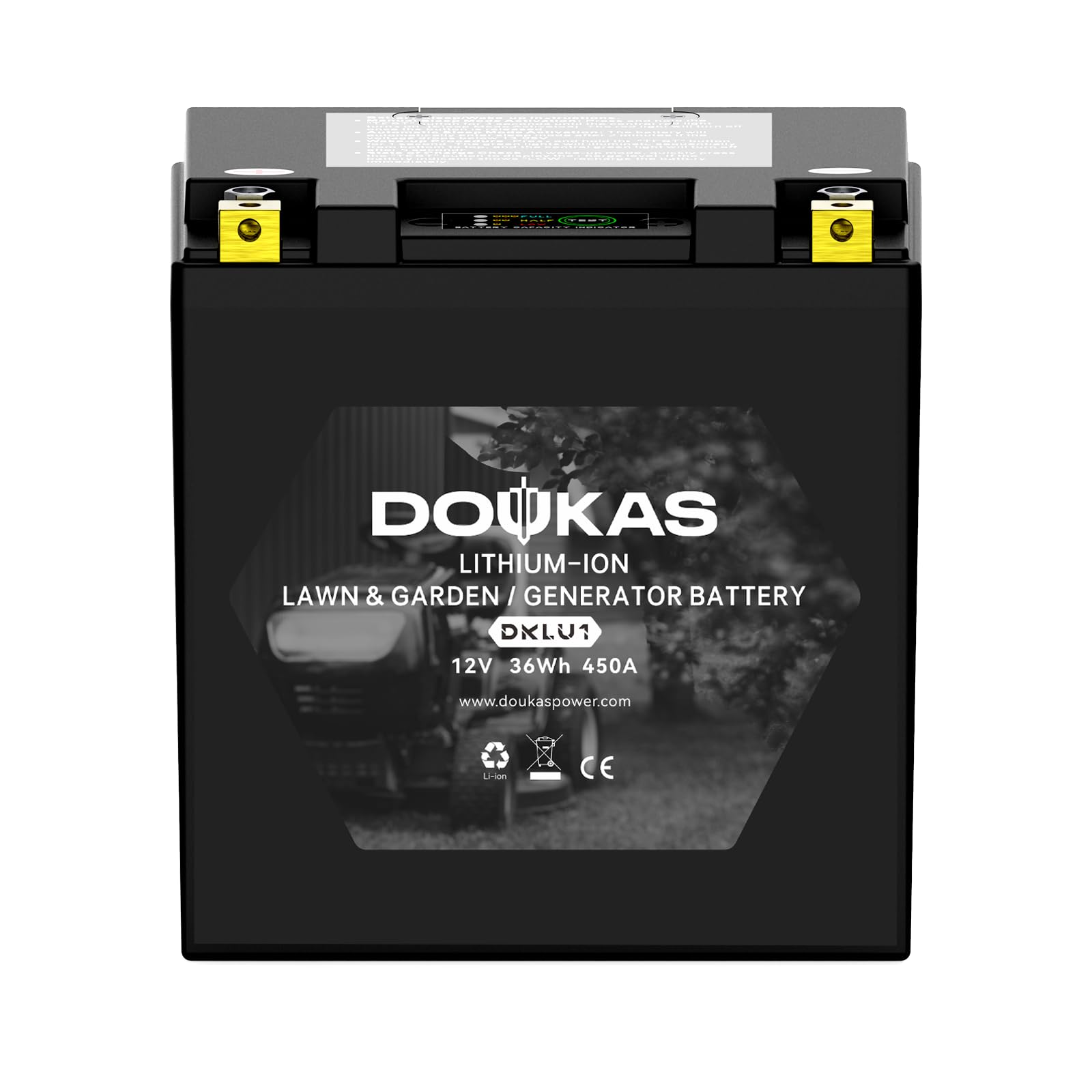
The DKLU1 lithium battery delivers a lightweight starting solution for small engines, including lawn tractors, generators, and portable outboard motors that use the Group U1 form factor. Weighing just 3.3 pounds — roughly one-fifth the weight of a lead-acid battery with equivalent dimensions — this LiFePO4 battery produces 450 cold cranking amps, which is three times the cranking current of a standard U1 lead-acid battery. The built-in BMS protects against overcharging, over-discharging, overheating, and freezing temperatures, making it effectively maintenance-free after installation.
Owners report that the battery holds a charge for months without a trickle charger, with one user describing seven successful starts over a winter storage period without any charging in between. The smart sleep mode automatically preserves charge when the battery is not in use, ensuring the engine starts reliably after weeks or months of sitting. The display screen shows real-time voltage, giving owners clear insight into battery health without requiring a separate multimeter. The IP65 weatherproof rating and internal shock-absorbing layer protect against rain, mud, and vibration during operation.
The most important limitation is that this battery is designed specifically for Group U1 applications and is not compatible with standard automotive or marine Group 24, 27, or 31 battery trays. A small number of owners reported battery failure after one winter, with some noting that standard lead-acid chargers cannot properly charge lithium batteries, potentially leading to undercharging if the wrong charger is used. The battery is also limited to 3 amp-hours of capacity, meaning it provides starting power only and cannot support accessory loads for extended periods.
What works
- Extremely lightweight at 3.3 pounds for U1 applications
- Smart sleep mode preserves charge during storage
- Integrated voltage display for health monitoring
- Weatherproof and vibration-resistant design
What doesn’t
- Limited to Group U1 applications only
- Requires compatible LiFePO4 charger for proper charging
- Minimal 3Ah capacity cannot support accessory loads
Hardware and Specs Guide
Cold Cranking Amps (CCA)
CCA measures a battery’s ability to start an engine at 0 degrees Fahrenheit. Marine engines typically need higher CCA than automotive engines due to higher compression and exhaust system resistance. For outboard motors under 150 horsepower, 600 to 800 CCA is usually sufficient; larger inboards and twin-engine setups may require 1000 CCA or more. Jump starters list peak amperage rather than CCA, which is a short-duration burst rating that cannot be directly compared to battery CCA specifications.
Reserve Capacity (RC)
Reserve capacity indicates how many minutes a battery can deliver 25 amps while maintaining at least 10.5 volts. This metric matters for boaters who run electronics off the starting battery while the engine is off. A battery with 100 minutes of RC can power a fish finder and radio for roughly an hour before dropping to discharge levels that may prevent engine restart. Dual-purpose batteries balance RC with CCA, while dedicated starting batteries prioritize cranking power over deep-cycle endurance.
Lithium versus AGM Construction
Lithium iron phosphate (LiFePO4) batteries offer roughly 70 percent weight reduction, 10 times the cycle life, and faster charging compared to AGM batteries of equivalent capacity. However, LiFePO4 batteries require compatible alternators and chargers — standard lead-acid charging profiles may damage the BMS or prevent full charging. AGM batteries remain the safer drop-in replacement for existing boats, as they accept standard charging profiles and are more tolerant of temperature extremes, though they are heavier and have shorter lifespans.
Jump Starter Internal Chemistry
Portable jump starters use either lithium-ion polymer or lead-acid internal batteries. Lithium packs offer higher energy density, lighter weight, and faster self-recharging, but they lose capacity over time and require periodic top-up charging during storage. Lead-acid jump starters are heavier and have lower capacity but are more tolerant of neglect and can survive being left without a charge for longer periods. Supercapacitor jump starters like the ANCEL BS200 eliminate internal batteries entirely, using capacitors that charge from the vehicle’s battery and deliver high-current bursts without chemical degradation.
FAQ
Can I use a car battery starter on my boat?
What is the difference between a starting battery and a deep-cycle battery for boats?
How many CCA do I need for my outboard motor?
Can I replace my marine lead-acid battery with a lithium battery?
How often should I charge my portable jump starter?
Final Thoughts: The Verdict
For most boaters, the best boat battery starter winner is the NOCO Boost GB40 because it combines proven reliability, compact size, and sufficient power for the vast majority of recreational marine engines at a reasonable investment. If you want permanent installation with no risk of a dead backup, grab the ANCEL BS200 Super Starter. And for boaters ready to upgrade their entire electrical system with a dual-purpose lithium solution that replaces both starting and house batteries, nothing beats the LiTime 165Ah Dual Purpose Marine Battery.

Certification: BSc in Mechanical Engineering
Education: Mechanical engineer
Lives In: 539 W Commerce St, Dallas, TX 75208, USA
Md Amir is an auto mechanic student and writer with over half a decade of experience in the automotive field. He has worked with top automotive brands such as Lexus, Quantum, and also owns two automotive blogs autocarneed.com and taxiwiz.com.