Every rider knows the feeling: you pull the bike out of winter storage, turn the key, and get nothing but a cough and a click. Stale fuel, gummed-up carb jets, and water-logged gas are the hidden thieves that steal riding seasons before they even start. The chemistry behind gasoline degradation is unforgiving, and without the right treatment, your motorcycle’s fuel system becomes a ticking clock.
I’m Amir — the founder and writer behind Four Wheel Ask. My approach to fuel stabilizers is rooted in deep market research, cross-referencing chemical formulations against real-world owner reports to separate marketing claims from genuine engine protection.
My analysis of stabilizer chemistry and owner data reveals the top formula for protecting your bike’s fuel system: the best fuel stabilizer for motorcycle.
How To Choose The Best Fuel Stabilizer For Motorcycle
Selecting the right fuel stabilizer isn’t about grabbing the cheapest bottle on the shelf. Motorcycle fuel systems are sensitive to ethanol phase separation, carburetor gum buildup, and injector fouling. The right formula must match your storage duration, fuel type, and engine design. Here’s what matters most.
Chemistry Type: Enzyme vs. Petroleum
Enzyme-based stabilizers use biological catalysts to break down contaminants and keep fuel fresh for up to two years. Petroleum-based formulas work by coating fuel system components with a protective film that prevents varnish and corrosion. Enzyme formulas generally offer longer storage life, while petroleum types provide immediate cleaning benefits. For motorcycles with carburetors, enzyme stabilizers reduce the risk of jet clogging more effectively over multi-month storage.
Ethanol Compatibility and Phase Separation
Ethanol-blended fuels attract moisture, leading to phase separation where water, ethanol, and gasoline split into layers. This corrosive mixture destroys carburetors and injectors. A high-quality stabilizer must include a phase separation inhibitor that binds water molecules and disperses them safely into the fuel charge. Products labeled specifically for ethanol blends offer the most reliable protection for modern pump gas.
Dosing Precision and Treatment Volume
Every stabilizer has a recommended ratio, typically 1 ounce per 5 gallons or 1 ounce per 2.5 gallons for ethanol blends. Bottles with built-in measuring chambers allow precise dosing without guesswork or spillage. Over-dosing wastes product, while under-dosing leaves fuel vulnerable to degradation. For riders storing multiple bikes or seasonal equipment, bulk containers with higher treatment volumes provide better economy and consistency.
Quick Comparison
On smaller screens, swipe sideways to see the full table.
| Model | Category | Best For | Key Spec | Amazon |
|---|---|---|---|---|
| Star Tron Stabilizer+ | Value | Enzyme-based storage up to 2 years | 1 oz treats 5 gal; 16 oz bottle | Amazon |
| Quicksilver Quickstor | Premium | Mercury OEM-spec protection | 1 oz treats 5 gal; 12 oz bottle | Amazon |
| STA-BIL Diesel All-Season | Performance | Diesel anti-gel & cetane boost | Treats 150 gal; 20 oz bottle | Amazon |
| Mercury Quickleen | Design | Carbon deposit removal | 1 oz treats 5 gal; 12 oz bottle | Amazon |
| K-100 All-in-One | Battery | Water elimination & 2-point octane | 32 oz bottle; 0.5 oz per gal | Amazon |
| Sea Foam Motor Treatment | Best Overall | 3-in-1 cleaner, stabilizer, lubricant | 16 oz (pack of 3); multi-engine | Amazon |
| STA-BIL 32 oz (2-Pack) | Value | Classic gum & varnish prevention | 32 oz each; 2-pack | Amazon |
| Ethanol Shield 24 oz (2-Pack) | Design | Antioxidant & anticorrosive formula | 24 oz each; 2-pack | Amazon |
| PRI Fuel Stabilizer | Premium | Long-term storage & stale fuel revival | 32 oz; treats 320+ gal | Amazon |
| STA-BIL Gallon | Performance | Bulk fleet & multi-bike storage | 128 oz (1 gallon) | Amazon |
| Lucas Oil 10314 (12-Pack) | Battery | 2 & 4-cycle gasoline protection | 8 oz each; 12-pack | Amazon |
In‑Depth Reviews
1. Star Tron Stabilizer+ Fuel Storage & Corrosion Protection

Star Tron uses a proprietary enzyme technology that actively breaks down gum, varnish, and moisture contamination rather than just preventing new buildup. This makes it particularly effective for motorcycles that have already accumulated some fuel degradation from prior storage cycles. The 16-ounce bottle treats up to 80 gallons, giving it strong cost efficiency for riders with multiple bikes or seasonal equipment. Owner feedback consistently highlights its ability to keep both ethanol-free and ethanol-blended fuels stable without the need for additional additives.
The corrosion inhibitor package adds a second layer of protection for metal fuel tank interiors, a common failure point on bikes stored in humid environments. Unlike some stabilizers that only condition the fuel, Star Tron’s chemistry actively modifies the fuel’s molecular structure to resist oxidation. Reports from owners who store bikes for six to twelve months show near-zero starting issues when using the recommended 1-ounce-per-5-gallon dose. The pour-top bottle design is straightforward, though some users note that measuring 30 ml precisely without a graduated container requires careful attention.
For riders who rotate between ethanol and non-ethanol fuel depending on availability, Star Tron’s dual compatibility is a significant advantage. The formula does not recommend diesel use, but for gasoline-powered motorcycles, it covers all common blend ranges including E10. The two-year storage claim holds up well in owner accounts, with several reports of treated fuel remaining viable well past the 12-month mark. If you want a stabilizer that actively cleans while it preserves, this is a strong candidate at a reasonable entry point.
What works
- Enzyme technology breaks down existing gum and varnish deposits
- Exceptional value treating up to 80 gallons per bottle
- Works reliably with both ethanol and non-ethanol gasoline
What doesn’t
- Pour-top bottle makes precise measuring less convenient
- Not formulated for diesel engines
2. Quicksilver Quickstor Fuel Treatment and Stabilizer

Quicksilver Quickstor is built to Mercury Marine’s original equipment specifications, which means it undergoes the same validation testing as factory-installed marine components. While marketed primarily for boats, the fuel chemistry is identical to what high-output marine engines require — and motorcycle engines share many of the same fuel system sensitivities, especially ethanol-related corrosion. The 12-ounce bottle provides a 1-ounce-per-5-gallon treatment ratio, making it suitable for standard motorcycle tanks and small-engine equipment alike.
Owner reports consistently praise its reliability for winterization, with multiple accounts of engines starting cleanly after six months of storage without any fuel system cleaning. The stabilizer prevents both oxidation and the formation of gum deposits, which is critical for carbureted bikes where jet passages are narrow and easily blocked. Several long-term users report switching to Quicksilver after experiencing varnish issues with generic stabilizers, noting that the OEM-grade chemistry delivers more consistent fuel preservation across varying temperature cycles.
The primary trade-off is availability and price positioning — Quicksilver sits above entry-level stabilizers, but the engineering pedigree justifies the premium for riders who prioritize OEM-level quality. The bottle size is adequate for single-bike storage but may require multiple units for a multi-bike garage. If you view fuel stabilizer as an insurance policy for your engine, the Quicksilver formulation offers the same validation standards that marine mechanics trust for seasonal layups.
What works
- Manufactured to Mercury Marine OEM specifications for rigorous quality
- Prevents both oxidation and gum formation effectively
- Strong owner reputation for hassle-free winterization
What doesn’t
- Premium price point compared to general-purpose stabilizers
- Small bottle size limits per-unit treatment volume
3. STA-BIL Diesel All-Season – Anti-Gel & Cetane Boost

This is a diesel-specific formula, so it belongs in this guide for riders who own diesel motorcycles (such as some military-style or heavy-touring diesel conversions) or who manage mixed-fuel garages. The STA-BIL Diesel All-Season combines anti-gel protection down to minus 40 degrees Fahrenheit with a cetane boost that improves cold-start combustion and reduces white smoke. The 20-ounce bottle treats up to 150 gallons, making it one of the highest-coverage options in this lineup for bulk diesel storage.
Owner feedback from agricultural and marine diesel users highlights its ability to prevent fuel sludge formation and eliminate water accumulation in storage tanks. The demulsification chemistry separates water from diesel so it can be filtered out rather than emulsified and burned, which protects injection pumps from micro-abrasion. Reports from cold-climate operators confirm that treated diesel remains fluid and startable after harsh winter conditions, reducing the need for emergency jump-starts or fuel system bleeding in spring.
For the gasoline motorcycle rider, this product is not directly applicable — but it earns a place here because STA-BIL’s brand reliability carries across their entire line. The same engineering discipline that makes this diesel formula effective is present in their gasoline stabilizers. If you run a mixed-fuel household with diesel equipment alongside your motorcycle, this bottle ensures your diesel assets stay protected through the same storage cycles.
What works
- Anti-gel protection effective down to minus 40 degrees
- Demulsifies water to protect injection pumps
- High treatment volume of 150 gallons per bottle
What doesn’t
- Designed exclusively for diesel — not for gasoline motorcycles
- Cetane boost may not be necessary for all diesel engines
4. Mercury 8M0047931 Quickleen Engine & Fuel System Cleaner
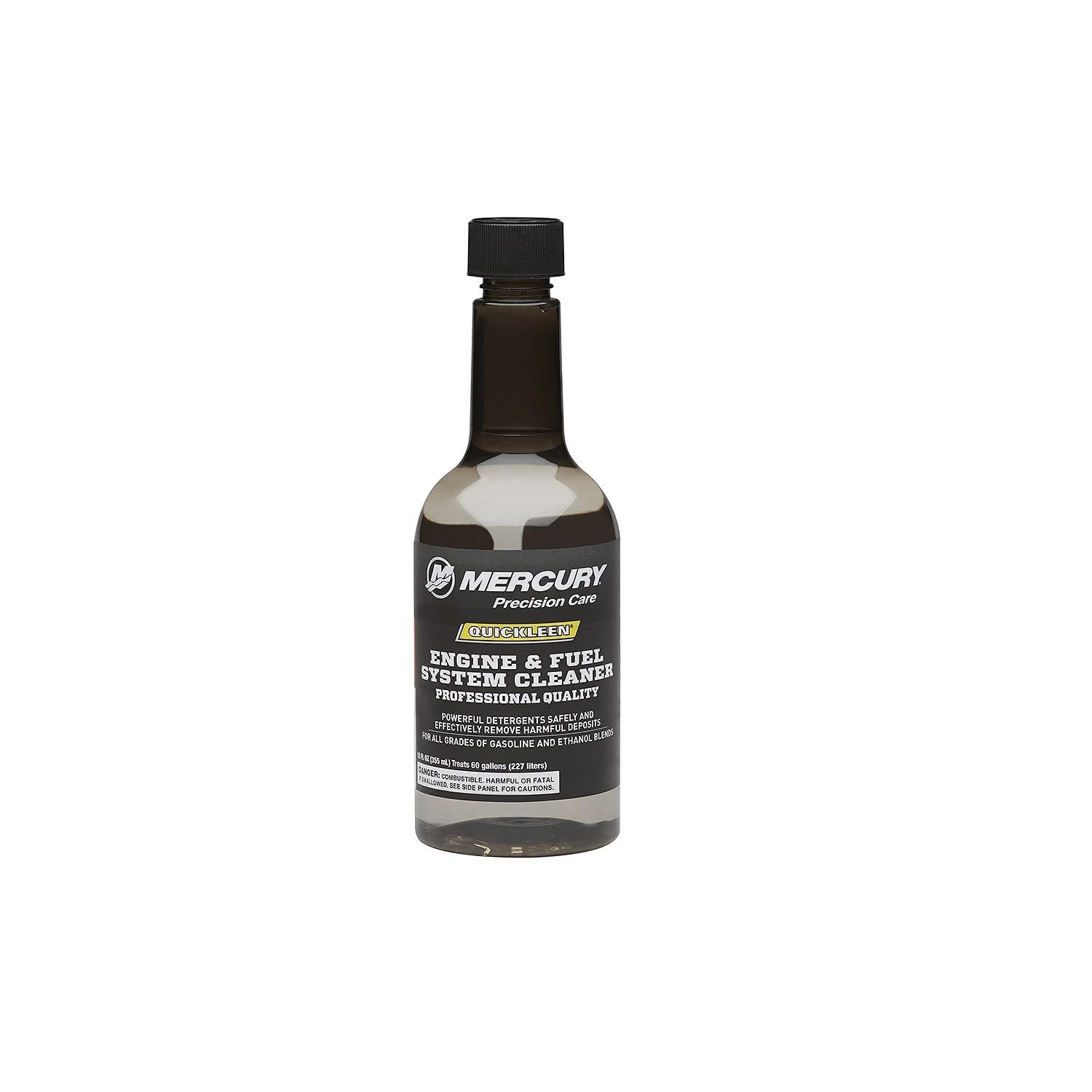
Mercury Quickleen is a fuel system cleaner rather than a dedicated stabilizer, but its ability to remove carbon deposits from carburetors, injectors, intake valves, spark plugs, piston crowns, and cylinder heads makes it a valuable companion to any stabilizer regimen. The 12-ounce bottle uses a 1-ounce-per-5-gallon ratio, and owner reports describe noticeable improvements in idle smoothness and full-throttle power after treatment. For motorcycles that have accumulated miles on ethanol-blended fuel, carbon buildup is a common performance thief that Quickleen addresses directly.
Mercury explicitly states that Quickleen does not contain fuel stabilizers — it is a standalone cleaner designed for intermittent use throughout the riding season. Owner accounts describe its effectiveness at resolving sputtering, hard starting, and power loss caused by bad gas or carbon accumulation. One long-term user reported that two seasons of regular use eliminated persistent carburetor issues that had resisted other treatments, ultimately avoiding a costly rebuild. The OEM backing from Mercury Marine adds credibility, as marine engines operate under continuous high-load conditions that accelerate carbon formation.
For riders building a comprehensive fuel care routine, Quickleen fills the gap between stabilization and active cleaning. Use it at the start of the season to clear out storage-related deposits, then rely on a dedicated stabilizer like Star Tron or Sea Foam for ongoing preservation. The product’s specificity — it cleans but does not stabilize — means you need both if your goal is complete fuel system protection. That said, its cleaning performance is well-documented across both marine and small-engine applications.
What works
- Effectively removes carbon deposits from multiple engine components
- Resolves sputtering and hard-starting issues from bad gas
- OEM engineering from Mercury Marine ensures rigorous quality
What doesn’t
- Does not contain any fuel stabilizer — must be paired with a separate product
- Premium price for a niche cleaning application
5. K-100 MG All-in-One Gasoline Fuel Treatment & Additive
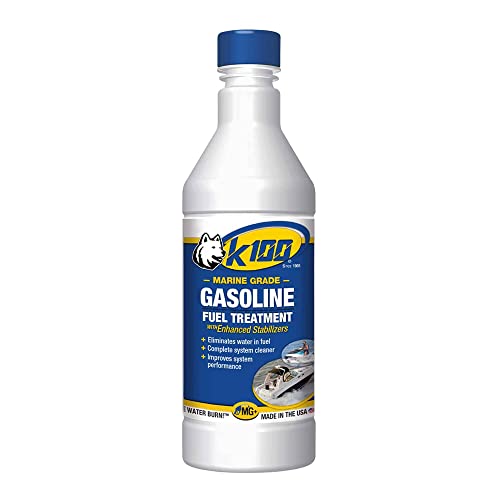
K-100 markets itself as an all-in-one solution that eliminates water, stabilizes fuel, and cleans the engine and fuel system simultaneously. Its proprietary chemistry breaks water molecules down into burnable particles rather than simply dispersing them, which is a different approach than traditional emulsifiers. The 32-ounce bottle uses a 0.5-ounce-per-gallon treatment ratio, making it more concentrated than many competitors, and it claims a 2-point octane boost that can help bikes running on lower-octane pump gas avoid pre-ignition.
Owner reports from harsh northern climates are particularly compelling: multiple users report that engines stored for two to three years with K-100 treatment started on the first pull. Chainsaws, snowmobiles, generators, and motorcycles all appear in the feedback, suggesting broad compatibility across 2-stroke and 4-stroke platforms. The water-elimination chemistry is a standout feature for riders who store bikes in damp environments where condensation in the fuel tank is a recurring problem. One owner documented a 30-mile-per-tank improvement in fuel economy after regular use.
The primary caution is that K-100 can damage painted surfaces if spilled, so careful handling during tank filling is essential. The lack of a built-in measuring dispenser means you’ll need a separate graduated container for precise dosing. For riders who want a single additive that covers stabilization, water control, and cleaning without needing multiple bottles, K-100 delivers a compelling all-in-one value proposition, especially for long-term storage scenarios where fuel turnover is minimal.
What works
- Breaks water into burnable particles instead of just dispersing it
- Provides up to 2-point octane boost for improved combustion
- Owner reports confirm multi-year storage starts with no issues
What doesn’t
- Can damage painted surfaces if spilled during filling
- No built-in measuring system requires separate tools
6. Sea Foam Motor Treatment – Fuel System Cleaner, Stabilizer & Oil Treatment

Sea Foam is arguably the most versatile product in this guide, functioning as a fuel system cleaner, fuel stabilizer, and oil treatment all in one can. The 3-pack of 16-ounce bottles provides ample volume for multiple bikes or several seasons of maintenance. Sea Foam works by dissolving fuel residue and varnish throughout the entire fuel path — from the tank through the injectors or carburetor — while also adding protective lubricity to reduce wear. Its dual fuel-and-oil compatibility means you can treat both the gas tank and the crankcase for comprehensive engine care.
Owner feedback is overwhelmingly positive, with verified reports of smoother idle, restored lost power, and improved fuel economy after treatment. Mechanic recommendations appear frequently in reviews, with several professionals citing Sea Foam as their go-to for ethanol-related water control and valve deposit cleaning. One detailed account describes a Ford F150 with rough idle and stalling that was resolved after a single treatment, while small-engine users report similar success with lawn tractors and generators after winter storage. The stabilizing chemistry keeps fuel fresh for up to two years, matching the top performers in dedicated stabilizers.
The only real downside is that Sea Foam’s multi-purpose nature means it doesn’t specialize as heavily in any single function. Riders who need absolute max storage duration might pair it with a dedicated stabilizer for extended layups. But for the vast majority of motorcycle owners — weekend riders, seasonal storage, and daily riders alike — Sea Foam delivers cleaning, stabilization, and lubrication in one bottle at a reasonable cost per treatment. It is the most well-rounded choice for any garage.
What works
- Unique 3-in-1 formula cleans, stabilizes, and lubricates effectively
- Backed by decades of positive mechanic and owner feedback
- Compatible with both gasoline and diesel in 2 and 4-cycle engines
What doesn’t
- Multi-purpose design may not be as specialized as dedicated stabilizers
- Requires 3,000-mile intervals for optimal fuel system cleaning
7. STA-BIL 32 oz Fuel Stabilizer (Pack of 2)
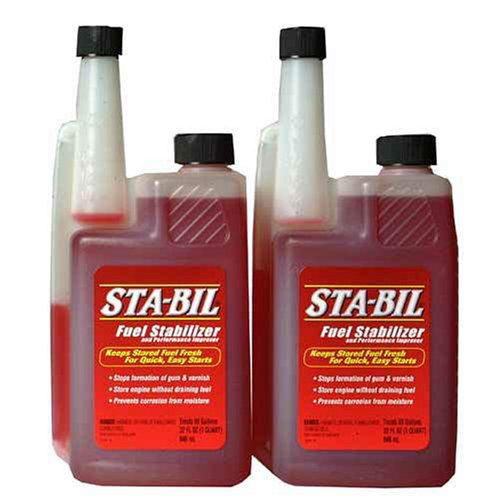
STA-BIL is the most recognized name in fuel stabilization, and this 2-pack of 32-ounce bottles offers excellent value for riders who need bulk volume for multiple vehicles or long-term storage. The classic formula stops the formation of gum and varnish, prevents corrosion, and keeps stored fuel fresh for easy starts after months of inactivity. Each 32-ounce bottle treats up to 160 gallons at the standard 1-ounce-per-5-gallon rate, making this pack suitable for a small fleet of bikes plus lawn equipment.
Owner reviews span more than a decade of use, with consistent reports of engines starting reliably after winter storage without the need to drain the fuel tank. Several users note that STA-BIL has prevented carburetor varnish issues that plagued their equipment before they started using it. The brand’s ubiquity in brick-and-mortar stores means the formula is well-tested across every climate and storage condition imaginable. One long-term user specifically mentions that their generator started after a full year of disuse thanks to STA-BIL treatment.
The classic STA-BIL formula is petroleum-based and works best when added to fresh fuel before storage. It is not designed to revive already-stale gasoline, though some owners report partial success with moderately degraded fuel. The 2-pack format provides redundancy and convenience, especially for riders who store bikes at multiple locations or want to keep one bottle in the shop and one in the garage. It’s a proven, no-surprises stabilizer that sets the baseline for what a stabilizer should do.
What works
- Classic formula with decades of proven reliability across all engines
- Excellent bulk value with two 32-ounce bottles per pack
- Prevents gum, varnish, and corrosion in stored fuel systems
What doesn’t
- Petroleum-based formula does not revive already-stale fuel
- Large bottles may be inconvenient for single-bike owners
8. Ethanol Shield Fuel Stabilizer, 24 oz (2 Pack)

Ethanol Shield is a newer entrant that comes armed with a proprietary antioxidant and anticorrosive formula designed specifically to combat the effects of ethanol-blended fuels. Its phase separation inhibitor is the standout feature: it actively prevents the water-ethanol-gasoline split that causes corrosion and starting failures. The 2-pack of 24-ounce bottles provides generous coverage, and the formulation includes Combustion Cool Technology (CCT) to reduce combustion chamber temperatures and upper cylinder lubrication to protect valve stems and piston rings.
Owner feedback highlights its water-dispersing capability as superior to many mainstream stabilizers, with users reporting that treated fuel in seasonal equipment started without any need to drain or refresh the tank. Multiple reviews mention that rubber seals and o-rings remained soft and pliable after storage, suggesting the plastic and rubber protection additives are genuinely effective. The brand’s focus on ethanol-specific chemistry makes it a strong choice for riders who primarily use pump gas with ethanol content, especially in regions where ethanol-free fuel is hard to find.
The main drawbacks reported by owners are occasional packaging issues — one review noted a leaking bottle upon arrival — and the fact that it is a relatively new product compared to legacy brands like STA-BIL. The price point sits in the mid-to-premium range, but the 2-pack format helps offset the per-treatment cost. For riders who want a modern formulation with ethanol-specific engineering and protective additives for fuel system elastomers, Ethanol Shield represents a thoughtful alternative to older chemistries.
What works
- Phase separation inhibitor specifically designed for ethanol fuels
- Protects rubber seals and plastic components from drying and cracking
- Combustion Cool Technology helps reduce engine temperatures
What doesn’t
- Newer brand with shorter track record than legacy competitors
- Occasional packaging quality issues reported by some owners
9. PRI Fuel Stabilizer For Gasoline 32 oz – Reduces HC/NOx Emissions

PRI (Power Reduction Inc.) is a different kind of stabilizer — it not only preserves fresh fuel but can actually revive fuel that has already started to degrade. The 32-ounce bottle treats a very high volume of gasoline, and its ability to restore stale fuel to a usable state sets it apart from every other product in this guide. Owner accounts describe reviving year-old lawnmower gas that would not start before treatment, with the same fuel running cleanly after PRI was added. One 40-year mechanic cited it as the best fuel treatment he had ever used.
The formula also reduces hydrocarbon and nitrogen oxide emissions, making it an environmentally conscious choice for riders who store multiple bikes or run classic two-strokes that tend to burn dirtier. Reports from owners storing fuel for up to seven years with periodic annual treatment confirm that PRI maintains fuel quality well beyond the typical two-year window. Multiple users switched from hardware-store brands after experiencing gummed carburetors and hard starting, and report that PRI eliminated those issues entirely.
The premium price reflects its specialty chemistry and the fact that it works both as a preservative and a recovery agent. For riders who have experienced the frustration of throwing away stale fuel or paying for carburetor cleaning, PRI pays for itself after one saved tank. The only practical limitation is that it is designed exclusively for gasoline — it does not work in diesel — and its relatively high cost per bottle may be overkill for riders who only store a bike for three months each winter. But for serious collectors and long-term storage, PRI is unmatched.
What works
- Can revive stale fuel that other stabilizers cannot restore
- Reduces HC and NOx emissions for cleaner operation
- Exceptional long-term storage performance up to seven years
What doesn’t
- Premium price point compared to standard stabilizers
- Gasoline-only formula — not compatible with diesel
10. STA-BIL Fuel Stabilizer, 1 Gallon

The 1-gallon jug of STA-BIL is the ultimate bulk option for riders who manage multiple motorcycles, a fleet of seasonal equipment, or simply want to treat fuel at the pump before storing it. This is the same trusted STA-BIL formula in a concentrated bulk format that treats up to 640 gallons of gasoline. For a garage with three bikes, a lawn tractor, a generator, and a snow blower, a single gallon provides multiple seasons of coverage without repeated trips to the store.
Owner feedback confirms that the bulk formula performs identically to the smaller bottles, with multiple reports of treated fuel remaining viable for more than four years — well beyond the two-year claim on the label. One verified reviewer documented using treated non-ethanol gas that had been stored for over four years with no appreciable degradation. The gallon jug is designed for refilling smaller measuring bottles, making it a practical choice for riders who already use STA-BIL and want to reduce packaging waste.
The size is obviously overkill for a single bike owner who stores one machine for three months each year. But for anyone who buys fuel in bulk for multiple machines or stores fuel in 5-gallon cans for emergency use, the per-ounce cost of the gallon jug is significantly lower than buying individual 8-ounce or 16-ounce bottles. It is the most economical way to ensure every engine in your garage gets consistent, reliable stabilization treatment.
What works
- Lowest per-ounce cost of any STA-BIL format available
- Treats up to 640 gallons for multi-bike or fleet use
- Owner reports confirm fuel viability beyond four years of storage
What doesn’t
- Excessive volume for single-bike or short-term storage needs
- Requires separate measuring container for accurate dosing
11. Lucas Oil 10314 Fuel Stabilizer – 8 Ounce (Pack of 12)
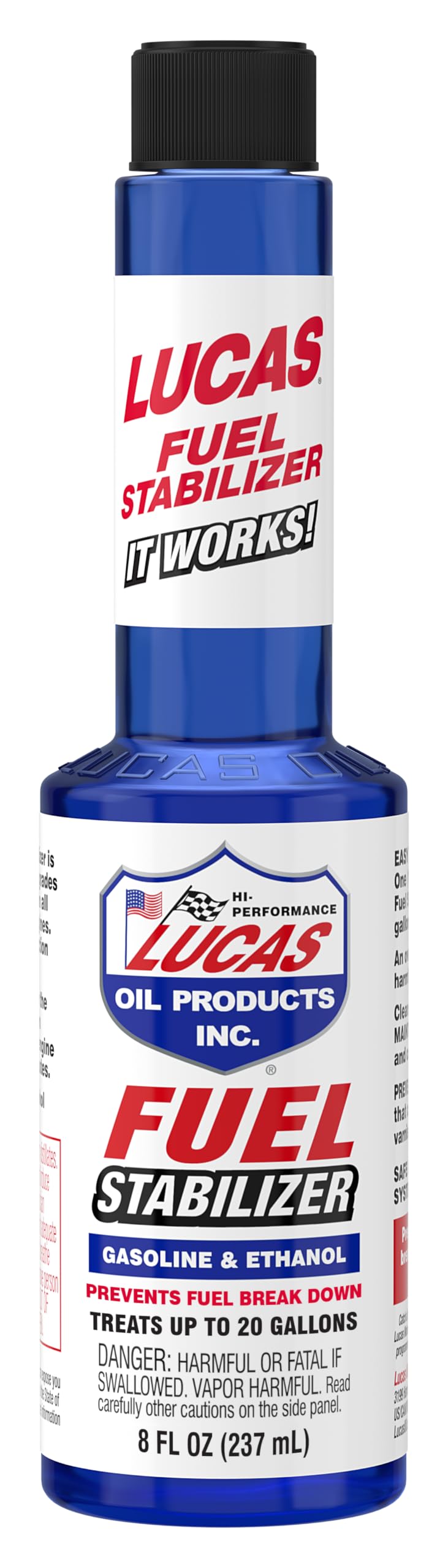
Lucas Oil is a well-respected name in the lubricant and additive space, and their fuel stabilizer delivers the same dependable performance in a convenient 12-pack of 8-ounce bottles. The small individual bottles are sized perfectly for a single treatment — one bottle treats a standard motorcycle tank, making it easy to grab one and go without measuring or pouring from a large container. The formula works in all grades of gasoline and is safe for both 2-stroke and 4-stroke engines, covering everything from a sportbike to a weed whacker.
Owner reviews highlight its ability to prevent gasoline breakdown during storage and, in some cases, improve engine smoothness after treatment. One detailed account describes using it to salvage 10 gallons of old fuel that had been sitting for months — after treatment, the fuel was usable and the engine ran cleanly. Another owner specifically noted that using Lucas stabilizer prevented a costly injector clog repair on their motorcycle, estimating the savings at to compared to injector replacement. The 12-pack format ensures you always have a bottle on hand for each machine in the garage.
The 8-ounce bottles are smaller than most standard stabilizer containers, so the per-ounce cost is higher than buying a larger jug. However, the convenience factor is real — no measuring, no spillage, no messy refills. Each bottle treats up to 40 gallons, which is more than enough for most motorcycle tanks plus a margin for error. If you value grab-and-go simplicity and want to keep one bottle in each vehicle or equipment shed, the Lucas Oil 12-pack is a practical and well-built solution.
What works
- Pre-measured 8-ounce bottles eliminate measuring and spillage
- Safe for both 2-stroke and 4-stroke gasoline engines
- Proven ability to revive old fuel and prevent costly injector repairs
What doesn’t
- Higher per-ounce cost compared to bulk jug options
- Small bottles generate more packaging waste per treatment
Hardware & Specs Guide
Dosing Ratio and Coverage
The standard dosing ratio across most fuel stabilizers is 1 ounce per 5 gallons of gasoline, though some concentrated formulas like K-100 use 0.5 ounce per gallon. Always verify the specific ratio for your chosen product, as under-dosing leaves fuel vulnerable to oxidation while over-dosing wastes additive. Treatment volume per bottle varies widely — a 16-ounce bottle treats 80 gallons, while a 32-ounce bottle treats 160 gallons. For multi-bike garages or bulk fuel storage, larger containers provide better economy. Products with built-in measuring chambers or pre-measured single-dose bottles eliminate the need for separate graduated tools, reducing the chance of dosing errors during winterization.
Storage Duration and Fuel Type Compatibility
Premium stabilizers claim fuel preservation for up to two years, with some like PRI reporting effectiveness beyond four to seven years in real-world owner accounts. Enzyme-based stabilizers generally offer longer active life than petroleum-based alternatives because the biological catalysts continue working as long as fuel is present. Ethanol-compatible stabilizers must include phase separation inhibitors that bind water molecules and prevent the corrosive water-ethanol-gasoline split. For ethanol-free fuel, simpler antioxidant formulas suffice, but for pump gas with any ethanol content, a dedicated ethanol-shield stabilizer is strongly recommended. Always confirm your product is rated for ethanol blends if you use standard pump fuel.
Engine Type and Application Range
Most gasoline stabilizers are safe for both 2-stroke and 4-stroke engines, but diesel formulas are chemically distinct and must not be used in gasoline engines. Motorcycles with carburetors benefit most from stabilizers with gum and varnish prevention, as carburetor jet passages are narrow and easily blocked. Fuel-injected bikes are less susceptible to jet clogging but still require stabilizer to prevent injector fouling and corrosion. Products like Sea Foam that also function as oil treatments add crankcase cleaning and upper cylinder lubrication, providing broader engine protection beyond just fuel preservation. Always check the manufacturer’s engine compatibility list before first use.
Additive Chemistry and Performance Features
Stabilizer chemistry falls into three main categories: enzyme-based (biological catalysts that break down contaminants), petroleum-based (hydrocarbon films that prevent buildup), and hybrid formulas that combine cleaning detergents with stabilizers. Additional features may include octane boosters (2 to 3 points), cetane improvers for diesel, anti-gel protection for cold climates, Combustion Cool Technology for lower cylinder temperatures, and corrosion inhibitors for metal fuel system components. Products that include multiple functions — stabilizer plus cleaner plus lubricant — reduce the number of separate additives needed but may not specialize as deeply in any single area as a dedicated stabilizer would.
FAQ
Can I use a fuel stabilizer in a motorcycle with ethanol-blended gasoline?
How long does treated fuel stay fresh in a motorcycle tank?
Can a fuel stabilizer fix old or stale gasoline that has already degraded?
Do fuel injectors need stabilizer treatment differently than carburetors?
Final Thoughts: The Verdict
For most riders, the best fuel stabilizer for motorcycle winner is the Sea Foam Motor Treatment because it delivers cleaning, stabilization, and oil treatment in one versatile formula with overwhelming owner and mechanic endorsement. If you want maximum long-term storage capability with the ability to revive stale fuel, grab the PRI Fuel Stabilizer. And for riders who prioritize ethanol-specific protection with advanced phase separation control, nothing beats the Ethanol Shield 2-Pack.

Certification: BSc in Mechanical Engineering
Education: Mechanical engineer
Lives In: 539 W Commerce St, Dallas, TX 75208, USA
Md Amir is an auto mechanic student and writer with over half a decade of experience in the automotive field. He has worked with top automotive brands such as Lexus, Quantum, and also owns two automotive blogs autocarneed.com and taxiwiz.com.