A blown fuse can turn a routine drive into a frustrating guessing game. Without a reliable tester, you are left probing wires blindly, wasting time on circuits that look fine but carry no current. The right tool transforms electrical diagnosis from a tedious chore into a precise, repeatable process.
I’m Amir — the founder and writer behind Four Wheel Ask. My research process involves cross-referencing technical datasheets, studying owner-reported failure patterns across forums, and evaluating build quality indicators from dozens of automotive electrical tools on the market.
From deep spec analysis and owner feedback, the best car fuse tester light is the Autel PowerScan PS100 for its diagnostic depth and proven reliability.
How To Choose The Best Car Fuse Tester Light
Selecting the right fuse tester means matching the tool to the electrical complexity of your vehicle. Modern cars carry sensitive ECUs and multiplexed wiring that older test lights can damage. Understanding the core specifications — voltage range, current draw, and display type — separates a smart purchase from a regretful one.
Voltage Range and Compatibility
Most passenger vehicles operate on 12V DC systems, but heavy-duty trucks, RVs, and agricultural equipment often use 24V or higher. A tester rated for 3-72V DC offers the flexibility to move between vehicle types without buying a second tool. Check the minimum voltage threshold as well; some testers cannot detect low-voltage signals below 6V, making them useless for diagnosing sensor circuits or partially discharged batteries.
Computer Safety and Current Draw
Traditional incandescent test lights can draw 150-300 milliamps through a circuit, enough to damage airbag modules, transmission controllers, and engine ECUs. Digital LED test lights with current draw under 30 milliamps are far safer for modern electronics. Look for explicit computer-safe ratings or micro-current circuitry in the specifications. A tester that protects sensitive components is worth the premium.
Display and Readability
Basic test lights use a simple bulb that glows when voltage is present. Digital test lights add LCD or LED numerical readouts showing exact voltage values, polarity indicators, and continuity confirmation. For diagnostic work beyond simple fuse checks, a digital display with 0.1V resolution allows you to identify voltage drops, parasitic drains, and intermittent failures that a bulb alone cannot reveal.
Cord Length and Build Quality
A coiled cord that stretches to ten feet or more lets you reach from the battery to the tailgate without hunting for a ground point. Spring-wire cords resist tangling and last longer than straight rubber cables. The probe tip should be sharp stainless steel for piercing wire insulation, and the ground clamp must bite firmly onto terminals. Strain relief at both ends of the cord prevents premature failure at stress points.
Quick Comparison
On smaller screens, swipe sideways to see the full table.
| Model | Category | Best For | Key Spec | Amazon |
|---|---|---|---|---|
| Autel PowerScan PS100 | Circuit Probe Tester | Full System Diagnostics | DC 6-30V, AC/DC/Resistance, 20ft Cord | Amazon |
| GODIAG GT101 | Power Probe Tester | Component Activation | DC 6-40V, Relay Test, Injector Cleaner | Amazon |
| VDIAGTOOL V210 | Wire Tracer | Open & Short Finding | DC 6-42V, Transmitter & Receiver | Amazon |
| AWBLIN 822 | Circuit Probe Tester | Voltage & Current Testing | DC 1-60V, LCD Display, 196in Cord | Amazon |
| JASTIND Upgraded Buzzer | Digital Test Light | Polarity & Voltage Check | DC 3-72V, LED Display, 140in Cord | Amazon |
| OEMTOOLS 25886 | Traditional Test Light | Fuse Checking | 6-24V, Incandescent, 12ft Coiled Cord | Amazon |
| JASTIND Heavy Duty | Digital Test Light | Wide Voltage Reading | DC 3-72V, Digital Display, 142in Cord | Amazon |
| ALLOSUN GK5225 | Wire Piercing Tester | Wiring Diagnosis | 6-12V, Hook Probe, 59in Cord | Amazon |
| Astro Pneumatic 7760 | Cordless Tester | Quick Fuse Checks | DC 3-28V, Body Ground, Battery Powered | Amazon |
| OBDResource CC0176 | Voltage Tester Pen | Digital Readout | DC 0.8-100V, Auto-Detection, Backlit LCD | Amazon |
| Lisle 28400 | Heavy Duty Tester | Basic 12V Testing | 12V, Incandescent, 49in Cord | Amazon |
In‑Depth Reviews
1. Autel PowerScan PS100
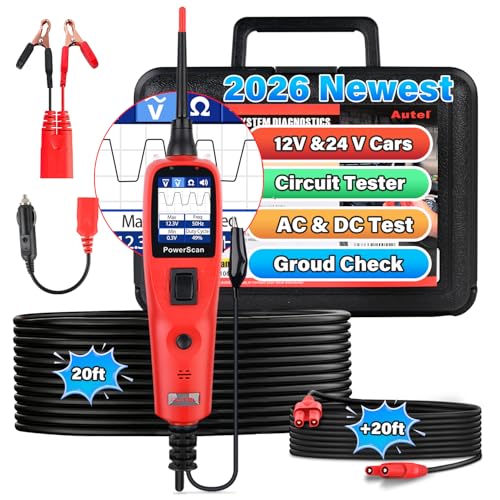
The Autel PowerScan PS100 sits at the top of the diagnostic food chain for a reason. It combines four operating modes — DC voltage, AC voltage, resistance, and tone indication — into a single hand-held probe that communicates results through both a backlit LCD and red/green polarity LEDs. The 20-foot extension cord plus a secondary 20-foot cable gives you a combined reach of 40 feet, which is enough to trace circuits from the battery to the trailer hitch without repositioning the ground clamp.
What separates the PS100 from standard test lights is its component activation capability. You can supply power or ground directly to a component — a fuel pump, cooling fan, or relay — and observe its response in real time without jumper wires. The built-in 10-amp circuit breaker protects against overloads and automatically resets, which saves fuses and prevents accidental damage to sensitive modules. Owner feedback consistently highlights the cigarette lighter adapter as a convenience feature that lets you power the tool from inside the cabin without opening the hood.
For technicians who work on multiple vehicle types, the AC voltage mode adds frequency and duty cycle readouts, enabling alternator waveform analysis and sensor signal verification. The stainless steel probe pierces insulation cleanly, and the ergonomic handle reduces fatigue during extended diagnostic sessions. This is a professional-grade tool that eliminates the need for a multimeter in most routine electrical tests.
What works
- Four diagnostic modes cover nearly every electrical test scenario
- Component activation function eliminates need for jumper wires
- Resettable 10-amp circuit breaker protects against overload
- 40-foot combined cable reach suits full-size trucks and trailers
What doesn’t
- Premium price positions it beyond casual DIY budgets
- Learning curve for users accustomed to basic test lights
2. GODIAG GT101
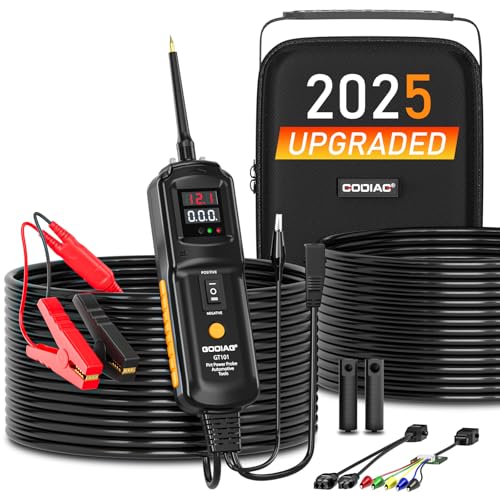
The GODIAG GT101 is engineered for technicians who need component-level testing beyond simple voltage detection. It functions as a power probe, continuity tester, relay checker, and injector cleaner all in one package. The tool can supply power to electrical components with reverse polarity protection, allowing you to activate lights, motors, solenoids, and sensors directly from the probe tip while reading current draw on the color display.
One of the standout features is the integrated relay testing mode. Instead of swapping relays or using a separate tool, you can test relay coil resistance and switching function through the probe. The built-in 20-amp circuit breaker trips automatically under overload and resets itself, protecting both the tool and the vehicle wiring. The injector cleaning adapter kit is a unique addition — it lets you pulse injectors with the tool while flushing them with a pressurized cleaner, saving a dedicated injector cleaner purchase.
The 20-foot test cord provides generous reach, and the digital color display shows voltage and current readings clearly in direct sunlight. The self-test function at startup confirms the tool is functioning correctly before you begin diagnostics. Owner reports from fleet maintenance settings indicate the GT101 handles daily abuse well, with the spring cord and strain relief holding up better than budget alternatives.
What works
- Relay testing mode saves time on circuit diagnostics
- Injector cleaning adapter adds genuine workshop capability
- Color display readable in bright conditions
- Self-test function ensures tool integrity before use
What doesn’t
- Higher price point than basic test lights
- Some users report the battery compartment design is tight
3. VDIAGTOOL V210

The VDIAGTOOL V210 takes a different approach from traditional test lights by employing a transmitter and receiver system to locate open circuits, short circuits, and broken wires without piercing insulation. The transmitter injects a signal into the circuit, and the receiver uses an adjustable sensitivity knob and a flexible 7-inch probe to trace the signal path. When the tone changes or drops out, you have found the fault point.
This tool is especially valuable for diagnosing intermittent electrical issues in complex wiring harnesses. You can flex wires and connectors while listening for tone changes in the receiver, which reveals breaks that only appear under specific conditions. The receiver LED indicates open or short conditions visually, which helps in noisy shop environments where audio cues are hard to hear. Both units run on standard 9V batteries, and the kit includes two batteries to get you started immediately.
Owner feedback from experienced technicians highlights the V210 as a time-saver for finding broken wires in bundles that would otherwise require stripping and probing each conductor individually. The compact size makes it easy to store in a tool bag, and the straightforward controls require minimal training. For anyone who regularly chases electrical gremlins in older vehicles or trailers, this tracer fills a gap that standard test lights cannot address.
What works
- Locates open and short circuits without wire piercing
- Adjustable sensitivity fine-tunes signal detection
- Flexible probe reaches tight harness locations
- LED and tone feedback suit noisy environments
What doesn’t
- Signal strength drops on shielded wiring
- No auto shut-off drains batteries if left on
4. AWBLIN Power Circuit Probe Tester

The AWBLIN 822 distinguishes itself with a dual-mode design that measures both voltage and current through the same probe tip. A single press of the small black round button toggles between voltage mode, which reads 1-60V DC with 0.1V resolution, and current mode, which measures DC 0-8A. The LCD backlit display shows the reading clearly, and the red/green LED indicator confirms polarity at a glance without needing to look at numbers.
The 196-inch spring cord stretches to over 16 feet, allowing you to move freely around the vehicle without disconnecting the ground clamp. The anti-loss probe cover is integrated into the spring wire design, so you cannot misplace it during storage. When the two alligator clamps are connected to the battery, the built-in flashlight immediately illuminates the work area, which is a practical touch for night or under-dash diagnostics. Overload protection automatically disconnects the circuit if current exceeds 8A, and an audible buzzer alerts you to the fault condition.
For DIYers who want a single tool that handles both voltage testing and current measurement, the AWBLIN eliminates the need to carry a separate multimeter for basic checks. The continuity function with buzzer confirmation speeds up fuse and wire testing, and the compact probe body fits comfortably in one hand. The storage bag keeps everything organized between uses.
What works
- Voltage and current measurement in one probe
- Exceptionally long spring cord for vehicle-wide reach
- Integrated flashlight activates on battery connection
- Overload protection with automatic disconnect
What doesn’t
- Current mode limited to 8A for component testing
- No AC voltage measurement capability
5. JASTIND Upgraded Buzzer Test Light

The JASTIND Upgraded Buzzer test light covers a wide 3-72V DC range, making it suitable for everything from motorcycles with 6V systems to heavy trucks running 24V electrical platforms. The bright LED digital display shows voltage with 0.1V resolution and remains readable in both direct sunlight and complete darkness. A blue backlight illuminates the digits without washing out the reading.
Bidirectional voltage testing sets this model apart from standard test lights. You can attach the alligator clip to either a positive terminal or ground, and the tool automatically identifies polarity through red and green LEDs accompanied by distinct buzzer tones — one beep for positive, double beep for negative. The micro-current circuit board keeps draw well below levels that could damage ECUs, airbag controllers, or transmission modules. The 140-inch PU spring wire provides excellent stretch memory and does not develop the kinks common in rubber cords.
The anti-lost silica gel probe cover is tethered to the spring wire, so it stays with the tool at all times. Owners who have used this tester for over six months report consistent accuracy and no degradation in the LED display brightness. The comfort of knowing you can test from 3V up to 72V with a single device makes this a strong choice for mixed-fleet owners and mobile technicians.
What works
- Wide 3-72V DC range covers nearly all vehicle types
- Bidirectional polarity detection with distinct tone cues
- Computer-safe micro-current circuitry
- Anti-lost probe cover integrated into cord design
What doesn’t
- No current measurement function
- PU outer skin less abrasion-resistant than rubber
6. OEMTOOLS 25886

The OEMTOOLS 25886 is a traditional incandescent test light that has remained popular for good reason. It works on 6V, 12V, and 24V systems and draws approximately 30 milliamps at 12V, which is within the safe range for most automotive computers. The super sharp stainless steel probe pierces wire insulation easily and can double as a fuse probe for panel testing. Two replacement bulbs are included in the package, extending the service life significantly.
The coiled cord stretches to 12 feet and retracts when not in use, preventing tangles and clutter in the toolbox. The plastic strain relief at the probe end is shaped to absorb flexing stress, which is the most common failure point on test lights. The heavy-duty ground clamp has copper-coated teeth that bite firmly onto battery terminals, chassis ground points, and fuse box tabs without slipping off during testing. Owner feedback confirms the red LED light is bright enough to see in direct sunlight, unlike some cheaper LED units that wash out.
For a straightforward tool that checks fuses, verifies power at connectors, and tests for ground continuity, the OEMTOOLS 25886 delivers reliable performance at a very accessible investment. It does not offer digital readouts or component activation, but for users who mainly need a quick go/no-go check on circuits, the simplicity is an advantage rather than a limitation.
What works
- Incandescent bulb draws safe current for computer circuits
- 12-foot coiled cord reaches across most vehicles
- Two replacement bulbs included for extended service life
- Bright light visible in direct sunlight
What doesn’t
- No digital voltage readout for precise measurement
- Ground clamp connection quality varies with use
7. JASTIND Heavy Duty Digital Test Light

The JASTIND Heavy Duty model brings a digital voltage display and auxiliary work light to the 3-72V DC testing segment at a reasonable investment point. The LED digital display resolves voltage to 0.1V with an accuracy of ±0.2V, giving you real-time feedback on circuit health. Two auxiliary LED beads illuminate the measurement area automatically, which is a genuine help when working under dashboards or in engine bays at night.
Bidirectional testing works through the red and green LED indicators plus the buzzer system. Attach the clamp to ground and probe a live wire: red light with one beep confirms positive voltage. Reverse the clamp to battery positive and probe a ground circuit: green light with two beeps confirms the ground path. The precision-designed circuit board generates a minimal current draw, reducing the probability of damaging central computer modules during testing. The anti-lost probe protective cover slides onto the sharp stainless steel tip and is tethered to prevent separation.
The 142-inch spring cord with anti-tensile PU skin and copper inner conductor stretches and recovers reliably over repeated use. The large alligator clip provides a solid bite on terminals and battery posts. For users who need a wide voltage range and digital precision without stepping into power probe territory, this tester offers a practical middle ground.
What works
- Digital voltage display with 0.1V resolution for accurate reading
- Auxiliary LEDs illuminate dark work areas effectively
- Bidirectional testing with distinct audio-visual cues
- Computer-safe low current draw design
What doesn’t
- No continuity or resistance measurement function
- Display refresh rate can lag on rapid probing
8. ALLOSUN Automotive Wire Piercing Tester
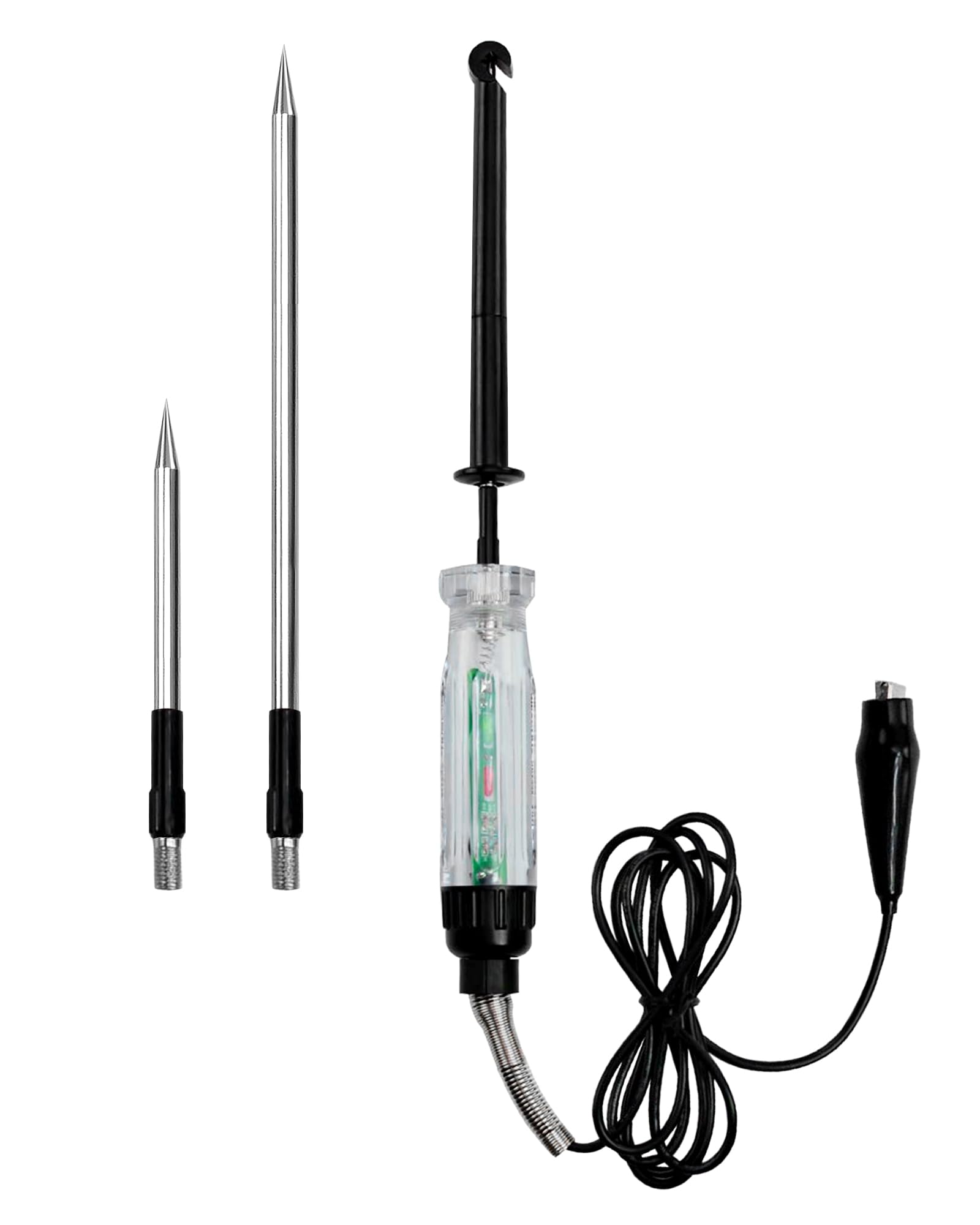
The ALLOSUN GK5225 focuses on a specific but common need: testing wires in tight harnesses where conventional probes cannot maintain contact. The three interchangeable probe tips include a standard pointed probe, a hooked probe that locks onto wires hands-free, and a pierce-type probe for insulated conductors. The end hook design allows you to hang the tester on a wire while you manipulate other test equipment, freeing both hands for the diagnostic task.
The tool is designed for DC 6-12V circuits and should not be used on systems above 15V, which limits its application to standard passenger vehicles. Two high-visibility LED bulbs and a loud buzzer indicate power and continuity. The slim stainless steel probe reaches into recessed fuse boxes and behind dash panels where bulkier testers cannot fit. The insulated cord resists heat and oil exposure, common hazards in engine bay environments.
The hook cover prevents accidental finger stabs during storage, a small but appreciated safety detail. For radio installers, trailer wiring technicians, and anyone who routinely back-probes connectors, the hands-free hook feature reduces frustration significantly. The 59-inch cord length is adequate for close-range work but will require an extension or repositioning for full-vehicle diagnostics.
What works
- Hands-free hook probe holds wire during testing
- Three interchangeable tips for different wire access needs
- Compact slim probe reaches tight under-dash locations
- Heat and oil resistant cord for engine bay use
What doesn’t
- Limited to 6-12V DC systems only
- Short 59-inch cord requires frequent repositioning
9. Astro Pneumatic 7760 Cordless Circuit Tester

The Astro Pneumatic 7760 eliminates the ground cable entirely by using your own body as the ground path. You hold the tester in one hand and touch a bare metal ground point with your other hand or finger, completing the circuit through your body. This cordless approach is uniquely convenient for rapidly scanning fuse panels, because there is no clip lead bouncing around or getting pulled off when you move to the next fuse.
The tool operates on DC circuits from 3V to 28V, which covers automotive, marine, and powersports applications. The V-Tip design allows safe and centered wire piercing without damaging the insulation excessively. The tester is advertised as safe for ECMs, transducers, and airbag circuits, though the body-ground method means you are part of the circuit — a consideration for safety-conscious users. The chrome-plated housing resists corrosion and provides a comfortable grip.
Owner feedback consistently praises the 7760 for speeding up fuse panel checks; what took a minute with a traditional test light takes seconds with the cordless approach. Some users note that it is not a full circuit diagnostic tool — it will not apply power or detect ground issues — but for the specific job of checking whether a fuse has power, it is arguably the fastest option available. The battery-powered design means no cord management at all.
What works
- No ground cable means zero cord tangling during fuse checks
- Extremely fast scan rate across fuse panels
- Safe for sensitive automotive electronics
- Compact and lightweight for pocket storage
What doesn’t
- Cannot check ground circuits or apply power
- User must make bare-hand contact with ground
10. OBDResource Voltage Circuit Probe Tester
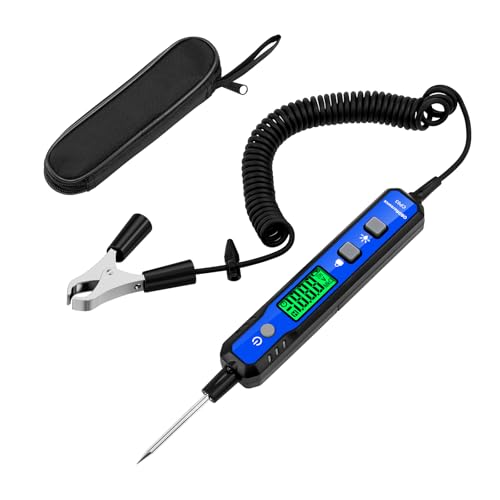
The OBDResource CC0176 offers the widest voltage detection range in this lineup at 0.8V to 100V DC, making it useful for everything from low-voltage sensor signals to high-voltage electric vehicle auxiliary circuits. The auto-detection mode identifies DC voltage, polarity, resistance, and continuity as soon as the probe makes contact — no manual switching is required. The HOLD button locks the reading on the LCD display for later review.
Precision is a strong point here, with ±1% accuracy and dynamic resolution that shifts to 0.001V below 2V and 0.1V at 100V. The resistance measurement function from 1Ω to 0.01MΩ adds diagnostic utility for checking relays, spark plug wires, and heating elements. An audible buzzer sounds for continuity under 50Ω, and the display shows “OL” when voltage exceeds 100V. The included long spring probe and protective cover ensure safe handling and storage.
The backlit LCD screen and integrated LED flashlight make this tester usable in dim environments without a separate work light. A dedicated button cycles between backlight and flashlight modes. The storage bag keeps the tool and accessories organized. For users who want a digital voltage pen that covers an exceptionally wide range and includes continuity checking, the OBDResource offers strong capability at a budget-friendly investment.
What works
- Widest voltage range at 0.8-100V DC for versatile use
- Auto-detection eliminates mode switching during testing
- High accuracy with multi-range resolution
- Backlit LCD and flashlight for dark environments
What doesn’t
- No current measurement or component activation
- Limited owner feedback for long-term reliability assessment
11. Lisle 28400 Heavy Duty Circuit Tester

The Lisle 28400 is a purpose-built, no-nonsense circuit tester designed for 12V systems only. It strips away every extra feature to deliver a single function: testing low voltage up to 12 volts. The probe, handle, cord, and clamp are reinforced for extra durability, and the strain relief spring at the cord exit point prevents the most common failure mode in test lights. The 49-inch cord is shorter than most competitors, but the rugged construction suggests this tool is meant to survive years of shop use.
The build quality is evident in the details. The handle is molded with a comfortable grip profile, the probe is secured firmly without wobble, and the ground clamp has aggressive teeth that hold onto terminals. The incandescent bulb provides a clear, unambiguous indication of power presence. There is no LED, no digital display, no buzzer — just a bulb that lights up when the circuit is live. For a mechanic who already owns a multimeter for detailed diagnostics, this simplicity is a virtue for quick voltage checks.
Lisle has a reputation in the tool industry for manufacturing equipment that outlasts the user. The 28400 follows that tradition with materials that resist oil, heat, and mechanical abuse. It is the right tool for someone who needs a durable, straightforward tester that fits in a drawer and works every time without menus, modes, or batteries.
What works
- Heavy-duty construction built for daily professional use
- Strain relief spring extends cord life at stress point
- Simple operation with no batteries or settings required
- Lisle reputation for long-term durability
What doesn’t
- Limited to 12V systems only
- Short 49-inch cord restricts reach during testing
Hardware & Specs Guide
Voltage Detection Range
The voltage range determines which vehicles and circuits a tester can handle. Basic test lights cover 6V to 24V, which suits most cars and light trucks. Extended-range models reaching 3V to 72V handle motorcycles, heavy trucks, and some electric vehicle auxiliary circuits. Ultra-wide models covering 0.8V to 100V can detect low sensor signals and high-voltage systems, but they typically lack the current capacity for component activation. Match the voltage range to the vehicle types you work on most frequently.
Display Type and Resolution
Incandescent bulbs provide a simple on/off indication with no numerical value. They are reliable, visible in sunlight, and draw moderate current. LED bulbs last longer and draw less current but can be harder to see in bright conditions. Digital displays with 0.1V resolution let you measure voltage drops, identify charging system output, and verify sensor signals with precision. LCD screens require backlighting for dark environments, while LED digit displays remain self-illuminated.
Computer Safety and Current Draw
Modern vehicles rely on sensitive electronic control modules that can be damaged by excessive current from a test light. Traditional incandescent test lights draw 150-300 milliamps through the circuit under test, which is enough to fry an ECU. Computer-safe test lights use micro-current LED circuits that draw under 30 milliamps, drastically reducing the risk. Always verify the current draw specification before testing on airbag systems, transmission controllers, or engine management modules.
Cord Construction and Length
Coiled spring cords stretch and retract, eliminating tangles and keeping the workspace organized. Straight rubber cords are durable but require manual coiling for storage. Cord length from 49 inches to 20 feet determines how far you can move from the battery before needing to relocate the ground clamp. Longer cords with PU or rubber outer sheaths and copper inner conductors offer the best balance of flexibility and conductivity. Strain relief at both ends is critical for long-term reliability.
FAQ
Can I use a test light on modern computer-controlled vehicles?
What is the difference between a test light and a power probe?
How do I test a fuse with a circuit tester?
What voltage range do I need for a typical car?
Can a test light find a short circuit?
Final Thoughts: The Verdict
For most buyers, the best car fuse tester light winner is the Autel PowerScan PS100 because it combines four diagnostic modes, component activation, and a resettable circuit breaker into one professional-grade tool that replaces both a test light and a multimeter. If you want comprehensive relay testing and injector cleaning capability, grab the GODIAG GT101. And for a reliable, straightforward fuse checker that just works without batteries or menus, nothing beats the value of the OEMTOOLS 25886.

Certification: BSc in Mechanical Engineering
Education: Mechanical engineer
Lives In: 539 W Commerce St, Dallas, TX 75208, USA
Md Amir is an auto mechanic student and writer with over half a decade of experience in the automotive field. He has worked with top automotive brands such as Lexus, Quantum, and also owns two automotive blogs autocarneed.com and taxiwiz.com.