Frame rust, underbody corrosion, and hidden oxidation silently destroy vehicle value faster than almost any other maintenance failure. A single winter on salted roads or a season near coastal salt air can transform a solid chassis into a structural liability, yet most owners discover the damage only when repairs become expensive or unsafe. The difference between a vehicle that lasts fifteen years and one that crumbles at eight often comes down to one deliberate choice: which rust protection system you trust with your metal.
I’m Amir — the founder and writer behind Four Wheel Ask. My approach to evaluating rustproofing products relies on deep market research, chemical formulation analysis, and aggregation of real owner feedback across automotive, marine, and industrial applications to separate marketing claims from measurable performance.
After analyzing market data and owner feedback, this guide ranks the top rust-fighting solutions to help you confidently choose the best auto rustproofing for your vehicle needs.
How To Choose The Best Auto Rustproofing
Rustproofing products fall into distinct chemical categories that serve different stages of corrosion. A converter chemically neutralizes existing rust and turns it into a stable primer layer, while an inhibitor blocks moisture at the molecular level before oxidation begins. Barrier coatings physically seal metal from air and water, and penetrating oils creep into tight spaces to displace moisture on fasteners and seams. Understanding which stage of rust you are fighting determines which chemistry will actually solve the problem.
Surface Preparation Is Non-Negotiable
The highest-performing coating applied over grease, loose rust, or contaminated metal will fail prematurely. Every professional-grade system demands a clean, etched surface for molecular bonding. Products that claim “apply over rust” typically contain converter chemistry that reacts with iron oxide, but even those require removal of flaking scale and oil. Skip the prep step and you are essentially sealing in the problem rather than stopping it.
Chemical Compatibility and Topcoating
Some rust preventive coatings, especially moisture-cured urethanes like POR-15, require a UV-resistant topcoat if exposed to sunlight. Wax-based sprays remain flexible and self-healing but attract dust and cannot be painted over. Solvent-based encapsulators offer the hardest finish but may crack if applied too thickly on flexible panels. Match the chemistry to the component — frames and suspension parts need different properties than body panels or threaded fasteners.
Application Method and Access
Aerosol sprays provide convenience and reach into cavities with extension tubes, while brush-on liquids deliver thicker films for flat surfaces. Internal frame coatings require specialized wands or nozzles to mist the inside of boxed sections where rust typically starts from the inside out. Consider how much disassembly you are willing to perform — full underbody treatments demand wheel removal and masking, while spray-and-walk products trade thoroughness for speed.
Quick Comparison
On smaller screens, swipe sideways to see the full table.
| Model | Category | Best For | Key Spec | Amazon |
|---|---|---|---|---|
| POR-15 Rust Preventive Coating | Moisture-Cured Urethane | Permanent rust encapsulation | 16 oz, gloss gray, cures via humidity | Amazon |
| KBS Coatings RustSeal | Barrier Coating | High-temp & chemical resistance | 1 quart satin black, 600°F rating | Amazon |
| 3M Professional Grade Rubberized Undercoating | Rubberized Coating | Sound dampening & underbody protection | 6-pack 16 oz, textured finish | Amazon |
| Eastwood Internal Frame Coating | Internal Frame Spray | Inside boxed chassis sections | 14 oz aerosol with extension tube | Amazon |
| CorrosionX Heavy Duty | Self-Healing Inhibitor | Marine & pressure-wash exposure | 12 oz aerosol, 5-year indoor protection | Amazon |
| CorrosionX Rust Inhibitor | Dielectric Inhibitor | Electronics & galvanic corrosion prevention | 16 oz aerosol, 39,000V dielectric rating | Amazon |
| CRC Heavy Duty Corrosion Inhibitor | Wax-Based Inhibitor | Long-term storage & salt spray areas | 4-pack 10 oz, flexible film | Amazon |
| Blaster Surface Shield | Lanolin-Based Spray | Eco-friendly undercoating | 6-pack 12 oz, low-odor formula | Amazon |
| Meuvcol 2-in-1 Rust Converter & Primer | Converter & Primer | Budget-friendly rust conversion | 35 oz matte black, brush-on liquid | Amazon |
| PB Blaster Penetrating Oil | Penetrant & Inhibitor | Freezing stuck bolts & fasteners | 6-pack 11 oz, low surface tension | Amazon |
| Rust-Oleum Black Undercoating | Rubberized Coating | Bulk underbody coverage | 12-pack 15 oz, matte finish | Amazon |
In‑Depth Reviews
1. POR-15 Rust Preventive Coating

POR-15 has earned its reputation as the gold standard in rust prevention through a fundamentally different curing chemistry. Unlike conventional paints that dry by solvent evaporation, this coating cures by reacting with ambient moisture in the air, which means it actually forms a harder, more durable film in humid conditions — the exact environment where rust thrives. The cured result is a non-porous, hammer-tough barrier that resists chemicals, salt, and abrasion at a level that powder coating struggles to match.
Application requires the full three-step system: thorough cleaning with a dedicated degreaser, etching with Metal Prep to neutralize residual rust and create a tooth for adhesion, then two thin coats of the rust preventive coating. Owner reports consistently confirm that skipping or rushing any of these steps dramatically reduces longevity. The coating must be topcoated with a UV-resistant finish if exposed to direct sunlight, as the polymer will chalk and degrade over time under ultraviolet exposure.
Professional shop data and long-term owner reviews across classic car restorations, farming equipment, and marine trailers show that POR-15, when applied correctly, stops rust propagation permanently on the treated surface. The 16-ounce can covers roughly 50 to 100 square feet per coat, making it economical for frame rails, floor pans, and suspension components. This is the product to choose when you want a single application that outlasts the vehicle.
What works
- Moisture-cured chemistry creates exceptionally hard, durable finish
- Forms permanent chemical bond when applied over properly prepped metal
- Excellent chemical and salt resistance for harsh environments
- Trusted across automotive, marine, and industrial sectors
What doesn’t
- Requires strict three-step surface preparation for success
- Must be topcoated if exposed to UV light
- Cannot be shaken — must be stirred to avoid air bubbles
- Long cure time between coats extends project timeline
2. KBS Coatings RustSeal

KBS Coatings RustSeal competes directly with POR-15 but brings several distinct advantages that make it the better choice for specific applications. The most notable differentiator is its temperature tolerance — RustSeal withstands continuous exposure up to 600°F, making it suitable for exhaust components, engine blocks, and brake system parts where standard moisture-cured coatings would degrade. The satin black finish flows out with exceptional self-leveling properties that eliminate brush marks and create a factory-like powder-coated appearance.
Chemical resistance is another area where RustSeal excels. Owner reports document its ability to repel fuels, oils, hydraulic fluids, and even graffiti without staining or softening. The coating forms a permanent non-porous barrier against both moisture and oxygen, and repeated exposure to moisture actually strengthens the film rather than weakening it. This makes it particularly effective for boat engine rooms, bilges, chain lockers, and any application where standing water or fuel spills are routine.
The quart container provides 50 square feet of coverage and can be applied by brush, roller, or spray equipment. Unlike some competitors that require a dedicated prep system, RustSeal bonds well to properly cleaned metal using standard degreasing and light abrasion. Owners consistently note that the satin finish hides imperfections better than gloss alternatives, and the coating’s flexibility prevents cracking on components that experience thermal cycling or minor flexing.
What works
- Withstands continuous heat up to 600°F for exhaust and engine parts
- Superior flow and leveling eliminates brush marks
- Resists fuels, oils, acids, and alkalis without degradation
- Coating strengthens with repeated moisture exposure
What doesn’t
- Not recommended for direct UV exposure without topcoat
- Quart size may be excessive for small projects
- Full cure requires adequate ventilation and drying time
- Premium cost per square foot compared to aerosol options
3. 3M Professional Grade Rubberized Undercoating

3M brings its industrial material science expertise to the undercoating category with a rubberized formulation that prioritizes both corrosion protection and noise reduction. The textured, rubbery film absorbs road noise and dampens vibration from gravel, tire roar, and chassis harmonics, creating a noticeably quieter cabin experience. This dual-purpose performance makes it the preferred choice for daily drivers where comfort matters as much as rust prevention.
The six-pack format delivers 96 total ounces of coverage, which is sufficient to coat the entire underbody of a full-size pickup truck or two smaller sedans. Application is straightforward with the aerosol format, and the formula is engineered to resist running and sagging on vertical surfaces. Professional installers value the predictable spray pattern that lays down a consistent film thickness without requiring frequent nozzle cleaning or can warming.
Owner feedback over multiple winter seasons confirms that the rubberized coating remains flexible down to low temperatures without cracking or delaminating from the substrate. The film self-heals minor cuts and abrasions from road debris, maintaining its protective barrier over years of service. While not as chemically hard as moisture-cured urethanes, the combination of corrosion protection, sound deadening, and ease of application creates a compelling package for underbody preservation.
What works
- Significantly reduces road noise and vibration inside the cabin
- Resists running and sagging during vertical application
- Six-pack provides ample coverage for full-size vehicles
- Flexible film self-heals minor cuts and stone impacts
What doesn’t
- Not suitable for high-heat areas like exhaust components
- Rubberized texture collects dirt and grime over time
- Difficult to remove once fully cured
- Less chemical resistance than urethane-based coatings
4. Eastwood Internal Frame Coating

Most rustproofing efforts fail to address the primary source of frame failure: corrosion that starts inside boxed chassis sections where moisture enters through drain holes and factory openings but never fully dries. Eastwood’s Internal Frame Coating is specifically engineered to solve this problem with an aerosol formulation that includes an extension tube and nozzle designed to mist the interior of structural cavities. The coating both prevents new rust formation and chemically converts existing surface oxidation into a stable, paintable barrier.
Application requires inserting the extension tube into frame openings, bolt holes, and access ports, then spraying while slowly withdrawing the nozzle to ensure complete internal coverage. The aerosol format provides excellent atomization that reaches into corners and weld seams where brush-applied products cannot access. Owner reports from restoration projects consistently highlight the product’s ability to stop rust from spreading inside frames that were already showing early-stage corrosion at drain holes and suspension mounting points.
The 14-ounce can covers a single frame section or multiple smaller components, and the coating dries to a glossy black finish that bonds aggressively to both clean and lightly rusted metal. Eastwood includes lifetime technical support with the product, which is valuable for first-time users who need guidance on identifying all the entry points in their specific vehicle platform. This is the only product in this guide purpose-built for internal cavity protection rather than external surface coating.
What works
- Specifically designed to reach and protect internal frame cavities
- Extension tube system provides targeted application inside boxed sections
- Combines rust prevention with converter chemistry for existing oxidation
- Gloss finish allows visual confirmation of coverage
What doesn’t
- Requires drilling additional access holes on some frames
- Single can may not cover an entire full-size truck frame
- Solvent odor requires good ventilation during application
- Not intended for exterior underbody coating
5. CorrosionX Heavy Duty Anti Rust Spray

CorrosionX Heavy Duty represents a fundamentally different approach to rust protection compared to the hard-coating urethanes. Rather than forming a rigid barrier, this product uses polar bonding technology that creates a molecular-level attachment to metal surfaces, resulting in a self-healing film that reflows into scratches and abraded areas without reapplication. The dripless formula clings aggressively to vertical and overhead surfaces without running, making it practical for complex underbody geometries.
The protection duration is exceptional for a non-curing product — manufacturer testing indicates up to five years of protection in indoor storage conditions and approximately two years in full outdoor exposure. Owner reports from marine environments confirm that the coating survives direct pressure washing and saltwater immersion better than waxy alternatives that wash away over time. The film remains flexible and bonded even when machinery vibrates or components shift during operation, which prevents the cracking and flaking that plague brittle coatings.
One of the most valuable application scenarios for this product is treating the inside of door panels, rocker panels, and other enclosed body cavities where moisture collects. The aerosol format with the included precision applicator reaches these areas effectively, and the self-healing property ensures that the film repairs itself if disturbed during assembly. For owners who want a set-and-forget treatment that does not require perfect surface preparation, this is the strongest option available.
What works
- Self-healing film reflows into scratches without reapplication
- Survives pressure washing and saltwater exposure
- Dripless formula works on vertical and overhead surfaces
- Polar bonding provides molecular-level metal attachment
What doesn’t
- Not paintable over the top for cosmetic finishes
- Film remains tacky and may attract dust in dry environments
- Requires periodic inspection in high-abrasion areas
- Smaller 12-ounce can size limits coverage per purchase
6. CorrosionX Rust Inhibitor

The original CorrosionX formulation distinguishes itself through a U.S. Navy qualification under the Advanced Corrosion Preventive Compound military specification, making it the only consumer-available product on the market that meets that rigorous standard. The dielectric film rated above 39,000 volts provides safe protection for battery terminals, sensor connectors, engine control modules, and fuse boxes while preventing galvanic corrosion between dissimilar metals — a common failure mode in aluminum-intensive modern vehicles.
Beyond electronics protection, this product functions as an industrial-strength penetrating oil that frees rusted bolts, marine fittings, and seized engine components. The low-viscosity carrier creeps into thread clearances and capillary spaces where penetrating oils with higher surface tension cannot reach, then leaves behind a molecular-bonded corrosion barrier after the carrier evaporates. Owner reports from coastal environments document its effectiveness on trailer light connectors, outboard motor electrical systems, and RV power distribution panels.
The 16-ounce aerosol format includes the same precision applicator found in the Heavy Duty variant, allowing targeted application to specific components without overspray onto adjacent surfaces. The dielectric properties make it uniquely valuable for modern vehicles with extensive electronic systems where moisture intrusion at connectors causes intermittent failures. For owners seeking a single product that both protects electronics and frees rusted hardware, this formulation delivers the broadest utility.
What works
- Qualified by the U.S. Navy for advanced corrosion prevention
- Dielectric film rated over 39,000 volts protects electronics safely
- Penetrates and frees rusted fasteners while leaving protective film
- Prevents galvanic corrosion between dissimilar metals
What doesn’t
- Thin film may not provide sufficient protection for heavy abrasion areas
- Not designed for cosmetic or exterior surface coating
- Dielectric properties require careful application to avoid contamination
- Smaller can size requires multiple units for full underbody treatment
7. CRC Heavy Duty Corrosion Inhibitor

CRC’s Heavy Duty Corrosion Inhibitor uses a wax-based carrier that deposits a thick, flexible film designed for long-term storage and salt-spray environments. The four-pack format provides excellent value for owners who need to treat multiple vehicles or large equipment, with each 10-ounce can delivering substantial coverage on electrical connections, engine components, fasteners, shafts, and steering linkages. The wax film remains pliable over years of service rather than becoming brittle and cracking like some solvent-deposited coatings.
Application scenarios where this product excels include seasonal vehicle storage, agricultural equipment that sits idle between planting and harvest seasons, and industrial machinery exposed to high humidity environments. Owner reports from marine applications confirm that the wax barrier effectively prevents corrosion on trailer winches, pivot points, and electrical terminals through multiple seasons of saltwater exposure. The film self-heals minor displacement from handling, maintaining protection in areas that experience occasional contact.
One practical advantage of the wax-based formulation is its reversibility — unlike cured urethane coatings, CRC’s inhibitor can be removed with petroleum-based solvents when service access is required. This makes it the preferred choice for components that require periodic maintenance, such as steering linkage joints, throttle cables, and electrical terminal blocks. The trade-off is that the film may need annual inspection and touch-up in high-wear areas, but the ease of reapplication offsets this consideration for most users.
What works
- Thick wax film provides long-term protection in storage environments
- Removable with solvents for access to maintenance components
- Flexible coating resists cracking with thermal cycling
- Four-pack format offers excellent coverage value
What doesn’t
- Wax film can attract and hold dust and debris
- Not suitable for high-heat applications like exhaust systems
- Annual inspection and touch-up recommended in wear areas
- May wash away slowly in high-pressure washing environments
8. Blaster Surface Shield Complete Corrosion Protection
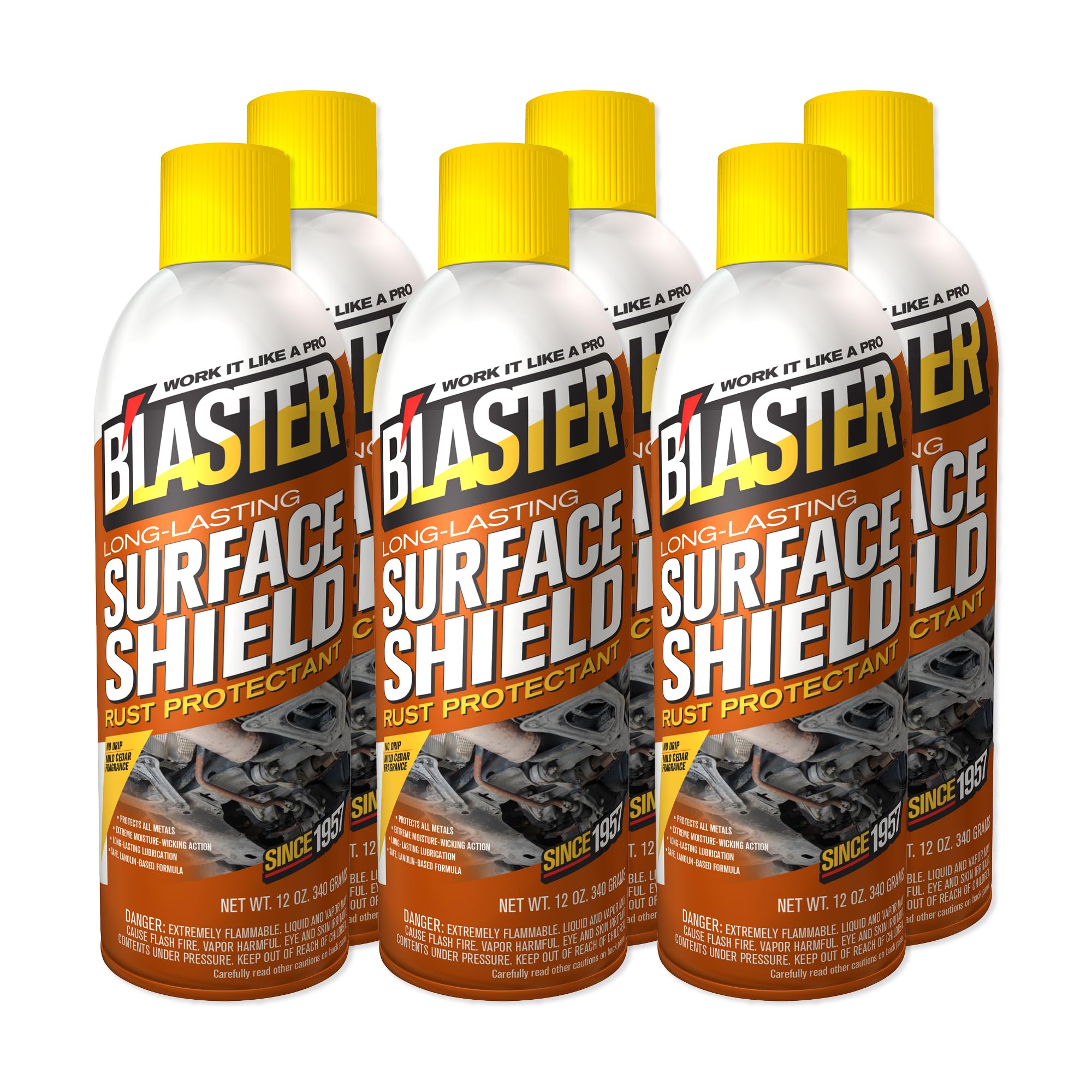
Blaster Surface Shield takes a fundamentally different approach to rust protection by using lanolin, a natural wool-derived oil, as its active corrosion-inhibiting ingredient. The lanolin-based formula is non-toxic, low in volatile organic compounds, and produces minimal odor during application, making it the most environmentally responsible option in this guide. The spray is safe for use on plastic, rubber, glass, and wiring without causing any material degradation or swelling.
The corrosion protection duration is rated at up to two years, and the uniform spray pattern deposits a consistent film without peaks or valleys that could leave thin spots. Owner reports from the salt belt states document successful protection on brake lines, fuel tank straps, and suspension components through multiple winter seasons. The low-odor characteristic is particularly appreciated by DIY owners who lack professional spray booths and must work in attached garages or residential driveways.
The six-pack format provides generous coverage for a full underbody treatment, and the aerosol cans include the precision spray nozzle commonly found on professional-grade products. The lanolin film remains soft and self-healing, which means it continues to protect even if the coating is scraped or displaced by road debris. For owners who prioritize environmental safety, low fume exposure during application, and compatibility with non-metal materials, Surface Shield represents the most thoughtful formulation available.
What works
- Non-toxic, low-VOC lanolin formula minimizes environmental impact
- Very low odor compared to solvent-based rust inhibitors
- Safe on plastic, rubber, glass, and wiring without damage
- Uniform spray pattern provides consistent film thickness
What doesn’t
- Soft film remains tacky and collects grime over time
- Shorter protection window compared to moisture-cured urethanes
- Not paintable or topcoatable for cosmetic finishes
- May require more frequent reapplication in high-abrasion zones
9. Meuvcol 2-in-1 Rust Converter & Metal Primer
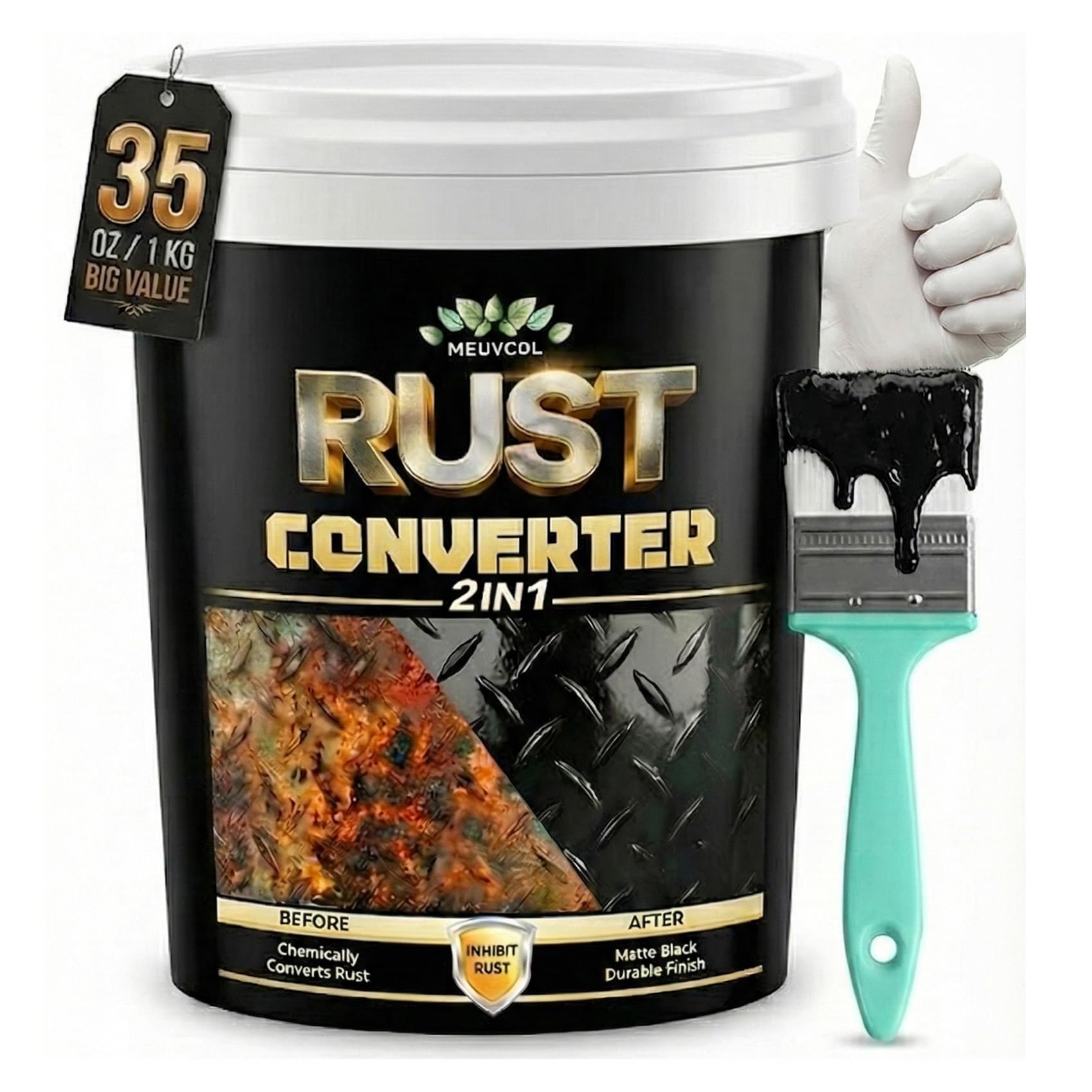
Meuvcol’s 2-in-1 formulation combines rust converter chemistry with a primer-grade barrier coating in a single 35-ounce container, delivering exceptional volume for the budget-conscious buyer. The matte black finish is designed to be left as a final coating or topcoated with paint for cosmetic applications. The product functions by chemically reacting with iron oxide (rust) to form a stable, water-insoluble compound that stops further oxidation while simultaneously depositing a protective film.
The application process is straightforward — remove loose scale and grease, wipe the surface dry, and apply with a brush in thin coats, allowing 24 hours between applications for full film formation. Owner feedback from farm equipment and trailer restoration projects confirms that the converter chemistry effectively neutralizes light to moderate surface rust without requiring complete removal down to bare metal. The included brush and gloves add practical value for first-time users who may not have application tools on hand.
Heat resistance is a notable feature for a product in this price tier, with the cured film maintaining integrity in engine bay environments and exhaust-adjacent areas. The 35-ounce container provides enough material to treat an entire truck frame or multiple automotive components, making the per-project cost significantly lower than smaller specialty products. While the long-term durability does not match premium moisture-cured urethanes, the combination of rust conversion, priming, and generous volume creates compelling value for budget-constrained projects.
What works
- Large 35-ounce container provides excellent coverage per dollar
- Converter chemistry neutralizes existing rust without full removal
- Includes brush and gloves for immediate application
- Adequate heat resistance for engine bay use
What doesn’t
- Long 24-hour dry time between coats extends project completion
- Matte finish less durable than gloss or urethane alternatives
- Brush application limits ability to reach tight cavities
- Not suitable for heavy structural rust without mechanical prep
10. PB Blaster Penetrating Oil
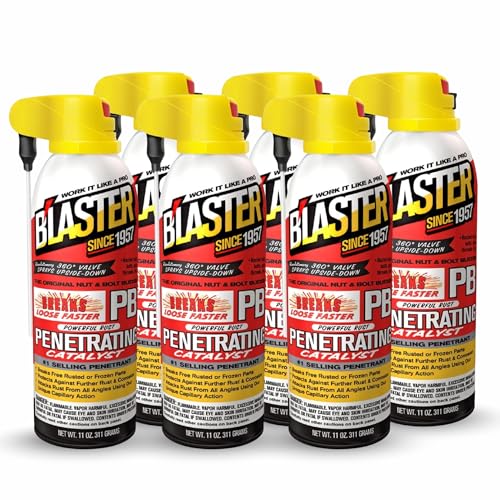
PB Blaster has built a decades-long reputation as the go-to penetrant for freeing rusted and seized fasteners, and the six-pack format ensures that mechanics and DIY owners always have a can within reach. The low surface tension formula creeps deep into thread clearances and tight spaces, breaking the bond between rusted surfaces through capillary action rather than brute force. The penetrating catalyst chemistry is engineered to dissolve the crystalline structure of rust, allowing bolts and nuts to turn free without snapping.
Beyond its primary function as a penetrant, the product leaves a protective film that helps prevent future corrosion on the treated threads. The adjustable ProStraw applicator provides two spray patterns — a wide fan for general coverage and a concentrated stream for targeted delivery into tight bolt holes and blind fasteners. Owner reports from automotive repair shops consistently rate PB Blaster as the most effective penetrant for exhaust manifold bolts, suspension hardware, and rusted brake line fittings.
The six-can bundle is the most economical way to purchase PB Blaster for regular use, and each 11-ounce can is compliant with 50-state VOC regulations. While this product is not designed for coating large surfaces or providing long-term underbody protection, it is an essential companion product for anyone who needs to disassemble rusted components before applying a rustproofing treatment. The penetrating action saves time, broken bolts, and frustration when dealing with fasteners that have been exposed to road salt for years.
What works
- Low surface tension penetrates deeper than standard lubricants
- Effectively breaks rust bonds on seized fasteners
- Six-pack format provides excellent value for regular use
- ProStraw applicator offers targeted or wide spray patterns
What doesn’t
- Not a surface coating or long-term rust prevention treatment
- Penetrating film is thin and evaporates over time
- Strong solvent odor requires ventilation during use
- Not suitable for large-area corrosion protection
11. Rust-Oleum Black Undercoating

Rust-Oleum’s Black Undercoating in the 12-pack configuration represents the highest-volume solution for large-scale underbody protection projects. Each 15-ounce can delivers a rubberized coating that provides corrosion protection, noise reduction, and moisture sealing in a single application. The matte finish absorbs light and reduces glare from the underbody, creating a professional appearance that is particularly valued in vehicle restoration and custom build work.
The coating is formulated for use on wheel wells, frame rails, floor pans, and other underbody surfaces where stone chips and moisture are the primary threats. Owner reports document successful applications on fleet vehicles, off-road trucks, and restored classic cars where consistent coverage across large areas is essential. The aerosol format allows for quick application without specialized spray equipment, and the rubberized film remains flexible enough to absorb minor impacts from road debris without cracking.
The 12-can case provides enough material to undercoat multiple vehicles or one large truck with extra cans for touch-up work. Rust-Oleum’s formulation is compatible with most existing underbody coatings and can be applied over properly cleaned surfaces without primer in most cases. For shops, fleets, or owners with multiple vehicles to protect, the bulk format reduces per-unit cost while ensuring consistent chemistry across all applications. The trade-off is that the rubberized coating is not as chemically hard as moisture-cured urethanes, but for general underbody protection, the convenience and coverage volume make this a practical choice.
What works
- 12-pack provides exceptional coverage for large-scale projects
- Rubberized film reduces road noise and absorbs stone impacts
- Matte finish creates professional appearance under the vehicle
- Compatible with most existing underbody coatings
What doesn’t
- Rubberized coating less durable than urethane-based systems
- Not suitable for high-heat areas like exhaust or engine components
- Can be difficult to remove if future repairs require access
- Large case quantity may exceed needs for single-vehicle owners
Hardware & Specs Guide
Rust Converter vs Inhibitor vs Barrier Coating
Rust converters use phosphoric acid or tannic acid chemistry that reacts with iron oxide (rust) to create a stable, inert compound that can be painted over. Inhibitors block moisture and oxygen at the molecular level using polar bonding or dielectric films, preventing corrosion before it starts. Barrier coatings physically seal the metal surface with a impermeable layer, typically using urethane, epoxy, or rubberized polymers. Understanding which category fits your situation is essential — converters treat existing rust, inhibitors protect clean metal, and barrier coatings provide a sacrificial shield against physical abrasion and chemical exposure.
Surface Preparation and Adhesion
Every rustproofing product demands specific surface preparation for optimal performance. Moisture-cured urethanes like POR-15 require etching with an acid-based metal prep to create a micro-rough surface for mechanical bonding. Wax-based and lanolin inhibitors need clean, dry metal but can tolerate light surface rust. Rubberized undercoatings adhere best to scuffed or primed surfaces and may delaminate from smooth, glossy paint. Contaminants such as oil, grease, silicone, and loose rust will cause any coating to fail prematurely, regardless of product quality.
Coverage and Film Thickness
Coverage rates vary dramatically by product chemistry and application method. Brush-on urethanes typically cover 50 to 100 square feet per quart at the recommended two-coat application. Aerosol products deliver less coverage per ounce because of overspray and the thinner film required for proper atomization. Film thickness directly correlates with protection longevity — thin films may last one to two years in harsh environments, while properly applied thick coatings can exceed five years. Multiple thin coats always outperform a single thick coat due to reduced solvent entrapment and more uniform curing.
Cure Time and Environmental Conditions
Cure time ranges from 30 minutes for aerosol penetrants to 24 hours for moisture-cured urethanes. Temperature and humidity dramatically affect cure speed — urethanes cure faster in higher humidity, while solvent-based products dry slower in humid conditions. Application below 50°F or above 90°F can cause adhesion failure, solvent popping, or incomplete curing. Full chemical resistance and hardness develop over several days to weeks as the polymer continues to cross-link. Planning the application around weather conditions is critical for achieving maximum protection.
FAQ
Can I apply rustproofing over existing rust?
How often should I reapply auto rustproofing?
Can I paint over rustproofing coatings?
Is professional application worth the extra cost?
What is the best rustproofing for a vehicle driven on salted roads?
Final Thoughts: The Verdict
For most buyers, the best auto rustproofing winner is the POR-15 Rust Preventive Coating because its moisture-cured chemistry provides the most durable, permanent rust barrier available when applied with proper surface preparation. If you need high-temperature resistance for engine and exhaust components, grab the KBS Coatings RustSeal. And for internal frame cavity protection where rust starts from the inside out, nothing beats the Eastwood Internal Frame Coating.

Certification: BSc in Mechanical Engineering
Education: Mechanical engineer
Lives In: 539 W Commerce St, Dallas, TX 75208, USA
Md Amir is an auto mechanic student and writer with over half a decade of experience in the automotive field. He has worked with top automotive brands such as Lexus, Quantum, and also owns two automotive blogs autocarneed.com and taxiwiz.com.