An RV power system is only as strong as its foundation, and choosing the wrong battery chemistry or capacity can turn a dream trip into a constant search for hookups. Flooded lead-acid units still dominate many older rigs, but lithium iron phosphate technology has shifted what owners expect from a deep-cycle bank. The stakes are higher than ever because a single decision affects weight distribution, usable amp hours, charging speed, and total cost over a decade of ownership.
I’m Amir — the founder and writer behind Four Wheel Ask. My work involves systematically comparing battery chemistries, BMS architectures, cycle-life benchmarks, and real owner satisfaction data across hundreds of RV power configurations to separate marketing claims from genuine performance.
Every product on this list has been vetted for real-world usability, safety integration, and long-term value. By analyzing specifications and thousands of owner reports, I have selected the models that qualify as the best batteries for rv owners can trust.
How To Choose The Best Batteries For RV
Selecting a battery for a recreational vehicle requires balancing chemistry, capacity, weight, and charging compatibility. The wrong choice can lead to sagging voltage under load, premature capacity loss, or a bank that simply cannot keep up with modern appliances. Below are the critical factors that separate a well-matched system from a regrettable purchase.
Battery Chemistry: LiFePO4 vs. Lead-Acid
Lithium iron phosphate (LiFePO4) has become the standard for serious RV owners because it delivers deeper usable capacity without the voltage sag that plagues lead-acid under load. A 100Ah LiFePO4 battery provides roughly 80–100Ah of usable energy, whereas a lead-acid unit of the same nominal capacity typically delivers only 50Ah before voltage drops too low. LiFePO4 also lasts 4,000 to 15,000 cycles compared to 200–500 cycles for flooded or AGM lead-acid, making the upfront premium more economical over a decade of use.
Capacity Planning and Usable Amp Hours
Total amp-hour (Ah) rating matters, but usable capacity matters more. For a typical RV with a 12V fridge, LED lighting, a water pump, and occasional inverter use, a 100Ah lithium bank offers a solid baseline for weekend boondocking. Owners who run a residential fridge, microwave, or air conditioning should plan for 200Ah to 600Ah. Lead-acid banks require roughly double the nominal capacity to match the usable energy of lithium, which also adds significant weight.
BMS and Protection Features
A robust Battery Management System (BMS) is non-negotiable for lithium batteries. Look for overcharge, over-discharge, short-circuit, and over-current protection as a baseline. Low-temperature cutoff is critical if you camp in freezing conditions — it prevents the battery from accepting a charge below 32°F, which can cause permanent damage. Some premium BMS units also offer cell balancing and Bluetooth monitoring for real-time state-of-charge tracking.
Size, Weight, and Mounting Flexibility
LiFePO4 batteries weigh about 60–70% less than lead-acid equivalents at the same usable capacity. A 100Ah lithium battery typically weighs 22–31 pounds, while a comparable AGM unit can exceed 60 pounds. Physical dimensions also vary — Group 31 is the most common form factor for 100Ah lithium units, but compact options exist for tight compartments. Verify terminal orientation and mounting position before ordering, especially in older RV battery trays.
Quick Comparison
On smaller screens, swipe sideways to see the full table.
| Model | Category | Best For | Key Spec | Amazon |
|---|---|---|---|---|
| GOLDENMATE 12V 100Ah LiFePO4 | LiFePO4 | Best Overall RV Upgrade | 100Ah, 28.7 lbs, 100A BMS | Amazon |
| CYCLENBATT Mini Bluetooth 100Ah | LiFePO4 | Compact Fit with App Control | 100Ah, 20.8 lbs, Bluetooth 5.0 | Amazon |
| ECO-WORTHY 12V 100Ah LiFePO4 | LiFePO4 | Real-Time SOC Display | 100Ah, 25.1 lbs, LED Panel + Bluetooth | Amazon |
| Power Queen 12V 100Ah G31 | LiFePO4 | Grade-A Cell Reliability | 100Ah, 24 lbs, 100A BMS | Amazon |
| Litime 12V 100Ah TM LiFePO4 | LiFePO4 | ABYC E-13 Compliance | 100Ah, 22.2 lbs, Low-Temp Cutoff | Amazon |
| Battle Born 100Ah 12V LiFePO4 | LiFePO4 | Premium Long-Term Investment | 100Ah, 31 lbs, 10-Year Warranty | Amazon |
| Dumfume 2-Pack 12V 200Ah LiFePO4 | LiFePO4 | High-Capacity Off-Grid Bank | 200Ah each, 200A BMS, 41.7 lbs each | Amazon |
| Dumfume 12V 600Ah LiFePO4 | LiFePO4 | Massive Single-Battery Reserve | 600Ah, 200A BMS, 7.2kWh | Amazon |
| Mighty Max ML100-12 100Ah | SLA / AGM | Budget Lead-Acid Replacement | 100Ah, 28 lbs, UL Certified | Amazon |
| WEIZE 12V 100Ah Deep Cycle | SLA / AGM | Heavy-Duty Lead-Acid Backup | 100Ah, 63 lbs, 1150A Max Discharge | Amazon |
| Newport 12V50Ah Marine AGM | AGM | Lightweight Starter / Trolling | 50Ah, 32 lbs, Sealed AGM | Amazon |
In‑Depth Reviews
1. GOLDENMATE 12V 100Ah LiFePO4 Battery

The GOLDENMATE 12V 100Ah LiFePO4 strikes an impressive balance between cost, cycle life, and usable capacity. It uses Grade-A lithium cells and a built-in 100A BMS that covers overcharge, over-discharge, over-current, overheating, and short-circuit protection. The self-discharge rate is exceptionally low, allowing up to one year of storage without maintenance after a full charge — a practical advantage for seasonal RV owners.
At 28.7 pounds in a Group 31 form factor, this battery is about half the weight of a lead-acid equivalent with the same nominal capacity. The BMS also includes high and low-temperature protection, which prevents charging below freezing and discharging in extreme heat. Owners can connect up to four units in series or parallel to build a 51.2V 400Ah system, making it scalable for larger rigs.
The only notable limitation is the absence of Bluetooth monitoring. There is no app-based state-of-charge tracking, so owners must rely on an external shunt or battery monitor. For the price point, however, the protection features and cycle-life rating of up to 15,000 cycles make this a standout value for RV owners seeking a reliable lithium upgrade without paying for premium extras they may not need.
What works
- Strong 100A BMS with full protection suite including low-temp cutoff
- Excellent scalability — supports 4S4P configurations up to 400Ah
- Very low self-discharge enables season-long storage without trickle charging
What doesn’t
- No Bluetooth or app-based monitoring included
- Not waterproof — requires dry mounting location or additional enclosure
- Cannot be used as a starter battery for engine cranking
2. CYCLENBATT Mini Bluetooth 12V 100Ah LiFePO4
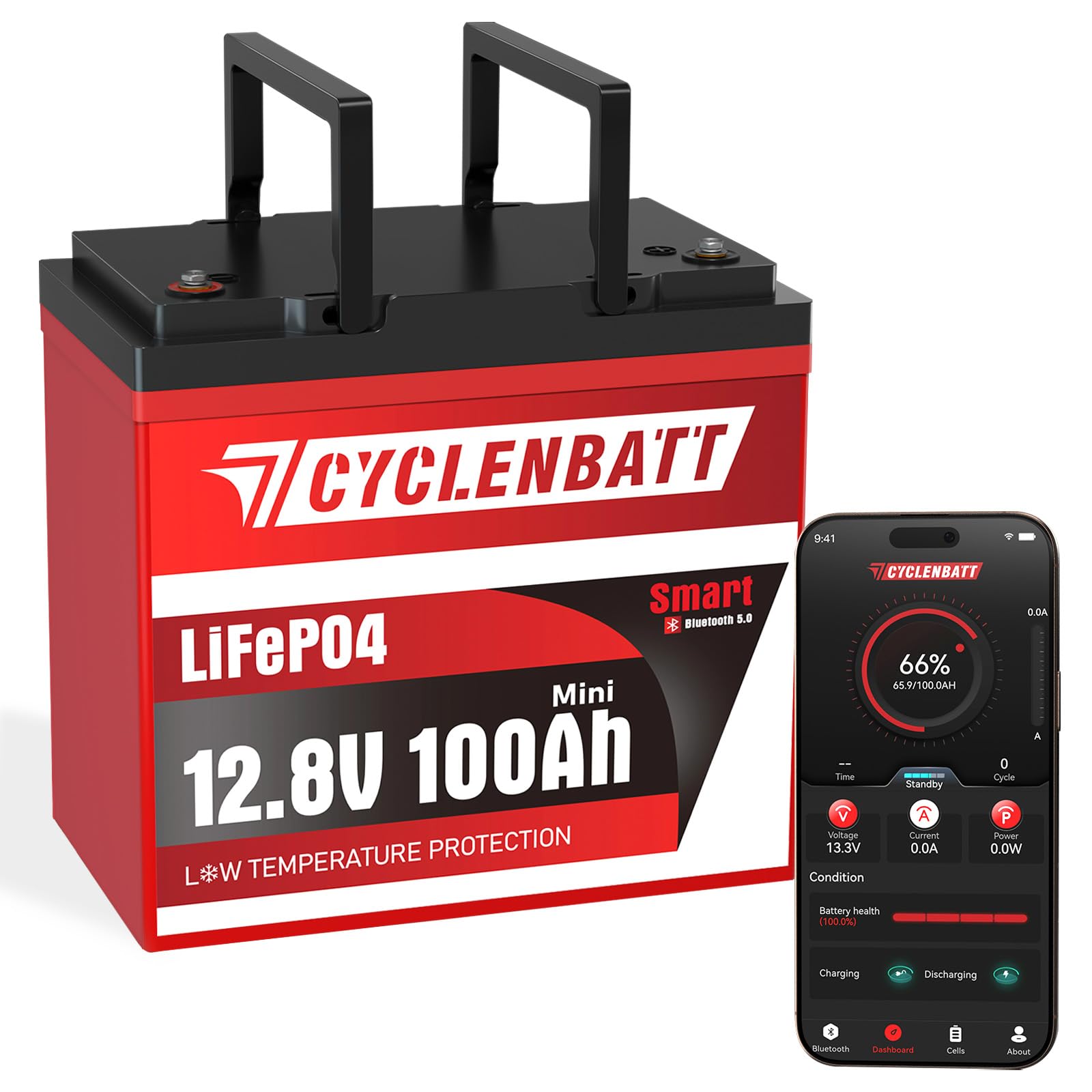
The CYCLENBATT Mini Bluetooth packs 100Ah of LiFePO4 capacity into a chassis that is 46% smaller than a standard Group 31 battery and weighs just 20.8 pounds. This makes it one of the most space-efficient options on the market for RV compartments with tight clearance. The built-in Bluetooth 5.0 module pairs with the CYCLENBATT app to display state of charge, voltage, current, power, and individual cell temperature in real time.
The smart BMS includes low-temperature shutdown that stops charging below 32°F and stops discharging below -4°F, protecting the cells from cold-weather damage. Owners can also toggle charging or discharging functions directly from the app, adding a layer of control that is rare at this price tier. The battery supports up to 4S4P expansion, yielding a maximum system capacity of 20.48kWh.
The trade-off for the compact footprint is a slightly lower maximum continuous discharge current compared to full-size Group 31 units. It is rated for 100A continuous, which is sufficient for most RV loads but may limit heavy inverter use. The 5-year warranty provides solid long-term coverage, and the terminal hardware uses standard M8 bolts for straightforward installation.
What works
- Exceptionally compact and lightweight — 46% smaller than Group 31
- Bluetooth monitoring with real-time SOC, voltage, and temperature data
- Low-temperature cutoff protects cells in freezing environments
What doesn’t
- Continuous discharge limited to 100A, which may constrain large inverters
- App interface requires some initial setup familiarity
- Not suited for starter battery applications
3. ECO-WORTHY 12V 100Ah LiFePO4 with SOC Display
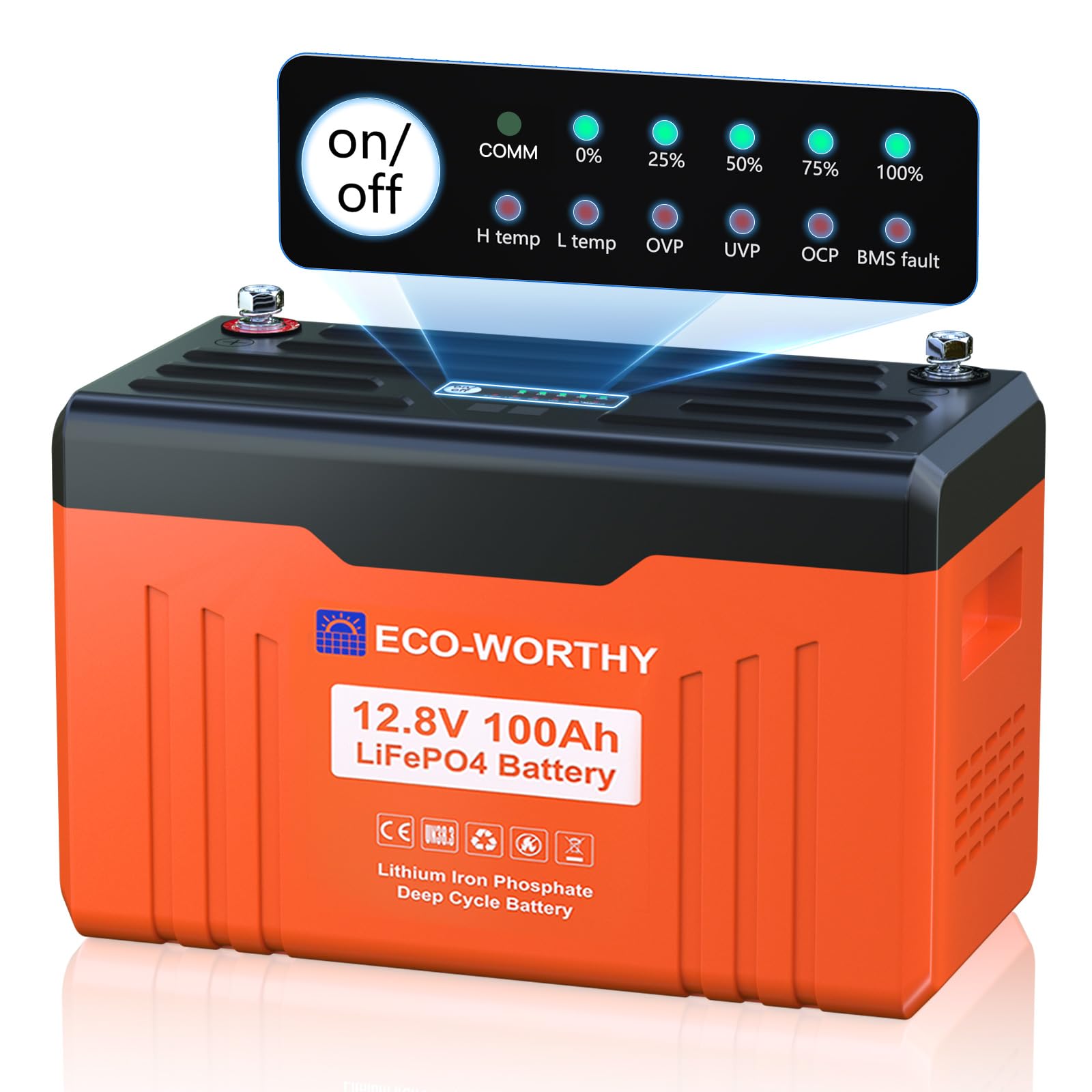
The ECO-WORTHY 12V 100Ah LiFePO4 combines an integrated LED state-of-charge display with Bluetooth connectivity, giving owners two ways to monitor battery status without buying additional hardware. The LED panel shows SOC at a glance, while the ECO-WORTHY app provides deeper metrics including voltage, current, runtime, and individual cell consistency. A built-in buzzer alerts users to BMS faults instantly, which adds an extra layer of safety for unattended installations.
This battery uses a metal fixture to secure the internal cells, preventing swelling and reducing the risk of internal short circuits over the battery’s lifespan. It supports up to 4P2S expansion for a total of 10.24kWh, and the Group 27 size (11.8 x 6.9 x 8.7 inches) fits most RV battery trays without modification. The 3-year warranty is competitive for this segment.
Some owners have noted that the Bluetooth range is limited to about 98 feet, which is adequate for most RV layouts but may drop signal in larger motorhomes with metal compartments. The included M8 terminals are standard, but the manual could be more detailed for first-time lithium users. Overall, the dual SOC display options and robust cell-fixture design make this a strong mid-range pick.
What works
- Dual monitoring — onboard LED panel plus Bluetooth app
- Metal cell fixture prevents swelling and enhances safety
- Built-in buzzer alerts for BMS fault conditions
What doesn’t
- Bluetooth range limited to roughly 98 feet
- Manual lacks depth for first-time lithium users
- Group 27 size may require adapter shims in trays designed for Group 31
4. Power Queen 12V 100Ah LiFePO4 Battery Group 31
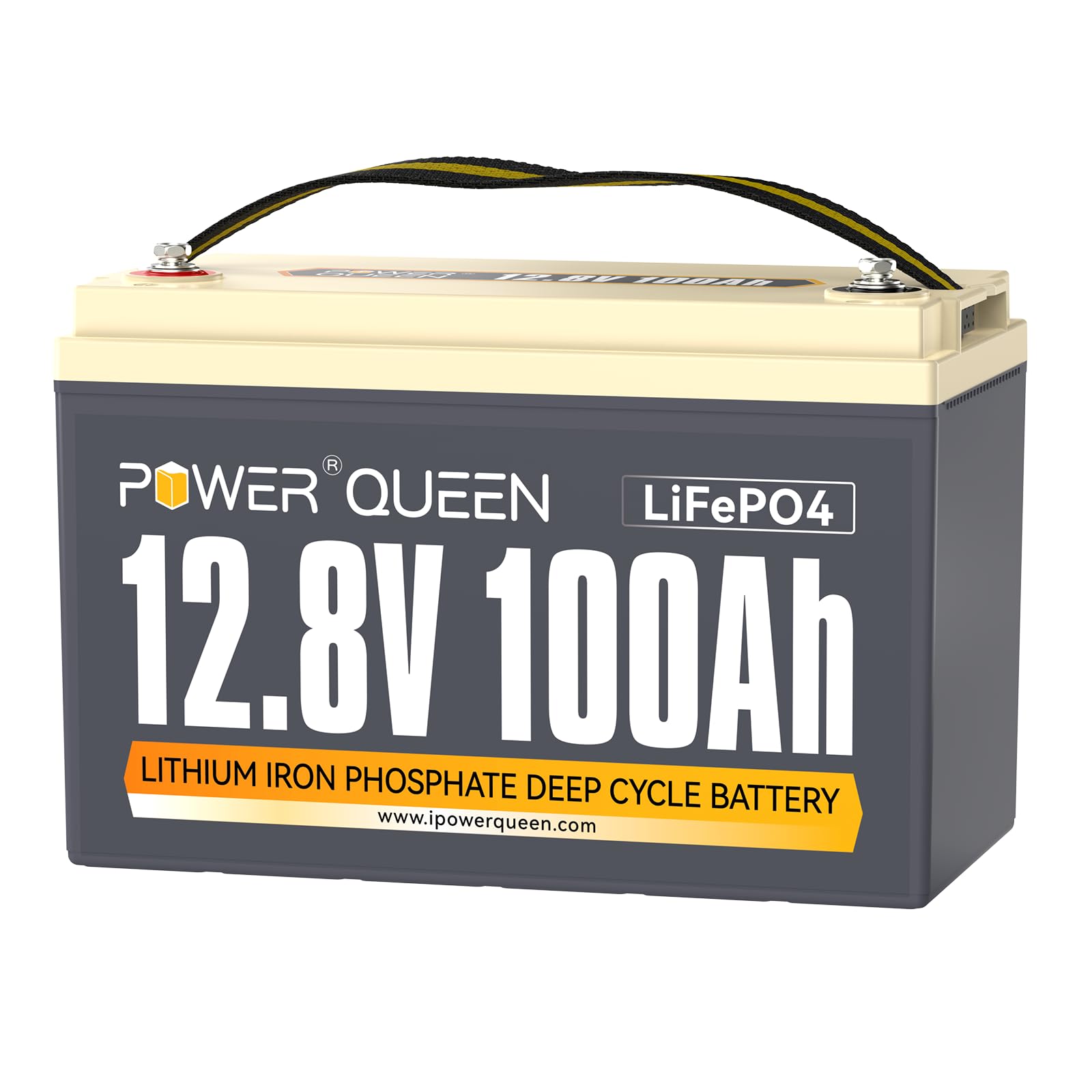
The Power Queen 12V 100Ah LiFePO4 is built around Grade-A lithium iron phosphate cells that deliver stable voltage and consistent power output across the discharge curve. The 100A BMS provides comprehensive protection against overcharge, over-discharge, short circuits, and overheating, and the battery is rated for up to 15,000 deep cycles at lower depth of discharge. At just 24 pounds in a standard Group 31 case, it offers a significant weight savings over lead-acid alternatives.
This battery supports series and parallel expansion up to 4S4P, enabling a maximum configuration of 51.2V 400Ah (20.48kWh). The self-discharge rate is quoted at 3% per month, which is excellent for seasonal storage. Power Queen backs the unit with a 5-year warranty, reflecting confidence in the cell quality and BMS longevity.
The main drawback is the lack of Bluetooth or any onboard display. Owners who want real-time SOC monitoring will need to install an external battery monitor or shunt. Additionally, the terminal bolts are standard M8, but some users have reported that the included hardware could be slightly longer for easier connection with thick cable lugs. For owners who prioritize cell quality and cycle life over gadget integration, this is a compelling choice.
What works
- Grade-A LiFePO4 cells with stable voltage and long cycle life
- Lightweight at 24 pounds for easy handling and installation
- 5-year warranty provides solid long-term coverage
What doesn’t
- No Bluetooth monitoring or built-in SOC display
- Included terminal bolts are shorter than ideal for thick lugs
- Not designed for starter battery use
5. Litime 12V 100Ah Trolling Motor LiFePO4 (Group 31)

The Litime 12V 100Ah TM LiFePO4 battery meets the ABYC E-13 standard, meaning its BMS has been tested for resistance to dust, water ingress, and salt spray — a significant reliability marker for RV owners who venture into coastal or high-humidity environments. The BMS also includes TVS (transient voltage suppression) to protect 12V to 36V trolling motors from voltage spikes, which translates to cleaner power delivery for sensitive RV electronics.
At 22.16 pounds, it is one of the lightest 100Ah lithium batteries available, reducing tongue weight in trailers or overall load in motorhomes. The low-temperature protection stops charging below 32°F and stops discharging below -4°F, preserving cell integrity in cold climates. Litime rates this battery for 4,000 cycles at 100% depth of discharge, with a projected 10-year service life under normal use.
The primary limitation is the price, which sits above many competitors without offering Bluetooth or an integrated display. The BMS is highly capable, but owners who want app-based monitoring will need to purchase an external system. The terminal hardware is well-executed with M8 bolts and insulating caps, but the manual could do a better job explaining the ABYC certification details and what they mean for installation.
What works
- ABYC E-13 certified for dust, water, and salt spray resistance
- TVS protection shields electronics from voltage spikes
- Extremely lightweight at 22.2 pounds for a 100Ah bank
What doesn’t
- No Bluetooth or onboard SOC display
- Premium pricing without app-based monitoring features
- Manual lacks thorough explanation of ABYC certification
6. Battle Born 100Ah 12V LiFePO4 Battery
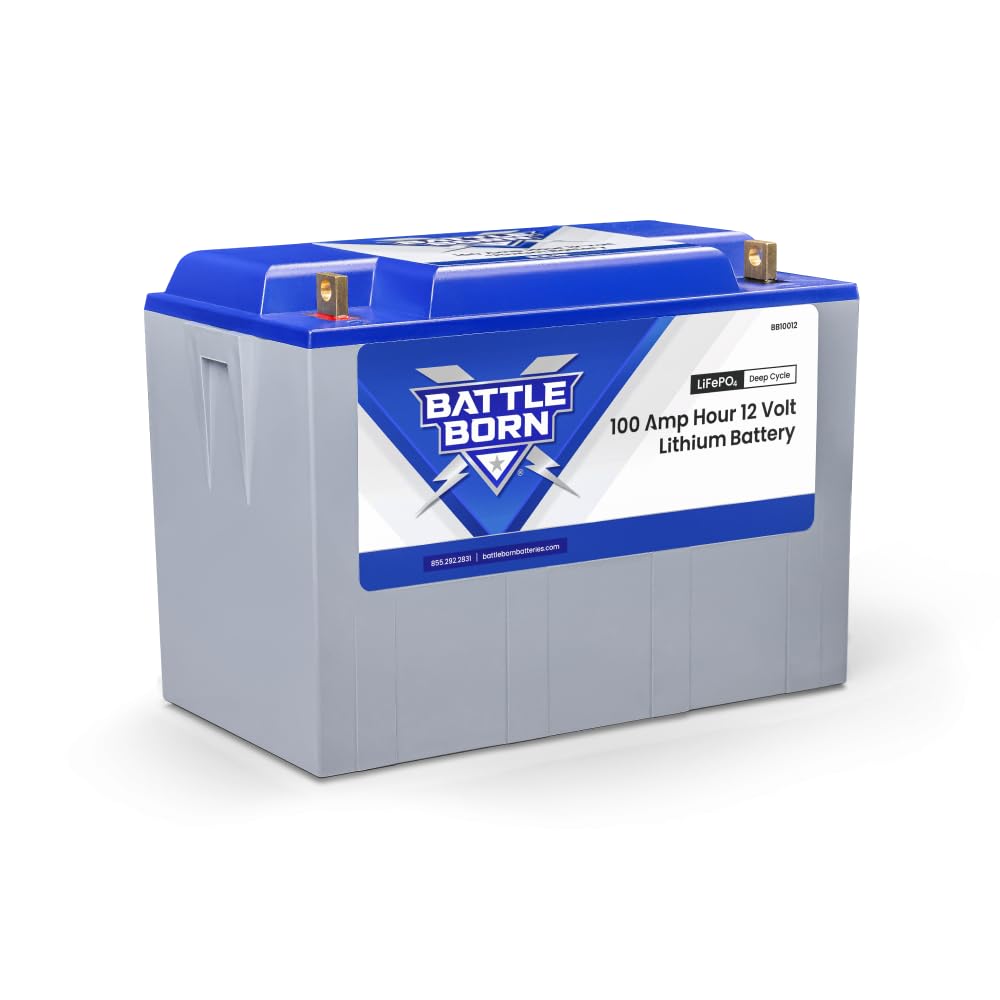
The Battle Born 100Ah LiFePO4 is a reference-grade battery that has been widely adopted in the RV industry for its robust internal BMS, which includes low-temperature protection, high and low voltage cutoff, short-circuit protection, and cell balancing. It is designed as a drop-in replacement for Group 27 and Group 31 battery trays, and it can be mounted in any orientation without venting concerns. The lithium iron phosphate chemistry is rated for 3,000 to 5,000 deep discharge cycles, translating to 10–15 years of service in typical RV use.
At 31 pounds, it is slightly heavier than some lithium competitors, but the extra mass comes from a rugged case and higher-grade internal components. The battery supports series and parallel wiring, allowing owners to build 24V, 36V, or 48V banks as needed. Battle Born backs this unit with a 10-year warranty, which is among the longest in the industry and reflects the company’s confidence in its BMS design and cell sourcing.
The main barrier is the price point, which sits at the high end of the 100Ah lithium segment. There is no Bluetooth or app integration, and the BMS, while reliable, does not offer the granular user controls found on some newer competitors. For RV owners who prioritize proven reliability, warranty length, and North American customer support, the Battle Born remains a benchmark choice despite the premium cost.
What works
- Industry-leading 10-year warranty with strong customer support
- Drop-in replacement for Group 27 and 31 trays with flexible mounting
- Proven BMS reliability across thousands of RV installations
What doesn’t
- Premium price significantly higher than comparable 100Ah units
- No Bluetooth or app-based monitoring built in
- Heavier than many competing lithium batteries at 31 pounds
7. Dumfume 2-Pack 12V 200Ah LiFePO4 Batteries

The Dumfume 2-pack delivers two 12V 200Ah LiFePO4 batteries, each providing 2560Wh of energy storage and a built-in 200A BMS. This configuration is ideal for RV owners who need substantial off-grid capacity without wiring multiple smaller batteries in parallel. Each unit weighs 41.66 pounds — roughly 30% lighter than a lead-acid bank of equivalent usable energy — and features an ABS+PC fireproof shell for improved thermal management.
The 200A BMS on each battery handles heavy loads, making this pack suitable for running large inverters, residential refrigerators, and air conditioning units. Dumfume rates these cells for 15,000 cycles at 60% depth of discharge, with 95% discharge efficiency and 98% energy retention. The compact footprint of each unit (21.06 x 8.07 x 8.46 inches for the pair) fits well in dedicated battery compartments.
There are two important caveats. First, the batteries are not designed for starter or golf cart applications — they are strictly for deep-cycle energy storage. Second, the BMS requires ambient temperatures above 41°F for optimal charging, so cold-weather campers may need to insulate the compartment or use a heating pad. The 2-pack format offers excellent value per kilowatt-hour, but it represents a significant upfront investment.
What works
- Massive 2560Wh per battery with 200A BMS for heavy loads
- 15,000-cycle rating at 60% DOD for exceptional longevity
- Fireproof ABS+PC shell improves safety in enclosed compartments
What doesn’t
- Not suitable for starter or golf cart applications
- Charging efficiency drops below 41°F ambient temperature
- High upfront cost for the 2-pack configuration
8. Dumfume 12V 600Ah LiFePO4 Battery
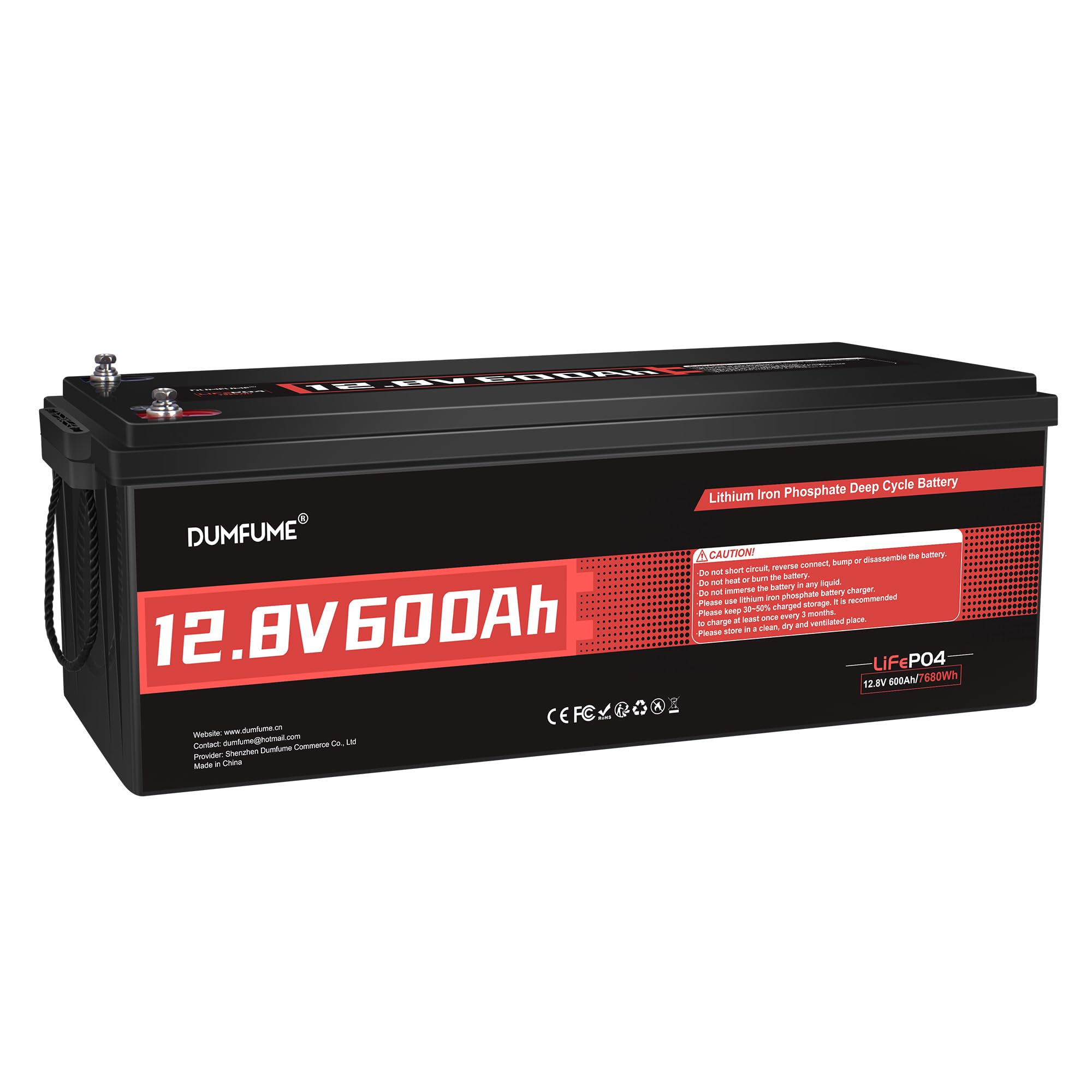
The Dumfume 12V 600Ah LiFePO4 battery packs 7.2kWh of energy into a single unit, enough to run a typical RV’s lighting, refrigerator, and small appliances for a full day without external power. The built-in 200A BMS provides overcharge, over-discharge, over-current, overheating, and short-circuit protection, with a low-temperature cutoff that stops charging below 32°F and discharging below -4°F. This is a true one-battery solution for owners who want minimal wiring complexity.
The battery supports both series and parallel expansion, allowing integration into 24V or 48V systems if needed. Dumfume rates the cycle life at 4,000 cycles at 100% DOD, 6,000 cycles at 80% DOD, and 15,000 cycles at 60% DOD, with a projected 10-year lifespan under normal use. The weight is approximately 112 pounds, which is heavy but still lighter than a lead-acid bank with comparable usable capacity.
The primary consideration is physical size and weight — this is a large, heavy unit that requires a sturdy compartment and may be difficult for one person to maneuver into place. Additionally, the BMS performance is optimized for ambient temperatures above 41°F, so cold-weather installations need insulation or active heating. For RV owners with high energy demands who want a single-battery solution, this offers tremendous capacity in one package.
What works
- Enormous 7.2kWh capacity in a single battery — minimal wiring
- 200A BMS with comprehensive protection and low-temp cutoff
- Supports series and parallel expansion for system flexibility
What doesn’t
- Very heavy at roughly 112 pounds — requires two-person installation
- Optimal charging requires ambient temperature above 41°F
- Not suitable for starter or golf cart applications
9. Mighty Max ML100-12 12V 100Ah SLA / AGM Battery

The Mighty Max ML100-12 is a sealed lead-acid AGM battery that has been a staple entry-level choice for RV owners who need a drop-in replacement without switching to lithium. It is UL certified, maintenance-free, and spill-proof, allowing mounting in any position. The Group 27 footprint (12.09 x 6.65 x 8.48 inches) fits many standard RV trays, and at 28 pounds, it is manageable for solo installation.
This battery is best suited for RVs with modest power requirements — running lights, a water pump, and a basic furnace fan for a weekend trip. It offers 100Ah nominal capacity, but the usable capacity is roughly 50Ah to avoid discharging below 50% depth of discharge, which would shorten the already limited 200–500 cycle lifespan. The high discharge rate capability makes it suitable for applications with occasional surge loads.
The main limitation is cycle life. Lead-acid AGM batteries typically last 2–4 years under regular RV use, compared to 10+ years for LiFePO4. The 28-pound weight is light for lead-acid, but the energy density is much lower than lithium. For budget-conscious owners who camp primarily at hookup sites or rarely cycle the battery deeply, this remains a functional entry point.
What works
- UL certified with spill-proof AGM construction for worry-free mounting
- Lightweight for a lead-acid battery at 28 pounds
- Low upfront cost compared to lithium alternatives
What doesn’t
- Only 50Ah usable capacity — must avoid discharging below 50%
- Short cycle life of 200–500 cycles under regular use
- Higher self-discharge rate than lithium requires more frequent charging
10. WEIZE 12V 100Ah Deep Cycle Battery Group 31

The WEIZE 12V 100Ah Deep Cycle battery is a sealed lead-acid AGM unit built in a Group 31 form factor. It is designed for applications that require high surge current — up to 1150A maximum discharge — making it suitable for RVs with winches, inverter loads, or occasional engine starting in a pinch. The battery is maintenance-free and spill-proof, with terminals configured as left positive and right negative.
At 63 pounds, this is a heavy battery, reflecting the lead content and thick plates needed for deep-cycle durability. The 100Ah nominal capacity yields roughly 50Ah usable before voltage drops below safe levels. WEIZE rates the self-discharge at 3% per month, which is average for AGM chemistry. The battery fits applications such as RV auxiliary power, trolling motors, solar storage, and UPS systems.
The weight makes installation cumbersome, and the cycle life is typical for lead-acid at 300–500 cycles. Owners who deeply cycle this battery regularly will see capacity fade within 2–3 years. The high discharge current is an advantage for surge loads, but the usable capacity limitation remains the primary trade-off against lithium options at a higher initial cost. For RV owners on a tight budget who need a rugged AGM battery, this is a solid choice.
What works
- Very high 1150A max discharge current for surge loads
- Maintenance-free AGM construction with spill-proof design
- Group 31 size fits standard RV battery trays
What doesn’t
- Heavy at 63 pounds — difficult to maneuver into tight compartments
- Only 50Ah usable capacity due to lead-acid chemistry limits
- 300–500 cycle life requires replacement every 2–3 years with regular use
11. Newport 12V50Ah Deep Cycle Marine AGM Battery
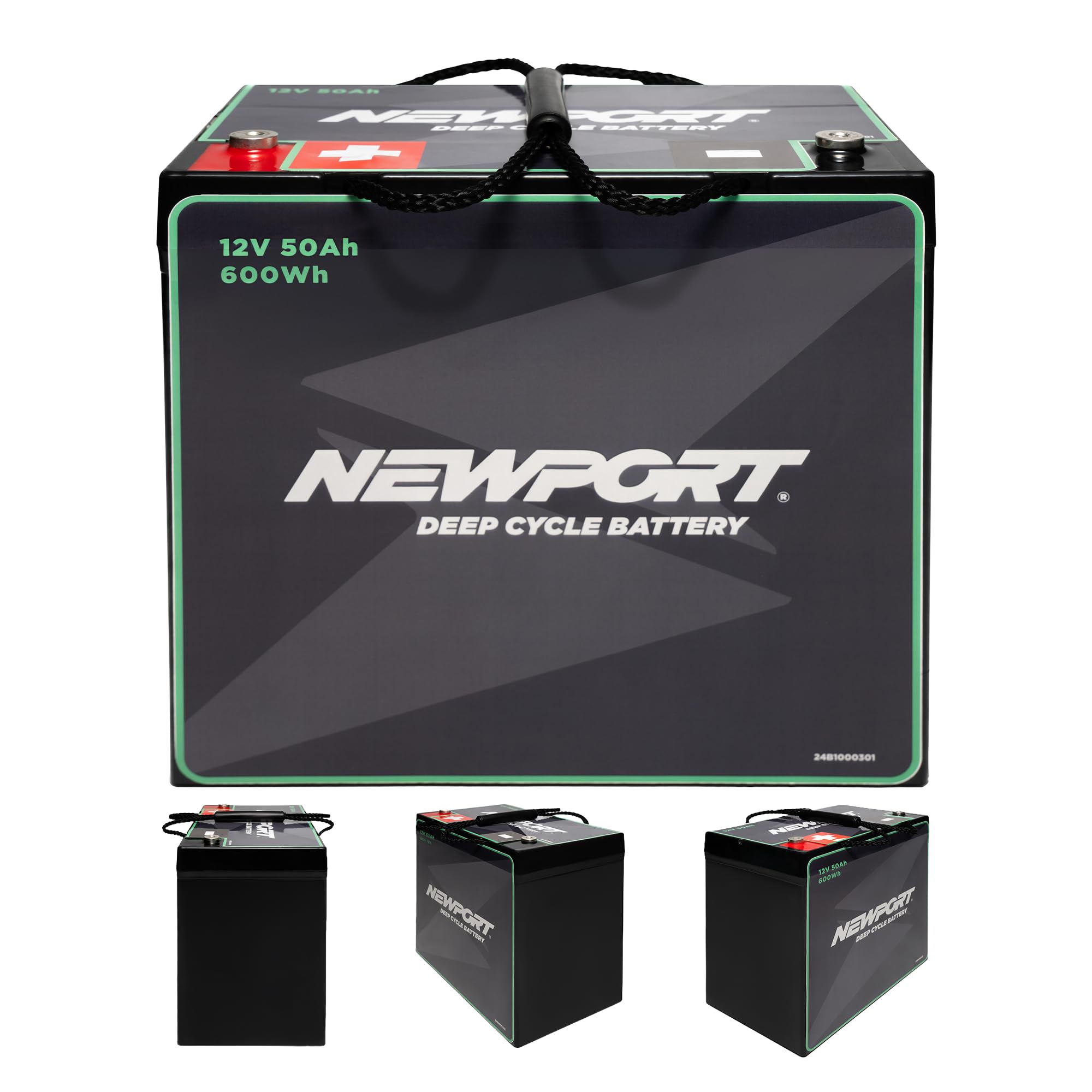
The Newport 12V50Ah is a sealed AGM deep-cycle marine battery that serves as an affordable entry point for RV owners with minimal power needs. It weighs 32 pounds and uses a lead-acid AGM construction that is leak-proof and vibration-resistant. The 50Ah nominal capacity provides roughly 25Ah usable before the recommended 50% depth of discharge limit, making it suitable for powering LED lights, a water pump, and small electronics for a night or two.
The battery is compatible with trolling motors and small marine applications, and it uses standard marine terminals for easy connection. The 1-year limited warranty reflects the expected service life of a budget AGM battery under regular cycling. For RV owners who primarily camp at full-hookup campgrounds and only need a small buffer battery for brief off-grid stops, this unit offers a functional low-cost solution.
The primary trade-off is usable capacity. With only 25Ah available, a typical RV fridge running on DC can drain this battery in a few hours, and running an inverter for device charging will deplete it quickly. The cycle life is limited to a few hundred cycles. This battery is best viewed as a supplemental or starter battery for small trailers or pop-up campers rather than a primary house bank for extended boondocking.
What works
- Low cost makes it accessible for small trailers and pop-ups
- Sealed AGM design is leak-proof and vibration resistant
- Lightweight at 32 pounds for easy handling and installation
What doesn’t
- Only 25Ah usable capacity severely limits off-grid runtime
- Limited cycle life — typically 200–300 cycles before capacity fade
- Small capacity makes it impractical for larger RVs or extended boondocking
Hardware & Specs Guide
LiFePO4 Chemistry
Lithium iron phosphate cells offer a flat discharge curve, meaning voltage stays near 12.8V for most of the cycle. This provides consistent power to inverters and appliances without the voltage sag that occurs with lead-acid batteries. LiFePO4 also handles deeper discharge without damage, delivering 80–100% of rated capacity versus 50% for lead-acid. The chemistry is inherently safer than other lithium-ion formulations due to its thermal stability and resistance to thermal runaway.
Battery Management System (BMS)
The BMS is the electronic brain of a lithium battery. It monitors each cell’s voltage and temperature, balances cells during charging, and disconnects the battery if any parameter goes out of spec. Key features include overcharge protection, over-discharge cutoff, short-circuit protection, over-current limiting, and low-temperature charge prevention. A high-quality BMS directly extends battery life and prevents catastrophic failure. Some BMS units also offer Bluetooth connectivity for real-time monitoring via a smartphone app.
Cycle Life and Depth of Discharge
Cycle life refers to the number of charge-discharge cycles a battery can deliver before its capacity drops to 80% of the original rating. LiFePO4 batteries typically achieve 3,000–15,000 cycles depending on depth of discharge (DOD). Shallower discharges (60% DOD) dramatically extend cycle life compared to full 100% DOD cycling. Lead-acid batteries are limited to 200–500 cycles at 50% DOD. For RV owners who boondock frequently, the higher cycle life of lithium translates to many more seasons of service before replacement is needed.
Usable Capacity and Amp Hours
Nominal amp-hour (Ah) ratings are measured at a specific discharge rate, typically C/20 for lead-acid and C/5 or C/1 for lithium. A 100Ah LiFePO4 battery can deliver 100A for one hour or 5A for 20 hours at rated voltage. For lead-acid, the Peukert effect means effective capacity decreases under higher loads. More importantly, lead-acid batteries should only be discharged to 50% to avoid damage, giving a 100Ah AGM battery only 50Ah usable. Lithium batteries can safely discharge to 80–100% DOD, providing significantly more usable energy from the same nominal rating.
FAQ
Can I replace my RV lead-acid battery with a lithium battery without changing my charger?
How many amp hours do I need for boondocking in an RV?
Do I need a special battery monitor for lithium RV batteries?
Is it safe to mount a lithium battery inside the RV living space?
Final Thoughts: The Verdict
For most buyers, the best batteries for rv winner is the GOLDENMATE 12V 100Ah LiFePO4 because it delivers the best combination of robust BMS protection, high cycle life, scalability, and value without requiring a premium budget. If you want Bluetooth monitoring and a compact footprint, grab the CYCLENBATT Mini Bluetooth 100Ah. And for massive off-grid capacity in a single battery, nothing beats the Dumfume 12V 600Ah LiFePO4.

Certification: BSc in Mechanical Engineering
Education: Mechanical engineer
Lives In: 539 W Commerce St, Dallas, TX 75208, USA
Md Amir is an auto mechanic student and writer with over half a decade of experience in the automotive field. He has worked with top automotive brands such as Lexus, Quantum, and also owns two automotive blogs autocarneed.com and taxiwiz.com.