Every breath inside your vehicle passes through a single component most drivers ignore until the musty smell forces a replacement. The difference between a well-engineered cabin air filter and a cheap generic panel shows up in allergy symptoms, fog-free windows, and how long your HVAC blower motor survives. This category is packed with options that range from simple dust barriers to multi-layer HEPA assemblies capable of trapping 99.97% of airborne particulates.
I’m Amir—the founder and writer behind Four Wheel Ask. My approach to evaluating cabin air filters combines specification sheet forensics with thousands of owner-reported real-world observations, allowing me to identify which filters actually hold up under daily driving conditions and which introduce unnecessary airflow restriction.
After analyzing dozens of specifications, owner feedback reports, and filtration data, the best auto air conditioning filter options deliver genuine cabin air quality improvements for a wide range of vehicles and budgets.
How To Choose The Best Auto Air Conditioning Filter
Selecting the right cabin air filter comes down to understanding three core factors: media composition, particle capture efficiency, and vehicle-specific fitment. A filter that doesn’t seal properly or restricts airflow too much will compromise both air quality and HVAC component life.
Filter Media Types
Standard particulate filters use pleated paper or nonwoven synthetic media to trap dust and pollen. Carbon-impregnated filters add an activated charcoal layer that adsorbs odors, ozone, and some harmful gases like sulfur dioxide. HEPA-grade filters use dense melt-blown electrostatic media certified to capture 99.97% of particles at 0.3 microns, making them the gold standard for allergy and asthma sufferers but potentially reducing airflow slightly.
Filtration Efficiency & MERV Ratings
MERV (Minimum Efficiency Reporting Value) ratings quantify a filter’s ability to capture particles across three size ranges. Most automotive cabin filters fall between MERV 8 and MERV 13. A MERV 8 filter handles pollen and dust mites, while MERV 13 captures smoke, bacteria, and virus carriers. Higher MERV ratings mean denser media, which can increase blower motor load—always verify that your vehicle’s HVAC system can handle the restriction before upgrading to a HEPA filter.
Fitment & Seal Integrity
A filter that doesn’t match the factory dimensions or lacks a proper foam/gasket seal will allow unfiltered air to bypass the media entirely. Always cross-reference the OEM part number, measure your existing filter if possible, and check owner forums for fitment feedback on aftermarket options. Filters with structural ribs or rigid frames maintain their shape better under high airflow conditions.
Quick Comparison
On smaller screens, swipe sideways to see the full table.
| Model | Category | Best For | Key Spec | Amazon |
|---|---|---|---|---|
| Bosch 6087C HEPA | HEPA Cabin Filter | Allergy sufferers | 99.97% at 0.3 microns | Amazon |
| Mann Filter CUK 2941-2 | Premium Carbon | OEM replacement | German engineering | Amazon |
| PureFlow HEPA PC99204HX | HEPA Cabin Filter | European cars | 4-layer filtration | Amazon |
| PureFlow PC99594X | Carbon Cabin Filter | Hyundai/Kia | Activated charcoal | Amazon |
| Purolator PBC35667 | Carbon Cabin Filter | Toyota owners | Electrostatic fibers | Amazon |
| Puroma 2-Pack | Carbon Cabin Filter | Budget value | 2-pack, wide fit | Amazon |
| RICHWEI CF10285 | Carbon Cabin Filter | Toyota/Lexus | Activated carbon | Amazon |
| RICHWEI CF10134 | Carbon Cabin Filter | Honda/Acura | High-grade materials | Amazon |
| RICHWEI CF12150 | Carbon Cabin Filter | Ford trucks | Carbon filtration | Amazon |
| SNOWOOW Tesla HEPA | HEPA Cabin Filter | Tesla Model 3/Y | H13 True HEPA | Amazon |
| Forccord Mazda 2-Pack | HEPA Cabin Filter | Mazda CX-90/CX-70 | 5-layer HEPA | Amazon |
In‑Depth Reviews
1. Bosch 6087C HEPA Cabin Air Filter

The Bosch 6087C is a true HEPA-grade cabin air filter that meets ISO 29463-3:2011 standards, delivering 99.97% filtration efficiency at 0.3 microns. This places it in a different league from standard particulate filters, as the dense melt-blown electrostatic layer combined with an additional static cotton media provides exceptional particle capture without relying on chemical odor neutralizers. The structural ribs integrated into the frame design maintain filter integrity over the full service interval, preventing media collapse even under high blower speeds.
Fitment is focused on Lexus and Toyota models from 2016 onward, including the ES350, RX350, NX series, Avalon, and Camry. The 1.38-inch thickness is slightly deeper than many competitors, which increases media surface area and extends dust-holding capacity. Owners report noticeable improvements in cabin air clarity and reduced allergy symptoms after switching from standard carbon filters, though the denser media may produce a minor airflow reduction on the highest fan setting in some vehicles.
For drivers who prioritize respiratory health and live in areas with high pollen counts, wildfire smoke, or urban particulate pollution, the Bosch 6087C represents the highest standard of cabin air filtration available for compatible Toyota and Lexus platforms. The lack of added chemical fragrances is a deliberate engineering choice that avoids masking odors while still adsorbing them through the electrostatic charge.
What works
- Certified HEPA efficiency at 99.97% for 0.3 micron particles
- Structural frame ribs prevent media sagging over time
- No chemical odorants or fragrances added to media
What doesn’t
- Denser media can slightly reduce max airflow on some vehicles
- Limited fitment to Lexus and Toyota models from 2016+
2. Mann Filter CUK 2941-2 Cabin Air Filter
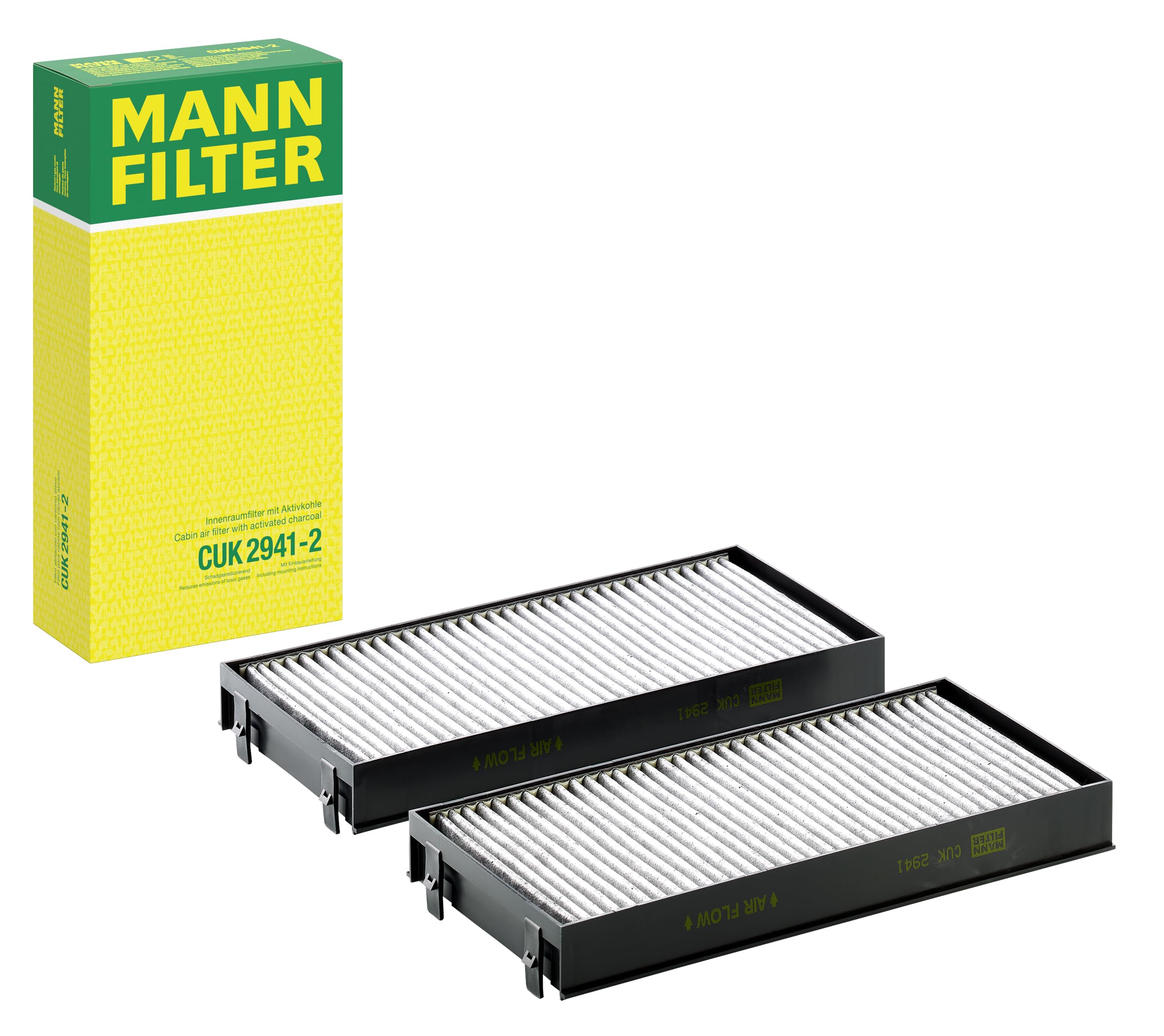
Mann Filter is a leading European OEM supplier, and the CUK 2941-2 reflects that engineering pedigree with a combination of mechanical and electrostatic filtration principles. The pleated paper media is augmented with an electrostatic charge that attracts and holds microscopic particles much smaller than the pore size alone would capture. The activated carbon layer adsorbs odors and harmful gases, while the consistent filtration performance across the entire service interval is a hallmark of Mann’s quality control processes.
This filter is designed as a direct OEM replacement for BMW and Mini applications, with the original equipment part number 64 31 6 945 586 cross-referenced directly. The 9.06 x 6.3 x 1.18-inch dimensions ensure a precise fit within the factory housing, and the perimeter seal prevents bypass air that would compromise filtration. Owner feedback consistently highlights the exact fitment and the noticeable reduction in diesel exhaust odors and ambient pollution entering the cabin.
For European car owners who want a drop-in replacement that matches the performance of the factory-installed filter without paying dealer markup, the Mann CUK 2941-2 is the reference standard. The electrostatic media provides superior particle capture compared to basic carbon filters, making it a strong choice for urban drivers dealing with traffic-related air pollution.
What works
- Electrostatic media captures sub-micron particles effectively
- Exact OEM fitment with proper perimeter seal
- Consistent performance over full service interval
What doesn’t
- Premium pricing compared to aftermarket alternatives
- Limited vehicle compatibility outside BMW and Mini
3. PureFlow HEPA Cabin Air Filter PC99204HX

The PureFlow PC99204HX brings certified HEPA-level filtration to the Volkswagen, Audi, and Cupra platform with a four-layer media design that includes particulate filtration, activated charcoal, baking soda infusion, and a final support layer. The HEPA media targets 99.97% efficiency at 0.3 microns, which places it in the same performance class as the Bosch 6087C but with the added benefit of baking soda for enhanced odor absorption. This makes it particularly effective for drivers who encounter strong organic odors from agricultural areas or industrial zones.
Compatibility spans the VW Tiguan, Jetta, Taos, GTI, Golf family, and Audi A3, Q3, and TT models from 2015 through 2025. The 9.93 x 9.26-inch footprint is among the largest in this category, providing ample media surface area for high dust-holding capacity. Owner reports indicate that the filter maintains airflow well despite the HEPA density, though some users note a slight reduction in fan noise damping compared to OEM filters with thicker foam gaskets.
For European car owners who want maximum protection against airborne particulates without sacrificing odor control, the PureFlow PC99204HX delivers genuine HEPA performance with the added advantage of baking soda-infused carbon media. It is a strong upgrade over standard paper or basic carbon filters for anyone with allergies or sensitivity to traffic fumes.
What works
- HEPA-certified 99.97% efficiency at 0.3 microns
- Baking soda layer enhances odor absorption
- Wide compatibility across VW and Audi models
What doesn’t
- Minor airflow reduction due to HEPA density
- Less sound-damping than OEM foam-gasket filters
4. PureFlow Cabin Air Filter PC99594X
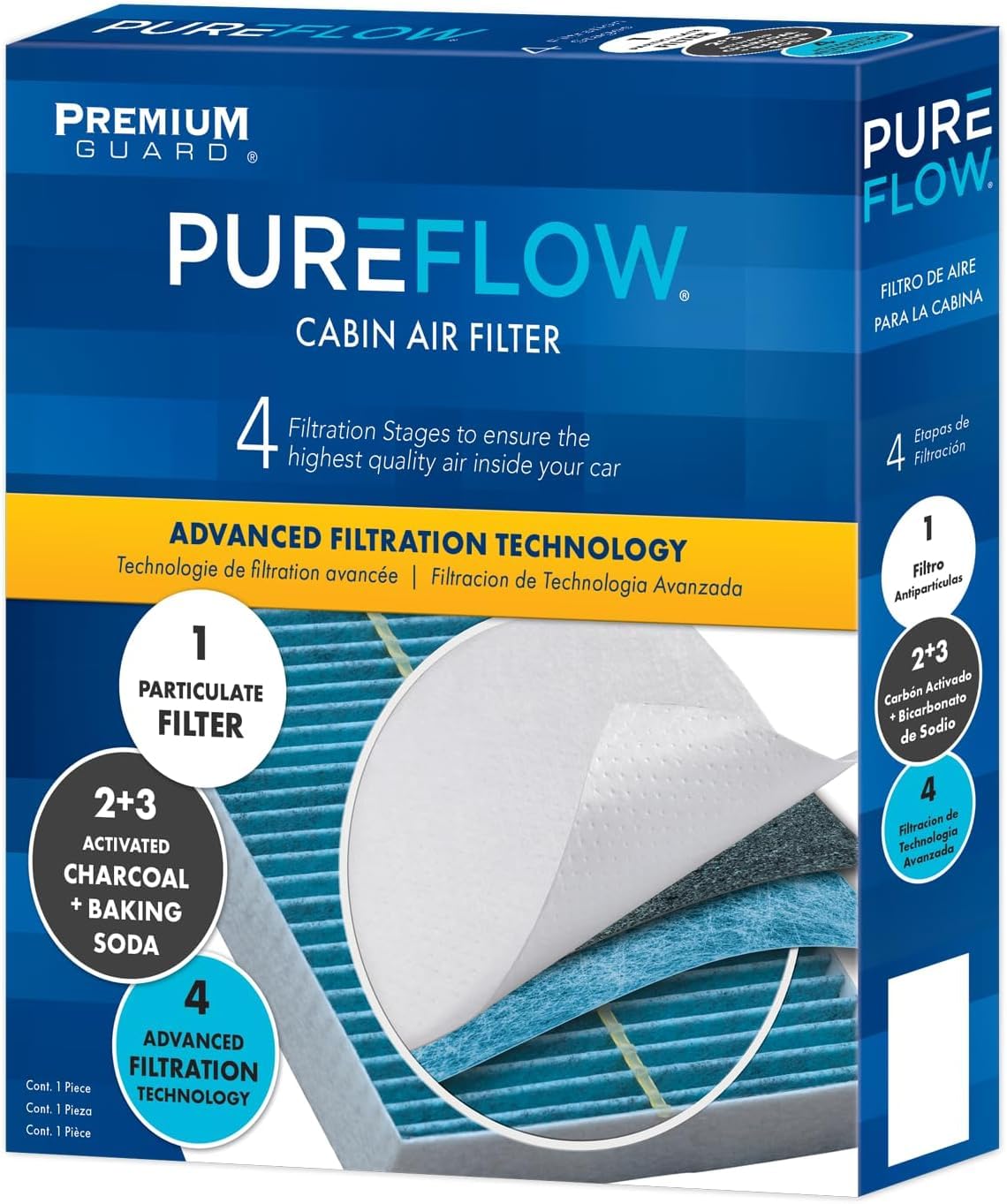
The PureFlow PC99594X is engineered for the latest generation of Hyundai and Kia vehicles, including the Tucson, Elantra, Santa Fe, Sportage, Sorento, and the Ioniq 5 EV. Its four-layer filtration architecture starts with a particulate capture layer for dust and pollen, moves through an activated charcoal stage for gas adsorption, incorporates baking soda for odor neutralization, and finishes with a support layer that maintains media integrity. This multi-stage approach addresses both particulate and gaseous contaminants in a single replacement unit.
The filter replaces OEM part numbers 97133-L1000, 97133-N9100, and 97133N9000, and the 8.9 x 8.23-inch dimensions align with the factory housing specifications for these models. Owner feedback emphasizes the noticeable improvement in cabin air freshness after installation, particularly the reduction of musty odors that develop when the AC system accumulates moisture. The baking soda infusion appears to be more effective at neutralizing persistent smells compared to standard carbon-only filters.
For Hyundai and Kia owners looking for a direct upgrade over the basic paper filter that often ships from the factory, the PureFlow PC99594X offers a meaningful improvement in air quality without any modification or adapters. It is especially well-suited for drivers in humid climates where musty evaporator odors are a frequent complaint.
What works
- Four-layer media captures particles, gases, and odors
- Baking soda infusion neutralizes persistent musty smells
- Direct fit for late-model Hyundai and Kia vehicles
What doesn’t
- Not HEPA-certified for sub-micron particles
- Limited compatibility outside Hyundai/Kia platform
5. Purolator PBC35667 PurolatorBOSS Cabin Air Filter
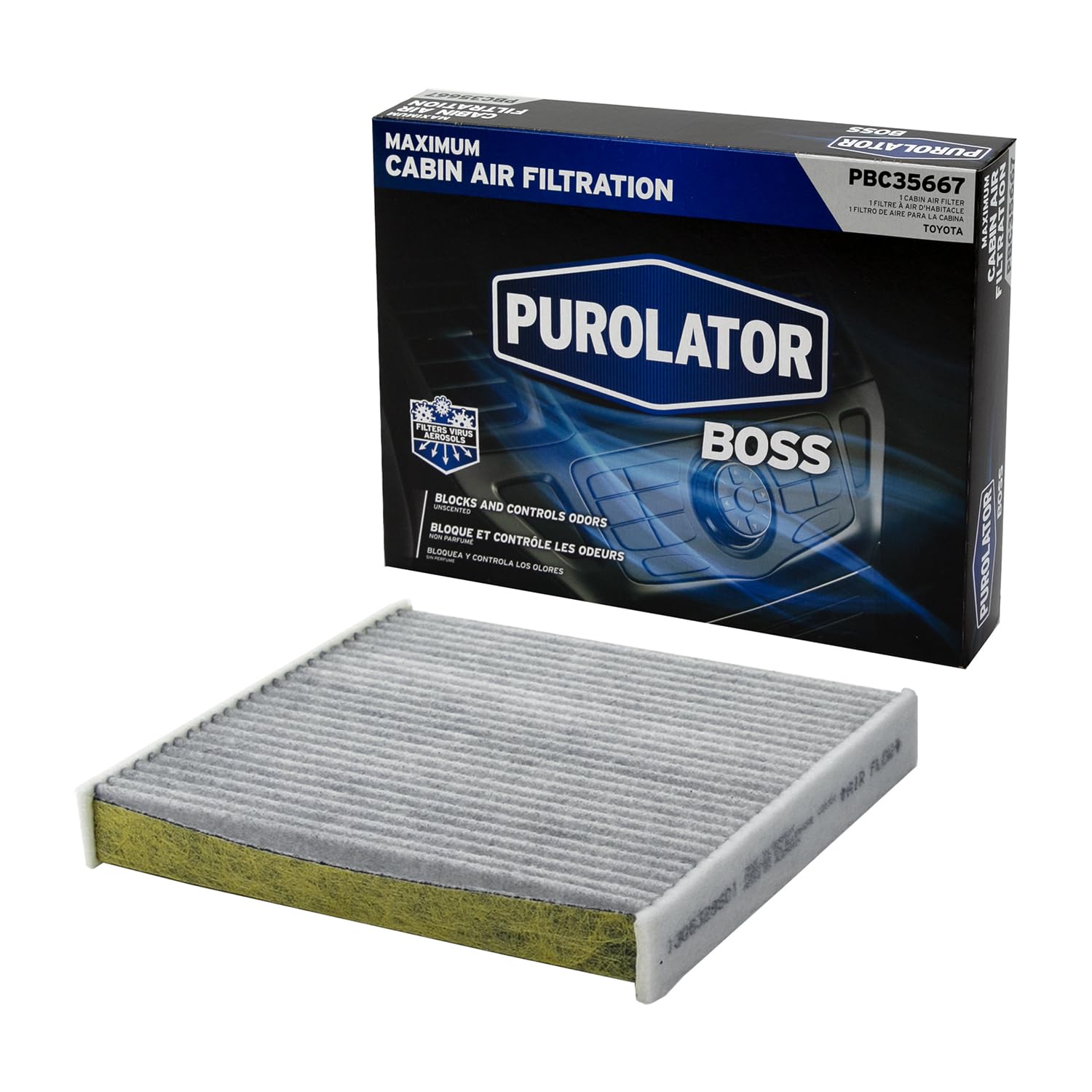
Purolator is a well-established name in automotive filtration, and the PBC35667 PurolatorBOSS filter leverages electrostatically charged microfibers to capture microscopic particles that standard paper media would miss. The activated carbon layer inhibits odor-causing bacteria and mold growth directly on the filter surface, which addresses a common failure point where carbon filters become a breeding ground for microbes after they saturate with moisture. This filter is designed for Toyota models including the RAV4, Camry, and Corolla across multiple generations.
The slide-in mounting type and 8.46 x 7.48-inch dimensions make installation straightforward in the compatible Toyota platforms, and the OEM-level fit ensures no unfiltered air bypasses the media. Owner reports consistently mention the ease of installation and the noticeable reduction in outside odors, particularly diesel exhaust and agricultural smells. The electrostatic charge provides a meaningful boost in fine particle capture without the airflow restriction associated with HEPA media.
For Toyota owners who want better filtration than a basic paper filter but don’t need the full HEPA treatment, the Purolator PBC35667 hits a strong value point. The electrostatic technology bridges the gap between standard carbon filters and premium HEPA options, making it a practical daily driver upgrade.
What works
- Electrostatic microfibers capture sub-micron particles effectively
- Carbon layer resists bacterial and mold growth
- Straightforward installation with OEM-level fit
What doesn’t
- Not certified HEPA for allergy-sensitive users
- Limited Toyota model compatibility
6. Puroma Cabin Air Filter with Activated Carbon (2-Pack)

The Puroma cabin air filter delivers impressive value by pairing activated carbon filtration with a two-pack configuration that covers two vehicles or provides a spare for the next service interval. The soda-woven combined with activated carbon media targets odor-causing contaminants while the nonwoven filter layer traps particulate matter. With compatibility spanning Toyota, Lexus, Scion, Subaru, Jaguar, Land Rover, and Pontiac models across two decades of production, this is one of the broadest vehicle coverage ranges in the category.
Each filter measures 8.43 x 7.6 x 1.18 inches and is a direct replacement for the CP285 and CF10285 part numbers. The airflow arrow printed on the frame simplifies correct orientation during installation, and the commercial-grade rating suggests higher durability than basic consumer filters. Owner reviews highlight the fit accuracy across multiple Toyota and Lexus models and the noticeable improvement in cabin air freshness, though some users note that the carbon layer is thinner than premium-brand alternatives.
For households with multiple compatible vehicles or owners who want a spare filter ready for the next change, the Puroma two-pack offers exceptional convenience. The wide vehicle coverage also makes it a practical choice for used car buyers who may not know the exact service history of their vehicle.
What works
- Two-pack provides excellent value and convenience
- Extremely broad vehicle compatibility list
- Commercial-grade rating for durability
What doesn’t
- Carbon layer is thinner than premium alternatives
- No HEPA certification for allergy sufferers
7. RICHWEI CF10285 Cabin Air Filter

The RICHWEI CF10285 is a high-grade activated carbon cabin air filter with HEPA-grade media, designed as a direct replacement for Toyota, Lexus, Scion, Subaru, Jaguar, Land Rover, and Pontiac models. The pleated construction with activated carbon and nonwoven material provides dual-action filtration that traps both particulate matter and gaseous contaminants. The manufacturer emphasizes strict quality control and repeated testing during production, which aligns with the consistent fitment feedback from owners across multiple vehicle platforms.
This filter replaces an extensive list of OEM part numbers including 87139-02020, 87139-02090, and many other Toyota and Lexus variants, covering models from 2005 through 2022. The 8.43 x 7.6-inch dimensions match the standard CP285/CF10285 form factor, and the pleated media design provides ample surface area for dust loading over the service interval. Owner reports note that the filter fits snugly within the factory housing without gap or deformation.
For Toyota and Lexus owners seeking a budget-conscious alternative to OEM filters without sacrificing filtration quality, the RICHWEI CF10285 delivers solid performance. The HEPA-grade media provides better particle capture than basic carbon filters, though it does not carry formal HEPA certification.
What works
- HEPA-grade media improves particle capture
- Extensive OEM part number cross-reference
- Snug fitment with no gap or deformation
What doesn’t
- Not formally HEPA certified
- Single-pack configuration only
8. RICHWEI CF10134 Cabin Air Filter

The RICHWEI CF10134 is purpose-built for Honda and Acura vehicles, covering the Accord, Civic, CR-V, Odyssey, Pilot, Ridgeline, and Acura MDX, RDX, TLX, and other models from 2003 through 2022. The activated carbon and nonwoven media combination targets both particulate matter and gaseous odors, while the pleated construction maximizes media surface area within the compact 9.25 x 8.82-inch form factor. High-grade materials and repeated quality testing are cited as manufacturing standards.
This filter replaces OEM part numbers including 80219-SHJ-A01, 80292-SDA-407, and a wide range of Honda and Acura variants. The fitment data covers a substantial 19-year vehicle range, making it a practical option for multi-vehicle households or owners of older Honda models. Owner feedback emphasizes the proper sealing and the absence of rattling or air whistling that can occur with poorly fitting filters.
For Honda and Acura owners who want a reliable activated carbon filter without paying dealer prices, the RICHWEI CF10134 offers strong value. The extensive model coverage and consistent quality control make it a dependable choice for routine cabin air filter replacement.
What works
- Wide Honda and Acura model coverage from 2003-2022
- Proper sealing eliminates rattling and whistling
- Activated carbon reduces odors effectively
What doesn’t
- No HEPA certification available
- Single-pack configuration
9. RICHWEI CF12150 Cabin Air Filter

The RICHWEI CF12150 is engineered for Ford Super Duty trucks and Expedition SUVs, covering the F-150, F-250, F-350, F-450, F-550, and Lincoln Navigator from 2015 through 2024. The activated carbon and nonwoven media construction targets the heavy-duty demands of truck ownership, where cabin air quality is frequently compromised by dust, diesel exhaust, and agricultural particulates. The pleated media provides robust dust-holding capacity suited to extended service intervals.
This filter replaces OEM part numbers DR3Z19N619A, FP72, FP79, JL7Z19N619A, FL3Z19N619A, and E3TF11000AA, with the 8.11 x 8.07-inch dimensions matching the factory Ford housing. The carbon layer addresses the strong odors that are common in work truck environments, while the nonwoven particulate layer traps the fine dust that penetrates standard paper filters. Owner feedback highlights the secure fitment and the noticeable reduction in outside diesel fumes when driving in traffic or job sites.
For Ford truck and SUV owners who spend significant time on dirt roads, construction sites, or in urban traffic, the RICHWEI CF12150 provides robust filtration tailored to the demanding conditions these vehicles face. It is a practical upgrade over the basic paper filter that many Ford trucks ship with from the factory.
What works
- Designed specifically for Ford Super Duty trucks
- Carbon layer reduces diesel and exhaust odors
- High dust-holding capacity for extended intervals
What doesn’t
- Limited compatibility outside Ford and Lincoln
- Single-pack configuration only
10. SNOWOOW Tesla Model 3/Y HEPA Cabin Air Filter (2-Pack)

The SNOWOOW HEPA cabin air filter is purpose-built for Tesla Model 3 and Model Y vehicles from 2016 through 2025, featuring H13 True HEPA certification that captures 99.97% of particles at 0.3 microns. The four-stage filtration system targets PM2.5 particulate matter, which is particularly relevant for EV owners who tend to value cabin air quality as part of the overall premium ownership experience. The sturdy frame design resists deformation in wet conditions, addressing a common failure point where standard paper frames warp and lose seal integrity.
This two-pack includes a ribbon handle design for easy removal and an installation tool, reflecting the specific service procedure required for Tesla models where the filter is accessed through the glovebox area. The 9.65 x 5.6-inch dimensions are tailored to the Tesla housing, and the MERV 13 rating places this filter in the high-efficiency category. Owner feedback emphasizes the dramatic improvement in cabin air quality and the reduction of the musty evaporator smell that is a well-known issue in the Tesla community.
For Tesla Model 3 and Model Y owners who want to eliminate the notorious musty AC smell and improve overall cabin air quality, the SNOWOOW two-pack is a well-engineered solution. The H13 HEPA certification provides genuine protection against fine particulate pollution, making it a strong choice for urban and highway driving.
What works
- H13 True HEPA certification for maximum protection
- Ribbon handle and tool simplify Tesla installation
- Two-pack covers both filter positions
What doesn’t
- Only compatible with Tesla Model 3 and Model Y
- Premium pricing reflects HEPA certification
11. Forccord Cabin Air Filter 2-Pack for Mazda CX-90/CX-70
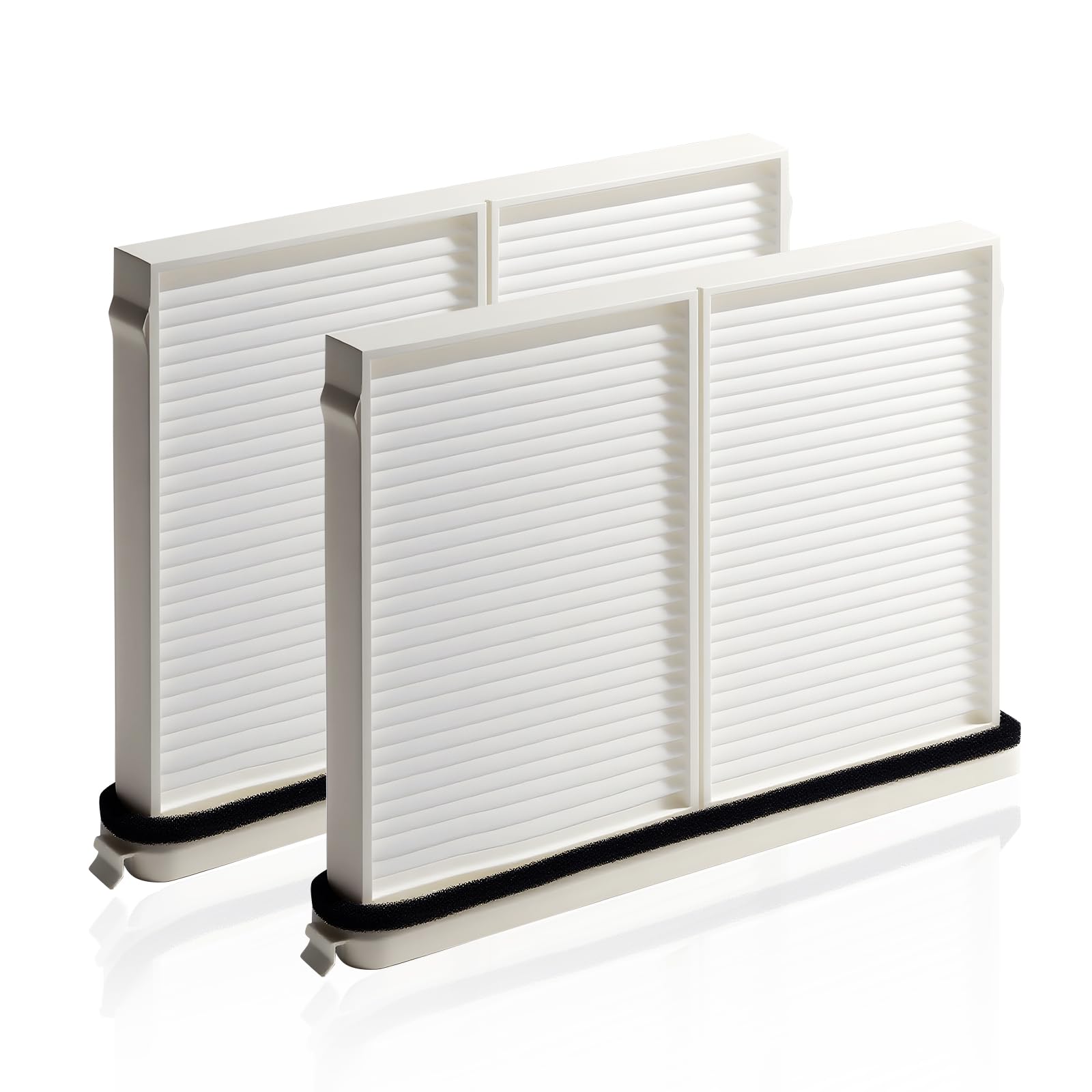
The Forccord cabin air filter is designed exclusively for the Mazda CX-90 (2024-2026) and CX-70 (2025-2026), using a newly developed five-layer media construction that incorporates silk filter cloth and melt-blown material for double-layer HEPA performance. The five-layer approach provides redundant filtration stages that capture 99.9% of harmful pollutants including dust, pollen, and exhaust particulates. Each filter in the two-pack is engineered to last up to 20,000 miles, exceeding the standard 12,000-mile replacement interval by a significant margin.
The filter replaces OEM part number KR9P-61-J6X and measures 8 x 6 inches with a 2-inch depth, which is thicker than many standard cabin filters and contributes to the extended service life. Two filters are included in the package, providing up to two years of coverage based on the 20,000-mile per filter rating. Owner feedback highlights the ease of installation and the noticeable improvement in cabin air freshness, with the double HEPA media providing particularly strong performance against pollen during spring allergy season.
For Mazda CX-90 and CX-70 owners who want the convenience of a long-life, two-pack solution with genuine HEPA-grade filtration, the Forccord filter delivers excellent value. The five-layer media design and extended service interval make it a set-and-forget option for busy owners.
What works
- Five-layer HEPA media captures 99.9% of pollutants
- Two-pack provides up to 2 years of coverage
- Extended 20,000-mile service interval
What doesn’t
- Only compatible with CX-90 and CX-70
- Thicker media may not fit all aftermarket housings
Hardware & Specs Guide
Filter Media Types
The most common cabin air filter media categories are standard particulate, activated carbon, and HEPA. Standard particulate filters use pleated paper or nonwoven synthetic fibers that trap dust and pollen through mechanical interception. Activated carbon filters add a charcoal layer that adsorbs gases and odors through a chemical bonding process. HEPA filters use dense melt-blown electrostatic media certified to capture 99.97% of particles at 0.3 microns, providing the highest level of protection but with a minor trade-off in airflow resistance.
Particle Capture Efficiency
MERV ratings provide a standardized measure of filtration efficiency. MERV 8 filters capture 70-85% of particles in the 3-10 micron range, handling pollen, dust mites, and mold spores. MERV 11 filters capture 85-95% of particles in the 1-3 micron range, including lead dust and fine pollen. MERV 13 filters capture 90% or more of particles in the 0.3-1 micron range, including smoke, bacteria, and virus carriers. Higher MERV ratings require denser media that may increase blower motor load in some HVAC systems.
Fitment Verification
Always cross-reference the OEM part number and measure the physical dimensions of your existing filter before purchasing a replacement. Cabin air filters are vehicle-specific, and even models from the same manufacturer can use different filter shapes and sizes across different years and trim levels. Many aftermarket filters list compatibility by make, model, and year range—verify this against your vehicle’s service manual or the Amazon Confirmed Fit tool before ordering.
Service Interval Considerations
Most manufacturers recommend replacing the cabin air filter every 12,000 miles or 12 months, whichever comes first. Drivers in areas with high pollen counts, frequent dust exposure, or heavy traffic congestion should consider more frequent replacements at 6,000 to 8,000 miles. Filters with higher dust-holding capacity or extended-life ratings can sometimes last 15,000 to 20,000 miles, but the odor-adsorbing capability of carbon filters typically diminishes before the particulate capture capacity is exhausted.
FAQ
How often should I replace my auto air conditioning filter?
What is the difference between a standard and a carbon cabin filter?
Can a HEPA cabin air filter damage my HVAC system?
Why does my cabin air filter smell musty after just a few months?
Does a dirty cabin air filter affect fuel economy?
Final Thoughts: The Verdict
For most buyers, the best auto air conditioning filter winner is the Bosch 6087C HEPA Cabin Air Filter because it delivers certified HEPA-grade filtration with structural integrity and no chemical additives, making it the gold standard for Toyota and Lexus owners who prioritize respiratory health. If you need European car compatibility with HEPA performance, grab the PureFlow PC99204HX. And for unmatched value with a two-pack configuration and the broadest vehicle coverage, nothing beats the Puroma 2-Pack Cabin Air Filter.

Certification: BSc in Mechanical Engineering
Education: Mechanical engineer
Lives In: 539 W Commerce St, Dallas, TX 75208, USA
Md Amir is an auto mechanic student and writer with over half a decade of experience in the automotive field. He has worked with top automotive brands such as Lexus, Quantum, and also owns two automotive blogs autocarneed.com and taxiwiz.com.