Small-displacement motorcycles offer a compelling entry point into two-wheeled mobility, blending low running costs with genuine riding enjoyment. The current market spans everything from budget mini bikes and street-legal commuters to powerful electric dirt machines, making the selection process more nuanced than simply picking the cheapest option.
I’m Amir — the founder and writer behind Four Wheel Ask. My market research involves analyzing owner-reported durability data, comparing real-world performance figures, and evaluating build quality across dozens of models to separate genuine value from marketing hype.
After examining ten distinct models through the lens of long-term reliability and component quality, the best mini motorcycle for most buyers balances daily usability with enough character to keep the ride interesting.
How To Choose The Best Mini Motorcycle
Selecting the right mini motorcycle requires matching your intended use—off-road trail riding, street commuting, or pure weekend fun—with the appropriate engine type, drivetrain, and level of assembly complexity.
Engine Type and Fuel Delivery
Carbureted engines are simpler and cheaper to repair but demand regular tuning and fuel stabilizer. Electronic fuel injection (EFI) provides consistent cold starts and better throttle response, though troubleshooting requires diagnostic tools. For daily riders, EFI is worth the premium.
Street Legality and Registration
Not all mini motorcycles are road legal. Models like the Lifan KPM 200 come with a Manufacturer Statement of Origin (MSO) and meet federal standards for street use. Off-road-only mini bikes cannot be licensed and must be towed or trailered to riding areas.
Assembly and Long-Term Support
Most bikes arrive 90-95% assembled, but proper setup—adjusting valves, replacing factory oil, and torquing bolts—directly impacts reliability. Brands with responsive customer service and available spare parts reduce downtime when issues inevitably arise.
Quick Comparison
On smaller screens, swipe sideways to see the full table.
| Model | Category | Best For | Key Spec | Amazon |
|---|---|---|---|---|
| Lifan KPM 200 | Street | Best Overall Street Legal | 200cc EFI, 6-speed, 82 mph | Amazon |
| X-PRO Hawk DLX 250 | Dual-Sport | Best Dual-Sport Value | 250cc EFI, 6-speed, 72 mph | Amazon |
| Freego X2 Electric | Electric Dirt | Premium Electric Performance | 6000W motor, 50 mph, 56 mi range | Amazon |
| X-PRO Lifan KP Mini 150 | Street | Best Beginner Street Bike | 150cc carb, 5-speed, 56 mph | Amazon |
| Lifan X-PRO KP MINI 150 (Black/Yellow) | Street | Reliable Urban Commuter | 150cc carb, 5-speed, 55-65 mph | Amazon |
| HHH TANK 200 EFI Scooter | Scooter | Automatic Street Cruiser | 168cc EFI, CVT, 62 mph | Amazon |
| WINDONE RM7 Electric | Electric Dirt | Mid-Range Electric Off-Road | 2200W motor, 37 mph, 45 mi range | Amazon |
| Trailmaster Hurricane 200X | Mini Bike | Off-Road Mini Bike | 196cc OHV, CVT, disc brakes | Amazon |
| Coleman B200 | Mini Bike | Entry-Level Trail Bike | 196cc 4-stroke, 30 mph, 200 lb limit | Amazon |
| X-PRO Vader 125 | Street | Ultra-Budget Street Learner | 125cc carb, 4-speed, disc brakes | Amazon |
In‑Depth Reviews
1. Lifan KPM 200

The Lifan KPM 200 stands out as the only full-size mini motorcycle in this lineup, featuring an NBF Generation II EFI engine that produces 17 horsepower through a six-speed gearbox. Owner reports indicate a real-world top speed of 82 mph, making it the fastest and most highway-capable option tested. The cafe racer styling and 30.7-inch seat height suit a wide range of rider sizes, with one reviewer at 6 feet and 240 pounds reporting a comfortable fit.
Build quality impresses at its price point, with consistent feedback praising the finish, fitment of body panels, and overall assembly from the factory. Assembly time averages around two hours, though some owners note that fasteners of varying lengths require careful sorting. The 2-year, 12,000-mile warranty provides a safety net that budget competitors lack entirely.
Riders seeking a genuine street-legal motorcycle rather than a pit bike or toy will find the KPM 200 delivers genuine capability. Fuel injection eliminates the cold-start ritual of carbureted models, and the six-speed transmission allows relaxed cruising at 60 mph without excessive vibration. The primary limitation is outright top speed for sustained highway use, but for secondary roads and daily commuting, it is a standout performer.
What works
- Factory EFI system provides reliable cold starts
- Six-speed transmission offers strong highway cruising
- Full warranty and parts support from Lifan
What doesn’t
- Minor assembly details require careful attention
- Not a true freeway performer at sustained high speeds
2. X-PRO Hawk DLX 250 EFI

The X-PRO Hawk DLX 250 EFI fills a unique niche as a dual-sport motorcycle that is equally at home on dirt trails and paved roads. The fuel-injected 250cc engine, inverted front forks, and digital dash represent genuine upgrades over the carbureted Hawk models that preceded it. Owner data shows a top speed of 72 mph with basic gearing modifications, and the dual electric and kick-start system provides redundancy in remote areas.
Customer feedback consistently highlights the excellent customer service from X-PRO, with owners citing responsive support for shipping damage and missing components. However, the consensus among experienced buyers is that the bike requires significant pre-ride preparation: adjusting valve clearances, replacing factory oil, and correcting an overly tight chain are standard recommendations. The rear axle nut has been reported to arrive overtightened, sometimes denting the swingarm.
For riders who are comfortable with basic wrenching, the Hawk DLX 250 EFI represents exceptional value. The combination of true dual-sport capability, electronic fuel injection, and a dealer network that responds to issues makes it a logical choice for those seeking a bike they can improve over time. It is not a turn-key solution for novice riders who cannot perform their own maintenance.
What works
- EFI system starts easily in all conditions
- Inverted forks offer genuine off-road performance
- Strong aftermarket and community support
What doesn’t
- Requires thorough pre-delivery setup and bolt checks
- Highway vibration and speedometer error reported
3. Freego X2 Electric Motorcycle
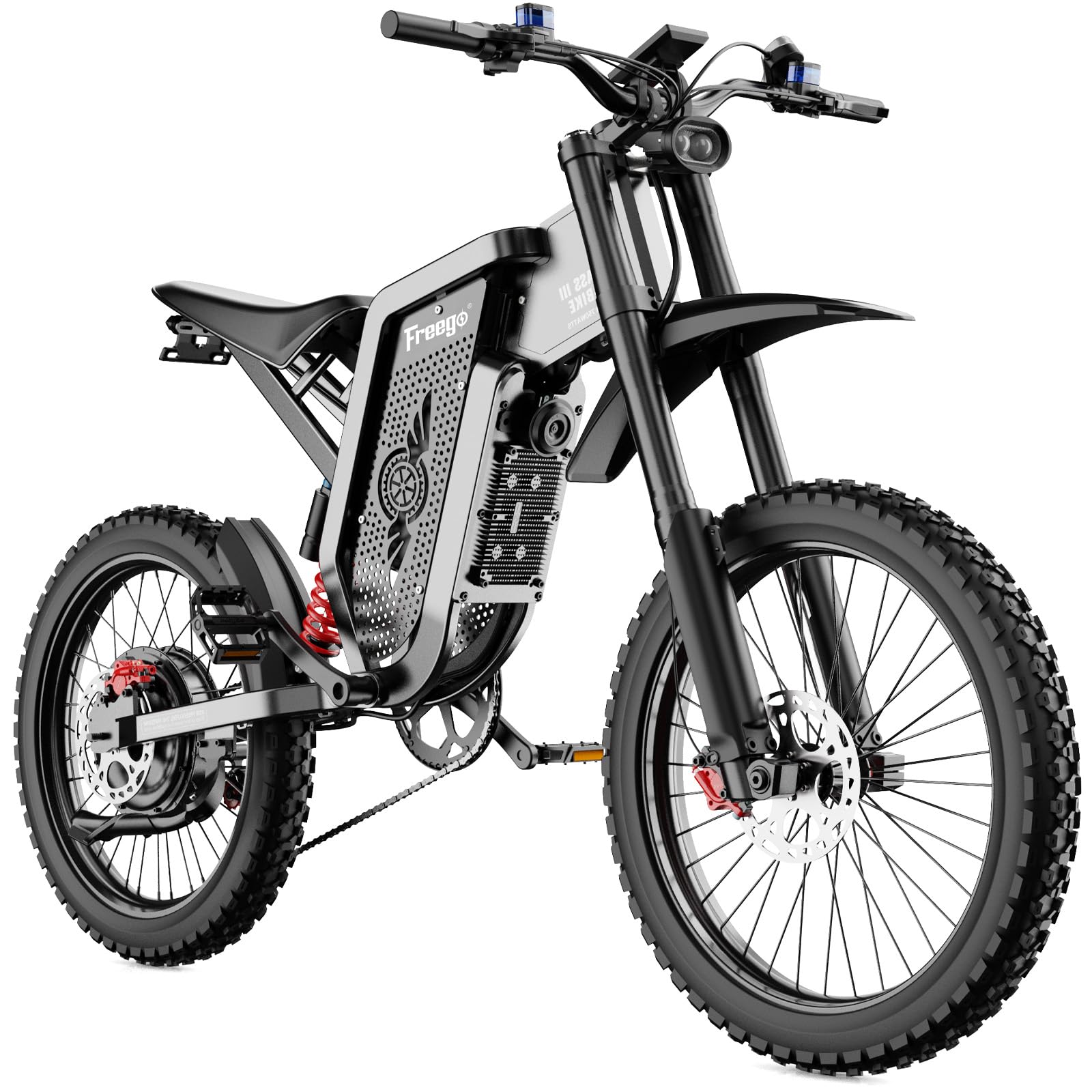
The Freego X2 represents the premium end of electric mini motorcycles, packing a 6000W peak motor and a 60V 30Ah removable battery into a 19-inch wheel platform. UL2849 and UL2271 certifications add a layer of safety and legal compliance that many electric competitors lack. Owner reports confirm a real-world top speed around 50 mph and a range between 37 and 56 miles depending on terrain and rider weight.
Build quality receives high marks, with the aluminum alloy frame and full hydraulic brakes providing a planted feel on loose surfaces. The removable battery is a practical advantage for apartment dwellers or riders without garage access. Customer service from Freego is noted as responsive, with several owners reporting that replacement parts for minor issues were shipped promptly after diagnosis.
What separates the X2 from cheaper electric options is its 7-speed gearing and terrain modes, which allow the rider to optimize power delivery for efficiency or performance. The trade-off is weight—at roughly 130 pounds, it is heavier than most gas equivalents, but the suspension handles the heft competently. For riders seeking an electric alternative that can handle serious off-road use without constant range anxiety, this is the most capable option reviewed.
What works
- Removable battery simplifies charging logistics
- UL certifications ensure legal compliance
- Excellent suspension and hydraulic brake feel
What doesn’t
- Higher initial investment than gas equivalents
- Reported quality control issues on early units
4. X-PRO Lifan KP Mini 150 (Black/Red)

The Lifan KP Mini 150 is widely considered the benchmark for beginner street motorcycles, offering a genuine motorcycle experience in a compact package. The 150cc air-cooled engine delivers enough power to reach 56 mph in third gear with a 180-pound rider, according to owner reports. Assembly is minimal—handlebars, clutch, throttle, and battery connection—making it one of the few models that truly arrives nearly ready to ride.
Owner feedback spans thousands of miles with few complaints, though several riders note that the carburetor requires periodic adjustment and that the factory tires are not ideal for wet pavement. The KP Mini has been directly compared to the Honda Grom by multiple owners, with the consensus that it offers comparable performance at a significantly lower entry point. The Lifan engine is praised for its reliability, with one owner accumulating over 1,000 miles before the bike was stolen.
New riders will appreciate the predictable power delivery and low seat height that allows flat-footing at stops. The manual transmission teaches proper motorcycle operation without overwhelming the rider. Experienced riders may find the suspension soft and the brakes adequate rather than inspiring, but for its intended purpose as a first bike, it is difficult to beat.
What works
- Nearly complete from the factory, minimal assembly
- Proven Lifan engine with strong reliability record
- Low seat height suits smaller and newer riders
What doesn’t
- Carburetor tuning required periodically
- Suspension feels basic on rough roads
5. Lifan X-PRO KP MINI 150 (Black/Yellow)

This variant of the KP Mini 150 comes with upgraded features including an LCD tachometer and a redesigned “fatty” exhaust that produces a deeper engine note. Owner reports confirm assembly takes between 30 minutes for experienced mechanics and 90 minutes for beginners, with the bike arriving undamaged and including the necessary paperwork for registration. The carbureted engine starts easily when properly tuned, though owners universally recommend replacing the factory oil immediately.
Performance is consistent with the standard KP Mini, achieving a top speed between 55 and 65 mph depending on rider weight. Several owners note that the bike feels stable at speed and that the upgraded exhaust does not significantly affect power output. The LCD display is a genuine improvement, showing speed, RPM, temperature, and odometer in a clear layout that rivals bikes costing significantly more.
Long-term reliability appears strong, with multiple owners reporting hundreds of trouble-free miles. The bike is compared favorably to the Honda Grom in terms of overall feel, with the caveat that parts availability is not as robust as Honda’s dealer network. For urban commuting on roads with speed limits under 55 mph, this is a practical and enjoyable choice.
What works
- Informative LCD dash with real-time data
- Quick assembly out of the box
- Stable and fun handling at urban speeds
What doesn’t
- Factory oil should be replaced immediately
- Parts support less established than major brands
6. HHH TANK 200 EFI Scooter

The HHH TANK 200 EFI scooter blurs the line between scooter and mini motorcycle, offering a CVT automatic transmission with a 168cc EFI engine that delivers highway-legal performance. Owner data shows a real-world top speed of 62 mph, with one reviewer reporting 60 mph maintained uphill. The long 52-inch wheelbase and front hydraulic disc brake provide stability and stopping power that smaller scooters lack.
Assembly is the primary frustration—multiple owners report that no instructions are included and that hardware bags are unlabeled. Basic mechanical knowledge is required to correctly mount the front end, connect wiring, and secure the rear trunk. The MSO and registration paperwork arrive separately via standard mail, which has caused confusion for some buyers expecting them in the crate.
For riders who dislike manual shifting, the TANK 200 EFI provides a compelling combination of power, fuel efficiency, and storage capacity. The EFI system eliminates the need for choke operation and provides reliable starting. However, long-term reliability concerns appear in owner feedback, with bolts vibrating loose and electrical issues appearing before 5,000 miles. Applying thread locker to all critical fasteners during setup is strongly advised.
What works
- EFI provides consistent starting and fuel economy
- CVT transmission is intuitive for new riders
- Under-seat and trunk storage for daily items
What doesn’t
- No assembly instructions or labeled hardware
- Reports of bolts loosening and electrical failures
7. WINDONE RM7 Electric Dirt Bike
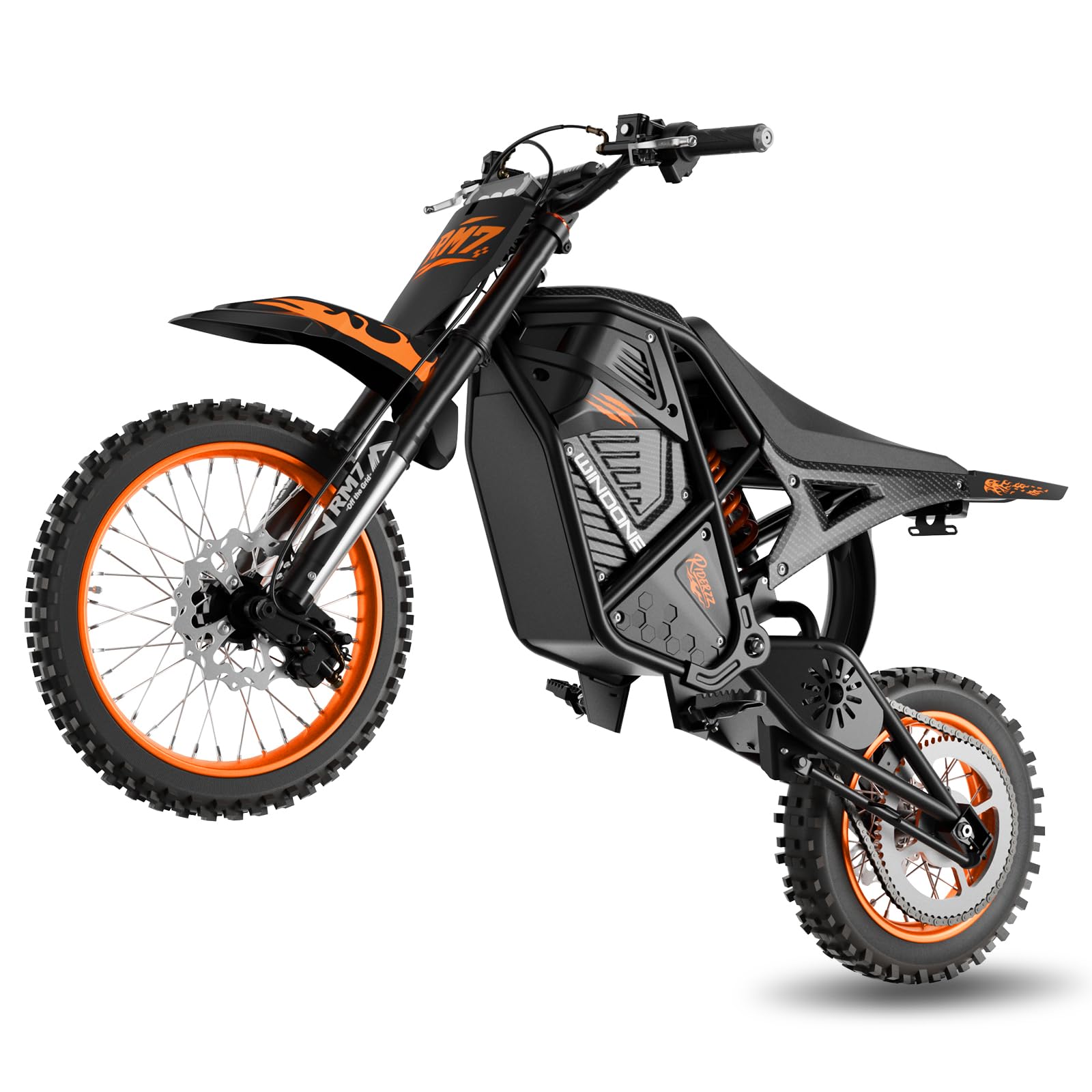
The WINDONE RM7 occupies the middle ground in the electric dirt bike segment, pairing a 2200W peak motor with a 48V 22.5Ah battery that claims 37 to 45 miles of range. Owner reviews confirm a real-world top speed of 34.9 mph with a 178-pound rider, making it suitable for trail riding and neighborhood cruising rather than high-speed racing. The three-speed mode selector (15, 22, and 37 mph limits) is a thoughtful feature for managing battery range and rider skill level.
Build quality is praised in teardown analysis, with particular attention to the geared hub motor’s cooling design and the battery management system’s consistent voltage output. The dual hydraulic brakes provide strong stopping power, and the IPX6 water resistance rating adds confidence for wet conditions. Assembly is noted as challenging, particularly the brake setup, with instructions that some owners found unclear.
The primary drawback is customer support responsiveness—multiple owners report non-existent replies to email inquiries. The bike itself is well-engineered for the price, but buyers should be prepared to handle any issues independently or through Amazon’s return process. For those comfortable with that caveat, the RM7 delivers solid electric off-road performance without the premium price tag of high-end competitors.
What works
- Geared hub motor delivers smooth, controllable power
- Three speed modes suit different skill levels
- Well-designed battery management system
What doesn’t
- Customer support is reportedly unresponsive
- Assembly instructions lack clarity
8. Trailmaster Hurricane 200X

The Trailmaster Hurricane 200X is built as a dedicated off-road mini bike rather than a street-legal motorcycle, using a 196cc OHV engine paired with a torque converter CVT drive. The hydraulic front and rear disc brakes are genuine performance upgrades over the cable-operated brakes found on many budget mini bikes. Owner feedback indicates assembly takes roughly two hours for one person, with no drilling required for the pre-assembled shock and brake components.
Reviewers who received undamaged units are overwhelmingly positive, praising the bike’s power delivery and suspension performance on rough terrain. The aggressive 19×7-8 tires provide excellent traction in loose dirt and gravel. However, quality control issues appear in multiple reports: a hole in the front tire from poor packaging, improperly installed front brake pads, a sticking throttle, and a dim headlight with no replacement bulb source.
The Trailmaster is not CARB-compliant, so California residents cannot register it. For off-road use elsewhere, it strikes a good balance between capability and price. The main risk is the variability in assembly quality—buyers who are mechanically inclined can correct issues, but those expecting a perfectly functioning unit out of the crate may be disappointed.
What works
- Dual hydraulic disc brakes provide strong stopping
- Torque converter CVT delivers smooth power
- Aggressive tires suit varied off-road terrain
What doesn’t
- Frequent quality control issues out of the crate
- Not street legal or CARB compliant
9. Coleman Powersports B200

The Coleman B200 is a straightforward, no-frills mini bike designed for recreational trail riding rather than street commuting. The 196cc 4-stroke OHV engine uses a recoil pull start and drives the rear wheel through a torque converter, providing adequate power for riders up to 200 pounds. Assembly is minimal, with most owners reporting the bike comes mostly assembled and ready to run after adding fuel and checking fluids.
Customer sentiment is generally positive, with many reviewers describing the B200 as a great gift for children or a fun toy for adults. The double shock absorber and low-pressure tires provide a compliant ride over uneven ground. However, detailed owner reports raise concerns about quality control: one unit arrived with side cover damage, missing bolts, and pre-filled oil that should have been absent per the warning stickers. The same owner found excessive metal shavings at the first oil change.
For budget-conscious buyers who understand they are purchasing an entry-level recreational vehicle rather than a precision machine, the Coleman B200 delivers reasonable value. The bright headlight is a practical feature for low-light rides. Riders seeking long-term durability or the ability to modify and upgrade should consider the Trailmaster or a street-legal alternative instead.
What works
- Low price point for a motorized trail vehicle
- Simple pull-start operation, no battery needed
- Heavy-duty frame construction
What doesn’t
- Quality control issues and poor dealer support reported
- Not street legal or designed for pavement use
10. X-PRO Vader 125

The X-PRO Vader 125 is the most budget-oriented street-legal motorcycle in this review, featuring a 125cc carbureted engine and a four-speed manual transmission. It is explicitly not designed for highway use, with a top speed appropriate for urban streets and secondary roads. The front and rear disc brakes are welcome safety features at this price point, and the 12-inch wheels with 120/70 and 130/70 tires provide reasonable traction.
Owner experiences vary dramatically. Several first-time riders report the Vader as an excellent beginner bike that is easy to handle and fun to ride, with responsive customer support from X-PRO. However, detailed long-term reviews reveal serious reliability concerns: one owner reported transmission failure at 3,000 miles, and another documented multiple catastrophic failures before 150 miles, including sheared motor mount bolts and a carburetor fuel leak onto a hot exhaust. The MSO and title arrive separately via standard mail, which has caused registration delays for some buyers.
The Vader 125 represents the lowest barrier to entry for a street-legal motorcycle, but the risk of significant mechanical issues is higher than with any other product reviewed. Buyers must be prepared for potential warranty battles and the possibility of performing major repairs on a brand-new machine. For the same investment, the Coleman B200 offers a more reliable experience, albeit without street legality.
What works
- Lowest cost entry to a street-legal motorcycle
- Disc brakes provide adequate stopping power
- Small size is manageable for new riders
What doesn’t
- Significant reliability concerns in long-term ownership
- Not highway capable and limited to local roads
Hardware & Specs Guide
Engine Displacement and Power Output
Engine size directly correlates with usable power and top speed. A 125cc engine is suitable for flat urban roads at speeds under 50 mph, while a 200cc or 250cc engine can maintain 65-80 mph on highways. Fuel injection (EFI) provides better cold starts and altitude compensation than carburetors, which require manual choke operation and periodic cleaning. The Lifan KPM 200’s EFI system is the most refined in this class, delivering consistent performance across temperature ranges.
Transmission Types
Manual transmissions (5-speed or 6-speed) offer the most control and are standard on true motorcycles like the Lifan KP Mini and Hawk DLX. Automatic CVT transmissions, found on the HHH TANK 200 and Trailmaster Hurricane, simplify operation but reduce engine braking and mechanical feedback. Electric motorcycles like the Freego X2 use single-speed reduction drives with software-based gearing modes that optimize power delivery for different terrains.
Braking Systems
Hydraulic disc brakes, especially on both front and rear wheels, provide the most consistent stopping power. The Trailmaster Hurricane’s dual hydraulic discs are a standout feature at its price point. Mechanical disc brakes require more lever effort and periodic cable adjustment. Electric models like the Freego X2 and Windone RM7 use hydraulic brakes that self-adjust as pads wear, reducing maintenance frequency.
Battery and Charging (Electric Models)
Battery capacity is measured in watt-hours (Wh). The Freego X2’s 1800Wh battery offers the longest range at 37-56 miles, while the Windone RM7’s 1080Wh battery provides 37-45 miles. Removable batteries, like the Freego X2’s, allow charging without moving the bike and simplify storage in cold climates. UL certification (2849 or 2271) indicates the battery and charger meet safety standards for overcharge, short circuit, and thermal protection.
FAQ
What is the difference between a mini bike and a mini motorcycle?
Do I need a motorcycle license to ride a mini motorcycle?
How much assembly is required for these mini motorcycles?
What is the average top speed of a 150cc mini motorcycle?
Are Chinese mini motorcycles reliable?
Final Thoughts: The Verdict
For most buyers, the best mini motorcycle winner is the Lifan KPM 200 because it combines genuine highway capability, EFI reliability, and a factory warranty that budget competitors do not offer. If you want a dedicated off-road toy with strong brakes and suspension, grab the Trailmaster Hurricane 200X. And for an electric option that balances performance, range, and legal compliance, nothing beats the Freego X2 Electric Motorcycle.

Certification: BSc in Mechanical Engineering
Education: Mechanical engineer
Lives In: 539 W Commerce St, Dallas, TX 75208, USA
Md Amir is an auto mechanic student and writer with over half a decade of experience in the automotive field. He has worked with top automotive brands such as Lexus, Quantum, and also owns two automotive blogs autocarneed.com and taxiwiz.com.