The difference between a brake line replacement that lasts a decade and one that starts showing rust within weeks comes down to material selection and fitting compatibility. A 3/16 brake line kit must withstand constant exposure to road salt, moisture, and extreme pressure cycles while delivering a leak-free seal at every connection point. The market is flooded with copper-coated steel posing as genuine copper-nickel, zinc-plated tubing with questionable burst ratings, and fitting assortments that skip the exact thread sizes your vehicle actually needs.
I’m Amir — the founder and writer behind Four Wheel Ask. My approach to evaluating these kits involves cross-referencing material composition claims against SAE specifications, analyzing owner-reported failure modes across multiple vehicle platforms, and comparing fitting completeness against the thread sizes used by major domestic and import manufacturers.
Through extensive market analysis, the best 3/16 brake line kit pairs premium copper-nickel alloy with complete fittings for reliable long-term service.
How To Choose The Best 3/16 Brake Line Kit
Selecting the right brake line kit requires understanding the material properties, fitting compatibility, and tool requirements that determine whether your installation holds pressure long-term. The three variables that separate a reliable kit from a frustration source are alloy composition, thread-size coverage, and flare-type support.
Material Selection: Copper-Nickel vs. Zinc-Coated Steel
Copper-nickel alloy tubing does not rust and remains malleable enough to form tight-radius bends without kinking or work-hardening. Zinc-coated steel offers lower material cost but relies entirely on a thin plating layer that can chip during bending or scratching during installation, exposing raw steel to corrosion. Owner reports consistently show copper-nickel lines surviving multiple winters in salt-belt regions while zinc-coated lines from the same installation window develop surface rust within months.
Fitting Assortment Completeness
A 3/16 brake line kit with only the most common 3/8-24 inverted flare nuts leaves you hunting for adapters when you encounter 7/16-24 or 1/2-20 connections. The most versatile kits include at least sixteen pieces spanning four thread sizes plus unions for joining sections. Vehicle-specific needs — particularly on older domestic trucks or European imports with bubble-flare requirements — demand either a comprehensive assortment or a brand that offers metric thread variants.
Flaring Tool Compatibility
Single-flare tools included in many budget kits cannot produce the double flares required for safe brake system connections. A kit that packages a single-flare tool without double-flare capability forces you to buy a separate tool. Kits bundling a proper double-flare tool or flaring bar with multiple adapter sizes deliver genuine value for first-time installers.
Quick Comparison
On smaller screens, swipe sideways to see the full table.
| Model | Category | Best For | Key Spec | Amazon |
|---|---|---|---|---|
| Nstarsmotor Copper-Nickel | Copper-Nickel | Overall reliability | 25 ft, 16 fittings, SAE threads | Amazon |
| The Stop Shop | Copper-Nickel | Metric bubble flare | 25 ft, 16 metric fittings, ISO flare | Amazon |
| TUBPRO | Copper-Nickel | Complete kit with unions | 25 ft, 16 nuts + 4 unions | Amazon |
| carleef | Kit + Tool | DIY with flaring tool | 25 ft, double-flare tool included | Amazon |
| AC PERFORMANCE | Stainless Steel | Custom AN lines | 16 ft, 304 stainless, 37° flare | Amazon |
| smseace | Kit + Tool | Budget tool bundle | 25 ft, bender + cutter + flare tool | Amazon |
| 4LIFETIMELINES | Fitting Kit | Shop fitting assortment | 32 SKU, 3/16″ & 1/4″ coverage | Amazon |
| Haokixin | Copper-Coated | Budget copper appearance | 25 ft, 32 fittings, copper-coated | Amazon |
| Nstarsmotor Zinc | Zinc-Coated | Budget steel option | 25 ft, 40 fittings + 4 unions | Amazon |
| MuHize | Dual Size | 3/16″ + 1/4″ combo | 25 ft each size, zinc-coated | Amazon |
| Luney | Kit + Tool | Entry-level all-in-one | 25 ft, bender + single flare tool | Amazon |
In‑Depth Reviews
1. Nstarsmotor 25 ft 3/16 True Copper-Nickel Alloy Brake Line Kit

This Nstarsmotor kit delivers genuine copper-nickel alloy — confirmed by the material composition of 88.1% copper, 9.7% nickel, 1.4% iron, and 0.8% manganese — making it fully non-magnetic and rust-proof. The 0.028-inch nominal wall thickness meets SAE and ISO specifications, and the tubing accepts double flares cleanly even with entry-level flaring tools, based on multiple owner reports across F-350, LX450, and various classic truck applications.
The sixteen-piece fitting assortment covers the four most common 3/16-inch inverted flare thread sizes: ten 3/8-24, two 7/16-24, two 1/2-20, and two 9/16-18. This range accommodates the majority of domestic light trucks and SUVs without requiring additional adapter purchases. The copper-nickel composition remains workable by hand for large-radius bends and accepts a tubing bender for tighter radii without spring-back or cracking.
The lifetime warranty backing adds long-term confidence that most budget kits omit. Owners of older Dodge, Ford, and Toyota platforms consistently report successful installations with zero corrosion issues after extended service. The 25-foot length provides enough material for a typical axle-to-axle replacement on most full-size trucks with some left over for fuel-line work.
What works
- Genuine copper-nickel composition verified by owner reports and non-magnetic testing
- Sixteen fittings spanning four thread sizes cover most domestic applications
- Lifetime warranty provides long-term protection against material defects
What doesn’t
- No unions or connectors included for joining sections
- Fittings are SAE only — no metric bubble flare nuts for European applications
2. The Stop Shop 25 ft. Copper Nickel 3/16″ Brake Line Tubing with Metric ISO/Bubble Flare Fittings

This kit solves a specific pain point that domestic-focused kits ignore: metric ISO bubble flare fittings. The sixteen included nuts are arranged as ten 10×1.0mm, two 11×1.5mm, two 12×1.0mm, and two 13×1.5mm — the exact sizes needed for VW, Audi, BMW, Land Rover, and other European platforms that use bubble-flare connections rather than the SAE inverted flare common on American vehicles.
The copper-nickel tubing matches the same non-rusting, easy-bending characteristics as the best domestic kits but with the wall thickness and ductility optimized for forming bubble flares without splitting. Owners of 2002 VW Jettas and LR3s report that the tubing accepts both bubble and inverted flares without cracking, and the included nuts match factory thread specifications precisely.
Packaging is clean and the coil arrives without kinks. The 25-foot length suits full-vehicle replacements on most sedans and small SUVs. The tubing remains soft enough for hand-bending in tight engine-bay areas but rigid enough to hold shape without collapsing. For anyone working on an import, this is the rare kit that arrives with the correct metric hardware rather than requiring a separate fitting order.
What works
- Sixteen metric bubble-flare nuts covering four common thread sizes for European vehicles
- Genuine copper-nickel alloy will never rust and flares consistently
- Tubing works for both bubble and inverted flare forming without splitting
What doesn’t
- No unions or couplers included for joining line sections
- Not suitable for SAE inverted flare domestic applications without separate fittings
3. TUBPRO Genuine 3/16″ OD x 25 ft Copper Nickel Brake Line Replacement Kit with 16 Nuts and 4 Unions

The TUBPRO kit distinguishes itself by including four 3/8-24 inverted flare unions alongside the standard sixteen-nut assortment. This addition matters when you need to join two sections of line for a long run or repair a damaged section without running a full new length. The unions are precision-machined brass and hold pressure reliably when double-flared ends are properly seated.
The tubing is genuine copper-nickel alloy confirmed by owner reports who note it does not attract a magnet — a simple field test that exposes copper-coated steel impostors. The 0.028-inch wall thickness matches industry standard, and the tubing forms clean double flares using basic tooling. Owners of 1995 Dodge Dakotas and boat trailers report successful installations with no leakage or corrosion after months of service.
The fitting assortment mirrors the Nstarsmotor kit: ten 3/8-24, two 7/16-24, two 1/2-20, and two 9/16-18. The addition of the four unions gives this kit an edge for anyone repairing rather than fully replacing lines. The tubing ships coiled with minimal memory, so it lays flat during layout and measurement.
What works
- Four brass unions included for joining line sections or performing section repairs
- Genuine copper-nickel alloy confirmed non-magnetic by owners
- Fitting assortment covers four common SAE inverted flare thread sizes
What doesn’t
- No metric fittings for European or Asian vehicle applications
- Yellow packaging color makes the kit harder to spot in a crowded shop drawer
4. carleef 3/16 Brake Line Kit with 16 Brake Line Fittings and Tubing Bender, Double & Single Brake Line Flaring Tool Kit

This carleef kit bundles a 25-foot spool of copper-coated steel tubing with a flaring bar and yoke that supports both single and double flare configurations through five adapter sizes. The tooling accepts 3/16-inch through 5/8-inch tubing, making it useful beyond the included line for future projects. The flaring bar is cast metal with machined die seats that produce consistent double flares on the soft copper-coated line.
The included fittings are standard inverted flare nuts covering the four main 3/16-inch thread sizes. The tubing has a 0.028-inch wall thickness and bends easily by hand for gentle curves, though tight-radius bends benefit from the included bender. Owners of 2003 Wranglers and other DIY projects report leak-free connections using the provided tooling and fittings.
A limitation worth noting: the flaring tool works well on the included soft copper-coated line but struggles with OEM steel lines, as some owners report the yoke pushes the steel tubing down rather than forming a clean flare. For the price point, this kit functions well as a complete starter setup for one or two brake line jobs, but the tooling is not intended for commercial or repeated heavy use.
What works
- Flaring bar and yoke support double flares with five adapter sizes
- Includes tube bender and cutter for a complete starter toolkit
- Soft copper-coated tubing bends easily and flares consistently
What doesn’t
- Flaring tool cannot handle OEM steel or stainless lines
- Copper coating can wear through, exposing steel to corrosion over time
5. AC PERFORMANCE 3/16″ Stainless Steel Brake Line Hard Tube 16 Feet Coil

This AC PERFORMANCE coil is extruded from 304 stainless steel with a 0.7mm wall thickness, making it the most corrosion-resistant option in this comparison — genuine stainless will never rust regardless of coating condition. The 16-foot length is shorter than the standard 25-foot kits, reflecting that stainless is typically chosen for targeted replacement sections or custom AN-line builds rather than full-vehicle runs.
The tubing accepts 37-degree AN flares well using proper tooling like a Ridgid 377, and the surface finish is highly polished for a show-quality appearance. Owners report that the stainless is workable with manual benders for gentle to moderate curves, though tight-radius bends require more effort than copper-nickel. The material suits custom builds where appearance and absolute corrosion resistance justify the additional installation effort.
A critical consideration: stainless steel requires a dedicated flaring tool designed for hard materials. Standard automotive double-flare tools often cannot form a leak-proof seal on 304 stainless, and some owners report multiple failed attempts before achieving a proper seal. This is not a beginner-friendly option — it rewards experienced fabricators who already own the right tooling and understand stainless work-hardening behavior.
What works
- Type 304 stainless steel offers absolute corrosion resistance with polished appearance
- Works well with 37-degree AN flare tooling for custom hydraulic line builds
- Good dimensional consistency and no coating to chip or wear off
What doesn’t
- Requires specialized flaring tools — standard tools often fail on stainless
- Only 16 feet of tubing, insufficient for full-vehicle replacement on most trucks
6. smseace 26-Pack 3/16 Inch Brake Line Kit Including 25 ft Zinc-Plated Lines with Fittings, Bender, Single Flare Tool, and Cutter

The smseace kit provides zinc-plated steel tubing with a comprehensive tool bundle: a 3-in-1 tube bender capable of 180-degree bends, a single-flare tool supporting multiple pipe sizes from 3/16-inch up to 5/8-inch, and a precision cutter with a 1/8-inch to 7/8-inch range. The 25-foot coil gives enough length for full-axle replacements on most light trucks and SUVs.
The included fittings cover the essential 3/16-inch inverted flare sizes, and the two unions add flexibility for joining sections. The zinc plating provides a reasonable rust barrier, though owners in salt-belt regions should monitor the lines for corrosion initiation at scratches or tight bends where the plating may stress-crack. The tubing bends easily by hand and accepts single flares without difficulty using the included tool.
The primary limitation is the single-flare-only capability of the included tool. Brake systems require double flares for safe operation — a single flare can crack under pressure and cause sudden brake failure. Owners who purchase this kit should budget for a separate double-flare tool unless they are using the tubing for non-safety applications like fuel or transmission cooler lines.
What works
- Complete tool bundle with bender, cutter, and single-flare tool included
- Zinc-plated tubing bends easily by hand with good flexibility
- Two unions included for connecting line sections
What doesn’t
- Single-flare tool is insufficient for brake system double-flare requirements
- Zinc plating on steel is less corrosion-resistant than copper-nickel alloy
7. 4LIFETIMELINES Premium Brake Line Fitting Kit: Complete Assortment with 32 SKU, 3/16″ and 1/4″ Tube Nuts, Unions, and Adapters

This is not a tubing kit — it is a professional-grade fitting assortment containing 136 pieces across 32 SKUs covering both 3/16-inch and 1/4-inch inverted flare and bubble flare connections. The assortment includes inverted tube nuts, bubble flare nuts, unions, and bubble-to-inverted adapters in both SAE and metric thread configurations. The kit ships in a shatter-resistant plastic tray with lid labeling for quick identification.
For a working shop or a serious DIYer who maintains multiple vehicles, this kit eliminates the need to run to the parts store when you encounter an odd thread size mid-project. The brass and nickel-plated components resist corrosion and seat properly against flare seats. The included metric bubble flare fittings cover the common European thread sizes, while the SAE inverted nuts cover domestic applications from 3/8-24 through 9/16-18.
The lifetime warranty adds peace of mind for a component set that will see years of use. The kit does not include tubing, so you will need to purchase a 25-foot copper-nickel coil separately. For anyone who plans to do more than one brake line job, this fitting kit pays for itself by eliminating the frustration of hunting for individual nuts and adapters at retail pricing.
What works
- 136 pieces across 32 SKU covering both SAE and metric thread configurations
- Includes bubble-to-inverted adapters for mixed-system repairs
- Lifetime warranty and organized storage case with labeling
What doesn’t
- No tubing included — requires separate purchase of brake line coil
- Plastic case can crack if dropped from bench height
8. Haokixin 2 Sets 3/16 Brake Line 25 ft Copper Nickel Tubing with Stainless Steel Brake Line Clamps and 32 Fittings

The Haokixin kit offers the highest fitting count in the budget tier with 32 pieces spanning five thread sizes: four 7/16-24, twenty 3/8-24, four 1/2-20, and four 9/16-18 inverted pipe nuts. The 25-foot tubing is copper-coated steel rather than solid copper-nickel — an important distinction confirmed by owner magnet tests. The coating provides initial corrosion resistance, but any scratch or bend that stresses the plating will expose the underlying steel.
One verified owner report noted surface rust beginning within twelve days of installation, suggesting the plating quality may vary between production batches. Other owners successfully installed the line on a 1983 Dodge W150 and a 2005 Chevrolet Cavalier with good initial results. The tubing bends easily by hand for gentle curves, though tighter bends require a tool to avoid kinking.
The kit represents a low-cost entry point for someone who needs brake line material and fittings immediately, but the corrosion risk makes it a poor choice for daily drivers in regions with road salt. For a project vehicle kept in dry storage or an off-road rig that sees minimal road salt exposure, the value proposition improves significantly.
What works
- Thirty-two fittings across five thread sizes provide broad application coverage
- Copper coating bends easily by hand for gentle radius curves
- Two complete kits included for the price of one
What doesn’t
- Copper-coated steel is not genuine copper-nickel and can rust within weeks
- Surface coating may attract magnet — confirms it is not true CuNi alloy
9. Nstarsmotor 25ft 3/16 Inch Brake Line Kit, Zinc-Coated Steel Tubing with 40 Fittings and 4 Unions

This Nstarsmotor zinc-coated steel kit comes with an impressive forty fittings plus four unions, making it the most fitting-rich option in this comparison. The zinc coating meets SAE J1047 specifications for corrosion protection, and the double-wall galvanized construction delivers a 4,900 psi burst rating — significantly higher than typical 3,000 psi ratings. The tubing is produced under ISO quality controls and ships in moisture-resistant packaging.
The fitting assortment includes twenty-eight 3/8-24 nuts, four 7/16-24, four 1/2-20, four 9/16-18, plus four brass unions. This allows for multiple installation configurations without running out of the most common size. Owners report successful installations on Ford F-250 trucks and 1965 Corvairs, noting the tubing bends easily and holds double flares without splitting.
A notable complaint from some owners involves the compression fittings being made of soft material that can strip during tightening. The zinc coating, while better than bare steel, still lacks the permanent corrosion resistance of copper-nickel alloy. For budget-conscious buyers in dry climates or on vehicles that see limited road salt exposure, this kit delivers good value through fitting quantity alone.
What works
- Forty fittings plus four unions provide exceptional application coverage
- 4,900 psi burst rating exceeds standard 3,000 psi specifications
- Zinc coating meets SAE J1047 corrosion protection standards
What doesn’t
- Some compression fittings reported to strip during tightening
- Zinc coating on steel is less durable long-term than copper-nickel alloy
10. MuHize Brake Line Tubing Kit 3/16 and 1/4 Inch 25 ft Dual Size — Zinc Double Galvanized Steel
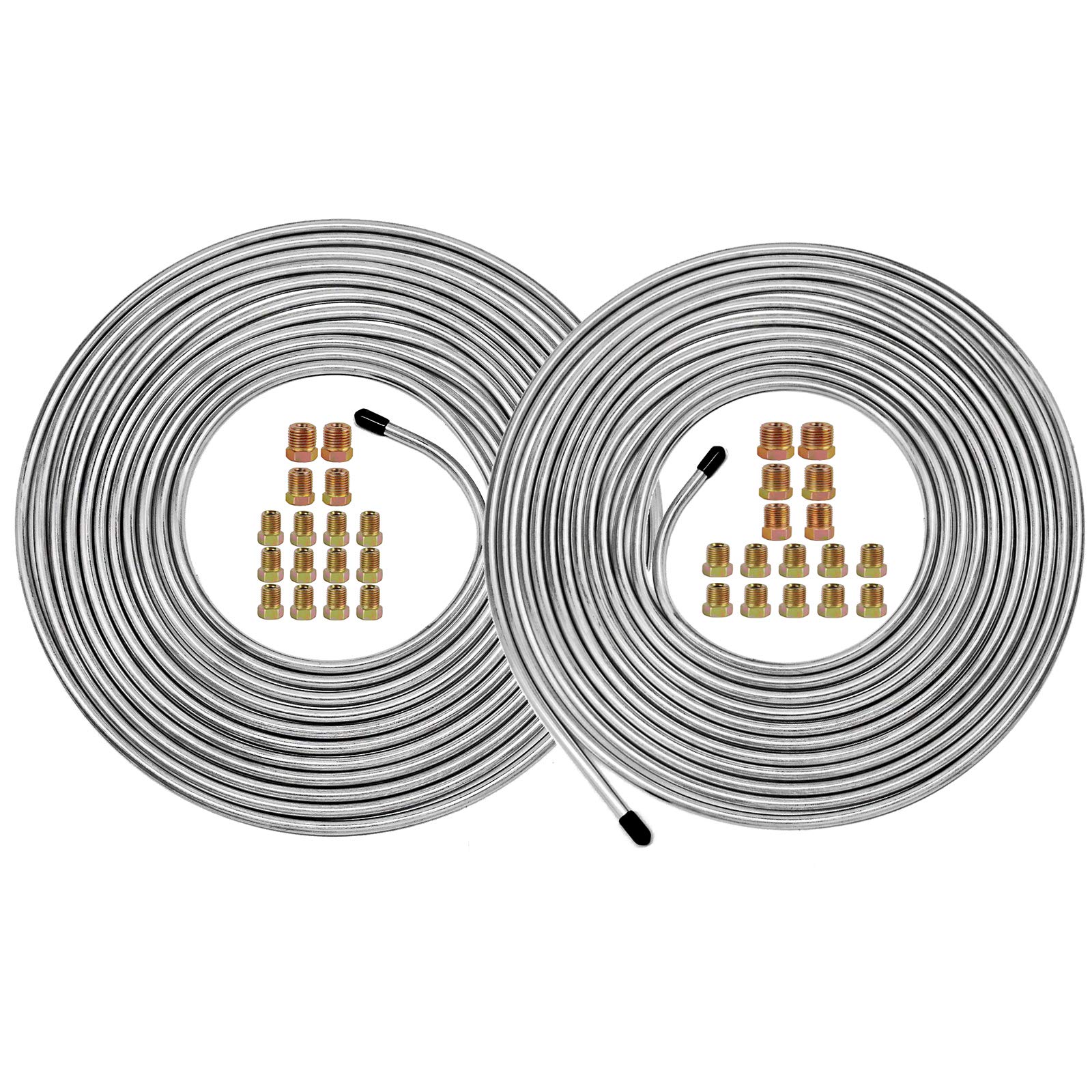
The MuHize kit is unique in this comparison because it includes both 3/16-inch and 1/4-inch tubing in a single package — 25 feet of each size. This dual-size approach covers both standard brake line applications and larger fuel or transmission cooler line needs. The zinc double-galvanized coating adds a second layer of corrosion protection compared to standard single-galvanized tubing.
The 3/16-inch section ships with sixteen inverted flare nuts: ten 3/8-24, two 7/16-24, two 1/2-20, and two 9/16-18. The 1/4-inch section includes its own fitting set for that size. Owners report that both tube sizes bend easily by hand and accept flares well using standard flaring tools. The kit has proven popular for simultaneous brake and fuel line replacement projects.
A limitation reported by some users: the included fittings can strip or leak, with one owner recommending replacing them with hardware-store couplers for critical braking applications. The zinc coating provides better corrosion resistance than copper-coated steel but still falls short of copper-nickel long-term. For someone replacing both brake and fuel lines on an older vehicle, the convenience of one kit for both sizes is practical.
What works
- Includes both 3/16-inch and 1/4-inch tubing for multi-system projects
- Double galvanized zinc coating provides enhanced corrosion protection
- Both tube sizes bend and flare easily with standard tools
What doesn’t
- Some fittings reported to strip or leak — recommended to replace with premium hardware
- Steel tubing still inferior to copper-nickel for long-term corrosion resistance
11. Luney 26 PCS 3/16″ Brake Line Kit with 25 ft Zinc-Plated Lines, 16 Fittings, 2 Unions, 4 Nuts, Bender, Single Flaring Tool, and Cutter

The Luney kit packages zinc-plated steel tubing with a full set of installation tools: a brake line bender, a single flaring tool, and a tubing cutter. The 26-piece count includes the 25-foot coil, sixteen brass fittings, two unions, and four additional nuts. The brass fittings and unions resist corrosion better than the zinc-plated steel and provide dependable sealing when properly double-flared.
The single flaring tool included in this kit is designed for soft steel and copper tubing only — it cannot produce double flares or handle OEM steel lines. One critical owner report warns that the tool lacks the adapters needed for double-flaring and that a single flare on a brake line is both unsafe and illegal in most jurisdictions. Anyone using this kit for brake work must purchase a separate double-flare tool.
Packaging quality is average, with some units arriving with minor damage to the blow-molded case. The tools feel functional but not industrial-grade — suitable for one or two jobs but not for daily professional use. For the entry-level price, the Luney kit works as a tubing-and-tool starter bundle for non-safety applications like fuel or transmission cooler lines, but brake system use requires upgraded tooling.
What works
- Full tool set including bender, cutter, and flare tool included in the kit
- Brass fittings and unions resist corrosion better than steel components
- Zinc-plated tubing bends easily and works for non-safety applications
What doesn’t
- Single-flare tool cannot produce double flares required for safe brake systems
- Packaging may arrive damaged and tools are not commercial-grade durability
Hardware & Specs Guide
Copper-Nickel Alloy Composition
Genuine copper-nickel brake line tubing — often referred to by the trademarked name NiCop — typically contains approximately 88-90% copper, 9-10% nickel, and trace amounts of iron and manganese. This composition is non-magnetic, will never rust, and remains ductile enough for hand bending without work-hardening. A simple magnet test confirms authenticity: if the tubing attracts a magnet, it contains iron and is not true copper-nickel. The material costs more than coated steel but eliminates the corrosion risk entirely for the life of the vehicle.
SAE Inverted Flare Thread Standards
The 3/16-inch brake line standard uses SAE inverted flare connections where the tube end is flared at 45 degrees and clamped by a threaded nut onto a male seat. The four most common thread sizes for 3/16-inch line are 3/8-24 (the most prevalent, used on most domestic applications), 7/16-24, 1/2-20, and 9/16-18. Metric ISO bubble flare systems, common on European and Asian vehicles, use a different flare geometry with sizes like 10×1.0mm, 11×1.5mm, 12×1.0mm, and 13×1.5mm. Always confirm your vehicle’s flare type and thread size before purchasing.
Burst Pressure Ratings
Standard 3/16-inch brake line tubing with 0.028-inch wall thickness typically carries a burst pressure rating around 3,000 to 4,900 psi depending on material. Copper-nickel and zinc-coated steel lines in this wall thickness range both exceed the maximum pressure generated by any production vehicle’s hydraulic braking system, which rarely exceeds 1,500 psi under panic braking. The practical failure mode is not line burst but rather corrosion pitting that creates weak points over years of exposure. This is why material selection matters more than burst rating for real-world reliability.
Double Flare vs. Single Flare vs. Bubble Flare
Double flares fold the tube end back onto itself, creating two layers of material at the sealing surface for maximum strength and vibration resistance — this is the only flare type accepted for brake systems on North American vehicles. Single flares are easier to form but crack under brake pressure and are only suitable for non-safety systems such as fuel return or transmission cooler lines. Bubble flares (ISO/DIN flares) form a raised bubble on the tube end and are used on European and Asian vehicles with metric thread fittings. Using the wrong flare type for your vehicle’s system guarantees a leak and potential brake failure.
FAQ
What is the difference between copper-nickel and standard steel brake lines?
Can I use a single flare tool for brake line connections?
How do I know which thread size my brake line fittings need?
Is 25 feet of tubing enough to replace all brake lines on my vehicle?
Can I mix different types of brake line tubing in the same system?
Final Thoughts: The Verdict
For most buyers, the best 3/16 brake line kit winner is the Nstarsmotor Copper-Nickel kit because it delivers genuine non-magnetic CuNi alloy, sixteen properly sized SAE fittings, and a lifetime warranty at a price that undercuts many lesser kits. If you need metric bubble flare fittings for a European vehicle, grab the The Stop Shop kit with its dedicated ISO thread assortment. And for a shop or serious DIYer maintaining multiple vehicles, nothing beats the 4LIFETIMELINES fitting assortment for eliminating mid-project parts store runs.

Certification: BSc in Mechanical Engineering
Education: Mechanical engineer
Lives In: 539 W Commerce St, Dallas, TX 75208, USA
Md Amir is an auto mechanic student and writer with over half a decade of experience in the automotive field. He has worked with top automotive brands such as Lexus, Quantum, and also owns two automotive blogs autocarneed.com and taxiwiz.com.