Nothing stalls a weekend project faster than a lawnmower, generator, or pressure washer that refuses to start after sitting for three months. The culprit is almost always degraded fuel — gasoline that has oxidized, absorbed moisture, or formed gum and varnish in the carburetor passages. A proper stabilizer stops that decay before it starts.
I’m Amir — the founder and writer behind Four Wheel Ask. My approach to fuel additives involves cross-referencing ASTM oxidation stability data, reviewing owner-reported long-term storage results, and analyzing the chemical mechanisms behind corrosion inhibitors, phase separation preventatives, and deposit control detergents.
Different stabilizer chemistries target different failure modes, from ethanol-related phase separation to the formation of sticky resin that clogs tiny jets. Choosing the right best small engine fuel stabilizer depends on understanding how each formula addresses ethanol, moisture, and long-term storage conditions.
How To Choose The Best Small Engine Fuel Stabilizer
Selecting a fuel stabilizer involves more than grabbing the cheapest bottle on the shelf. The right choice depends on storage duration, fuel type, and the specific failure modes you want to prevent. A stabilizer that works perfectly for a motorcycle stored for six months may not offer enough protection for a boat sitting through a wet winter.
Storage Duration and Dosage
Stabilizers label their protection window — typically one year or two years. A product rated for 24 months generally contains higher concentrations of antioxidants and metal deactivators. Owners who only store equipment for three to six months can use a standard dose, while those facing multi-year storage should follow the extended-protection dosage on the bottle.
Ethanol Compatibility and Phase Separation
Ethanol-blended fuels absorb moisture from the air, eventually reaching a saturation point where water separates from the gasoline. That separated layer can corrode metal components and feed microbial growth. Enzyme-based stabilizers and water-dispersant additives help keep moisture suspended in small droplets that burn off during operation, reducing the risk of phase separation.
Engine Type and Fuel System Materials
Two-cycle engines, four-cycle engines, and fuel-injected systems each place different demands on a stabilizer. Some formulas include upper-cylinder lubricants that protect rings and cylinder walls. Others focus on preventing deposits in tiny carburetor jets. Check that the stabilizer is safe for the seals, gaskets, and plastic components in your specific equipment.
Quick Comparison
On smaller screens, swipe sideways to see the full table.
| Model | Category | Best For | Key Spec | Amazon |
|---|---|---|---|---|
| STA-BIL Storage | Antioxidant | Long-term storage up to 24 months | 1 oz treats 2.5 gal | Amazon |
| Star Tron Stabilizer+ | Enzyme | Contaminant breakdown & moisture control | 1 oz treats 5 gal | Amazon |
| HappyFuel Premium | Antioxidant | Classic cars & collector vehicles | Single can per fill-up | Amazon |
| Honda Fuel Stabilizer | OEM | Honda small engines & powersports | 1 oz treats 5 gal | Amazon |
| Lucas Safeguard | Ethanol Treatment | Ethanol fuel conditioning & corrosion protection | 1 oz treats 5 gal | Amazon |
| Quicksilver Quickstor | Marine-Grade | Boats & marine equipment storage | 1 oz treats 5 gal | Amazon |
| Star Tron Enzyme Concentrate | Enzyme Concentrate | High-concentration treatment for all engines | 1 oz treats 16 gal | Amazon |
| Mercury Quickleen | Fuel System Cleaner | Carbon deposit removal for marine engines | 1 oz treats 5 gal | Amazon |
| K-100 All-in-One | Multi-Function | Water elimination & octane boost in stored engines | 32 oz treats 80 gal | Amazon |
| Sea Foam Motor Treatment | Multi-Purpose | Fuel stabilizer, injector cleaner & oil treatment | 16 oz per 8 gal | Amazon |
| Ethanol Shield Fuel Stabilizer | Phase Separation Inhibitor | Advanced ethanol protection & seal preservation | 24 oz, treats 60 gal | Amazon |
In‑Depth Reviews
1. STA-BIL Storage Fuel Stabilizer

STA-BIL Storage has dominated the fuel stabilizer market for decades, and the formulation in this 32-ounce bottle justifies that reputation. The proprietary blend of antioxidants, anti-corrosives, and detergents works to inhibit oxidation and prevent the formation of gum and varnish in fuel systems. Owner reports consistently note that engines treated with STA-BIL start on the first or second pull after six to twelve months of storage, which aligns with the manufacturer’s claim of 24-month freshness protection.
The formula is alcohol-free and compatible with all ethanol blends up to E85, making it suitable for a wide range of small engines including lawn mowers, snow blowers, generators, motorcycles, and boats. The dosage is straightforward — one ounce treats 2.5 gallons of gasoline — and the bottle includes measurement markings for easy dispensing. Users who have employed this product for over a decade report no issues with carburetor clogging or fuel system corrosion, even in humid environments where phase separation risk is elevated.
Compared to newer enzyme-based competitors, STA-BIL relies on traditional antioxidant chemistry rather than biological catalysts. This means it excels at preventing fuel degradation during storage but does not actively break down existing deposits or moisture the way some enzyme formulas do. For owners who start with fresh fuel and treat it immediately before storage, this stabilizer delivers consistent, predictable results across nearly every small engine application.
What works
- Proven long-term stability with verified 24-month protection window
- Easy-to-measure bottle with clear dosage markings
- Works across all ethanol blends and two-cycle engines
- Decades of positive owner feedback across multiple equipment types
What doesn’t
- Does not actively break down existing deposits or moisture
- Higher per-gallon cost compared to concentrated enzyme formulas
2. Star Tron Stabilizer+ Fuel Storage & Corrosion Protection

Star Tron Stabilizer+ takes a different approach to fuel preservation by using enzyme technology rather than strictly synthetic antioxidants. The enzymes are designed to break down gum, varnish, and other hydrocarbon contaminants that accumulate in stored fuel systems. This gives the product a dual function — it stabilizes fresh fuel while also helping to clean and rejuvenate systems that may already have deposit buildup from previous untreated fuel.
The dosage rate of one ounce per five gallons makes this one of the more cost-effective stabilizers on the market. Owner feedback highlights its effectiveness on both ethanol-free and ethanol-blended gasoline, with many users reporting that equipment stored for up to two years started without carburetor cleaning. The corrosion inhibitors add a layer of protection for metal components inside the fuel tank and carburetor, which is especially relevant for equipment stored in damp environments.
Some users find the measuring process less convenient than the squeeze-bottle design offered by STA-BIL, since Star Tron Stabilizer+ requires a separate measuring tool for small doses. The 16-ounce bottle treats 80 gallons, making it a solid choice for owners who maintain multiple pieces of equipment and want a single bottle that covers a full season of storage for several machines. The enzyme chemistry also means it can help reduce moisture-related issues by breaking down water into particles that pass through the fuel system.
What works
- Enzyme technology actively breaks down existing deposits
- Excellent value with 1 oz treating 5 gallons
- Compatible with ethanol-free and ethanol-blended fuels
- Corrosion inhibitors protect metal fuel system components
What doesn’t
- Measuring small doses requires a separate tool
- Some users prefer the squeeze-bottle dispensing of competitors
3. HappyFuel Premium Fuel Stabilizer

HappyFuel distinguishes itself through a transparent, science-backed development process that includes ASTM D525 oxidation stability testing. The formula addresses fuel storage from multiple mechanistic angles — it bonds with gasoline compounds to prevent evaporation of volatile components, forms a protective layer on engine metals to stop corrosion, and scavenges water to limit biological growth in the fuel system. This four-pronged approach gives it a theoretical edge over simpler stabilizers that only target oxidation.
Owner reports from the classic car community are particularly strong, with multiple collectors noting that HappyFuel helps mitigate the problems caused by ethanol-blended gasoline in vintage fuel systems. Users with Harley-Davidson motorcycles have also reported smoother idling and reduced engine temperatures after switching to this stabilizer. The metal can packaging is a practical detail — it eliminates the risk of plastic bottle degradation during long storage periods.
One consideration is that the recommended dosage is a full can per fill-up, which can be less flexible than products that allow precise per-gallon dosing. For owners who store multiple vehicles or a large quantity of fuel, this may result in higher per-treatment costs compared to concentrated formulas. However, for those who want a comprehensive stabilizer that addresses oxidation, corrosion, and moisture in a single package, the HappyFuel formulation offers a compelling option.
What works
- Multimechanism approach targeting oxidation, corrosion, and water
- ASTM D525 testing validates performance claims
- Strong owner reports from classic car and motorcycle owners
- Metal can packaging avoids plastic degradation issues
What doesn’t
- Full-can dosing reduces flexibility for small fuel quantities
- Higher per-treatment cost compared to concentrated stabilizers
4. Genuine Honda Fuel Stabilizer & Corrosion Inhibitor
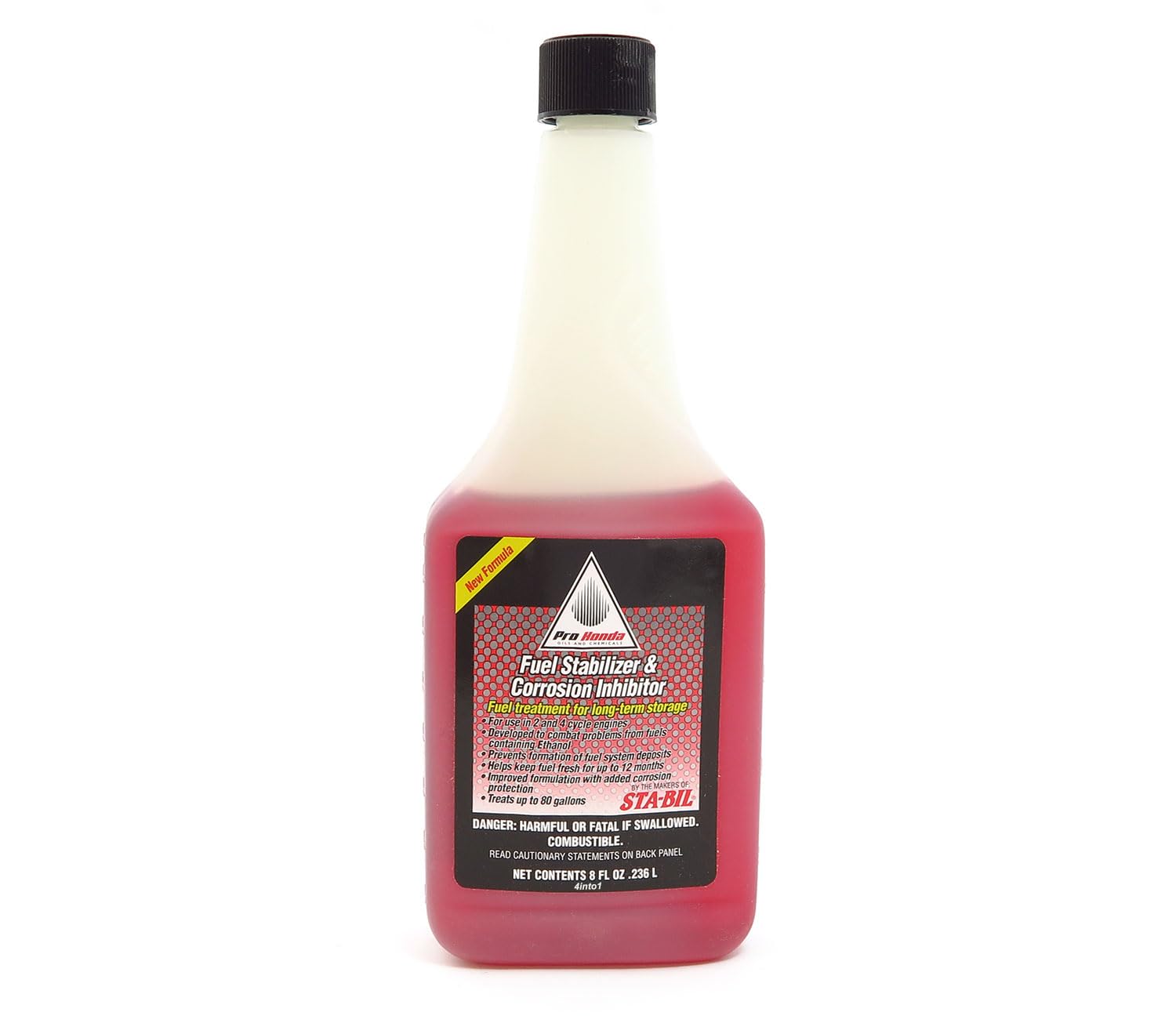
The Genuine Honda Fuel Stabilizer is specifically formulated to work with Honda engines, though it is compatible with any two-cycle or four-cycle small engine. Being an OEM part means the chemistry has been validated against Honda’s internal specifications for fuel system protection, seal compatibility, and long-term storage stability. The 8-ounce bottle treats up to 80 gallons of fuel, making the per-gallon cost very competitive.
Owner feedback highlights the product’s ability to keep fuel fresh for a full year of storage, with several users reporting that their Honda lawn mowers, generators, and motorcycles started reliably after winter storage. The corrosion inhibitor component is particularly relevant for engines that sit in humid environments where internal rust can form on carburetor and fuel tank surfaces. The formula is also designed to combat problems associated with ethanol-blended fuels, which tend to attract moisture and accelerate corrosion.
The primary limitation is that this stabilizer’s formulation is optimized for one-year storage rather than the 24-month window offered by some competitors. For owners who only store equipment seasonally — typically six to eight months — this is more than adequate. However, those who need multi-year protection for long-term vehicle storage may want to pair this with a product that offers extended stability. The small bottle size also means it may not be the most economical option for owners with large fuel storage requirements.
What works
- OEM-formulated for optimal Honda engine compatibility
- Excellent corrosion inhibition for humid storage environments
- Cost-effective per-gallon treatment ratio
- Safe for both two-cycle and four-cycle engines
What doesn’t
- Rated for one-year storage rather than extended 24-month protection
- Small bottle size may require multiple purchases for large fuel quantities
5. Lucas Oil Safeguard Ethanol Fuel Stabilizer
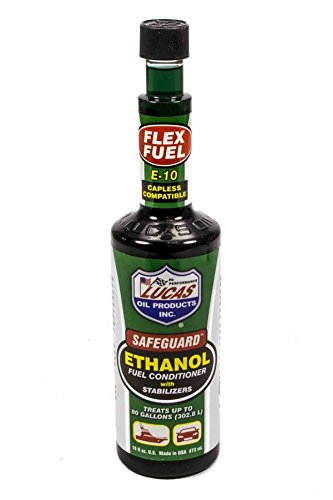
Lucas Oil’s Safeguard Ethanol Fuel Stabilizer is specifically designed to address the challenges introduced by ethanol-blended gasoline, including phase separation, corrosion, and deposit formation. The formulation includes detergents that help keep fuel injectors and carburetor passages clean while the stabilizer component slows the oxidation process that leads to varnish and gum. Owner reviews frequently mention improved idle quality and reduced engine hesitation after treatment.
The dosage recommendation is one ounce per five gallons, which aligns with industry-standard ratios and makes it easy to calculate treatment for any fuel quantity. Users with high-performance vehicles — including tuned cars running ethanol blends up to E40 — have reported no issues with fuel system seals or high-pressure fuel pumps after extended use. This suggests the formula is safe for modern fuel system components while still providing protection for older carbureted engines.
One area where this product differs from dedicated stabilizers is its primary focus on ethanol-related issues rather than long-term storage. While it does provide stabilization, the formulation prioritizes fuel conditioning and deposit control during active use. Owners who need storage protection beyond twelve months may want to supplement with a dedicated storage stabilizer. The 16-ounce bottle treats 80 gallons, offering a reasonable balance of coverage and value for regular users.
What works
- Targets ethanol-specific problems like phase separation and corrosion
- Detergent additives help maintain clean fuel system components
- Safe for modern fuel systems including high-pressure pumps
- Positive user reports from both small engines and tuned performance vehicles
What doesn’t
- Storage protection is secondary to fuel conditioning function
- May not match dedicated stabilizers for multi-year storage scenarios
6. Quicksilver Quickstor Fuel Treatment and Stabilizer

Quicksilver Quickstor is produced to Mercury Marine’s OEM specifications, which means it undergoes validation for the demanding conditions of marine fuel systems — high humidity, temperature fluctuations, and extended storage periods. The stabilizer is rated to keep fuel fresh for up to two years, preventing oxidation and the associated gum and varnish deposits that plague stored boat engines. The dosage is one ounce per five gallons, consistent with most premium stabilizers.
Owner reports from boaters who use Quickstor annually during winterization are overwhelmingly positive, with many noting that their engines start reliably after months of storage without needing carburetor service. The formulation is designed to work with both regular and ethanol-blended gasoline, which is critical for marine environments where ethanol-related phase separation can cause significant damage to fuel system components. The 12-ounce bottle treats 60 gallons, providing ample coverage for a single boat or multiple small engines.
One consideration is that this stabilizer is positioned primarily for marine and powersports applications rather than general small engine use. While it works perfectly well in lawn mowers and generators, the pricing and packaging are optimized for the marine market. Owners who maintain both boats and land-based equipment may prefer a more universal stabilizer, but those looking for a product specifically validated for marine storage conditions will find Quickstor to be a reliable choice.
What works
- OEM-formulated for Mercury Marine engines with validated two-year storage
- Excellent performance in high-humidity marine environments
- Works with ethanol-blended gasoline to prevent phase separation
- Strong reputation among boat owners for reliable winterization
What doesn’t
- Packaging and pricing optimized for marine rather than general use
- Less cost-effective for owners who only need to treat land-based equipment
7. Star Tron Enzyme Fuel Treatment Concentrate

The Star Tron Enzyme Fuel Treatment Concentrate takes the enzyme-based approach further by offering a highly concentrated formula that treats sixteen gallons of fuel per ounce. This makes it one of the most cost-effective stabilizers available when calculated on a per-gallon basis. The enzyme technology works by breaking down hydrocarbon deposits and preventing the accumulation of gum and varnish, while also dispersing water into submicron-sized droplets that burn off during engine operation.
Owner reviews consistently report that this product outperforms traditional stabilizers for equipment stored longer than one year. Users have noted that outboard motors, lawn mowers, and chainsaws treated with Star Tron started easily after extended storage periods, even when previous stabilization methods had failed. The ability to rejuvenate old, sub-spec fuel is a unique advantage — some owners have successfully restored fuel that had already begun to degrade, avoiding the need to drain and replace the tank.
The concentrated nature of this formula means precise measurement is important, especially for small fuel quantities. The bottle does not include a built-in measuring system, so users need to have a graduated measuring device on hand. Some owners also report that the enzyme chemistry requires a few engine cycles to fully treat the system, rather than providing immediate results like some synthetic stabilizers. Despite these minor inconveniences, the performance data and owner satisfaction make this a strong contender for long-term storage applications.
What works
- Highest concentration ratio — 1 oz treats 16 gallons for excellent value
- Enzyme technology breaks down existing deposits and rejuvenates old fuel
- Helps prevent phase separation by dispersing water in fuel
- Proven performance for storage periods exceeding one year
What doesn’t
- Requires separate measuring tool for accurate small doses
- Enzyme chemistry takes multiple cycles for full system treatment
8. Mercury Quickleen Engine & Fuel System Cleaner
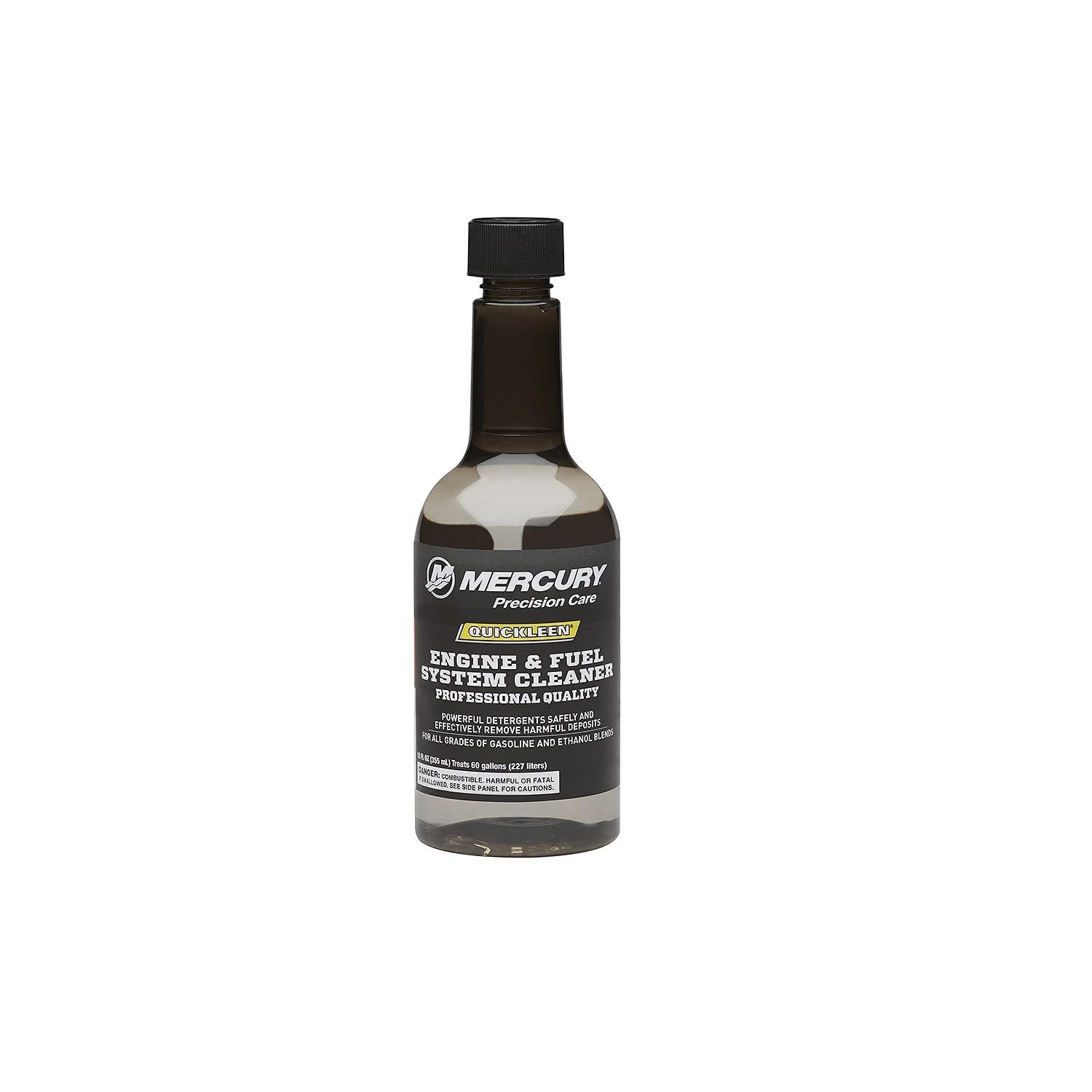
Mercury Quickleen is a dedicated fuel system cleaner rather than a stabilizer, though it deserves a place in this guide because carbon deposits directly contribute to starting difficulties in stored engines. The formula removes carbon buildup from carburetors, fuel injectors, intake valves, spark plugs, piston crowns, and cylinder heads. For engines that have been running with degraded or untreated fuel, this deposit removal can restore lost performance and eliminate hard-starting issues.
Owner feedback from marine applications is particularly strong, with users reporting that Quickleen resolved sputtering, hesitation, and full-throttle power loss that had persisted through multiple seasons. The product also proved effective on land-based equipment — several owners used it to clear up rough running in generators and lawn mowers that had been stored with untreated fuel. The dosage is one ounce per five gallons, and Mercury recommends using it occasionally throughout the season rather than as a dedicated storage stabilizer.
The key limitation is that Quickleen does not contain fuel stabilizers, so it must be paired with a dedicated stabilizer for long-term storage protection. It is specifically designed as a maintenance cleaner for engines in active use or as a restorative treatment for engines that have already developed deposit-related issues. Owners looking for an all-in-one product may prefer a stabilizer with cleaning additives, but those who want targeted deposit removal for a specific problem engine will find Quickleen highly effective.
What works
- Effectively removes carbon deposits from multiple engine components
- Resolved persistent performance issues reported by marine and small engine owners
- OEM-formulated to Mercury Marine specifications
- Useful as a periodic maintenance treatment for active engines
What doesn’t
- Does not contain fuel stabilizers — must be paired with separate storage protection
- Not designed as a storage stabilizer for long-term equipment layup
9. K-100 All-in-One Gasoline Fuel Treatment
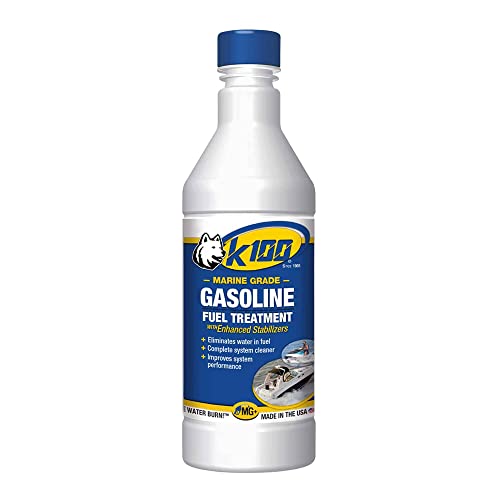
K-100 All-in-One takes a multi-function approach by combining water elimination, octane boosting, and fuel stabilization in a single bottle. The water-dispersant technology breaks water molecules into burnable particles that pass through the combustion chamber without causing corrosion or phase separation. This is particularly valuable for small engines stored in humid environments where condensation can accumulate in fuel tanks over weeks or months.
Owner reviews highlight the product’s ability to bring engines back to life after long storage periods — several users reported that equipment unused for two to three years started on the first or second pull after treatment. The octane boost component provides a two-point increase, which can help compensate for octane degradation that occurs as fuel ages. The 32-ounce bottle treats 80 gallons, offering a solid value for owners who maintain multiple pieces of equipment or want a single stabilizer for the entire fuel inventory.
One important caveat from owner experience is that K-100 can damage painted surfaces if spilled, so careful handling during pouring is essential. Additionally, the multi-function formulation means it may not match dedicated stabilizers in terms of pure oxidation prevention for multi-year storage. However, for seasonal storage combined with the need to address moisture issues and octane loss, the all-in-one approach offers a convenient solution that reduces the number of additives needed in the workshop.
What works
- Breaks down water into burnable particles to prevent corrosion
- Provides a two-point octane boost for aged fuel
- Proven ability to restart engines after multi-year storage
- Single product addresses stabilization, water, and octane needs
What doesn’t
- Can damage painted surfaces if spilled
- Multi-function formulation may not match dedicated stabilizers for extreme long-term storage
10. Sea Foam Motor Treatment

Sea Foam Motor Treatment occupies a unique position in the fuel additive market because it functions as a fuel stabilizer, fuel system cleaner, and oil treatment all in one. The formula is compatible with both gasoline and diesel engines, making it an ideal choice for owners who maintain a mixed fleet of equipment. As a stabilizer, it helps fuel resist evaporation, preserves ignition vapors, and prevents gum and varnish formation for up to two years.
Owner reviews across multiple platforms consistently rate Sea Foam as one of the most effective products for solving rough idle, stalling, and hard-starting issues. In addition to its stabilizing properties, the cleaning action helps remove deposits from fuel injectors and carburetor passages, restoring lost performance. Many owners report that a single can resolved persistent problems that had resisted other treatments. The three-pack format provides good value for regular users who want to keep a bottle in the workshop for both stabilization and maintenance.
The broad applicability of Sea Foam means it is not optimized specifically for long-term storage in the way that dedicated stabilizers like STA-BIL are. Its effectiveness as a stabilizer is a secondary benefit of its primary cleaning function. For owners who prioritize storage protection above all else, a dedicated stabilizer may be more appropriate. However, for those who want a single product that can handle stabilization, cleaning, and oil treatment duties, Sea Foam remains a proven and widely trusted option.
What works
- Three-in-one functionality as stabilizer, cleaner, and oil treatment
- Compatible with both gasoline and diesel engines
- Proven effectiveness for resolving rough idle and starting issues
- Strong reputation among mechanics and DIY owners alike
What doesn’t
- Stabilization capability is secondary to cleaning function
- May not match dedicated stabilizers for pure long-term storage protection
11. Ethanol Shield Fuel Stabilizer

Ethanol Shield represents a newer generation of fuel stabilizer chemistry that goes beyond simple antioxidant protection. The formula includes phase separation inhibitors that prevent ethanol-blended gasoline from separating into distinct layers, along with Combustion Cool Technology that helps manage combustion chamber temperatures. The addition of rubber and plastic protection agents ensures that fuel system seals and gaskets remain pliable during long storage periods — a common failure point in engines that sit for extended time.
Owner feedback for this product has been strong since its introduction in early 2024, with users noting that it outperforms previous stabilizers they had tried. The water-dispersing ability is particularly praised — several owners reported that previously problematic equipment started reliably after winter storage without the need for carburetor cleaning. The bonding technology that helps two-cycle oil mix more thoroughly with ethanol-blended fuel is a unique feature that addresses a known issue in chainsaws, trimmers, and other mixed-fuel equipment.
The 24-ounce two-pack treats 60 gallons per bottle, positioning it as a premium option in terms of per-treatment cost. The advanced chemistry comes at a higher price point than traditional stabilizers, though the inclusion of seal preservation and phase separation inhibitors adds value for owners who have experienced fuel system failures due to ethanol degradation. For those who want the most comprehensive protection available for ethanol-blended fuels, Ethanol Shield offers features not found in conventional stabilizers.
What works
- Phase separation inhibitors prevent ethanol fuel breakdown
- Rubber and plastic protection keeps seals pliable during storage
- Combustion Cool Technology helps manage engine temperatures
- Two-cycle oil bonding improves mixed-fuel stability
What doesn’t
- Higher per-treatment cost compared to traditional stabilizers
- Some users reported packaging leakage during shipping
Hardware & Specs Guide
Antioxidant vs. Enzyme Chemistry
Traditional stabilizers use synthetic antioxidants that slow the oxidation process by interrupting the chemical chain reaction that degrades fuel. Enzyme-based stabilizers use biological catalysts that actively break down hydrocarbon contaminants and help disperse water. Antioxidant formulas are excellent for preventing future degradation, while enzyme products can also address existing deposit issues. The choice depends on whether your fuel is fresh or already showing signs of aging.
Dosage Concentration and Coverage
Each stabilizer provides a specific dosage ratio, typically ranging from one ounce per 2.5 gallons to one ounce per 16 gallons. Higher concentration ratios offer better per-gallon value but require more careful measurement for small fuel quantities. Owners with multiple pieces of equipment should calculate the total fuel they treat each season and choose a product whose bottle size and concentration match their usage pattern without creating waste or requiring multiple bottles.
Ethanol Compatibility and Phase Separation
Fuels containing ethanol are more prone to phase separation — the point at which water absorption causes the ethanol and gasoline to separate into distinct layers. Dedicated stabilizers with phase separation inhibitors can raise the water tolerance threshold of ethanol-blended fuel, delaying or preventing separation. Enzyme-based stabilizers help by dispersing water into small droplets that burn during combustion. Owners in humid climates should prioritize products that explicitly address phase separation.
Corrosion Inhibition and Seal Protection
Fuel system corrosion occurs when acidic combustion byproducts and moisture attack metal surfaces inside the tank, carburetor, and fuel lines. High-quality stabilizers include corrosion inhibitors that form a protective barrier on metal surfaces. Advanced formulations also include seal-conditioning agents that keep rubber and plastic components from drying out and cracking during long storage periods. Both features become more important for equipment stored in unconditioned spaces with high humidity.
FAQ
How long does small engine fuel last without a stabilizer?
Can I use too much fuel stabilizer?
Should I use stabilizer in fuel I plan to use within a few weeks?
Do I need to run the engine after adding stabilizer?
Final Thoughts: The Verdict
For most buyers, the best small engine fuel stabilizer winner is the STA-BIL Storage because its proven antioxidant formula delivers reliable 24-month protection across the widest range of engines and storage conditions. If you want enzyme technology that actively breaks down deposits, grab the Star Tron Enzyme Concentrate. And for the ultimate ethanol protection with seal preservation and phase separation inhibitors, nothing beats the Ethanol Shield.

Certification: BSc in Mechanical Engineering
Education: Mechanical engineer
Lives In: 539 W Commerce St, Dallas, TX 75208, USA
Md Amir is an auto mechanic student and writer with over half a decade of experience in the automotive field. He has worked with top automotive brands such as Lexus, Quantum, and also owns two automotive blogs autocarneed.com and taxiwiz.com.