Automatic transmission fluid temperature is the single most ignored metric in everyday driving, yet it determines whether your transmission lasts 100,000 miles or 250,000 miles. Most factory dashboards only show a vague “hot” warning long after damage has started, leaving drivers who tow, haul, or live in mountainous terrain completely blind to the real thermal stress their transmission endures. Installing a dedicated gauge transforms guesswork into actionable data.
I’m Amir — the founder and writer behind Four Wheel Ask. I’ve spent years analyzing ATF temperature gauge specifications, comparing sensor accuracy data, and aggregating real-world owner feedback across hundreds of forum discussions and verified purchase reports to separate reliable monitoring solutions from expensive paperweights.
Any driver who tows or pushes their vehicle hard knows that selecting the best atf temperature gauge is the difference between catching a problem early and rebuilding a transmission.
How To Choose The Best ATF Temperature Gauge
Selecting the right transmission temperature gauge requires understanding sensor technology, display preferences, and installation requirements. The wrong choice can leave you with inaccurate readings or a complicated wiring mess. Focus on these key factors to match a gauge to your driving habits and vehicle setup.
Sensor Type: Mechanical Capillary vs. Electronic Sender
Mechanical gauges use a fluid-filled capillary tube that runs directly from the sensor to the gauge head. They require no electrical power for the reading itself, but routing the tube through the firewall can be tedious and a kinked tube means a dead gauge. Electronic senders use a thermistor that changes resistance with temperature and send a signal through thin wires. They are easier to route, support additional features like digital displays and programmable warnings, and keep hot transmission fluid safely outside the cabin. For most modern vehicles, electronic gauges offer better flexibility and safety.
Display Type: Analog Needle, Digital Readout, or Dual Vision
Analog dials with a sweeping needle provide quick glanceability and a classic aesthetic that matches factory instrumentation. Digital displays offer precise numerical readings down to the degree and are easier to read at night, but some drivers find them distracting. Dual-vision gauges combine both analog and digital readouts in one housing, giving you the contextual awareness of a needle plus the exact temperature number. Choose based on your tolerance for visual clutter and whether you prefer trend monitoring or exact data.
Temperature Range and Accuracy Tolerance
Most ATF temperature gauges cover 100–260°F or 100–300°F. Normal operating temperature for automatic transmission fluid is typically 160–200°F, with towing loads pushing toward 220–240°F. Sustained operation above 240°F accelerates fluid breakdown. Look for a gauge with a published accuracy specification within ±5°F at typical operating temperatures. Avoid gauges that rely on vague markings without degree increments, as they make trend spotting harder.
Sensor Thread Compatibility and Adapter Requirements
The most common sender thread size is 1/8-27 NPT, but many transmissions use metric test ports or require a tee fitting to splice into the cooler line. Some gauge kits include adapters for 3/8-inch and 1/2-inch NPT, while others expect you to source them separately. If you plan to install the sensor in a transmission pan, check whether the pan has a dedicated port or requires drilling. Kit completeness matters: missing adapters can turn a one-hour install into a multi-day parts run.
Backlighting, Dimming, and Customization Options
Gauges with selectable LED colors allow you to match existing dashboard lighting, but some models fail to save your color preference after the vehicle shuts off. Dimming capability is critical for nighttime driving — a gauge that stays full brightness will blind you on dark roads. Look for a dimmer wire that connects to the headlight circuit for automatic brightness reduction. Smoked lenses and black bezels reduce glare and create a stealthy appearance when the gauge is off.
Quick Comparison
On smaller screens, swipe sideways to see the full table.
| Model | Category | Best For | Key Spec | Amazon |
|---|---|---|---|---|
| Auto Meter 2640 | Electric | Reliable daily monitoring | 100–260°F, incandescent lighting | Amazon |
| MaxTow Double Vision | Dual Display | Analog + digital readouts | 80–260°F, green LED, 3 dimming modes | Amazon |
| AEM 30-4402 | Premium | Data logging & tuning | 100–300°F, 0–5V analog output | Amazon |
| GlowShift Tinted 7 Color | Multi-Color | Custom interior matching | 80–260°F, 7 colors + 2 cycle modes | Amazon |
| B&M 80212 | Complete Kit | Easy all-in-one install | 100–350°F, color-coded dial, T-fittings | Amazon |
| Bosch SP0F000053 | Mechanical | Budget brand reliability | 100–250°F, 270° sweep, black bezel | Amazon |
| ZHSYMX Universal 52mm | Digital LED | Low-cost entry option | 100–300°F, red digital display, slim depth | Amazon |
| TCHENPART 7 Color | Color Selectable | Dashboard color matching | 80–260°F, 7 color LED, 52mm | Amazon |
| GAZOZ PERFORMANCE | Multi-Function | Versatile kit with boost option | 52mm, universal fit, compact design | Amazon |
In‑Depth Reviews
1. Auto Meter 2640 Z-Series Electric Transmission Temperature Gauge
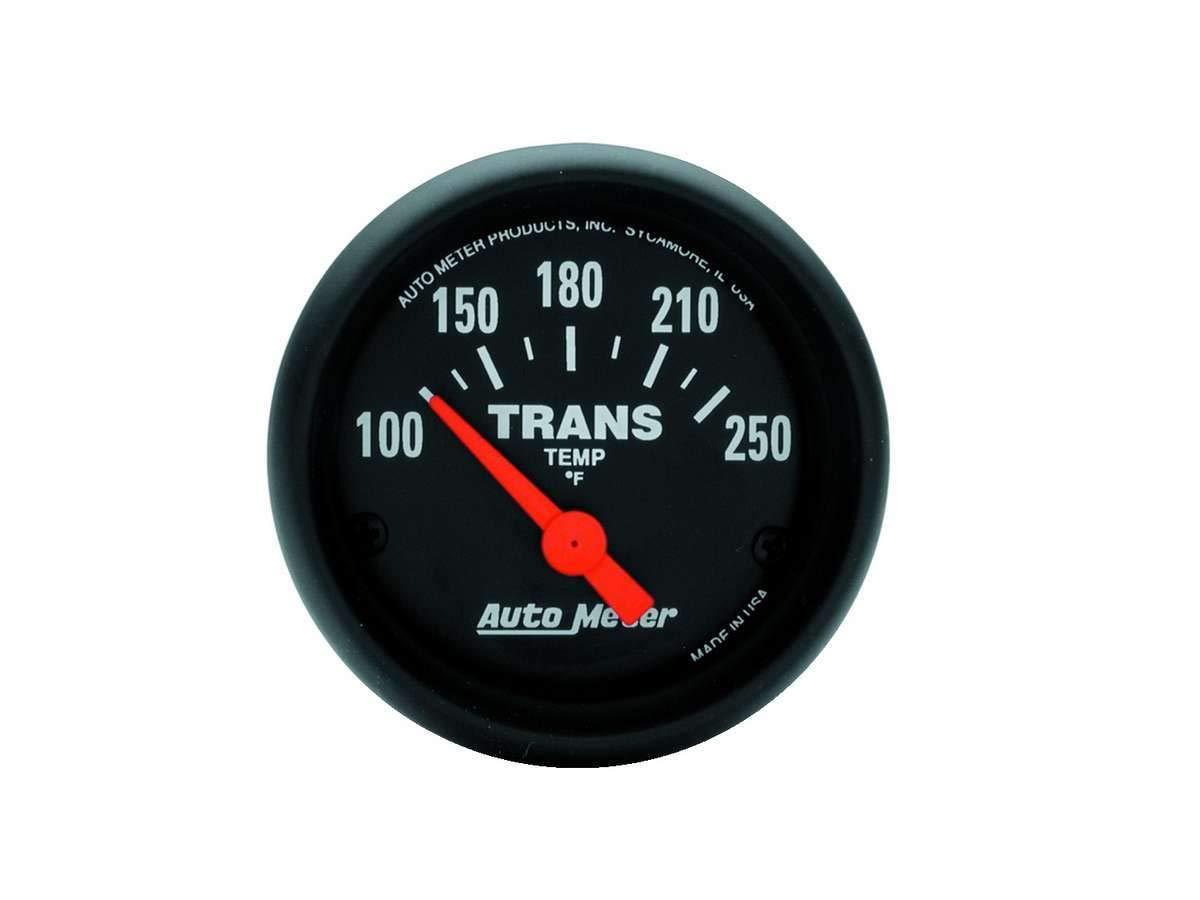
Auto Meter’s Z-Series 2640 has earned a reputation among truck and SUV owners for delivering consistent, reliable temperature data without unnecessary frills. The 2-1/16-inch diameter gauge fits standard pods, and the traditional incandescent lighting provides even illumination around the dial perimeter. Owner reports from 4L60E and 4R100 transmissions confirm that the included 1/8-inch NPT sender works directly in factory test ports on many GM and Ford platforms, with highway temperatures typically reading 125–130°F and towing loads peaking around 210°F on steep grades.
The gauge kit includes 3/8-inch and 1/2-inch NPT adapters, red and green bulb covers, and a mounting bracket, though several buyers noted that wiring is not included — you will need 18-gauge wire, spade connectors, and a 5-amp fuse to complete the installation. Accuracy verification against infrared temperature guns has been reported as positive, with readings within a few degrees of the actual fluid temperature. The air-core electric motor design keeps hazardous fluid out of the cabin, a meaningful safety advantage over mechanical capillary tubes.
One limitation worth considering: the sender length is relatively long, and some owners of GM 700R4 transmissions found it necessary to source a shorter sender to maintain proper fluid flow past the sensor. Additionally, the included mounting bracket is functional but some users upgraded to a sturdier aftermarket pod for long-term vibration resistance. For daily drivers who want race-proven reliability at a realistic price point, this gauge delivers exactly what it promises with minimal surprises.
What works
- Proven air-core electric motor for accuracy and safety
- Includes 1/8″, 3/8″, and 1/2″ NPT adapters for broad compatibility
- Consistent readings verified against IR temperature guns
- Incandescent lighting with interchangeable bulb covers
What doesn’t
- No wiring harness included — requires separate purchase of wire and connectors
- Sender length can interfere with fluid flow in some transmissions
- Mounting bracket feels basic for the price bracket
2. MaxTow Double Vision 260F Transmission Temperature Gauge Kit

The MaxTow Double Vision gauge stands out by combining an analog needle sweep with a digital numerical readout in a single 2-1/16-inch housing. This dual-display approach gives drivers the situational awareness of a sweeping needle plus the exact degree reading of a digital display, all illuminated with green LED backlighting that includes three daytime and three nighttime dimming modes. Owners of Ford Super Duty trucks report that the 1/8-27 NPT sensor fits the 4R100 test port without adapters, and the 9-foot sensor harness provides enough slack for remote mounting locations.
Installation feedback highlights the importance of proper grounding — several users who initially saw erratic readings or a blinking display traced the issue to an improperly grounded sender wire rather than a defective gauge. One owner noted that the cable burned after contacting an exhaust component, but splicing in protective conduit resolved the issue permanently. The gauge reads from 80° to 260° Fahrenheit, covering the full relevant range for automatic transmission fluid monitoring under both normal driving and heavy towing conditions.
The kit includes a gauge visor, mounting hardware, and both power and sensor harnesses, making it one of the more complete packages at this price tier. Some users mentioned that the green LED color may not match every dashboard scheme, but the three dimming levels for day and night help reduce glare. A 2007 Highlander owner used the gauge for a 1,000-mile tow of a 4,000-pound trailer and found the readings responsive and easy to read in direct sunlight. The one-year limited warranty and lifetime technical support add peace of mind for buyers concerned about long-term reliability.
What works
- Analog needle plus digital readout for dual reference
- Three daytime and three nighttime dimming modes
- Complete kit with harnesses, visor, and hardware
- Responsive sensor with good accuracy at towing temperatures
What doesn’t
- Green LED may clash with factory dashboard lighting
- Wires relatively thin — careful routing required to avoid heat damage
- Separate ground wire essential but not emphasized in basic instructions
3. AEM 30-4402 100-300F Oil, Transmission or Water Temperature Gauge

AEM’s 30-4402 sits at the top end of the consumer market for good reason: it functions as a standalone gauge while also outputting a 0-5V analog signal that can be fed directly into an engine management system or data logger. This makes it the obvious choice for tuners, racers, and anyone who wants to log transmission temperature alongside other engine parameters. The gauge reads from 100° to 300° Fahrenheit and uses bright LED displays to alert the driver of potentially damaging conditions before the transmission starts slipping.
Build quality is a clear step above the mid-tier options. Owners consistently describe the gauge as feeling substantial and precise, with smooth bezel rotation and crisp display segments. The kit includes multiple bezels and face plates so you can personalize the appearance to match your interior, a detail that reviewers appreciated when installing the gauge in high-end builds. One turbo car owner noted that if you want the absolute best, you step up to Defi, but AEM delivers 95% of that performance at a significantly lower entry point.
The primary complaint is the short sensor wire leads — several installers wished the harness was roughly double the length to simplify routing into the engine bay or transmission area. Additionally, one buyer reported receiving only the oil pressure face plate with their unit, suggesting quality control on included accessories may vary. Despite these concerns, the accuracy and data-logging capability of this gauge are well documented, and for serious builders who need integrated temperature monitoring, the AEM 30-4402 is the clear professional-grade recommendation.
What works
- 0-5V analog output for ECU integration and data logging
- Interchangeable bezels and face plates for customization
- Superior build quality and display precision
- Wide 100-300°F range covers all transmission scenarios
What doesn’t
- Sensor wire leads too short for easy routing
- Premium pricing may be overkill for casual daily drivers
- Inconsistent accessory inclusion reported by some buyers
4. GlowShift Tinted 7 Color 260F Automatic Transmission Temp Gauge Kit

GlowShift has built a loyal following among budget-conscious enthusiasts by offering seven color modes — blue, red, green, teal, purple, white, and yellow — plus two color-cycle modes, all at a price that undercuts most competitors. The Tinted 7 Color Series gauge reads from 80° to 260° Fahrenheit and features a smoked lens, illuminated red needle, and matte black trim ring for a stealthy appearance when the vehicle is off. A dimmer wire reduces brightness by 30% when connected to the headlight switch, solving the nighttime glare problem that plagues many aftermarket gauges.
Owner feedback from Jeep Cherokee and motorhome applications confirms that the gauge is accurate enough for real-world monitoring. One pre-1996 motorhome owner used the gauge to confirm that a fluid cooler reduced transmission temperature by 100°F under load, demonstrating the practical value of having actual data rather than dashboard guesswork. The kit includes a 1/8-27 NPT temperature sensor, 2-foot power and sensor harness, gauge visor, mounting bracket, and step-by-step instructions that most DIYers found adequate.
The most frequently reported annoyance is that the gauge does not remember the selected color after the vehicle is restarted, requiring you to cycle through modes again each time you drive. Additionally, some owners found the wiring harness flimsy, with thin sending unit wires that needed re-soldering for a reliable connection. The color-change button on the bezel can rattle against the lens on rough roads, and the kit lacks a T-fitting or hose barbs for tapping into transmission cooler lines. Despite these quirks, the value proposition remains strong for drivers who prioritize customization and affordability over premium build materials.
What works
- Seven color modes plus two cycle modes for dashboard matching
- Dimmer wire reduces glare by 30% with headlights on
- Accurate enough to verify cooler performance under load
- Complete kit with visor, bracket, and instructions
What doesn’t
- Color selection resets every time the vehicle starts
- Wiring harness feels flimsy — some owners re-solder connections
- Color-change button can rattle against the lens
5. B&M 80212 Transmission Temperature Gauge Kit

B&M’s 80212 kit has been a staple in the hot rod and towing community for years, offering a color-coded analog dial that reads from 100° to 350° Fahrenheit. The color zones — green for normal, yellow for caution, red for danger — make it immediately obvious when your transmission is entering an unsafe range without requiring precise number interpretation. Owners of Ford E4OD transmissions report that the temperature sender threads directly into the driver-side upper test port without adapters, and the anti-glare ABS enclosure keeps the gauge readable in bright sunlight.
The kit includes all necessary wires, terminals, sending unit, and T-fittings for a relatively straightforward installation. The sender is designed to be installed in the transmission cooler line using the included T-fitting, though some owners prefer to mount it directly in a pan port if one is available. B&M recommends using their 80250 drain plug kit if you want to drill and tap the transmission pan for a direct read. Installation feedback from Ford and GM owners confirms that the gauge is accurate enough to detect meaningful temperature changes — readings above 200°F under load signal the need for an auxiliary cooler.
A few owners noted that the backlighting technology feels dated compared to modern LED gauges, with a less even distribution of light across the dial face. The gauge requires a flat mounting surface, which can be limiting in vehicles with curved dashboard sections. Power was commonly sourced from a keyed fuse slot using a piggyback terminal, and most installers found the process manageable in under two hours. For those who want a proven product from a respected transmission performance brand and prefer the simplicity of a color-coded analog display, the B&M 80212 delivers exactly what it advertises.
What works
- Color-coded dial provides instant visual reference without number reading
- Includes T-fittings, wires, and terminals for complete installation
- Sender threads directly into Ford E4OD test ports
- Proven track record in towing and performance applications
What doesn’t
- Backlighting technology less uniform than modern LED options
- Requires flat mounting surface — not ideal for curved dashes
- Sender designed for cooler line, not pan mounting without additional kit
6. Bosch SP0F000053 Style Line 2″ Mechanical Water/Oil Temperature Gauge

Bosch brings its automotive OEM reputation to the aftermarket with the SP0F000053 Style Line gauge, a 2-inch mechanical water or oil temperature gauge designed for 2-1/16-inch openings. The 270-degree needle sweep provides excellent resolution across the 100–250°F range, and the black dial face with a black bezel delivers a clean, factory-matched appearance that blends into most dashboards without drawing attention. The gauge includes 12-volt internal backlighting and a removable black mounting panel for flexible installation options.
Owner feedback highlights the gauge’s ease of installation and the value proposition relative to premium brands like Auto Meter. Several buyers mounted the gauge under the hood for live engine tuning and reported that the mechanical sensor accurately tracked temperature drops when the thermostat opened, revealing that their factory gauge was reading 12°F colder than actual fluid temperature. The kit includes mounting hardware and is compatible with standard 2-inch gauge pods. Most installers completed the job in under 15 minutes when using an existing air bleed port for the probe.
The most significant concern from the data is accuracy inconsistency at the extremes. One owner tested two units simultaneously in boiling water and found both read 200°F against an actual temperature of 212–213°F measured by meat thermometers, representing a 12°F error at the high end. Another reviewer noted that the gauge is marked as made in China despite the Bosch branding, which may disappoint buyers expecting German manufacturing. For budget-focused shoppers who want a recognizable brand name and clean aesthetics, this gauge offers a functional entry point, but the accuracy variance means it should be used as a trend indicator rather than a precision instrument.
What works
- Bosch brand recognition and OEM-style appearance
- Wide 270° needle sweep for detailed resolution
- Quick 15-minute install in most vehicles
- Revealed factory gauge inaccuracy for one owner
What doesn’t
- Reported 12°F error at boiling temperature across two units
- Made in China despite German brand expectations
- Mechanical capillary tube requires careful routing to avoid kinks
7. ZHSYMX Universal 52mm Water Temperature Gauge 0-300F Digital LED

ZHSYMX’s 52mm digital gauge targets budget-minded DIYers who want a modern LED display without spending premium money. The gauge measures 100–300°F with a bright red center LED readout that is 87% larger than earlier digital models, plus a sweeping red LED needle around the perimeter for at-a-glance reference. The housing depth is under 18.8mm, making it one of the slimmest options for mounting in tight pods or custom panels where space is constrained. Two programmable buttons on the faceplate allow peak-and-recall functions and user-selectable threshold warnings.
Installation feedback is mixed but informative. Owners of an LS-swapped 1986 Chevy C10 used the gauge as a temporary solution and confirmed readings within 10 degrees of the stock coolant sending unit, which is acceptable for a gauge at this entry price. The sensor uses a 1/8-inch NPT thread, and the wiring requires connection to key-on power rather than dash lights to function. Some users found the included instructions unclear and the thin wires difficult to work with, recommending careful connector crimping to avoid intermittent readings.
The most critical review reported a complete out-of-box failure with mismatched wire colors between the instructions and actual product, along with a cheap overall feel. This failure rate appears to be the exception rather than the norm based on the broader review sample, but it highlights the quality-control variance buyers accept at this tier. The unit does include a radiator hose tap adapter, which is a nice inclusion for those who prefer not to install a permanent sensor bung. For temporary monitoring or projects on a tight budget, this gauge works well enough, but long-term reliability remains an open question.
What works
- Large center LED readout with sweeping needle perimeter
- Ultra-slim 18.8mm depth fits tight mounting locations
- Peak-and-recall with programmable threshold warnings
- Includes radiator hose tap adapter for non-permanent install
What doesn’t
- Thin wires and unclear instructions complicate installation
- Quality control inconsistent — some units fail out of box
- Accuracy adequate but not precise enough for critical monitoring
8. TCHENPART 7 Color 80-260F Transmission Temperature Gauge 52mm
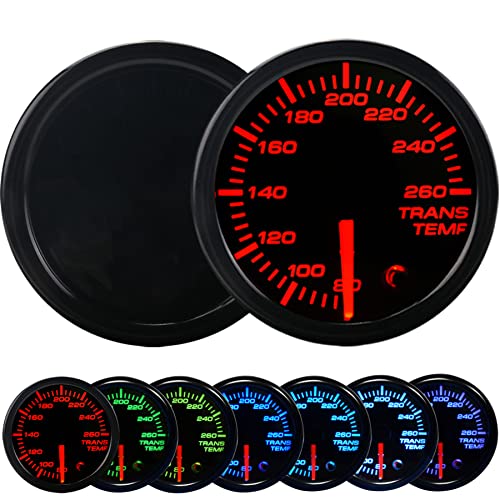
TCHENPART’s 7-color gauge offers a similar feature set to the GlowShift at a comparable price point, with 80–260°F range, a 52mm black dial, tinted lens, and illuminated red needle. The color-change button on the lens lets you cycle through seven LED colors to match your dashboard lighting, and the blackout appearance when the gauge is off creates a clean modern look. The package includes the gauge, a 6.7-inch sensor, 24-inch power wire rated for 12V vehicles only, an instruction paper, U-bracket, and mounting hardware.
Owner reports show a concerning pattern of sensor failure within the first year of use. Multiple reviews describe the gauge working correctly for 6–7 months before the sensor stopped sending temperature data, while the gauge itself continued to power on and cycle through colors. One owner towing a camper watched the temperature spike to 260°F and then drop to the minimum reading, after which the probe never recovered proper function. Another user reported the gauge never read above 105°F, suggesting either a defective sensor or wiring issue.
On the positive side, buyers who received fully functional units reported that the gauge looks great, the backlighting is bright and customizable, and the installation is straightforward for anyone comfortable with basic 12V wiring. The manufacturer offers a one-year warranty and provides technical support for wiring-related issues, though sensor replacement may still require shipping and downtime. Given the documented durability concerns, this gauge is best suited for temporary installations or as a backup monitor where a failure would not leave you completely blind to transmission temperature.
What works
- Seven user-selectable LED colors for dashboard matching
- Clean blackout appearance when gauge is powered off
- Straightforward installation for basic 12V wiring experience
- One-year warranty included with manufacturer support
What doesn’t
- Sensor failures reported within 6–12 months of use
- Some units never read above 105°F out of box
- Gauge powers on but sensor stops sending data — no warning indication
9. GAZOZ PERFORMANCE 52mm Transmission Trans Temp Gauge Kit

GAZOZ PERFORMANCE positions this 52mm gauge kit as a versatile multi-parameter solution that can monitor transmission temperature, boost, or cylinder head temperature depending on the sensor configuration you purchase. The universal fit design claims compatibility with cars, trucks, and SUVs, making it a flexible option for enthusiasts who want one gauge ecosystem across multiple vehicles or projects. The compact form factor is intended to integrate into dashboards without obstructing visibility or adding clutter.
Owner feedback is predominantly positive on build quality and visual appeal for the price. Buyers report that the gauge works well out of the box, with bright backlighting and clear readability that ranks above other offerings in the same budget tier. However, one owner noted a significant calibration concern: the gauge read 160°F on a completely cold transmission, then quickly climbed to the peak temperature, suggesting either a sensor offset issue or a lack of zero-point calibration. The programming button is located on the back of the gauge, requiring removal from the pod to adjust features — an inconvenience if you need to tweak settings after installation.
The included documentation emphasizes the gauge kit’s ability to provide real-time data for optimizing performance and fuel efficiency, but the review data does not contain enough long-term usage reports to verify durability beyond initial installation. The manufacturer is GAZOZ PERFORMANCE, a less established brand compared to Auto Meter or B&M, which may affect warranty support responsiveness. For buyers who want a functional gauge at a low entry price and are comfortable troubleshooting calibration issues, this kit offers acceptable performance, but the lack of cold-start accuracy is a meaningful limitation for serious transmission monitoring.
What works
- Universal fit claimed for cars, trucks, and SUVs
- Bright backlighting with good daytime readability
- Compact 52mm form factor integrates cleanly
- Multi-parameter kit supports temperature, boost, and other sensors
What doesn’t
- Cold readings reported 160°F when transmission was at ambient temperature
- Programming button on rear requires gauge removal for adjustments
- Less established brand with unknown long-term support quality
Hardware & Specs Guide
Electronic Senders vs. Mechanical Capillary Tubes
Electronic temperature senders use a thermistor — a resistor whose resistance changes with temperature — to send a variable voltage signal to the gauge. These senders are powered by 12V DC and can be routed through the firewall using thin wires, keeping hot transmission fluid safely outside the passenger compartment. Mechanical gauges rely on a sealed capillary tube filled with a temperature-sensitive fluid that expands and contracts to move the needle. While mechanical gauges do not require electrical power for the reading itself, the capillary tube is fragile and difficult to route without kinking. For most modern vehicles, electronic senders are the safer, more flexible choice, especially when the gauge will be mounted in the dashboard or A-pillar pod.
NPT Thread Standards and Adapter Compatibility
The vast majority of aftermarket temperature senders use 1/8-27 NPT (National Pipe Thread) threads. Many transmissions come with a test port that accepts this thread directly, but some use metric threads or require adapters to step up to 3/8-inch or 1/2-inch NPT for pan mounting. When installing a sender in the transmission cooler line, a 3/8-inch or 1/2-inch NPT tee fitting is typically required. Always verify your transmission model and test port thread pitch before ordering — a mismatch will delay your installation by days while you source the right brass adapter from a local hardware store.
Temperature Ranges and Fluid Degradation Thresholds
Automatic transmission fluid begins to degrade noticeably above 240°F. At 260°F, fluid breakdown accelerates rapidly, leading to varnish buildup, seal hardening, and eventual clutch slippage. Most aftermarket gauges cover 80–260°F or 100–300°F, which is adequate for monitoring normal driving (160–200°F), heavy towing (200–240°F), and emergency overheating situations. A gauge that only reads up to 250°F leaves no margin for error once you are in the danger zone. Choose a gauge with at least a 260°F upper limit if you tow regularly or drive in mountainous terrain.
Backlighting Technology and Nighttime Visibility
Traditional incandescent bulbs provide warm, even illumination but consume more power and generate heat inside the gauge housing. Modern LED backlighting is brighter, cooler, and offers color-selectable options, but some LEDs exhibit uneven illumination or hot spots on the dial face. A dimmer circuit — either automatic via a headlight-wire connection or manual via a rheostat — is essential for nighttime driving. Gauges without dimming capability at full brightness create dangerous glare that reduces forward visibility and causes eye strain on long night drives.
FAQ
Where should I install the temperature sensor for the most accurate reading?
What temperature should my transmission run at normally?
Can I install a transmission temperature gauge myself without professional help?
Why does my gauge reading fluctuate while driving?
Final Thoughts: The Verdict
For most buyers, the best atf temperature gauge winner is the Auto Meter 2640 Z-Series because it combines race-proven electric motor accuracy, broad adapter compatibility, and straightforward installation at a price that reflects genuine engineering rather than marketing hype. If you want the precision of both analog and digital readouts in a single gauge, grab the MaxTow Double Vision for its dual-display design and excellent dimming modes. And for tuners and data-logging enthusiasts who need to integrate transmission temperature into an engine management system, nothing beats the professional-grade capability of the AEM 30-4402 with its 0-5V analog output.

Certification: BSc in Mechanical Engineering
Education: Mechanical engineer
Lives In: 539 W Commerce St, Dallas, TX 75208, USA
Md Amir is an auto mechanic student and writer with over half a decade of experience in the automotive field. He has worked with top automotive brands such as Lexus, Quantum, and also owns two automotive blogs autocarneed.com and taxiwiz.com.