A gas caddy pump does more than move fuel — it eliminates the back strain, spill risk, and frustration that come with wrestling heavy five-gallon cans. Whether you are refueling a tractor, boat, generator, or fleet of lawn equipment, the right pump transforms a messy chore into a clean, efficient operation. The market offers everything from manual siphon hoses to powerful 12V electric units and rolling tank caddies, and the choice depends heavily on your typical job size, portability needs, and tolerance for setup time.
I’m Amir — the founder and writer behind Four Wheel Ask. I have spent years tracking fuel-transfer product specifications, analyzing build materials and flow-rate data, and studying thousands of owner feedback reports to understand what separates a dependable pump from a frustrating one.
After analyzing dozens of models and thousands of owner reports, the best gas caddy pump balances flow rate, build quality, ease of use, and lasting value.
How To Choose The Best Gas Caddy Pump
Selecting the right gas caddy pump starts with understanding your typical fuel-transfer volume, the types of liquids you handle, and how often you need to move the unit between locations. The wrong choice leads to slow refueling, leaky connections, or a pump that fails after a handful of uses. Focus on these three areas to narrow the field.
Pump Mechanism and Power Source
Manual siphon pumps rely on a shaking or priming action to start flow — they have no batteries or motors to fail, but they depend on gravity and height differential for sustained transfer. Battery-powered units (typically running on D cells or USB-C packs) offer push-button convenience at moderate flow rates around 2.3 to 3.8 GPM, making them ideal for occasional home-garage use. 12V DC electric pumps deliver the highest flow rates, often exceeding 10 GPM, and are best for frequent, high-volume jobs, though they require connection to a vehicle battery or dedicated power source. Consider your tolerance for setup effort versus raw speed.
Flow Rate and Hose Reach
Flow rate, measured in gallons per minute (GPM), determines how quickly you can empty or fill a tank. A pump rated at 2 GPM will take roughly two and a half minutes to move five gallons, while a 15 GPM unit does the same in twenty seconds. Hose length matters just as much — a short hose forces you to position the caddy close to the receiving tank, which is impractical for tractors, boats, or equipment parked in tight spots. Look for a hose at least eight feet long for general use, and ensure the hose material is rated for the specific fuel type (gasoline, diesel, kerosene) to avoid swelling or degradation.
Build Quality and Tank Construction
The pump housing, seals, and tank material directly affect longevity. Cast-iron or stainless-steel pump bodies tolerate rough handling and outdoor storage far better than thin plastic. On rolling caddies, high-density polyethylene (HDPE) tanks resist corrosion and denting, but steel tanks offer superior durability for heavy commercial use. Check for brass shut-off valves at both the tank and hose connection — these prevent drips when disconnecting. Also inspect the wheel design: larger wheels with bearings roll easily over gravel and grass, while small fixed wheels struggle on anything but smooth concrete.
Quick Comparison
On smaller screens, swipe sideways to see the full table.
| Model | Category | Best For | Key Spec | Amazon |
|---|---|---|---|---|
| TERA PUMP Fuel Transfer Pump | Electric | All-around mid-range use | 2.3 GPM, 10-ft hose, D battery | Amazon |
| DEWAY Wireless Pump | Electric | Trigger-nozzle control | 3.8 GPM, 51-in hose, USB-C | Amazon |
| Steauty 12V Kit | 12V Electric | Portable case storage | 110 GPH, 11.5-ft cord, metal | Amazon |
| PAMBEE 15-Gal Caddy | Rolling Caddy | Medium-volume gravity feed | 15 gal, 10-ft hose, siphon pump | Amazon |
| GAOMON 15-Gal Caddy | Rolling Caddy | DEF/urea compatibility | 15 gal, 10-ft hose, 2 GPM | Amazon |
| TUFFIOM 35-Gal Caddy | Rolling Caddy | Large-volume manual pump | 35 gal, 11.9-ft hose, steel | Amazon |
| LAPPPLSP 16-Gal 12V | 12V Caddy | Switch-controlled electric pump | 16 gal, 3.7 GPM, 12V DC | Amazon |
| VEVOR 35-Gal Steel | Rolling Caddy | Heavy-duty steel tank | 35 gal, 8.2-ft hose, 4 wheels | Amazon |
| Scepter 14-Gal 2-Pack | Rolling Caddy | Dual-unit fuel storage | 14 gal each, 10-ft hose, 2 GPM | Amazon |
| Fill-Rite FR1204H | 12V Electric | High-flow commercial use | 15 GPM, cast iron, 1-in NPT | Amazon |
| FlowPro Shaker Siphon | Manual Siphon | Simple no-power transfer | 10 GPM, 1-in copper, 10-ft hose | Amazon |
In‑Depth Reviews
1. TERA PUMP Fuel Transfer Pump

The TERA PUMP strikes a rare balance between affordability and real-world reliability, making it the top pick for anyone from weekend warriors to small-farm operators. It runs on two D batteries (sold separately), so there is no tether to a vehicle battery or wall outlet, yet it delivers a respectable 2.3 GPM through its flow-control nozzle. The 10-foot abrasion-resistant vinyl hose gives excellent reach, and the telescoping suction tube extends from 16.5 to 22 inches to fit standard 3-to-20-gallon containers. Owner reports consistently highlight how this unit eliminates the hassle of lifting heavy cans — one reviewer noted it has been running strong since 2022 with only seasonal battery removal to protect the contacts.
Build quality is a clear step above many competitors in this price tier. The cast-iron pump body and swivel-nut nozzle that rotates 360 degrees reduce hose tangling, and the nozzle locks open for hands-free extended fueling. The U-shaped battery compartment includes a hook for hanging storage, a thoughtful touch that keeps the unit accessible in a crowded garage. On the downside, a few owners experienced pump failure after limited use, though the manufacturer’s one-year warranty and responsive replacement policy resolved most complaints. The instruction manual could be clearer, but assembly is straightforward enough for anyone comfortable with basic mechanical tasks.
For the vast majority of buyers, the TERA PUMP offers the best mix of portability, flow speed, and durability without pushing into premium pricing territory. It handles gasoline, diesel, kerosene, and even DEF (AdBlue) with proper post-use rinsing, making it a genuinely versatile tool. If you value a setup that works right out of the box and holds up over years of moderate use, this is the unit to beat.
What works
- Reliable D battery operation with no external power cord needed
- Locking flow-control nozzle for hands-free refueling
- Telescoping intake fits multiple container sizes
- Strong cast-iron pump housing
- One-year manufacturer warranty with responsive support
What doesn’t
- Batteries not included in the package
- Occasional pump failure reported after limited use
- Instruction manual lacks detail for first-time users
2. DeWay Gas Can Fuel Transfer Pump
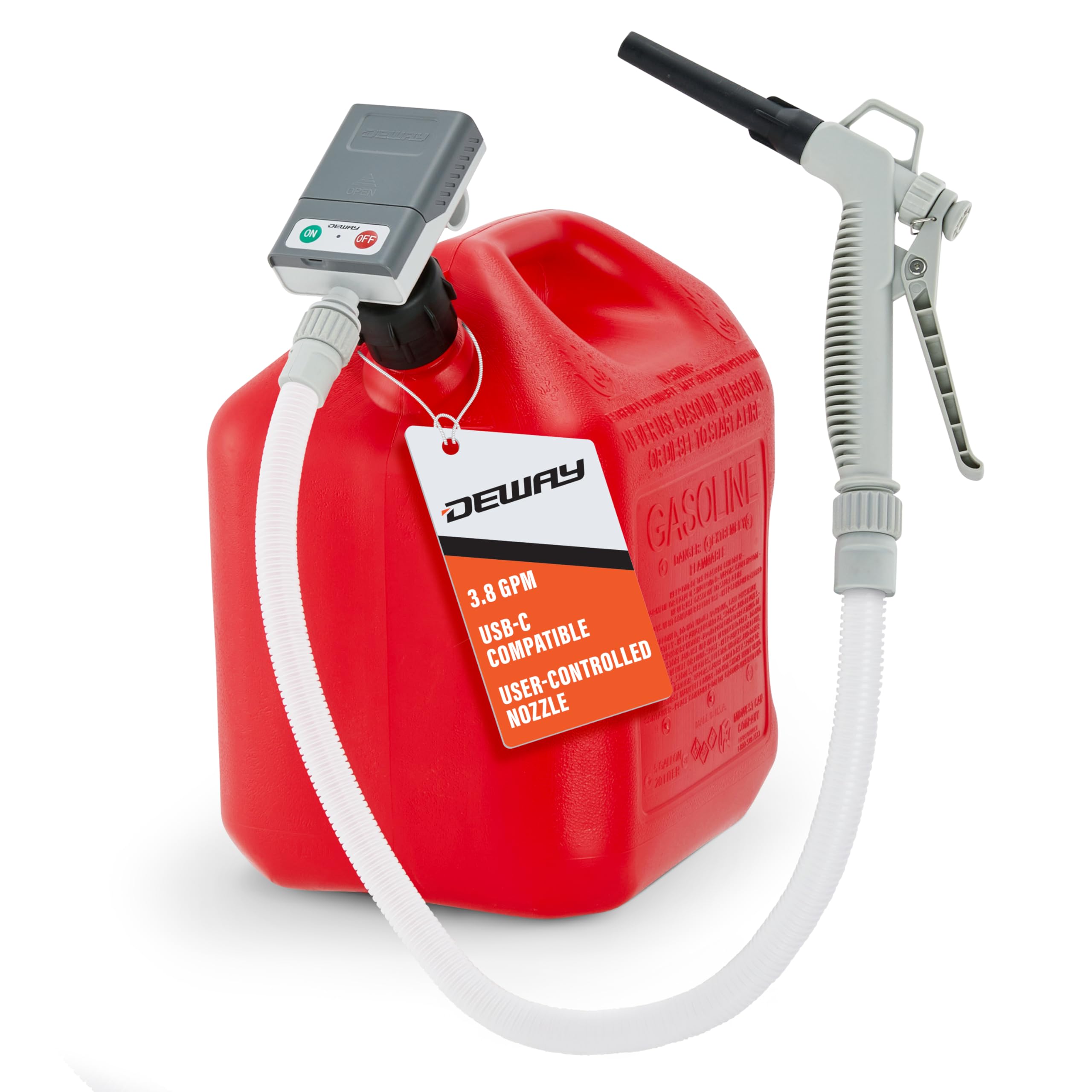
The DeWay pump stands out for its dual-power flexibility — it runs on four AA batteries or via the included USB-C cable, which plugs into a car, power bank, or wall adapter. This eliminates the worry of dead batteries mid-job and makes it one of the most adaptable portable pumps on the market. The hand-trigger nozzle mimics a gas-station pump handle, giving you precise start-stop control, and the integrated locking tab allows continuous hands-free flow when you need it. Owners consistently praise the 3.8 GPM transfer rate, noting that a five-gallon can empties in roughly a minute and a half without any lifting or tilting.
The accessory package is well thought out — three universal gas-can adapters cover most North American brands like Midwest, Scepter, and No-Spill, and the 51-inch discharge hose provides enough length to reach into truck beds and equipment tanks without repositioning the source container. The clear hose styling lets you monitor flow and spot air pockets or leaks immediately. Some users report that suction weakens over longer vertical lifts, especially with diesel, leaving about an inch of fuel in the bottom of a five-gallon can. A few also wished the hose were longer for cap-less vehicle tanks, though a simple 3/4-inch plastic pipe extension solves that issue.
Considering the competitive flow rate, dual-power option, and thoughtful nozzle design, the DeWay is an excellent choice for anyone who wants electric-pump convenience without committing to a 12V hardwire setup. The manufacturer offers a one-year limited warranty and responsive customer service for any nozzle or motor issues. If trigger-style control and USB-C charging appeal to you, this pump deserves serious consideration.
What works
- Dual power via AA batteries or USB-C cable
- Gas-station-style trigger nozzle with lock-on tab
- 3.8 GPM flow rate empties 5 gallons quickly
- Three universal gas-can adapters included
What doesn’t
- Suction drops on longer vertical lifts with diesel
- Hose could be longer for cap-less vehicle tanks
- Leaves a small residual amount in source can
3. Steauty 12V Fuel Transfer Pump Kit

The Steauty kit delivers exceptional value by packaging a metal-bodied 12V pump, two power cables, and a full set of hoses into a compact carrying case that keeps everything organized and protected. The pump moves up to 110 gallons per hour (roughly 1.8 GPM) and draws from a source tank up to 39 inches below the pump, which covers most standard fuel-container depths. Owners appreciate the grab-and-go convenience — no assembly is required beyond connecting the power leads, and the entire setup stores neatly in the case between jobs. One reviewer specifically noted that this pump saves their back from lifting full five-gallon cans and is much more reliable than battery-powered units that die halfway through a refuel.
The kit includes an 11.5-foot cigarette-lighter power cord and an 11.8-foot alligator-clip conversion cable, so you can tap into any 12V source — a car, truck, boat, or even a dedicated battery charger. The built-in filter and gasket help keep debris out of the pump mechanism, and the metal pump housing feels substantially more durable than the all-plastic alternatives at similar price points. The flow rate is moderate compared to larger 12V pumps, but it is consistent and steady, emptying a five-gallon can in about three minutes. A few owners wish the pump were faster, and the manufacturer explicitly states this unit is designed for low-viscosity petroleum products only — it is not recommended for water without a flush afterward.
For anyone who needs a reliable, easy-to-store 12V transfer solution without the bulk of a rolling caddy, the Steauty kit is a smart investment. It removes the guesswork of piecing together hoses and adapters, and the included case means the pump stays clean and protected when not in use. The moderate flow rate is a fair trade-off for the compact footprint and hassle-free storage.
What works
- Complete kit in a portable carrying case
- Durable metal pump housing
- Includes both cigarette-lighter and alligator-clip cables
- Built-in filter protects the pump from debris
What doesn’t
- Moderate flow rate — 5 gallons takes about 3 minutes
- Not for water without a flush afterward
- Requires a 12V power source; no battery option
4. PAMBEE 15 Gallon Gas Can With Siphon Pump

The PAMBEE 15-gallon rolling caddy solves the problem of frequent trips between the fuel pump and your equipment by storing enough gasoline or diesel for multiple refueling sessions. The HDPE tank is rust-proof and holds up to 15 gallons, and the two brass shut-off valves — one at the tank and one at the hose end — let you disconnect the 10-foot hose safely without fuel spillage. The siphon pump operates in either siphon or gravity-feed mode, achieving roughly 3 GPM in siphon mode depending on how quickly you work the pump handle. Owners consistently report that this unit eliminates the mess and back strain of pouring from individual cans, and several noted it fits easily in truck beds and garages.
Portability is handled by a molded top handle and six-inch wheels that roll reasonably well over gravel and grass when the tank is full. The hose holder keeps the delivery hose neatly coiled during transport. A removable filter in the filler neck prevents debris from entering during refueling, though it does slow the fill rate if you press the nozzle too quickly — the manufacturer advises slow, steady pumping to avoid splashing. Some users noted that laying the tank on its side reduces usable capacity to about 11 gallons, and the unit is heavy when full (23 pounds empty, well over 100 pounds loaded), so plan your lifting strategy accordingly.
For the price, the PAMBEE delivers a well-engineered package that is easy to assemble and operate right out of the box. The dual shut-off valves provide genuine leak protection, and the siphon pump is simple to prime without batteries or electrical connections. It is an excellent mid-volume solution for anyone tired of handling multiple small cans.
What works
- 15-gallon HDPE tank resists rust and denting
- Two brass shut-off valves prevent spills during disconnect
- 10-foot automotive-grade rubber hose with storage holder
- Siphon and gravity-feed modes for flexibility
What doesn’t
- Heavy when full — over 100 pounds loaded
- Laying on its side reduces usable capacity
- Slow pumping required with filter installed to avoid splashing
5. GAOMON 15 Gallon Fuel Caddy

The GAOMON 15-gallon caddy distinguishes itself through broad liquid compatibility — it handles gasoline, diesel, kerosene, light oil, non-potable water, and even DEF/AdBlue/urea liquid, making it one of the most versatile rolling caddies in this class. The 60-liter HDPE tank is built with corrosion-resistant polyethylene, and the 10-foot automotive-grade rubber hose includes a hose holder for tidy storage. The siphon pump delivers roughly 2 GPM, which is modest compared to some competitors, but the real advantage here is the ability to handle urea-based fluids without seal degradation — a common failure point on pumps not rated for DEF.
Two brass shut-off valves provide leak-free hose disconnection, and the six-inch wheels with a molded top handle make transport manageable across paved surfaces. Owners report that the caddy rolls easily when full and remains stable on flat ground. One reviewer criticized the shut-off valve placement at the tank rather than the nozzle tip, noting that you must remember to close it before topping off or you risk overflowing the receiving tank. Another user wished for a lower handle to help lift the caddy out of a truck bed or trunk, as the unit lacks good grip points near the base when loaded.
Despite these ergonomic quibbles, the GAOMON caddy earns strong marks for its leak-free operation and DEF compatibility. It is a straightforward, no-fuss solution for anyone who needs one container to handle multiple fluid types — especially if you are working with diesel exhaust fluid alongside conventional fuels. The value proposition is solid for the build quality and versatility offered.
What works
- Compatible with DEF/AdBlue in addition to fuels
- Rust-proof HDPE construction
- Two brass shut-off valves prevent leaks
- Easy to roll when fully loaded
What doesn’t
- Shut-off at tank rather than nozzle tip can cause overflows
- No lower handle for lifting out of vehicle beds
- Moderate 2 GPM flow rate
6. TUFFIOM 35 Gallon Fuel Gas Caddy

The TUFFIOM 35-gallon caddy is built for users who need serious fuel capacity and a durable steel tank that can handle outdoor storage and frequent use. The alloy-steel body is lightweight for its size yet rigid, and the reversible rotary hand pump is a standout feature — it not only dispenses fuel but also siphons residual fuel from the hose back into the tank, reducing drips and waste. The 11.9-foot kink-free hose allows you to reach equipment parked at a distance, and the wide-diameter filler neck makes refilling the tank fast and spill-free. Owners frequently praise the stable four-wheel design, which uses two heavy-duty 10-inch wheels and two swivel casters for excellent maneuverability on rough terrain.
The anti-static grounding clamp is a smart safety addition, preventing static discharge during filling operations. An easy-to-read level gauge on the vent helps you monitor fuel volume at a glance and avoid overflows. Assembly is straightforward, though the included instructions are minimal — experienced users recommend applying Teflon tape to all threaded fuel connections to prevent leaks. A small number of buyers reported debris inside the tank from the manufacturing process, which can clog the pump if not flushed before first use. The pump rotor is aluminum and can be damaged by metal shavings, so a pre-use cleaning is strongly advised.
When properly set up, the TUFFIOM caddy delivers reliable, high-capacity fuel transport with the convenience of a reversible pump that minimizes mess. It is ideal for farms, large properties, and commercial settings where moving 35 gallons of fuel across uneven ground is a regular task. The build quality and capacity justify the investment for heavy users.
What works
- 35-gallon steel tank with durable powder-coat finish
- Reversible pump siphons hose back to tank
- Four-wheel design with 10-inch wheels for rough terrain
- Anti-static grounding clamp for safe fueling
What doesn’t
- Debris from manufacturing may require pre-use cleaning
- Aluminum pump rotor can be damaged by contamination
- Instructions are sparse and lack detail
7. LAPPPLSP 16 Gallon 12V Fuel Caddy

The LAPPPLSP 16-gallon caddy integrates a 12V DC electric pump directly into the tank assembly, offering push-button convenience without a separate handheld pump unit. The pump delivers 2.3 to 3.7 GPM with a switch control panel, and the 12V connection allows direct hookup to a car or tractor battery. The HDPE tank is corrosion-resistant and rated for gasoline, diesel, and kerosene, and the integrated wheels and heavy-duty top handle make it reasonably mobile when filled to its 60-liter capacity. Owners appreciate the ability to simply flip a switch and walk away while the pump does the work, especially for hurricane-preparation fueling where speed matters.
The design includes an upgraded axle to prevent the wheel issues that plagued earlier production runs. However, several owners reported that the tank developed leaks near the wheel mounts after a few months, and the plastic pump connections can crack under stress. The pump is notably slow — one reviewer described filling a car as watching paint dry — though it is still easier and cleaner than lifting multiple five-gallon cans. The unit is stable when full but tips over easily when empty, requiring a second person to hold it steady while filling at the gas station.
For occasional use, particularly in emergency preparedness scenarios, the LAPPPLSP caddy provides a complete electric-pump solution in a single package. The slow flow rate and reported durability issues make it less suitable for daily commercial use, but for homeowners who want electric convenience without assembling separate components, it fills a specific niche. Be prepared to inspect the plastic fittings regularly and consider upgrading the pump if longevity is a concern.
What works
- Integrated 12V electric pump with push-button switch
- Corrosion-resistant HDPE tank
- Easy to roll when fully loaded
- Good for emergency fuel storage and hurricane prep
What doesn’t
- Slow flow rate — filling a car takes significant time
- Reports of tank leaks near wheel mounts
- Plastic pump connections prone to cracking
- Empty unit tips over easily
8. VEVOR 35 Gallon Fuel Caddy

The VEVOR 35-gallon caddy stands out for its all-steel construction at a price point where many competitors use HDPE. The carbon-steel tank is resistant to UV radiation and dents, and the bi-directional hand rotary pump allows you to dispense fuel or siphon it back into the tank by reversing the crank direction — a feature that minimizes drips when you finish pumping. The 8.2-foot kink-free hose is shorter than some competitors, but the wide-diameter filler neck permits fast refills without spillage. Owners who use it for tractor refueling consistently praise the pumping speed, with one reporting moving 25 gallons in about seven minutes.
The four-wheel configuration uses two heavy-duty 10-inch wheels and two smaller 2.5-inch swivel casters, providing stable rolling on pavement and packed gravel. The anti-static grounding clamp is a standard inclusion, and the accurate fuel gauge on the vent cap helps you monitor levels at a glance. Assembly involves mounting the wheels and pump, and several owners noted that the pipe threads are somewhat loose — liberal use of Teflon tape is essential to prevent leaks at the connections. A minority of buyers experienced pump leaks from the start, gauge failures, and a handle that split after limited use, with warranty support described as unresponsive.
Despite the quality-control inconsistencies reported by some, the VEVOR caddy offers exceptional value for its steel construction and 35-gallon capacity. It is best suited for buyers who are comfortable applying thread sealant and performing a thorough initial inspection before first use. For those who get a well-built unit, it delivers commercial-grade capacity at a fraction of the cost of premium brands.
What works
- Durable all-steel carbon-steel tank resists UV and dents
- Bi-directional rotary pump for dispensing and siphoning
- Four-wheel design for stable transport
- Fast pumping speed — 25 gallons in about 7 minutes
What doesn’t
- Threaded connections may leak without heavy Teflon tape use
- Quality control issues reported with pump and gauge
- Warranty support inconsistent per owner feedback
- Hose shorter than some competing 35-gallon models
9. Scepter 14-Gallon Duramax 2-Pack

The Scepter Duramax two-pack offers 28 total gallons of fuel storage split between two identical 14-gallon rolling caddies, making it a practical choice for owners who want redundancy or need to separate fuel types (gasoline and diesel, for example). Each unit features a 10-foot hose with a siphon pump rated at 2 GPM, two mechanical shut-off valves, and six-inch wheels for transport. The HDPE construction meets DOT and UN transportation requirements, and owners consistently report zero leaks even after extended storage — one reviewer noted that the units performed flawlessly through a 10-day hurricane power outage.
The stop-and-go pump handle reduces spills and overfills, and the bolt-on hose hanger keeps the delivery hose organized during transport. Ergonomics draw mixed feedback: the handle is low and can be uncomfortable when the tank is full, and the 90-pound loaded weight requires care when maneuvering over uneven ground. The nozzle lacks a lock-on feature, meaning you must hold it continuously during refueling, which can be fatiguing. A few owners also reported that the wheels lack bearings, causing them to drag or wobble on rough surfaces, and that the air vent is too small for efficient uphill flow.
For emergency preparedness and long-term fuel storage, the Scepter two-pack is hard to beat — the leak-proof reputation and robust HDPE build inspire confidence. The ergonomic shortcomings are real but manageable, especially if you primarily use the caddies on smooth garage or driveway surfaces. The dual-unit configuration adds flexibility that a single larger tank cannot match.
What works
- Two 14-gallon units for 28 total gallons of storage
- Leak-proof seals confirmed by long-term owners
- Meets DOT and UN transport requirements
- Ideal for emergency fuel reserves and storm prep
What doesn’t
- Low handle position uncomfortable when loaded
- Nozzle lacks lock-on for continuous flow
- Wheels drag on rough surfaces without bearings
- Small air vent limits uphill flow
10. Fill-Rite FR1204H 12V Fuel Transfer Pump

The Fill-Rite FR1204H is the professional-grade option on this list — a bung-mounted 12V pump built with cast-iron construction and rotary vane technology that maintains consistent flow even as internal components wear. Rated at 15 GPM, it can move fuel from tank depths of 8 feet and discharge up to 37 feet of head, making it suitable for large stationary tanks, service trucks, and heavy equipment. The removable junction box rotates 180 degrees for easier wiring in tight spaces, and the thermal overload protection prevents motor damage during extended use. Owners widely regard Fill-Rite as the benchmark for durability, with many noting that the all-metal build outlasts plastic competitors by years.
The pump includes a 3/4-inch elbow, grounding wire, wire nuts, and PTFE tape for installation, though you will need to supply your own suction pipe and discharge hose. The 1-inch NPT inlet threads fit standard tank bungs, and the pump is compatible with gasoline, diesel, kerosene, ethanol blends, methanol blends, and biodiesel — a wider range than most consumer-grade pumps. The cast-iron housing handles rain and outdoor storage far better than aluminum or plastic alternatives, which is a key differentiator for users who cannot keep their pump under cover. Some owners felt the actual flow rate is closer to 12-13 GPM than the advertised 15 GPM, but still consider it the best pump in its class for reliability.
For anyone who relies on fuel transfer as part of their daily work — farmers, fleet managers, mobile mechanics — the Fill-Rite FR1204H is an investment in longevity. The limited lifetime warranty on the pump body and the company’s reputation for honoring it add further peace of mind. It is overkill for occasional home use, but for commercial or heavy hobbyist applications, nothing else on this list matches its build quality and flow capability.
What works
- Cast-iron body withstands harsh outdoor conditions
- 15 GPM flow rate with 37-ft discharge head
- Rotary vane technology maintains performance as parts wear
- Limited lifetime warranty on the pump
What doesn’t
- Requires separate suction pipe and hose purchase
- Actual flow rate slightly under advertised 15 GPM
- Overkill for light home-garage use
11. FlowPro Self-Priming Shaker Siphon Hose
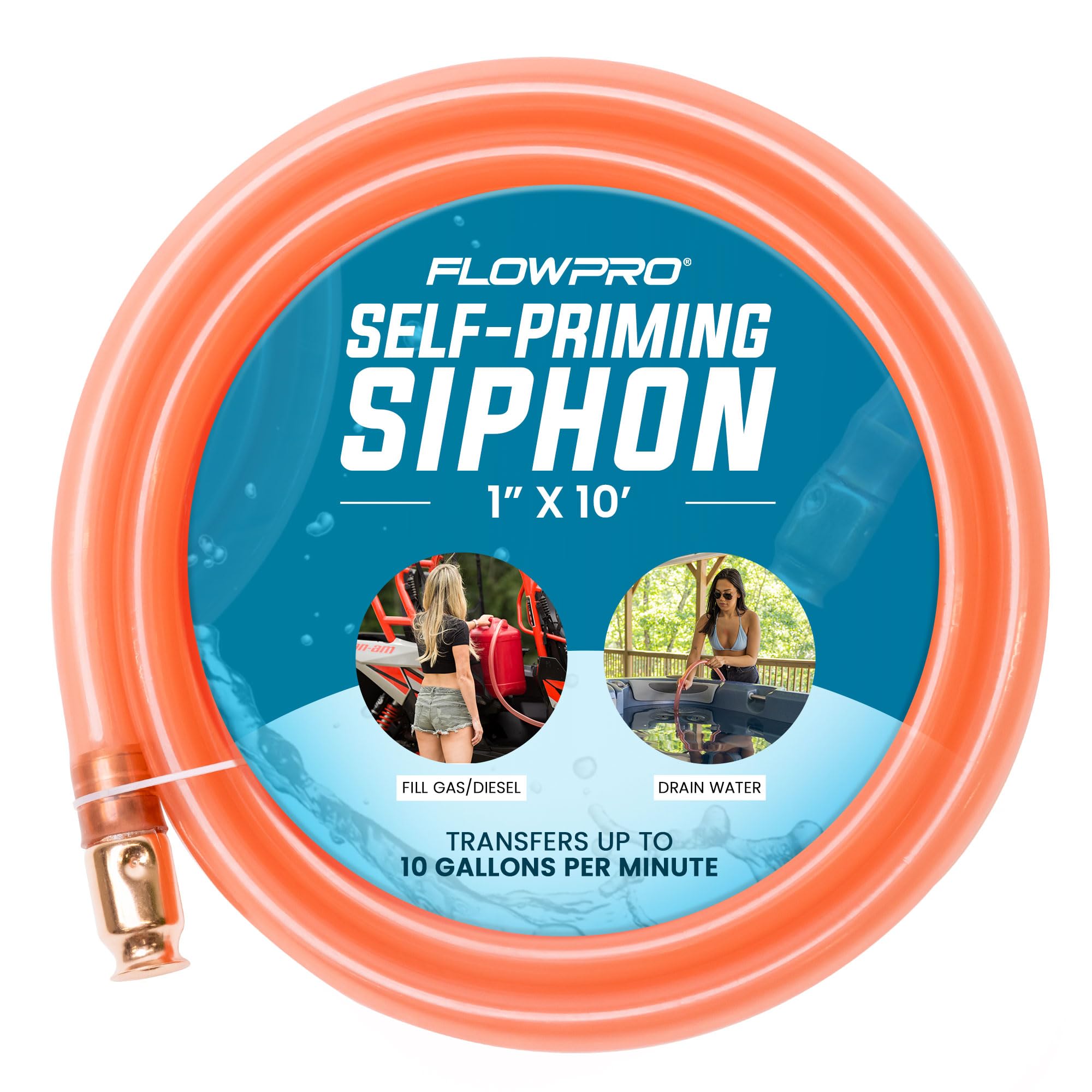
The FlowPro Shaker Siphon is the simplest and most portable option — a 1-inch by 10-foot hose with a copper nozzle and a self-priming mechanism that starts flow with a rapid shaking motion. No batteries, no electricity, no pump mechanism to fail. It can transfer up to 10 gallons per minute, faster than many electric pumps, and works with gasoline, diesel, oil, water, and non-corrosive chemicals. The lead-free copper nozzle fits most container openings, and the anti-static materials reduce spark risk during flammable-liquid transfer. Owners who get a properly functioning unit report excellent performance for siphoning diesel between large tanks and draining pool covers.
However, the FlowPro suffers from significant quality inconsistency. Multiple owners report that the internal glass ball — the critical priming component — becomes stuck after a few uses, rendering the siphon unable to self-prime. Others note that the tubing kinks and yellows over time, and the glass ball feels fragile against rough handling. The design requires patience: you must shake the hose rapidly and consistently to establish flow, and it can be fussy to get started. A few reviewers found that even after repeated shaking, the siphon would not prime at all, leading to frustration and the conclusion that competitive products offer better reliability at similar or lower cost.
For the price, the FlowPro represents a gamble — when it works, it is a fast, elegant solution with no power requirements. When it fails, it fails completely and without easy repair. It is best suited for users who value extreme simplicity and are willing to accept the possibility of a defective unit, or who need a backup option for emergency transfer. Most buyers would be better served by a battery-powered or 12V pump for assured reliability.
What works
- No batteries or electricity required for operation
- High flow rate — up to 10 GPM when primed
- Versatile with many liquid types including water
- Anti-static materials for flammable liquid safety
What doesn’t
- Self-priming mechanism frequently fails after a few uses
- Tubing kinks and yellows over time
- Glass ball feels fragile and can become stuck
- Significant quality inconsistency across units
Hardware & Specs Guide
Flow Rate and Power Source
Flow rate determines how quickly you can move fuel from the source to the receiving tank. Manual siphon hoses like the FlowPro can achieve up to 10 GPM but depend entirely on gravity and proper priming. Battery-powered pumps such as the TERA PUMP and DeWay offer moderate rates between 2.3 and 3.8 GPM with the convenience of cordless operation. 12V electric pumps like the Fill-Rite FR1204H deliver the highest sustained flow at 15 GPM, but they require connection to a vehicle battery or external 12V supply. Choose based on how much time you are willing to spend per transfer and whether you have ready access to a power source.
Hose Length and Material
The hose length directly affects how close you must position the source container to the receiving equipment. Short hoses under 6 feet work for bench-top or close-proximity jobs, while hoses of 10 feet or more allow you to reach into truck beds, boat fuel fills, and tractor tanks without repositioning. Automotive-grade rubber and vinyl are the most common materials — rubber is more resistant to fuel swelling and cracking over time, while vinyl is lighter and more flexible. Check that the hose is rated for the specific fuel you plan to transfer; diesel and biodiesel blends can degrade hoses not specified for petroleum products.
Tank Materials and Build
Rolling caddies use either high-density polyethylene (HDPE) or steel for the fuel tank. HDPE is lighter, rust-proof, and less expensive, but can deform under severe heat or impact. Steel tanks, as seen on the VEVOR and TUFFIOM caddies, offer superior durability and UV resistance at the cost of higher weight and potential for rust if the exterior coating is damaged. For the pump mechanism itself, cast iron (Fill-Rite) provides the longest service life in outdoor or commercial settings, while brass internal components resist corrosion from ethanol-blended fuels. Check that all seals and gaskets are compatible with the fuel type to avoid swelling and leaks.
Portability and Wheel Design
Wheel size and type determine how easily you can move a full caddy across your property. Small fixed wheels (under 6 inches) work on smooth concrete but sink into gravel or grass. Larger pneumatic or solid-rubber wheels with bearings roll much more easily over uneven terrain and reduce the effort required to maneuver a 100+ pound loaded tank. Swivel casters on the front add maneuverability in tight spaces but can feel unstable at speed. Look for a top handle that is positioned high enough to provide leverage without forcing you to bend awkwardly — this is one of the most common ergonomic complaints on budget caddies.
FAQ
What type of gas caddy pump is best for home garage use?
Can I use a gas caddy pump for both gasoline and diesel interchangeably?
How do I maintain my fuel transfer pump to ensure longevity?
Final Thoughts: The Verdict
For most buyers, the best gas caddy pump winner is the TERA PUMP Fuel Transfer Pump because it combines reliable D battery operation, a locking flow-control nozzle, and a 10-foot hose at a price that undercuts most competitors with similar features. If you want trigger-nozzle precision with USB-C power flexibility, grab the DeWay Gas Can Pump. And for high-volume commercial use where flow rate and cast-iron durability are non-negotiable, nothing beats the Fill-Rite FR1204H.

Certification: BSc in Mechanical Engineering
Education: Mechanical engineer
Lives In: 539 W Commerce St, Dallas, TX 75208, USA
Md Amir is an auto mechanic student and writer with over half a decade of experience in the automotive field. He has worked with top automotive brands such as Lexus, Quantum, and also owns two automotive blogs autocarneed.com and taxiwiz.com.