A trailer wiring harness that fails at the worst moment — a dark highway, a sudden brake check, a downpour — isn’t just an inconvenience; it’s a safety liability. The difference between a harness that lasts a decade and one that corrodes within a season comes down to materials, connector design, and how well the manufacturer understands real-world abuse. Over the past several years analyzing thousands of owner reports and specifications across nearly every wiring harness category, I’ve seen the same patterns repeat: copper purity, weather sealing at the connector, and proper wire gauge separate the reliable setups from the constant-trouble ones. This guide cuts through the listing page fluff to help you match a harness to your actual trailer, vehicle, and usage profile.
I’m Amir — the founder and writer behind Four Wheel Ask. My research process involves cross-referencing technical specifications, owner-reported failure modes, and long-term durability data across hundreds of wiring harness models to identify what truly holds up under real conditions.
From restoring an old boat trailer to adding towing capacity to a late-model SUV, selecting the best wiring harness determines whether your lights work reliably or fail at the worst moment.
How To Choose The Right Wiring Harness
A wiring harness is the central nervous system of your trailer or vehicle electrical setup. Choose based on connector compatibility, wire quality, and the specific installation demands of your tow vehicle or project. The wrong harness leads to dim lights, intermittent failures, and corrosion that spreads through the entire system.
Connector Type and Circuit Count
Four-way flat connectors handle basic lighting — tail lights, brake lights, turn signals, and ground — and suit most small utility and boat trailers. Five-wire harnesses add a dedicated circuit for left and right side separation, which simplifies splicing. Seven-pin round connectors add reverse lights, electric brake control, and auxiliary power for battery charging, making them necessary for RVs, horse trailers, and larger campers. Match the connector to your trailer’s plug before buying.
Wire Gauge and Material Quality
Eighteen AWG pure copper wire is the standard for most trailer lighting applications, providing adequate current capacity for LED and incandescent bulbs without excessive voltage drop over twenty to thirty feet. Copper-clad aluminum wire reduces cost but increases resistance and corrosion risk, especially in marine environments. Thicker PVC insulation and an outer braided nylon loom add abrasion resistance when routing the harness under the trailer frame or through tight spaces.
Vehicle-Specific vs. Universal Fit
Vehicle-specific T-connector harnesses plug directly into your car or SUV’s existing tail light wiring using OEM connectors — no cutting, splicing, or taping required. These are ideal for late-model vehicles with complex lighting circuits or CAN bus systems that can’t tolerate tapped wires. Universal splice-in harnesses work for older vehicles, trailers, and custom builds where you need to run fresh wire from front to back, but they require careful connection sealing to prevent corrosion.
Quick Comparison
On smaller screens, swipe sideways to see the full table.
| Model | Category | Best For | Key Spec | Amazon |
|---|---|---|---|---|
| CURT 56011 | Vehicle-Specific | Plug-and-play towing on Civic, Fit, Mazda 3, CX-5 | SMT converter, 4-way flat output | Amazon |
| Tekonsha 118336 | Vehicle-Specific | Honda/Acura/Isuzu models with factory wiring | T-One T-Connector, 4-way flat, 2.1A stop/turn | Amazon |
| MECMO 56407 | Vehicle-Specific | Jeep Wrangler JL / Gladiator JT (2018-2025) | 4-pin flat, tin-plated copper terminals | Amazon |
| Curt 56333 | Vehicle-Specific | Caliber, Journey, Patriot — powered converter | 4-way flat, 20 ft battery lead, 3A/6A rating | Amazon |
| CheeMuii 7 Way | Universal | RV, camper, caravan with 7-pin requirements | 8 ft cord, junction box, double prong plug | Amazon |
| Gubrdfrsod 7 Pin | Universal | Race car / utility trailer rewiring | 6 ft cord, 7-gang junction box, waterproof | Amazon |
| Oyviny 4 Pin 5 Wire | Universal | Rewiring small to medium ATV / utility trailers | 22 ft, wishbone Y-harness, nylon net tube | Amazon |
| WALSIO 26FT | Universal | Boat / marine trailer full rewiring | 26 ft, 18 AWG pure copper, braided loom | Amazon |
| Aufind 35FT | Universal | Extra-long runs on large trailers | 35 ft, 18 AWG, includes clips & connectors | Amazon |
| OTOHANS Complete Electrics | ATV / Mini | Chinese 50cc-125cc ATV, dirt bike, go kart rewiring | Full loom includes CDI, stator, solenoid, coil | Amazon |
| Frontline Full Body Harness | Safety | Fall protection for lifting / towing work | OSHA/ANSI compliant, suspension trauma straps | Amazon |
In‑Depth Reviews
1. CURT 56011 Vehicle-Side Custom 4-Pin Trailer Wiring Harness
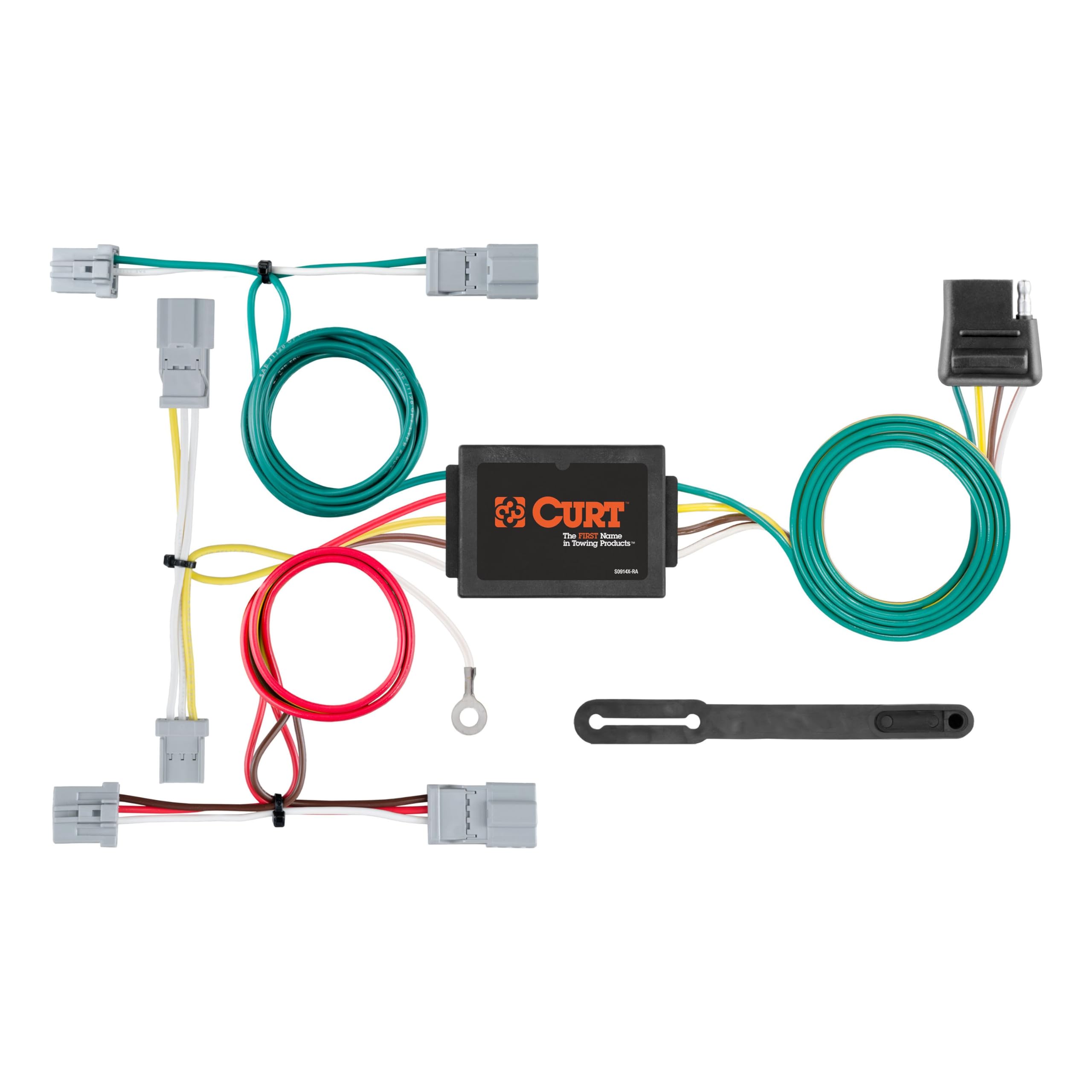
The CURT 56011 is the benchmark for vehicle-specific trailer wiring, offering a genuine plug-and-play solution that requires zero cutting or splicing. It connects directly into the tail light assembly of compatible Honda Fit, Civic, Accord (non-LED), Mazda 3, CX-5, and Mitsubishi Galant models, outputting a standard 4-way flat socket. The integrated SMT (surface-mount technology) converter handles the vehicle-trailer compatibility layer internally, which is critical for modern cars with complex lighting circuits that can’t tolerate simple tapped connections.
Owner feedback consistently highlights the installation speed — typically under thirty minutes — and the reliability of the sealed converter module. The factory-style connectors lock securely into the vehicle harness, and the extra wire length provides flexibility for routing the socket to the hitch area. Several users with 2011-2015 Honda Fits and Mazda CX-5s reported first-try success with no troubleshooting required, and CURT’s customer support received praise for rapid replacement when a rare unit had a fault.
The only notable limitation is the vehicle fitment list; if your car isn’t among the compatible models, you’ll need a different harness. Additionally, the instructions are generic and could be clearer about routing the exit grommet, though online installation videos fill that gap easily. For drivers who want a set-and-forget towing solution on a compatible vehicle, this is the most reliable option available.
What works
- True plug-and-play with no splicing required
- SMT converter ensures vehicle-trailer compatibility
- Extra wire length for flexible hitch routing
- Strong brand reputation and support
What doesn’t
- Fitment limited to specific Honda/Mazda/Mitsubishi models
- Generic instructions require supplemental research
2. Tekonsha 118336 T-One T-Connector Custom Harness

Tekonsha’s T-One connector line is a longtime reference in the vehicle-specific wiring category, and the 118336 covers a broad range of Honda, Acura, and Isuzu models including the 1994-2002 Accord, 1997-2006 CR-V, 2001-2006 MDX, and the 2003-2008 Pilot. The harness plugs directly into the vehicle’s existing wiring behind the tail light assembly — no cutting, stripping, or splicing. The integrated converter module handles the stop/turn separation at 2.1 amps per circuit and the tail light circuit at 5 amps, sufficient for standard incandescent or LED trailer lighting.
Owners consistently report installation times under fifteen minutes, with many describing the process as “too easy” compared to universal kits they had previously wrestled with. The weather-proof construction holds up well in wet environments, and the harness length gives enough slack to reach the hitch receiver without stretching. Multiple verified buyers using 2002-2007 Honda Odysseys and Pilots noted that the harness replaced failed aftermarket converters that had been spliced in years earlier, restoring full functionality instantly.
The main criticism centers on the instructions — users say they lack clarity on where to route the exit point through the vehicle body, requiring some trial and error or a YouTube reference. The plastic trim pins used during reassembly of the interior panels are fragile and prone to breaking. Also, the harness converter is not designed to be left exposed outside the vehicle, so it must be tucked inside the body cavity. For Honda and Acura owners, this is the most polished option available.
What works
- Extremely fast install without cutting any wires
- Broad Honda/Acura/Isuzu vehicle coverage
- Weather-proof connector and converter module
- Tested reliability over many years of production
What doesn’t
- Fragile trim pins during reassembly
- Instructions lack specific routing details
- Converter must remain inside vehicle body
3. MECMO 56407 4-Pin Trailer Wiring Harness for Jeep Wrangler JL / Gladiator JT

The MECMO 56407 is purpose-built for the 2018-2025 Jeep Wrangler JL and the 2020-2025 Gladiator JT, covering the 4xe hybrid, Rubicon, Sahara, and Sport trims (excluding the EcoDiesel). It uses a plug-and-play T-connector that splices into the existing wiring behind the tail lights, outputting a standard 4-way flat socket. The harness includes a weatherproof dust cover for the socket and uses heavy-duty bonded wire with tin-plated copper terminals to resist corrosion — a critical feature for Jeeps that regularly see mud, water crossings, and off-road debris.
Owners report a straightforward installation process, though running the main power wire from the rear control module to the battery under the hood adds time — most users follow the driver-side frame rail route. The harness works with both LED and incandescent trailer lights, and the dust cover fits snugly. Multiple 2023-2024 Wrangler 4xe owners confirmed full functionality after installation, including correct turn signal and brake light operation after securing the tail light connector with extra force to ensure it clicked locked.
The primary concern is that the included wire connectors are not weatherproof, so heat-shrink sealed connectors are recommended for long-term reliability. Some owners also note that the wires from the control box to the left tail light could be a few inches longer for cleaner routing. The power lead routing is the most time-consuming part, but the kit provides sufficient length. For any JL or JT owner adding a hitch, this harness eliminates the electrical guesswork.
What works
- Perfect fit for JL Wrangler and Gladiator JT
- Tin-plated copper terminals resist corrosion
- Dust cover protects socket when not in use
- Supports both LED and incandescent trailer lights
What doesn’t
- Included connectors are not weatherproof
- Power wire routing adds installation time
- Left tail light wires could be slightly longer
4. Curt 56333 T-Connector Custom Wiring Harness for Caliber / Journey / Patriot
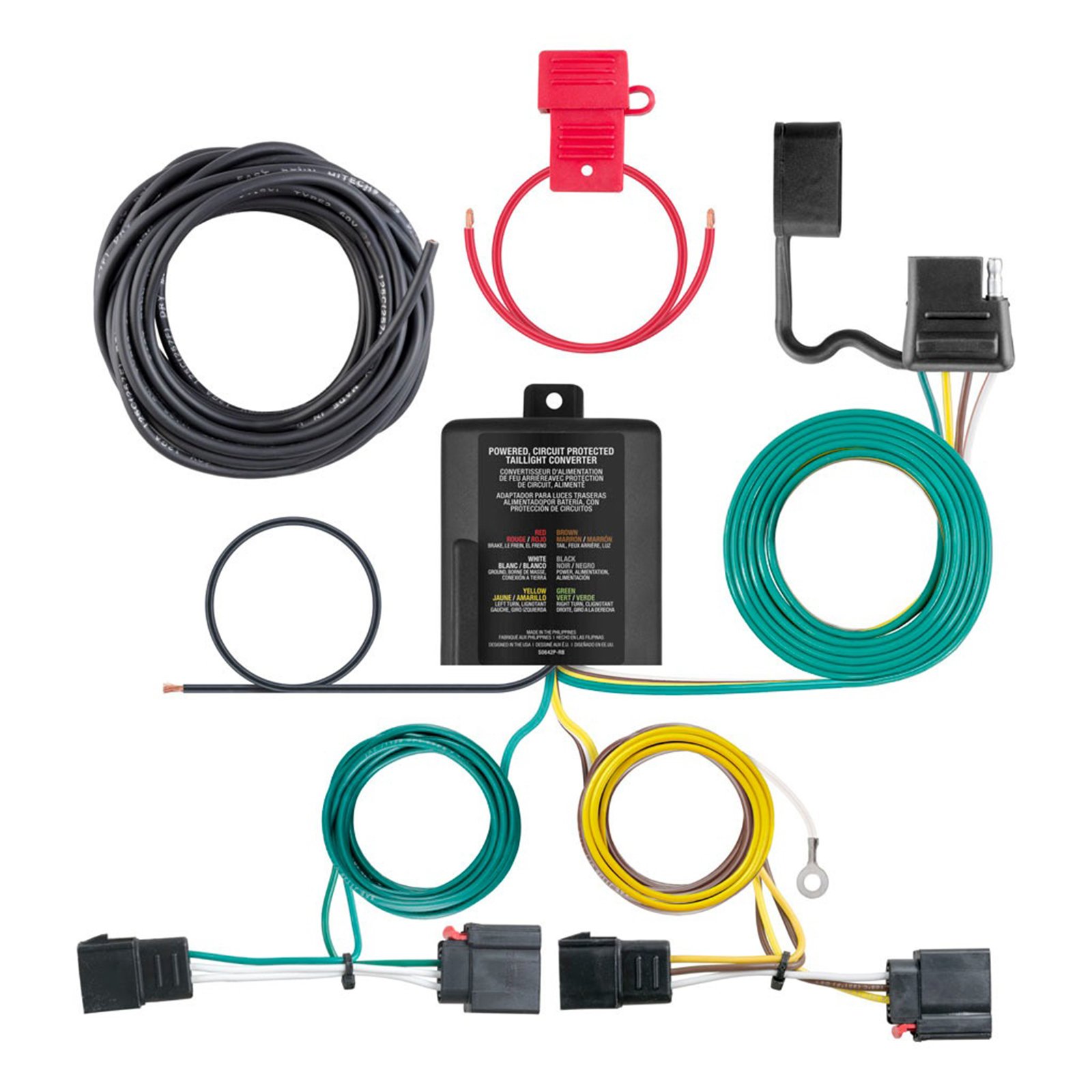
The Curt 56333 is a powered T-connector system designed for the Dodge Caliber, Journey, and Jeep Patriot, among other Chrysler-group models. Unlike passive converters that draw all current from the vehicle’s tail light circuit, this harness includes a separate battery lead with a fuse holder and approximately twenty feet of wire, ensuring the trailer lights receive clean, regulated power without overloading the vehicle’s lighting circuits. The converter uses PWM (pulse-width modulation) technology for efficient power delivery and is potted to resist moisture and vibration.
Owner feedback highlights the dramatic improvement over universal splice-in kits — users who previously struggled with dim or intermittent lights on their Patriot or Journey reported flawless operation after installing the 56333. The plug-and-play design connects inline with the factory tail light connectors, and the included fuse holder and battery lead allow the converter to be mounted in a protected location inside the vehicle. The install is straightforward for anyone comfortable running a single power wire to the battery.
The main drawback is that the converter module is not weatherproof and cannot be mounted outside the vehicle, which limits placement options in some applications. A few owners noted that the instructions could be clearer about the exact routing of the battery lead. Additionally, the pin contact fit inside the tail light connectors was occasionally loose on certain model years, requiring a small adjustment with a pick tool. For Chrysler-group vehicles needing a clean, powered towing setup, this harness is a significant upgrade over basic splice kits.
What works
- Separate battery lead prevents circuit overload
- PWM converter delivers clean, regulated power
- Plug-and-play with factory connectors
- Potted module resists moisture and vibration
What doesn’t
- Converter not weatherproof — interior mount only
- Instructions are vague on battery lead routing
- Occasional loose pin fit on some model years
5. CheeMuii 7 Way Trailer Wiring Harness Kit with Junction Box

The CheeMuii 7 Way kit delivers a complete 7-pin round connector solution with an integrated junction box and an 8-foot vehicle cord, making it a strong candidate for RV, camper, and caravan owners who need electric brake, reverse light, and auxiliary power circuits. The 7-pin plug uses a double-prong copper design for each terminal, which provides better contact surface area and current capacity than single-prong alternatives. The junction box features seven color-coded terminals that simplify identification of each circuit function during installation.
Users report that the kit serves as an excellent replacement for corroded or failing original wiring on older trailers, and the labeled junction box terminals make the wiring process straightforward even for first-time installers. The copper wire construction delivers good conductivity, and the included instructions provide useful guidance for matching wire colors to functions. Multiple reviews mention that the kit completely resolved intermittent light failures that had been plaguing their trailers for months.
The junction box is described as water-resistant rather than fully waterproof, so adding silicone sealant or dielectric grease at the terminal connections is wise for trailers stored outdoors or used in wet conditions. Some users also note that the 8-foot cord length is adequate for short tongue setups but may require an extension for longer trailers or specific hitch geometries. Overall, this is a well-priced, complete 7-pin solution for upgrading or replacing trailer wiring on a budget.
What works
- Complete 7-pin system with junction box included
- Double-prong copper terminals improve conductivity
- Color-coded terminals simplify wiring
- Great value for a full replacement kit
What doesn’t
- Junction box is water-resistant, not fully waterproof
- 8 ft cord may be short for some hitch setups
6. Gubrdfrsod 6 Ft 7 Pin Trailer Wiring Harness with 7 Gang Junction Box
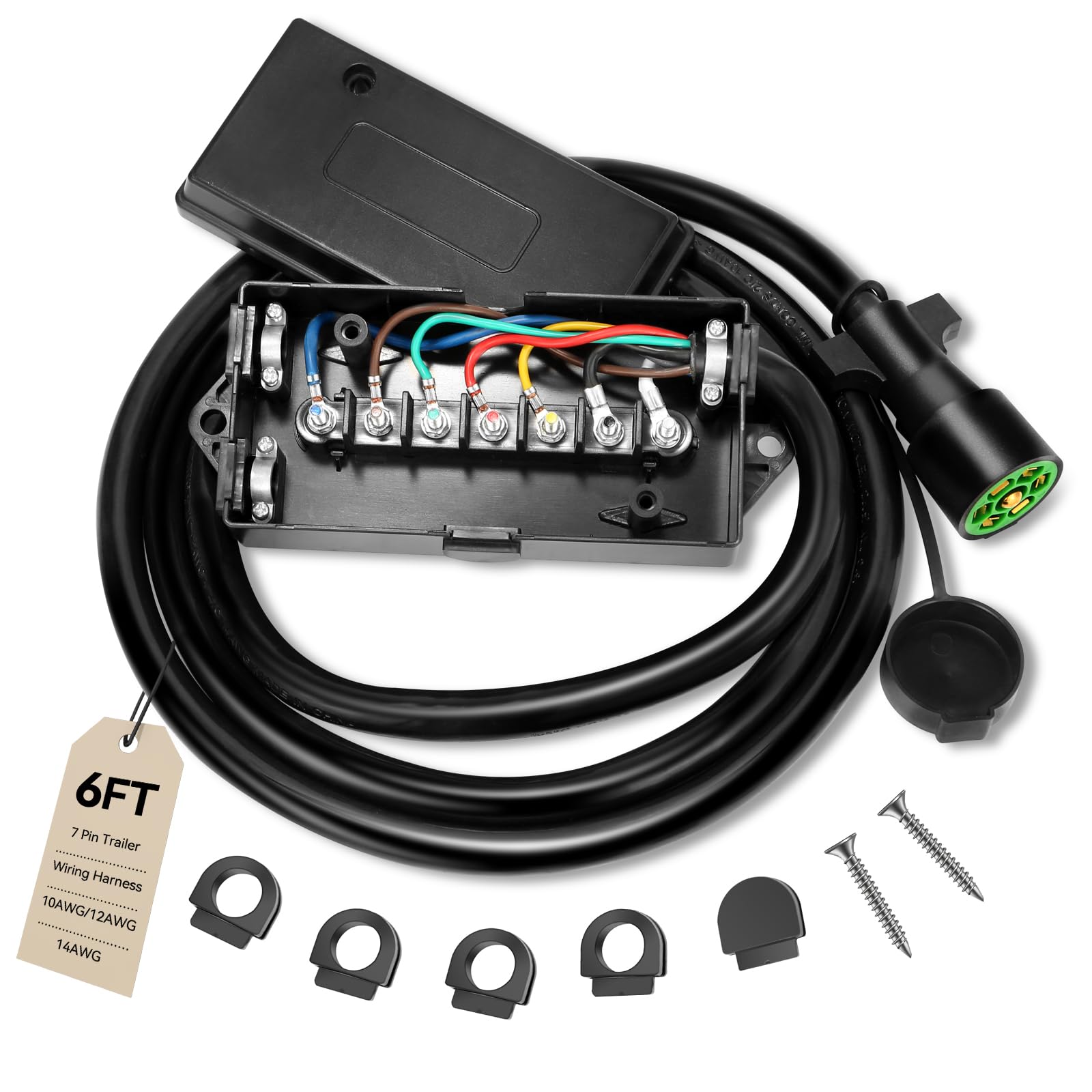
This Gubrdfrsod 7-pin harness combines a 6-foot vehicle cord with a dedicated 7-gang junction box, offering a clean, organized approach to trailer rewiring. The junction box features seven color-coded terminals with clear labels, allowing you to connect brake lights, tail lights, turn signals, reverse lights, electric brakes, and auxiliary power without confusion. The wire and plug use pure copper conductors with PVC insulation, and the entire assembly is designed to be weather-resistant when properly mounted.
Owner feedback from race car trailer and utility trailer owners highlights the ease of installation — the pre-wired junction box eliminates the need to splice or crimp inside a cramped taillight housing. One user with a car trailer reported not only restoring all lighting and brake functions but also using the constant power lug to run a winch, demonstrating the flexibility of the 7-pin design. The junction box is large enough to accommodate solid wire connections and provides a weather-tight enclosure that protects against road spray and dust.
A few users noted that the included instructions are minimal, and you will need to supply your own loop butt connectors and mounting hardware to secure the box to the trailer frame. The 6-foot cord length is relatively short, so vehicles with a long tongue or rear-mounted hitch may require an extension. The terminals inside the box are labeled, but verifying the function with a multimeter before final assembly is recommended. For trailer owners who want a professional-looking, organized wiring center, this kit punches above its weight.
What works
- Organized 7-gang junction box simplifies wiring
- Color-coded terminals for each circuit
- Weather-tight enclosure protects connections
- Constant power lug supports accessories like winches
What doesn’t
- Short 6 ft cord may need extension
- Connectors and mounting hardware not included
- Instructions are minimal
7. Oyviny 4 Pin 5 Wire Trailer Wiring Harness 22FT Wishbond Kit

The Oyviny 4 Pin 5 Wire harness uses a wishbone Y-design that routes two brown wires independently to the left and right taillights, eliminating the need for a jumper splice across the trailer. This is a cleaner approach for rewiring a trailer from scratch, as each side gets a dedicated circuit. The 22-foot length plus a 2.5-foot ground wire provides plenty of slack for trailers up to medium size, and the black nylon net tube protects the wires from abrasion during routing under the frame.
Owners of 5×8 ATV trailers and small utility trailers consistently report that the harness simplifies what would otherwise be a tedious splicing job. The color-coded wires match industry standards, making it easy to connect brake lights, turn signals, and side markers. The pure copper conductors deliver consistent current, and the thickened PVC insulation resists the cracking and brittleness that cheaper wire jackets develop after a season in the sun. Users also appreciate that the Y-split happens at the front of the trailer, avoiding the need to run wire across the axle.
A few owners noted that the wire gauge appears slightly thinner than standard 18 AWG, raising concern about overheating on longer trips or with higher-current incandescent bulbs. For LED trailer lights, this is unlikely to be an issue. The nylon net tube can fray at cut ends if not properly secured with tape or heat shrink. Overall, this is a thoughtful, affordable option for anyone rewiring a small to medium trailer who wants a Y-harness layout without paying for a premium brand.
What works
- Y-harness design eliminates splicing across trailer
- 22 ft length suits small to medium trailers
- Nylon net tube protects against abrasion
- Color-coded wires for straightforward installation
What doesn’t
- Wire may be slightly thinner than 18 AWG rating
- Nylon tube frays if cut ends are not sealed
8. WALSIO 26FT 4 Pin 5 Wire Trailer Wiring Harness Kit

The WALSIO 26FT kit delivers a straightforward 4-pin, 5-wire configuration using 18 AWG pure copper wire with thickened PVC insulation and an outer braided nylon mesh loom. This triple-layer protection approach — copper conductor, PVC jacket, nylon sleeve — provides solid defense against abrasion, UV exposure, and road debris. The Y-harness split occurs at the front of the harness, keeping the wiring organized and away from the axle area. The 26-foot length covers most boat trailers, horse trailers, and ATV trailers comfortably.
Owner reports consistently praise the build quality, with several users noting that after nearly a year of use on boat trailers exposed to saltwater launches, the plug ends showed no signs of corrosion — a strong indicator that the copper purity and plating are genuine. The braided loom keeps the wires neat and protected when pulled through the trailer frame, and the 2.5-foot ground wire provides a solid chassis connection. Installation is described as easy, with the color coding matching standard trailer wiring conventions. The protective cover on the plug keeps debris out when disconnected.
The most common feedback is that the Y-split runs all the way to the plug rather than being bundled for the first few feet, which means the wires separate immediately. Some users solved this by taping the first three feet together to keep things tidy during routing. For boat trailer owners in particular, the corrosion resistance and adequate length make this a reliable, budget-conscious choice that doesn’t cut corners on materials.
What works
- Triple-layer protection against abrasion and UV
- 26 ft length fits most boat and utility trailers
- Plug shows no corrosion after months of marine use
- Easy color-coded installation
What doesn’t
- Y-split extends the full length, not bundled at front
- Requires taping for cleaner routing
9. Aufind 35FT 4 Pin 5 Wire Trailer Wiring Harness with Accessories
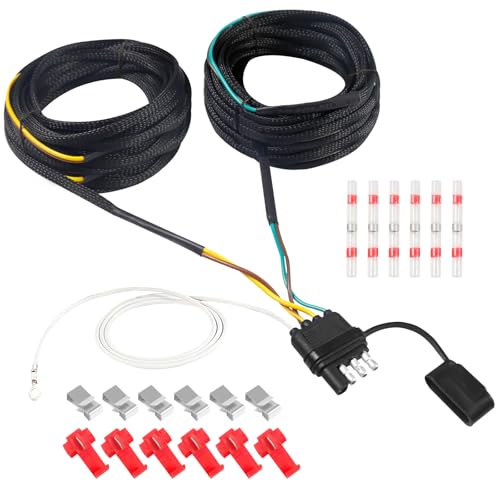
The Aufind 35FT stands out in the universal harness category for its generous length and bundled accessories. At 35 feet, it covers large utility trailers, gooseneck trailers, and any setup where the tow vehicle receiver is far from the trailer taillights. The 18 AWG pure copper wire is wrapped in thickened PVC and a black braided nylon mesh loom, matching the protection level of shorter premium kits. What sets this kit apart is the included hardware: six trailer frame wire clips, six solder-seal wire connectors, and six plastic wire connectors — everything needed for a complete installation without a separate trip to the auto parts store.
Owner feedback highlights the complete kit approach as a major time-saver. The solder-seal connectors provide a more reliable connection than standard crimp butt connectors, especially in wet environments. The wire clips make routing along the frame rails clean and secure. The Y-harness design with color-coded wires keeps the installation logical. Users with boat trailers and large ATV trailers report that the extra length eliminates the need for extensions or creative splicing to reach the rear lights.
Some owners recommend using higher-quality heat shrink connectors for the most critical connections, as the included plastic connectors are adequate but not premium. The wire clips are functional but basic. A few users noted that the braided loom adds stiffness, making it slightly harder to tuck the harness tightly against the frame in cold weather. For large trailers or any installation where extra length provides routing flexibility, this kit delivers exceptional value by including the installation essentials in one package.
What works
- 35 ft length covers large and long trailers
- Includes clips, solder-seal connectors, and wire connectors
- Complete kit saves a separate trip for installation hardware
- Solder-seal connectors provide reliable, weatherproof joints
What doesn’t
- Included plastic connectors are basic
- Braided loom adds stiffness in cold weather
10. OTOHANS AUTOMOTIVE Complete Electrics Wiring Harness for 50cc-125cc ATV

The OTOHANS Complete Electrics kit is a comprehensive wiring solution for small-displacement Chinese-made ATVs, dirt bikes, pit bikes, and go karts with 49cc to 125cc electric-start upright engines. The kit includes the main wire harness, a 5-pin AC CDI, solenoid relay, voltage regulator/rectifier, an ignition switch with two keys, a multifunctional handlebar switch, a stator with magneto generator, an ignition coil with spark plug lead, a spark plug, a fuse, and cable ties. This is essentially a full electrical system replacement in one box.
Owner feedback is mixed but informative. Several users with 110cc TaoTao and similar ATVs reported a successful plug-and-play installation that restored full electrical function — starting, lighting, and charging — with no modifications. The wiring diagram is included and should be followed carefully. The components appear to be good quality for the price point, and multiple users noted that the kit resolved issues that had stranded their machines for months. The stator and CDI are the most critical components, and they seem to match the standard dimensions for generic Chinese 125cc engines.
The most significant concerns come from users who found that the harness wire gauge is lighter than original equipment, and the pulse coil lead on the stator was a quarter-inch too short for their specific engine. One user reported a defective ignition switch with a bent kill switch contact, and the handlebar switch plug was wired incorrectly for their application. The harness is not model-specific, so some circuits (like neutral and reverse lights) may be missing if your ATV used a different pinout. This kit is best suited for someone comfortable tracing wires and making minor modifications — not a casual drop-in replacement for all engines.
What works
- Complete electrical system in one box — everything included
- Plug-and-play for many standard Chinese 50-125cc engines
- Resolves hard-to-diagnose electrical failures
- Good value compared to buying components separately
What doesn’t
- Not model-specific — may need modifications
- Lighter gauge wire than some OEM harnesses
- Occasional QC issues with switches and connectors
- No starter wire from starter to relay included
11. Frontline Full Body Harness with Suspension Trauma Straps

The Frontline Full Body Harness is a fall protection safety harness designed for professional use in construction, lifting, and towing-related work at height. While not a wiring harness in the traditional automotive sense, this type of harness is relevant for technicians and DIYers who work on large trailers, RVs, or commercial vehicles where accessing the roof or elevated sections is required. The harness includes suspension trauma straps, which are a critical safety feature that allows the wearer to stand or relieve pressure while suspended, reducing the risk of suspension trauma during a fall event.
Owner feedback from safety-conscious professionals highlights the durable stitching and robust buckle construction that meets OSHA and ANSI standards. The harness is fully adjustable, providing a comfortable fit for extended wear during vehicle maintenance or roof work. Users appreciate the trauma straps as a differentiator from basic fall arrest harnesses that lack this feature. The padding on the shoulder straps and leg loops is described as generous enough for all-day wear in hot or cold conditions.
The most common complaint is that the front shoulder straps tend to loosen and slip during use, requiring periodic readjustment that can be difficult to perform while at height. This is a significant safety concern in a fall protection device and should be checked before each use. Additionally, the harness lacks some of the refinements of premium brands — the labels and attachment points are functional but not premium-feeling. For budget-conscious professionals or serious DIYers who need OSHA-compliant fall protection for vehicle access work, this harness delivers the critical safety features without the high price of top-tier brands.
What works
- OSHA and ANSI compliant for professional use
- Suspension trauma straps included for safety
- Fully adjustable with comfortable padding
- Strong stitching and durable buckles
What doesn’t
- Front shoulder straps loosen during use
- Lacks premium brand refinements
Hardware & Specs Guide
Wire Gauge Explained
Wiring harnesses for trailer lighting typically use 18 AWG (American Wire Gauge) copper conductors. Eighteen AWG wire carries approximately 10 amps of current over a 20-foot run with minimal voltage drop — sufficient for standard LED and incandescent trailer lights drawing 2-6 amps total. Thinner wire (20 AWG or smaller) increases resistance, causing dim lights, slower turn signal response, and heat buildup that can melt insulation over long distances. Pure copper wire conducts electricity better than copper-clad aluminum or steel-core wire, which are cheaper but corrode faster and generate more heat under load. For trailers over 25 feet long or those with electric brakes, stepping up to 16 AWG or using a 7-pin connector with dedicated brake and power circuits is recommended to prevent voltage drop at the far end.
Connector Types and Pin Configurations
Four-way flat connectors are the most common standard for small to medium trailers, providing circuits for left turn/brake, right turn/brake, tail lights, and ground. Five-wire harnesses add a separate wire for left and right taillight separation, making splicing easier. Seven-pin round connectors add three additional circuits: reverse lights (backup assist), electric brake controller output, and a 12V auxiliary power line for battery charging or accessories. The 7-pin configuration uses a 12V, 6-pin round pattern with the ground in the center, and is required for most RVs, horse trailers, and car haulers. Adapters exist to step down from 7-pin to 4-pin for towing smaller trailers, but proper pin alignment and current ratings must be verified to avoid blown fuses.
Weather Resistance and Corrosion Protection
The number-one cause of trailer wiring failure is corrosion at connection points. Quality harnesses use tin-plated copper terminals that resist oxidation better than bare brass or unplated copper. Braided nylon mesh loom adds abrasion protection when the harness is pulled through frame rails or exposed to road debris. At the connector plug, a tight-fitting rubber dust cover prevents moisture, salt spray, and debris from entering the socket when the trailer is disconnected. For the junction box or converter module, look for potted (epoxy-filled) electronics that prevent water ingress. Even with weather-resistant components, applying dielectric grease to pins and using heat-shrink butt connectors for splices adds a second layer of protection that significantly extends service life, especially in marine environments with saltwater exposure.
Vehicle-Specific vs. Universal Harness Tradeoffs
Vehicle-specific T-connector harnesses plug directly into the factory tail light connectors using OEM-style housings, requiring no cutting, stripping, or splicing. They include a built-in converter module that separates the vehicle’s combined stop/turn circuit into separate brake and turn signals for the trailer. The main tradeoff is fitment — each harness works only with specific vehicle models and years, and using one on an incompatible vehicle can damage the vehicle’s lighting module. Universal splice-in harnesses are more flexible; they work with any vehicle or trailer by connecting directly to the wires using T-taps, crimp connectors, or solder. However, every splice is a potential failure point and corrosion entry path. For daily-driven vehicles where reliability and clean installation matter, vehicle-specific harnesses are almost always the better choice. For older vehicles, trailers, or custom builds, universal harnesses offer the necessary flexibility.
FAQ
How do I know if I need a 4-pin or 7-pin trailer wiring harness?
What does the converter module in a vehicle-specific harness do?
Can I splice into my car’s existing wiring instead of buying a harness?
How long should a trailer wiring harness last?
What does the 5th wire in a 5-wire harness do?
Do I need a separate ground wire for each light on my trailer?
What is the difference between a T-connector and a hardwired harness?
Can I use a wiring harness designed for incandescent bulbs with LED trailer lights?
Final Thoughts: The Verdict
For most buyers, the best wiring harness winner is the CURT 56011 because it delivers genuine plug-and-play installation with reliable SMT circuitry for compatible Honda, Mazda, and Mitsubishi vehicles. If you want a T-connector that covers Honda and Acura models with a proven track record, grab the Tekonsha 118336. And for Jeep Wrangler JL or Gladiator JT owners who need a corrosion-resistant 4-pin setup that works with both LED and incandescent trailer lights, nothing beats the MECMO 56407.

Certification: BSc in Mechanical Engineering
Education: Mechanical engineer
Lives In: 539 W Commerce St, Dallas, TX 75208, USA
Md Amir is an auto mechanic student and writer with over half a decade of experience in the automotive field. He has worked with top automotive brands such as Lexus, Quantum, and also owns two automotive blogs autocarneed.com and taxiwiz.com.