Selecting a two-stroke engine kit means choosing between raw power potential and the daily reliability that keeps you on the road instead of pushing a dead bike home. The market is flooded with kits that share similar castings but vary wildly in machining quality, hardware durability, and real-world power delivery. Understanding where manufacturers cut corners and where they invest in stronger components separates a weekend project that runs for years from one that spends more time in the garage than on the pavement.
I’m Amir — the founder and writer behind Four Wheel Ask. My approach centers on cross-referencing technical specifications against verified owner feedback to identify which kits deliver consistent performance and which ones hide weak points behind attractive photos.
After reviewing many kits and reading owner feedback, the best 2 cycle engine kit delivers reliable power and solid build quality for daily commuting needs.
How To Choose The Best 2 Cycle Engine Kit
Two-stroke engine kits follow a similar formula — single-cylinder, air-cooled, carbureted — but the execution varies significantly between budget and premium options. The frame of your bicycle determines what physically fits, while your expectations for power and durability dictate which price tier makes sense. Below are the critical factors that separate a smooth-running build from a recurring headache.
Frame Clearance and Mounting Geometry
The single biggest installation obstacle is the V-frame triangle. Most kits require at least 10 inches of vertical clearance between the bottom bracket and the top tube. Frame tube diameter should measure roughly 1 inch or 25 to 29 millimeters. Measure your frame before ordering — many returns happen because a bike looked like it would fit but the engine mounting studs conflicted with the down tube or seat tube angles. Mountain bikes, cruisers, and beach cruisers with traditional diamond frames work best. Full-suspension frames and step-through frames almost always require modification or are simply incompatible.
Displacement and Real-World Power
Advertised displacement does not always match actual cylinder volume. Several kits labeled 100cc or 110cc measure closer to 85cc or 90cc due to bore and stroke variations. The typical 80cc kit produces roughly 1.8 to 2.2 kilowatts and reaches 25 to 35 miles per hour on flat ground. Stepping up to a true 100cc or 110cc adds low-end torque for hill climbing and heavier riders but also increases vibration and fuel consumption. For most commuters on moderate terrain, an 80cc kit provides the best balance of speed and reliability. For riders over 200 pounds or those facing steep grades, a larger displacement kit reduces strain on the engine and keeps cruising speeds consistent.
Cylinder Construction and Port Machining
The cylinder is the heart of any two-stroke kit. Entry-level kits use cast iron sleeves that handle heat well but add weight and resist porting modifications. Higher-end kits use plated aluminum cylinders with precise port timing that delivers smoother power delivery and better throttle response. Inspect the port edges through the exhaust and intake openings before installation — rough, jagged edges indicate a low-quality casting that will wear unevenly and lose compression faster. The cylinder head matters too: a head with larger cooling fins and a machined squish band helps control detonation and keeps operating temperatures within safe limits during extended rides.
Hardware Quality and Included Components
The difference between a kit that stays tight and one that shakes apart often comes down to the fasteners. Many budget kits include standard Phillips-head bolts that strip easily during installation. Kits that provide hex socket cap screws or Allen-head bolts resist stripping and allow higher torque without rounding. The chain tensioner is another common weak point — stock tensioners with small bearings fail quickly under load. Upgrading to a tensioner with sealed bearings or a spring-loaded design is one of the first modifications experienced builders recommend. The quality of the carburetor, CDI unit, and spark plug also varies; expect to re-jet or replace the carburetor on most budget kits to achieve proper air-fuel ratios.
Quick Comparison
On smaller screens, swipe sideways to see the full table.
| Model | Category | Best For | Key Spec | Amazon |
|---|---|---|---|---|
| H-YEEU 110cc | Complete Kit | High power & torque | 3.8kW / 6000rpm | Amazon |
| Sange 100cc | Complete Kit | Premium build quality | 50km/h top speed | Amazon |
| Afranti 80cc | Complete Kit | Upgraded hardware | Hex socket bolts | Amazon |
| Afranti Updated 80cc | Complete Kit | Digital speedometer | 2.8kW / 6000rpm | Amazon |
| IMAYCC 80cc | Complete Kit | Heavy-duty sprocket | 2.1kW / 5000rpm | Amazon |
| WBGANG 100cc | Complete Kit | Quiet operation | 75dB noise level | Amazon |
| Frederimo 100cc | Complete Kit | Modified full set | 100cc displacement | Amazon |
| LYNICESHOP 49cc | Racing Engine | Pocket bike / mini ATV | 11000rpm max | Amazon |
| CUBELLIN 100cc | Complete Kit | Fuel economy | 150 mpg | Amazon |
| KONKENIE 80cc | Engine Only | Simple swap | 1.85kW / 5500rpm | Amazon |
| YIYIBYUS 80cc | Engine Only | Budget engine swap | 1.85kW / 5500rpm | Amazon |
In‑Depth Reviews
1. H-YEEU 110cc Complete Kit
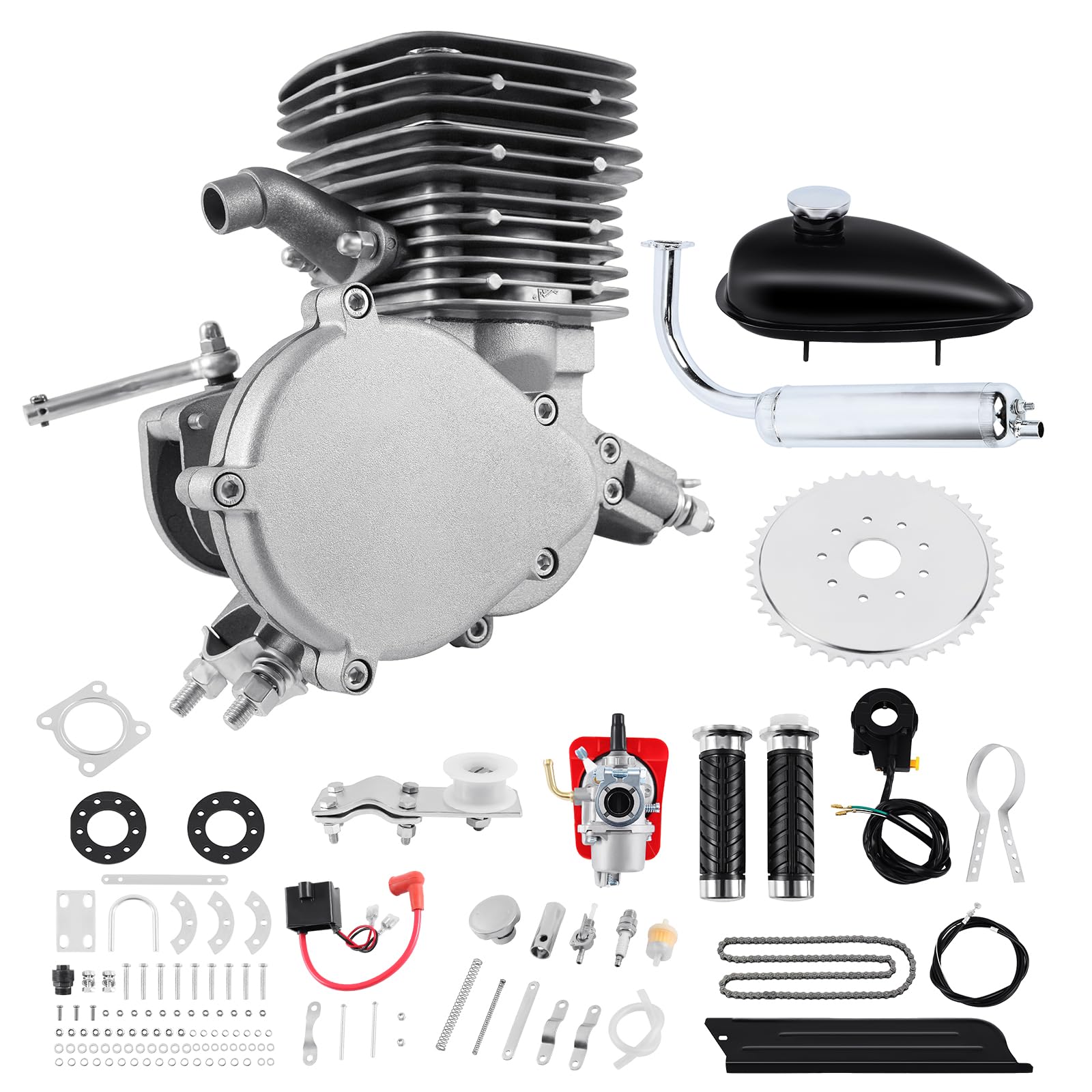
The H-YEEU 110cc kit delivers the highest displacement in this lineup with a claimed 3.8 kilowatts at 6000 rpm, translating to roughly 5.5 to 6.5 horsepower. Owner reports confirm that the motor starts reliably and accumulates over 100 miles without issues when properly broken in. The iron cylinder sleeve provides long-term wear resistance that plated cylinders cannot match, and the 52 millimeter bore combined with a 40.2 millimeter stroke produces genuine low-end torque for heavier riders and hill climbs.
Multiple owners report that this kit fits most 26 to 28 inch bicycles and includes all necessary components for a complete conversion. The 110cc designation measures closer to an actual 85cc displacement by US standards due to how manufacturers calculate volume, but the power output still exceeds typical 80cc kits. The included 36-tooth sprocket provides a good balance between acceleration and top speed, with riders reporting 35 to 40 miles per hour on flat ground after break-in.
Some owners note that the gear reduction crossover bearings require attention during assembly and recommend applying thread locker to all fasteners. The kit’s weight at nearly 26 pounds makes it one of the heavier options, which contributes to vibration at higher rpm if the mounting hardware is not tightened properly. Overall, this kit offers the best power-to-displacement ratio in the lineup for riders who prioritize torque and long-term durability.
What works
- Genuine low-end torque for steep hills and heavier riders
- Iron sleeve construction resists wear over many miles
- Includes complete kit with all necessary mounting hardware
- Starts reliably after proper break-in procedure
What doesn’t
- Heavier than smaller displacement options
- Some units require gear reduction bearing attention
- Displacement measures lower than advertised 110cc
2. Sange 100cc Conversion Kit

The Sange 100cc kit positions itself as a premium option with a focus on smooth operation and low vibration. The single-cylinder, air-cooled, two-stroke engine is built from high-quality steel components that offer higher strength and hardness compared to budget castings. The claimed top speed of 50 kilometers per hour is realistic for flat-terrain riding with a standard sprocket setup, and the 3-liter-per-100-kilometer fuel consumption figure makes it one of the more efficient options in this class.
Owner feedback highlights that the engine starts easily and runs quietly, with noise levels well below typical budget kits. The complete hardware set includes all necessary components to convert most 26 or 28 inch bikes, including the engine, fuel tank, muffler, and mounting brackets. Several owners note that the kit requires moderate mechanical skill — including drilling and grinding for certain frame configurations — but the end result is a reliable daily rider when installed correctly.
Some owners report quality control inconsistencies, including a cylinder sleeve that arrived cracked and piston installation that was reversed from the factory. The clutch lever has been described as loose and potentially unsafe without reinforcement. The carburetor jetting tends to run rich from the factory, with owners recommending a main jet size of 68 instead of the stock 70 for proper air-fuel mixture. Despite these issues, the core engine platform responds well to tuning and delivers consistent power after initial setup.
What works
- Smooth and quiet operation for daily commuting
- Strong steel construction with good durability
- Complete kit with all essential components
- Excellent fuel economy for a 100cc platform
What doesn’t
- Quality control issues on some units
- Clutch lever needs reinforcement for safety
- Requires carburetor re-jetting out of the box
3. Afranti 80cc Motorized Bike Kit
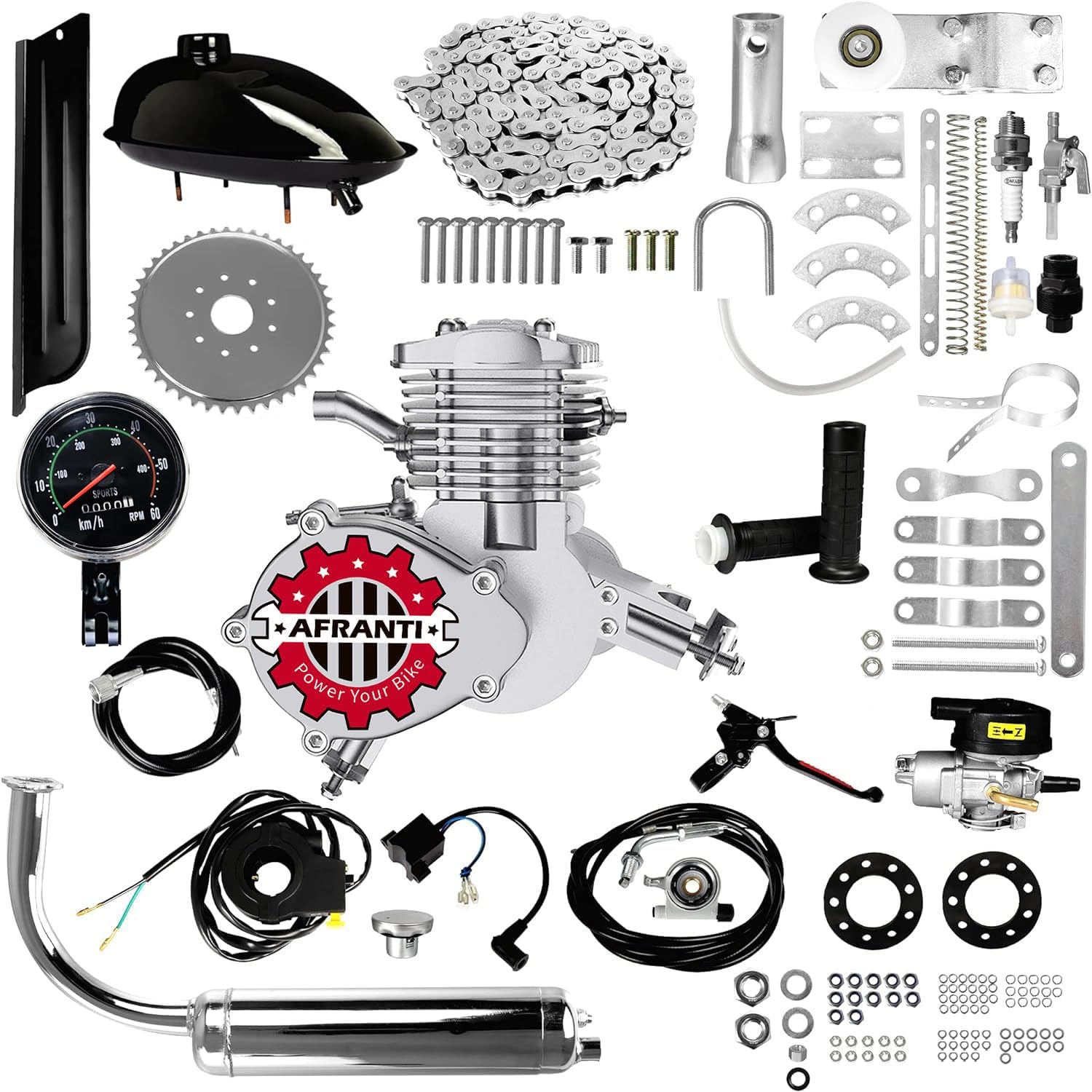
The Afranti 80cc kit stands out for its focus on hardware quality, specifically the upgraded hex socket screws and bolts that replace the standard Phillips-head fasteners found on most budget kits. This single change dramatically reduces the frustration of stripped bolts during installation and provides more reliable clamping force over time. The claimed 5 to 6 horsepower output is optimistic for an 80cc two-stroke, but owner reports indicate real-world top speeds between 25 and 35 miles per hour with proper tuning.
The kit fits most 26 or 28 inch V-frame bikes with at least 9 to 11 inches of clearance between the bottom bracket and top bar. Frame tube diameter should be around 1 inch or 25 to 29 millimeters for proper mounting. The included tool kit provides basic hardware for assembly, though owners recommend supplementing with a thread locker and better-quality wrenches. The fuel economy of 100 to 150 miles per gallon makes this an economical choice for daily commuting.
Several owners report that the supplied rag joint for the rear sprocket is a weak point and recommend upgrading to a hub-mounted sprocket adapter for reliable power transfer. The speedometer included with some versions tends to fail quickly, and the fuel filter has been noted as prone to leaking. Some units arrived with damaged wiring or throttle components, indicating inconsistent packaging quality. Despite these drawbacks, owners who invested in upgrades report reliable operation with hundreds of miles logged.
What works
- Upgraded hex socket bolts resist stripping
- Good power output for the 80cc displacement
- Excellent fuel economy for daily use
- Fits most standard V-frame bicycle geometries
What doesn’t
- Rag joint sprocket mount is a known weak point
- Some units arrive with damaged components
- Speedometer reliability is poor
4. Afranti Updated 80cc with Speedometer

The updated Afranti 80cc kit builds on the original design with a digital speedometer and several hardware refinements. The 2.8 kilowatt output at 6000 rpm provides consistent power delivery across the operating range, with a claimed top speed of 50 kilometers per hour. The kit includes upgraded hex socket screws and bolts similar to the original model, addressing the most common complaint about fastener quality in budget kits. The larger fuel tank is a welcome improvement for riders who want extended range without frequent refueling.
Owner feedback indicates that the kit runs smoothly after a proper break-in period, with the recommended 16 to 1 fuel-to-oil ratio for the first 500 kilometers before switching to 20 to 1. The digital speedometer adds convenience but some owners report that the installation instructions for wiring are vague, requiring YouTube tutorials to complete. The kit fits most 26 to 28 inch wheeled bikes with V-frames, including mountain bikes, road bikes, gravel bikes, and beach cruisers.
Several owners report chain failure within the first few miles of operation, with one chain breaking after only 400 feet. The stock chain tensioner and sprocket combination appears to be the root cause, and replacing these components with aftermarket upgrades is strongly recommended before putting serious miles on the kit. The instructions remain vague and assume a level of mechanical knowledge that many first-time builders lack. Owners who invested in upgrades and careful tuning report reliable operation over hundreds of miles.
What works
- Digital speedometer adds convenience for monitoring speed
- Larger fuel tank extends riding range
- Upgraded fasteners reduce installation frustration
- Smooth power delivery after proper break-in
What doesn’t
- Chain failure reported in early miles by multiple owners
- Vague wiring instructions for speedometer
- Stock tensioner and sprocket need upgrades
5. IMAYCC 80cc Complete Engine Kit
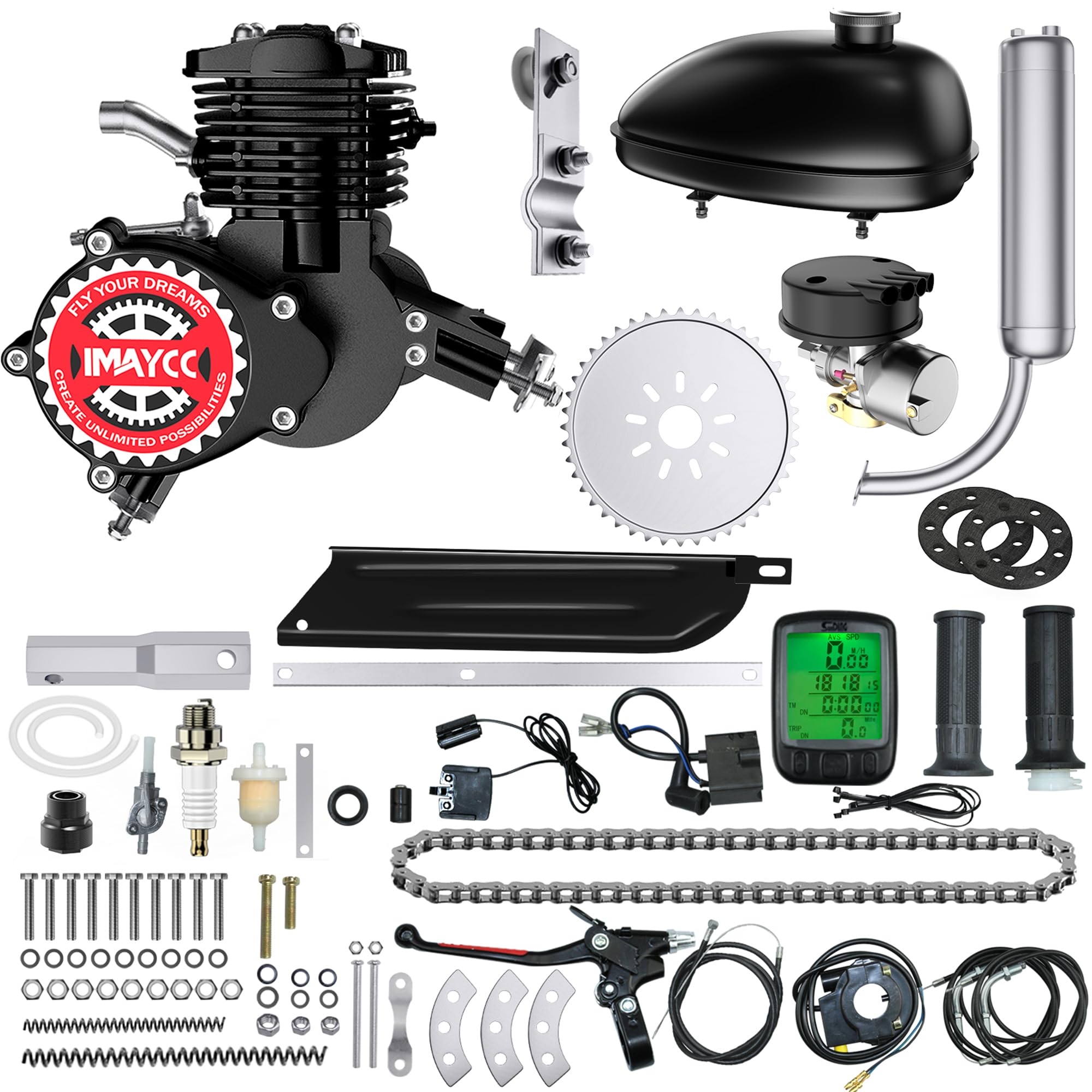
The IMAYCC 80cc kit comes with a rugged 44-tooth drive sprocket and a 110-link chain that provide a solid foundation for power transfer. The 2.1 kilowatt output at 5000 rpm produces a claimed top speed over 50 miles per hour on flat ground according to one owner, though realistic daily riding speeds settle around 25 to 30 miles per hour. The 2.5-liter teardrop fuel tank provides ample range, with fuel consumption rated at 2 to 2.5 liters per 100 kilometers at cruising speeds of 20 to 25 kilometers per hour.
Owner reports highlight that the motor starts quickly and runs reliably after the initial break-in period. The recommended fuel ratio of 16 to 1 for the first 500 kilometers before switching to 20 to 1 is consistent with industry standards for air-cooled two-stroke engines. The kit is designed for DIY installation with basic mechanical tools and an estimated 2 to 4 hours of work. Owners recommend searching for specific installation videos before starting to avoid common pitfalls with the CDI wiring and clutch cable routing.
Some owners report that the magneto can become waterlogged in wet weather conditions, causing starting issues until dried out. The exhaust mounting studs have been known to break during installation if overtightened, and the chain tensioner requires regular inspection to prevent it from loosening into the spokes. The stock bolts should be replaced with stronger aftermarket alternatives for long-term reliability. Despite these maintenance requirements, owners who stay on top of periodic checks report consistent performance over many months of daily use.
What works
- Includes heavy-duty 44-tooth sprocket and 110-link chain
- Starts quickly and runs reliably after break-in
- Large 2.5-liter fuel tank for extended range
- Good power output for the 80cc displacement class
What doesn’t
- Magneto susceptible to water damage in wet weather
- Exhaust studs can break during installation
- Chain tensioner requires frequent inspection
6. WBGANG 100cc Conversion Kit

The WBGANG 100cc kit emphasizes quiet operation with a rated noise level around 75 decibels, making it suitable for neighborhoods and areas with noise restrictions. The kit converts standard 26 to 28 inch bicycles into motorized rides with a complete two-stroke engine package. The claimed 28 miles per hour top speed is realistic for a 100cc platform, and the 440-pound load capacity accommodates heavier riders and cargo without excessive strain on the engine or frame.
The 0.53-gallon fuel tank provides approximately 100 kilometers of range per 0.66 gallons of fuel, which translates to efficient daily commuting with minimal refueling stops. The aluminum engine body with reinforced iron components offers a good balance of weight savings and durability. Owners report that the engine bolts onto the frame easily and starts without major issues when the carburetor is properly adjusted. The rounded edge design on mounting brackets reduces the risk of scratching the bike frame during installation.
Several owners note that the instructions are poor and require prior motorcycle or small engine knowledge to complete the installation successfully. The recommended upgrades include replacing all bolts with thread-locked fasteners, upgrading the chain tensioner, and installing a hub-mounted sprocket adapter. Some owners report that the actual top speed is closer to 25 miles per hour rather than the advertised 28, and the motor may blow up after only a few weeks of use if not properly broken in. The carburetor tuning out of the box tends to be rich and requires adjustment for optimal performance.
What works
- Quiet operation suitable for noise-sensitive areas
- Good load capacity for heavier riders
- Efficient fuel consumption for daily commuting
- Aluminum engine body with reinforced iron parts
What doesn’t
- Poor instructions require prior mechanical knowledge
- Carburetor needs tuning out of the box
- Some units fail after short use without proper break-in
7. Frederimo 100cc Modified Full Set

The Frederimo 100cc kit markets itself as a modified full set designed for riders who want a complete conversion package without sourcing additional components. The kit includes the engine, fuel tank, muffler, CDI, carburetor, and all necessary mounting hardware for most 26 to 28 inch bicycles. The construction uses aluminum, plastic, and steel components that provide adequate durability for regular commuting use. The 100cc displacement delivers noticeably more low-end torque compared to 80cc kits, making hill climbs easier.
Owner feedback indicates that the engine starts easily and runs well when configured correctly. The assembly instructions are widely criticized as nearly useless, with small pictures and missing sections on wiring and clutch cable routing. However, owners who turned to YouTube tutorials found the installation straightforward. The kit includes extra hardware for bicycle modifications, which is a thoughtful inclusion for builders who want to customize their setup. The engine runs smoothly after the initial break-in period with a proper 16 to 1 fuel-to-oil ratio.
Some owners report receiving a non-modified engine when they ordered the modified version, leading to dissatisfaction with power output. The carburetor breather design has been cited as a problem area, with the engine refusing to run until the breather was modified or replaced. The instructions lack any guidance on wiring the CDI unit, which can be confusing for first-time builders. Despite these issues, owners who successfully completed the installation report that the kit provides good value for the price point and performs reliably for daily commuting.
What works
- Complete kit with all necessary components included
- Good low-end torque for hill climbing
- Includes extra hardware for modifications
- Runs smoothly after proper break-in period
What doesn’t
- Instructions are vague and nearly useless
- Some units not actually modified as advertised
- Carburetor breather design causes running issues
8. LYNICESHOP 49cc Racing Engine Set

The LYNICESHOP 49cc racing engine targets a different application than the bicycle kits above: it is designed for pocket bikes, mini off-road vehicles, and mini ATVs with similar engine mounts. The 1.8 kilowatt output at 11000 rpm makes this a high-revving powerplant suited for lightweight vehicles rather than full-size bicycles. The 6-tooth 25H sprocket provides aggressive gearing for quick acceleration on small chassis. The high-compression head and third bearing support distinguish this from standard 49cc utility engines.
Owner reports indicate that the engine works well for riders up to 150 pounds and starts reliably with a push start once the carburetor is properly adjusted. The recommended procedure involves adjusting the carburetor pin height and using zip ties to secure the gas line when the fuel tank is flipped for clearance. The engine ships as a bare powerplant without detailed instructions, so mechanical experience is required for installation and tuning. The alloy pull starter and heavy-duty clutch are welcome upgrades over standard pocket bike engines.
Several owners note that the mounting hole pattern includes five bottom holes with one being slightly smaller than the others, and bolts are not included. The muffler attaches to the bottom of the engine, which may require a side exit or flexible exhaust tube for proper clearance in tighter chassis configurations. The oil ratio is not documented by the manufacturer, leaving owners to research appropriate two-stroke mixture ratios on their own. Despite these documentation gaps, the engine performs well for its intended application and provides good value for mini vehicle projects.
What works
- High-revving 11000rpm design for racing applications
- Heavy-duty clutch and alloy pull starter included
- Third bearing support improves crank durability
- Good value for pocket bike and mini ATV projects
What doesn’t
- No documentation or instructions included
- Bolts not included for mounting
- Muffler clearance issues in tight chassis
9. CUBELLIN 100cc Motorized Bike Kit

The CUBELLIN 100cc kit focuses on fuel efficiency with a claimed 150 miles per gallon, making it one of the most economical options for daily commuting. The 36-tooth sprocket reduces engine rpm at cruising speed, which contributes to the impressive fuel economy figure. The 8-millimeter mounting bolts are thicker than the standard 6-millimeter hardware found on many budget kits, providing twice the clamping force and improved resistance to vibration-induced loosening. The 50-millimeter bore single-piece cylinder and head design increases weight capacity and lowers operating temperatures.
The aluminum engine body with an iron fuel tank and iron chain offers good durability when combined with the sandblasting, painting, and shot blasting surface treatments. Owners report that the engine works well for daily use, with one rider logging two months of reliable operation. The upgraded tunable carburetor includes a choke lever mounted on the handlebars, adjustable main jet, pilot jet, copper oil needle, idle rpm screw, and idle air screw. This level of carburetor adjustability is unusual at this price point and allows fine-tuning for different altitudes and temperatures.
Several owners report catastrophic failure shortly after installation, with one engine blowing up the next day and another arriving broken out of the box. The quality control appears inconsistent, with some units running perfectly and others failing immediately. The 100cc power output requires attention to the fuel-to-oil ratio during break-in, and using the wrong mixture can cause rapid wear or seizure. Instructions are minimal, and first-time builders will need to supplement with video tutorials. Consider this kit if budget is the primary constraint and you are prepared for potential quality variance.
What works
- Excellent fuel economy at 150 miles per gallon
- Thicker 8mm mounting bolts for better clamping force
- Tunable carburetor with handlebar choke
- Single-piece cylinder design lowers operating temps
What doesn’t
- Inconsistent quality control with some units failing
- Minimal instructions for first-time builders
- Catastrophic failure reported shortly after installation
10. KONKENIE 80cc Petrol Gas Motor Engine

The KONKENIE 80cc engine provides a straightforward power upgrade for riders who already have a bicycle and want to add motorization. The 1.85 kilowatt output at 5500 rpm delivers a claimed 1.65 horsepower, which translates to realistic speeds of 20 to 30 miles per hour depending on rider weight and terrain. The 0.53-gallon teardrop fuel tank is externally mounted and provides approximately two hours of continuous riding before refueling. The CDI ignition system enables easy starting with just a gentle pedal push.
The engine fits most 26 to 28 inch wheeled bikes with V-frames, including mountain bikes, cruisers, motorbikes, and road bikes. The aluminum and iron construction provides adequate durability, with owners reporting that the engine runs strong after installation. The fuel consumption rate of 0.53 gallons per 62 miles makes this an economical choice for riders who want to minimize fuel costs. The black appearance blends well with most bicycle frames and does not look out of place on a converted bike.
Some owners report that the piston rings are not strong enough for sustained high-rpm operation, with multiple failures occurring after short periods of use. The included spark plug can be too long and contact the piston, requiring replacement with a shorter plug before first start. The painted bolts cause issues with the chain guard mounting, as the paint creates binding during installation. Owners who replaced the piston rings, swapped the spark plug, and cleaned up the bolt threads report a fun and reliable engine that performs well for recreational riding.
What works
- Easy starting with CDI ignition system
- Good fuel economy for daily commuting
- Fits most standard V-frame bicycles
- Attractive black finish blends with bike frames
What doesn’t
- Piston ring strength inadequate for sustained high rpm
- Spark plug too long and contacts piston
- Painted bolts cause installation issues
11. YIYIBYUS 80cc Incomplete Engine Only

The YIYIBYUS 80cc engine is sold as an incomplete kit, meaning it includes only the engine itself without the full accessory package that comes with complete kits. This makes it suitable for riders who already have the mounting hardware, fuel tank, exhaust, and CDI from a previous build or who want to source higher-quality components individually. The 1.85 kilowatt output at 5500 rpm matches the specifications of the KONKENIE 80cc engine, suggesting a common manufacturing platform with variations in included accessories and quality control.
The cylinder and head feature multiple heat dissipation holes that help prevent overheating during prolonged use, which is a genuine design consideration for sustained riding. The non-contact CDI ignition system enables easy starting with a simple pedal push. The 80cc displacement with a fuel consumption rate of 0.53 gallons per 62 miles provides economical operation for riders who already have the supporting components. The silver finish gives the engine a classic look that works well on cruisers and vintage-style bicycles.
Owner feedback reveals significant quality concerns, with one engine arriving with a cracked compression head and another locking up after only two months of use. The manufacturing tolerances appear inconsistent, and some units require immediate internal repairs before they can be safely operated. The 90-day warranty period is shorter than most competitors, which is concerning given the reported failure rates. Consider this engine only if you have mechanical experience, are comfortable inspecting and potentially rebuilding the engine before installation, and want the lowest possible entry price for a replacement powerplant.
What works
- Lowest entry price for budget-conscious builders
- Good heat dissipation with multiple cooling holes
- Easy starting with CDI ignition system
- Economical fuel consumption for casual riding
What doesn’t
- Engine only — requires sourcing all other components
- Quality control issues with cracked heads and lockups
- Short 90-day warranty period
Hardware & Specs Guide
Cylinder and Piston Construction
The cylinder is the single most important component determining engine longevity. Premium kits use plated aluminum cylinders with precisely machined port openings that deliver consistent power across the rpm range. Budget kits rely on cast iron sleeves that tolerate heat well but add reciprocating weight and lack the port precision of plated designs. The piston should have two compression rings and one oil ring for proper sealing. Check the piston-to-cylinder clearance before assembly — excessive clearance causes power loss and rapid wear, while insufficient clearance leads to seizure as the engine heats up. The squish band on the cylinder head should be machined flat and parallel to the piston crown for controlled combustion and detonation resistance.
Crankshaft and Bearing Quality
The crankshaft assembly takes the highest loads in a two-stroke engine. Quality kits use forged or machined cranks with hardened crank pins and caged needle bearings on the connecting rod. Budget kits often use cast cranks with stamped crank pins that flex under load and accelerate bearing wear. The main bearings should be sealed or shielded to prevent contamination from clutch dust and road debris. Some kits include a third bearing support on the drive side, which significantly reduces crankshaft flex and extends bearing life. Listen for bearing noise during the first few minutes of operation — any grinding or roughness indicates a defective crank assembly that should be replaced before putting the engine into service.
Carburetor and Fuel Delivery
The carburetor is the most frequently replaced component on budget engine kits. Stock carburetors typically use fixed jetting that is calibrated for sea-level operation and may require re-jetting for different altitudes or temperature ranges. Look for carburetors with adjustable main jets, pilot jets, and idle mixture screws for fine-tuning. The float bowl should be metal rather than plastic for durability, and the gaskets should seal properly without leaks. The fuel tank should have a fuel filter and petcock with a screen to prevent debris from entering the carburetor. Many owners upgrade to larger NT or CNS carburetors for improved throttle response and power output, but this requires matching intake manifold modifications.
Ignition and Electrical System
Two-stroke engine kits use capacitor discharge ignition systems that provide a strong spark at low rpm for easy starting. The CDI unit should be potted or sealed to prevent moisture ingress, which is a common failure point on budget kits. The ignition coil should produce a blue-white spark at the spark plug gap; a weak yellow spark indicates insufficient voltage for reliable combustion. The magneto flywheel should be balanced and keyed to the crankshaft for proper ignition timing. Some kits include a lighting coil for powering headlights and taillights, but the output is typically limited to 12 volts at 3 to 5 watts, sufficient for basic LED lighting but not for high-power accessories. The spark plug should be a resistor-type to reduce radio frequency interference.
FAQ
What fuel-to-oil ratio should I use for break-in and normal operation?
Will a 100cc engine kit bolt onto my existing bicycle frame?
Why does my engine kit keep stalling or running poorly after installation?
How fast will a 2 cycle engine kit make my bicycle go?
What tools and mechanical skills do I need to install an engine kit?
Final Thoughts: The Verdict
For most buyers, the best 2 cycle engine kit winner is the H-YEEU 110cc Complete Kit because it delivers the highest power output in this lineup with genuine low-end torque and an iron cylinder sleeve for long-term durability. If you want quiet operation and a complete package with good hardware, grab the Afranti 80cc Kit for its upgraded hex socket fasteners and reliable daily performance. And for budget-minded builders who already have supporting components, nothing beats the entry price of the YIYIBYUS 80cc Engine Only, provided you have the mechanical skills to work through potential quality issues.

Certification: BSc in Mechanical Engineering
Education: Mechanical engineer
Lives In: 539 W Commerce St, Dallas, TX 75208, USA
Md Amir is an auto mechanic student and writer with over half a decade of experience in the automotive field. He has worked with top automotive brands such as Lexus, Quantum, and also owns two automotive blogs autocarneed.com and taxiwiz.com.