Choosing the wrong refrigerant can turn a simple recharge into a costly compressor failure or a leaking evaporator nightmare. The market is flooded with blends, sealers, and dyes, making it hard to separate effective solutions from snake oil. This guide breaks down what actually matters under the hood.
I’m Amir — the founder and writer behind Four Wheel Ask. My approach relies on deep market research, scrutinizing published technical specifications, and aggregating long-term owner feedback to identify consistent quality and performance patterns.
After analyzing dozens of cans, chemical compositions, and thousands of verified owner experiences, I have compiled the definitive resource for selecting the best auto ac refrigerant for your specific vehicle and leak condition.
How To Choose The Best Auto AC Refrigerant
Selecting the right product requires understanding your system’s current condition, the refrigerant type it is designed for, and whether a simple recharge or a chemical leak repair is needed. Using the wrong blend can damage seals, clog expansion valves, or create unsafe pressures.
Refrigerant Compatibility
Modern vehicles use either R-134a or R-1234yf, and mixing them or using hydrocarbon alternatives in a system not designed for them can lead to component failure. Always check the under-hood sticker or owner’s manual before purchasing.
Leak Sealer Chemistry
Not all sealers are created equal. Polymer-based sealants can clog delicate TXV valves, while organosilane formulas are generally safer for modern systems. UV dye integration helps pinpoint the leak location after application, which is critical for permanent repairs.
Quick Comparison
On smaller screens, swipe sideways to see the full table.
| Model | Category | Best For | Key Spec | Amazon |
|---|---|---|---|---|
| RED TEK ProSeal12 | Sealant | Permanent leak repair in older systems | 2 oz. liquid, compatible with R12/R134a | Amazon |
| TSI Supercool D8 | UV Dye | Professional leak detection | 8 oz. bottle, treats 32 vehicles | Amazon |
| Generic Arctic Air | Moisture Remover | Basic moisture control for R1234yf | Single can, plastic bottle | Amazon |
| National Refrigerants R1234yf | Refrigerant | OEM-compatible R1234yf recharge | 8 oz. can, SAE J2844 compliant | Amazon |
| Arctic Freeze R-134a | Refrigerant + Sealant | Quick recharge with stop leak | 14 oz. self-sealing can, includes hose | Amazon |
| A/C Pro ACP-105 | Refrigerant + Sealant | Restoring lost refrigerant and conditioning seals | 12 oz. can with Max-Seal technology | Amazon |
| ENVIRO-Safe R134a Replacement | Alternative Refrigerant | Budget-friendly R-134a alternative | 3 cans with piercing valve, 21 oz. total | Amazon |
| Leak Saver Direct Inject Ultimate | Sealant + Dye + Remover | Professional 3-in-1 system treatment | 3-in-1 formula, safe for all refrigerants | Amazon |
| Vehicle AC Refrigerant by cmebiz | Alternative Refrigerant | Value pack for DIY recharge | 3 cans of 6 oz. with piercing valve | Amazon |
| ZeroR AC Refrigerant Recharge Kit | Hydrocarbon Blend | Natural refrigerant for R134a systems | 4 cans, SSV compatible, 6 oz. each | Amazon |
| Honeywell Automotive Refrigerant | Refrigerant | Premium OEM-grade R-1234yf | 4 cans, professional-grade purity | Amazon |
In‑Depth Reviews
1. RED TEK ProSeal12 A/C Seal Treatment
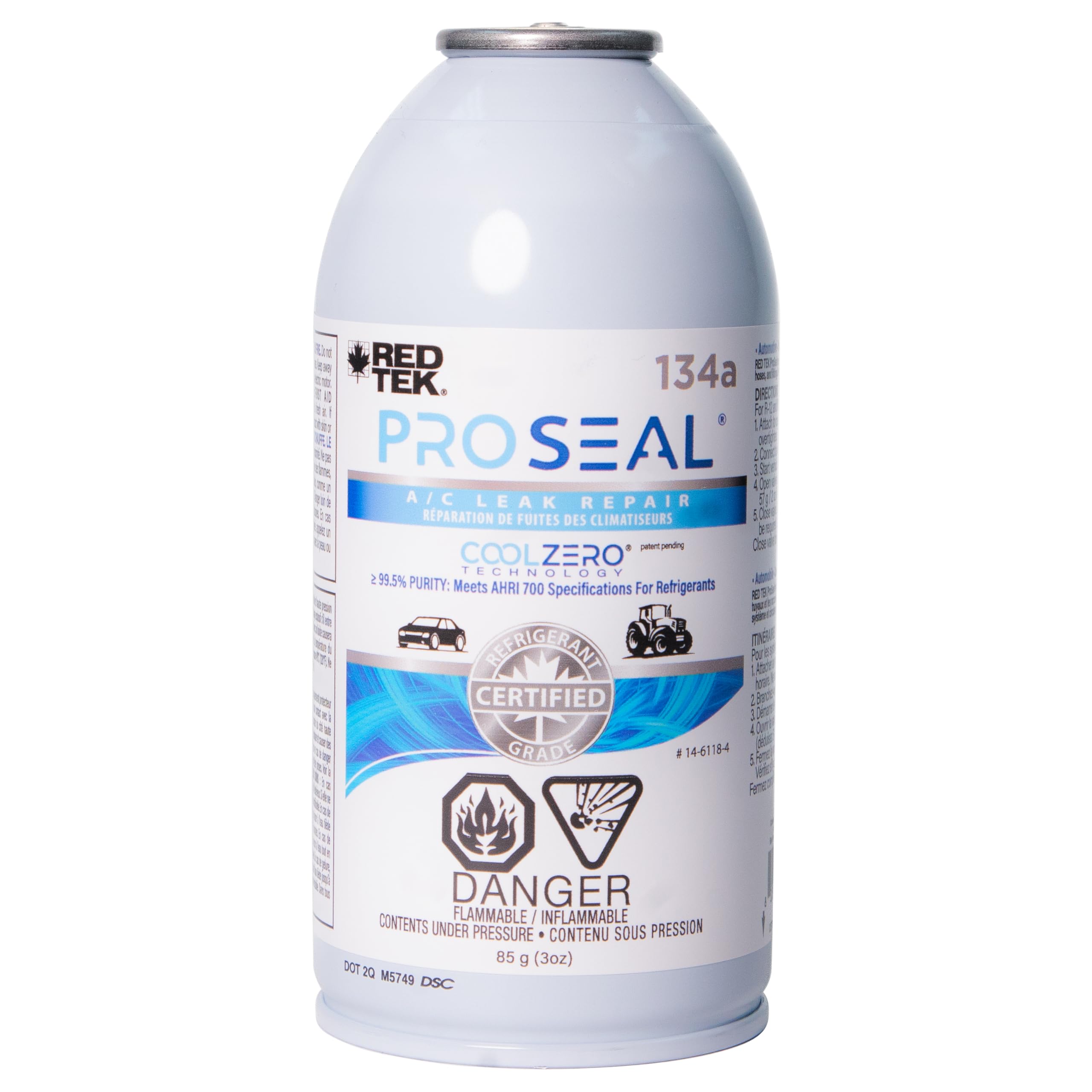
RED TEK ProSeal12 stands out as a dedicated sealant designed to address leaks in older R-12 and R-134a systems without adding bulk refrigerant. Its formulation remains in the system as a liquid lubricant, ready to seal future leaks around seals, gaskets, and o-rings. This targeted approach makes it a cost-effective alternative to replacing entire evaporators or condensers.
Owner feedback consistently highlights its effectiveness on high-mileage vehicles, with reports of sealing evaporator leaks in trucks over two decades old. The non-toxic, methanol-free composition reduces health risks during application, though the manufacturer advises it is non-returnable due to hazardous material classification. The included instructions are noted as confusing by some users, and customer support is minimal.
For someone with a known slow leak in an older vehicle, this product offers a permanent solution if the system still holds a partial charge. It is not intended for systems that are completely empty or for use as a routine recharge additive. This is a specialist tool for a specific problem.
What works
- Seals leaks in R-12 and R-134a systems without adding bulk refrigerant.
- Liquid lubricant remains in system for future leak protection.
- Safer, non-toxic formula compared to methanol-based sealers.
What doesn’t
- Confusing installation instructions with limited support.
- Cannot be returned under any circumstances.
- Not suitable for empty or completely discharged systems.
2. TSI Supercool D8 A/C U/V Dye Green

TSI Supercool D8 is a concentrated fluorescent dye that simplifies leak identification in both R-134a and R-12 systems. The 8-ounce bottle treats up to 32 vehicles, making it a cost-effective solution for DIYers who maintain multiple cars or for small workshops. It is compatible with PAG, ester, and mineral oils, and contains no solvents that could damage system components.
Reviews indicate the dye is highly visible under standard UV light, with users successfully identifying leaks at compressor rear seals and o-ring connections. The product is safe for recovery equipment and does not degrade refrigerant performance. Some users note that a proper injection kit is required for best results, as the self-measure bottle design can be messy without a dedicated tool.
This is an essential diagnostic tool for anyone refusing to guess where a leak is located. While it does not seal or recharge, accurate detection prevents wasted refrigerant and unnecessary part replacement. It is a lifetime supply for the average DIY mechanic.
What works
- Treats up to 32 vehicles per bottle, excellent value.
- Compatible with all common oils and refrigerants.
- No solvents means zero damage to system components.
What doesn’t
- Requires a separate injection kit or tool for clean application.
- Does not seal leaks or recharge the system.
- Self-measure bottle design can be messy for inexperienced users.
3. Generic Arctic Air for R1234YF Systems

This product is positioned as a moisture eliminator for R-1234yf systems, explicitly stating it is NOT a refrigerant. It is designed for emergency vehicle repairs or professional mechanic use where moisture contamination in the system is suspected. The single-can format is intended for quick treatment rather than a full system recharge.
User experiences are sharply divided. Some owners in hot climates report restored AC performance after a simple application, while others report that the can failed to thread onto standard hoses, rendering it unusable. The manufacturer information is sparse, and the product dimensions suggest a plastic bottle rather than a traditional metal refrigerant can, which may affect durability.
This is a gamble for those seeking a basic moisture fix on a modern R-1234yf system. The inconsistent quality control and lack of detailed technical specifications make it a secondary option compared to established refrigerant brands. It might work for some, but the failure rate is notable.
What works
- Inexpensive entry point for R-1234yf moisture removal.
- Some users report restored AC performance in hot climates.
What doesn’t
- Inconsistent quality; some cans fail to thread onto hoses.
- Labeling is vague, and it is not a refrigerant.
- Plastic construction feels less durable than metal cans.
4. National Refrigerants R1234yf 8 oz Can

National Refrigerants delivers a straightforward, OEM-compatible R-1234yf refrigerant designed for vehicles manufactured after 2015. The 8-ounce can is ideal for quick top-offs in cars, SUVs, and light trucks. Its low global warming potential (GWP) formula meets modern environmental standards while providing clean cooling performance.
Customer feedback confirms the product is exactly as advertised—pure refrigerant that works when paired with the correct recharge kit. Users highlight the importance of checking the vehicle’s under-hood sticker to confirm R-1234yf compatibility. The pricing is noted as a premium over some competitors, but the reliability and compliance with SAE J2844 standards justify the cost for those who want factory-spec performance.
For anyone with a post-2015 vehicle needing a genuine R-1234yf recharge, this is a solid, no-nonsense choice. It does not include sealers or dyes, so it is best for systems that only need a refrigerant top-off without underlying leak issues.
What works
- OEM-compatible for post-2015 vehicles.
- Low GWP formula meets environmental standards.
- Compliant with SAE J2844 for professional use.
What doesn’t
- Premium pricing compared to some alternatives.
- Requires separate recharge kit with correct fittings.
- No leak sealer or dye included.
5. Arctic Freeze Auto A/C Recharge R-134a

Arctic Freeze combines R-134a refrigerant with a stop leak additive in a 14-ounce self-sealing container, and includes a recharge hose (without a gauge). This all-in-one approach appeals to DIYers who want a simple, quick fix for systems that have lost some refrigerant due to small leaks. The self-sealing can allows for partial use without losing contents.
Owner reviews are generally positive, noting quick restoration of cold air in vehicles with minor leaks. However, the included hose lacks a gauge, meaning users must estimate the correct charge amount based on pressure feel or invest in a separate gauge. One user reported excellent customer service when the product did not fix their AC, only to find a failed compressor was the true issue.
This kit is best for straightforward recharges on R-134a systems with small, repairable leaks. The absence of a gauge is a significant limitation for those unfamiliar with proper charging procedures. It is a convenient solution but not a substitute for proper diagnosis.
What works
- All-in-one refrigerant, sealant, and hose included.
- Self-sealing can allows for partial use without waste.
- Good customer service for troubleshooting issues.
What doesn’t
- No gauge included, making proper charge estimation difficult.
- Stop leak may not fix larger or non-leak issues.
- Hose fitting may not work on all vehicle models.
6. A/C Pro ACP-105 Refrigerant With Max-Seal

A/C Pro’s ACP-105 uses Max-Seal chemistry to restore lost refrigerant while simultaneously conditioning rubber seals and gaskets. The 12-ounce can includes corrosion inhibitors that reduce moisture and acid buildup, extending the life of the system. It is designed for three easy steps, making it accessible for DIY users.
Long-term owners report that it can revive AC performance in 16-year-old vehicles within minutes, delivering cold air even in extreme heat. The seal conditioning additive helps prevent future leaks by re-conditioning dried-out o-rings. Some users note that the can works best with an existing hose and gauge set for accurate pressure monitoring.
This product represents a balanced approach for R-134a systems that are low on refrigerant and have minor seal degradation. It stops small leaks and protects against future ones, making it a proactive maintenance tool rather than just a quick fix. It is not intended for systems with major structural damage.
What works
- Max-Seal technology reconditions rubber seals and gaskets.
- Corrosion inhibitors reduce moisture and acid buildup.
- Proven to restore cold air in older vehicles quickly.
What doesn’t
- Works best with a separate hose and gauge for accuracy.
- Not suitable for systems with large or structural leaks.
- Single 12 oz can may not be enough for completely empty systems.
7. ENVIRO-Safe R134a Refrigerant Replacement
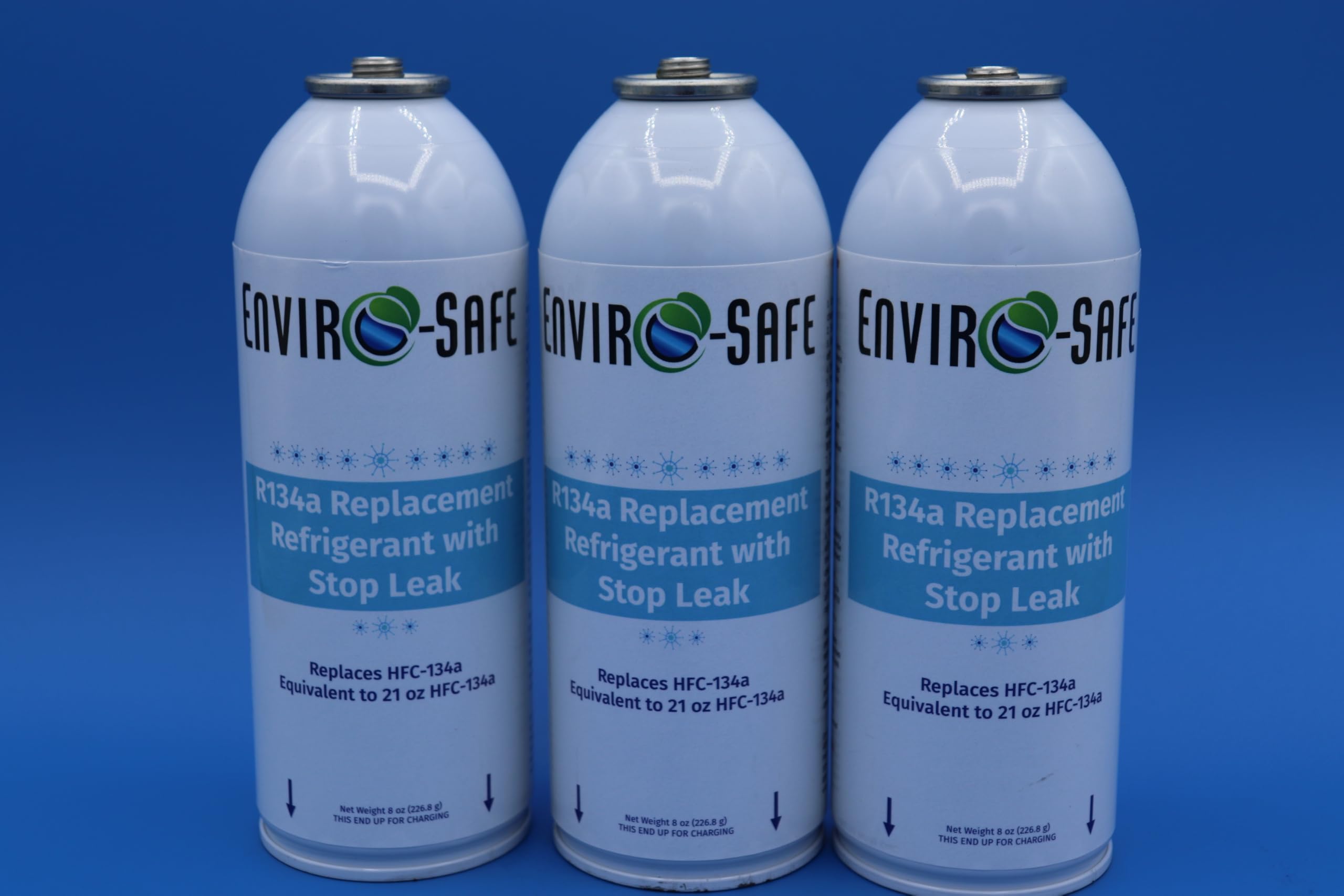
This Enviro-Safe product is an established hydrocarbon blend designed as a drop-in replacement for R-134a, operating at lower head pressure for improved efficiency. The 3-can pack with a piercing valve offers a complete DIY recharge solution. The brand claims 27 years of history with this formula.
User feedback is mixed. Some find it works as well as genuine R-134a at a fraction of the cost, while others criticize the labeling as misleading because it is a substitute, not pure R-134a. Reports of poor cooling performance in some systems suggest that heat transfer properties differ from the original refrigerant. Additionally, the product contains unlabeled refrigerant oil, which may affect charge calculations.
This is a budget-conscious alternative for those willing to accept a hydrocarbon blend. It is best suited for older systems that are less sensitive to refrigerant type, but users should be aware of the potential performance trade-offs and the lack of precise composition labeling.
What works
- 3-can pack provides good quantity for a complete recharge.
- Operates at lower head pressure, potentially improving efficiency.
- Established brand with long market presence.
What doesn’t
- Labeling can be misleading; not genuine R-134a.
- Hydrocarbon blend may offer different cooling performance.
- Contains unlabeled refrigerant oil, affecting charge accuracy.
8. Leak Saver Direct Inject Ultimate 3-in-1

Leak Saver’s Direct Inject Ultimate combines a permanent leak sealant, a moisture remover, and UV dye into a single system. The organosilane formula is safe for all system components, including expansion valves and Schrader valves, and works with all refrigerants except ammonia. It is designed for systems where the full charge is not lost within 7 days.
This product has over 4 million units sold and strong professional trust. Users report success in sealing slow leaks in central air conditioning and automotive systems, with the UV dye helping to identify the leak location days after application. The straightforward injection method avoids messy syringes, though automotive applications require a standard 134A to 1/4-inch charging adapter.
For a comprehensive system treatment that addresses leaks, moisture, and leak detection in one step, this is an excellent choice. It is particularly valuable for hard-to-find slow leaks that mechanics often miss with conventional sniffers.
What works
- 3-in-1: sealant, moisture remover, and UV dye.
- Safe for all system components including TXVs.
- Proven success on slow leaks in automotive and HVAC systems.
What doesn’t
- Requires separate adapter for automotive systems.
- Not suitable for rapid leak scenarios where charge is lost quickly.
- UV dye may take days to show at very small leak sites.
9. Vehicle AC Refrigerant by cmebiz

This cmebiz product offers three 6-ounce cans of R-134a replacement refrigerant along with a piercing valve for easy recharging. It is positioned as a value pack for DIY enthusiasts who want to restore original cooling performance in their vehicles. The compact 6-ounce cans are manageable for topping off systems that are partially low.
Reviews indicate high satisfaction among first-time DIYers, who found the process straightforward after watching a short tutorial. Users report successful recharges on older models like the 1998 Jeep Cherokee and 2007 Toyota FJ Cruiser. However, experienced users advise against using this product without understanding high-pressure system safety, as improper handling can lead to injury.
This is a solid entry-level option for those with compatible R-134a systems who are willing to learn the proper charging procedure. The multiple cans provide flexibility for topping off over time, and the piercing valve is a convenient addition for standard recharge hoses.
What works
- 3 cans provide flexibility for multiple top-offs.
- Easy to use with basic DIY knowledge after watching a tutorial.
- Works well on older R-134a vehicles.
What doesn’t
- Not recommended for those unfamiliar with AC system safety.
- Hydrocarbon blend may not perform identically to pure R-134a.
- Small 6 oz cans may not be enough for a fully empty system.
10. ZeroR AC Refrigerant Recharge Kit
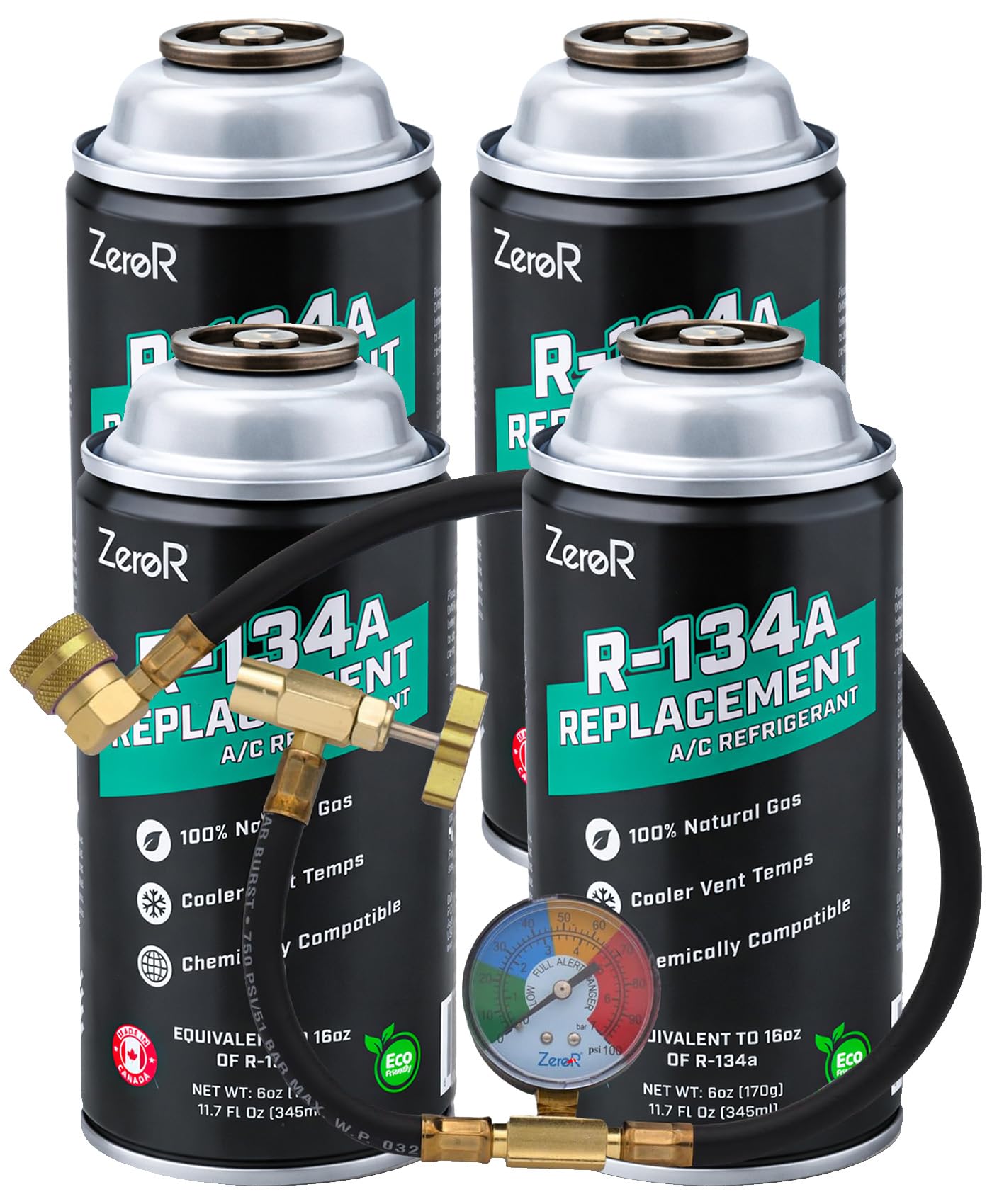
ZeroR offers a 4-can pack of hydrocarbon blend refrigerant that is 100% natural, ozone-safe, and non-global warming. Each 6-ounce can (11.7 fluid ounces) uses a Self-Sealing Valve (SSV) that allows for storage of unused gas, preventing waste. The blend is chemically compatible with R-134a systems, though it is labeled for non-MVAC use.
User experiences are mixed. Many report excellent results, with AC systems blowing ice cold after a simple recharge on vehicles like the 2002 Subaru WRX and 2008 Chevy Impala. The SSV system is praised for preventing gas loss during storage. However, some users report that the included hose does not securely attach to the low-side port, leading to frustration and product failure. The lack of instructions is a common criticism.
This is a solid choice for those who understand SSV-compatible tools and want a natural refrigerant alternative. The 4-can pack provides good value, but the inconsistent hose quality and missing instructions may be a barrier for novice DIYers.
What works
- Natural hydrocarbon blend is ozone-safe with low global warming impact.
- SSV cans allow storage of unused refrigerant.
- Effective cooling performance in many user reports.
What doesn’t
- Some hoses fail to securely attach to the low-side port.
- No instructions included, complicating first-time use.
- Labeled for non-MVAC use, which may limit legal application in vehicles.
11. Honeywell Automotive Refrigerant

Honeywell’s automotive refrigerant is a premium R-1234yf product that comes in a 4-pack for multiple recharges. Users consistently describe the cans as heavy, fully filled, and containing high-purity gas. After a compressor replacement and system evacuation, the refrigerant integrated cleanly, with pressures stabilizing and cooling returning to normal immediately.
Professional mechanics and serious DIYers appreciate the consistent performance and purity. The well-sealed cans prevent contamination, and the refrigerant handles pressure and temperature changes smoothly. While the upfront cost is higher than many competitors, the reliability and OEM-grade quality make it a favorite for those who value professional results.
For those with post-2015 vehicles requiring R-1234yf who refuse to compromise on quality, this is the definitive choice. It is especially recommended after compressor replacement or system flushing where contamination is a concern.
What works
- High purity refrigerant provides reliable, professional-grade performance.
- Well-sealed cans prevent contamination during storage.
- 4-pack offers convenience for multiple vehicles or larger systems.
What doesn’t
- Premium pricing is the highest in this roundup.
- No leak sealer or dye included; pure refrigerant only.
- Requires a separate R-1234yf recharge kit for application.
Hardware & Specs Guide
R-134a vs. R-1234yf
R-134a is the standard for vehicles from the mid-1990s to about 2015, while R-1234yf is used in most newer cars due to its lower global warming potential. They use different service ports and are not interchangeable. Using the wrong type can damage the compressor or create unsafe system pressures.
Leak Sealer Chemistry
Polymer-based sealers can clump and clog expansion valves, while organosilane-based formulas (like those used by Leak Saver) are safer for modern systems. UV dye integration helps locate the leak after sealing, which is critical for a permanent fix rather than a temporary patch.
Hydrocarbon Blends
Products like ENVIRO-Safe and ZeroR use hydrocarbon blends as alternatives to traditional refrigerants. They are often flammable and may have different heat transfer properties. While they can work well in some systems, they are not universally OEM-approved and may void warranties on newer vehicles.
Self-Sealing Valves (SSV)
SSV cans allow partial use and storage of unused refrigerant, reducing waste. They require a compatible tool or hose designed for SSV, rather than the traditional piercing-style tool. Using the wrong tool can cause slow or incomplete discharge.
FAQ
Can I use R-1234yf in a car that originally used R-134a?
How does a leak sealer actually stop a leak?
Is it safe to use a stop leak product in my car’s AC?
Why do some refrigerant cans include oil or dye?
Final Thoughts: The Verdict
For most buyers, the best auto ac refrigerant winner is the RED TEK ProSeal12 because it offers a safe, permanent solution for common leaks in both R-12 and R-134a systems. If you need comprehensive leak detection and treatment, grab the Leak Saver Direct Inject Ultimate. And for pure, OEM-grade R-1234yf performance in modern vehicles, nothing beats the Honeywell Automotive Refrigerant.

Certification: BSc in Mechanical Engineering
Education: Mechanical engineer
Lives In: 539 W Commerce St, Dallas, TX 75208, USA
Md Amir is an auto mechanic student and writer with over half a decade of experience in the automotive field. He has worked with top automotive brands such as Lexus, Quantum, and also owns two automotive blogs autocarneed.com and taxiwiz.com.