Blowing a tweeter or letting a mid-bass driver flub out on a vocal track are classic signs of a system starved for proper frequency management. A speaker crossover is the only component that ensures each driver handles only the frequencies it was built for, saving equipment and cleaning up the stage. But not all crossovers deliver the same precision, and choosing the wrong one can muffle the entire sound.
I’m Amir — the founder and writer behind Four Wheel Ask. My work focuses on deconstructing product specifications, analyzing build quality reports, and aggregating owner feedback to separate genuine performance from marketing claims in the car audio landscape.
After reviewing frequency response curves, filter slopes, and power handling data across eleven distinct models, the best car audio speaker crossover for your build comes down to matching the correct filter type and channel count to your amplifier setup without wasting a cent on unnecessary processing.
How To Choose The Best Car Audio Speaker Crossover
Selecting a crossover starts with understanding your system architecture. A passive crossover sits between the amplifier and the speakers, splitting the signal after amplification. An active crossover (or DSP) operates at line level before the amp, allowing per-channel equalization, time alignment, and precise filter slopes. Your choice dictates how much control you have over the final sound.
Passive vs. Active: Where Control Begins
Passive crossovers are simpler to install, requiring only a connection between the amp and the speaker pair. However, they are fixed networks; you cannot adjust the crossover point after purchase. Active crossovers and DSP units let you set high-pass and low-pass filters independently for each channel, dial in slopes from 6 dB to 48 dB per octave, and often include parametric equalizers. The trade-off is installation complexity and the need for amplifier channels to match the driver count.
Power Handling and Impedance Matching
Every crossover has a power rating, usually expressed as RMS and peak wattage. Exceeding the RMS rating can burn out the internal coils or capacitors. Equally critical is impedance—ensure the crossover is rated for the same ohm load as your speakers (most car audio runs at 4 ohms). A mismatch here will shift the crossover frequency and possibly degrade sound quality or damage drivers.
Slope Steepness and Frequency Points
The slope (measured in dB per octave) determines how aggressively frequencies are cut beyond the crossover point. A 12 dB/octave slope is common for passive units and works well for general music. Steeper slopes, such as 24 dB/octave or 48 dB/octave, protect tweeters from low-frequency energy more effectively and allow for higher power handling. For multi-way systems, look for a crossover that lets you tweak both the high-pass and low-pass points independently.
Quick Comparison
On smaller screens, swipe sideways to see the full table.
| Model | Category | Best For | Key Spec | Amazon |
|---|---|---|---|---|
| AudioControl LC7i | Active LOC | Factory integration | 6-channel, AccuBASS | Amazon |
| Banda Audiopart X8AiR | DSP Processor | Total tuning flexibility | 79-band EQ, 8-ch out | Amazon |
| PRV Audio DSP 2.8X | DSP Crossover | 8-channel control | 15-band EQ, sequencer | Amazon |
| Stetsom STX 2448 DSP | DSP Processor | Steep slope precision | 48 dB/octave, LCD | Amazon |
| Timpano TPT-SP4BT | Bluetooth DSP | Smartphone app tuning | 4-ch, sequencer | Amazon |
| Taramp’s Pro 2.6S | DSP Equalizer | Compact DSP upgrade | 6-ch DSP, output pair | Amazon |
| Timpano TPT-360 | Electronic Crossover | 3-way active setups | 3-way, variable points | Amazon |
| Taramp’s Pro 2.4S | DSP Presets | Quick EQ profiles | 15-band EQ, 12 presets | Amazon |
| DS18 PRO-CFX 2-Way | Passive Crossover | 2-way component sets | 300W RMS, gold terminals | Amazon |
| Audiopipe CRX-303 | Passive 3-Way | Budget 3-way builds | 300W, polymer caps | Amazon |
| Audiopipe CRX-203 2-Pack | Passive 2-Way | Budget 2-way systems | Gold terminals, 2-pack | Amazon |
In‑Depth Reviews
1. AudioControl LC7i
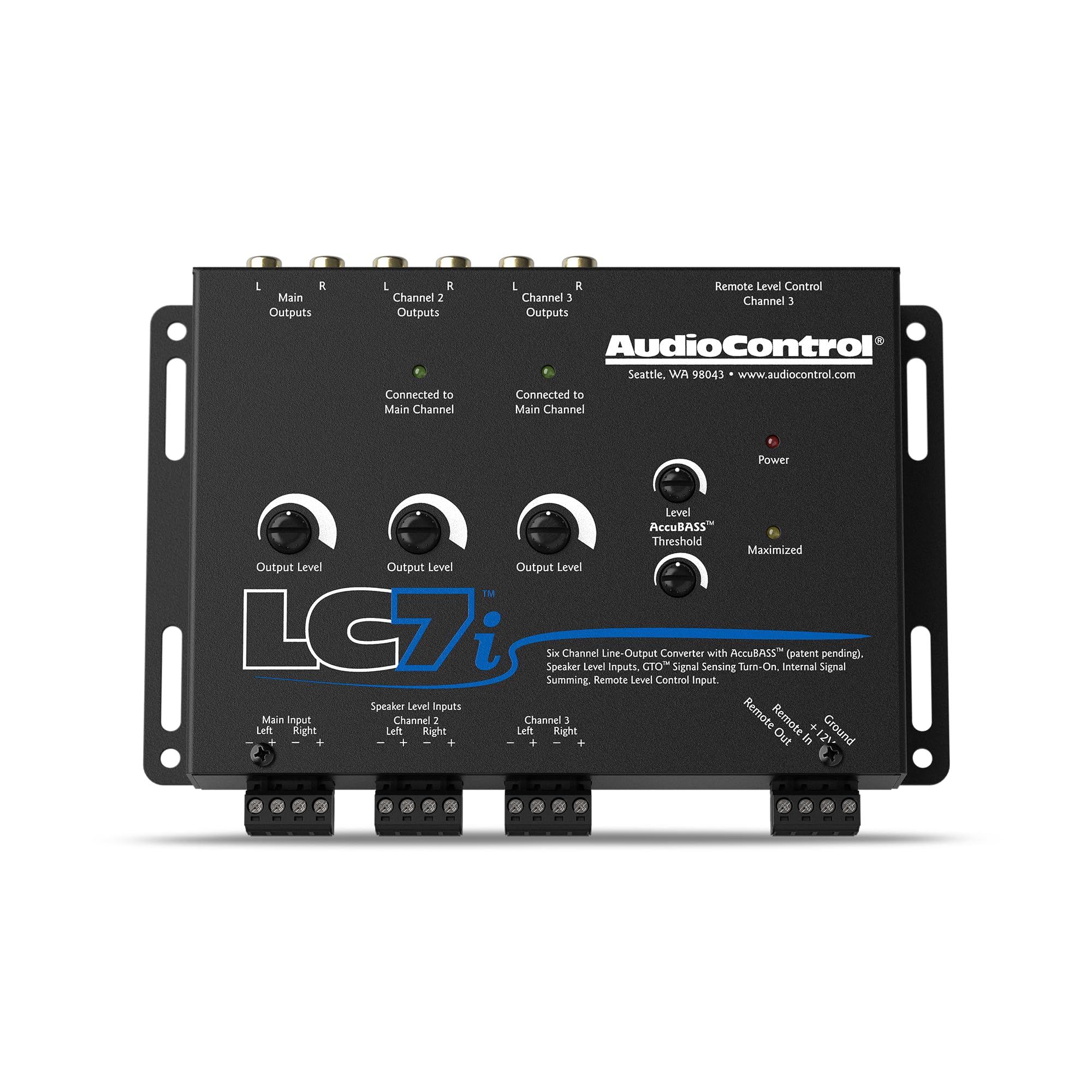
The AudioControl LC7i sits at the top because it solves the most common pain point in car audio: integrating a high-quality aftermarket system with a factory stereo. Its six channels of active line output conversion mean you can pull signal directly from speaker-level outputs without degrading sound quality. The AccuBASS circuitry actively detects and restores bass roll-off that OEM radios often apply as volume increases, a feature that passive crossovers simply cannot address.
Internally, the LC7i uses channel summing to interface seamlessly with factory amplifiers that already have built-in crossovers. Its GTO signal sense and remote 12V trigger make installation straightforward, while the compact chassis (4.72” deep) fits behind most dashboards. The fixed and variable output level controls give the installer fine gain adjustment without introducing noise.
For anyone keeping a factory head unit but wanting to add subwoofers and aftermarket amplifiers, this unit delivers the cleanest signal path available at this tier. Its value lies in preventing the need to replace the entire dash, saving both budget and installation time.
What works
- AccuBASS restoration is excellent for factory bass roll-off
- Six channels offer flexibility for complex systems
- Compact size fits tight install locations
What doesn’t
- No built-in DSP for advanced EQ or time alignment
- Requires additional amplifier channels for full active crossover
2. Banda Audiopart X8AiR
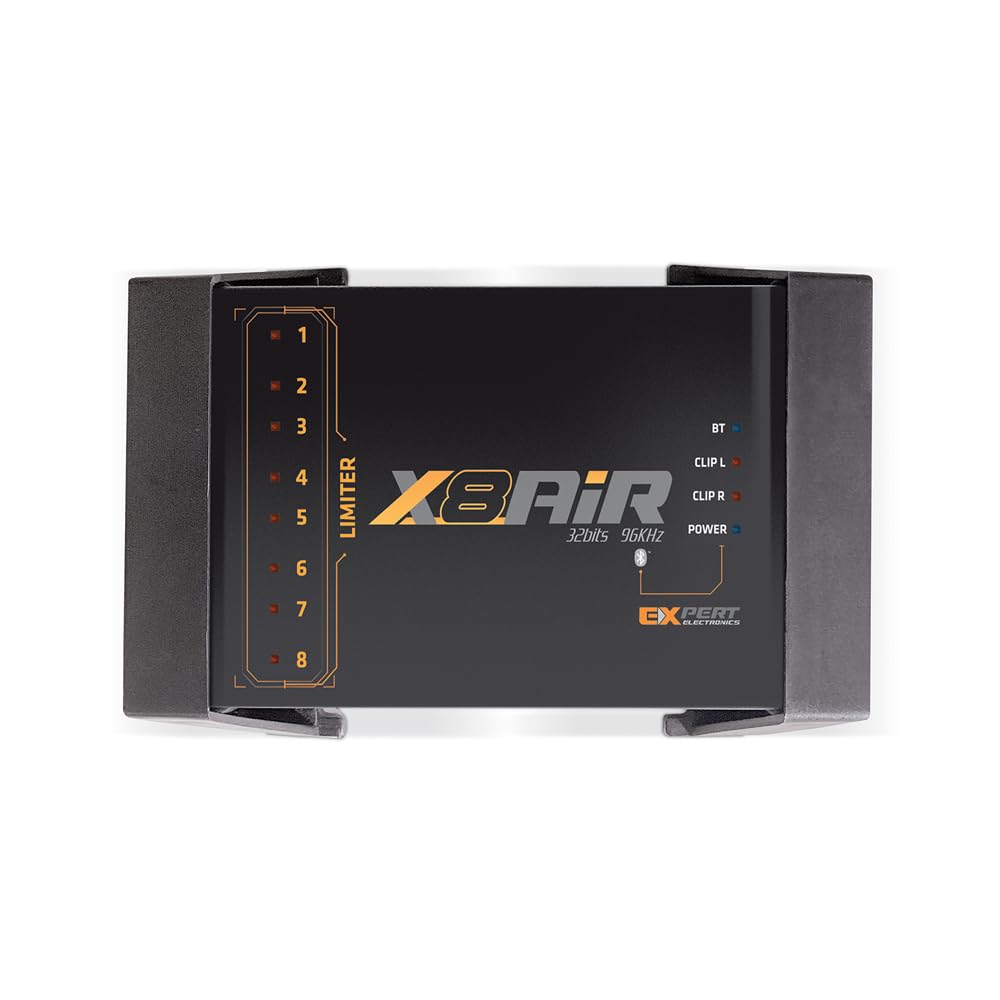
The Banda Audiopart X8AiR represents a serious step up in processing power, featuring a 32-bit/96kHz DSP with 8 output channels and an astonishing 79-band equalizer per channel. This level of granularity means you can surgically correct room modes and vehicle-specific resonances that a typical 15-band EQ cannot touch. The adjustable crossover points, time alignment, and phase control create a truly professional tuning environment.
Bluetooth connectivity with a dedicated mobile app allows real-time adjustment from the driver’s seat, making it easy to tweak the curve without crawling to the trunk. The unit supports 4 inputs and 8 outputs, making it a natural fit for multi-amplifier setups that include component speakers and subwoofers. Its compact processor footprint hides easily under a seat or in a glovebox.
This DSP is aimed at the enthusiast who wants total command over the sound stage and is comfortable learning the software. The 79-band capability is overkill for a simple 2-way system but becomes invaluable in a 3-way active front stage with time alignment.
What works
- 79-band EQ provides unmatched tuning precision
- Bluetooth app tuning is convenient and responsive
- 8-channel output supports complex active systems
What doesn’t
- Learning curve for full DSP software is steep
- No physical remote control included
3. PRV Audio DSP 2.8X

The PRV Audio DSP 2.8X is a workhorse digital crossover that packs 2 inputs and 8 independent output channels into a chassis barely over an inch thick. Its integrated 15-band graphic equalizer comes with 12 preset curves covering everything from flat response to competition-style tuning, which is a massive time-saver during initial setup. The sequencer feature allows triggered startup and shutdown of multiple downstream devices, simplifying system wiring.
What sets this unit apart is the intuitive on-board LCD display and navigation. While many DSPs require a laptop or smartphone app for every adjustment, the PRV 2.8X lets you modify crossover points, EQ bands, and parametric equalizer settings directly on the unit. The crossover filters support Butterworth, Bessel, and Linkwitz-Riley alignments with variable slopes, giving installers the tools to phase-align a multi-way system without external measurement gear.
This DSP excels in builds where the installer wants professional-level control but prefers a physical interface over a mobile app. Its 8 outputs make it perfect for a fully active 4-way system with subwoofer.
What works
- On-unit LCD display simplifies adjustments
- 12 EQ presets accelerate system tuning
- Sequencer feature for clean power management
What doesn’t
- No Bluetooth tuning capability
- Display text is small for some users
4. Stetsom STX 2448 DSP PRO

The Stetsom STX 2448 DSP PRO is engineered for those who demand extreme filter steepness. It offers crossover slopes up to 48 dB per octave, which provides near-brick-wall filtering to protect tweeters and match subwoofer integration with surgical precision. The 15-band graphic equalizer and adjustable parametric EQ give you full control over the frequency shaping, and the intuitive LCD display includes a screensaver and password lock for competition security.
A standout hardware feature is the new sequencer for amp remote activation, allowing multiple amplifiers to power on in a programmed order. The delay adjustment function is essential for time-aligning drivers in different locations. The unit supports variable crossover frequencies from 10 Hz to 22 kHz with multiple filter types, giving the installer full flexibility for any system topology.
This processor is best suited for SPL competitions or high-SQL builds where precise phase alignment and aggressive filtering are non-negotiable. The 48 dB/octave slopes are rare at this level.
What works
- 48 dB/octave slopes offer extreme filtering
- Password lock protects tuning in competitions
- Sequencer for multi-amp power management
What doesn’t
- Price point is higher than basic DSPs
- Interface can be complex for beginners
5. Timpano TPT-SP4BT Bluetooth DSP

The Timpano TPT-SP4BT is a compact 4-output DSP that prioritizes wireless convenience. Its entire tuning suite is controlled through a dedicated mobile app (available on Android and iOS), allowing you to adjust equalization, crossover filters, time alignment, gain, and phase inversion from the driver’s seat. This is a massive upgrade over units that require a laptop or physical knob adjustments every time you want to tweak a setting.
The processor includes a built-in voltmeter, frequency generator, pink noise generator, and frequency sweep—tools usually reserved for much more expensive professional processors. The sequencer feature (S1, S2, S3) lets you program the startup and shutdown of up to three external devices, such as amplifiers or cooling fans. Its small footprint (3.15” x 2.36” x 0.5”) fits into tight spaces that larger DSPs cannot.
This DSP is an excellent choice for the DIY installer who wants full DSP functionality without the physical bulk or complex wiring. The Bluetooth control makes it almost effortless to dial in a custom curve for different music genres.
What works
- Bluetooth app control is very user-friendly
- Built-in voltmeter and signal generator are handy
- Ultra-compact dimensions for hidden installs
What doesn’t
- Only 4 output channels limit system complexity
- App stability can vary by phone model
6. Taramp’s Pro 2.6S DSP

The Taramp’s Pro 2.6S is a digital audio processor that balances channel count with a compact chassis. With 6 output channels, it provides enough bandwidth for a 3-way front stage plus a subwoofer channel, while its output mirroring function allows you to duplicate a channel’s signal to another output, effectively expanding your routing options without additional external splitters.
This unit features individual mute functions on each output and an output pairing function, which simplifies configuring a 2-way active system with left and right channels. The on-board DSP handles equalization and crossover settings, and its lightweight 3.5-ounce frame makes it one of the most install-friendly processors in the lineup. The 12V power requirement is standard for car audio, making integration straightforward.
The Pro 2.6S is ideal for the installer who wants six channels of DSP processing in a very small package. It does not include a graphic display or Bluetooth, so tuning requires a laptop, but the processing power is solid for the footprint.
What works
- Lightweight and very small form factor
- Output mirroring and pairing expand routing options
- Individual mute per channel aids troubleshooting
What doesn’t
- Tuning requires a laptop—no app or display
- No built-in EQ presets for quick setup
7. Timpano TPT-360 Electronic Crossover

The Timpano TPT-360 is a full-featured three-way electronic crossover that offers variable crossover points between front, rear, and subwoofer outputs. Unlike fixed passive networks, this unit lets you dial in the exact frequency where the signal splits, which is essential for matching speakers with different natural roll-offs. Its remote subwoofer control makes it easy to adjust bass level from the driver’s seat.
This crossover can be configured for a 2-way system with front and rear fade capability or as a dedicated three-way system. The variable crossover points cover a wide range, from 32 Hz to 320 Hz for the subwoofer channel and up to 4 kHz for the mid/high outputs. The 2.28-pound chassis is built to handle the demands of a full active system without needing a laptop for tuning.
The TPT-360 is best for the enthusiast who wants active crossover control without the complexity of a full DSP. It gives you the essential tool: adjustable frequency distribution without needing to learn DSP software.
What works
- Variable crossover points are a huge upgrade over passives
- Remote subwoofer level control is convenient
- Can operate as 2-way or 3-way system
What doesn’t
- No equalization or time alignment features
- Physical size is larger than modern DSPs
8. Taramp’s Pro 2.4S DSP

The Taramp’s Pro 2.4S packs a 15-band graphic equalizer, a parametric EQ, and a full crossover network into a DSP that also includes 12 preset equalizer curves for different music genres. This makes it exceptionally fast to set up: select “Rock,” “Hip Hop,” or “Vocal,” and the processor applies a complete EQ curve that you can then fine-tune with the parametric band.
The crossover section supports Butterworth, Bessel, and Linkwitz-Riley filters with slopes from -6 dB to -48 dB per octave, covering every common alignment. The cutoff frequency range from 10 Hz to 22 kHz gives you the flexibility to set subsonic filters, mid-bass bandpasses, and tweeter high-passes. The 2-channel input, 4-channel output configuration suits a standard front-stage plus subwoofer active setup.
This DSP excels when you want to experiment with different sonic signatures quickly. The preset library alone can save hours of tuning time compared to building an EQ curve from scratch.
What works
- 12 EQ presets are genuinely useful and well-tuned
- Supports multiple filter types and steep slopes
- Parametric EQ allows fine adjustments
What doesn’t
- Only 4 output channels limit system expansion
- No Bluetooth or app control
9. DS18 PRO-CFX 2-Way Passive Crossover

The DS18 PRO-CFX is a high-quality passive 2-way crossover designed for component speaker sets. Its 300W RMS power handling ensures it can keep up with high-output amplifiers, and the gold-plated screw terminals provide a corrosion-resistant connection that maintains signal integrity over time. The crossover point is set at 3.5 kHz, a common sweet spot for separating tweeter and mid-range duties.
The construction uses a combination of metal and plastic housing with acrylic accents, giving it a sturdy feel while remaining compact (6.3” x 3.5” x 1.5”). It is designed to be installed between the amplifier and the speakers, utilizing a single amplifier channel to drive two speakers efficiently. The stereo audio output mode is maintained throughout the network.
This passive crossover is a straightforward upgrade for anyone running a 2-way component system who wants a reliable, high-quality network without the complexity of tuning an active DSP. It is essentially “install and forget.”
What works
- Solid 300W RMS rating for high-output systems
- Gold terminals resist corrosion
- Simple drop-in installation
What doesn’t
- Fixed crossover point—no adjustability
- Large footprint compared to mini passive units
10. Audiopipe CRX-303 3-Way Passive Crossover

The Audiopipe CRX-303 is a 3-way passive crossover that handles 300 watts max power, dividing the signal for a woofer, midrange, and tweeter. Its frequency bands are set at 20 Hz–316 Hz for the woofer, 700 Hz–4 kHz for the midrange, and 1.5 kHz–20 kHz for the tweeter. This provides a dedicated bandpass for the midrange that helps vocals punch through without competing with the sub-bass or overly high treble.
The construction uses high-grade polymer capacitors and ferrite and air-cooled spools to manage heat dissipation, which is critical for sustained high-volume listening. The RCA connectivity allows easy integration with standard amplifier wiring. The 4-ohm impedance rating matches most common car speakers.
This crossover is a smart entry point for building a 3-way passive system on a budget. It takes the guesswork out of frequency matching for a woofer/mid/tweeter combo and protects all drivers from receiving the wrong range.
What works
- Dedicated midrange bandpass improves vocal clarity
- Ferrite and air-cooled coils handle heat well
- Good value for a 3-way passive network
What doesn’t
- Fixed crossover points limit custom tuning
- Plastic housing feels less durable than metal enclosures
11. Audiopipe CRX-203 2-Way Passive Crossover (2-Pack)

The Audiopipe CRX-203 is a 2-way passive crossover sold as a 2-pack, making it an economical solution for building a complete 2-way component system with left and right channels. Each crossover handles 150 watts RMS (300 watts peak), which is sufficient for most mid-range coaxial and component sets. The gold-plated screw terminals provide reliable connectivity and resist oxidation.
The crossover frequency splits at 3.39 kHz for the tweeter and 4.3 kHz for the woofer, with a frequency response range from 20 Hz to 20 kHz. The polymer capacitors inside are a step up from basic electrolytic types, offering better signal clarity and longer life. The flush mount design fits into standard door panel locations without requiring custom brackets.
This 2-pack is the most accessible entry point for someone adding a pair of tweeters to existing full-range speakers. It provides basic protection and a reasonable crossover point without requiring any programming or additional components.
What works
- 2-pack value covers a full front stage
- Gold terminals are a nice touch at this tier
- Simple wiring for beginners
What doesn’t
- Fixed crossover point limits system tuning
- Power handling is lower than premium options
Hardware & Specs Guide
Passive Networks
Passive crossovers use capacitors, inductors, and resistors to filter frequencies after the amplifier. They require no power supply and are simple to wire, but they offer zero adjustability after purchase. The crossover point is determined by the component values, which are chosen for a specific speaker impedance. If you change speakers, the crossover point shifts. They are best for fixed component sets where the user wants a straightforward, reliable solution without tuning.
Active DSP Crossovers
Active crossovers operate at line level before the amplifier, using digital signal processing to set variable crossover points, slopes, and EQ curves. They require a 12V power connection and often a laptop or smartphone app for configuration. The key advantage is the ability to independently set high-pass, low-pass, and bandpass filters per channel, along with time alignment and phase adjustment. This allows for precise staging and driver protection that passive networks cannot match.
Filter Slopes (dB/octave)
The slope indicates how quickly the filter attenuates signals beyond the crossover point. A 6 dB/octave slope is very gentle and sounds natural, but provides less protection for tweeters. A 12 dB/octave slope is the most common in passive crossovers. Steeper slopes like 24 dB/octave or 48 dB/octave are found in active DSP units and offer aggressive filtering that protects drivers more effectively and allows for higher amplifier power before distortion.
Channel Count and System Topology
Channel count refers to the number of input and output paths on the crossover or DSP. A 2-way passive crossover has one input and two outputs (tweeter + woofer). A 4-channel DSP can handle a front 2-way active system plus a subwoofer. An 8-channel DSP can run a 3-way front stage (tweeter, mid, woofer) plus a subwoofer per side. Matching channel count to your number of amplifier channels and drivers is critical for proper system design.
FAQ
What is the difference between a passive and an active crossover?
Can I use a passive crossover with a DSP?
What impedance should my crossover match?
How do I know what crossover frequency to set?
Final Thoughts: The Verdict
For most buyers, the best car audio speaker crossover winner is the AudioControl LC7i because it solves factory integration issues with AccuBASS while providing clean line-level output for aftermarket amplifiers. If you want total DSP tuning flexibility, grab the Banda Audiopart X8AiR. And for a simple, reliable passive solution, nothing beats the value of the DS18 PRO-CFX.

Certification: BSc in Mechanical Engineering
Education: Mechanical engineer
Lives In: 539 W Commerce St, Dallas, TX 75208, USA
Md Amir is an auto mechanic student and writer with over half a decade of experience in the automotive field. He has worked with top automotive brands such as Lexus, Quantum, and also owns two automotive blogs autocarneed.com and taxiwiz.com.