Cold mornings test more than your patience—they expose the gap between a vehicle’s factory heating system and what your cabin actually needs. After reviewing dozens of owner reports and cross-referencing heating element durability, power draw data, and real-world defrost performance, the search for supplemental warmth comes down to understanding how heat moves through a confined space and which technology handles that job most reliably.
I’m Amir — the founder and writer behind Four Wheel Ask. My approach to automotive accessories involves combing through specification sheets, comparing build materials across price tiers, and analyzing long-term owner feedback to separate products that deliver consistent performance from those that just look good on paper.
Whether you commute in a cold climate, drive an older vehicle with a weak heater core, or just want frost-free windows without idling for ten minutes, the right device changes your winter experience. Understanding which best auto plug-in heaters provide reliable warmth without draining your battery or budget means looking beyond wattage and marketing claims.
How To Choose The Best Auto Plug-In Heater
Selecting the right supplemental heater for your vehicle involves more than picking the highest wattage on the shelf. You need to consider where the heat comes from, how it moves through the cabin, and whether the device can sustain safe operation over long periods without compromising your electrical system.
Heating Technology: PTC Ceramic vs. Forced Air vs. Radiant
PTC ceramic elements self-regulate temperature by increasing electrical resistance as they heat up, which reduces fire risk and extends lifespan. Forced air designs use a fan to push air over a hot coil, delivering faster cabin warm-up but generating more noise. Radiant heaters warm objects directly without a fan, making them silent but slower to raise overall cabin temperature. For vehicle use, PTC ceramic offers the best balance of safety, efficiency, and rapid heat delivery.
Power Source and Wattage Realities
Most passenger vehicles provide around 120 to 180 watts maximum through a 12V cigarette lighter socket, meaning a 200W or 400W heater requires a direct battery connection or a higher-capacity auxiliary port. Devices that plug into household AC outlets (120V) can deliver 800 to 1500 watts, but those require an external power source such as a garage outlet or a generator. Matching the heater’s power demand to your available electrical supply determines whether the device actually works when you need it.
Safety Certifications and Build Materials
Look for overheat shutoff, tip-over protection, and flame-retardant housings. ETL or UL certification indicates the unit has passed independent testing for electrical safety. Units with ABS or polycarbonate shells resist deformation better under prolonged heat exposure than cheaper plastics. For diesel-powered heaters, verify that the combustion chamber and exhaust routing isolate fumes from the cabin air supply.
Form Factor and Installation Complexity
Compact plug-in units that mount directly to a wall outlet work well for garages and small indoor spaces. Under-dash auxiliary heaters with water hose connections provide permanent, high-output heat but require mechanical installation. Portable 12V units that sit on the dashboard or center console offer zero-install convenience but produce modest heat. Heated blankets deliver personal warmth without trying to heat the entire cabin, which is often the most energy-efficient approach for single occupants.
Quick Comparison
On smaller screens, swipe sideways to see the full table.
| Model | Category | Best For | Key Spec | Amazon |
|---|---|---|---|---|
| DREO Quiet Space Heater | Tower Heater | Whole-room supplemental warmth | 1500W PTC Ceramic, 70° oscillation | Amazon |
| VEVOR 8KW Diesel Air Heater | Diesel Heater | RVs, trucks, boats, off-grid | 8KW output, 12V, remote/LCD | Amazon |
| Saihisday 12V Auxiliary Heater | Underdash Heater | Permanent vehicle installation | 4-port, 12V, 8A, water hose | Amazon |
| Brightown 800W Plug In Heater | Wall Outlet Heater | Garage, bathroom, small rooms | 800W, remote, 180° rotating plug | Amazon |
| VOCRS 1500W PTC Heater | Portable Tower | Bedroom, office, home use | 1500W, remote, 12H timer | Amazon |
| Portable Car Heater 12V 200W | 12V Cigarette Lighter | Windshield defrost on the go | 200W, 360° rotatable base | Amazon |
| Car Heater Portable 12V 2 in 1 | 12V Fan Heater | Heating and cooling in one unit | 12V, 360° rotation, dual function | Amazon |
| Stalwart Heated Car Blanket | 12V Heated Blanket | Personal warmth without cabin heat | 12V, 60-inch cord, fleece | Amazon |
| EVGATSAUTO 400-600W Car Heater | Battery Direct Heater | Direct battery hookup heating | 400-600W, dual gear, 3 outlets | Amazon |
| PiSFAU 200W Car Power Inverter | Power Inverter | Powering AC devices in vehicle | 200W, 2 AC outlets, USB-C | Amazon |
| ALLWIN Sound Deadening Mat | Insulation Mat | Heat insulation and sound dampening | 394 mil, 10.8 sqft, aluminum foil | Amazon |
In‑Depth Reviews
1. DREO Quiet Space Heater

The DREO Heater 319 uses a Hyperamics 1500W PTC ceramic system that heats up spaces quickly while a brushless DC motor and winglet fan design keep noise down to around 34 dB. This makes it one of the few high-output heaters that can run in a bedroom or office without disrupting sleep or conversation. The 70-degree oscillation distributes warm air across a wide area rather than blasting one spot, which matters when you are trying to raise the ambient temperature of an entire room rather than just sitting directly in front of the unit.
Build quality stands out in this price bracket. The unit carries ETL certification and includes child-lock, tip-over protection, V0 flame-retardant material, and overheat protection. The adjustable thermostat lets you set temperatures from 41 to 95 degrees Fahrenheit in one-degree increments, which gives finer control than the three-position switches found on many competing models. The 12-hour timer adds convenience for overnight use without wasting energy.
For anyone looking to supplement a vehicle’s cabin heat while parked in a garage or workshop, this unit delivers the highest consistent heat output for the power draw. It is not a 12V device, so you need access to a standard 120V outlet, but for stationary use it outperforms nearly every cigarette-lighter-powered alternative on the market.
What works
- Exceptionally quiet operation at 34 dB suits overnight use
- Wide 70-degree oscillation prevents cold spots in medium rooms
- Precise digital thermostat with one-degree adjustments saves energy
What doesn’t
- Requires a 120V AC outlet, limiting vehicle portability
- Not designed for wet environments like bathrooms
2. VEVOR 8KW Diesel Air Heater
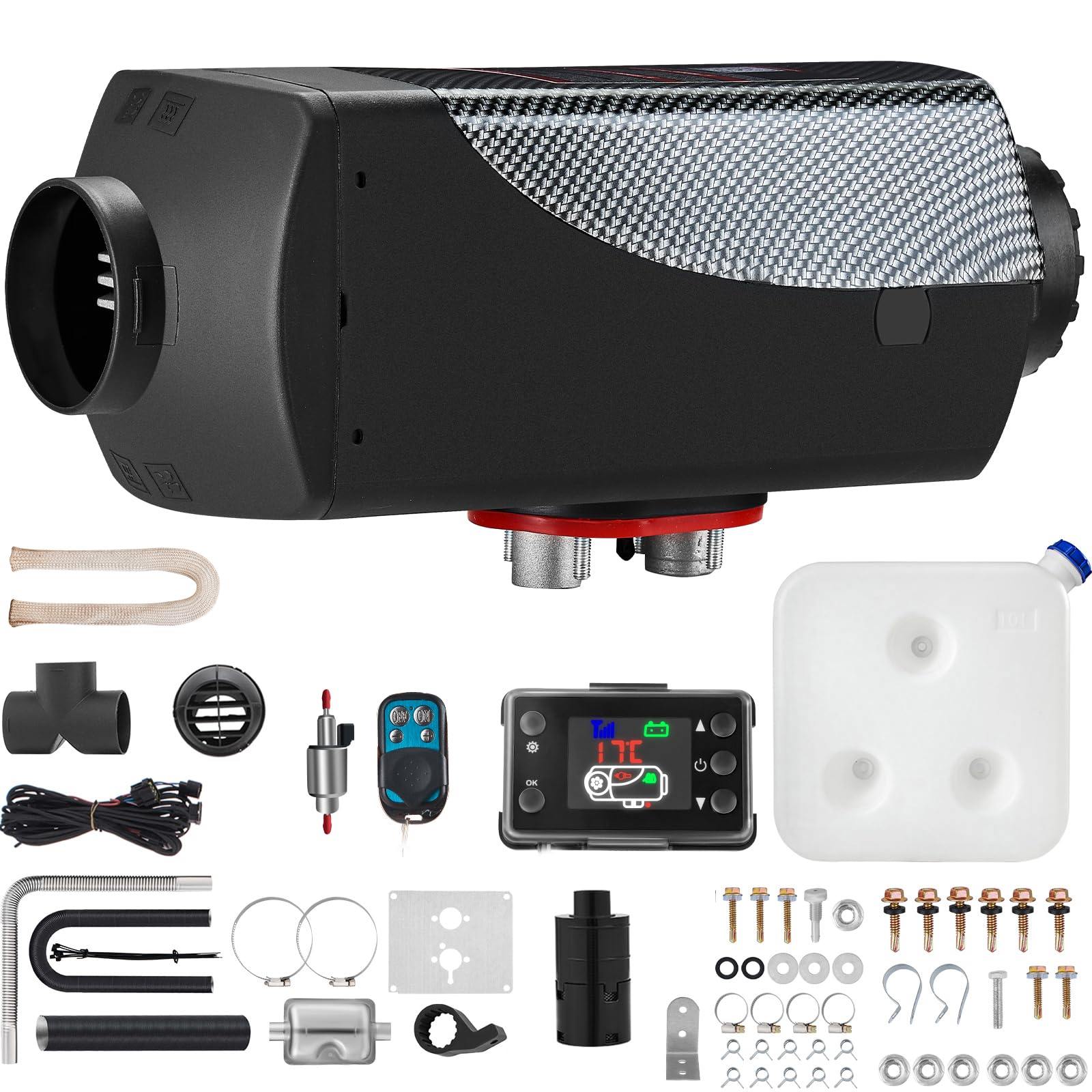
The VEVOR 8KW diesel air heater represents a completely different category from the electric plug-in units above. It burns diesel fuel to generate heat, which means it can produce substantial warmth without drawing from your vehicle’s electrical system beyond the 12V needed to run the fan and fuel pump. The unit includes a 10-liter fuel tank, oil pump, silencer, exhaust pipe, and full installation kit, making it a complete system for those willing to do the mounting work.
Operating temperature range extends from minus 40 degrees Fahrenheit up to 122 degrees Fahrenheit, which covers extreme cold conditions where electric heaters struggle. The LCD controller and remote allow you to set target temperatures between 46.4 and 96.8 degrees Fahrenheit with a control distance of up to 98 feet. Fuel consumption runs between 0.048 and 0.10 gallons per hour, meaning a full tank can provide heat for an entire night on roughly one gallon of diesel.
This is the right choice for RV owners, truck campers, boat cabins, and anyone who spends extended time in vehicles away from shore power. The installation requires routing exhaust and intake lines through the vehicle body, which takes mechanical skill, but the payoff is a heating system that works independently of your engine and maintains comfortable temperatures in subzero conditions.
What works
- Fuel-burning design works independently of engine or shore power
- Extreme cold capability down to minus 40 degrees Fahrenheit
- Low fuel consumption enables all-night operation on minimal diesel
What doesn’t
- Installation is labor-intensive and requires cutting vehicle panels
- Diesel exhaust must be routed safely away from cabin air intakes
3. Saihisday 12V Car Auxiliary Heater

The Saihisday auxiliary heater is a permanent underdash solution that taps into your vehicle’s existing coolant system. It uses a powerful blower motor with four vent holes to push warm air from the engine’s heater core into the cabin, functioning as a secondary heater core that boosts output for defrosting and cabin comfort. The unit runs on 12V with an 8-amp draw, which is manageable for most vehicle electrical systems.
Installation requires connecting the unit to a 5/8-inch inner diameter water hose, which means you need to splice into your heater core lines. The kit includes a three-speed control switch with specific wiring instructions for the red, blue, and black wires. This is not a plug-and-play device; it assumes you have basic mechanical knowledge and the tools to route hoses and secure the housing under the dashboard.
Once installed, the extra airflow and four-port distribution make a noticeable difference in how quickly the windshield clears and how evenly heat spreads across the cabin. It is especially useful for larger vehicles like vans and SUGs where the factory heater struggles to reach the rear seating areas.
What works
- Taps into engine coolant for genuine hot air, not electric resistance heat
- Four-port design distributes airflow better than single-vent units
- Three-speed fan control lets you match output to conditions
What doesn’t
- Requires mechanical installation and coolant hose splicing
- Water hoses and fittings are not included in the package
4. Brightown 800W Plug In Heater
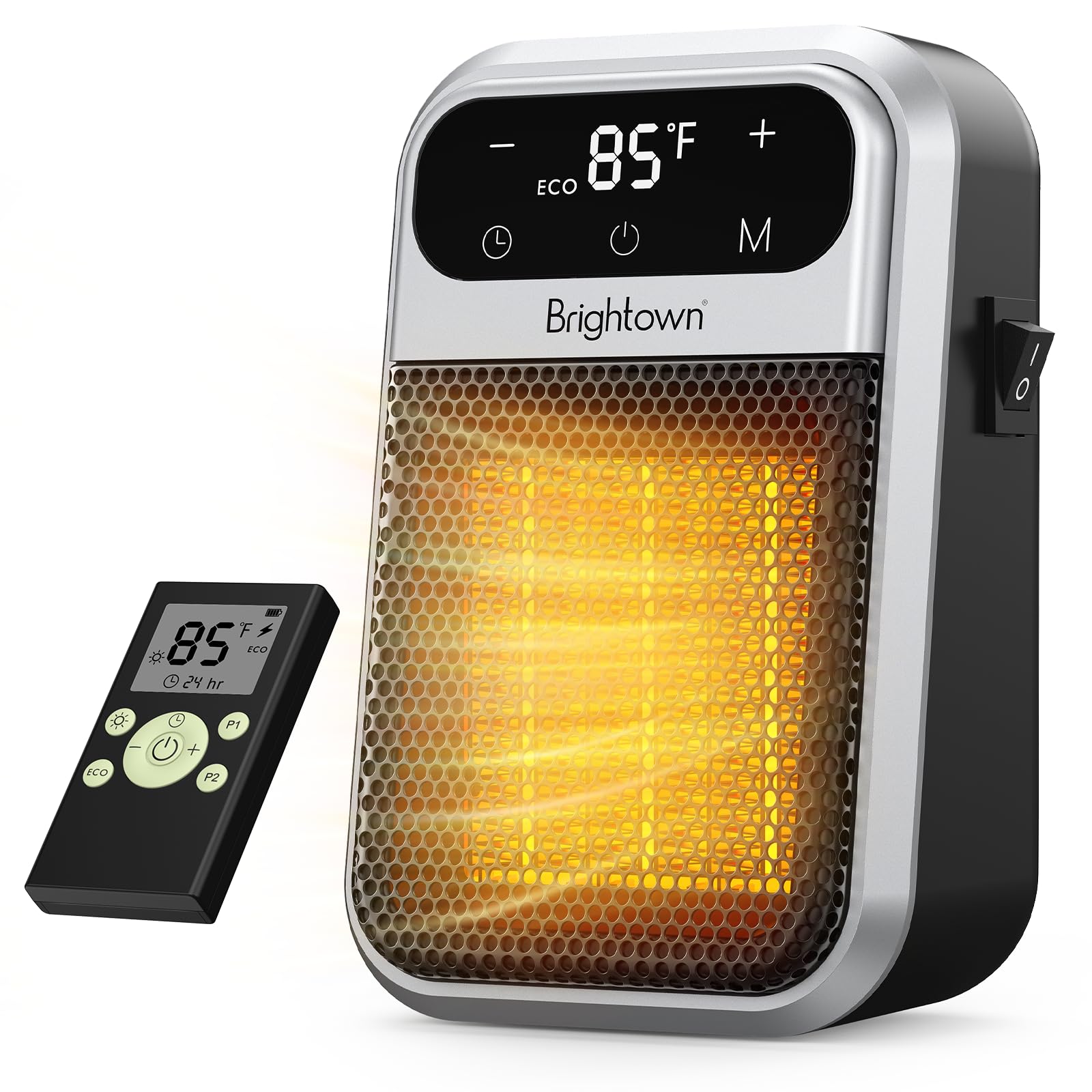
The Brightown plug-in heater solves a simple spatial problem that many wall-mounted heaters ignore: the plug itself. Its 180-degree rotating plug lets you orient the unit vertically or horizontally depending on whether your outlet is mounted sideways or upside down, which eliminates the cord strain and awkward angles common with fixed-plug designs. At just 3.9 by 3.5 by 6.5 inches, it barely protrudes from the wall and takes up zero floor space.
The 800-watt output heats rooms up to about 100 square feet, making it suitable for bathrooms, home offices, dorm rooms, and garages. The forced-air system operates below 40 decibels, so it will not interfere with phone calls or sleep. Safety features include overheat protection, flame-retardant housing, and a 12-hour timer. The included remote control lets you adjust temperature and timer settings from across the room.
For automotive settings, this unit works well in a garage or workshop where you have a standard 120V outlet available. It is not designed for 12V vehicle use, but its compact form factor and low profile make it easy to pack and use in any indoor space that needs supplemental heat.
What works
- Rotating plug design accommodates any outlet orientation
- Ultra-compact footprint frees up floor and counter space
- Near-silent operation below 40 dB suits sleep and work environments
What doesn’t
- Limited to 100 square feet, not for large garages or open spaces
- Not a 12V device, requires household AC power to operate
5. VOCRS 1500W PTC Electric Heater
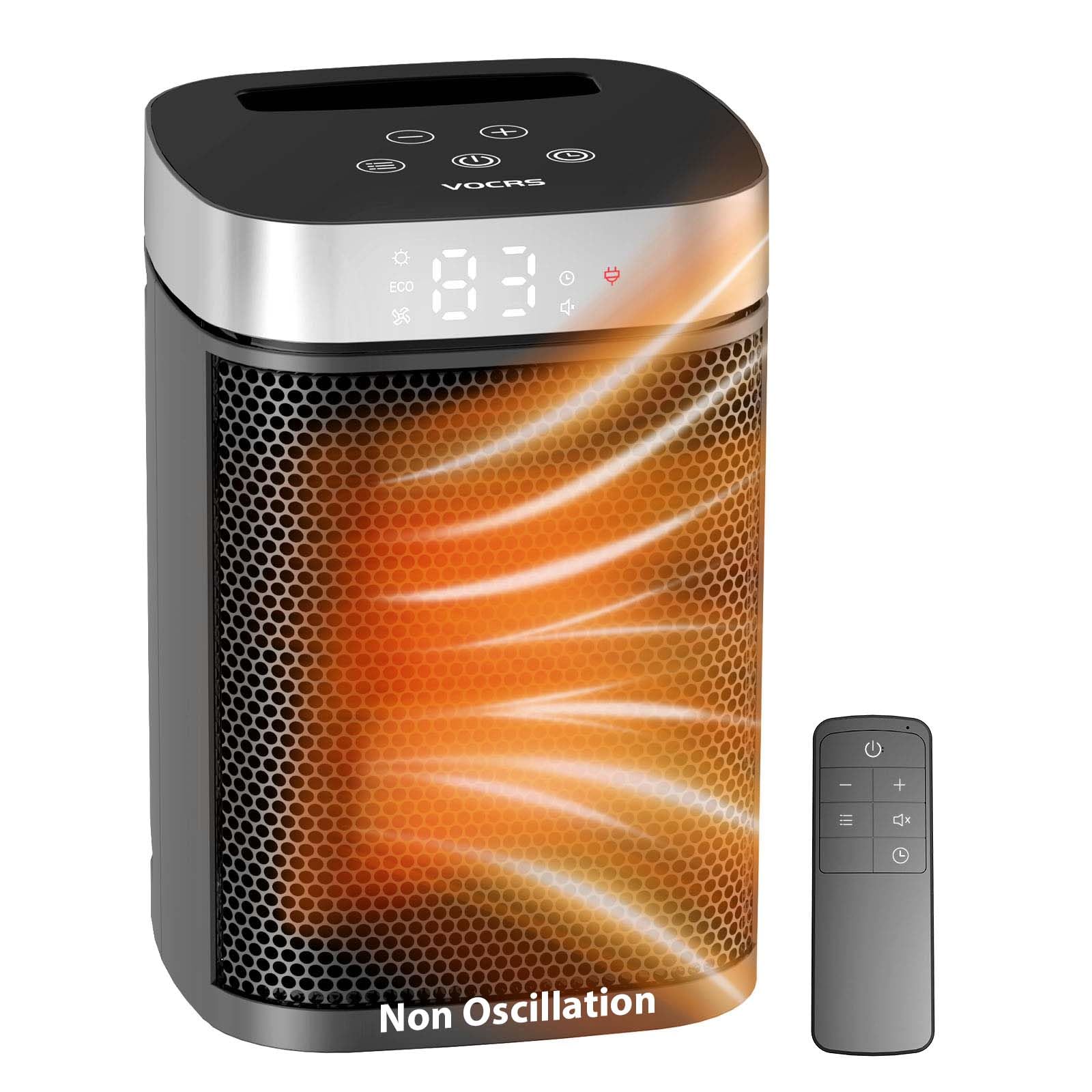
The VOCRS 1500W PTC heater offers three selectable power levels—700 watts, 1000 watts, and 1500 watts—letting you match heat output to room size and energy budget. This flexibility is rare at this price point, where most competitors offer only a single high-output setting. The unit covers up to 200 square feet, which puts it in the same coverage class as heaters costing significantly more.
Safety features include ETL certification, overheat protection, and tip-over automatic shutoff. The built-in carry handle makes it easy to move between rooms, and the 12-hour timer allows you to program operation windows so the heater runs only when needed. The remote control works for all major functions including mode switching and temperature adjustment.
For anyone using a garage, basement, or home office as a workspace on cold days, this heater delivers strong performance per dollar. It is not a vehicle cabin heater, but it pairs well with an inverter setup if you need heat in a workshop or camping shelter that has AC power available.
What works
- Three power settings allow precise heat output scaling
- ETL certification with tip-over and overheat protection
- Integrated carry handle simplifies room-to-room portability
What doesn’t
- Not designed for 12V vehicle use without an inverter
- Tower form factor is stable but less compact than wall-mounted units
6. Portable Car Heater 12V 200W
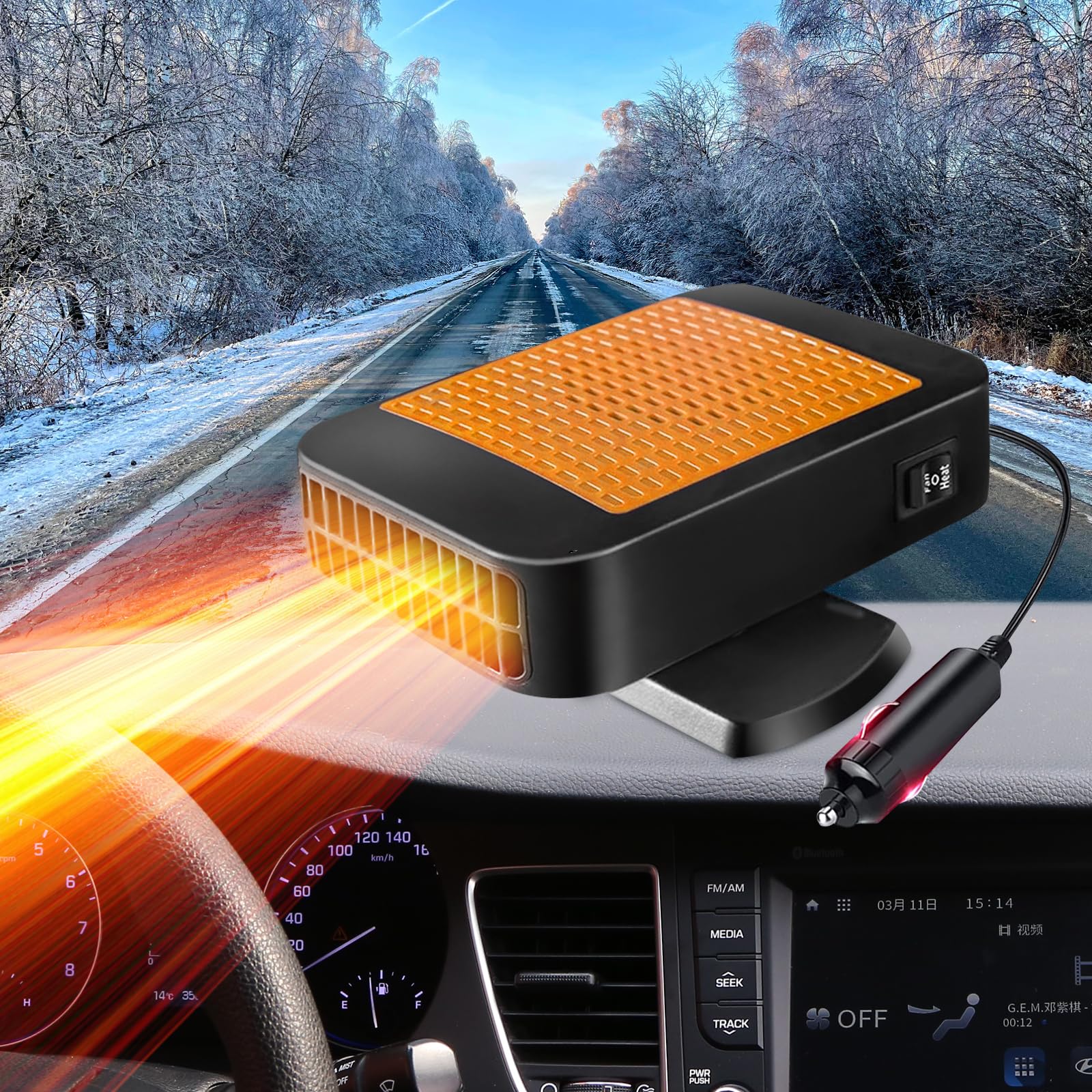
This 12V portable heater plugs directly into your vehicle’s cigarette lighter socket and delivers 200 watts of heat output aimed at windshield defrosting and localized cabin warmth. The 360-degree rotatable base lets you direct airflow toward the windshield for fog removal, toward the driver for personal warmth, or toward the passenger seat. At just 12.6 ounces, it stays put on the dashboard without blocking your view.
The unit uses high-quality ABS materials that resist heat deformation, and the pure copper cable minimizes voltage drop over the cord length. It is not designed to heat an entire cabin on its own, but it excels at clearing windshield condensation and frost within seconds of startup. Many owners report that it reduces the time they need to idle their engine before driving, which saves fuel and reduces cold-start wear.
This heater works best as a targeted defroster for drivers who need a quick fix for fogged or iced windows. It will not replace a functioning factory heater, but for older vehicles with weak defrost vents or for drivers who want to minimize warm-up idling, it solves a specific daily annoyance.
What works
- Zero-install operation plugs directly into any 12V auxiliary port
- 360-degree rotation targets airflow precisely where needed
- Lightweight ABS construction resists heat without adding bulk
What doesn’t
- 200-watt output is insufficient for heating an entire cabin
- Continuous use may draw down battery if engine is not running
7. Car Heater Portable 12V 2 in 1
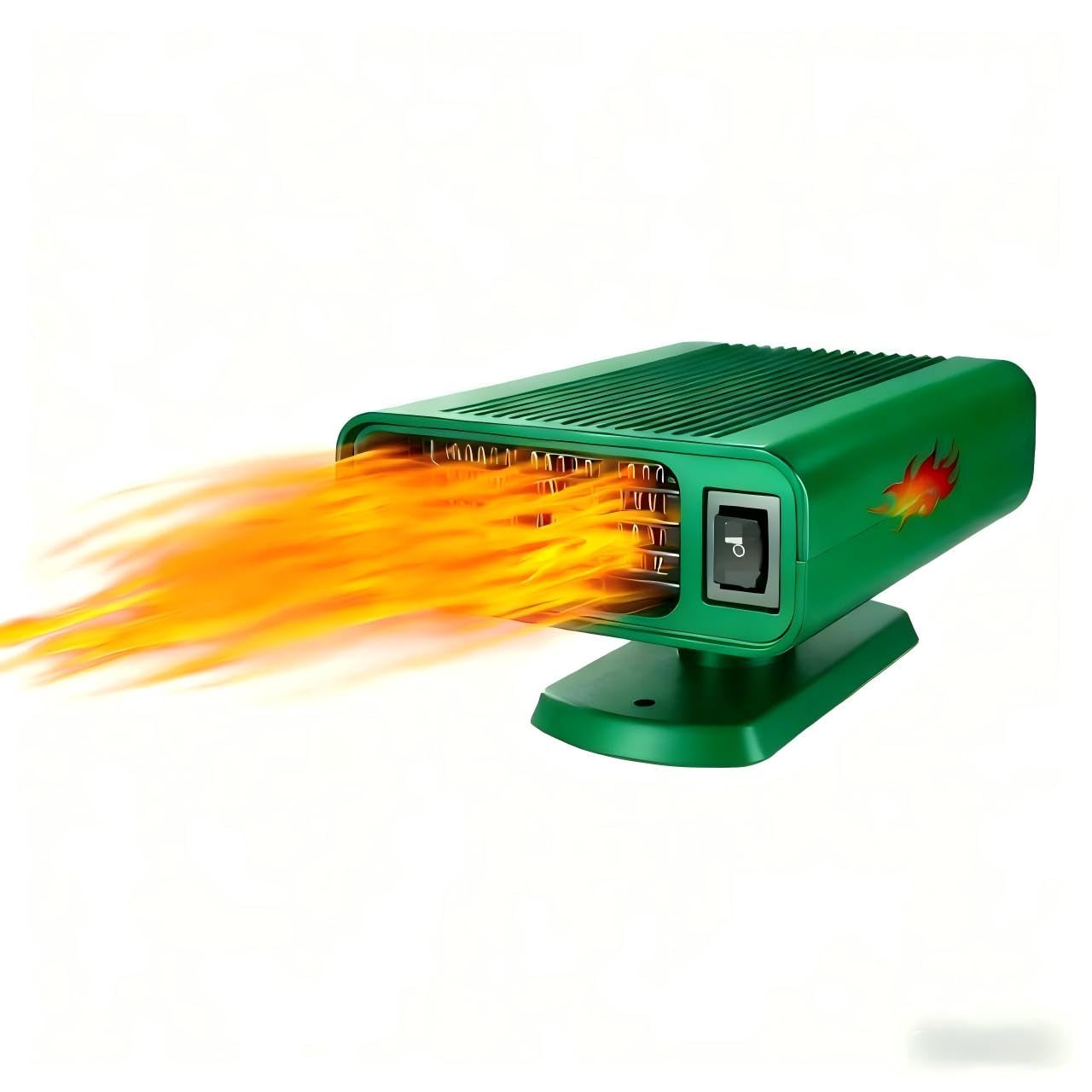
This 12V unit adds a cooling fan mode alongside its heating function, making it a year-round tool rather than a seasonal accessory. In winter, the heating setting clears frost, fog, and mist from the windshield, side windows, and rear window. In summer, the fan-only mode circulates cabin air to reduce stuffiness without running the air conditioning compressor full time.
The 360-degree rotary holder allows free adjustment of airflow direction, and the included non-slip mat keeps the heater from sliding during cornering. The unit is constructed from ABS and polymer heat-resistant hard plastic with a pure copper cable that protects your vehicle’s electrical system. Warm air begins flowing within about 30 seconds of power-on, which is fast enough to clear fog before you finish buckling your seatbelt.
For drivers who want a single device that handles both winter defrosting and summer ventilation, this 2-in-1 design eliminates the need to swap equipment seasonally. The build quality appears solid based on early owner reports, and the compact size means it stores easily in the glove box when not in use.
What works
- Dual heating and cooling functions provide year-round utility
- 30-second heat-up time clears fog faster than factory defrost
- Non-slip mat and 360-degree mount keep it stable during driving
What doesn’t
- Cooling mode is just a fan, not air conditioning
- Heating output is modest and best for windshield-only use
8. Stalwart Heated Car Blanket

The Stalwart heated blanket takes a different approach to vehicle warmth: instead of trying to heat the air around you, it heats you directly. The 12V fleece blanket plugs into your vehicle’s auxiliary power outlet and delivers gentle, even warmth across its 59 by 43-inch surface. The 60-inch cord reaches most seating positions, so rear passengers can also use it in SUVs and vans.
The buffalo check plaid pattern gives it a classic look that does not scream “car accessory,” and the included storage case with handles makes it easy to stow in the trunk or behind a seat. Spot cleaning is required since the heating elements prevent machine washing, but the fleece material resists pilling and holds up well to regular use.
This is one of the most energy-efficient ways to stay warm in a vehicle because it concentrates heat on your body rather than wasting energy trying to warm the entire cabin. For solo commuters, truck drivers, and campers who sit still for long periods, a heated blanket often provides more comfort per watt than any forced-air heater.
What works
- Direct body heating uses far less power than cabin air heaters
- Long cord reaches front and rear seating positions
- Compact folded size stores easily in emergency kits or trunks
What doesn’t
- Spot-clean only, no machine washing due to internal wiring
- Does not address windshield fogging or cabin air temperature
9. EVGATSAUTO 400-600W Car Heater

The EVGATSAUTO heater delivers 400 to 600 watts of heating power through three air outlets, with a dual-gear switch that lets you select between the two power levels. Unlike most 12V heaters that plug into the cigarette lighter, this unit requires a direct connection to the vehicle battery—red wire to positive, black wire to negative. This direct connection allows it to draw more current than a standard auxiliary port can supply, resulting in noticeably higher heat output.
The unit is constructed with high-quality iron materials and features a compact design that fits under dashboards or in confined spaces. The three outlets distribute airflow across a wider area than single-vent designs, which helps reduce hot spots and improves defrost coverage on the windshield. Noise levels are described as low, though forced-air operation is never completely silent.
This heater works best for owners who are comfortable with basic wiring and want more heat than a 12V socket can provide. The direct battery connection means you must ensure the wiring is fused and properly routed to avoid short circuits, but the payoff is heat output that approaches low-end household space heaters.
What works
- Battery-direct connection allows higher wattage than lighter socket units
- Three outlets distribute warm air more evenly than single-vent designs
- Dual-gear switch lets you choose between 400W and 600W output
What doesn’t
- Requires hardwiring to battery, not plug-and-play
- Owner reviews indicate inconsistent quality control across units
10. PiSFAU 200W Car Power Inverter

The PiSFAU 200W power inverter converts your vehicle’s 12V DC power into 110V AC power, which means you can run small household appliances including space heaters, laptops, and phone chargers from your car’s auxiliary port. The unit features two standard AC outlets, four USB charging ports, and a dedicated 20W USB-C fast-charging port. The compact design measures roughly the size of a smartphone at 2.7 by 1.4 by 5 inches.
This is not a heater itself—it is an enabler that lets you use AC-powered heaters and other devices in your vehicle. The 200-watt continuous output is enough to run a small personal heater, charge multiple devices simultaneously, or power lighting and electronics during camping trips. The unit includes multiple protection systems against overheating, undervoltage, overvoltage, overload, and short circuits.
For anyone who already owns a compact AC space heater and wants to use it on the road, this inverter provides a safe and portable way to do so. The silent operation and efficient circuit design mean you get usable AC power without audible whine or excessive battery drain at idle.
What works
- Enables use of any small AC appliance, including heaters, in your vehicle
- Included USB-C port charges laptops and tablets at full speed
- Multi-protection safety system guards against electrical faults
What doesn’t
- 200W limit restricts which heaters you can safely power
- Not an independent heat source, requires a separate heating device
11. ALLWIN Sound Deadening Insulation Mat

The ALLWIN sound deadening and heat insulation mat serves a different purpose than active heaters, but it directly affects how well your vehicle retains heat. This 394-mil thick closed-cell foam mat with aluminum foil facing blocks up to 98 percent of radiant heat transfer, which means engine heat stays in the engine bay during summer and cabin heat stays inside during winter. It is waterproof, odorless, and does not absorb moisture.
The 40 by 40-inch sheet covers 10.8 square feet and can be cut to fit hoods, firewalls, engine compartments, trunks, wheel arches, body panels, and floor pans. The self-adhesive backing simplifies installation, and the flexible material conforms to curved surfaces without needing a roller. Working temperature range spans from minus 40 to 300 degrees Fahrenheit, which covers both extreme cold and under-hood heat exposure.
This is a passive heat retention solution that works alongside any active heater. By reducing heat loss through the firewall and floor panels, it makes every watt your heater produces more effective. For anyone installing a high-output auxiliary heater, adding insulation first ensures that the heat stays inside the cabin rather than escaping through metal panels.
What works
- Blocks 98 percent of radiant heat transfer for better heat retention
- Waterproof closed-cell foam resists moisture and won’t absorb odors
- Flexible adhesive backing installs easily on curved or uneven surfaces
What doesn’t
- Not a heat source, only improves retention of existing heat
- Single 40×40 sheet may not cover an entire vehicle interior
Hardware & Specs Guide
PTC Ceramic Heating Elements
Positive Temperature Coefficient ceramic elements increase electrical resistance as they heat up, which creates a self-regulating effect that prevents overheating. This technology is safer than traditional nichrome wire coils because the element cannot exceed its design temperature even if the fan fails. PTC heaters also respond faster to thermostat changes and maintain more consistent output across varying ambient temperatures.
Wattage and Current Draw Calculations
A standard 12V vehicle auxiliary port is typically fused at 10 to 15 amps, which limits continuous power draw to about 120 to 180 watts. Exceeding that rating blows the fuse or damages the wiring. Heaters rated above 200 watts require a direct connection to the battery with an appropriately sized fuse and wire gauge. For 120V household heaters, most standard circuits deliver 1500 watts (12.5 amps at 120V) continuously without tripping a breaker.
Forced Air vs. Radiant vs. Convection Distribution
Forced air heaters use a fan to push air over a heated element, providing the fastest cabin warm-up but generating noise. Radiant heaters emit infrared energy that warms objects and people directly without moving air, which is silent but slower to raise ambient temperature. Convection heaters rely on natural air circulation and work best in small, enclosed spaces. For vehicle use, forced air is preferred for rapid defrosting, while radiant is better for maintaining comfort once the cabin is warm.
Combustion Heater Safety Considerations
Diesel and gasoline-fired heaters burn fuel inside a sealed combustion chamber and exhaust the fumes outside the vehicle. Critical safety elements include a properly routed exhaust pipe that terminates outside the vehicle envelope, a fuel pump that shuts off automatically if the flame extinguishes, and a carbon monoxide sensor inside the cabin. These heaters are far more powerful than electric units but demand careful installation and regular maintenance of the burner nozzle and glow plug.
FAQ
Can a 12V plug-in heater actually warm a car cabin?
Is it safe to leave a plug-in heater running overnight?
What is the difference between a car heater and a car defroster?
How do I know if my vehicle’s electrical system can handle a plug-in heater?
What size heater do I need for a standard garage or workshop?
Final Thoughts: The Verdict
For most buyers, the best auto plug-in heaters winner is the DREO Quiet Space Heater because it combines whisper-quiet PTC ceramic heating with precise thermostat control and wide oscillation at a reasonable price point. If you need true off-grid heat for RV or truck camping, grab the VEVOR 8KW Diesel Air Heater. And for quick windshield defrosting without installation work, nothing beats the Portable 12V Car Heater with 360-degree rotation.

Certification: BSc in Mechanical Engineering
Education: Mechanical engineer
Lives In: 539 W Commerce St, Dallas, TX 75208, USA
Md Amir is an auto mechanic student and writer with over half a decade of experience in the automotive field. He has worked with top automotive brands such as Lexus, Quantum, and also owns two automotive blogs autocarneed.com and taxiwiz.com.