Choosing the wrong panel bonding adhesive can mean delaminated seams, rust creeping in behind a failed bond, or a quarter panel that lets go at highway speed. Unlike body filler or seam sealer, a structural adhesive must resist impact, vibration, moisture, and thermal cycling over years of service. The chemistry behind these formulations — whether two-part epoxy, polyurethane, or hybrid urethane — determines working time, gap-fill capability, and ultimate tensile strength. Understanding those differences separates a repair that lasts from one that fails prematurely.
I’m Amir — the founder and writer behind Four Wheel Ask. My approach combines deep dives into material data sheets, cross-referencing substrate compatibility claims with real-world owner feedback across automotive forums and repair communities to identify which adhesives deliver on their specifications in actual collision and restoration work.
After studying material compatibility and feedback, the Polymix Metal Panel Bond 60 is the best automotive panel bonding adhesive for structural repairs.
How To Choose The Best Automotive Panel Bonding Adhesive
Selecting the right panel bonding adhesive starts with understanding the substrate you are joining and the load the bond must carry. Steel, aluminum, SMC, fiberglass, and various plastics each require specific adhesion promoters and cure kinetics. Beyond chemistry, working time, viscosity, and the need for mechanical reinforcement all influence whether a given product is right for your repair.
Chemistry: Epoxy vs. Urethane vs. Hybrid
Two-part epoxy adhesives offer the highest tensile strength and excellent gap-fill properties, making them ideal for structural panel replacements where welding was traditionally used. Polyurethane adhesives provide superior flexibility and vibration dampening, which suits glass-to-frame bonding and plastic bumper repairs. Hybrid formulations attempt to bridge both worlds, but generally sacrifice peak strength for versatility. Match the chemistry to the specific strain the joint will encounter.
Working Time and Cure Speed
Open time dictates how long you have to position panels before the adhesive begins to set. Fast-cure products with five to fifteen minute working times suit small repairs where clamping is straightforward. Slower-cure adhesives with thirty to sixty minutes of open time allow complex assemblies or multi-panel alignments. Full cure to structural strength typically takes twenty-four hours regardless of working time, though some urethanes reach handling strength within two hours.
Viscosity and Sag Resistance
Low-viscosity adhesives flow into tight joints and work well for vertical panel seams when combined with mechanical fasteners. High-viscosity, non-sag formulations stay in place on vertical surfaces without running, which matters when bonding door skins or roof panels where gravity works against you. Thicker adhesives also fill larger gaps, but require more clamping force to achieve a thin bond line.
Substrate Compatibility and Surface Prep
No adhesive performs well on contaminated or improperly prepared surfaces. Bare metal requires abrasion to bare substrate and immediate cleaning with solvent. Painted surfaces need complete removal of loose coatings. Plastics and composites often require specific adhesion promoters or primers included in the kit. Products that include spacer beads for consistent bond line thickness simplify achieving correct glue-line depth without guesswork.
Quick Comparison
On smaller screens, swipe sideways to see the full table.
| Model | Category | Best For | Key Spec | Amazon |
|---|---|---|---|---|
| Polymix Metal Panel Bond 60 | Epoxy | Structural panel replacement | 3335 PSI tensile, 24 hr cure | Amazon |
| 3M 38315 Panel Bonding | Epoxy | Multi-substrate OEM repair | 47.5 mL net fill, glass bead tech | Amazon |
| Buck Panel Bonding 400 mL | Epoxy | Large-volume panel bonding | 400 mL cartridge, 45 min cure | Amazon |
| Maxi-Bond MB-835 | Epoxy | Non-sag vertical bonding | 200 mL, high-viscosity paste | Amazon |
| SEM 39747 Multi-Purpose | Epoxy | Consistent bond line thickness | 7 oz can, spacer bead tech | Amazon |
| Norton SpeedGrip Urethane | Urethane | Plastic bumper and trim repair | 3500 PSI, 45 min fast cure | Amazon |
| LAUCO Dual Cartridge Gun | Dispenser | 200 mL epoxy and urethane | Steel frame, 1:1 & 2:1 ratios | Amazon |
| DAFEIKE 200 mL Epoxy Gun | Dispenser | 3M 200 mL cartridge dispensing | Metal frame, 1:1 & 2:1 | Amazon |
| LUORIN Epoxy Gun 200 mL | Dispenser | Heavy-duty professional use | Full-metal frame, high-thrust | Amazon |
| HAOXAOON Seam Sealer 2 Pack | Urethane | Seam sealing and gap filling | 10.5 oz tube, 24 hr cure | Amazon |
| Calvana Windshield Adhesive | Urethane | Glass frame and window bonding | 310 mL, 2 hr fast cure | Amazon |
In‑Depth Reviews
1. Polymix Metal Panel Bond 60 Adhesive 200 mL

The Polymix Metal Panel Bond 60 is a two-part urethane adhesive engineered specifically for bonding steel and aluminum panels in structural automotive repairs. Its primary application is replacing quarter panels, roofs, box sides, van sides, utility vehicle sides, and door skins — exactly the jobs where weld distortion and heat damage are common concerns. The adhesive eliminates the need to remove internal panels, rubber gaskets, or disconnect electronic systems, and it self-seals so no additional seam sealer is required.
With a tensile strength rating of 3335 PSI and a twenty-four-hour full cure cycle, this adhesive provides a bond strength that competes with spot welding while avoiding the thermal deformation that warps thin-gauge sheet metal. Users consistently report that the working time is generous enough to allow panel fitment and adjustment before the material sets. The 200 mL cartridge delivers enough material for multiple smaller repairs or a single large panel bond.
Owner feedback across restoration forums highlights consistent mixing ratios, reliable cure behavior, and adhesion that holds up to grinding and subsequent body filler application. Some professionals with years of experience using big-brand alternatives note that Polymix performs equally well at a more accessible investment point, making it a smart choice for serious DIY restorers and smaller body shops alike.
What works
- High tensile strength competes with weld integrity
- Self-sealing eliminates need for additional seam sealer
- No heat distortion compared to welding
- Generous working time for panel alignment
What doesn’t
- Requires a 200 mL dual-cartridge dispenser gun
- Full cure takes 24 hours before sanding or loading
2. 3M Panel Bonding Adhesive 38315 50 mL

The 3M 38315 is a two-part epoxy adhesive formulated to bond steel, aluminum, SMC, and traditional fiberglass non-structural components. It also serves to reinforce welded or riveted structural joints. The formulation incorporates glass bead technology that ensures a consistent bond line thickness — a critical detail for achieving uniform strength across the entire joint area without starved or over-thick glue lines.
The 50 mL cartridge is intentionally compact, which suits small repairs such as reattaching headlight mounting tabs, reinforcing brackets, or bonding small trim pieces. Users note that the adhesive is very tacky and grabs immediately upon contact, making it difficult to slide or adjust panels after the two surfaces meet. This characteristic works well for small parts where positioning is straightforward but becomes a limitation for larger panels requiring fine alignment.
Long-term owner reports confirm that bonds hold securely for years when surface preparation follows instructions — bare, roughened metal with no contamination. Experienced restorers emphasize that this product forms a waterproof barrier and effectively replaces welding for many non-structural applications, eliminating the need to burn off protective coatings or manage heat warpage on thin metal.
What works
- Glass bead technology ensures consistent bond line
- Immediate grab reduces need for complex clamping
- Bonds multiple substrate types effectively
- Trusted by body shops for decades
What doesn’t
- Small 47.5 mL net fill limits coverage area
- No repositioning possible once surfaces contact
3. Buck Panel Bonding Adhesive 400 mL

The Buck Panel Bonding Adhesive delivers a two-part epoxy formula in a 400 mL cartridge — roughly twice the volume of most standard panel bond cartridges. This larger capacity is designed for jobs that consume significant adhesive, such as full roof skins, box sides, or multiple door skins on the same vehicle. The formulation meets OEM standards and is marketed as a direct replacement for 3M 08115 and similar epoxy adhesives.
Cure behavior at room temperature eliminates the need for heat lamps or ovens, and the adhesive resists chemicals, water, and corrosion once fully cured. The kit includes three static mixing nozzles, which is helpful because the high-volume cartridge can empty quickly once dispensing begins. Users note that a 400 mL gun is required — standard 200 mL dispensers will not fit the larger cartridge format.
Feedback from owners performing functional repairs — not show-quality restorations — highlights the value of getting twice the product for a similar investment compared to smaller cartridges from major brands. The bond holds up well under impact and vibration, and the working time is adequate for aligning larger panels before the adhesive begins to set. Some users recommend using dimple-die rivets for additional mechanical fastening on structural seams.
What works
- Twice the volume of standard 200 mL cartridges
- OEM-grade chemical and corrosion resistance
- Three mixing nozzles included in the kit
- Room-temperature cure simplifies workflow
What doesn’t
- Requires dedicated 400 mL cartridge gun
- Not compatible with standard 200 mL dispensers
4. Maxi-Bond Panel Bonding Adhesive MB-835 200 mL

The Maxi-Bond MB-835 is a two-part epoxy system formulated with a non-sag property that keeps the adhesive stable on vertical and contoured surfaces without dripping or running. This makes it particularly useful for bonding door skins, quarter panels, and other body panels where gravity would cause thinner adhesives to flow away from the joint. The 200 mL dual cartridge includes static mixing nozzles for air-free dispensing.
Substrate compatibility spans steel, aluminum, fiberglass, plastic, and composite materials, giving it broad utility across different vehicle types and repair scenarios. The high-viscosity paste consistency fills minor gaps without requiring shims or excessive clamping pressure, though users should factor that a dedicated epoxy gun is necessary — manual plunger-style dispensers struggle with the thick material.
Experienced restorers report that the cured bond is rock solid and machines well with grinders and sanders, blending seamlessly into surrounding panels. Feedback notes that this adhesive is particularly effective for fiberglass repairs on classic truck and car bodywork, where achieving structural integrity without heat distortion is critical. The one-hour working time variant provides enough flexibility for complex assemblies.
What works
- Non-sag formula stays on vertical surfaces
- Broad compatibility with metals and plastics
- Sands and machines well after cure
- Good gap-fill properties at high viscosity
What doesn’t
- Requires a high-mechanical-advantage epoxy gun
- One-hour working time variant is not universal
5. SEM 39747 Multi-Purpose Panel Adhesive 7 oz
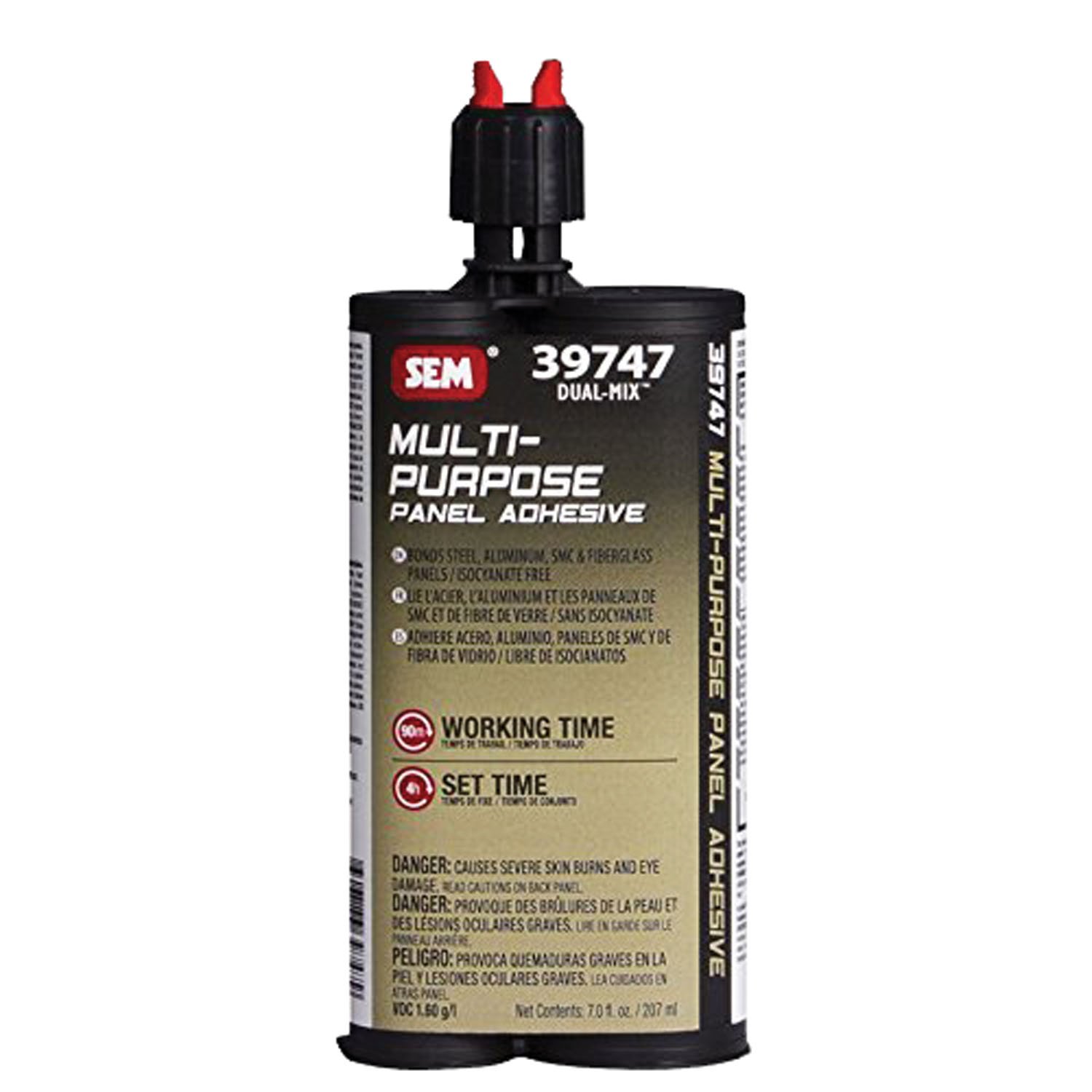
The SEM 39747 Multi-Purpose Panel Adhesive is a two-part epoxy packaged in a 7 oz can format rather than a cartridge. Its key design feature is the inclusion of glass microspheres that act as spacer beads, ensuring a consistent bond line thickness regardless of clamping pressure. This eliminates the guesswork of achieving proper glue-line depth, which directly impacts joint strength and corrosion resistance.
The long working time enables careful panel positioning before the adhesive begins to set, which matters for complex assemblies or one-person repairs. Once cured, the material provides high impact resistance and bonds to fiberglass, metal, and various plastics. Users on restoration forums consistently report that the thicker consistency of SEM outperforms thinner, runnier budget alternatives that create mess and require cleanup.
Feedback from owners repairing door panels on older Honda and Toyota models confirms that the adhesive creates a stiff, durable bond that resists flexing and vibration. Some users note that leftover material in the mixing nozzle can be allowed to harden, allowing the nozzle to function as a cap for future use. The glass microspheres do create a slightly different sanding feel compared to pure epoxy, but the trade-off for consistent bond line thickness is well worth it.
What works
- Glass microspheres guarantee consistent bond line
- Long working time suits complex repairs
- Thick consistency avoids dripping and mess
- High impact resistance after full cure
What doesn’t
- Can format requires specific application technique
- Microspheres alter sanding feel slightly
6. Norton SpeedGrip Urethane Structural Adhesive

The Norton SpeedGrip Urethane Structural Adhesive is a two-part 1:1 urethane system designed for structural and cosmetic repairs on plastic bumpers, bumper tabs, emblems, door trims, interior and exterior plastic parts, TPE, TPO, TEO, PP, ABS, SMC, and fiberglass panels. This broad plastic compatibility makes it a go-to choice for modern vehicles where traditional epoxy may not bond adequately to low-surface-energy substrates.
With a tensile strength of 3500 PSI and a full cure time of 45 minutes, SpeedGrip delivers fast handling strength that speeds up repair cycles. The urethane chemistry remains flexible after cure, absorbing impact without cracking — a critical property for bumper repairs that must survive minor collisions without bond failure. The material can be sanded to a feather edge, allowing seamless blending with surrounding panels.
Users in automotive repair settings report that the adhesive bonds aggressively and sets quickly, requiring careful alignment before application. The fast cure is a double-edged sword: it enables rapid workflow but leaves little room for repositioning. Owners of semi trucks and heavy equipment have successfully used SpeedGrip for hood bracket repairs, citing the quick turnaround and durable hold as key advantages over slower-curing alternatives.
What works
- Excellent bond to low-surface-energy plastics
- Fast 45-minute cure speeds repair cycles
- Flexible urethane absorbs impact without cracking
- Sands to feather edge for seamless blending
What doesn’t
- Fast working time leaves minimal adjustment window
- Requires additional mixing nozzles for multiple uses
7. LAUCO Dual Cartridge Epoxy Gun 200 mL
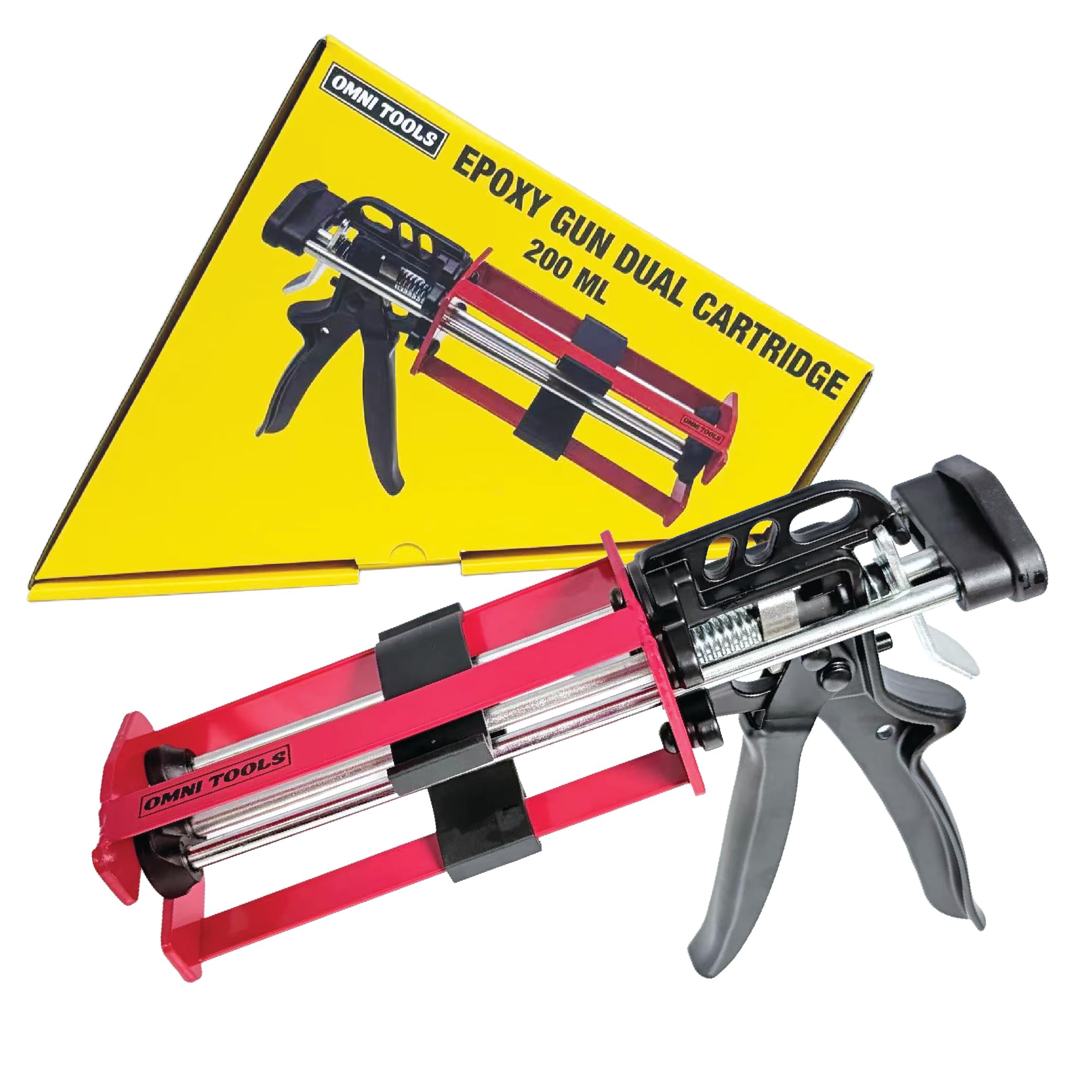
The LAUCO Dual Cartridge Epoxy Gun is a manual adhesive applicator engineered for 200 mL and 215 mL cartridges with both 1:1 and 2:1 mix ratios. Heavy-duty steel construction sets it apart from plastic-body dispensers that flex or fail under the pressure required to push high-viscosity structural adhesives. The reinforced body and trigger deliver smooth, reliable flow suitable for body shop and industrial environments.
The ergonomic grip reduces hand fatigue during extended dispensing sessions, and the tool accepts standard static mixing nozzles for clean, air-free material mixing. Users who have paired this gun with 3M, Polymix, and other 200 mL cartridges report flawless compatibility and consistent plunger pressure without slipping or binding. The 2:1 ratio capability is particularly useful for adhesives that require different component proportions than the more common 1:1 systems.
Professionals and serious DIY enthusiasts note that having a dedicated quality dispenser gun significantly improves application consistency compared to improvised solutions. The LAUCO gun delivers the mechanical advantage needed for thick pastes and urethanes, ensuring complete evacuation of the cartridge and proper mix ratio throughout the entire bead. Several owners mention that the build quality exceeds expectations for the investment.
What works
- Heavy-duty steel frame resists flexing under load
- Compatible with both 1:1 and 2:1 cartridges
- Ergonomic grip reduces hand fatigue
- Works reliably with major brand cartridges
What doesn’t
- Designed only for 200-215 mL cartridge sizes
- Mixing nozzles sold separately
8. DAFEIKE 200 mL Dual Component Epoxy Gun

The DAFEIKE 200 mL Dual Component Epoxy Gun is purpose-built for 3M 200 mL cartridges including models 08115, 08116, 08217, 08223, and similar. The metal frame exceeds expectations for a gun at this level — users describe the frame material as over a quarter-inch thick, with no flex or slop in the trigger mechanism. The heat-treated pushing rod and thick pushing plate ensure even pressure across the cartridge plungers.
Owners who purchased this gun specifically for 3M Panel Bond adhesive report that the cartridge fits exactly with zero wobble, and the trigger delivers smooth, controllable output without the jerky motion common in cheaper dispensers. The gun handles both 1:1 and 2:1 ratio cartridges without requiring any mechanical adjustment, which simplifies switching between different adhesive chemistries during a single job.
Feedback from body shop technicians and restoration enthusiasts consistently praises the build quality as genuinely heavy-duty rather than the flimsy construction typical of budget guns. One owner used it to bond a roof skin on a 1999 Mustang GT and confirmed the gun performed without any issues through the entire 200 mL cartridge. The robust construction suggests this tool will outlast multiple adhesive cartridges without degradation.
What works
- Exceptionally thick, rigid metal frame
- Perfect fit for 3M 200 mL cartridges
- Smooth trigger with no flex or binding
- Handles both 1:1 and 2:1 ratios seamlessly
What doesn’t
- Designed exclusively for 200 mL cartridges
- Overbuilt for lighter-duty applications
9. LUORIN Epoxy Gun Dual Component 200 mL

The LUORIN Epoxy Gun is a full-metal-frame manual applicator designed for 200 mL dual-component cartridges at both 1:1 and 2:1 ratios. The high-thrust mechanism delivers steady adhesive flow with less effort than standard caulking gun designs, which matters when dispensing thick structural epoxy or urethane pastes. Rubber-coated handle and quick-release tab improve comfort and prevent slipping during extended use.
The gun accommodates popular adhesive formulations including epoxy, urethane, and acrylic, making it versatile for panel bonding, structural epoxy, plastic repair, fiberglass work, and gap filling. The metal construction stands up to demanding shop environments where plastic dispensers would crack or deform under repeated use. The included plunger pads engage the cartridge evenly, reducing the risk of one side dispensing faster than the other.
User feedback highlights the value proposition — several owners report that the LUORIN gun performs identically to professional-grade dispensers at a more accessible investment point. Some users experienced initial slipping with the first unit received, but the manufacturer replaced it promptly, suggesting commitment to customer satisfaction. The compact size helps access tight spaces in engine bays or between body panels.
What works
- Full-metal frame provides genuine durability
- High-thrust mechanism reduces dispensing effort
- Rubber-coated grip improves comfort and control
- Compact size fits in confined work areas
What doesn’t
- Occasional quality control issues with first units
- Limited to 200 mL cartridge format only
10. HAOXAOON 2 Pack Polyurethane Seam Sealer 10.5 oz

The HAOXAOON Polyurethane Seam Sealer is a single-component urethane formulated for sealing seams, gaps, and joints on automotive, truck, boat, and RV bodies. Unlike two-part structural adhesives, this product is designed primarily as a seam sealer and gap filler rather than a load-bearing panel bond. The low-odor formula resists shrinking and cracking, and it remains flexible after cure to accommodate thermal expansion and vibration.
With a service temperature range of -40 to 170 degrees Fahrenheit and full cure achieved in 24 hours, this sealer suits both interior and exterior applications where weatherproofing is the primary concern. The material bonds to bare metal and painted surfaces, and it can be painted over with polyurethane paint after scuffing the cured surface. The two-pack format provides practical value for covering multiple seams or completing larger sealing projects.
Owner feedback consistently rates the value favorably, with users noting that the performance matches name-brand seam sealers at a more accessible investment. The material sets up nicely and creates a factory-like seal and finish when applied carefully. Some users caution that the product will dry inside the tube if not used promptly, so planning the application sequence to consume the entire tube in one session is recommended.
What works
- Non-shrink, non-crack formula maintains seal integrity
- Paintable after 24-hour cure with proper scuffing
- Two-pack provides good coverage value
- Works on bare metal and painted surfaces
What doesn’t
- Not a structural panel bonding adhesive
- Will dry in tube if not used promptly
11. Calvana Urethane Windshield Adhesive 310 mL
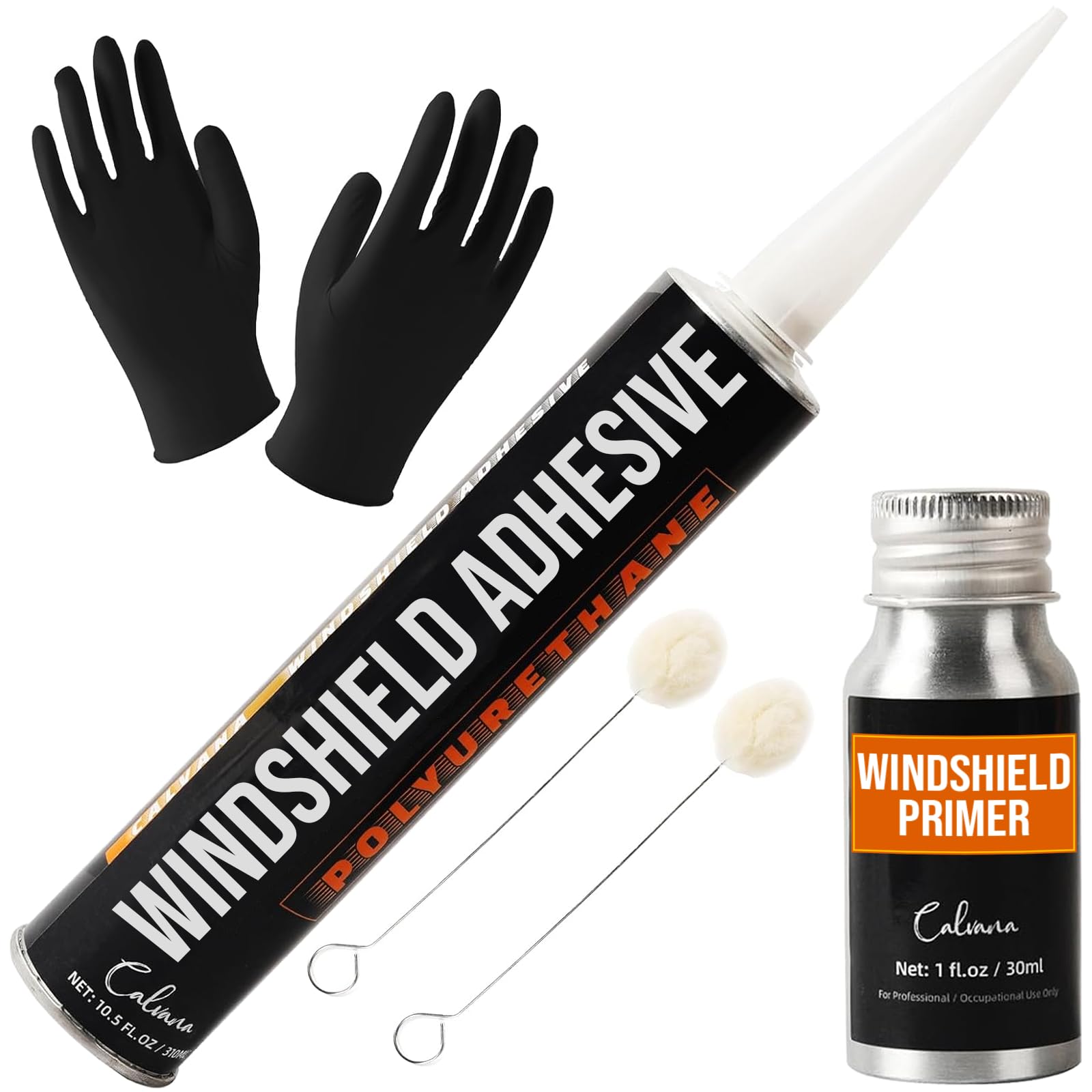
The Calvana Urethane Windshield Adhesive is a polyurethane sealant with a 310 mL capacity, designed for bonding windshields, rear windows, sunroofs, headlights, taillights, and other automotive glass components. The formulation features non-sag properties that keep the adhesive in place on angled glass surfaces, and the moisture-curing chemistry provides reliable adhesion in humid and high-temperature conditions. The kit includes one windshield primer, gloves, two applicator sticks, and a mixing tip.
With a full cure time of two hours, this adhesive allows vehicles to return to service faster than traditional 24-hour cure options. The high-viscosity formula fills gaps effectively and absorbs vibrations from high-speed driving and road impacts. The primer prepares the glass surface for optimal adhesion, which is critical for windshield installations where bond failure creates safety hazards.
User reports from automotive enthusiasts and small shop owners confirm that the adhesive performs comparably to premium brands at a more accessible investment point. The included primer is noted as thin and fast-drying — gloves are essential during application. Some users found the adhesive extremely thick and difficult to dispense with standard caulking guns, recommending a high-mechanical-advantage gun for easier handling.
What works
- Fast two-hour cure reduces vehicle downtime
- Non-sag formula works on vertical glass surfaces
- Includes primer and applicator accessories
- Competes with premium brands at lower investment
What doesn’t
- Extremely thick, needs high-mechanical-advantage gun
- Primer dries very fast and can be messy
Hardware & Specs Guide
Tensile Strength
Tensile strength measures the maximum stress an adhesive can withstand while being pulled apart before breaking. For structural panel bonding, higher tensile strength — typically above 3000 PSI — indicates the adhesive can resist the loads a welded joint would normally handle. Lower tensile values around 1500-2000 PSI are acceptable for non-structural sealing and trim attachment but not for load-bearing panel replacements.
Full Cure Time
Full cure time is the period required for the adhesive to reach its maximum mechanical properties. Fast-cure formulations achieve handling strength in 45 minutes to 2 hours, enabling quicker return to service. Standard-cure adhesives require 24 hours to reach full structural strength. Working time within that cure window dictates how long you can adjust panels before the adhesive becomes too tacky to move.
Viscosity and Sag Resistance
Viscosity describes the adhesive resistance to flow. Low-viscosity materials flow readily into tight joints but may drip from vertical surfaces. High-viscosity, non-sag pastes stay in place on door skins, roof panels, and quarter panels without running. Sag resistance is critical for vertical seams where gravity would pull thinner adhesive out of the joint before it cures.
Substrate Compatibility
Different adhesives bond differently to steel, aluminum, SMC, fiberglass, ABS, TPO, and other plastics. Epoxy adhesives generally excel on metal and fiberglass but may not bond to low-surface-energy plastics without primers. Urethane adhesives offer better plastic compatibility and flexibility. Always verify that the adhesive specification includes your specific substrate material before application.
FAQ
Can panel bonding adhesive replace welding entirely?
How should I prepare surfaces before applying panel adhesive?
What does bond line thickness mean and why does it matter?
Do I need a special gun for dual-cartridge panel adhesives?
Can I paint over cured panel bonding adhesive?
Final Thoughts: The Verdict
For most buyers, the best automotive panel bonding adhesive winner is the Polymix Metal Panel Bond 60 because it delivers 3335 PSI tensile strength, self-sealing capability, and eliminates heat distortion at a mid-range investment point. If you need a trusted brand with glass bead technology for consistent bond lines, grab the 3M 38315 Panel Bonding Adhesive. And for large-volume panel bonding with OEM-grade performance, nothing beats the Buck Panel Bonding Adhesive 400 mL.

Certification: BSc in Mechanical Engineering
Education: Mechanical engineer
Lives In: 539 W Commerce St, Dallas, TX 75208, USA
Md Amir is an auto mechanic student and writer with over half a decade of experience in the automotive field. He has worked with top automotive brands such as Lexus, Quantum, and also owns two automotive blogs autocarneed.com and taxiwiz.com.