Spec sheets lie. Owner reports do not. When a fleet manager or owner-operator spends tens of thousands of miles behind the same wheel, the oil they choose becomes the single most consequential decision for engine longevity. Thin-film strength, shear stability, and deposit control separate oils that merely meet a standard from those that actually protect under continuous high-load operation. The difference shows up in oil analysis reports, not marketing copy.
I’m Amir — the founder and writer behind Four Wheel Ask. My analysis focuses on cross-referencing technical specifications with real-world owner feedback to identify which heavy-duty engine oils consistently deliver on their performance claims across diverse operating conditions.
After examining hundreds of owner reports and lab data, the best engine oil for semi trucks delivers proven wear protection for heavy-duty diesel engines.
How To Choose The Best Engine Oil For Semi Trucks
Selecting the right engine oil for a semi truck goes far beyond grabbing a jug off the shelf. Heavy-duty diesel engines operate at sustained higher loads, produce significantly more soot, and place greater thermal stress on lubricants than light-duty engines. Understanding a few fundamental parameters ensures the oil you choose protects your investment over hundreds of thousands of miles.
Viscosity Grades: 15W-40 vs 5W-40
Viscosity is the single most important specification. SAE 15W-40 remains the standard recommendation for most over-the-road semi trucks operating in moderate to warm climates. It provides the film strength needed for main bearings and turbocharger bushings under continuous load. SAE 5W-40, typically a synthetic formulation, delivers superior cold-start protection for fleets operating in northern climates or seasonal temperature swings. The 5W rating flows more readily at low temperatures, reducing dry-start wear, while maintaining the same high-temperature protection as 15W-40.
API Service Categories: CK-4 vs CJ-4 vs FA-4
The American Petroleum Institute designates service categories that indicate backward and forward compatibility with emission control systems. CK-4 is the current standard for 2020 and earlier model year engines, designed to protect diesel particulate filters and selective catalytic reduction systems. CJ-4 remains acceptable for older engines but does not offer the same oxidation stability as CK-4 under modern EGR and high-soot conditions. FA-4 is a lower-viscosity category for newer engines specifically designed for fuel economy — never use FA-4 in an engine not explicitly approved for it. Always verify that the oil meets the API category specified in your owner manual.
Conventional vs Synthetic vs Synthetic Blend
Conventional oils provide adequate protection for well-maintained older engines on standard drain intervals, but they oxidize faster under extreme heat. Synthetic blend oils mix conventional base stocks with a portion of synthetic base oil to improve oxidation resistance and cold-flow properties at a moderate cost. Full synthetic oils offer the highest shear stability, the lowest volatility, and the best low-temperature pumpability. For semi trucks running extended drain intervals — anything beyond 25,000 miles — a full synthetic or premium synthetic blend is the prudent choice to maintain viscosity grade and deposit control throughout the service life.
OEM Specifications and Approvals
Beyond API categories, engine manufacturers publish their own specifications that include additional bench tests and field-validation criteria. Cummins CES 20086, Detroit Diesel DFS 93K222, Mack EOS-4.5, and Volvo VDS-4.5 are common approvals for heavy-duty diesel oils. Using an oil that carries the specific approval for your engine ensures it has passed wear, aeration, and soot-handling tests that generic API certification does not cover. Oils that meet multiple OEM specs provide flexibility for mixed-fleet operations.
Quick Comparison
On smaller screens, swipe sideways to see the full table.
| Model | Category | Best For | Key Spec | Amazon |
|---|---|---|---|---|
| Shell Rotella T4 Triple Protection 15W-40 | Conventional | Proven all-around fleet protection | 15W-40, API CK-4 | Amazon |
| Mobil 1 Turbo Diesel Truck 5W-40 | Full Synthetic | Premium cold-start protection | 5W-40, API CK-4 | Amazon |
| Valvoline Heavy Duty Full Synthetic 15W-40 | Full Synthetic | Valve train wear reduction | 15W-40, API CK-4 | Amazon |
| Chevron Delo 400 XSP 5W-40 | Full Synthetic | Sub-zero starting reliability | 5W-40, API CK-4 | Amazon |
| Royal Purple 04154 15W-40 | Full Synthetic | Fuel efficiency improvement | 15W-40, API CK-4 | Amazon |
| Schaeffer SynShield 15W-40 | Full Synthetic | Severe-duty wear control | 15W-40, API CK-4 | Amazon |
| Ultra 1Plus 15W-40 | Full Synthetic | Stay-in-grade viscosity retention | 15W-40, API CK-4 | Amazon |
| MOTORCRAFT 10W-30 | Conventional | Ford Powerstroke OEM recommendation | 10W-30, API SN | Amazon |
| Triax 15W-40 | Full Synthetic | HEUI injector stiction elimination | 15W-40, API CK-4 | Amazon |
| Lucas Oil 10287 15W-40 | Conventional | Budget-friendly fleet top-up | 15W-40, API CK-4 | Amazon |
| Honda 08207-10W30 | Conventional | Small diesel generator use | 10W-30, API SN | Amazon |
In-Depth Reviews
1. Shell Rotella T4 Triple Protection 15W-40
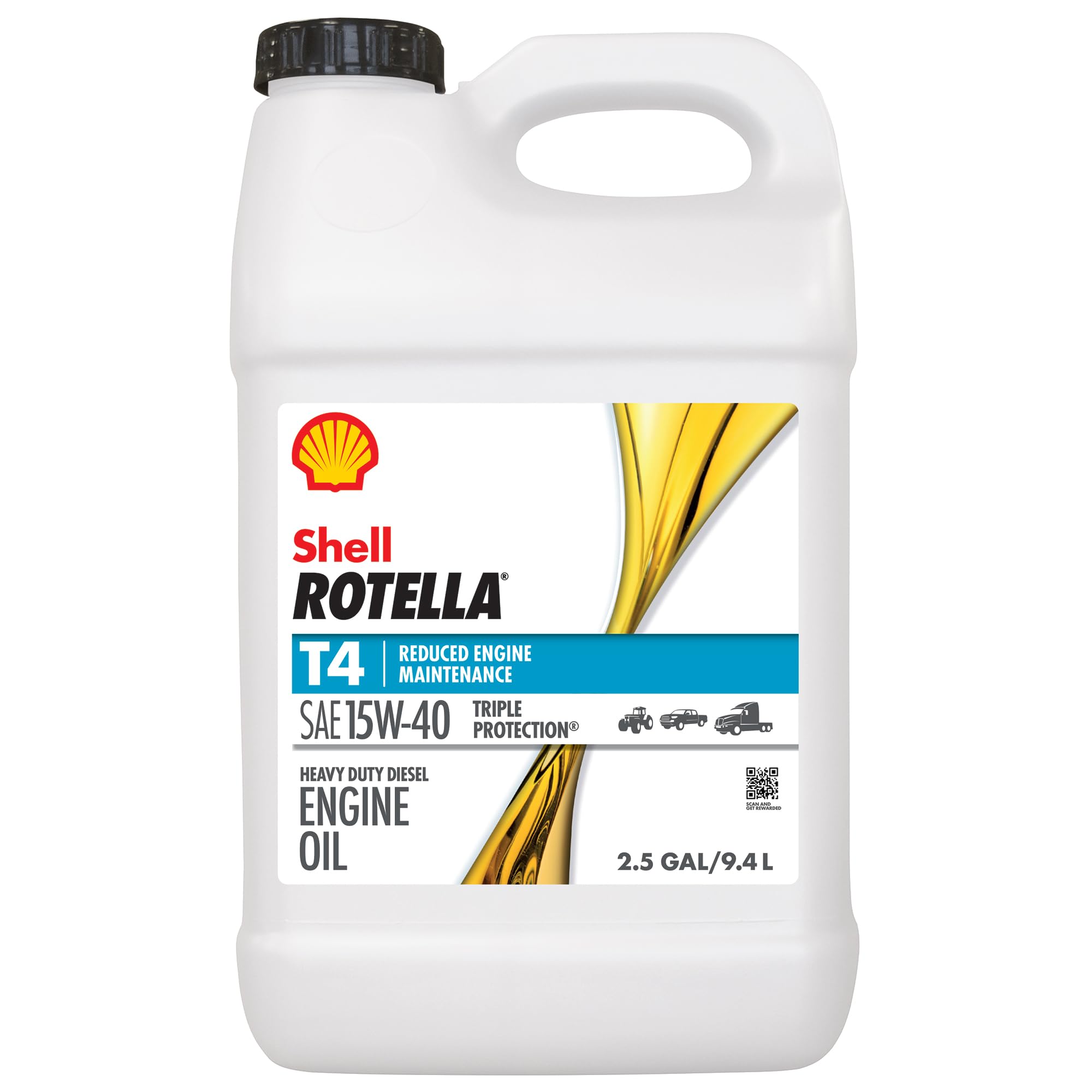
Shell Rotella T4 has earned its reputation through decades of field service in some of the most demanding diesel applications on the road. The Triple Protection technology — targeting wear, deposits, and oil breakdown — is backed by additive chemistry that includes advanced dispersants and enhanced shear stability. Owner feedback consistently highlights its ability to maintain oil pressure even as drain intervals approach the upper limit, and the formulation is compatible with the latest emission-controlled engines using EGR and diesel particulate filters.
What sets the T4 apart from competing conventional oils is its synthetic blend of base stocks that improves viscosity control without stepping up to a full synthetic price tier. For operators running older pre-emission engines alongside newer trucks, the T4’s backward compatibility with API CJ-4, CI-4 PLUS, and earlier categories makes it a true mixed-fleet workhorse. The 2.5-gallon container size is particularly convenient for trucks that require 3 to 4 gallons per change, reducing waste and handling compared to multiple single-gallon jugs.
Delivery packaging has been noted as a minor friction point — some containers arrive with lid seepage if shipped on their side. This is a logistics issue rather than a product flaw, and Amazon’s return policy addresses it promptly. For fleet managers who prioritize proven field performance over marketing novelty, the Rotella T4 remains the benchmark that other heavy-duty diesel oils are measured against.
What works
- Proven Triple Protection formulation with decades of fleet validation
- Strong backward compatibility across multiple API categories
- Convenient 2.5-gallon container for typical truck oil change volumes
- Enhanced shear stability maintains viscosity through extended drains
What doesn’t
- Some containers arrive with lid seepage due to shipping orientation
- Conventional blend may not suit ultra-long 60,000-mile drain intervals
2. Mobil 1 Turbo Diesel Truck 5W-40

Mobil 1 Turbo Diesel Truck is engineered specifically for modern diesel engines that demand low-temperature flow without sacrificing high-temperature film strength. The 5W-40 viscosity grade provides exceptional cold-start pumpability — owners report noticeably quieter operation and reduced valvetrain noise after switching from heavier oils. The full synthetic base stock resists thermal breakdown even under sustained high-load conditions, making it a strong candidate for trucks that spend extended hours at highway speed or under heavy payload.
Owners running Cummins, Powerstroke, and Duramax engines consistently report smoother idle and reduced engine noise after switching to Mobil 1 Turbo Diesel Truck. Multiple verified users note that the oil maintains its viscosity grade throughout the entire drain interval without shearing down, a common failure point for lower-quality conventional oils in high-heat applications. The API CK-4 certification ensures compatibility with diesel particulate filters and SCR systems on 2020 and earlier model year trucks.
One consideration for fleet operators is that the 5W-40 formulation costs more per quart than conventional 15W-40 oils. However, owners who have performed oil analysis note that the extended drain capability — combined with reduced wear metals — often offsets the higher upfront cost over the life of the engine. For owner-operators who run a single truck and want maximum protection, particularly in colder climates, this oil represents a well-justified premium.
What works
- Exceptional cold-start protection down to sub-zero temperatures
- Full synthetic formulation resists thermal breakdown under heavy load
- Consistent owner reports of quieter engine operation and smoother idle
- API CK-4 certified for 2020 and earlier emission-equipped engines
What doesn’t
- Higher per-quart cost than conventional 15W-40 alternatives
- 5W-40 may not be recommended for older pre-2000 engines
3. Valvoline Heavy Duty Full Synthetic 15W-40
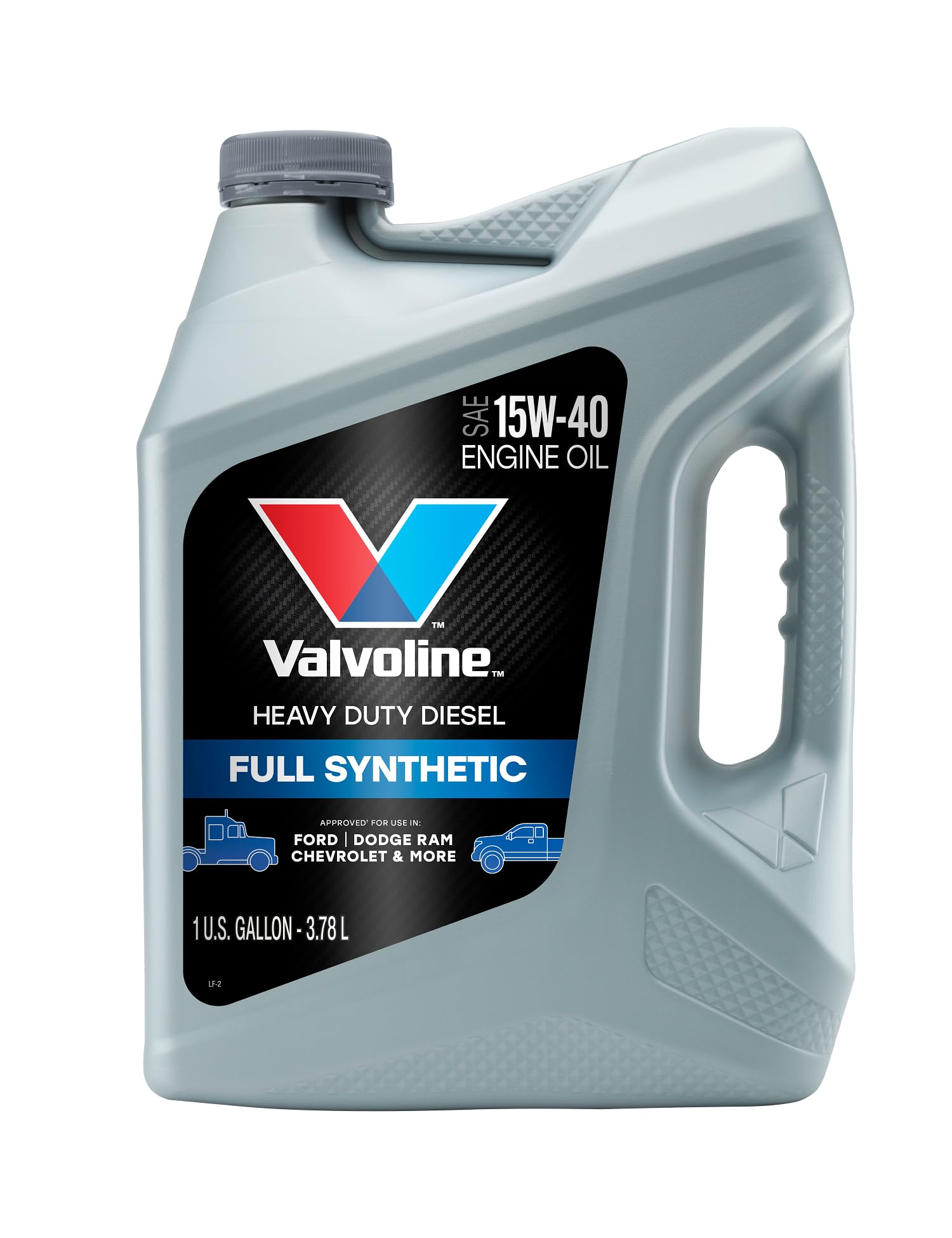
Valvoline Heavy Duty Full Synthetic 15W-40 brings full synthetic performance to a price point that competes directly with premium synthetic blends. The formulation is validated through the Cummins ISB engine test, demonstrating a 35% reduction in valve train wear compared to industry standards. For fleet operators who want the protection of a full synthetic without paying a significant premium over conventional oil, this product represents a strong value proposition.
The oil carries approvals from Cummins CES 20086, Ford WSS-M2C171-F1, Volvo VDS-4.5, Mack EOS-4.5, Detroit Diesel DFS 93K222, and Caterpillar ECF-3 — making it one of the most broadly endorsed oils in this category. Owners report consistent performance across mixed fleets that include both highway tractors and off-road equipment. The Volvo T-13 engine test shows up to 28% longer oil life versus industry standards, a meaningful advantage for trucks on extended drain intervals.
Some owners note that while the oil performs well in modern engines, its full synthetic formulation may cause seal leaks in older, high-mileage engines that have accumulated sludge deposits. This is a general consideration with any switch to synthetic in aged engines rather than a specific flaw of this product. For trucks built after 2010, this oil delivers an ideal balance of protection and per-mile cost.
What works
- Full synthetic performance at a near-blend price point
- Broad OEM approval list simplifies mixed-fleet purchasing
- Proven 35% wear reduction in Cummins ISB engine testing
- Extended oil life capability validated by Volvo T-13 testing
What doesn’t
- Full synthetic may aggravate seal leaks in older high-mileage engines
- 1-gallon container requires multiple units for most truck oil changes
4. Chevron Delo 400 XSP 5W-40

Chevron Delo 400 XSP is engineered for extreme temperature operation, with a 5W-40 viscosity that flows readily at sub-zero temperatures while maintaining SAE 40 protection at operating temperature. The full synthetic formulation provides consistent cold engine starting for diesel engines operating in harsh winter conditions, a critical advantage for fleets that cannot risk overnight gelling or dry-start wear. Owners in northern climates consistently rank this oil as the most reliable cold-weather option in its category.
Owner reports from diverse applications — including Briggs & Stratton generators, Honda GCV160 mowers, Mazda turbo engines, and 7.3L Powerstroke pickups — highlight the oil’s versatility beyond its primary heavy-duty diesel target. Multiple users report measurable reductions in crankcase temperature, with one owner documenting a 30-degree Fahrenheit drop compared to conventional oil. The API CK-4 certification ensures compatibility with modern emission systems while maintaining backward compatibility for older engines.
A point of consideration is that the 5W-40 viscosity, while excellent for cold starts, may produce slightly lower oil pressure at hot idle compared to a 15W-40 in engines with worn bearings. Owners of high-mileage engines should verify that their oil pressure remains within specification before committing to a lighter viscosity. For well-maintained engines operating in regions with seasonal temperature swings, the Delo 400 XSP delivers category-leading cold-flow performance.
What works
- Superior cold-start performance in sub-zero temperatures
- Documented crankcase temperature reduction in multiple owner reports
- Versatile across diesel and gasoline engine platforms
- API CK-4 certified with strong backward compatibility
What doesn’t
- 5W-40 may show lower hot-idle oil pressure in high-mileage engines
- Requires longer warm-up to reach optimal flow characteristics
5. Royal Purple 04154 15W-40

Royal Purple has built a reputation on proprietary additive chemistry that reduces friction beyond what standard synthetic formulations achieve. The 15W-40 viscosity grade delivers the film strength required for heavy-duty diesel operation while incorporating friction modifiers that owners report translate to measurable fuel economy gains. One verified owner documented a 3 MPG increase after switching from conventional oil, a figure that, while application-dependent, aligns with the oil’s stated design goals.
Beyond fuel efficiency, the formulation includes enhanced corrosion protection and improved compatibility with ethanol-containing fuels, making it suitable for mixed fleets that include gasoline-powered equipment alongside diesel trucks. The oil’s thermal stability is rated for high-temperature operation, and owners running turbocharged diesels report consistent oil pressure even under sustained boost. The universal fit compatibility covers a wide range of vehicle types, from light-duty cars to heavy-duty trucks.
The primary trade-off with Royal Purple is cost — it sits at a premium price tier that may be difficult to justify for fleets operating on tight margins. However, for owner-operators who run a single truck and want every possible efficiency gain, the combination of wear protection and fuel economy improvement can offset the per-mile cost over time. The product is best suited for trucks that operate under consistent, fully warmed-up conditions where friction reduction provides the greatest benefit.
What works
- Proprietary friction modifiers deliver measurable fuel economy gains
- Enhanced corrosion protection for catalytic emission systems
- Strong thermal stability under sustained high-load operation
- Compatible with both diesel and gasoline engines in mixed fleets
What doesn’t
- Premium pricing limits ROI for cost-sensitive fleet operations
- Fuel economy improvement varies significantly by driving conditions
6. Schaeffer SynShield 15W-40

Schaeffer SynShield is a specialized full synthetic 15W-40 that incorporates micronized molybdenum and penetrative friction modifiers designed for severe operating conditions. The formulation targets excellent wear protection during sustained high-load operation, with particular attention to contamination control through superior soot-busting and deposit-dispersing capability. Owners of older high-mileage engines report the most dramatic improvements, with multiple verified users noting that their Duramax and Powerstroke engines run noticeably quieter and smoother after switching.
A durability advantage of the SynShield formulation is its strong stay-in-grade performance throughout the oil drain interval. The base stock resists viscosity shear from mechanical stress, maintaining consistent oil pressure even as the oil accumulates mileage. Owners report oil pressure increases of approximately 5 PSI at idle after switching from conventional oils, indicating reduced internal friction and better pumpability. The friction modification also contributes to fuel economy improvements, with some owners reporting 2 MPG gains.
The most significant consideration is that Schaeffer recommends a shorter drain interval of approximately 4,000 miles for optimal longevity, rather than the 10,000-mile intervals common with other synthetics. This philosophy prioritizes engine longevity over interval convenience, and owners who follow this recommendation report exceptional engine cleanliness at high mileages. For owner-operators who plan to keep their truck past 500,000 miles, the shorter interval approach may be the wiser long-term strategy.
What works
- Micron moly additive significantly reduces engine noise and vibration
- Stay-in-grade performance maintains viscosity throughout drain interval
- Superior soot and deposit control for severe operating conditions
- Owner reports of 5 PSI oil pressure increase at idle
What doesn’t
- Recommended 4,000-mile drain interval is shorter than competitors
- Higher per-quart cost requires longer ownership to justify ROI
7. Ultra 1Plus 15W-40 Full Synthetic

Ultra 1Plus SAE 15W-40 Full Synthetic is formulated with synthetic base oils and a premium additive package designed to exceed API CK-4, CJ-4, CI-4 with CI-4 PLUS, CI-4, and CH-4 performance criteria. The oil emphasizes stay-in-grade performance, meaning it resists shear-driven viscosity loss that causes many conventional oils to thin out during extended drain intervals. This characteristic is particularly valuable for semi trucks that operate at sustained highway speeds where continuous shear stress is highest.
The formulation addresses multiple failure modes simultaneously: oil oxidation, viscosity loss due to shear, oil aeration, catalyst poisoning, particulate filter blocking, engine wear, piston deposits, and soot-related viscosity increase. Owners using the oil in Kubota tractors and China mopeds report consistent performance across diverse applications, though the primary design target is high-speed four-stroke cycle diesel engines meeting 2020 on-highway and Tier 4 non-road emission standards.
While the oil performs well in the applications it targets, owner feedback is less extensive than the volume available for legacy brands like Rotella or Mobil 1. This is a function of market presence rather than product quality — Ultra 1Plus is a newer entrant in the heavy-duty diesel oil segment. For fleet managers willing to evaluate a less-established brand on its technical merits, the CK-4 certification and stay-in-grade performance claims make it a credible option worth considering.
What works
- Strong shear stability maintains viscosity through extended drains
- Comprehensive additive package addresses all major failure modes
- Suitable for 2020 on-highway and Tier 4 non-road emission engines
- Made in America with competitive pricing for a full synthetic
What doesn’t
- Less established brand with smaller owner feedback dataset
- Limited availability compared to legacy heavy-duty diesel oils
8. MOTORCRAFT 10W-30 Engine Oil

MOTORCRAFT engine oil is the genuine OEM formulation specified by Ford for Powerstroke diesel engines requiring 10W-30 viscosity. For owners of Ford trucks with 7.3L and 6.0L Powerstroke engines, using the factory-specified oil eliminates any ambiguity about compatibility with HEUI injector systems and other Ford-specific engineering parameters. The oil meets Ford’s WSS-M2C171-F1 specification, which includes wear and deposit control benchmarks calibrated specifically to Ford diesel engine platforms.
Owner feedback from Powerstroke owners is consistently positive, with multiple verified users noting that the oil performs as expected across normal operating conditions. The 10W-30 viscosity provides a balance between cold-flow protection and high-temperature film strength that is appropriate for moderate climates and standard duty cycles. Owners appreciate that the oil is genuine OEM product rather than a third-party aftermarket formulation, eliminating concerns about additive package compatibility.
The primary limitation of this oil is its narrow application scope — it is formulated specifically for Ford engines that call for 10W-30 viscosity. Semi trucks typically require 15W-40 or 5W-40 viscosity grades, and using 10W-30 in an engine not designed for it risks inadequate high-temperature protection under sustained load. Additionally, some owners note that Walmart often offers a lower price on the same MOTORCRAFT oil, making shopping around worthwhile before purchasing.
What works
- Genuine Ford OEM formulation ensures complete Powerstroke compatibility
- Consistent performance for moderate climate operation
- Eliminates guesswork about additive package compatibility
- Reliable delivery and proper packaging from verified sellers
What doesn’t
- 10W-30 viscosity is not suitable for most semi truck applications
- Often available at lower prices from brick-and-mortar retailers
9. Triax 15W-40 Full Synthetic
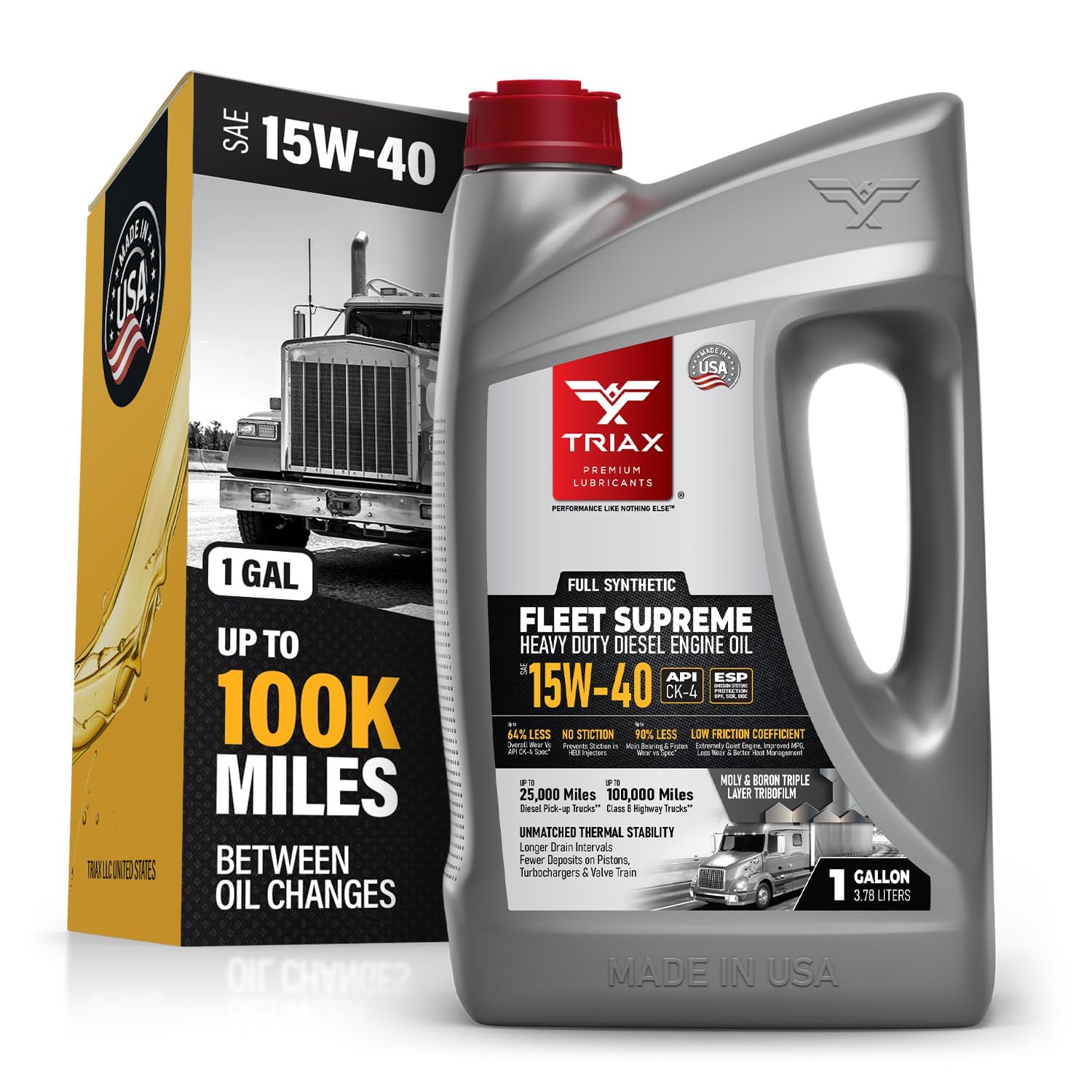
Triax 15W-40 is a full synthetic heavy-duty diesel oil engineered with a friction-modified formulation that includes Nano-Boron and Moly additives. The oil is specifically designed to eliminate HEUI injector stiction — a common failure mode in Ford Powerstroke and other HEUI-equipped diesel engines where hydraulic pressure builds up and locks injector spools. Owners of 7.3L, 6.0L, and 6.4L Powerstroke engines report that Triax resolves injector hesitation and misfire issues that persisted with other oils.
The claimed wear protection is substantial — up to 48% lower wear than industry standards, achieved through a friction coefficient that is 50% lower than competing oils. For semi trucks and heavy-duty pickups operating under severe service conditions like towing or hauling, the high shear stability and film strength maintain viscosity protection even as oil temperatures climb. The formulation also protects DPF and SCR systems, preventing particulate filter clogging that can cause costly regeneration cycles.
Triax claims drain intervals exceeding 100,000 miles for highway semi trucks and 30,000 miles for super-duty pickups. While these figures are impressive, they should be verified with oil analysis specific to your engine and operating conditions before adopting extended intervals. The oil’s premium positioning means it costs more per quart than standard heavy-duty oils, but for owner-operators dealing with HEUI stiction issues or seeking maximum protection for a high-value engine, the performance difference can be transformative.
What works
- Nano-Boron and Moly additives eliminate HEUI injector stiction
- Up to 48% lower wear than industry standards in testing
- Exceptional shear stability for severe towing and hauling conditions
- Claims 100,000-mile drain capability for highway semi trucks
What doesn’t
- Premium pricing requires documented ROI for fleet adoption
- Extended drain claims should be verified with individual oil analysis
10. Lucas Oil 10287 15W-40

Lucas Oil 10287 15W-40 is a conventional heavy-duty motor oil that delivers reliable performance at a budget-friendly price point. The formulation is designed to promote longer engine life, support extended oil changes, and reduce filter maintenance — claims that are backed by owner feedback from diverse applications including tractors, backhoes, mowers, and diesel trucks. The API CK-4 certification ensures compatibility with modern emission-controlled engines while maintaining backward compatibility for older equipment.
Owner reports consistently highlight the oil’s ability to make older diesel engines sound quieter and run smoother, with one verified user noting a dramatic improvement in their 45-year-old diesel motor. The universal fit compatibility covers buses, cars, and trucks, making it a versatile option for mixed equipment fleets. The 1-gallon container size is convenient for topping off between changes or for engines with smaller sump capacities.
The conventional formulation means this oil does not offer the same shear stability or oxidation resistance as full synthetic alternatives. For semi trucks running extended drain intervals or operating under severe conditions, a synthetic or synthetic blend would be a more appropriate choice. However, for operators who change oil at conservative intervals and want a proven, affordable option from a trusted brand, Lucas Oil delivers dependable performance per dollar.
What works
- Budget-friendly price point for cost-conscious fleet operations
- Proven brand with decades of positive owner feedback
- API CK-4 certified for modern emission-controlled engines
- Universal fit covers a wide range of vehicle and equipment types
What doesn’t
- Conventional formulation lacks synthetic-grade shear stability
- Not ideal for extended drain intervals beyond standard recommendations
11. Honda 08207-10W30 Engine Oil Pack of 4

Honda 08207-10W30 is a genuine OEM engine oil designed primarily for Honda small engines used in generators, mowers, and other utility equipment. The pack of four 32-ounce bottles provides a convenient supply for multiple oil changes on compatible equipment. For operators who run Honda-powered generators or auxiliary equipment alongside their semi truck operation, having the correct OEM oil on hand ensures proper lubrication and warranty compliance.
Owner feedback from generator and mower users confirms the oil performs reliably in those applications, with smooth operation and consistent protection. The genuine Honda formulation eliminates concerns about aftermarket oil compatibility with Honda’s specific engineering parameters. The pack of four bottles is priced competitively with individual bottles from big-box retailers, and the subscription option ensures timely delivery for regular maintenance schedules.
The critical limitation for semi truck use is that 10W-30 viscosity is not appropriate for heavy-duty diesel engines operating under sustained high load. Semi trucks require SAE 15W-40 or 5W-40 oils with API CK-4 or CJ-4 certification to provide adequate film strength and soot-handling capability. This oil is best reserved for its intended small-engine applications rather than primary truck use. Owners should consult their truck’s owner manual for the correct viscosity and API category.
What works
- Genuine Honda OEM formulation for small engine compatibility
- Convenient pack of four 32-ounce bottles for multiple changes
- Competitive pricing compared to big-box retail single bottles
- Consistent performance in generator and mower applications
What doesn’t
- 10W-30 viscosity is unsuitable for heavy-duty semi truck engines
- Lacks API CK-4 certification required for modern diesel emission systems
Hardware & Specs Guide
Viscosity Explained
SAE viscosity grades describe an oil’s flow characteristics at specific temperatures. The first number followed by “W” indicates cold-weather performance — a lower number means better flow at low temperatures. The second number indicates high-temperature viscosity at 100 degrees Celsius. For semi trucks, 15W-40 is the industry standard because it provides adequate cold-start protection for most climates while maintaining the film strength required for turbocharger and main bearing protection at operating temperature. 5W-40 synthetic options extend cold-weather capability down to minus 45 degrees Fahrenheit without sacrificing high-temperature protection.
API Service Categories
The American Petroleum Institute assigns service categories that indicate an oil’s performance level and compatibility with emission control systems. CK-4 is the current standard for heavy-duty diesel engines, offering enhanced protection against oxidation, viscosity loss, and catalyst poisoning compared to the previous CJ-4 category. CK-4 oils are backward compatible with CJ-4 and earlier categories. FA-4 is a separate low-viscosity category designed for newer engines specifically engineered for fuel economy — never use FA-4 in an engine not explicitly approved for it, as the lower viscosity may not provide adequate protection in standard engines.
FAQ
What viscosity oil should I use in my semi truck?
What is the difference between API CK-4 and CJ-4?
Can I mix synthetic and conventional engine oil in my diesel truck?
How often should I change oil in a semi truck?
Final Thoughts: The Verdict
For most buyers, the best engine oil for semi trucks winner is the Shell Rotella T4 Triple Protection 15W-40 because it delivers proven field performance across decades of fleet use, broad OEM compatibility, and a value proposition that works for both owner-operators and large fleets. If you need maximum cold-start protection for northern climate operation, grab the Mobil 1 Turbo Diesel Truck 5W-40. And for severe-duty applications requiring the ultimate in wear control and HEUI injector protection, nothing beats the Triax 15W-40.

Certification: BSc in Mechanical Engineering
Education: Mechanical engineer
Lives In: 539 W Commerce St, Dallas, TX 75208, USA
Md Amir is an auto mechanic student and writer with over half a decade of experience in the automotive field. He has worked with top automotive brands such as Lexus, Quantum, and also owns two automotive blogs autocarneed.com and taxiwiz.com.