A slow refrigerant leak turns a cool cabin into a warm headache, and chasing it with soap bubbles or UV dye often wastes hours on false leads. Electronic leak detectors have become the standard for automotive AC diagnostics, but separating the sensitive, durable tools from the overpriced or underbuilt options requires a close look at sensor technology, battery life, and real-world owner feedback.
I’m Amir — the founder and writer behind Four Wheel Ask. I’ve spent years analyzing product specifications, studying owner-reported failure patterns, and comparing build quality data across hundreds of automotive diagnostic tools to identify the models that deliver consistent, reliable performance.
After sifting through dozens of owner complaints and spec sheets, I have ranked the models that truly deliver consistent best auto freon leak detector.
How To Choose The Best Auto Freon Leak Detector
Selecting the right refrigerant sniffer means matching sensor architecture, sensitivity range, and ergonomics to the specific systems you service. Automotive AC circuits operate at higher pressures and use different refrigerants than residential units, so a detector that works for a split-system R410A may struggle with a vehicle’s R134a or R1234yf loop. Below are the critical factors that separate a professional-grade tool from a frustrating gadget.
Sensor Type: Heated Diode vs. Infrared
Heated diode sensors are the most common in automotive-grade detectors because they respond quickly to halogenated gases and offer sensitivity down to 0.1 oz/yr. They require a warm-up period of roughly 30 seconds and have a typical service life of 500–1,000 hours. Infrared sensors, by contrast, provide better immunity to false triggers from non-refrigerant vapors and last up to ten years, but they carry a higher upfront cost and a slightly slower response time. For a DIYer working on a single vehicle, a quality heated diode unit offers the best balance of speed and value. A technician servicing multiple systems daily may justify the premium for an infrared platform.
Sensitivity Modes and Detection Range
Most modern detectors offer two or three sensitivity levels. High sensitivity mode catches micro-leaks down to 0.03–0.14 oz/yr, but it can also pick up background contamination or moisture in the air. Lower sensitivity modes help you zero in on the exact leak location once the general area is identified. Units that display a numeric PPM reading or a bar-graph intensity scale make it easier to track the concentration gradient toward the source. A mute function is also valuable when working in tight engine bays where a constant beep becomes fatiguing.
Power Source and Runtime
Disposable AA and AAA batteries are simple to replace and keep the tool running indefinitely without charging downtime, but the cost and waste add up over time. Rechargeable lithium-ion packs with USB-C charging have become the preferred choice for most users — they deliver 6–10 hours of continuous operation and eliminate the need for spare cells. Look for units with at least a 2,000 mAh capacity if you plan to use the detector for extended diagnostic sessions. Also check whether the detector includes a low-battery indicator, because a dying sensor can produce false negatives.
Quick Comparison
On smaller screens, swipe sideways to see the full table.
| Model | Category | Best For | Key Spec | Amazon |
|---|---|---|---|---|
| Aprvtio ALD-200 | Heated Diode | Best Overall | 3-in-1 A1/A2L/A3 detection | Amazon |
| Elitech ILD-200 | Infrared | Long sensor life | 10 yr IR sensor, 0.14 oz/yr | Amazon |
| VIVOHOME Leak Detector | Heated Diode | Micro-leak sensitivity | 0.03 oz/yr max sensitivity | Amazon |
| TOPTES RT-389 | Semiconductor | Triple alarm modes | 90dB + vibration + visual | Amazon |
| Elitech ELD-210 | Heated Diode | Value with pump assist | Integrated pump-suction | Amazon |
| Kalageen LD-200 | Heated Diode | Battery endurance | 3000mAh, 8 hr runtime | Amazon |
| POROMETISTO HLD01 | Semiconductor | Color-coded display | Tri-color + UV light | Amazon |
| Sensyx SFD201 | IR + Semiconductor | Combustible gas detection | UL1484 compliant | Amazon |
| Aprvtio WJL-6000PRO | Infrared | Dual detection modes | PPM + %LEL monitoring | Amazon |
| WISSCOOL HVAC Detector | Heated Diode | Entry-level value | Numerical LCD, 3 modes | Amazon |
| Leak Saver Direct Inject | Sealant + Dye | Permanent leak repair | 3-in-1 sealant/dye/dryer | Amazon |
In‑Depth Reviews
1. Aprvtio ALD-200 Refrigerant Leak Detector

The Aprvtio ALD-200 stands out for its next-generation heated diode sensor that covers the full spectrum of modern refrigerants — including A2L mildly flammable gases like R32 and R454B as well as A3 hydrocarbons such as R290. That breadth of compatibility is rare at this price tier and makes the unit future-proof as the automotive industry transitions away from high-GWP refrigerants. The 2.8-inch TFT color display shows concentration levels clearly even in bright sunlight or dark engine bays, and the beep frequency ramps up as the leak intensifies so you can pinpoint the source without constantly checking the screen.
Owner feedback consistently highlights the tool’s ability to detect micro-leaks that soap bubbles and dye tests miss entirely. Multiple users report finding hidden evaporator-core or condenser leaks that professional HVAC technicians had overlooked with more expensive gear. The Peak Mode captures the highest reading during a sweep, which helps when you need to compare multiple suspect areas. The Reset Function also minimizes false alarms by recalibrating the sensor to the current background concentration with a single button press.
The oil-resistant, impact-tolerant housing adds real durability for shop-floor and field use, and the rechargeable battery supports a full day of continuous diagnostics. Some owners note that the battery life falls slightly short of the claimed maximum when the display brightness is turned up, but a midday charge via USB-C gets you back to work quickly. Overall, the ALD-200 delivers professional-grade detection breadth and accuracy at a price that undercuts most competing units with similar feature sets.
What works
- Covers A1, A2L, and A3 refrigerants — future-proof for R32 and R290
- Bright TFT display with clear concentration bar graph and peak hold
- Oil-resistant housing withstands job site abuse
What doesn’t
- Battery life runs closer to 6 hours with max screen brightness
- Warm-up period requires patience before first use
2. Elitech ILD-200 Infrared Leak Detector

The Elitech ILD-200 uses an infrared optical sensor rather than the heated diode found in most competitors, which gives it two distinct advantages: near-total immunity to false triggers from non-refrigerant vapors and a sensor lifespan rated at ten years. For a technician who works daily with multiple AC systems, the long-term cost of ownership is significantly lower than repeatedly replacing heated diode units. The 2.8-inch screen provides a peak display that clearly shows the direction of the leak, and the adjustable sensitivity (High/Medium/Low) lets you dial out background contamination when working in a shop saturated with refrigerant residue.
Owners report that the ILD-200 reliably detects leaks in R410A, R134a, and R1234yf systems with consistent accuracy, and several users mention that it picked up propane gas leaks from fireplaces and grills as a bonus use case. The tool requires a clean-air warm-up before each session, and periodic purging in fresh air keeps the sensor responsive. The auditory alarm increases in tempo as concentration rises, giving you an audible gradient that speeds up the search process.
The main trade-off is the higher upfront investment compared to heated diode models. The infrared sensor also responds slightly slower than a heated diode when sweeping rapidly across a large coil, so a methodical, slow pass technique works best. The unit is battery-powered (disposable cells), which some users see as a drawback versus rechargeable alternatives, but the battery life is generous and spares are easy to source. For professionals who need a tool that will still be accurate three to five years from now, the ILD-200 is a defensible investment.
What works
- Infrared sensor resists false alarms from non-refrigerant gases
- Ten-year sensor life drastically reduces replacement cost
- Large display with peak hold for precise leak location
What doesn’t
- Higher initial price than most heated diode units
- Requires slow, deliberate sweeps for accurate readings
3. VIVOHOME Refrigerant Leak Detector
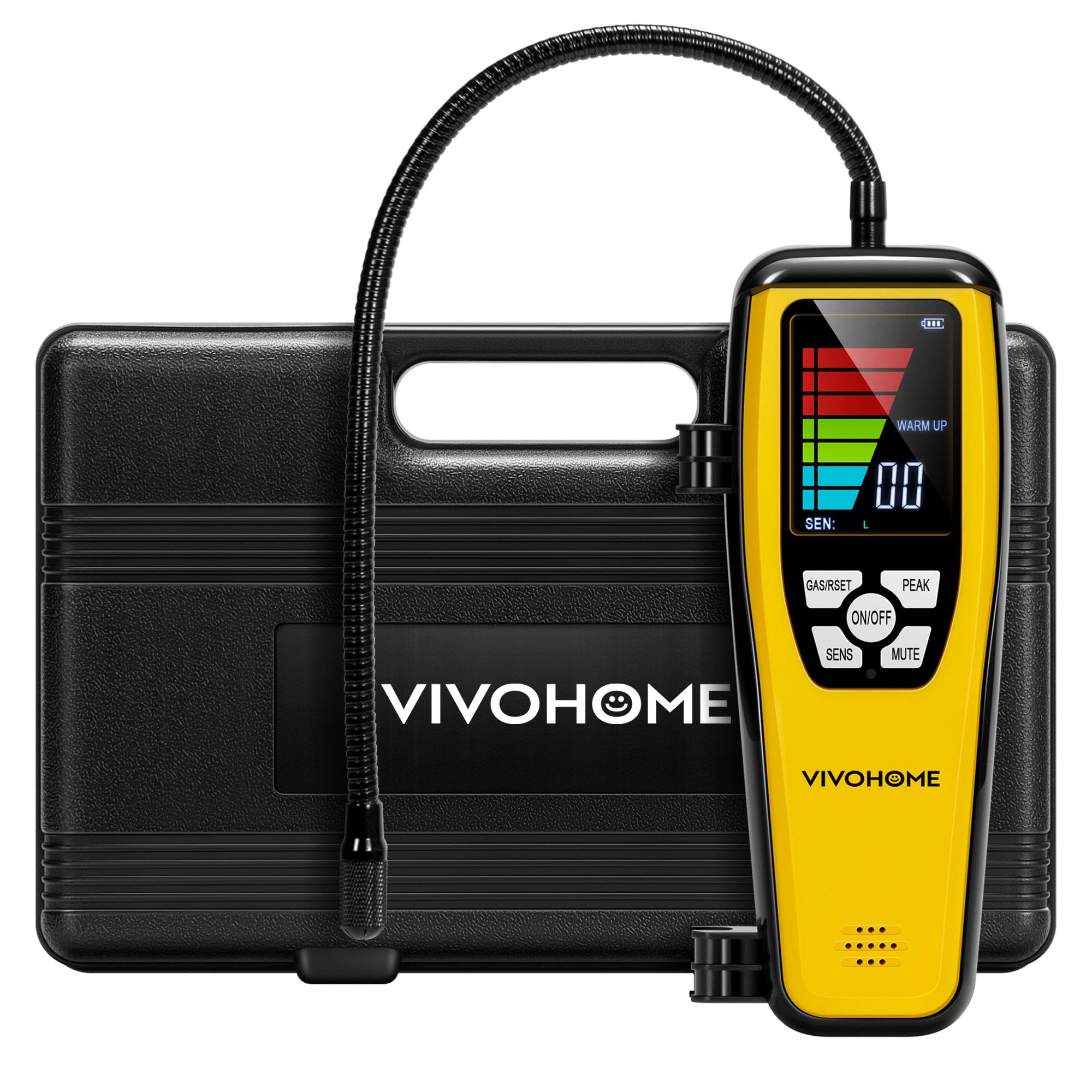
The VIVOHOME refrigerant leak detector claims a maximum sensitivity of 0.03 oz/yr, which is among the highest figures available outside of specialized industrial instruments. That extreme sensitivity allows it to find pinhole leaks in evaporator coils and crimped hose fittings that lower-grade detectors simply walk past. The 2.8-inch LCD screen uses a color-coded bar system — green for safe, yellow for moderate, red for high concentration — so you can gauge the severity at a glance without interpreting numeric values. The 15.8-inch flexible probe reaches behind dashboards and into tight engine compartments with ease.
Owners confirm the detector picks up R410A, R134a, and R1234yf leaks quickly, and several users report it identified a known leak that a heated diode unit from another brand failed to register. The Reset and Peak functions work as expected: Reset recalibrates the sensor to the current environment, and Peak stores the highest reading during a pass so you can double-check after moving the probe away. The 3000mAh rechargeable battery provides roughly six hours of continuous use, which covers most diagnostic sessions without needing a midday charge.
The primary drawback is that extreme sensitivity can produce false positives if you breathe directly on the sensor — warm, moist breath contains trace compounds that trigger the alarm. Seasoned users learn to hold their breath or turn away while testing, but newcomers may find the learning curve frustrating. The build quality feels solid for the price, though the plastic housing lacks the oil-resistant coating of the Aprvtio ALD-200. For DIYers who want the best chance of finding the smallest leak, the VIVOHOME is a compelling choice.
What works
- Exceptional 0.03 oz/yr sensitivity catches micro-leaks
- 3000mAh battery with USB-C charging runs a full workday
- Color-coded bar graph simplifies severity assessment
What doesn’t
- Prone to false triggers from breath or moisture
- Plastic housing lacks oil-resistant durability
4. TOPTES RT-389 Rechargeable Leak Detector
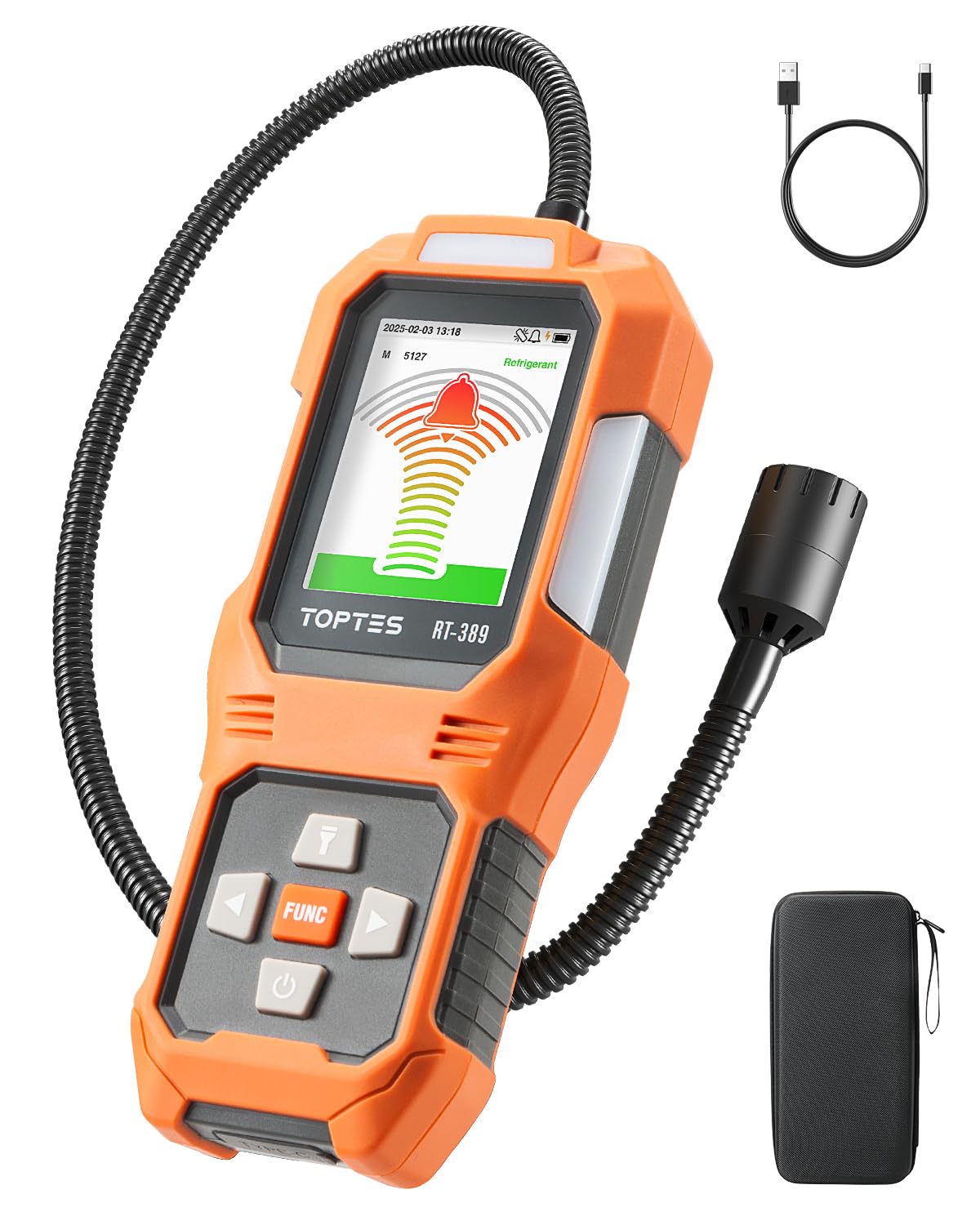
The TOPTES RT-389 differentiates itself with three independent alarm channels — an 90 dB audible siren, a visual indicator on the TFT display, and a vibration motor that buzzes the handle when a leak is detected. Each alarm can be activated or silenced independently, which is useful when working in noise-sensitive environments or when you need silent confirmation while the engine is running. The 14.5-inch flexible gooseneck probe holds its position once bent, so you can route it around obstacles and keep both hands free for other tasks. The built-in top light illuminates dark work areas without requiring a separate flashlight.
Owner reports highlight the detector’s ability to locate R410A and R134a leaks within minutes, with one user describing finding a pinhole in a condenser that a shop estimated would cost over two thousand dollars to diagnose. The dual display modes — a funnel chart for real-time PPM concentration and a curve graph for trend tracking — give you two ways to interpret the data. The 2,000 mAh rechargeable battery delivers over eight hours of operation, and the USB-C charging port means you can top up from a car charger or portable power bank.
The TOPTES RT-389 uses a Japanese semiconductor sensor rather than a heated diode, which provides good sensitivity but can be affected by rapid temperature changes. Some owners report occasional intermittent readings where the same spot triggers the alarm on one pass but not the next, likely due to the sensor’s recovery time. The high-strength engineering plastic shell is waterproof and dustproof, adding confidence for outdoor or garage use. For technicians who want flexible alarm feedback and a gooseneck probe, this is a well-rounded option.
What works
- Triple alarm system with independent mute for each channel
- Flexible gooseneck probe stays bent for hands-free access
- High-strength plastic shell is waterproof and dustproof
What doesn’t
- Intermittent readings on the same spot can confuse new users
- Sensor sensitive to rapid temperature shifts
5. Elitech ELD-210 Heated Diode Leak Detector

The Elitech ELD-210 uses a heated diode sensor with an integrated pump-suction system that actively draws air into the sensor, increasing the effective capture rate and reducing the time needed to sweep a large coil or condenser. This pump assist is typically found on units costing significantly more, making the ELD-210 a strong value proposition. The 3 adjustable sensitivity levels max out at 0.11 oz/yr, which is sufficient for finding the vast majority of automotive AC leaks. The warm-up time is around 30 seconds, and the response time is quoted at 3 seconds in normal operating conditions.
Users consistently report that the ELD-210 has already paid for itself after locating a single elusive leak in an automotive R134a system or a home R410A unit. The leakage level display runs from 0 to 7, giving you a numeric sense of concentration intensity that helps distinguish a background whiff from a genuine breach. The unit meets CE and EN14624 standards, and the inclusion of a dedicated anti-water absorption function reduces false alarms when testing near moisture-laden evaporator drains.
The ELD-210 runs on disposable batteries, which is the most common point of criticism among owners who prefer rechargeable platforms. The build quality is solid for the price tier, with a mix of metal, plastic, and rubber components that suggest reasonable drop protection. The lack of a carrying case or storage pouch is a minor inconvenience for mobile technicians. Overall, the pump-suction design and reliable heated diode sensor make this a smart buy for anyone who needs consistent performance without a premium outlay.
What works
- Integrated pump-suction speeds up leak location
- Three sensitivity levels cover 0.11 oz/yr to gross leaks
- Anti-water absorption function reduces false alarms near drains
What doesn’t
- Disposable batteries add recurring cost and waste
- No carrying case or pouch included
6. Kalageen LD-200 Refrigerant Leak Detector
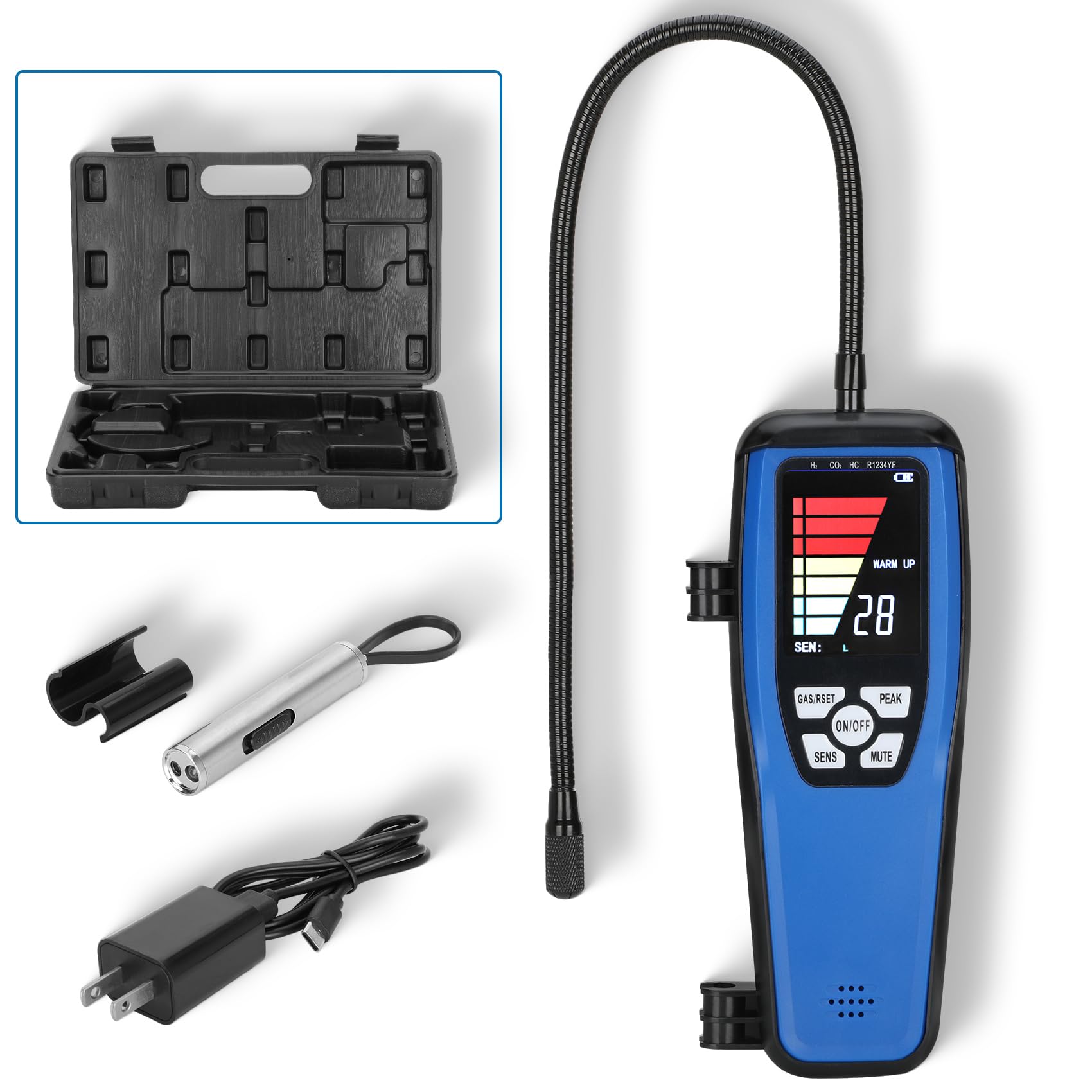
The Kalageen LD-200 centers its design around a high-capacity 3,000 mAh rechargeable lithium battery that delivers up to 8 hours of continuous operation from a single charge — one of the longest runtimes in its class. The heated diode sensor achieves a maximum sensitivity of 0.1 oz/yr and carries a rated service life exceeding 500 hours. The LCD screen displays leakage level and equipment status in real time, and the beep speed increases with concentration to guide you toward the source. A mute button silences the buzzer when you need to concentrate, and the peak recording function captures the maximum reading from each sweep.
Owners report that the LD-200 successfully locates R600a leaks in refrigeration appliances as well as R134a and R410A in automotive and residential systems. One user found a tiny R600 leak in a 50-gram fridge circuit that required soap-bubble confirmation, demonstrating the unit’s ability to detect very small discharges. The tool meets EN14624 standards and complies with SAE J2791 and SAE J2913, making it a credible option for professional use. The Type-C charging port is a modern convenience that eliminates the need to carry a proprietary charger.
The primary concern raised in owner feedback is quality control — a small number of units arrive with sensor faults or fail to detect known leaks even at the highest sensitivity setting. This suggests batch-to-batch variation in sensor calibration, which makes purchasing from a retailer with a solid return policy advisable. The build quality and in-hand feel are comparable to supply-house units, and the accessory bundle includes a charger and carrying case. When you get a good unit, the LD-200 offers exceptional battery life and solid detection capabilities.
What works
- 3,000 mAh battery provides class-leading 8-hour runtime
- Heated diode sensor meets SAE J2791 and J2913 standards
- Type-C charging with included case and accessories
What doesn’t
- Quality control inconsistencies on sensor calibration
- Some units arrive with sensor fault errors
7. POROMETISTO HLD01 Halogen Leak Detector
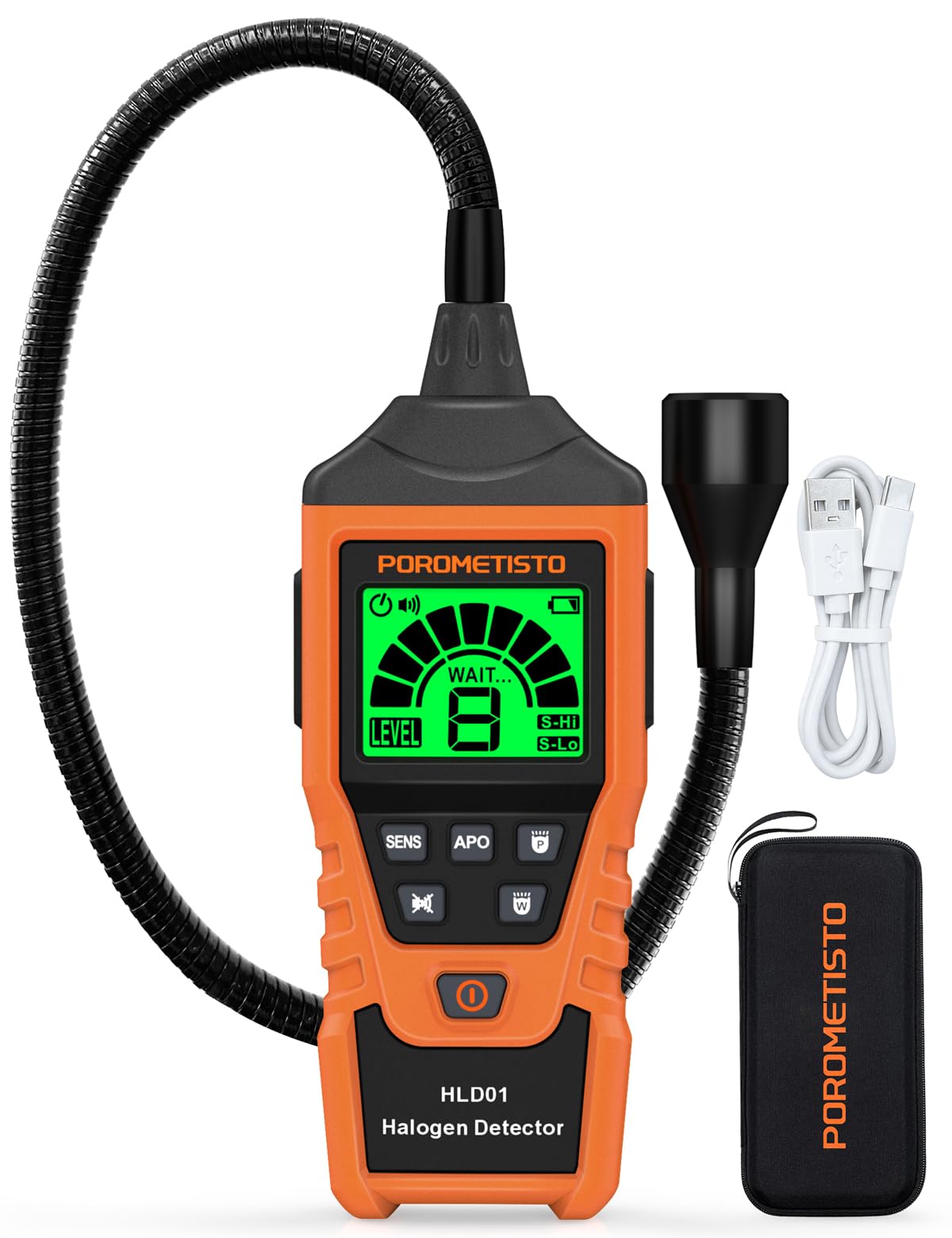
The POROMETISTO HLD01 features a unique tri-color LCD screen that changes from green (0–16 ppm, safe) to yellow (16–85 ppm, caution) to red (above 85 ppm, warning), giving you an instant visual read on leak severity without interpreting numeric values. The unit also includes a purple LED light that helps visually identify gas leak points by causing certain refrigerants to fluoresce at close range, which is a rare feature in this price segment. The dual calibration modes — automatic and manual — let you adapt the sensor baseline to different working environments, reducing the likelihood of false triggers when moving between a clean shop and a refrigerant-saturated workspace.
Owner feedback emphasizes the HLD01’s ease of use and robust build quality, with multiple users noting that the sturdy ABS plastic shell and included cloth storage bag make it convenient for mobile service. The rechargeable battery charges via USB-C and the unit heats up quickly, ready for use within about 30 seconds. The high and low sensitivity modes (S-HI/S-LO) allow you to cast a wide net for gross leaks and then narrow down to pinpoint the exact breach.
The detector covers CFCs, HCFCs, HFCs, and HFOs — including R1234yf and R32 — making it compatible with both legacy and current automotive refrigerants. The manufacturer includes a 2-year warranty, which is longer than the industry standard and suggests confidence in the sensor’s longevity. The main trade-off is that the color-changing display, while intuitive, does not provide a precise PPM number for users who prefer quantitative data for documentation or insurance claims.
What works
- Tri-color LCD provides instant leak severity at a glance
- Purple UV light helps confirm leak location visually
- 2-year manufacturer warranty exceeds industry standard
What doesn’t
- No numeric PPM readout for quantitative documentation
- Manual calibration takes practice to master
8. Sensyx SFD201 Refrigerant & Combustible Gas Detector

The Sensyx SFD201 is unique in this lineup because it combines halogen refrigerant detection with combustible gas detection for hydrocarbons such as R290 (propane), R600a (isobutane), and methane. This dual capability is increasingly important as the automotive and HVAC industries adopt A2L and A3 refrigerants that present flammability risks. The sensor is a Japan-made heat dioxide semiconductor unit that delivers high sensitivity and reliable performance. The large color LCD screen includes a level display that updates in real time, and the audible alarm can be muted for quiet operation.
Owners report that the SFD201 accurately detects R410A and R134a leaks in both automotive and residential systems, and several users confirm its ability to find leaks that more expensive heated diode units missed. The unit conforms to the UL1484 safety standard, which adds peace of mind when using it around flammable gases. The rechargeable lithium battery charges via USB-C and provides sufficient runtime for a full day of diagnostic work. The detector also includes a 30-second warm-up period and auto-zero function to stabilize readings before each session.
The main limitation is that the detector does not identify the specific type of gas — it alerts you to the presence of a refrigerant or combustible gas but cannot tell you whether the leak is R134a or propane. This is a common characteristic of broadband sensors, but it means you need to know what refrigerant your system uses before interpreting the alarm. The build quality is good for the price, with a comfortable grip and well-placed buttons. For shops that service both conventional and hydrocarbon-based systems, the SFD201 eliminates the need for two separate detectors.
What works
- Detects both halogen refrigerants and combustible hydrocarbons
- UL1484 certified for safe use around flammable gases
- Japan-made semiconductor sensor provides reliable sensitivity
What doesn’t
- Cannot distinguish between refrigerant types or combustible gases
- Learning curve to avoid false positives from environment
9. Aprvtio WJL-6000PRO Refrigerant Leak Detector
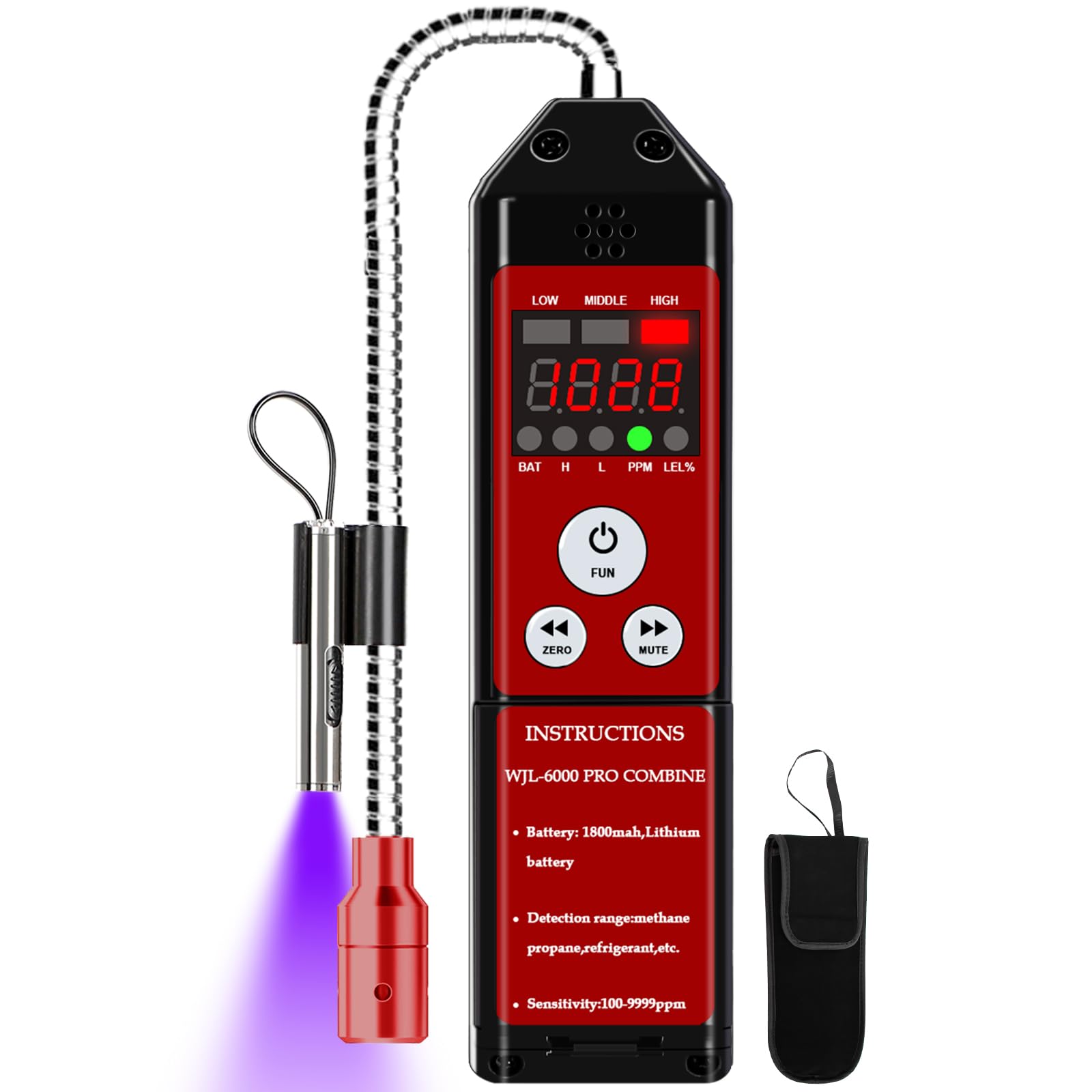
The Aprvtio WJL-6000PRO offers dual detection modes — PPM (parts per million) for locating micro-leaks with high precision and %LEL (lower explosive limit) for monitoring flammable gas concentration as a safety check. This combination is rare at this price point and makes the tool suitable for both conventional refrigerant searches and jobs involving hydrocarbon blends. The all-metal probe is a notable upgrade over the plastic tips found on many competing units, resisting dirt buildup and wear during daily use. The 1,800 mAh rechargeable battery delivers over 20 hours of operation, which is among the longest runtimes in this comparison.
Owner reports indicate the WJL-6000PRO finds leaks that soap bubbles miss, with one user describing it as saving a job that would have cost over a thousand dollars in unnecessary repairs. The 2-second response time is genuinely fast, and the 10-second refrigerant identification window helps confirm the presence of gas quickly. The audible alarm changes tone as concentration rises, and the mute button allows silent operation in customer-facing environments. The auto-calibration warm-up reduces false alarms by establishing a clean-air baseline before each session.
The unit supports an exhaustive list of refrigerants including R1234yf, R32, R454B, R290, and R600a, covering virtually every automotive and residential system on the market. Some users report that the instructions could be clearer, particularly regarding the switching between PPM and %LEL modes. The build quality feels solid, though the unit is slightly larger than some competitors. For technicians who need both leak detection and combustible gas monitoring in a single tool, the WJL-6000PRO delivers exceptional value.
What works
- Dual PPM and %LEL modes for leak detection and safety monitoring
- All-metal probe tip resists wear and dirt accumulation
- 20+ hour battery life from 1,800 mAh rechargeable cell
What doesn’t
- Instructions lack clarity on mode switching
- Slightly bulkier than some competing models
10. WISSCOOL HVAC Leak Detector
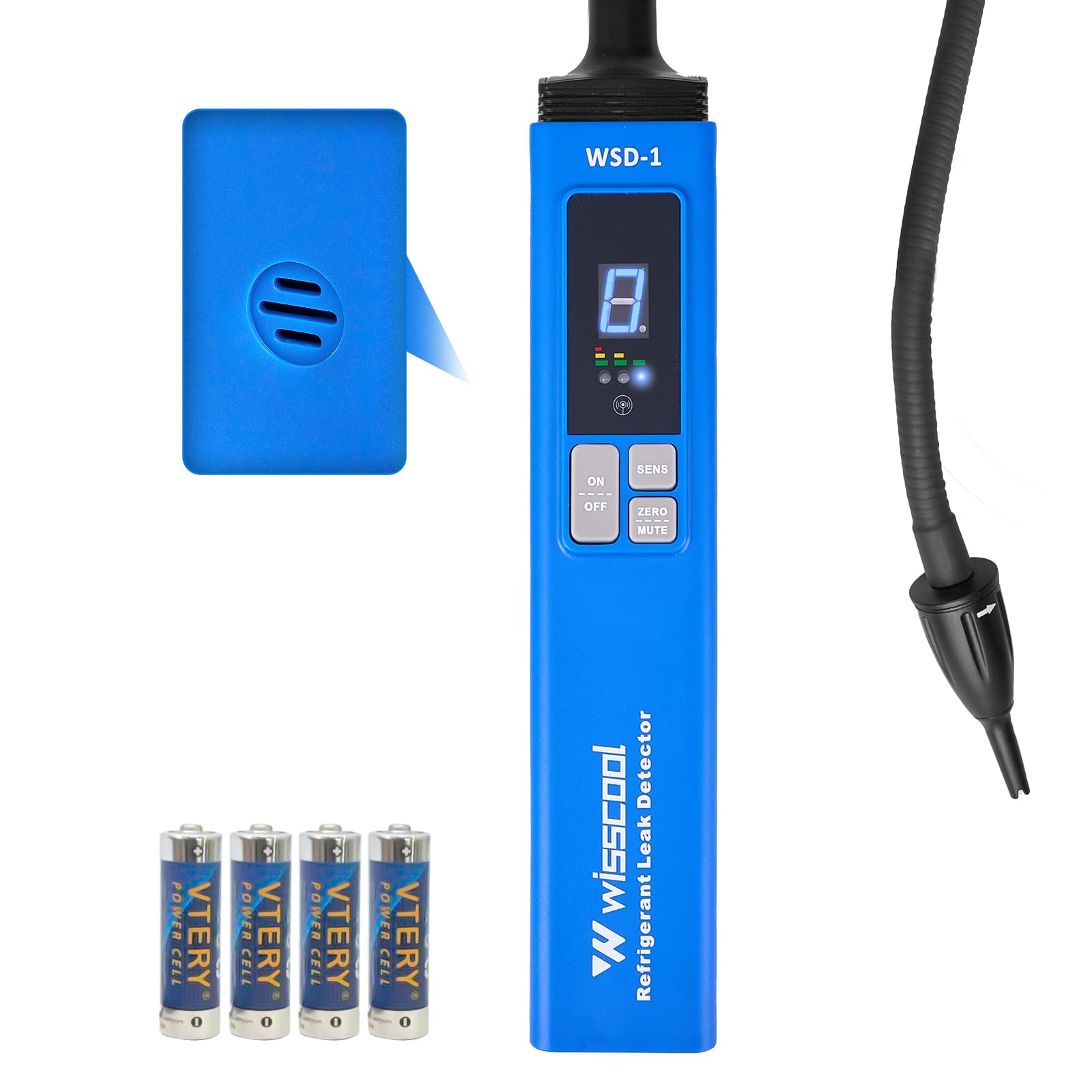
The WISSCOOL HVAC Leak Detector is an entry-level heated diode unit that provides solid detection capability at a very accessible price point. It offers three sensitivity levels with a maximum detection threshold of 0.1 oz/yr, which is sufficient for finding most common refrigerant leaks in automotive and residential systems. The numerical LCD display shows the sensitivity setting and leak intensity in real time, giving visual feedback that helps you track concentration changes as you move the probe. The 20-inch flexible probe is longer than many competitors and reaches deep into dashboards and behind fixed components.
Owner feedback is mixed but leans positive among those who received a properly functioning unit. Users describe the detector as easy to use for routine HVAC inspection, with a quick response during diagnostic checks and an easy-to-notice alert system. The audible alarm can be muted for indoor use, and the heated diode sensor supports stable performance over the rated 1,000-hour service life. The unit is lightweight and runs on AA batteries, which are easy to replace on the road.
The primary concern is consistency: several owners report units that arrived non-functional or failed to detect known leaks, suggesting quality control issues in the manufacturing process. The build quality is mostly plastic with a light, somewhat fragile feel that may not survive frequent drops in a tool bag. However, the manufacturer includes a 1-year warranty, and responsive customer service has been noted by users who received initial defective units. For a budget-conscious DIYer willing to test the unit thoroughly upon arrival, the WISSCOOL represents a low-risk entry into electronic leak detection.
What works
- 20-inch flexible probe reaches deep into tight engine bays
- Numerical LCD shows real-time leak intensity
- Three sensitivity modes cover 0.1 oz/yr to gross leaks
What doesn’t
- Quality control issues with non-functional units
- Plastic build feels fragile for daily tool-bag use
11. Leak Saver Direct Inject Ultimate 3-in-1

The Leak Saver Direct Inject Ultimate is not a detection tool — it is a repair solution designed to seal refrigerant leaks from the inside. Its 3-in-1 formula combines an organosilane sealant, a moisture remover, and UV dye in a single shot. When injected into an AC system, the sealant reacts with air and moisture at the leak site to form a permanent plug. The UV dye helps you locate the sealed area afterward with a UV light, confirming where the leak was. The moisture remover component protects the system from freeze-up and acid formation during the curing process.
Owner reports indicate that Leak Saver works best on slow leaks where the system retains most of its charge over a week. Multiple users describe successful repairs on R410A residential units and R134a automotive systems, with several noting that it saved them over a thousand dollars in service calls. The product works with all common refrigerants including R1234yf, R290, and R600a, and is safe for expansion valves, capillary tubes, and Schrader valves. The direct-inject design eliminates the need for messy syringes or pressurized cans — you use a standard manifold gauge set or an optional injection kit.
The main caveat is that Leak Saver is a repair, not a preventative treatment, and it is not recommended for systems that lose the full charge within seven days — those need mechanical repair first. Some owners report that the sealant did not fix their leak on the first attempt, requiring a second treatment. The product also voids manufacturer warranties in many cases, so it is best reserved for out-of-warranty systems. With over four million units sold since 2015 and overwhelmingly positive feedback, Leak Saver is the most trusted chemical leak repair option on the market.
What works
- Permanently seals slow refrigerant leaks from the inside
- UV dye confirms leak location without separate tools
- Safe for all system components including TXVs and capillary tubes
What doesn’t
- Not effective on fast leaks that lose full charge in under a week
- May void manufacturer warranties on sealed systems
Hardware & Specs Guide
Heated Diode Sensor
Most automotive-grade leak detectors use a heated diode sensor that operates by heating a ceramic element to detect halogen atoms in the air. These sensors warm up in approximately 30 seconds and offer sensitivity between 0.03 and 0.14 oz/yr. Service life typically ranges from 500 to 1,000 hours, after which sensitivity degrades and the sensor needs replacement. Heated diode sensors can false-trigger on moisture, high humidity, and cleaning solvents, so a clean-air warm-up and periodic baseline recalibration are essential for accurate results.
Infrared Sensor
Infrared (IR) sensors use optical absorption to detect refrigerant molecules, making them highly resistant to false alarms from non-refrigerant gases. They have a significantly longer service life — up to ten years — and maintain stable sensitivity over that period. The trade-off is a slower response time and a higher initial cost. IR sensors are the preferred choice for professional technicians who rely on their detector daily and cannot afford the downtime or calibration drift associated with heated diode units.
PPM and %LEL Detection Modes
PPM (parts per million) mode displays the exact concentration of refrigerant in the air, allowing you to track a gradient toward the source. %LEL (lower explosive limit) mode reads the concentration of flammable gas as a percentage of the minimum level at which it can ignite. This second mode is critical when working with A2L or A3 refrigerants such as R32 or R290, because it provides a safety threshold warning. Not all detectors offer %LEL, so if you service hydrocarbon systems, prioritize a model with this feature.
Battery Platform and Runtime
Rechargeable lithium-ion batteries with USB-C charging have become the dominant power source in modern detectors because they eliminate the recurring cost of disposables and provide 6–10 hours of continuous runtime. Units with 3,000 mAh capacity generally deliver the longest shifts before requiring a charge. Disposable AA batteries remain common in entry-level models and are easy to replace on the go, but they lack the convenience and environmental benefit of rechargeable systems. Always verify the low-battery indicator functions, as a dying battery can cause false negatives during a critical diagnostic pass.
FAQ
What refrigerants can an auto freon leak detector find?
How often should I replace the sensor on a heated diode detector?
Can I use a chemical leak sealer instead of finding the leak first?
What sensitivity level should I use for automotive AC leak detection?
Why does my leak detector keep giving false alarms?
Final Thoughts: The Verdict
For most buyers, the best auto freon leak detector winner is the Aprvtio ALD-200 because it combines a heated diode sensor that supports A1, A2L, and A3 refrigerants with a bright TFT display, peak hold, and oil-resistant housing — all at a price that undercuts comparable professional-grade units. If you want infrared-grade immunity to false alarms and a ten-year sensor life, grab the Elitech ILD-200. And for extreme micro-leak detection down to 0.03 oz/yr, nothing beats the VIVOHOME Refrigerant Leak Detector.

Certification: BSc in Mechanical Engineering
Education: Mechanical engineer
Lives In: 539 W Commerce St, Dallas, TX 75208, USA
Md Amir is an auto mechanic student and writer with over half a decade of experience in the automotive field. He has worked with top automotive brands such as Lexus, Quantum, and also owns two automotive blogs autocarneed.com and taxiwiz.com.