A fuel regulator bracket might seem like a minor component in a performance build, but the difference between a steady fuel curve and a dangerous pressure spike often comes down to the quality of that mount and the regulator it holds. A poorly designed bracket introduces vibration, misalignment, and leak paths that can turn a promising engine build into a frustrating diagnostic nightmare. The market is flooded with options that look similar on a web page but differ dramatically in thread quality, material consistency, and long-term sealing reliability once installed underhood.
I’m Amir — the founder and writer behind Four Wheel Ask. My work centers on analyzing product specifications, evaluating build quality across different price tiers, and distilling real owner feedback into clear, practical guidance for automotive enthusiasts.
Analyzing build quality and real owner feedback across dozens of options, one stands as a true best fuel regulator bracket for dependable performance.
How To Choose The Best Fuel Regulator Bracket
Selecting a fuel regulator bracket is about more than just finding something that bolts up. The bracket serves as the structural foundation for your fuel pressure regulation, and any flex, corrosion, or thread mismatch introduces variables that compromise tuning and safety. Understanding the material science, adjustability requirements, and mounting geometry specific to your engine family will save you from buying twice or, worse, dealing with a fuel system failure.
Material and Build Quality
The bracket and regulator body should be machined from either 6061-T6 billet aluminum or high-grade zinc alloy. Billet aluminum offers superior vibration damping and corrosion resistance, while zinc alloy components often work fine in low-pressure carbureted applications if the sealing surfaces are properly machined. Avoid cast parts with visible porosity or rough thread entries — these are early indicators of future leaks. An anodized or painted finish adds a layer of protection against fuel and heat exposure.
Adjustability Range and Mechanism
Carbureted systems typically need 1–9 PSI, while EFI setups require 30–85 PSI depending on the injector package. A numbered dial or set-screw adjustment with a locknut provides repeatable tuning. Look for a design that allows pressure adjustment without removing the unit from the bracket. The gauge port should use a standard 1/8-inch NPT thread so you can attach a known-good gauge rather than relying on a supplied gauge of unknown accuracy.
Mounting Configuration and Compatibility
Dedicated brackets like those designed for LS cylinder heads offer a clean, vibration-isolated mount that keeps the regulator secure and accessible. Universal brackets should use at least two robust mounting points and include rubber or polyurethane isolators to prevent hard-mount vibration transfer. For return-style systems, verify that the bracket positions the regulator so the return line can route cleanly back to the tank or cell without sharp bends that create back-pressure.
Quick Comparison
On smaller screens, swipe sideways to see the full table.
| Model | Category | Best For | Key Spec | Amazon |
|---|---|---|---|---|
| Holley 12-840 | Carbureted | Precision carb tuning | 4.5–9 PSI, billet aluminum | Amazon |
| Aeromotive 13129 | EFI Return | High-horsepower EFI builds | 40–75 PSI, ORB-06 ports | Amazon |
| ICT Billet LS Mount | Bracket Only | LS engine regulator mounting | Aerospace billet aluminum | Amazon |
| Speedway Motors | Integrated | LS swaps, Holley Sniper | 58 PSI, 5-micron filter | Amazon |
| EVIL ENERGY 6AN | EFI Bypass | Budget EFI systems | 30–70 PSI, includes bracket | Amazon |
| YESHMA EFI Kit | EFI Complete | Universal EFI conversions | 30–70 PSI, bracket included | Amazon |
| Spectre Performance | Carbureted | Classic carbureted engines | 1–4 PSI, barb fittings | Amazon |
| PQY 7855-DBK | EFI Return | Performance EFI upgrades | 60–85 PSI, AN8/AN6 | Amazon |
| WnSEu EFI Regulator | EFI Complete | Entry-level EFI builds | 0–160 PSI gauge, AN6 | Amazon |
| Pilida 9710 | Carbureted | Low-pressure carb setups | 1–5 PSI, zinc alloy | Amazon |
| Plobeda 50mm Filter | Filter Bracket | Universal filter mounting | 50mm, 6AN/8AN/10AN | Amazon |
In‑Depth Reviews
10. Holley 12-840 Billet Fuel Pressure Regulator

The Holley 12-840 is machined from billet aluminum with a black anodized finish, offering the kind of thread quality and sealing consistency that separates a true performance part from a generic alternative. Designed for carbureted applications requiring 4.5 to 9 PSI, this regulator targets the sweet spot for Holley and Edelbrock carburetors that demand steady pressure without the fluctuation that causes flooding or lean hesitation. The 3/8-inch NPT ports provide a standard interface compatible with most fuel line configurations, and the compact body fits easily into tight engine bays.
Owner reports consistently highlight the regulator’s ability to hold a rock-steady 4.5 PSI when used with factory fuel pumps that originally produced higher pressures. One user running a 1999 Dodge Dakota with a carb swap confirmed that the Holley unit eliminated the pressure spikes that had plagued their setup with cheaper regulators, while another noted that a prior budget Holley unit failed but this billet version performed flawlessly. The adjustment screw with locknut allows precise tuning without removing the unit from its mount, and the anodized finish resists fuel and heat degradation over time.
A small number of owners reported issues with the retaining clip for the spring and ball bearing assembly, and one unit arrived with galled inlet threads. These appear to be isolated manufacturing outliers rather than a pattern, but they underscore the importance of inspecting threads before installation. Overall, the Holley 12-840 delivers the pressure stability that carbureted builds require, backed by a brand with decades of fuel system engineering experience.
What works
- Steady pressure output eliminates carb flooding and rough idle
- Billet aluminum construction with clean anodized finish
- Standard 3/8-inch NPT ports for broad compatibility
- Compact size fits tight engine compartments
What doesn’t
- Occasional quality control issues with retaining clip and threads
- Limited to 4.5–9 PSI range, unsuitable for EFI applications
- Premium pricing compared to generic alternatives
11. Aeromotive 13129 EFI Fuel Pressure Regulator

The Aeromotive 13129 is the benchmark for return-style EFI pressure regulation, supporting up to 1000 horsepower with a compact body that features two ORB-06 inlet ports and one ORB-06 return port. The dedicated 1/8-inch NPT gauge port allows precise pressure monitoring, while the vacuum/boost reference port enables a 1:1 fuel pressure rise under forced induction. This is the regulator that serious builders turn to when they need repeatable, leak-free performance over tens of thousands of miles.
Long-term owner reports validate the 13129’s reputation. One user logged 20,000 miles on a 7.3 Powerstroke e-fuel conversion with a steady 65 PSI and no adjustment needed after initial setup, handling heat, dust, and vibration without corrosion or leakage. Another builder used it on a 7.3 Powerstroke after two failed attempts with cheaper units and confirmed zero issues. The 6061-T6 aluminum body and aerospace-grade manufacturing processes explain why this regulator commands a premium — it is designed to outlast the engine it feeds.
The only drawbacks are the investment required and the need for proper thread sealant on the NPT gauge port. Some users noted that the gauge port requires careful sealing to prevent minor seepage, and the unit does not include a bracket — you will need a separate mount like the ICT Billet LS bracket for a complete installation. For builders targeting 500-plus horsepower or forced induction, the Aeromotive 13129 is the definitive choice.
What works
- Exceptional pressure stability over tens of thousands of miles
- Compact dual-inlet design for clean hose routing
- Boost reference port for forced induction applications
- Accepts standard 1/8-inch NPT gauge for accurate monitoring
What doesn’t
- Highest price point in its class
- Does not include mounting bracket
- Gauge port requires careful thread sealant application
7. ICT Billet Fuel Pressure Regulator Mount for LS
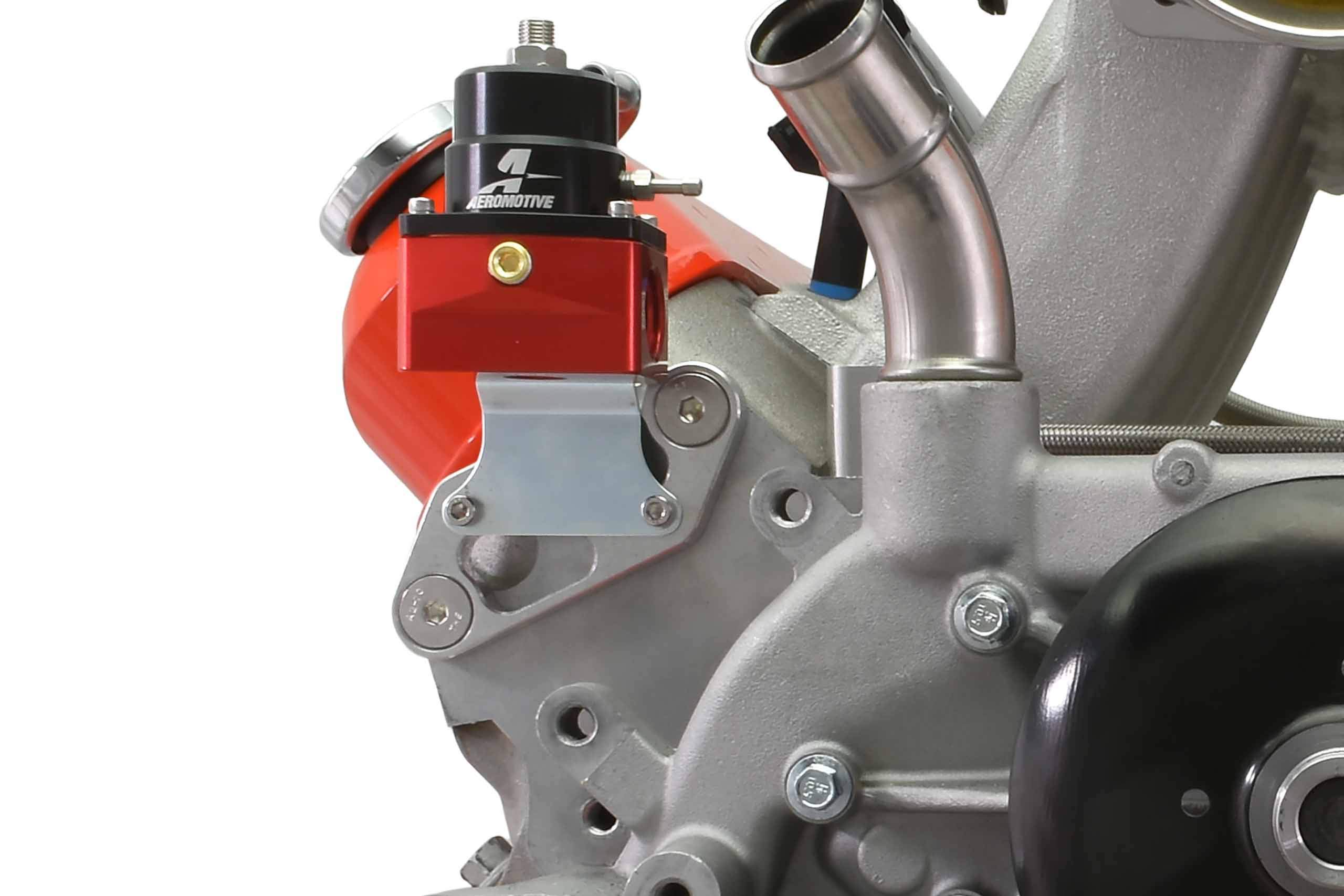
The ICT Billet 551964-LSFR1 is a dedicated mounting bracket machined from aerospace-grade billet aluminum in Wichita, Kansas, designed to install on the front or rear face of the driver or passenger LS cylinder head. This bracket solves the common problem of finding a secure, vibration-free mounting location for aftermarket fuel pressure regulators on LS swaps, providing machined mounting holes compatible with Aeromotive 13101, 13129, and other regulators with standard bolt patterns.
Reviews from LS builders confirm the bracket’s precision fitment. One owner mounted an Aeromotive FPR on a 408 stroker with CNC-ported 243 heads and reported a perfect fit on the passenger side, with multiple attachment options for different head configurations. The bracket weighs only 4.6 ounces, so it adds negligible mass while providing a rigid mounting platform. The natural aluminum finish blends well with a polished engine bay and resists corrosion without requiring paint or coating.
The only limitation reported by users is that the bracket offers only two small mounting holes per side, which limits adjustment range for regulators with non-standard port locations. One owner noted that it did not fit their specific engine due to head casting differences, but acknowledged the description clearly states LS compatibility. This bracket is purpose-built for the LS engine family and delivers exactly what it promises — a clean, secure mount for your regulator.
What works
- Precision-machined for LS cylinder head mounting
- Aerospace-grade billet aluminum with excellent durability
- Ultra-lightweight at 4.6 ounces
- Compatible with major aftermarket regulators
What doesn’t
- Limited mounting hole adjustment per side
- LS-specific — not suitable for other engine families
- Does not include the regulator itself
9. Speedway Motors Deluxe AN6 Fuel Filter Regulator

The Speedway Motors 91012808 combines a 58 PSI fuel pressure regulator with a 5-micron fuel filter in a single welded zinc-coated steel housing, eliminating the need for a separate filter and reducing potential leak points in LS swap and aftermarket EFI systems. The AN6 inlet, outlet, and return fittings are welded directly to the housing, which removes the cost and complexity of adapter fittings. The included mounting bracket with a rubber insulator reduces vibration transfer and simplifies chassis installation.
Users have reported excellent results on a variety of builds. One owner used it on an 89 Jeep Wrangler with a 5.7 Vortec and Summit EFI system, confirming that the pre-regulated 58 PSI output eliminated tuning headaches. Another praised the convenience of the integrated AN6 fittings and the clean installation. The unit supports up to 450 horsepower naturally aspirated, making it a strong fit for mild to moderately built LS and Gen 3 Hemi swaps. The rubber-isolated bracket keeps noise and vibration to a minimum.
The primary concern reported by some buyers is quality control — one unit arrived with internal components warped during welding, preventing proper pressure regulation, though the replacement unit worked perfectly. The flow direction labeling on the ports is not intuitive, with the inlet on the side and the return in the middle, so careful attention to the manual is required. Despite these issues, the integrated design concept reduces complexity and appeals to builders seeking a clean fuel system layout.
What works
- Integrated regulator and filter simplifies fuel system layout
- Welded AN6 fittings eliminate adapter leak points
- Rubber-isolated bracket reduces vibration transmission
- Pre-set 58 PSI ideal for LS and EFI swaps
What doesn’t
- Occasional quality control issues with internal components
- Non-intuitive port labeling requires careful installation
- Limited to 450 HP naturally aspirated applications
8. EVIL ENERGY Fuel Pressure Regulator 6AN
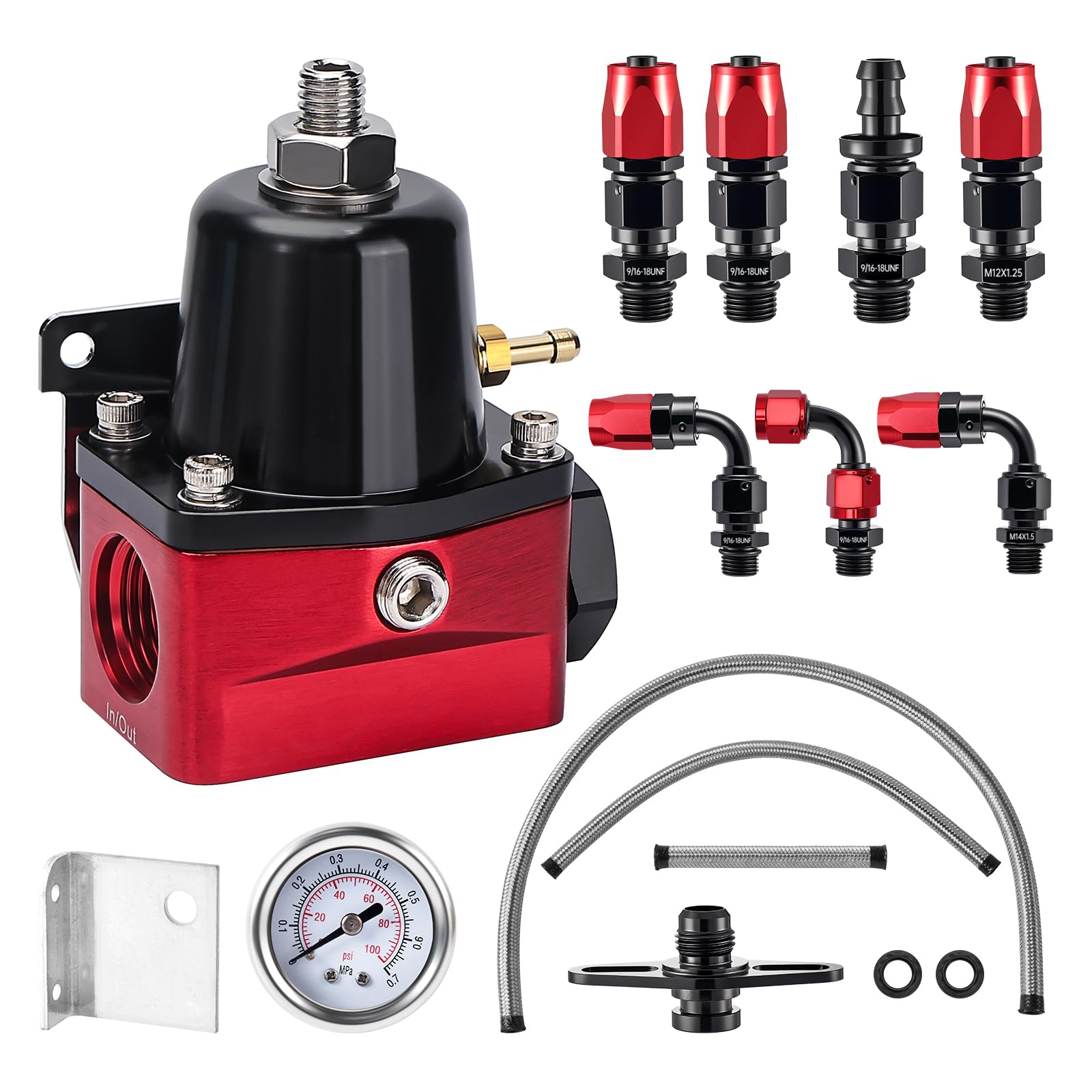
The EVIL ENERGY 6AN regulator delivers an adjustable 30 to 70 PSI range with a painted aluminum body, a bracket, a pressure gauge, and multiple AN fittings in one package, making it a popular choice for budget-conscious EFI conversions. The unit accepts gasoline, E85, and alcohol fuels but is not compatible with diesel. Four port options provide flexibility for return-style plumbing, and the set-screw adjustment on top allows for tool-free pressure changes.
Builders using this regulator on LS setups and Holley Sniper systems report solid construction and steady pressure maintenance once adjusted. One owner noted that after replacing a flimsy internal regulator with this unit, they dialed in 60 PSI and experienced no further issues. Another user on a boosted Corolla confirmed reliable operation for over a year. The included bracket simplifies mounting, and the AN6 stainless steel braided hose provides a professional appearance despite being a budget-tier component.
However, experienced builders flag several areas of concern. The supplied pressure gauge is widely reported as inaccurate with a bouncing needle, and the included fuel hoses are non-reinforced rubber that tears easily — these should be replaced with quality nylon-reinforced lines. The regulator itself holds pressure well in the 30–70 PSI range, but the fittings and accessories are clearly where cost was cut. For builders who understand these limitations and plan accordingly, the EVIL ENERGY unit offers genuine value.
What works
- Reliable pressure regulation in the 30–70 PSI range
- Complete kit includes bracket, gauge, and fittings
- Works with gasoline, E85, and alcohol fuels
- Easy external adjustment without disassembly
What doesn’t
- Included gauge is inaccurate with needle bounce
- Supplied fuel hoses are low-quality non-reinforced rubber
- Not suitable for applications over 500 HP
- Compatibility limited to EFI systems only
6. YESHMA EFI Fuel Pressure Regulator Kit
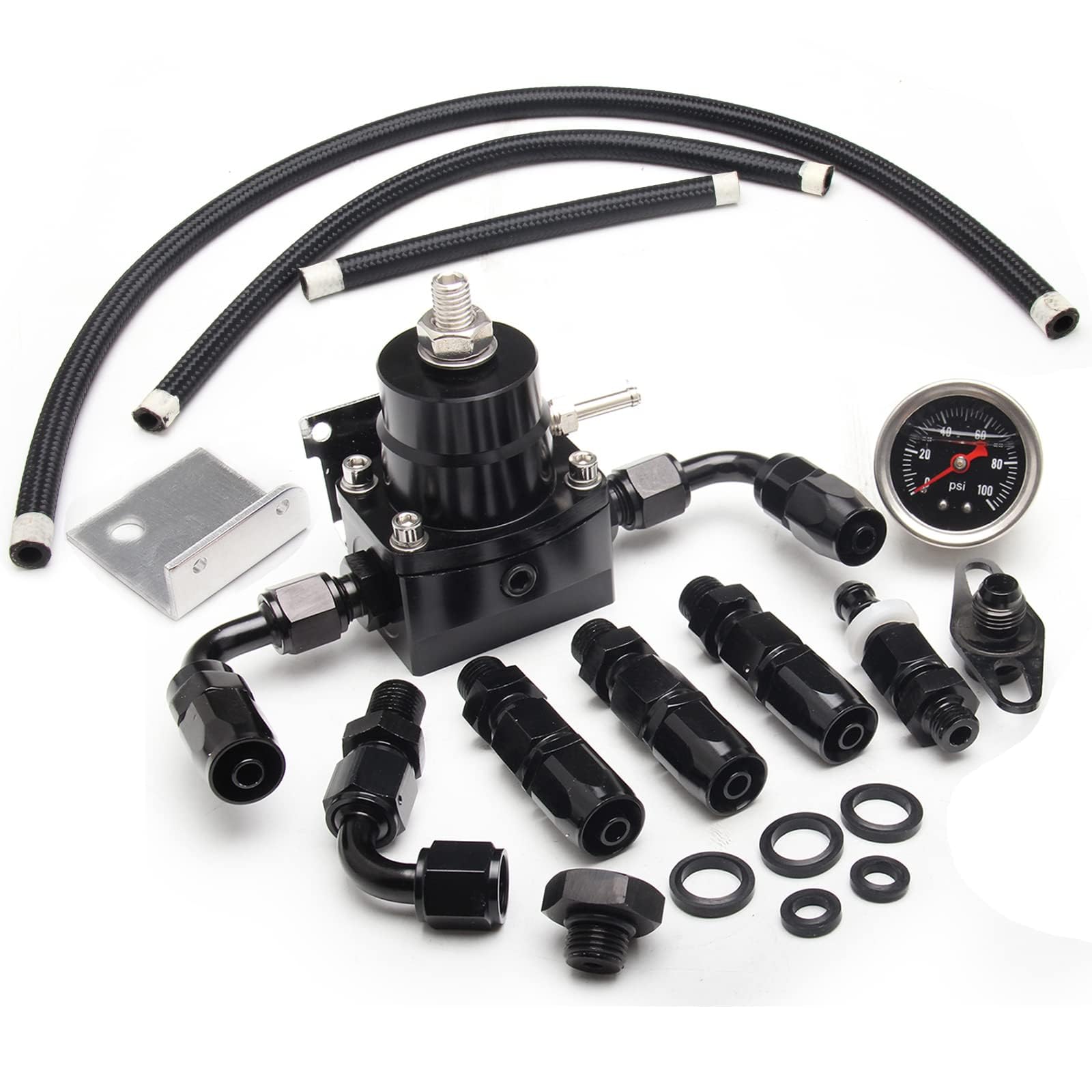
The YESHMA EFI kit provides a complete fuel pressure regulation package with a 0–100 PSI gauge, an aluminum regulator body, a bracket, three 6AN fuel lines, and multiple adapters including straight and 90-degree fittings. The adjustable range of 30 to 70 PSI covers the majority of naturally aspirated and mildly boosted EFI applications. The regulator features a 304 stainless steel and CPE synthetic rubber hose construction for fuel compatibility.
Owner feedback shows successful installations on a variety of builds. One user adapted it to a Jaguar 4.2 V8 return-style system, maintaining a constant 60 PSI base pressure with no issues after initial setup. Another installed it on a 78 Mercury with an Aces EFI throttle body on a 403 stroker and confirmed zero leaks after using thread tape on all connections. The kit is praised for including everything needed for a basic EFI fuel system, reducing the number of separate purchases required.
The most common complaints center on the supplied gauge — several owners report that the gauge is inaccurate and recommend replacing it with a known-quality unit. One user found the regulator would not adjust below 20 PSI despite the advertised 0–100 PSI range. The lack of installation instructions is also a recurring theme; professional installation is strongly recommended. For builders comfortable with fuel system work, the YESHMA kit provides a complete starting point at a reasonable investment.
What works
- Comprehensive kit includes regulator, bracket, lines, and adapters
- Stainless steel and CPE rubber hose construction
- Straight and 90-degree fittings for flexible routing
- Holds steady pressure once properly installed
What doesn’t
- Supplied gauge often inaccurate
- Minimum pressure may not go as low as advertised
- No installation instructions included
- Some units arrive with debris inside
4. Spectre Performance 2518 Fuel Pressure Regulator

The Spectre Performance 2518 is a straightforward adjustable regulator designed specifically for carbureted engines requiring 1 to 4 PSI. The bright plated aluminum body provides corrosion resistance and a clean aesthetic, while the 3/8-inch barb fittings and included mounting hardware allow for quick installation without specialized tools. This unit targets the specific needs of Holley and Eddlebrock carburetors that require low, stable pressure for proper float bowl operation.
Users report that the Spectre 2518 solves real performance problems. One owner running a Holley 650 on a 70 Impala 350 found that other regulators marketed for carburetors were actually flow restrictors that caused flooding, while this unit delivered the correct 4–6 PSI his engine needed, fixing hard starting and rough idle. Another owner successfully used it on a riding mower, demonstrating its versatility across different engine types. The compact size allows mounting in tight spaces where full-size regulators will not fit.
The primary limitation is the lack of an integrated gauge — you will need to purchase a separate gauge like the Spectre 2515 or 59013 to verify pressure. A small number of owners reported units that failed to regulate pressure regardless of screw adjustment, suggesting possible debris or manufacturing defects in isolated cases. Some users also noted that the adjustment screw range is limited and may not achieve the lowest settings. For basic carbureted applications, the Spectre 2518 offers a focused solution at a mid-range investment.
What works
- True pressure regulation for carbureted systems, not just flow restriction
- Corrosion-resistant plated finish
- Compact design fits tight engine compartments
- Includes barb fittings and mounting hardware
What doesn’t
- No integrated gauge — must be purchased separately
- Occasional units fail to regulate at all
- Limited to 1–4 PSI range
3. PQY Fuel Pressure Regulator AN8 Feed & AN6 Return
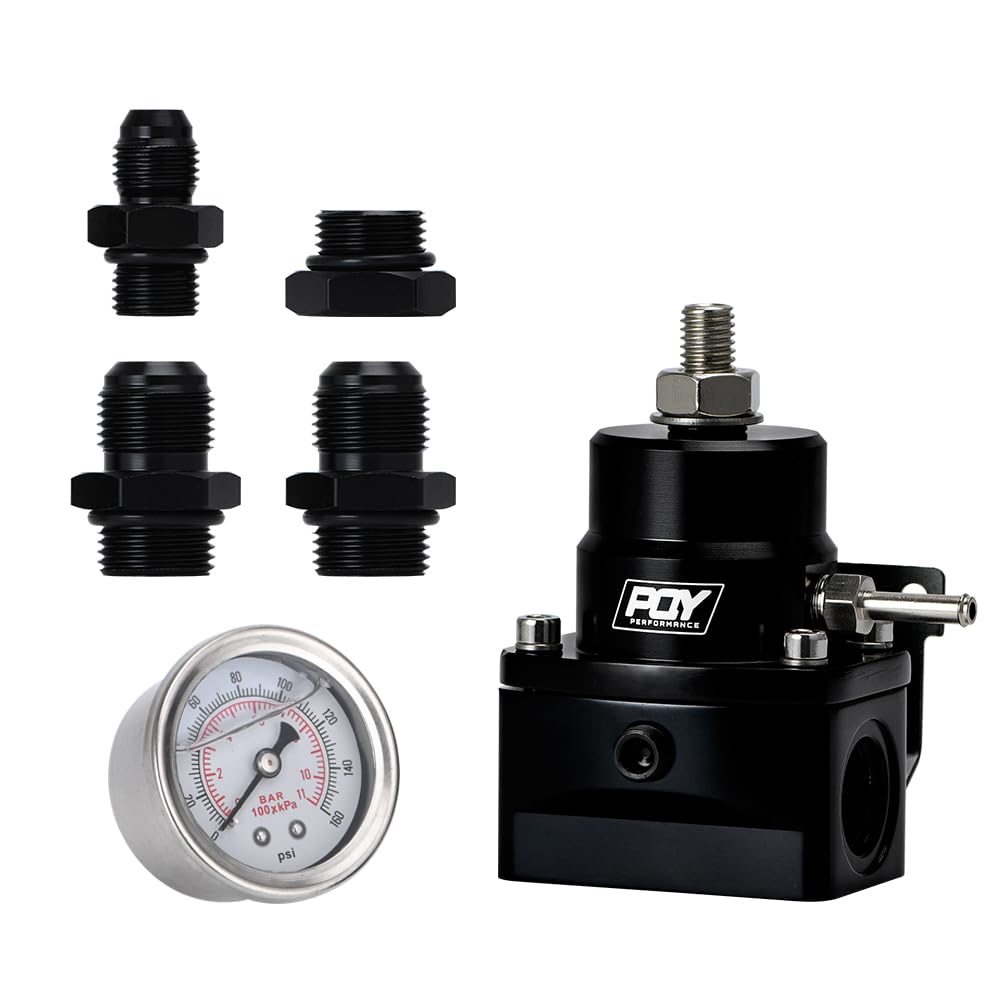
The PQY 7855-DBK is a CNC-machined regulator constructed from 6061-T651 billet aluminum, featuring AN8 feed and AN6 return ports along with a 1/8-inch NPT gauge port and a vacuum/boost reference connection. The adjustable range of 60 to 85 PSI targets high-pressure EFI applications including E85 and alcohol fuel systems. The included 0–160 PSI gauge provides real-time pressure monitoring, and the black anodized finish offers corrosion protection.
Shop-level users have validated this regulator’s performance at scale — one builder reported using 20–30 units in their shop, noting that they perform on par with regulators costing significantly more. The billet construction and quality O-ring sealing surfaces contribute to leak-free operation when installed with proper thread sealant. A creative owner modified the spring with a 350 TBI assembly to achieve a 5–25 PSI range for a 454 carburetor application, demonstrating the regulator’s adaptability for those willing to experiment.
Areas requiring attention include the need for professional installation and thread sealant on all NPT connections. One unit arrived contaminated with debris due to inadequate packaging, highlighting the importance of inspecting and cleaning any new fuel system component before installation. The regulator’s higher pressure range makes it unsuitable for stock carbureted applications without modification. For EFI builders who value machining quality over brand name, the PQY unit offers a compelling balance of precision and value.
What works
- CNC-machined 6061-T651 billet aluminum construction
- AN8 feed and AN6 return for high-flow applications
- Vacuum/boost reference for forced induction
- Competitive pricing relative to build quality
What doesn’t
- Some units arrive contaminated from inadequate packaging
- Professional installation and thread sealant required
- Not suitable for stock carbureted setups without spring modification
- Gauge quality varies between units
5. WnSEu Adjustable Universal EFI Fuel Pressure Regulator Kit

The WnSEu EFI regulator kit provides a complete fuel system solution with an aluminum regulator body, a 0–160 PSI gauge, and AN6 fittings, supporting up to 1000 horsepower in a universal EFI bypass configuration. The regulator is constructed from high-quality aluminum alloy and is compatible with gasoline, E85, and alcohol fuel systems. The compact design and multiple port options allow for flexible installation in engine bays with limited space.
Real-world feedback shows strong performance in swap applications. One owner integrated it into a K24-swapped Honda with a return-style fuel system, reporting that the regulator maintained set fuel pressure without any failures. The ease of installation for first-time AN fitting users was noted as a positive, with proper use of fuel-resistant Teflon tape preventing leaks at threaded joints. The kit’s ability to handle high-flow EFI fuel pumps makes it suitable for builds making significant power.
The most notable issue reported is color inconsistency — one buyer ordered lime green and received purple, suggesting that inventory management for color options may be unreliable. The kit also lacks installation instructions, which can be a barrier for less experienced builders. Some users noted that the included gauge is not calibrated to a high standard, though it provides a reasonable reference for pressure monitoring. For builders who prioritize capability and completeness over brand prestige, the WnSEu kit delivers impressive specification for its price tier.
What works
- Supports up to 1000 HP with high-flow fuel pumps
- Complete kit with gauge and AN6 fittings included
- Works with gasoline, E85, and alcohol fuels
- Compact design for tight engine bay installation
What doesn’t
- Color options are unreliable — you may not receive what you order
- No installation instructions included
- Gauge accuracy is adequate but not professional grade
- Some units may require additional thread sealant
1. Pilida 9710 Fuel Pressure Regulator Kit

The Pilida 9710 is an entry-level fuel pressure regulator kit designed for facet-type fuel pumps and low-pressure carbureted systems, offering an adjustable range of 1 to 5 PSI via a numbered dial on top. The zinc alloy body features an anodic oxidation process for corrosion resistance, and the kit includes 1/4-inch, 5/16-inch, and 3/8-inch fuel connectors to accommodate various line sizes. The maximum input pressure should not exceed 8 PSI, making this unit suitable for gravity-fed or low-pressure pump systems.
Owner experiences are mixed but informative. One user successfully installed it on a 1953 Kaiser Manhattan 226 Flathead 6 with a Carter WGD carburetor, reducing pressure from 7.5 PSI to under 4.5 PSI with no leaks, though they noted the cheap diaphragm could fail over time. Another user confirmed the product works when adjusted carefully and that the numbered notches provide useful reference points. The kit includes thread sealant tape and clear notes about its application in the item description, helping first-time users avoid common mistakes.
The significant concern raised by multiple owners is reliability. One report described a catastrophic internal failure after brief use, with the regulator no longer controlling pressure at all. Another user found that the numbered dial does not correspond to actual PSI output — the minimum achievable pressure was 3.5 PSI even with the dial turned fully down. These issues suggest that the unit works for basic pressure reduction but may lack the precision and durability required for critical applications or daily-driver reliability.
What works
- Inexpensive entry point for carbureted pressure reduction
- Includes multiple fuel connector sizes for versatility
- Numbered dial provides visual adjustment reference
- Zinc alloy construction with anti-corrosion coating
What doesn’t
- Reported catastrophic internal failure after short use
- Dial markings do not correspond to actual PSI output
- Minimum pressure limited to approximately 3.5 PSI
- Diaphragm quality raises long-term reliability concerns
2. Plobeda 50mm Inline Fuel Filter Mount with Bracket
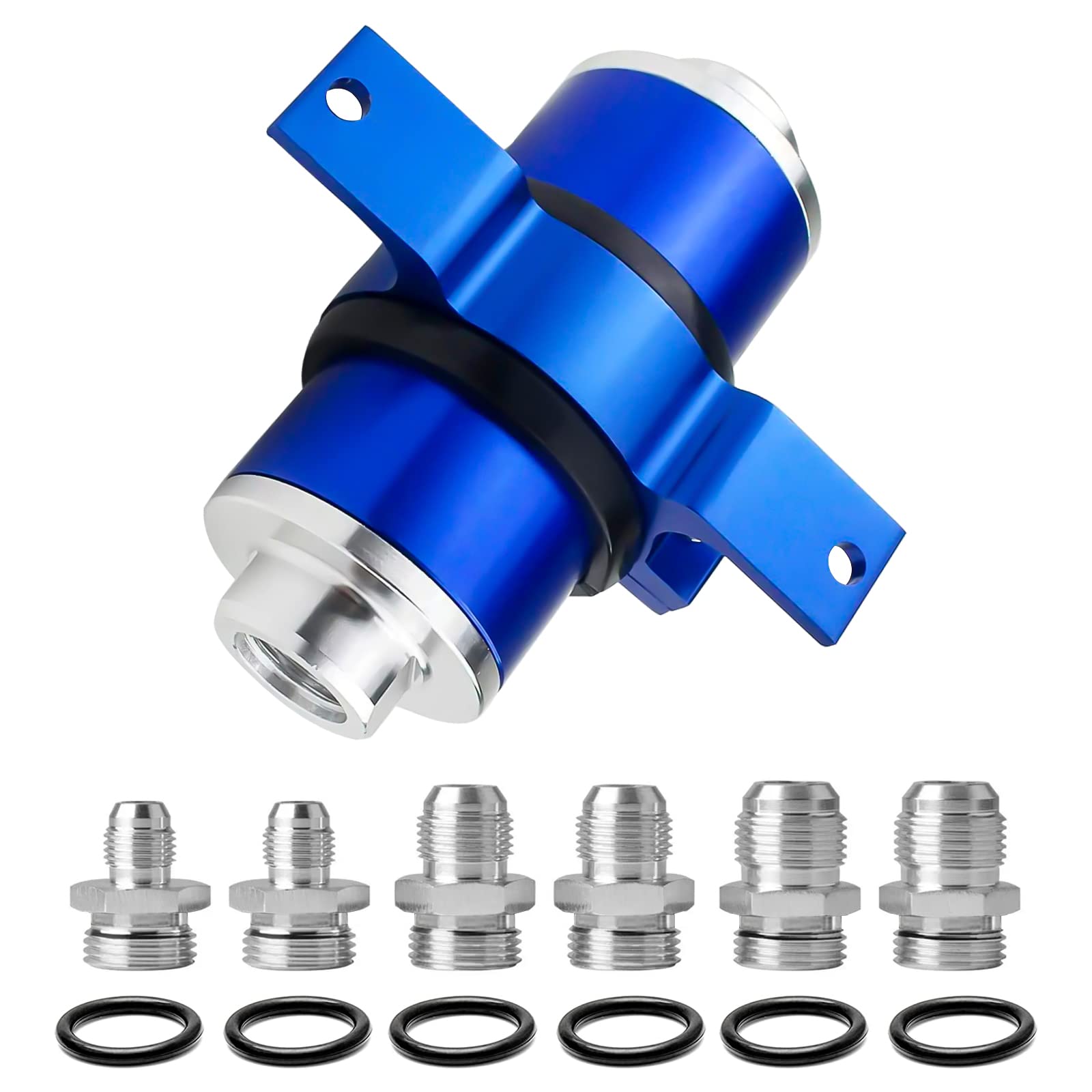
The Plobeda 50mm inline fuel filter kit is a filtering solution that includes a 50mm aluminum filter housing, a mounting bracket, a wrench, and a set of AN6, AN8, and AN10 connector adapters. The 100-micron stainless steel filter element is washable and reusable, servicing both carbureted and EFI fuel systems. The anodized aluminum construction provides surface durability and corrosion resistance for underhood installation.
Customer feedback consistently highlights the quality-to-value ratio. One owner who had been searching for a quality inline filter found this unit exceeded expectations, praising the multiple fitting adaptors and well-made construction. Another user reported running it on two fuel-injected squarebody trucks without any leaks or issues, noting that it performs identically to higher-priced branded filters. The cleanable stainless steel element reduces long-term maintenance costs compared to disposable paper filters.
The main limitation is the lack of directional flow marking on the housing, which can lead to incorrect installation. One review specifically mentioned uncertainty about which direction the fuel should flow through the filter. The 1-month warranty is shorter than industry standard, and the filter is not designed for high-pressure return-style systems without additional support. For builders seeking a cleanable inline filter with a robust bracket and multiple adapter options, this kit delivers strong utility at a modest investment.
What works
- Cleanable 100-micron stainless steel filter element
- Includes bracket, wrench, and multiple AN adapters
- Anodized aluminum construction resists corrosion
- Universally fits carbureted and EFI systems
What doesn’t
- No flow direction marking on the housing
- Short 1-month warranty period
- Not designed for high-pressure return-style regulators
- Included hardware quality is adequate but not premium
Hardware & Specs Guide
Material Grades
Billet 6061-T6 aluminum is the gold standard for regulator and bracket construction, offering high tensile strength, excellent vibration damping, and natural corrosion resistance. Zinc alloy is a budget-friendly alternative found in entry-level regulators, but porosity and thread quality vary significantly between manufacturers. Welded steel housings, used in integrated filter-regulator units, provide durability at the cost of additional weight. Anodized or painted finishes add protection against fuel and heat degradation.
Thread Types and Port Configurations
NPT (National Pipe Taper) threads are standard on gauge ports and many regulator bodies — they rely on thread deformation for sealing and require thread sealant tape or paste. ORB (O-Ring Boss) threads, commonly found on Aeromotive and ICT Billet components, use an O-ring for sealing and are more tolerant of repeated assembly and disassembly. AN (Army-Navy) fittings provide a standardized flare seal for high-pressure fuel lines. Matching the correct thread type between regulator, bracket, and fuel lines is critical for leak-free operation.
Pressure Ranges and Adjustment Mechanisms
Carbureted regulators typically operate between 1 and 9 PSI, with adjustment via a set screw or numbered dial. EFI regulators range from 30 to 85 PSI for naturally aspirated builds, with some units supporting up to 100 PSI for forced induction. The adjustment mechanism should include a locknut to prevent pressure drift from vibration. A dedicated 1/8-inch NPT gauge port allows connection of a high-quality gauge — the supplied gauges in budget kits are often inaccurate and should be replaced.
Mounting Bracket Design and Isolation
The bracket is the structural link between the regulator and the engine or chassis. Dedicated brackets machined for specific engine families, such as the ICT Billet LS mount, provide optimal positioning and vibration isolation. Universal brackets should incorporate rubber or polyurethane isolators to prevent hard-mount vibration transfer that can loosen fittings over time. The bracket must position the regulator so that inlet, outlet, and return lines route cleanly without sharp bends that create back-pressure or stress the AN fittings.
FAQ
Do I need a return-style or dead-head regulator?
Can I use an EFI regulator on a carbureted engine?
What thread sealant should I use on NPT ports?
How do I verify my regulator bracket is rigid enough?
Final Thoughts: The Verdict
For most builders, the best fuel regulator bracket winner is the Holley 12-840 because it delivers the pressure stability that carbureted engines require, with billet aluminum construction and proven reliability from a brand with decades of fuel system expertise. If you are building an EFI system with serious horsepower goals, the Aeromotive 13129 offers the long-term durability and boost reference capability that high-performance builds demand. And for LS swappers looking for a clean, dedicated mounting solution, the ICT Billet LS mount provides precision-machined alignment that keeps your regulator secure and accessible.

Certification: BSc in Mechanical Engineering
Education: Mechanical engineer
Lives In: 539 W Commerce St, Dallas, TX 75208, USA
Md Amir is an auto mechanic student and writer with over half a decade of experience in the automotive field. He has worked with top automotive brands such as Lexus, Quantum, and also owns two automotive blogs autocarneed.com and taxiwiz.com.