A cable stripper that nicks the conductor turns a clean wiring job into a hidden failure point. Whether you’re running new circuits in a classic car, repairing a trailer harness, or terminating Cat6a for a shop network, the margin between a perfect strip and a damaged wire comes down to blade geometry, depth control, and the tool’s ability to match the jacket material. The wrong stripper wastes time, ruins cable, and introduces resistance or intermittent faults that are hell to trace later.
I’m Amir — the founder and writer behind Four Wheel Ask. I’ve spent years analyzing market trends, studying product specifications, and aggregating owner-reported data to identify which tools deliver consistent performance across different wiring tasks.
After evaluating build quality, precision, and real-world feedback, the best cable stripper tool comes down to matching the tool to your specific wiring needs.
How To Choose The Best Cable Stripper Tool
Selecting the right cable stripper requires matching the tool’s capabilities to the types of cable you handle most often. Below are the key factors that separate a smart investment from a drawer-filler.
Blade Quality and Adjustability
The blade is the entire point of the tool. Look for hardened steel or replaceable blade cassettes that maintain a sharp edge over hundreds of strips. Adjustable cutting depth is non-negotiable for working with varied jacket thicknesses — it lets you score the insulation without penetrating the conductor underneath. Tools with fixed-depth notches are faster for repetitive work on known cable sizes, while infinitely adjustable dials offer more flexibility for oddball cables.
Build Materials and Ergonomics
Handle material and body construction determine how the tool feels after an hour of continuous use. Chromium-vanadium or forged steel heads survive drops and torque, while ABS/fiberglass composite bodies keep weight down without sacrificing rigidity. Look for cushioned grips and a natural hand angle — pistol-grip designs reduce wrist strain during repetitive cuts, and spring-loaded jaws speed up the work cycle. A tool that causes hand fatigue will produce sloppy strips.
Application Specificity
Not all strippers serve all jobs. A dedicated coaxial or Romex stripper will outperform a general-purpose plier-style tool on those specific cables. Multi-tool designs save space in a pouch but often compromise on stripping precision for the sake of including crimpers, cutters, and reamers. If your daily work involves one or two cable types, a specialized stripper is almost always the better call. For scrap recycling or heavy-gauge work, a drill-powered or hand-crank machine changes the economics entirely.
Quick Comparison
On smaller screens, swipe sideways to see the full table.
| Model | Category | Best For | Key Spec | Amazon |
|---|---|---|---|---|
| Klein Tools 21051 | Large Cable | Heavy-gauge 2/0–250 MCM | Clover 4-size rotary head | Amazon |
| KNIPEX Ergostrip | Precision | Small-gauge & data cables | 0.2–4 mm² stripping range | Amazon |
| Southwire SNM1214HD | Romex | 12/2 and 14/2 NM cable | Forged steel, bolt shear | Amazon |
| WEICON No. 4-16 | Round Cable | Round jacketed cables 4–16 mm | Auto rotatable blade, TÜV tested | Amazon |
| Klein Tools 11048 | Solid Wire | Dual 14/12 AWG solid wire | Paired stripping holes | Amazon |
| WORKPRO Set | Combo | DIY & auto wiring | Auto + manual stripper pair | Amazon |
| stedi MSP-30 | Round Cable | SOOW & 0.18–1 in cables | SK5 steel blade, triple action | Amazon |
| trueCABLE MULTISTRIP | Data/Coax | Ethernet & RG6/11 coax | Replaceable coax blade | Amazon |
| Hizmivos Manual Machine | Scrap/Recycling | High-volume stripping | Drill or hand crank, 0.06–1 in | Amazon |
| LILOOVKE BXJ-YS-DE | Scrap/Recycling | 1–25 mm wire stripping | Dual-drive, replacement blades | Amazon |
| TOOLEAGUE 9-in-1 | Multi-tool | Electrician daily carry | 9 functions, C-RV steel | Amazon |
In‑Depth Reviews
1. Klein Tools 21051 Large Cable Stripper

The Klein Tools 21051 uses a clover-style rotary head with four precision-ground cavities sized for 250 MCM down to 2/0 AWG. This design eliminates the need for a knife on large-service cable, reducing the risk of nicked conductors and hand lacerations. The aluminum and plastic body keeps weight manageable for a tool that handles the thickest service entrance wire.
Owner reports consistently highlight how cleanly the 21051 peels XLPE and PVC insulation without scoring the copper. The tool requires the user to start the blade into the jacket manually and twist — a short learning curve, but once mastered, the strip is repeatable and fast. Some users note that the exposed strip length can be hard to see while twisting, and over-peeling occasionally occurs on softer jackets. The replaceable blade system extends the tool’s useful life considerably.
For electricians or shop owners who regularly terminate 1/0 through 250 MCM cable, this stripper pays for itself in reduced waste and faster prep. The clover design also allows for sharp bends when needed, adding versatility beyond simple stripping. It is not a tool for small-gauge work, but within its intended range it performs at a level that justifies the premium positioning.
What works
- Exceptionally clean strips on 2/0–250 MCM cable
- Replaceable blades extend service life
- Far safer than using a knife on large conductors
What doesn’t
- Requires practice to judge the number of twists
- Insulation can jam in the cavity mid-strip
- Not suitable for small-gauge or solid wire
2. KNIPEX Ergostrip 16 95 01 SB

The KNIPEX Ergostrip is engineered for precision work on small-gauge and data cables, with a pistol-grip handle that puts the user’s hand in a natural cutting position. It strips conductors from 0.2 mm² up to 4 mm² and handles common round installation cables, twisted-pair data cable, and coaxial cable with dedicated blade paths. The multi-component grip with a soft-plastic zone provides secure handling even with oily or sweaty hands.
User feedback from control-system integrators and telecom installers emphasizes the tool’s ability to remove sheathing without nicking the inner conductors — a critical factor when terminating data cables where a single damaged pair can ruin the run. The opening spring and locking lever speed up repetitive work, and the location ridges simplify inserting single wires for stripping. Some users note the expense feels high for a tool that looks simple, but those who strip dozens of small cables daily consider it a productivity bargain.
This is not a general-duty electrician’s pliers — it’s a specialized stripper for the jobs where accuracy matters more than brute force. If your work involves 22 AWG sensor wires, control cables, or Ethernet terminations, the Ergostrip justifies its price through zero-damage strips and reduced rework. It is built in Germany with Knipex’s typical fit and finish, backed by a limited lifetime warranty.
What works
- Zero conductor damage on small-gauge wire
- Ergonomic grip reduces hand fatigue
- Handles multiple cable types with one tool
What doesn’t
- Premium price point for a specialized tool
- Limited to smaller cable diameters
- Not intended for heavy Romex or service cable
3. Southwire SNM1214HD Forged Romex Stripper

The Southwire SNM1214HD is a dedicated tool for stripping 12/2 and 14/2 Romex NM cable, and it does that one job with the focused efficiency of a forged steel head. The wide knurled jaw grips and twists multiple conductors simultaneously, and the integrated bolt shears handle 6-32 and 8-32 hardware. A J-hook on the body serves for wire looping, and the linesman-style head provides gripping and twisting capability.
Electricians who have added this to their pouch report that it strips Romex sheathing faster and more consistently than using a knife or a general-purpose stripper. The forged construction stands up to the rough treatment of daily job-site use — drops, bumps, and the occasional accidental cut on a live circuit. The step cutter design matches the two most common NM cable sizes precisely, leaving clean jacket breaks without digging into the inner insulation. The main limitation is that it only handles two cable sizes; if you work with 10/3 or 8/2, you will need a second tool.
For residential electricians and serious DIYers running NM cable for lighting and receptacle circuits, this tool is a time-saver that quickly pays for itself. The build quality is noticeably higher than budget Romex strippers, and the added functions (bolt shear, wire loop, linesman head) reduce the need to swap tools mid-task.
What works
- Fast, repeatable strips on 12/2 and 14/2
- Forged steel handle for heavy use
- Bolt shear and wire loop add versatility
What doesn’t
- Limited to two cable sizes only
- Not for stranded or small-gauge wire
- Made in China despite brand reputation
4. WEICON Cable Stripper No. 4-16

The WEICON No. 4-16 is a purpose-built cable knife for round jacketed cables between 4 mm and 16 mm in diameter. The self-rotating cutting blade automatically transitions from circular to longitudinal cutting as you work the tool around the cable, a clever mechanism that reduces the steps needed to strip the end of a round cable. The housing is made from glass-fiber-reinforced polyamide for durability without excess weight, and the blade steel comes from Solingen, a region famous for high-quality cutting edges.
Owner reports are consistent in praising the tool’s performance on perfectly round cables like NYM, marine cable, and SOOW-style jackets. The continuously adjustable cutting depth, controlled via a screw on the housing, allows fine-tuning to match the jacket thickness exactly. This precision prevents inner conductor damage that plagues fixed-depth tools on irregular cables. Some users initially struggled with the learning curve — the tool works best after watching a demonstration video — but once dialed in, it delivers jacket removal that looks machined. The TÜV-tested GS safety certification adds confidence for work environments where injury risk is a concern.
This stripper is not for Romex or oval-profile cables; it demands a round cross-section to function correctly. For marine, industrial, and outdoor wiring where round jacketed cable is the standard, the WEICON No. 4-16 is a specialized asset that outperforms general-purpose alternatives.
What works
- Self-rotating blade for fast circular and longitudinal cuts
- Adjustable depth prevents conductor damage
- German engineering with Solingen blade steel
What doesn’t
- Only works on perfectly round cables
- Learning curve for optimal results
- Slower than a knife for quick one-off cuts
5. Klein Tools 11048 Dual Wire Stripper

The Klein Tools 11048 is a compact, lightweight stripper purpose-built for the two most common solid-wire sizes in residential and light commercial work: 14 AWG and 12 AWG. Its signature feature is paired stripping holes that allow the user to strip both conductors of a 14/2 or 12/2 cable in a single motion. A single 10 AWG hole is included for larger solid conductors. The shear-type cutting blades produce square, clean cuts on solid wire, and the narrow nose fits into tight junction boxes.
Field feedback from electricians highlights the 11048 as a productivity booster for rough-in work. The ability to strip both wires at once translates directly into time saved on every outlet and switch installation. The spring-loaded self-opening action reduces hand motion, and the precision-ground holes remove insulation cleanly without scoring the copper. Users report that a single pair survives months of daily job-site use before the blades start to dull, and the made-in-USA construction is backed by Klein’s lifetime warranty. Some users do note that the tool is limited to solid wire and the three specified gauges — it cannot handle stranded wire, coax, or NM sheathing.
If your daily work involves terminating 12 and 14 AWG solid copper, this is the fastest manual stripper available for that task. It is not a multi-tool and does not pretend to be; it does one thing exceptionally well and does it at a price point that makes adding one to every tool bag painless.
What works
- Strips two wires simultaneously for speed
- Compact and lightweight for tight spaces
- Made in USA with lifetime warranty
What doesn’t
- Limited to 10, 12, and 14 AWG solid wire
- No stranded, coax, or jacket stripping
- Shear cutter requires clean alignment
6. WORKPRO Wire Stripper Set

The WORKPRO Wire Stripper Set bundles two complementary tools: an 8-inch self-adjusting automatic stripper and an 8-inch multi-tool manual stripper with pliers-style nose. The self-adjusting model uses a spring-loaded mechanism that automatically adapts to wire gauges from 10 to 24 AWG, making it ideal for quick production work where wire sizes vary. The manual stripper adds crimping capability for insulated and non-insulated terminals plus a wire cutter with induction-hardened edges.
Users consistently describe this set as excellent value for DIY automotive wiring, home electrical projects, and general shop use. The automatic stripper is praised for its speed on stranded wire — insert the wire, squeeze, and the insulation comes off cleanly without adjusting any dial. The manual stripper handles the heavier-duty jobs and provides the crimping function that the automatic tool lacks. Some reviews note that the automatic mechanism can occasionally slip on very stiff or heavily caked insulation, but for the bundled price, the combination covers a wide range of tasks. The carbon steel construction with black oxide treatment shows good corrosion resistance in humid shop environments.
For the hobbyist, small-shop owner, or homeowner who needs a capable stripper set without investing in premium single-purpose tools, this kit delivers versatility that punches above its price point. The two-tool approach means you always have a backup or a different mode of attack for stubborn cables.
What works
- Self-adjusting mechanism saves time on varied gauges
- Two tools cover stripping, cutting, and crimping
- Ergonomic TPE handles reduce fatigue
What doesn’t
- Automatic model can slip on stiff insulation
- Not as durable as forged steel alternatives
- Black oxide finish wears over time
7. stedi Round Cable Stripper MSP-30

The stedi MSP-30 is a three-mode cable stripper designed for round cables from 0.18 inches to 1 inch in diameter. It performs longitudinal cuts for end peeling, spiral cuts for end and mid-span access, and circular cuts to remove sheathing entirely. The blade is SK5 high-carbon steel, and the body uses ABS reinforced with glass fiber for a balance of rigidity and weight savings. A spring-loaded clamping mechanism holds the cable firmly against the blade during rotation.
Owner feedback highlights the tool’s performance on SOOW, SJOOW, and other rubber-jacketed round cables where removing the outer sheath without damaging the inner conductors is challenging. Users describe the process as similar to peeling a banana — one longitudinal cut followed by a circular cut, then pulling the jacket off in one piece. The adjustable blade depth is critical for matching different jacket thicknesses, and the spring clamp keeps the cable stable during the cut. Some users report an initial learning curve with the turn-to-cut mechanism, occasionally producing jagged cuts until the technique is dialed in. A minority of reviews mention the tool struggling with certain TPU-coated cables, requiring multiple passes.
For anyone working with portable cord, industrial control cable, or marine-grade round cable, the stedi MSP-30 offers solid performance at a mid-range price. It is a direct alternative to more expensive German-made round-cable strippers and delivers comparable results once the user adapts to its operating method.
What works
- Triple action handles end and mid-span stripping
- SK5 steel blade holds an edge well
- Effective on SOOW and similar rubber jackets
What doesn’t
- Inconsistent results on TPU-coated cables
- Turn-to-cut action requires practice
- Spring clamp can loosen over time
8. trueCABLE MULTISTRIP Wire Stripping Tool

The trueCABLE MULTISTRIP is a compact all-in-one tool for Ethernet and coaxial cable termination. It handles Cat5e, Cat6, and Cat6A UTP/FTP/STP cables along with RG59, RG6, RG7, and RG11 coax. The infinitely adjustable blade depth allows the user to set the perfect score for each jacket thickness, and the replaceable coaxial blade cassettes extend the tool’s lifespan well beyond disposable alternatives. A Velcro cable comb for braided shield management and a molded-in wire straightener for Ethernet conductors add practical touches that reduce prep time.
Low-voltage installers and home network builders consistently rate the MULTISTRIP as a reliable daily driver for structured cabling. The ergonomic ABS body with long-life springs reduces fatigue during multi-drop installations, and the adjustable depth control prevents the wire nicking that ruins high-frequency performance. The built-in straightener removes kinks from twisted-pair conductors before termination, improving punch-down consistency. A few users note that the plastic body, while durable, does not inspire the same confidence as an all-metal tool, and the coax blade cassette requires occasional replacement with heavy use. The Forever Warranty from trueCABLE adds peace of mind for a tool in this price tier.
If your work revolves around data cabling and F-type connector terminations, this tool consolidates what would otherwise require two or three separate strippers. It is not built for heavy-gauge power cable, but within its intended scope it delivers professional-grade results at a consumer-friendly price.
What works
- Covers Cat5e through Cat6A and multiple coax sizes
- Adjustable depth prevents conductor damage
- Built-in cable comb and wire straightener save time
What doesn’t
- Plastic body less durable than metal alternatives
- Coax blade cassette wears with frequent use
- Not for NM or large power cables
9. Hizmivos Manual Wire Stripping Machine
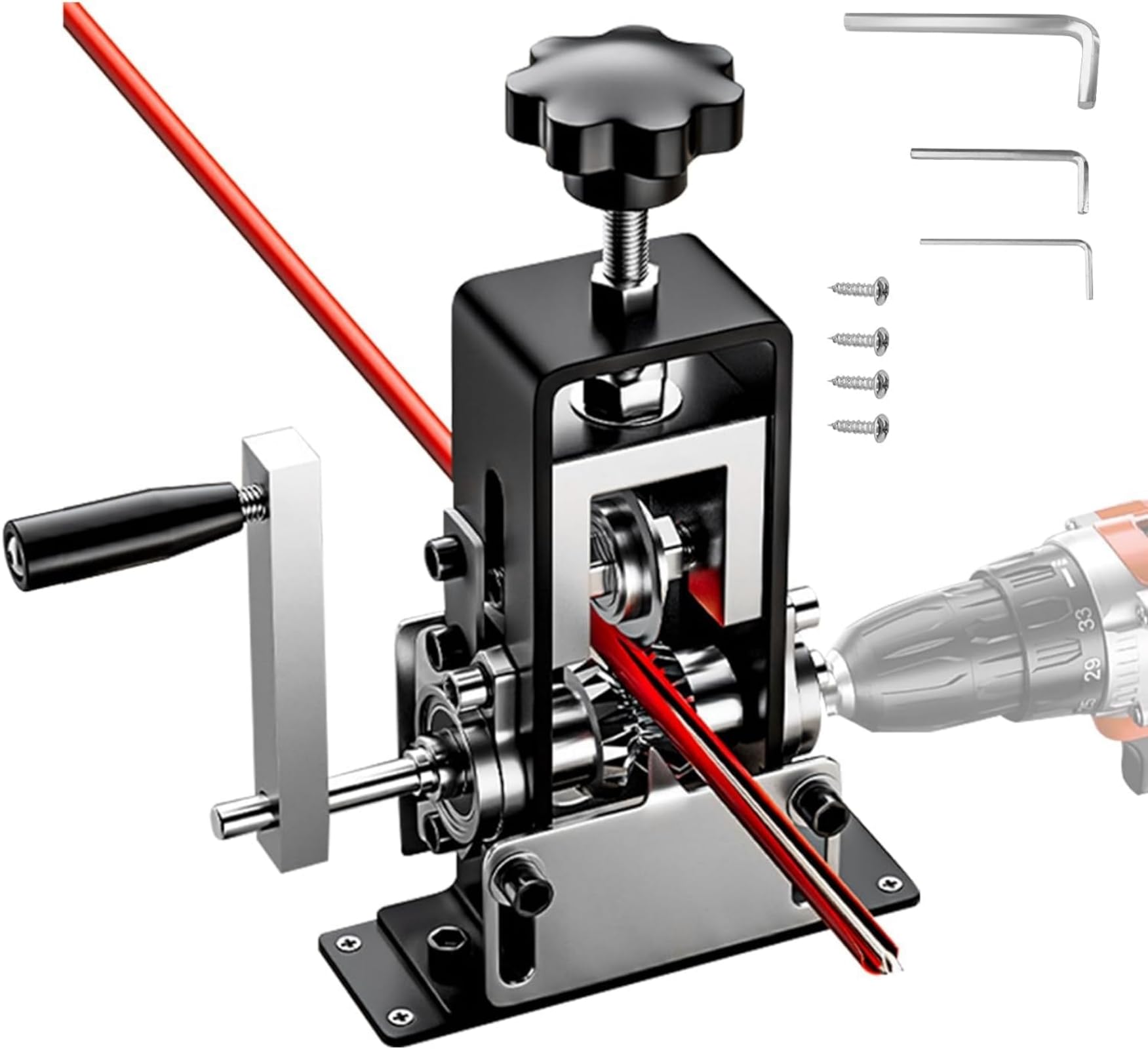
The Hizmivos Wire Stripping Machine is a benchtop-style stripper designed for high-volume processing of scrap wire. It accepts cables from 0.06 inches to 1 inch in diameter through multiple feed holes, and the blade height is adjusted via a regulating nut to match varying jacket thicknesses. The tool supports two drive modes: a hand crank for portable manual operation and a drill-compatible connector for motor-driven high-speed stripping.
Users in the scrap copper recovery space report that this machine dramatically accelerates the stripping process compared to hand tools. The hardened blades maintain their edge through hundreds of feet of THHN, Romex, and service cable, and the adjustable feed panel handles both thin and thick wires by routing them through different-sized holes. Several reviews highlight that the machine paid for itself after the first trip to the scrap yard — the time savings alone justify the cost. Some users note a design concern with the open front, which can lead to hand cuts if the operator is not careful, and recommend mounting the tool to a workbench for stability. The protective oil coating applied at the factory can attract dust and should be wiped down before first use.
For DIY recyclers, small-scale scrappers, and shop owners who accumulate copper wire waste, this machine converts a tedious manual chore into an efficient process. The dual-drive flexibility means it works off-grid with the hand crank or at speed with a standard electric drill.
What works
- Handles a wide range of wire sizes (0.06–1 inch)
- Drill drive option dramatically speeds up stripping
- Pays for itself quickly with scrap copper recovery
What doesn’t
- Open design poses a hand-cut risk
- Protective oil coating needs initial cleaning
- Best results require bench mounting
10. LILOOVKE Wire Stripper Machine BXJ-YS-DE

The LILOOVKE BXJ-YS-DE is another benchtop wire stripping machine with a dual-drive design, covering wire diameters from 1 mm to 25 mm. It features hardened steel blades with a V-shaped recess in the feed roller to prevent wire runout during stripping. The knife wheel height is adjustable via swivel screws, and a no-adjustment crimp plate automatically clamps the wire as it feeds through. The tool includes replacement blades of the same type as the installed set, extending service life.
Owner reports emphasize the time savings when processing large volumes of scrap wire, with many users comparing it favorably to far more expensive powered strippers. The ability to switch between hand crank and drill drive means the tool can be used anywhere without a dedicated motor. Some users note that the zinc body, while functional, is not as robust as aluminum or steel alternatives, and the tool performs best on smaller-gauge wire — heavy 1/0 and larger cables can exceed its mechanical limits. The recommendation to secure the tool to a workbench for stability is echoed across multiple reviews. A small number of users experienced blade binding on very soft or sticky jacket materials, requiring occasional cleaning and adjustment.
For the home scrapper or small electrical shop that processes mixed-gauge wire up to 25 mm diameter, this machine offers solid value and a clear upgrade path from hand stripping. The included replacement blades and dual-drive flexibility make it a practical entry point into mechanized wire processing.
What works
- Covers 1–25 mm diameter range
- Drill drive option for faster processing
- Replacement blades included with purchase
What doesn’t
- Zinc body less durable than premium alternatives
- Struggles with very large or stiff cables
- Requires bench mounting for stability
11. TOOLEAGUE 9-in-1 Wire Stripper Tool

The TOOLEAGUE 9-in-1 is a multifunctional pliers-style tool that combines wire stripping, cutting, crimping, unscrewing, shearing, pulling, and breaking functions into a single chromium-vanadium steel body. It handles 10–14 AWG solid wire and 10–20 AWG stranded wire through clearly marked stripping notches, and the induction-hardened cutting edges slice through copper and aluminum conductors cleanly. The PP+TPR grip handles are shaped for comfort during extended use.
User feedback from general electricians and maintenance technicians highlights the tool’s convenience for daily carry — it replaces several individual tools in the pouch without adding noticeable bulk. The C-RV steel construction with heat treatment and black oxide finish provides good corrosion resistance and edge retention at a price point that makes the tool nearly disposable if lost. Some users note that the front reamers are ineffective on EMT conduit, and the locking mechanism can disengage inside a crowded tool pouch. The stripping notches produce clean results on common building wire, though the tool is less precise on small-gauge stranded wire compared to a dedicated stripper.
For the professional electrician who wants a single-tool solution for rough-in work and service calls, the TOOLEAGUE 9-in-1 offers a compelling balance of function and value. It is not the best at any one job, but its versatility makes it a practical addition to any toolbox where space is at a premium.
What works
- Nine functions reduce tool pouch load
- C-RV steel with black oxide resists corrosion
- Clear AWG markings for fast size selection
What doesn’t
- Conduit reamer is ineffective on EMT
- Locking mechanism can open accidentally
- Less precise on very small stranded wire
Hardware & Specs Guide
Blade Materials & Edge Retention
The blade is the sole contact point between the tool and the cable jacket. High-carbon steel alloys such as SK5 or chromium-vanadium steel hold a sharp edge through hundreds of strips and resist chipping on hard PVC jackets. Some premium tools use replaceable blade cassettes from Solingen or similar high-end steel regions, extending the effective life of the tool indefinitely. Heat-treated and induction-hardened edges maintain sharpness longer than untreated steel, reducing the frequency of blade changes and the risk of ragged cuts that can damage conductors.
Adjustable Depth Mechanisms
Cable jacket thickness varies widely between manufacturers and cable types. Fixed-depth strippers work acceptably for repetitive use on a known cable, but adjustable depth control is essential for general-purpose stripping. The best systems use a threaded dial or set screw that varies the blade projection in small increments, allowing the user to score the jacket without penetrating the conductor insulation. This feature directly determines whether a stripper can handle both thin-walled data cables and thick rubber service cord without adjustment compromises.
Handle Ergonomics & Fatigue
The handle design dictates how much force transfers to the user’s hand during repetitive stripping cycles. Pistol-grip handles align the wrist in a neutral position, reducing strain on the carpal tunnel during high-volume work. Spring-loaded self-opening jaws eliminate the need to manually open the tool after each cut, further reducing hand fatigue. Cushioned thermoplastic elastomer (TPE) or polypropylene (PP) with TPR overlays provide a non-slip grip even with oily hands. The overall weight and balance of the tool also matter — a top-heavy stripper will tire the hand faster than a well-balanced one.
Multi-Function vs. Dedicated Design
Multi-function tools combine stripping with crimping, cutting, reaming, and screw-driving capabilities in a single body. This approach saves pouch space and reduces tool changes on the job, but it typically compromises stripping precision because the blade geometry must accommodate multiple functions. Dedicated strippers optimize blade angle, depth control, and notch sizing for one task, producing cleaner and more repeatable results. For professionals who strip more than a few cables per day, a dedicated stripper usually outperforms a multi-tool on speed and consistency.
FAQ
What is the most important feature in a cable stripper?
Can a wire stripper damage the conductor?
Are automatic self-adjusting strippers worth it?
How do I maintain a cable stripper for long life?
What gauge range should I look for in a general-purpose stripper?
Final Thoughts: The Verdict
For most buyers, the best cable stripper tool winner is the Klein Tools 21051 because it handles the heavy-service cable sizes that other strippers cannot touch, with a clean cutting action that protects the conductor. If you need precision on small-gauge and data cables, grab the KNIPEX Ergostrip. And for high-volume scrap recycling, nothing beats the Hizmivos Manual Wire Stripping Machine for speed and return on investment.

Certification: BSc in Mechanical Engineering
Education: Mechanical engineer
Lives In: 539 W Commerce St, Dallas, TX 75208, USA
Md Amir is an auto mechanic student and writer with over half a decade of experience in the automotive field. He has worked with top automotive brands such as Lexus, Quantum, and also owns two automotive blogs autocarneed.com and taxiwiz.com.